Drug Therapy In Pediatric &
Geriatric Age Groups
Dr Naser Tadvi
Objectives
• Discuss the principles of prescribing in pediatric and geriatric
age groups.
• Discuss the pharmacokinetic and pharmacodynamics
differences in pediatric, geriatric and adult age groups.
• Describe different paediatric dosage forms & compliance in
children.
• Discuss important adverse drug reactions occurring in
geriatric & pediatric age groups.
Pharmacokinetic differences in
children (Absorption)
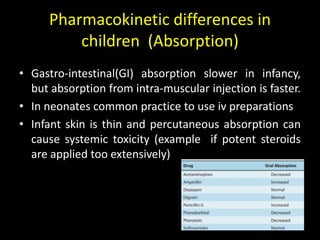
• Gastro-intestinal(GI) absorption slower in infancy,
but absorption from intra-muscular injection is faster.
• In neonates common practice to use iv preparations
• Infant skin is thin and percutaneous absorption can
cause systemic toxicity (example if potent steroids
are applied too extensively)
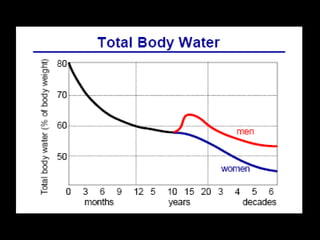
• Body fat content in infants low, water content is high
• Lower Vd of fat soluble drugs (diazepam) in infants
• ↓Plasma protein binding of drugs in neonates
(Kernicterus due to displacement of Bilirubin by
sulfonamides)
• Blood–brain barrier is more permeable in neonates
and young children, leading to an ↑risk of CNS
adverse effects.
Pharmacokinetic differences in
children (Distribution )
• At birth, the hepatic microsomal enzyme system is
relatively immature particularly in preterm infant but
after first four weeks it matures rapidly
• Conversely hepatic drug metabolism increased in
older infants and children
• Phenobarbitone metabolism faster in children than
adults
• Drugs administered to the mother can induce
neonatal enzyme activity (e.g. barbiturates).
Pharmacokinetic differences in children
(Metabolism )
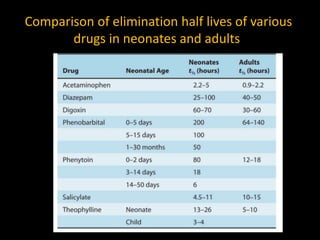
Comparison of elimination half lives of various
drugs in neonates and adults
Clinical significance
• Phenobarbital, when given to pregnant
women near term, can induce fetal hepatic
enzymes responsible for the glucuronidation
of bilirubin.
• Chloramphenicol can produce grey baby
syndrome in neonates
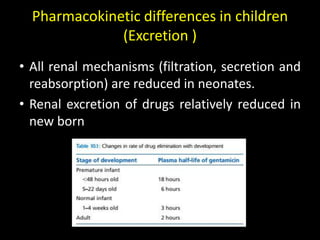
• All renal mechanisms (filtration, secretion and
reabsorption) are reduced in neonates.
• Renal excretion of drugs relatively reduced in
new born
Pharmacokinetic differences in children
(Excretion )
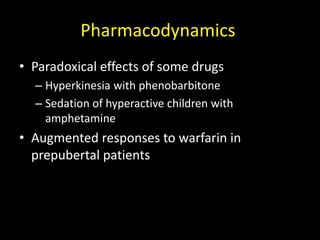
Pharmacodynamics
• Paradoxical effects of some drugs
– Hyperkinesia with phenobarbitone
– Sedation of hyperactive children with
amphetamine
• Augmented responses to warfarin in
prepubertal patients
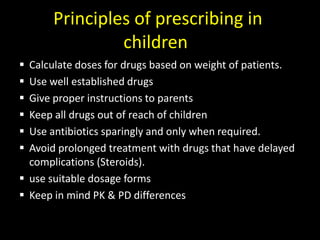
Principles of prescribing in
children
 Calculate doses for drugs based on weight of patients.
 Use well established drugs
 Give proper instructions to parents
 Keep all drugs out of reach of children
 Use antibiotics sparingly and only when required.
 Avoid prolonged treatment with drugs that have delayed
complications (Steroids).
 use suitable dosage forms
 Keep in mind PK & PD differences
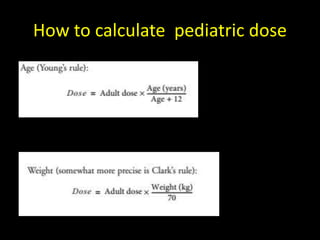
How to calculate pediatric dose
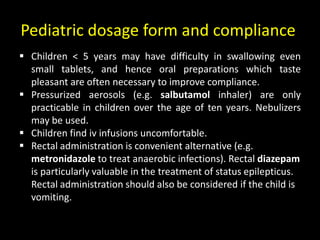
Pediatric dosage form and compliance
 Children < 5 years may have difficulty in swallowing even
small tablets, and hence oral preparations which taste
pleasant are often necessary to improve compliance.
 Pressurized aerosols (e.g. salbutamol inhaler) are only
practicable in children over the age of ten years. Nebulizers
may be used.
 Children find iv infusions uncomfortable.
 Rectal administration is convenient alternative (e.g.
metronidazole to treat anaerobic infections). Rectal diazepam
is particularly valuable in the treatment of status epilepticus.
Rectal administration should also be considered if the child is
vomiting.
Important Adverse effects in children
• With a few notable exceptions, drugs in children generally
have a similar adverse effect profile to those in adults.
• Examples of Some specific ADR
1. chronic corticosteroid use: inhibit growth
2. Tetracyclines : staining and occasionally dental hypoplasia
3. Fluoroquinolone(ciprofloxacin): damage growing cartilage
4. Metoclopramide: Dystonias more frequently than in adults
5. Valproate : hepatotoxicity is increased in young children
6. Aspirin: Reye’s syndrome
Geriatric Age group
• Let us then rejoice,
• While we are young.
• After the pleasures of youth
• And the tiresomeness of old age
• Earth will hold us.
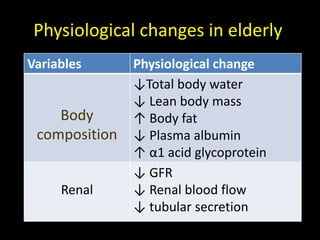
Physiological changes in elderly
Variables Physiological change
Body
composition
↓Total body water
↓ Lean body mass
↑ Body fat
↓ Plasma albumin
↑ α1 acid glycoprotein
Renal
↓ GFR
↓ Renal blood flow
↓ tubular secretion
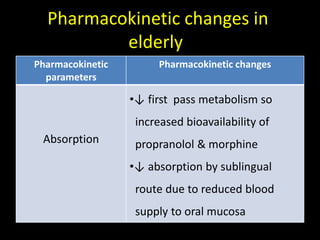
Pharmacokinetic changes in
elderly
Pharmacokinetic
parameters
Pharmacokinetic changes
Absorption
•↓ first pass metabolism so
increased bioavailability of
propranolol & morphine
•↓ absorption by sublingual
route due to reduced blood
supply to oral mucosa
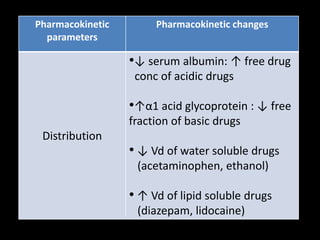
Pharmacokinetic
parameters
Pharmacokinetic changes
Distribution
•↓ serum albumin: ↑ free drug
conc of acidic drugs
•↑α1 acid glycoprotein : ↓ free
fraction of basic drugs
• ↓ Vd of water soluble drugs
(acetaminophen, ethanol)
• ↑ Vd of lipid soluble drugs
(diazepam, lidocaine)
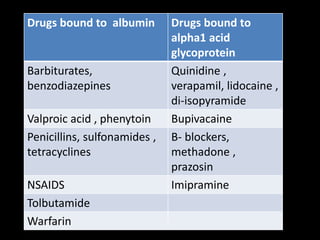
Drugs bound to albumin Drugs bound to
alpha1 acid
glycoprotein
Barbiturates,
benzodiazepines
Quinidine ,
verapamil, lidocaine ,
di-isopyramide
Valproic acid , phenytoin Bupivacaine
Penicillins, sulfonamides ,
tetracyclines
B- blockers,
methadone ,
prazosin
NSAIDS Imipramine
Tolbutamide
Warfarin
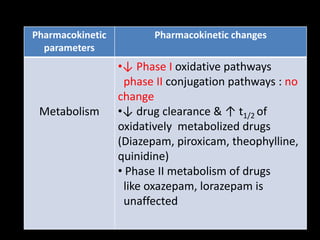
Pharmacokinetic
parameters
Pharmacokinetic changes
Metabolism
•↓ Phase I oxidative pathways
phase II conjugation pathways : no
change
•↓ drug clearance & ↑ t1/2 of
oxidatively metabolized drugs
(Diazepam, piroxicam, theophylline,
quinidine)
• Phase II metabolism of drugs
like oxazepam, lorazepam is
unaffected
↓
Pharmacokinetic
parameters
Pharmacokinetic changes
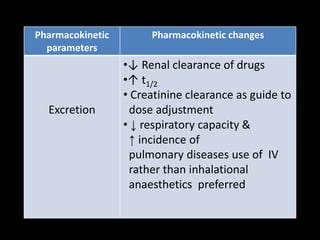
Excretion
•↓ Renal clearance of drugs
•↑ t1/2
• Creatinine clearance as guide to
dose adjustment
• ↓ respiratory capacity &
↑ incidence of
pulmonary diseases use of IV
rather than inhalational
anaesthetics preferred
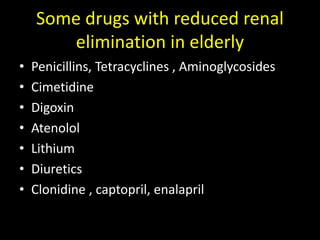
Some drugs with reduced renal
elimination in elderly
• Penicillins, Tetracyclines , Aminoglycosides
• Cimetidine
• Digoxin
• Atenolol
• Lithium
• Diuretics
• Clonidine , captopril, enalapril
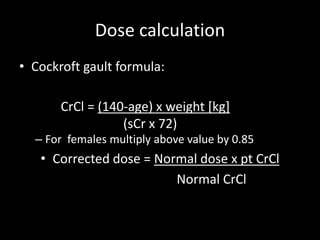
Dose calculation
• Cockroft gault formula:
– For females multiply above value by 0.85
• Corrected dose = Normal dose x pt CrCl
Normal CrCl
CrCl = (140-age) x weight [kg]
(sCr x 72)
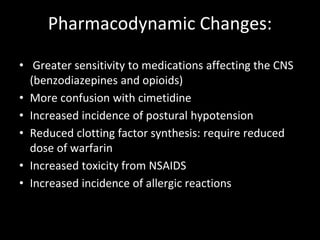
Pharmacodynamic Changes:
• Greater sensitivity to medications affecting the CNS
(benzodiazepines and opioids)
• More confusion with cimetidine
• Increased incidence of postural hypotension
• Reduced clotting factor synthesis: require reduced
dose of warfarin
• Increased toxicity from NSAIDS
• Increased incidence of allergic reactions
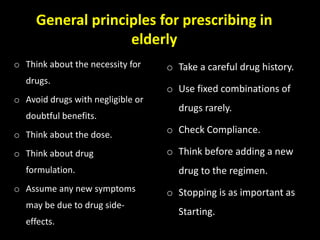
General principles for prescribing in
elderly
o Think about the necessity for
drugs.
o Avoid drugs with negligible or
doubtful benefits.
o Think about the dose.
o Think about drug
formulation.
o Assume any new symptoms
may be due to drug side-
effects.
o Take a careful drug history.
o Use fixed combinations of
drugs rarely.
o Check Compliance.
o Think before adding a new
drug to the regimen.
o Stopping is as important as
Starting.
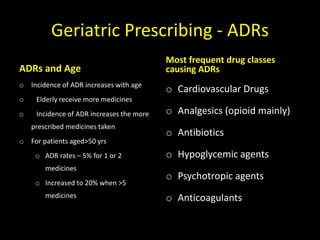
Geriatric Prescribing - ADRs
ADRs and Age
o Incidence of ADR increases with age
o Elderly receive more medicines
o Incidence of ADR increases the more
prescribed medicines taken
o For patients aged>50 yrs
o ADR rates – 5% for 1 or 2
medicines
o Increased to 20% when >5
medicines
Most frequent drug classes
causing ADRs
o Cardiovascular Drugs
o Analgesics (opioid mainly)
o Antibiotics
o Hypoglycemic agents
o Psychotropic agents
o Anticoagulants
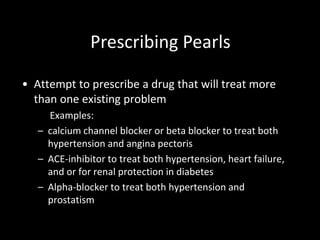
• Attempt to prescribe a drug that will treat more
than one existing problem
Examples:
– calcium channel blocker or beta blocker to treat both
hypertension and angina pectoris
– ACE-inhibitor to treat both hypertension, heart failure,
and or for renal protection in diabetes
– Alpha-blocker to treat both hypertension and
prostatism
Prescribing Pearls
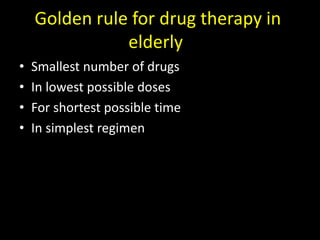
Golden rule for drug therapy in
elderly
• Smallest number of drugs
• In lowest possible doses
• For shortest possible time
• In simplest regimen
Summary
• principles of prescribing in pediatric and geriatric age
groups.
• pharmacokinetic and pharmacodynamics differences
in pediatric, geriatric and adult age groups.
• Paediatric dosage forms & compliance in children.
• Important adverse drug reactions occurring in
geriatric & pediatric age groups.
Reference