ANTICOAGULANTS
Presented by:
Sk. Samiya
Y16MPH273
Dept of Pharmacology
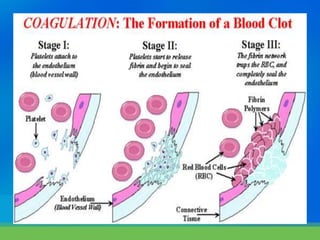
Anticoagulants are a class of drugs that work to
prevent blood coagulation(clotting). Such substances
occur naturally in leeches and blood-sucking insects.
A group of pharmaceuticals called anticoagulants can
be used as an injection as a medication
for thrombotic disorders.
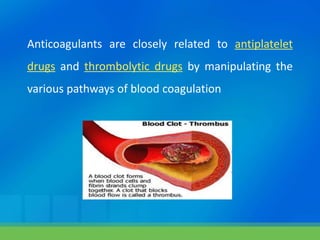
Anticoagulants are closely related to antiplatelet
drugs and thrombolytic drugs by manipulating the
various pathways of blood coagulation
Heparin was discovered by a medical student, McLean.
It was later isolated and identified by Howell as a
sulphated mucopolysaccaride.
Because of its high concentration in liver, it was named
as heparin.
Commercially, heparin is obtained from beef lung and
pig intestinal mucosa.
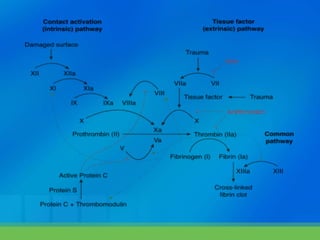
Heparin binds and accelerates the activity of plasma
antithrombin-lll.
Antithrombin-lll then inhibits activated clotting factors
Xa, lla, lXa, Xla, Xlla and Xllla by forming stable complex
with them.
At low concentration, heparin selectively inhibits the
conversion of prothrombin to thrombin.
Heparin thus prevents further thrombus formation, but
it does not have thrombolytic action
Heparin is not absorbed after oral administration
because of its high negative charge and large molecular
size.
Therefore, it must be given parenterally.
On i.v. administration, the anticoagulant effect starts
immediately, whereas on s.c. route, it takes 1-2 hours.
Heparin is highly protein bound.
It does not cross the BBB or placental barrier and is
safe during pregnancy.
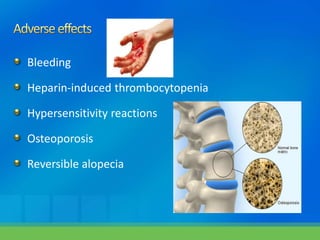
Bleeding
Heparin-induced thrombocytopenia
Hypersensitivity reactions
Osteoporosis
Reversible alopecia
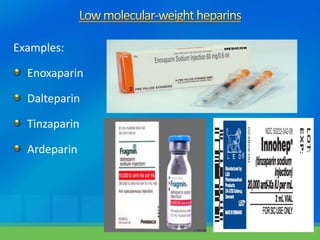
Examples:
Enoxaparin
Dalteparin
Tinzaparin
Ardeparin
LMWHs produce anticoagulant effect mainly by
antifactor Xa activity.
LMWH therapy usually does not require a PPT (Partial
thromboplastin time).
LMWHs are given subcutaneously.
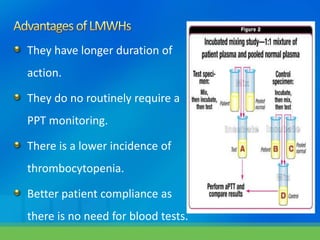
They have longer duration of
action.
They do no routinely require a
PPT monitoring.
There is a lower incidence of
thrombocytopenia.
Better patient compliance as
there is no need for blood tests.
LEPIRUDIN:
It is a recombinant hirudin.
It directly inhibits thrombin and is used as an
anticoagulant in patients with heparin-induced
thrombocytopaenia (HIT).
It is administered i.v, it requires a PPT monitoring.
No antidote is available.
Danaparoid
It is isolated from pig intestinal mucosa, and it has
mainly antifactor Xa activity.
It is administered subcutaneously for prophylaxis and
intravenously for treatment of deep vein thrombosis
especially in patients with HIT.
Bivalirudin: It is a synthetic heparinoid and has a
mechanism similar to that of lepirudin.
It can be used in coronary angioaplasty as an
alternative to heparin.
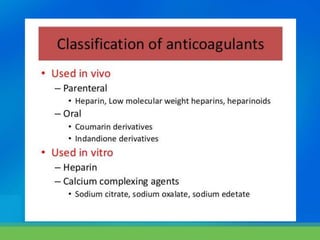
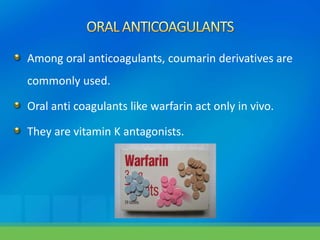
Among oral anticoagulants, coumarin derivatives are
commonly used.
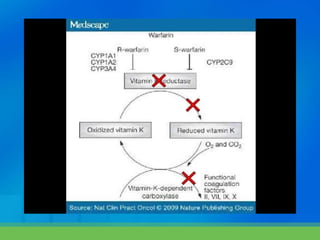
Oral anti coagulants like warfarin act only in vivo.
They are vitamin K antagonists.
Completely absorbed after oral administration.
It can also be given i.v or rectal.
Food interferes with the absorption of warfarin.
Highly bound to plasma proteins, freely crosses the
placental barrier.
Metabolized in liver, inactive metabolities are excreted
in urine and stool.
Half life – 40hours. Duration of action is 2-5 days.
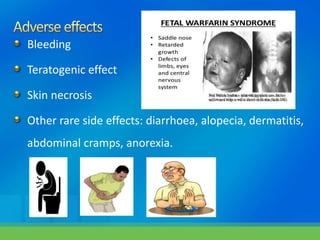
Bleeding
Teratogenic effect
Skin necrosis
Other rare side effects: diarrhoea, alopecia, dermatitis,
abdominal cramps, anorexia.
Warfarin X cholestyramine : Cholestyramine is a bile
acid-binding resin. It reduces the absorption of
warfarin from gut, thus decreases bioavailability of
warfarin.
Oral anticoagulants X barbiturates/rifampicin:
They are enzyme inducers, increase metabolic clearance
of oral anticoagulants and hence decrease the
anticoagulant effect.
Wafarin X salicylates/sulphonamide:
Warfarinishighlyproteinbond.Thesedrugsdisplacewarfarin
fromplasma-proteinbindingsiteandincreasethefreeplasma
concentrationofwarfarinandthusleadtobleeding.
Warfarin X alcohol,chloramphenicol,isoniazid:
Theyareenzymeinhibitors,decreasemetabolicclearanceof
warfarinandhenceincreasetheanticoagulanteffect.
Sodium citrate ----- used in blood banks to store the
blood.
Sodium oxalate ----- used as anticoagulant in laboratory
Sodium edetate ----- “
To prevent the formation of intravascular thrombus or
to prevent the future extension of the already formed
clot.
Treatment is initiated with LMWH or UFH and
continued for at least 4-5 days.
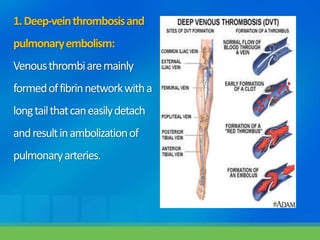
1.Deep-veinthrombosisand
pulmonaryembolism:
Venousthrombiaremainly
formedoffibrinnetworkwitha
longtailthatcaneasilydetach
andresultinambolizationof
pulmonaryarteries.
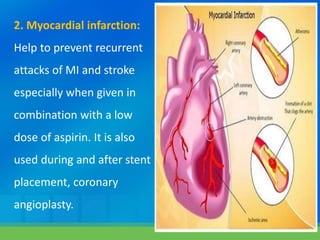
2. Myocardial infarction:
Help to prevent recurrent
attacks of MI and stroke
especially when given in
combination with a low
dose of aspirin. It is also
used during and after stent
placement, coronary
angioplasty.
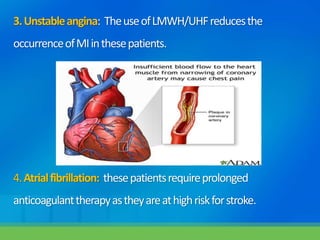
3.Unstableangina: TheuseofLMWH/UHFreducesthe
occurrenceofMIinthesepatients.
4.Atrialfibrillation: thesepatientsrequireprolonged
anticoagulanttherapyastheyareathighriskforstroke.
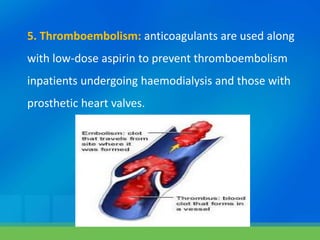
5. Thromboembolism: anticoagulants are used along
with low-dose aspirin to prevent thromboembolism
inpatients undergoing haemodialysis and those with
prosthetic heart valves.
https://en.wikipedia.org/wiki/Anticoagulant
www.drugs.com
http://www.medindia.net
Text book of pharmacology by “ Tara V Shanbhag”.
Text book of Essentials of Medical Pharmacology by
“K.D.Tripathi”
Anti coagulants

Anti coagulants