BASIC
MODES OF MECHANICAL
VENTILATION
Mazen Kherallah, MD, FCCP
POINTS OF DISCUSSIONS
 Advanced Basics:
 Flow and Time
 Limit and cycling
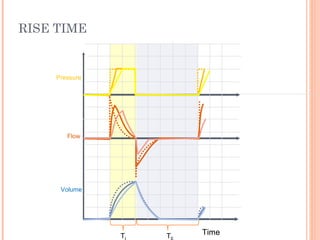
 Rise Time
 Volume vs Pressure Control
 Mandatory Modes of Ventilation
 Controlled Mandatory Ventilation (CMV or IPPV)
 Triggered Modes of Ventilation
 Continuous Positive Airway Pressure (CPAP)
 Pressure Support Ventilation (PSV)
 Hybrid Modes of Ventilation
 Assist Control Mode (A/C)
 Synchronized Intermittent Mandatory Ventilation (SIMV)
ADVANCED BASICS
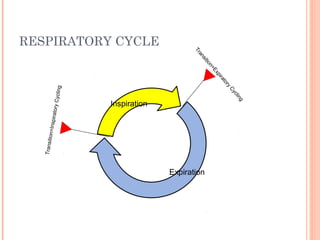
RESPIRATORY CYCLETransition=InspiratoryCycling
Transition=Expiratory
Cycling
Inspiration
Expiration
ExpInsp
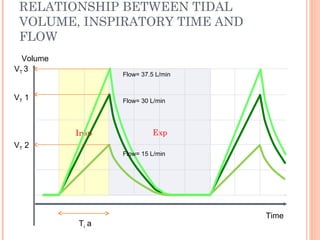
RELATIONSHIP BETWEEN TIDAL
VOLUME, INSPIRATORY TIME AND
FLOW
VT 1
Ti a
VT 2
VT 3
Time
Volume
Flow= 30 L/min
Flow= 15 L/min
Flow= 37.5 L/min
ExpExpInspInspInsp
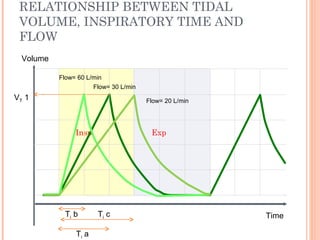
RELATIONSHIP BETWEEN TIDAL
VOLUME, INSPIRATORY TIME AND
FLOW
VT 1
Ti a
Time
Volume
Ti b Ti c
Flow= 30 L/min
Flow= 20 L/min
Flow= 60 L/min
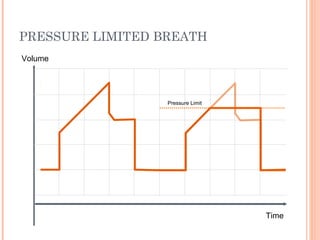
PRESSURE LIMITED BREATH
Time
Volume
Pressure Limit
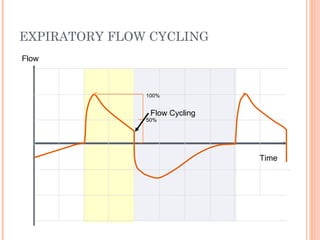
EXPIRATORY FLOW CYCLING
Time
Flow
50%
100%
Flow Cycling
RISE TIME
Time
Flow
Pressure
Volume
T T
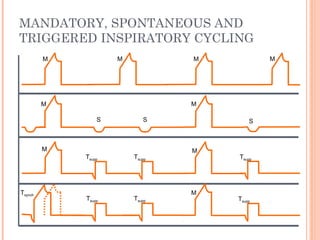
MANDATORY, SPONTANEOUS AND
TRIGGERED INSPIRATORY CYCLING
M
S
Tsynch
M M
M
MM
M
M
S
M
Tsupp Tsupp
Tsupp Tsupp
Tsupp
Tsupp
S
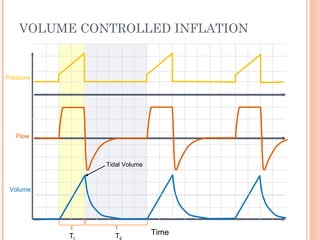
VOLUME CONTROLLED INFLATION
Time
Flow
Pressure
Volume
T T
Tidal Volume
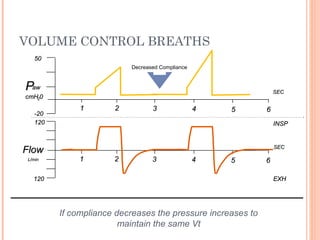
If compliance decreases the pressure increases to
maintain the same Vt
11 22 33 44 55 66
SECSEC
11 22 33 44 55 66
PPawaw
cmHcmH2200
5050
-20-20
120120
120120
SECSEC
INSPINSP
EXHEXH
FlowFlow
L/minL/min
VOLUME CONTROL BREATHS
Decreased Compliance
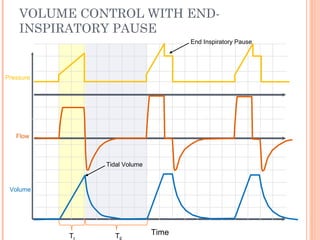
VOLUME CONTROL WITH END-
INSPIRATORY PAUSE
Time
Flow
Pressure
Volume
T T
Tidal Volume
End Inspiratory Pause
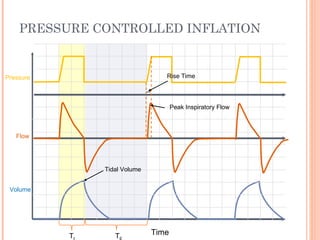
PRESSURE CONTROLLED INFLATION
Time
Flow
Pressure
Volume
T T
Tidal Volume
Rise Time
Peak Inspiratory Flow
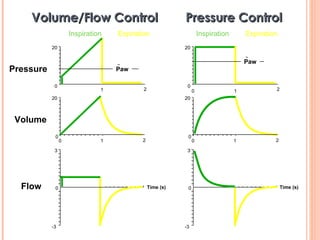
Inspiration Expiration
0 1
20
0
0 1 2
3
-3
0
20
0
21
20
0
0 1 2
3
-3
0
20
0
2
Inspiration Expiration
Volume/Flow Control Pressure ControlVolume/Flow Control Pressure Control
Time (s) Time (s)
Paw
Paw
Pressure
Volume
Flow
TRIGGERED MODES OF
VENTILATION
CPAP and PSVV
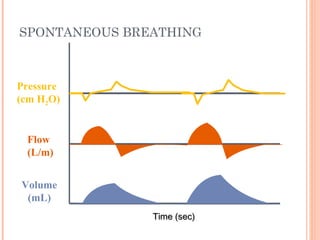
SPONTANEOUS BREATHING
Time (sec)Time (sec)
Flow
(L/m)
Pressure
(cm H2O)
Volume
(mL)
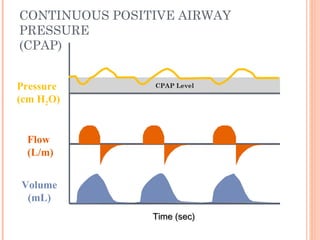
CONTINUOUS POSITIVE AIRWAY
PRESSURE
(CPAP)
Time (sec)Time (sec)
Flow
(L/m)
Pressure
(cm H2O)
Volume
(mL)
CPAP Level
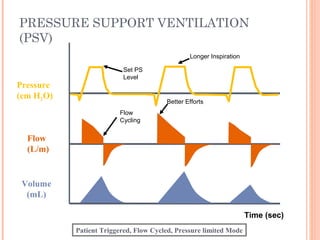
PRESSURE SUPPORT VENTILATION
(PSV)
Time (sec)
Flow
(L/m)
Pressure
(cm H2O)
Volume
(mL)
Set PS
Level
Flow
Cycling
Better Efforts
Longer Inspiration
Patient Triggered, Flow Cycled, Pressure limited Mode
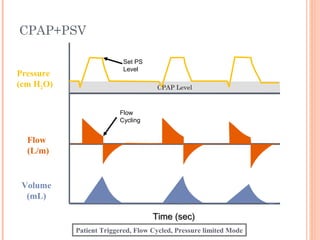
CPAP+PSV
Time (sec)Time (sec)
Flow
(L/m)
Pressure
(cm H2O)
Volume
(mL)
Set PS
Level
Flow
Cycling
Patient Triggered, Flow Cycled, Pressure limited Mode
CPAP Level
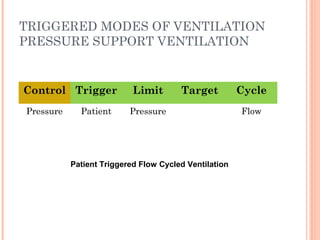
TRIGGERED MODES OF VENTILATION
PRESSURE SUPPORT VENTILATION
Control Trigger Limit Target Cycle
Pressure Patient Pressure Flow
Patient Triggered Flow Cycled Ventilation
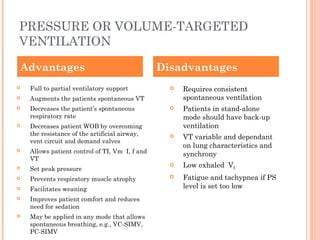
PRESSURE OR VOLUME-TARGETED
VENTILATION
 Full to partial ventilatory support
 Augments the patients spontaneous VT
 Decreases the patient’s spontaneous
respiratory rate
 Decreases patient WOB by overcoming
the resistance of the artificial airway,
vent circuit and demand valves
 Allows patient control of TI, Vm I, f and
VT
 Set peak pressure
 Prevents respiratory muscle atrophy
 Facilitates weaning
 Improves patient comfort and reduces
need for sedation
 May be applied in any mode that allows
spontaneous breathing, e.g., VC-SIMV,
PC-SIMV
 Requires consistent
spontaneous ventilation
 Patients in stand-alone
mode should have back-up
ventilation
 VT variable and dependant
on lung characteristics and
synchrony
 Low exhaled VE
 Fatigue and tachypnea if PS
level is set too low
Advantages Disadvantages
MANDATORY MODES OF
VENTILATION
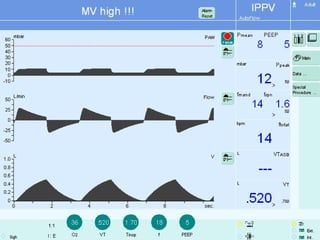
CMV or IPPV
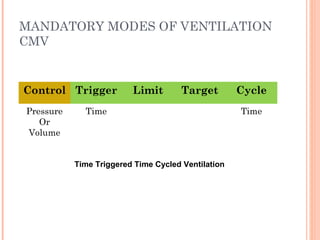
MANDATORY MODES OF VENTILATION
CMV
Control Trigger Limit Target Cycle
Pressure
Or
Volume
Time Time
Time Triggered Time Cycled Ventilation
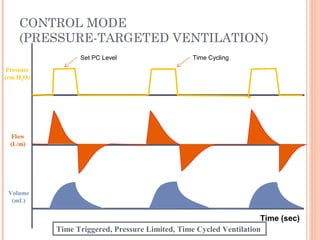
CONTROL MODE
(PRESSURE-TARGETED VENTILATION)
Flow
(L/m)
Pressure
(cm H2O)
Volume
(mL)
Time Triggered, Pressure Limited, Time Cycled Ventilation
Time (sec)
Time CyclingSet PC Level
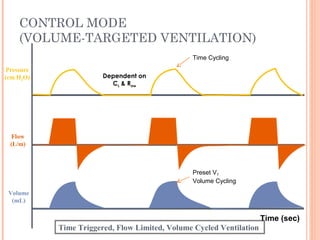
CONTROL MODE
(VOLUME-TARGETED VENTILATION)
Flow
(L/m)
Pressure
(cm H2O)
Volume
(mL)
Time Triggered, Flow Limited, Volume Cycled Ventilation
Time (sec)
Preset VT
Volume Cycling
Time Cycling
Dependent on
CL & Raw
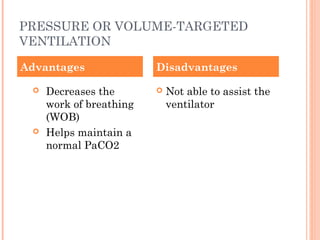
PRESSURE OR VOLUME-TARGETED
VENTILATION
 Decreases the
work of breathing
(WOB)
 Helps maintain a
normal PaCO2
 Not able to assist the
ventilator
Advantages Disadvantages
HYBRID MODES OF
VENTILATION
SIMV and A/C
HYBRID MODES OF VENTILATION
A/C
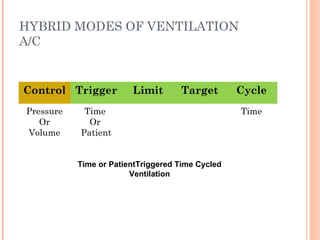
Control Trigger Limit Target Cycle
Pressure
Or
Volume
Time
Or
Patient
Time
Time or PatientTriggered Time Cycled
Ventilation
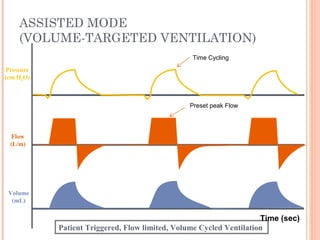
ASSISTED MODE
(VOLUME-TARGETED VENTILATION)
Flow
(L/m)
Pressure
(cm H2O)
Volume
(mL)
Patient Triggered, Flow limited, Volume Cycled Ventilation
Time (sec)
Preset peak Flow
Time Cycling
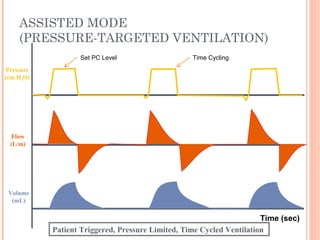
ASSISTED MODE
(PRESSURE-TARGETED VENTILATION)
Flow
(L/m)
Pressure
(cm H2O)
Volume
(mL)
Patient Triggered, Pressure Limited, Time Cycled Ventilation
Time (sec)
Time CyclingSet PC Level
PRESSURE OR VOLUME-TARGETED
VENTILATION
 Decreases the
work of breathing
(WOB)
 Allows patients to
regulate
respiratory rate
 Helps maintain a
normal PaCO2
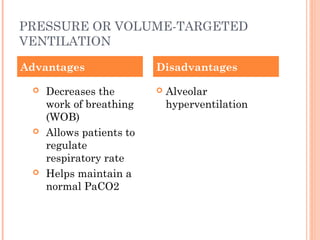
 Alveolar
hyperventilation
Advantages Disadvantages
HYBRID MODES OF VENTILATION
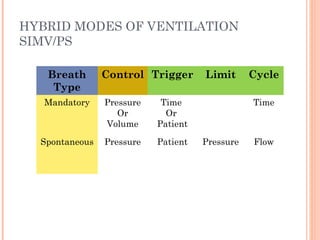
SIMV/PS
Breath
Type
Control Trigger Limit Cycle
Mandatory Pressure
Or
Volume
Time
Or
Patient
Time
Spontaneous Pressure Patient Pressure Flow
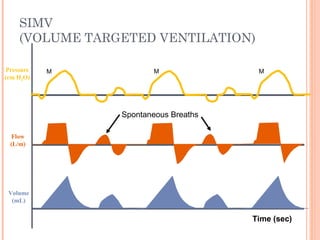
SIMV
(VOLUME TARGETED VENTILATION)
Flow
(L/m)
Pressure
(cm H2O)
Volume
(mL)
Spontaneous Breaths
M M M
Time (sec)
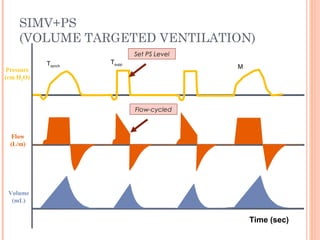
SIMV+PS
(VOLUME TARGETED VENTILATION)
Flow
(L/m)
Pressure
(cm H2O)
Volume
(mL)
M
TsuppTsynch
Set PS Level
Flow-cycled
Time (sec)
SIMV + PS
(PRESSURE-TARGETED VENTILATION)
Flow
(L/m)
Pressure
(cm H2O)
Volume
(mL)
Tsupp
Tsynch
Time Cycled
Flow-cycled
Tsynch
Set PC Level Set PS Level
Time (sec)
HYBRID MODE VENTILATION:
SUPPRESSION
Time (sec)Time (sec)
M Tsupp MM Tsupp
M M
Tsupp Tsupp
HYBRID MODE VENTILATION:
SYNCHRONIZATION
(SIMV+PSV)
Time (sec)Time (sec)
Flow
(L/m)
Pressure
(cm H2O)
Cycles
Triggered window for
supported breaths
Triggered window for
synchronized breaths
Mandatory Cycle Time
M Tsupp
Tsynch
M Tsynch Tsupp
SIMV
 Maintains respiratory
muscle strength by
avoiding muscle
atrophy
 Decreases mean
airway pressure
 Facilitates ventilator
discontinuation –
“weaning”!
 When used for
weaning, may be done
too quickly and cause
muscle fatigue
 Mechanical rate and
spontaneous rate may
asynchronous causing
“stacking”
 May cause
barotrauma or
volutrauma
Advantages Disadvantages
ALL MODES TABLES
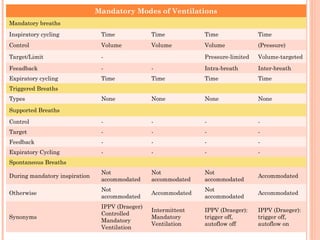
Mandatory Modes of Ventilations
Mandatory breaths
Inspiratory cycling Time Time Time Time
Control Volume Volume Volume (Pressure)
Target/Limit - Pressure-limited Volume-targeted
Feeadback - - Intra-breath Inter-breath
Expiratory cycling Time Time Time Time
Triggered Breaths
Types None None None None
Supported Breaths
Control - - - -
Target - - - -
Feedback - - - -
Expiratory Cycling - - - -
Spontaneous Breaths
During mandatory inspiration
Not
accommodated
Not
accommodated
Not
accommodated
Accommodated
Otherwise
Not
accommodated
Accommodated
Not
accommodated
Accommodated
Synonyms
IPPV (Draeger)
Controlled
Mandatory
Ventilation
Intermittent
Mandatory
Ventilation
IPPV (Draeger):
trigger off,
autoflow off
IPPV (Draeger):
trigger off,
autoflow on
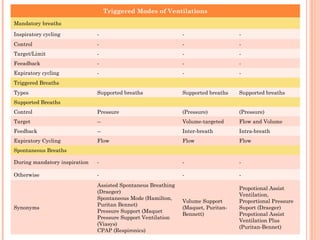
Triggered Modes of Ventilations
Mandatory breaths
Inspiratory cycling - - -
Control - - -
Target/Limit - - -
Feeadback - - -
Expiratory cycling - - -
Triggered Breaths
Types Supported breaths Supported breaths Supported breaths
Supported Breaths
Control Pressure (Pressure) (Pressure)
Target -- Volume-targeted Flow and Volume
Feedback -- Inter-breath Intra-breath
Expiratory Cycling Flow Flow Flow
Spontaneous Breaths
During mandatory inspiration - - -
Otherwise - - -
Synonyms
Assisted Spontaneus Breathing
(Draeger)
Spontaneous Mode (Hamilton,
Puritan Bennet)
Pressure Support (Maquet
Pressure Support Ventilation
(Viasys)
CPAP (Respironics)
Volume Support
(Maquet, Puritan-
Bennett)
Propotional Assist
Ventilation,
Proportional Pressure
Suport (Draeger)
Propotional Assist
Ventilation Plus
(Puritan-Bennet)
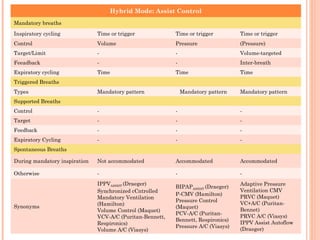
Hybrid Mode: Assist Control
Mandatory breaths
Inspiratory cycling Time or trigger Time or trigger Time or trigger
Control Volume Pressure (Pressure)
Target/Limit - - Volume-targeted
Feeadback - - Inter-breath
Expiratory cycling Time Time Time
Triggered Breaths
Types Mandatory pattern Mandatory pattern Mandatory pattern
Supported Breaths
Control - - -
Target - - -
Feedback - - -
Expiratory Cycling - - -
Spontaneous Breaths
During mandatory inspiration Not accommodated Accommodated Accommodated
Otherwise - - -
Synonyms
IPPVASSIST (Draeger)
Synchronized cCntrolled
Mandatory Ventilation
(Hamilton)
Volume Control (Maquet)
VCV-A/C (Puritan-Bennett,
Respironics)
Volume A/C (Viasys)
BIPAPASSIST (Draeger)
P-CMV (Hamilton)
Pressure Control
(Maquet)
PCV-A/C (Puritan-
Bennett, Respironics)
Pressure A/C (Viasys)
Adaptive Pressure
Ventilation CMV
PRVC (Maquet)
VC+A/C (Puritan-
Bennet)
PRVC A/C (Viasys)
IPPV Assist Autoflow
(Draeger)
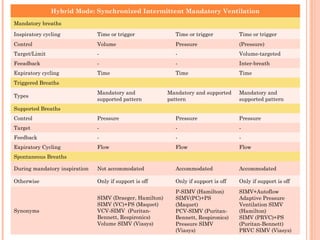
Hybrid Mode: Synchronized Intermittent Mandatory Ventilation
Mandatory breaths
Inspiratory cycling Time or trigger Time or trigger Time or trigger
Control Volume Pressure (Pressure)
Target/Limit - - Volume-targeted
Feeadback - - Inter-breath
Expiratory cycling Time Time Time
Triggered Breaths
Types
Mandatory and
supported pattern
Mandatory and supported
pattern
Mandatory and
supported pattern
Supported Breaths
Control Pressure Pressure Pressure
Target - - -
Feedback - - -
Expiratory Cycling Flow Flow Flow
Spontaneous Breaths
During mandatory inspiration Not accommodated Accommodated Accommodated
Otherwise Only if support is off Only if support is off Only if support is off
Synonyms
SIMV (Draeger, Hamilton)
SIMV (VC)+PS (Maquet)
VCV-SIMV (Puritan-
Bennett, Respironics)
Volume SIMV (Viasys)
P-SIMV (Hamilton)
SIMV(PC)+PS
(Maquet)
PCV-SIMV (Puritan-
Bennett, Respironics)
Pressure SIMV
(Viasys)
SIMV+Autoflow
Adaptive Pressure
Ventilation SIMV
(Hamilton)
SIMV (PRVC)+PS
(Puritan-Bennett)
PRVC SIMV (Viasys)
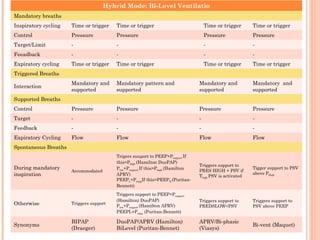
Hybrid Mode: Bi-Level Ventilatio
Mandatory breaths
Inspiratory cycling Time or trigger Time or trigger Time or trigger Time or trigger
Control Pressure Pressure Pressure Pressure
Target/Limit - - - -
Feeadback - - - -
Expiratory cycling Time or trigger Time or trigger Time or trigger Time or trigger
Triggered Breaths
Interaction
Mandatory and
supported
Mandatory pattern and
supported
Mandatory and
supported
Mandatory and
supported
Supported Breaths
Control Pressure Pressure Pressure Pressure
Target - - - -
Feedback - - - -
Expiratory Cycling Flow Flow Flow Flow
Spontaneous Breaths
During mandatory
inspiration
Accommodated
Trigers suuport to PEEP+Psupport If
this>Phigh (Hamilton DuoPAP)
Plow+Psupport If this>Phigh (Hamilton
APRV)
PEEPL+PsuppIf this>PEEPH (Puritan-
Bennett)
Triggers support to
PRES HIGH + PSV if
Thigh PSV is activated
Tigger support to PSV
above PHigh
Otherwise Triggers support
Triggers support to PEEP+Psupport
(Hamilton) DuoPAP)
Plow+Psupport (Hamilton APRV)
PEEPL+Psupp (Puritan-Bennett)
Triggers support to
PREDSLOW=PSV
Triggers support to
PSV above PEEP
Synonyms
BIPAP
(Draeger)
DuoPAP/APRV (Hamilton)
BiLevel (Puritan-Bennet)
APRV/Bi-phasic
(Viasys)
Bi-vent (Maquet)
THANK YOU

Basic ventilatory modes

  • 1.
  • 2.
    POINTS OF DISCUSSIONS Advanced Basics:  Flow and Time  Limit and cycling  Rise Time  Volume vs Pressure Control  Mandatory Modes of Ventilation  Controlled Mandatory Ventilation (CMV or IPPV)  Triggered Modes of Ventilation  Continuous Positive Airway Pressure (CPAP)  Pressure Support Ventilation (PSV)  Hybrid Modes of Ventilation  Assist Control Mode (A/C)  Synchronized Intermittent Mandatory Ventilation (SIMV)
  • 3.
  • 4.
  • 5.
    ExpInsp RELATIONSHIP BETWEEN TIDAL VOLUME,INSPIRATORY TIME AND FLOW VT 1 Ti a VT 2 VT 3 Time Volume Flow= 30 L/min Flow= 15 L/min Flow= 37.5 L/min
  • 6.
    ExpExpInspInspInsp RELATIONSHIP BETWEEN TIDAL VOLUME,INSPIRATORY TIME AND FLOW VT 1 Ti a Time Volume Ti b Ti c Flow= 30 L/min Flow= 20 L/min Flow= 60 L/min
  • 7.
  • 8.
  • 9.
  • 10.
    MANDATORY, SPONTANEOUS AND TRIGGEREDINSPIRATORY CYCLING M S Tsynch M M M MM M M S M Tsupp Tsupp Tsupp Tsupp Tsupp Tsupp S
  • 11.
  • 12.
    If compliance decreasesthe pressure increases to maintain the same Vt 11 22 33 44 55 66 SECSEC 11 22 33 44 55 66 PPawaw cmHcmH2200 5050 -20-20 120120 120120 SECSEC INSPINSP EXHEXH FlowFlow L/minL/min VOLUME CONTROL BREATHS Decreased Compliance
  • 13.
    VOLUME CONTROL WITHEND- INSPIRATORY PAUSE Time Flow Pressure Volume T T Tidal Volume End Inspiratory Pause
  • 14.
    PRESSURE CONTROLLED INFLATION Time Flow Pressure Volume TT Tidal Volume Rise Time Peak Inspiratory Flow
  • 15.
    Inspiration Expiration 0 1 20 0 01 2 3 -3 0 20 0 21 20 0 0 1 2 3 -3 0 20 0 2 Inspiration Expiration Volume/Flow Control Pressure ControlVolume/Flow Control Pressure Control Time (s) Time (s) Paw Paw Pressure Volume Flow
  • 16.
  • 17.
    SPONTANEOUS BREATHING Time (sec)Time(sec) Flow (L/m) Pressure (cm H2O) Volume (mL)
  • 18.
    CONTINUOUS POSITIVE AIRWAY PRESSURE (CPAP) Time(sec)Time (sec) Flow (L/m) Pressure (cm H2O) Volume (mL) CPAP Level
  • 19.
    PRESSURE SUPPORT VENTILATION (PSV) Time(sec) Flow (L/m) Pressure (cm H2O) Volume (mL) Set PS Level Flow Cycling Better Efforts Longer Inspiration Patient Triggered, Flow Cycled, Pressure limited Mode
  • 20.
    CPAP+PSV Time (sec)Time (sec) Flow (L/m) Pressure (cmH2O) Volume (mL) Set PS Level Flow Cycling Patient Triggered, Flow Cycled, Pressure limited Mode CPAP Level
  • 21.
    TRIGGERED MODES OFVENTILATION PRESSURE SUPPORT VENTILATION Control Trigger Limit Target Cycle Pressure Patient Pressure Flow Patient Triggered Flow Cycled Ventilation
  • 22.
    PRESSURE OR VOLUME-TARGETED VENTILATION Full to partial ventilatory support  Augments the patients spontaneous VT  Decreases the patient’s spontaneous respiratory rate  Decreases patient WOB by overcoming the resistance of the artificial airway, vent circuit and demand valves  Allows patient control of TI, Vm I, f and VT  Set peak pressure  Prevents respiratory muscle atrophy  Facilitates weaning  Improves patient comfort and reduces need for sedation  May be applied in any mode that allows spontaneous breathing, e.g., VC-SIMV, PC-SIMV  Requires consistent spontaneous ventilation  Patients in stand-alone mode should have back-up ventilation  VT variable and dependant on lung characteristics and synchrony  Low exhaled VE  Fatigue and tachypnea if PS level is set too low Advantages Disadvantages
  • 23.
  • 24.
    MANDATORY MODES OFVENTILATION CMV Control Trigger Limit Target Cycle Pressure Or Volume Time Time Time Triggered Time Cycled Ventilation
  • 25.
    CONTROL MODE (PRESSURE-TARGETED VENTILATION) Flow (L/m) Pressure (cmH2O) Volume (mL) Time Triggered, Pressure Limited, Time Cycled Ventilation Time (sec) Time CyclingSet PC Level
  • 26.
    CONTROL MODE (VOLUME-TARGETED VENTILATION) Flow (L/m) Pressure (cmH2O) Volume (mL) Time Triggered, Flow Limited, Volume Cycled Ventilation Time (sec) Preset VT Volume Cycling Time Cycling Dependent on CL & Raw
  • 27.
    PRESSURE OR VOLUME-TARGETED VENTILATION Decreases the work of breathing (WOB)  Helps maintain a normal PaCO2  Not able to assist the ventilator Advantages Disadvantages
  • 29.
  • 30.
    HYBRID MODES OFVENTILATION A/C Control Trigger Limit Target Cycle Pressure Or Volume Time Or Patient Time Time or PatientTriggered Time Cycled Ventilation
  • 31.
    ASSISTED MODE (VOLUME-TARGETED VENTILATION) Flow (L/m) Pressure (cmH2O) Volume (mL) Patient Triggered, Flow limited, Volume Cycled Ventilation Time (sec) Preset peak Flow Time Cycling
  • 32.
    ASSISTED MODE (PRESSURE-TARGETED VENTILATION) Flow (L/m) Pressure (cmH2O) Volume (mL) Patient Triggered, Pressure Limited, Time Cycled Ventilation Time (sec) Time CyclingSet PC Level
  • 33.
    PRESSURE OR VOLUME-TARGETED VENTILATION Decreases the work of breathing (WOB)  Allows patients to regulate respiratory rate  Helps maintain a normal PaCO2  Alveolar hyperventilation Advantages Disadvantages
  • 34.
    HYBRID MODES OFVENTILATION SIMV/PS Breath Type Control Trigger Limit Cycle Mandatory Pressure Or Volume Time Or Patient Time Spontaneous Pressure Patient Pressure Flow
  • 35.
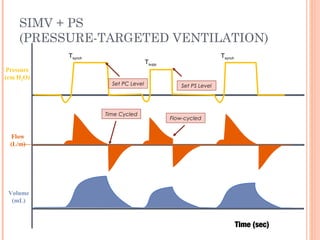
    SIMV (VOLUME TARGETED VENTILATION) Flow (L/m) Pressure (cmH2O) Volume (mL) Spontaneous Breaths M M M Time (sec)
  • 36.
    SIMV+PS (VOLUME TARGETED VENTILATION) Flow (L/m) Pressure (cmH2O) Volume (mL) M TsuppTsynch Set PS Level Flow-cycled Time (sec)
  • 37.
    SIMV + PS (PRESSURE-TARGETEDVENTILATION) Flow (L/m) Pressure (cm H2O) Volume (mL) Tsupp Tsynch Time Cycled Flow-cycled Tsynch Set PC Level Set PS Level Time (sec)
  • 38.
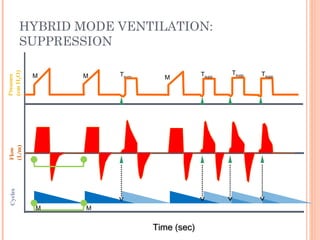
    HYBRID MODE VENTILATION: SUPPRESSION Time(sec)Time (sec) M Tsupp MM Tsupp M M Tsupp Tsupp
  • 39.
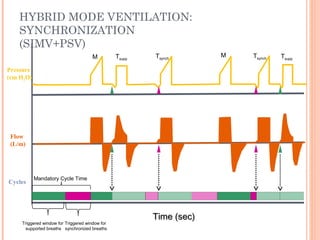
    HYBRID MODE VENTILATION: SYNCHRONIZATION (SIMV+PSV) Time(sec)Time (sec) Flow (L/m) Pressure (cm H2O) Cycles Triggered window for supported breaths Triggered window for synchronized breaths Mandatory Cycle Time M Tsupp Tsynch M Tsynch Tsupp
  • 40.
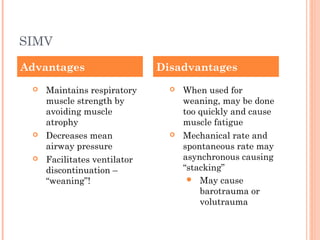
    SIMV  Maintains respiratory musclestrength by avoiding muscle atrophy  Decreases mean airway pressure  Facilitates ventilator discontinuation – “weaning”!  When used for weaning, may be done too quickly and cause muscle fatigue  Mechanical rate and spontaneous rate may asynchronous causing “stacking”  May cause barotrauma or volutrauma Advantages Disadvantages
  • 41.
  • 42.
    Mandatory Modes ofVentilations Mandatory breaths Inspiratory cycling Time Time Time Time Control Volume Volume Volume (Pressure) Target/Limit - Pressure-limited Volume-targeted Feeadback - - Intra-breath Inter-breath Expiratory cycling Time Time Time Time Triggered Breaths Types None None None None Supported Breaths Control - - - - Target - - - - Feedback - - - - Expiratory Cycling - - - - Spontaneous Breaths During mandatory inspiration Not accommodated Not accommodated Not accommodated Accommodated Otherwise Not accommodated Accommodated Not accommodated Accommodated Synonyms IPPV (Draeger) Controlled Mandatory Ventilation Intermittent Mandatory Ventilation IPPV (Draeger): trigger off, autoflow off IPPV (Draeger): trigger off, autoflow on
  • 43.
    Triggered Modes ofVentilations Mandatory breaths Inspiratory cycling - - - Control - - - Target/Limit - - - Feeadback - - - Expiratory cycling - - - Triggered Breaths Types Supported breaths Supported breaths Supported breaths Supported Breaths Control Pressure (Pressure) (Pressure) Target -- Volume-targeted Flow and Volume Feedback -- Inter-breath Intra-breath Expiratory Cycling Flow Flow Flow Spontaneous Breaths During mandatory inspiration - - - Otherwise - - - Synonyms Assisted Spontaneus Breathing (Draeger) Spontaneous Mode (Hamilton, Puritan Bennet) Pressure Support (Maquet Pressure Support Ventilation (Viasys) CPAP (Respironics) Volume Support (Maquet, Puritan- Bennett) Propotional Assist Ventilation, Proportional Pressure Suport (Draeger) Propotional Assist Ventilation Plus (Puritan-Bennet)
  • 44.
    Hybrid Mode: AssistControl Mandatory breaths Inspiratory cycling Time or trigger Time or trigger Time or trigger Control Volume Pressure (Pressure) Target/Limit - - Volume-targeted Feeadback - - Inter-breath Expiratory cycling Time Time Time Triggered Breaths Types Mandatory pattern Mandatory pattern Mandatory pattern Supported Breaths Control - - - Target - - - Feedback - - - Expiratory Cycling - - - Spontaneous Breaths During mandatory inspiration Not accommodated Accommodated Accommodated Otherwise - - - Synonyms IPPVASSIST (Draeger) Synchronized cCntrolled Mandatory Ventilation (Hamilton) Volume Control (Maquet) VCV-A/C (Puritan-Bennett, Respironics) Volume A/C (Viasys) BIPAPASSIST (Draeger) P-CMV (Hamilton) Pressure Control (Maquet) PCV-A/C (Puritan- Bennett, Respironics) Pressure A/C (Viasys) Adaptive Pressure Ventilation CMV PRVC (Maquet) VC+A/C (Puritan- Bennet) PRVC A/C (Viasys) IPPV Assist Autoflow (Draeger)
  • 45.
    Hybrid Mode: SynchronizedIntermittent Mandatory Ventilation Mandatory breaths Inspiratory cycling Time or trigger Time or trigger Time or trigger Control Volume Pressure (Pressure) Target/Limit - - Volume-targeted Feeadback - - Inter-breath Expiratory cycling Time Time Time Triggered Breaths Types Mandatory and supported pattern Mandatory and supported pattern Mandatory and supported pattern Supported Breaths Control Pressure Pressure Pressure Target - - - Feedback - - - Expiratory Cycling Flow Flow Flow Spontaneous Breaths During mandatory inspiration Not accommodated Accommodated Accommodated Otherwise Only if support is off Only if support is off Only if support is off Synonyms SIMV (Draeger, Hamilton) SIMV (VC)+PS (Maquet) VCV-SIMV (Puritan- Bennett, Respironics) Volume SIMV (Viasys) P-SIMV (Hamilton) SIMV(PC)+PS (Maquet) PCV-SIMV (Puritan- Bennett, Respironics) Pressure SIMV (Viasys) SIMV+Autoflow Adaptive Pressure Ventilation SIMV (Hamilton) SIMV (PRVC)+PS (Puritan-Bennett) PRVC SIMV (Viasys)
  • 46.
    Hybrid Mode: Bi-LevelVentilatio Mandatory breaths Inspiratory cycling Time or trigger Time or trigger Time or trigger Time or trigger Control Pressure Pressure Pressure Pressure Target/Limit - - - - Feeadback - - - - Expiratory cycling Time or trigger Time or trigger Time or trigger Time or trigger Triggered Breaths Interaction Mandatory and supported Mandatory pattern and supported Mandatory and supported Mandatory and supported Supported Breaths Control Pressure Pressure Pressure Pressure Target - - - - Feedback - - - - Expiratory Cycling Flow Flow Flow Flow Spontaneous Breaths During mandatory inspiration Accommodated Trigers suuport to PEEP+Psupport If this>Phigh (Hamilton DuoPAP) Plow+Psupport If this>Phigh (Hamilton APRV) PEEPL+PsuppIf this>PEEPH (Puritan- Bennett) Triggers support to PRES HIGH + PSV if Thigh PSV is activated Tigger support to PSV above PHigh Otherwise Triggers support Triggers support to PEEP+Psupport (Hamilton) DuoPAP) Plow+Psupport (Hamilton APRV) PEEPL+Psupp (Puritan-Bennett) Triggers support to PREDSLOW=PSV Triggers support to PSV above PEEP Synonyms BIPAP (Draeger) DuoPAP/APRV (Hamilton) BiLevel (Puritan-Bennet) APRV/Bi-phasic (Viasys) Bi-vent (Maquet)
  • 47.

Editor's Notes

  • #13 How do you know the problem is with the patient? Look at your flow curve.
  • #16 If follows from the equation of motion that the ventilator can control either the left side of the equation (ie, airway pressure) or the right side (ie, volume and flow). These curves illustrate the two basic approaches to ventilator control. If the ventilator controls flow, it controls volume indirectly (by definition) and vice versa. Usually, inspiratory flow is held constant during inspiration, causing volume and pressure to rise linearly. Inspiration ends (cycles off) when a preset tidal volume is met. In contrast, with pressure control ventilation, airway pressure may be held constant during inspiration. This causes inspiratory flow to decay exponentially from its peak value towards zero as volume rises exponentially. Inspiration usually ends after a preset inspiratory time or (in the case of pressure support) after a preset inspiratory flow threshold has been crossed. If inspiratory time is long enough (usually about 5 time constants) lung pressure will equilibrate with airway pressure and inspiratory flow will cease. You will note that for passive exhalation is exponential. That mean expiratory time must be at least 5 time constants long to exhale more that 99% of the tidal volume. As expiratory time becomes shorter than 5 time constants, gas trapping (ie, autoPEEP) occurs.