DR TARAK NATH CHATTOPADHYAY
MD PGT, MEDICINE, BSMC&H
 Total pressure of a gas mixture= σpartial
pressure of invidual gases
 Individual partial pressure α fraction of
volume of that gas
 P=760 mm Hg
 components
• O2 20.98%
• N2 78.06%
• Co2 .04%
• Others .92%
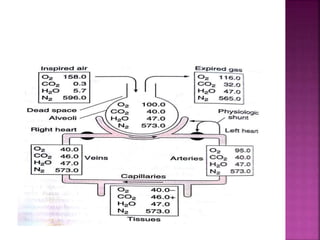
 PO2=760× .21=160mm Hg
 PCO2=760× .0004=.3mm Hg
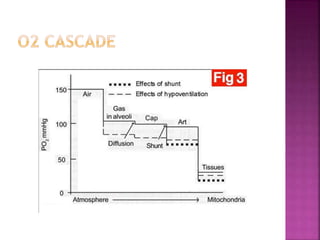
 It is the process of decreasing oxygen tension
from atmosphere to mitochondria
 Atmosphere alveoli arterial blood
capillary mitochondria
 Water vapour pressure at body temp
=47mmHg
 Thus, Pressure exerted by gas in saturated
moist air = 760-47 = 713mmHg
 Partial pressure of O2 in saturated moist air
= 713 x 0.21 = 149 mmHg
 This is the starting point of O2 cascade.
 Down the respiratory tree, O2 tension is
further diluted by the alveolar CO2.
 The partial pressure of alveolar oxygen
(PAO2) is calculated by Alveolar gas equation
PAO2= PiO2-PACO2/RQ
 RQ is the proportion of CO2 produced to the
O2 uptaken
PaCO₂ = PACO₂ ( 40mmHg ) as CO₂ is freely
diffusible.
 PAO2 =149-(40/0.8)~100mmHg
 PAO2 100mmHg PcapO2 40mm Hg
 Oxygen diffuses from alveoli to pulmonary
capillaries according to conc gradient
 Oxygenated,blood moves to pulm.
veins→left side of heart→ arterial system
→systemic tissues.
 Hb mediated + dissolved state
 O2 carrying capacity of blood= [(1.34 x
HbxSaO2)+(0.003xPaO2)] x Q
 O2 delivery to tissues depends on
1. Hb concentration
2. O2 binding capacity of Hb
3. saturation of Hb
4. amount of dissolved O2
5. cardiac output (Q)
 Initially the dissolved O2 is consumed. Then
the sequential unloading of Hb bound O2
occurs.
 PASTEUR POINT is the critical PO2 below
which the O2 delivery is unable to meet the
tissue demands.
FACTORS AFFECTING O2
CASCADE AT EACH
LEVEL
 High altitude
Patm is less; so does PiO2
 Vapour
URT humidifies inspired air
Increased vapour pressure, decreased PiO2
 Amount of CO2 in the alveolus depends on
the metabolism & degree of hypoventilation.
 Fever,sepsis,malignant hyperthermia
increases CO2 production
 Ventilation/perfusion mismatch
 • Shunt
 • Slow diffusion
 Upperzone overventilated, lower zone
underperfused& underventilated
 Pulmonary venous blood is admixture of all
capillary blood
hence PaO2>PAO2
 Deoxygenated blood enters systemic
circulation without getting oxygenated
 Atelectasis, consolidation, small airway
closure
 Normal diffusion is rapid.
 Completed by the time blood traverses 1/3
way along pulmonary capillary
 PaO2=102-age/3
 Normal Aa gradient 5-15 mHg
 Aa gradient increased in
1. Atelectasis
2. Slowing of diffusion
3. VQ mismatch
4. Mixed venous O2 tension
 Serum Hb level.
 Percentage of Hb saturated with O2.
 Cardiac output.
 Amount of dissolved oxygen
 Bound to Hb 95%
Dissolved in plasma 5%
 1Hb molecule binds with 4 O2 molecule
 1gm of fully oxygenated Hb contains 1.34ml
of O2 (vary depending on Fe content)
 At an arterial PO2 of 100mmHg,Hb is 98%
saturated,thus 15gm of Hb in 100ml
bloodnwill carry about 20ml of O2 (1.34ml x
15gm x 98/100=20)
 Henry’s law :states that the concentration of
any gas in a solution is proportional to its
partial pressure
Gas concentration α partial pressure
 • Dissolved O2 in arterial blood is thus
solubility coefficientx100mmHg
= .003ml/dL×100
=.3 ml
 100ml arterial blood carries 20.3 ml O2
 100ml venous blood (PO2 40mm Hg 75%
saturation) contains
1.34x15x75/100=15
 Thus every 100ml of blood passing through
the lungs will take up 5ml of O2
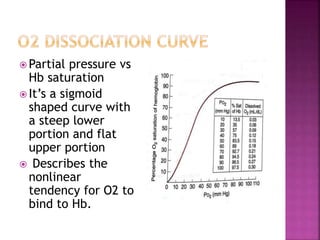
 Partial pressure vs
Hb saturation
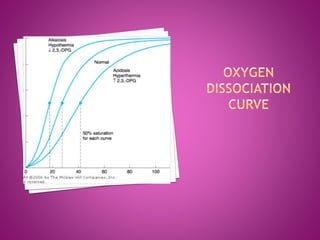
 It’s a sigmoid
shaped curve with
a steep lower
portion and flat
upper portion
 Describes the
nonlinear
tendency for O2 to
bind to Hb.
 One Hb molecule can bind 4 molecules of O2
 Deoxy Hb : globin units are tightly bound in a
tense configuration (T state)
As first molecule of O2 binds, it goes into a
relaxed configuration (R state) thus exposing
more O2 binding sites causing increase in 02
affinity
characteristic sigmoid shape ofODC
 The arterial point PO2=100mmHg and
SO2=97.5%
 The mixed venous point PO2=40mmHg and
SO2=75%
 The P50 PO2=27mmHg and SO2=50%
 It is the partial pressure at which 50% of Hb
is saturated.
 At a pH of 7.4 , temp 37C , the PO2 at which
the Hb is 50% saturated (P50) is 27mmHg
 When affinity of Hb for 02 is increased , P50
decreases : shift to left in ODC
 When affinity is reduced , P50 increases :
shift to right in ODC
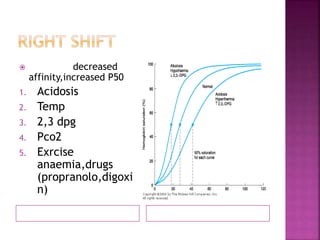
 decreased
affinity,increased P50
1. Acidosis
2. Temp
3. 2,3 dpg
4. Pco2
5. Exrcise
anaemia,drugs
(propranolo,digoxi
n)
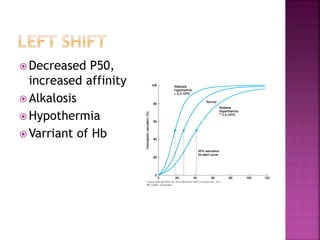
 Decreased P50,
increased affinity
 Alkalosis
 Hypothermia
 Varriant of Hb
 Temperature- higher temp, lesser affinity
 Acidosis- deoxyHb has higher affinity to H+
Acute 0.1 pH change causes 3mmHg change
in P50
Chronic depends on body compensatory
mechanism
 CO2
 2,3 DPG
 Produced in RBC via EMP shunt in glycolysis
pathway
 Normal level 4 mmol/L
 Binds to deoxyHb-decreases affinity, shift to
right
 Fetal RBC has lower conc of 2,3 DPG thus
higher affinity towards O2
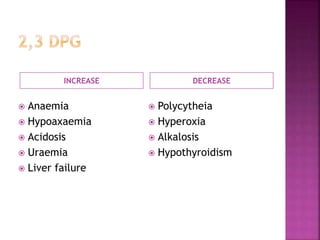
INCREASE DECREASE
 Anaemia
 Hypoaxaemia
 Acidosis
 Uraemia
 Liver failure
 Polycytheia
 Hyperoxia
 Alkalosis
 Hypothyroidism
 • Hypoxemia : Reduction of oxygen levels in
arterial blood a PaO2 of less than 8.0 kPa
(60 mmHg) or oxygen saturations less than
93%.
 • Hypoxia : Insufficient oxygen supply in the
tissues leads to organ damage
 Documented hypoxemia as evidenced by
PaO2 or SaO2 below desirable range for a
specific clinical situation
 Respiratory distress (RR > 24/min)
 Acute care situations in which hypoxemia is
suspected
 Increased metabolic demands (Burns,
multiple injuries, severe sepsis)
 Cardiac failure or myocardial infarction
 Short term therapy (Post anaesthesia
recovery
 Correcting Hypoxemia
By raising Alveolar & blood level of oxygen
 Decreasing symptoms of Hypoxemia
Supplemental O2 can relieve symptoms
Lessen dyspnea/ work of breathing
Improve mental function
 Minimizing Cardiopulmonary workload
Cardiopulmonary system will compensate for
hypoxemia by:
• Increase ventilation to get more O2
• Increasing cardiac output to get oxygenated
blood to tissues
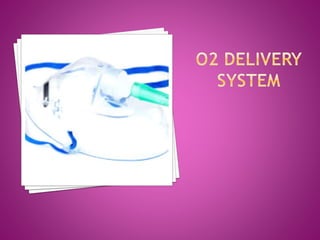
 •An oxygen delivery system is a device used
to administer, regulate, and supplement
oxygen to a subject to increase the arterial
oxygenation.
 •In general, the system entrails oxygen and
air to prepare a fixed concentration required
for administration.
 Low-flow or variable-performance devices
High-flow or fixed-performance devices.
 Provides a fraction of patients minute
ventilation requirement as pure O2. rest of
the ventilatory requirement is fullfilled by
entrailment of room air
 Flow- <6L/min
 Simple, easy to use, well tolerated
 Nasal canula, simple mask, O2 resevoir
canula
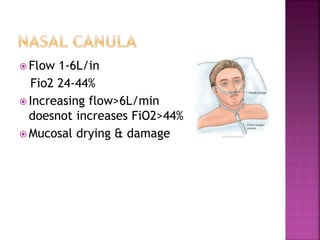
 Flow 1-6L/in
Fio2 24-44%
 Increasing flow>6L/min
doesnot increases FiO2>44%
 Mucosal drying & damage
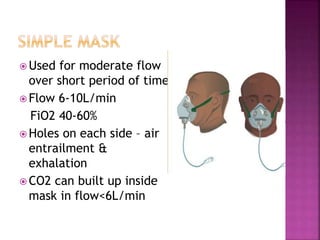
 Used for moderate flow
over short period of time
 Flow 6-10L/min
FiO2 40-60%
 Holes on each side – air
entrailment &
exhalation
 CO2 can built up inside
mask in flow<6L/min
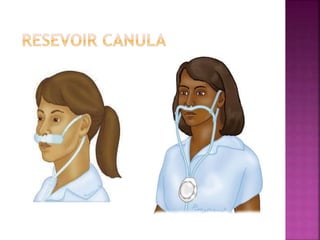
 Function by storing O2 during exhalation
making that that O2 available for next cycle
of inspiration
 Useful for >4L
 Can be moustache/pendent shaped
 Partial rebreather system
 They meet patiens inspiratory flow &
generate accurate FiO2
 Flows are such so that air entrailment not
required
 RR & Vt have no affect on FiO2
 Venturi mask, partial/nonrebreather mask,
high flow canula/maskS
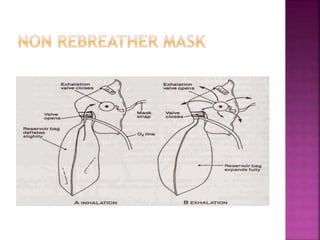
 Delivers high flow with high conc
 Inhalation & exhalation valve
 Flow10-15l/min
FiO2 60-95%
 Flow rate <6L/min increases chance of
rebreathing CO2
 NRB without any valves
 Flow 6-15L/min
FiO2 60-65%
 Patient inhales some of exhaled air
containing CO2
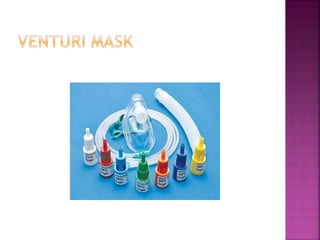
 Most often used for critically ill
 Flow 4-12L/min
FiO2 24-60%
 Precise O2 delivery+ minimal chance of CO2
build up- comonly used for COPD
 Holes on each side
colour coded entrailment ports
 Entrailment of room air occurs. Fixed & does
not depend upon PIFR
1 Oxygen is a life saving drug for hypoxaemic
patients.
2 Giving too much oxygen is unnecessary as
oxygen cannot be stored in the body
3 COPD patients (and some other patients) may
be harmed by too much oxygen as this can
lead to increased carbon dioxide (C02) levels
4 Other patients (e.g. myocardial infarction)
may also be harmed by too much oxygen
5 Only give as much as needed– no need for
extra!
• Doctors and nurses have a poor
understanding of how oxygen should be used
• Oxygen is often given without a prescription
• If there is a prescription, patients do not
always receive what is specified on the
prescription
• Where there is a prescription with target
range, almost one third of patients are
outside the range
• 94-98% Most patients (Those not at risk
of CO2 retention)
• 88-92% C02 retaining patients:
Chronic hypoxic lung disease
COPD
Severe Chronic Asthma
Bronchiectasis / CF
Chest wall disease
Neuromuscular disease
Obesity related hypoventilation
Target saturation should be individualized, should be
reviwed regularly & changed if required.
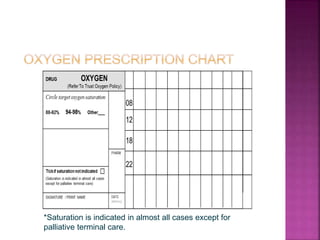
*Saturation is indicated in almost all cases except for
palliative terminal care.
 Patients must not go without oxygen while
waiting for medical review a me
 Initial 02 therapy is reservoir mask at 15
litres/minute (RM15)
 Once stable aim for SpO2 94-98% or patient-
specific target range
 COPD patients who are critically ill should
have the same oxygen therapy until blood
gases have been obtained and may then
need controlled oxygen therapy or non-
invasive or invasive ventilation
 Record SpO2 before therapy (if possible)
Establish target saturation
 94-98%
Use mask+flow
Repeated BG not necessary if pt within target range
 88-92%
Start with nasal canula 1-2L/min or 28% venturi
Titrate upwards
BG 30-60 min later
 Monitoring
SpO2 5min after any change; record 4hrly
if O2 therapy increases-obtain BG 30-60 min
if O2 therapy dereases- no need for BG
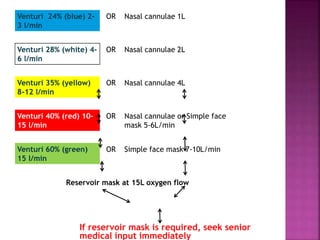
Venturi 24% (blue) 2-
3 l/min
OR Nasal cannulae 1L
Venturi 28% (white) 4-
6 l/min
OR Nasal cannulae 2L
Venturi 35% (yellow)
8-12 l/min
OR Nasal cannulae 4L
Venturi 40% (red) 10-
15 l/min
OR Nasal cannulae or Simple face
mask 5-6L/min
Venturi 60% (green)
15 l/min
OR Simple face mask 7-10L/min
Reservoir mask at 15L oxygen flow
If reservoir mask is required, seek senior
medical input immediately
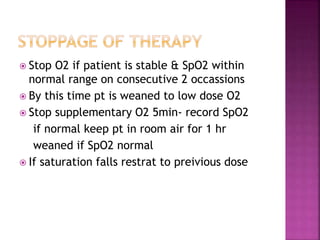
 Stop O2 if patient is stable & SpO2 within
normal range on consecutive 2 occassions
 By this time pt is weaned to low dose O2
 Stop supplementary O2 5min- record SpO2
if normal keep pt in room air for 1 hr
weaned if SpO2 normal
 If saturation falls restrat to preivious dose
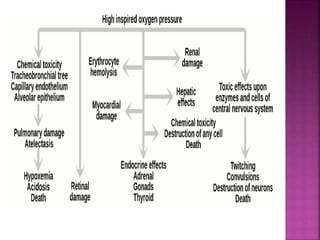
 Harmful effects of breathing molecular O2 at
increased partial pressure
 TIME- MATTERS A LOT !!
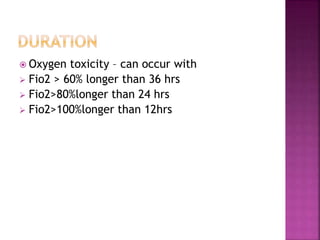
 Oxygen toxicity – can occur with
 Fio2 > 60% longer than 36 hrs
 Fio2>80%longer than 24 hrs
 Fio2>100%longer than 12hrs
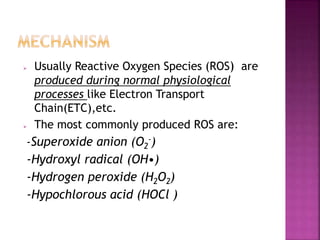
 Usually Reactive Oxygen Species (ROS) are
produced during normal physiological
processes like Electron Transport
Chain(ETC),etc.
 The most commonly produced ROS are:
-Superoxide anion (O2
-)
-Hydroxyl radical (OH•)
-Hydrogen peroxide (H2O2)
-Hypochlorous acid (HOCl )
 Reactive Oxygen Species (ROS) are a natural
occurrence:
Accidental products of nonenzymatic
and enzymatic processes.
Deliberate production by immune
cells killing pathogens.
UV irradiation, radioactive chemicals, Xrays
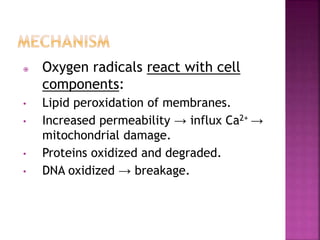
 Oxygen radicals react with cell
components:
• Lipid peroxidation of membranes.
• Increased permeability → influx Ca2+ →
mitochondrial damage.
• Proteins oxidized and degraded.
• DNA oxidized → breakage.
Oxygen cascade & therapy

Oxygen cascade & therapy

  • 1.
    DR TARAK NATHCHATTOPADHYAY MD PGT, MEDICINE, BSMC&H
  • 2.
     Total pressureof a gas mixture= σpartial pressure of invidual gases  Individual partial pressure α fraction of volume of that gas
  • 3.
     P=760 mmHg  components • O2 20.98% • N2 78.06% • Co2 .04% • Others .92%  PO2=760× .21=160mm Hg  PCO2=760× .0004=.3mm Hg
  • 4.
     It isthe process of decreasing oxygen tension from atmosphere to mitochondria  Atmosphere alveoli arterial blood capillary mitochondria
  • 5.
     Water vapourpressure at body temp =47mmHg  Thus, Pressure exerted by gas in saturated moist air = 760-47 = 713mmHg  Partial pressure of O2 in saturated moist air = 713 x 0.21 = 149 mmHg  This is the starting point of O2 cascade.
  • 6.
     Down therespiratory tree, O2 tension is further diluted by the alveolar CO2.  The partial pressure of alveolar oxygen (PAO2) is calculated by Alveolar gas equation PAO2= PiO2-PACO2/RQ  RQ is the proportion of CO2 produced to the O2 uptaken PaCO₂ = PACO₂ ( 40mmHg ) as CO₂ is freely diffusible.  PAO2 =149-(40/0.8)~100mmHg
  • 7.
     PAO2 100mmHgPcapO2 40mm Hg  Oxygen diffuses from alveoli to pulmonary capillaries according to conc gradient  Oxygenated,blood moves to pulm. veins→left side of heart→ arterial system →systemic tissues.
  • 8.
     Hb mediated+ dissolved state  O2 carrying capacity of blood= [(1.34 x HbxSaO2)+(0.003xPaO2)] x Q  O2 delivery to tissues depends on 1. Hb concentration 2. O2 binding capacity of Hb 3. saturation of Hb 4. amount of dissolved O2 5. cardiac output (Q)
  • 9.
     Initially thedissolved O2 is consumed. Then the sequential unloading of Hb bound O2 occurs.  PASTEUR POINT is the critical PO2 below which the O2 delivery is unable to meet the tissue demands.
  • 12.
  • 13.
     High altitude Patmis less; so does PiO2  Vapour URT humidifies inspired air Increased vapour pressure, decreased PiO2
  • 14.
     Amount ofCO2 in the alveolus depends on the metabolism & degree of hypoventilation.  Fever,sepsis,malignant hyperthermia increases CO2 production
  • 15.
     Ventilation/perfusion mismatch • Shunt  • Slow diffusion
  • 16.
     Upperzone overventilated,lower zone underperfused& underventilated  Pulmonary venous blood is admixture of all capillary blood hence PaO2>PAO2
  • 17.
     Deoxygenated bloodenters systemic circulation without getting oxygenated  Atelectasis, consolidation, small airway closure
  • 18.
     Normal diffusionis rapid.  Completed by the time blood traverses 1/3 way along pulmonary capillary
  • 19.
     PaO2=102-age/3  NormalAa gradient 5-15 mHg  Aa gradient increased in 1. Atelectasis 2. Slowing of diffusion 3. VQ mismatch 4. Mixed venous O2 tension
  • 20.
     Serum Hblevel.  Percentage of Hb saturated with O2.  Cardiac output.  Amount of dissolved oxygen
  • 22.
     Bound toHb 95% Dissolved in plasma 5%  1Hb molecule binds with 4 O2 molecule  1gm of fully oxygenated Hb contains 1.34ml of O2 (vary depending on Fe content)  At an arterial PO2 of 100mmHg,Hb is 98% saturated,thus 15gm of Hb in 100ml bloodnwill carry about 20ml of O2 (1.34ml x 15gm x 98/100=20)
  • 23.
     Henry’s law:states that the concentration of any gas in a solution is proportional to its partial pressure Gas concentration α partial pressure  • Dissolved O2 in arterial blood is thus solubility coefficientx100mmHg = .003ml/dL×100 =.3 ml
  • 24.
     100ml arterialblood carries 20.3 ml O2  100ml venous blood (PO2 40mm Hg 75% saturation) contains 1.34x15x75/100=15  Thus every 100ml of blood passing through the lungs will take up 5ml of O2
  • 25.
     Partial pressurevs Hb saturation  It’s a sigmoid shaped curve with a steep lower portion and flat upper portion  Describes the nonlinear tendency for O2 to bind to Hb.
  • 26.
     One Hbmolecule can bind 4 molecules of O2  Deoxy Hb : globin units are tightly bound in a tense configuration (T state) As first molecule of O2 binds, it goes into a relaxed configuration (R state) thus exposing more O2 binding sites causing increase in 02 affinity characteristic sigmoid shape ofODC
  • 27.
     The arterialpoint PO2=100mmHg and SO2=97.5%  The mixed venous point PO2=40mmHg and SO2=75%  The P50 PO2=27mmHg and SO2=50%
  • 28.
     It isthe partial pressure at which 50% of Hb is saturated.  At a pH of 7.4 , temp 37C , the PO2 at which the Hb is 50% saturated (P50) is 27mmHg  When affinity of Hb for 02 is increased , P50 decreases : shift to left in ODC  When affinity is reduced , P50 increases : shift to right in ODC
  • 29.
     decreased affinity,increased P50 1.Acidosis 2. Temp 3. 2,3 dpg 4. Pco2 5. Exrcise anaemia,drugs (propranolo,digoxi n)
  • 30.
     Decreased P50, increasedaffinity  Alkalosis  Hypothermia  Varriant of Hb
  • 31.
     Temperature- highertemp, lesser affinity  Acidosis- deoxyHb has higher affinity to H+ Acute 0.1 pH change causes 3mmHg change in P50 Chronic depends on body compensatory mechanism  CO2  2,3 DPG
  • 32.
     Produced inRBC via EMP shunt in glycolysis pathway  Normal level 4 mmol/L  Binds to deoxyHb-decreases affinity, shift to right  Fetal RBC has lower conc of 2,3 DPG thus higher affinity towards O2
  • 33.
    INCREASE DECREASE  Anaemia Hypoaxaemia  Acidosis  Uraemia  Liver failure  Polycytheia  Hyperoxia  Alkalosis  Hypothyroidism
  • 35.
     • Hypoxemia: Reduction of oxygen levels in arterial blood a PaO2 of less than 8.0 kPa (60 mmHg) or oxygen saturations less than 93%.  • Hypoxia : Insufficient oxygen supply in the tissues leads to organ damage
  • 36.
     Documented hypoxemiaas evidenced by PaO2 or SaO2 below desirable range for a specific clinical situation  Respiratory distress (RR > 24/min)  Acute care situations in which hypoxemia is suspected  Increased metabolic demands (Burns, multiple injuries, severe sepsis)  Cardiac failure or myocardial infarction  Short term therapy (Post anaesthesia recovery
  • 37.
     Correcting Hypoxemia Byraising Alveolar & blood level of oxygen  Decreasing symptoms of Hypoxemia Supplemental O2 can relieve symptoms Lessen dyspnea/ work of breathing Improve mental function  Minimizing Cardiopulmonary workload Cardiopulmonary system will compensate for hypoxemia by: • Increase ventilation to get more O2 • Increasing cardiac output to get oxygenated blood to tissues
  • 38.
     •An oxygendelivery system is a device used to administer, regulate, and supplement oxygen to a subject to increase the arterial oxygenation.  •In general, the system entrails oxygen and air to prepare a fixed concentration required for administration.  Low-flow or variable-performance devices High-flow or fixed-performance devices.
  • 39.
     Provides afraction of patients minute ventilation requirement as pure O2. rest of the ventilatory requirement is fullfilled by entrailment of room air  Flow- <6L/min  Simple, easy to use, well tolerated  Nasal canula, simple mask, O2 resevoir canula
  • 40.
     Flow 1-6L/in Fio224-44%  Increasing flow>6L/min doesnot increases FiO2>44%  Mucosal drying & damage
  • 41.
     Used formoderate flow over short period of time  Flow 6-10L/min FiO2 40-60%  Holes on each side – air entrailment & exhalation  CO2 can built up inside mask in flow<6L/min
  • 43.
     Function bystoring O2 during exhalation making that that O2 available for next cycle of inspiration  Useful for >4L  Can be moustache/pendent shaped  Partial rebreather system
  • 44.
     They meetpatiens inspiratory flow & generate accurate FiO2  Flows are such so that air entrailment not required  RR & Vt have no affect on FiO2  Venturi mask, partial/nonrebreather mask, high flow canula/maskS
  • 46.
     Delivers highflow with high conc  Inhalation & exhalation valve  Flow10-15l/min FiO2 60-95%  Flow rate <6L/min increases chance of rebreathing CO2
  • 47.
     NRB withoutany valves  Flow 6-15L/min FiO2 60-65%  Patient inhales some of exhaled air containing CO2
  • 49.
     Most oftenused for critically ill  Flow 4-12L/min FiO2 24-60%  Precise O2 delivery+ minimal chance of CO2 build up- comonly used for COPD  Holes on each side colour coded entrailment ports  Entrailment of room air occurs. Fixed & does not depend upon PIFR
  • 51.
    1 Oxygen isa life saving drug for hypoxaemic patients. 2 Giving too much oxygen is unnecessary as oxygen cannot be stored in the body 3 COPD patients (and some other patients) may be harmed by too much oxygen as this can lead to increased carbon dioxide (C02) levels 4 Other patients (e.g. myocardial infarction) may also be harmed by too much oxygen 5 Only give as much as needed– no need for extra!
  • 52.
    • Doctors andnurses have a poor understanding of how oxygen should be used • Oxygen is often given without a prescription • If there is a prescription, patients do not always receive what is specified on the prescription • Where there is a prescription with target range, almost one third of patients are outside the range
  • 53.
    • 94-98% Mostpatients (Those not at risk of CO2 retention) • 88-92% C02 retaining patients: Chronic hypoxic lung disease COPD Severe Chronic Asthma Bronchiectasis / CF Chest wall disease Neuromuscular disease Obesity related hypoventilation Target saturation should be individualized, should be reviwed regularly & changed if required.
  • 54.
    *Saturation is indicatedin almost all cases except for palliative terminal care.
  • 55.
     Patients mustnot go without oxygen while waiting for medical review a me  Initial 02 therapy is reservoir mask at 15 litres/minute (RM15)  Once stable aim for SpO2 94-98% or patient- specific target range  COPD patients who are critically ill should have the same oxygen therapy until blood gases have been obtained and may then need controlled oxygen therapy or non- invasive or invasive ventilation
  • 56.
     Record SpO2before therapy (if possible) Establish target saturation  94-98% Use mask+flow Repeated BG not necessary if pt within target range  88-92% Start with nasal canula 1-2L/min or 28% venturi Titrate upwards BG 30-60 min later  Monitoring SpO2 5min after any change; record 4hrly if O2 therapy increases-obtain BG 30-60 min if O2 therapy dereases- no need for BG
  • 57.
    Venturi 24% (blue)2- 3 l/min OR Nasal cannulae 1L Venturi 28% (white) 4- 6 l/min OR Nasal cannulae 2L Venturi 35% (yellow) 8-12 l/min OR Nasal cannulae 4L Venturi 40% (red) 10- 15 l/min OR Nasal cannulae or Simple face mask 5-6L/min Venturi 60% (green) 15 l/min OR Simple face mask 7-10L/min Reservoir mask at 15L oxygen flow If reservoir mask is required, seek senior medical input immediately
  • 58.
     Stop O2if patient is stable & SpO2 within normal range on consecutive 2 occassions  By this time pt is weaned to low dose O2  Stop supplementary O2 5min- record SpO2 if normal keep pt in room air for 1 hr weaned if SpO2 normal  If saturation falls restrat to preivious dose
  • 59.
     Harmful effectsof breathing molecular O2 at increased partial pressure  TIME- MATTERS A LOT !!
  • 60.
     Oxygen toxicity– can occur with  Fio2 > 60% longer than 36 hrs  Fio2>80%longer than 24 hrs  Fio2>100%longer than 12hrs
  • 61.
     Usually ReactiveOxygen Species (ROS) are produced during normal physiological processes like Electron Transport Chain(ETC),etc.  The most commonly produced ROS are: -Superoxide anion (O2 -) -Hydroxyl radical (OH•) -Hydrogen peroxide (H2O2) -Hypochlorous acid (HOCl )
  • 62.
     Reactive OxygenSpecies (ROS) are a natural occurrence: Accidental products of nonenzymatic and enzymatic processes. Deliberate production by immune cells killing pathogens. UV irradiation, radioactive chemicals, Xrays
  • 63.
     Oxygen radicalsreact with cell components: • Lipid peroxidation of membranes. • Increased permeability → influx Ca2+ → mitochondrial damage. • Proteins oxidized and degraded. • DNA oxidized → breakage.