Dr. C.G.Raghuram
Professor,
Dept. of Anaesthesiology,
Osmania General Hospital,
Hyderabad.
PROBLEMS ASSOCIATED WITH PBC
NECK
 Grossly restricted neck movements
 Patients are likely to be malnourished ,anemic and
hypoproteinemic
 Possibility of restricted mouth opening and narrowed nasal
passages.
 Difficult laryngoscopy and endotracheal intubation
 Compromised airway
 Psychiatric tendencies in patients and possible drug
interactions in anaesthesia
 Poor oral hygeine in patients
RELEVANT ASPECTS IN
HISTORY
 Duration of contractures
 History of convulsions
 Difficulty in breathing and swallowing
 H/O motion sickness
 H/O snoring
 H/O epistaxis and bleeding from oral cavity
 H/O psychiatric problems
 H/O acid peptic disease and reflux
RELEVANT EXAMINATION OF
PATIENT
 Nature of contracture
- soft
- firm(hard)
 Location of contracture
 Duration of contracture
 Extent of contracture ( sterno cleido mastoid involved?)
 Is mouth opening restricted ?
 Can the mandible be moved up and down
 Are the nasal passages patent?
 Is the patient dyspneic, can he lie down comfortably ?
 Can he blow air through mouth and nose
INVESTIGATIONS
 SURGICAL PROFILE:
 Complete blood picture
 Blood Grouping
 Random blood sugar
 Urea and Creatinine
 Serum electrolytes
• X-Ray chest –PA view
• ECG – 12 lead
• HbsAg ,HIV , HCV
• THYROID PROFILE
PREPARATION OF THE
PATIENT
 Improve oral hygeine
 Correct anemia and hypoproteinemia
 H2 receptor antagonists, prokinetics
 Anti emetics
 Aggressive treatment of upper and lower
respiratory tract infections
PRE- MEDICATION
GUIDELINES
 Avoid heavy sedation.
 Preserve respiration – drugs that depress respiration
viz. narcotics are better avoided till airway is
secured
 I.M. glycopyrolate / atropine is better than I.V.
premedication.
 Continue H2 receptor blockers and antiemetics
 Consider pre-op nasal decongestants – they help
you in putting a naso-pharyngeal airway
PRE MEDICATION
(Cont..)
 Use topical viscous anaesthesia for oral
cavity and pharynx before induction of
anaesthesia - it helps in improving
quality of anaesthesia
 Consider superior laryngeal nerve block
if hyoid and upper margin of thryiod
cartilage are visible.- it reduces
incidence of laryngospasm during
anaesthesia
USEFUL TIPS IN
ANAESTHESIA
 Aim to have total control of the airway- that should
be the ultimate goal
 Preserve spontaneous respiration till trachea is
intubated
 Consider using nasopharyngeal airway, oro-
pharyngeal airway, and laryngeal mask airway
where ever feasible –these devices improve quality
of anaesthesia.
 Consider superficial cervical plexus block if
contracture is situated in between sternomastoids- it
gives useful analgesia for the operative field .
 I.M Ketamine is a more useful option than I.V. Ketamine in a
dose of 2-5 mg/kg
REASONS :
 Analgesia lasts longer upto 30-45 mins .By which time the
contracture release will mostly be released.
 Less risk of resp. depression
 Stable hemodynamics
 Provides an ideal environment along with tumescent or
regional technique.
 Patient can be smoothly transitioned into an inhalational
technique
USEFUL TIPS (Cont …)
 If using LMA , fix the LMA to the maxilla /upperlip
.Never to the mandible.
 Consider using a muscle relaxant only if mask/LMA
ventilation is possible . Otherwise avoid them
 Try endotracheal intubation in deep planes of
inhalational anaesthesia.In spontaneous respiration
as far as possible.
 Consider bougies ,tube exchangers where ever
laryngoscopy and endotracheal intubation obscures
visibility.
 Fix E.T tubes always to the maxilla .Fixing them to
mandible can soak them and soil them with blood
and secretions from the operative field and can also
interfere with field of surgery .
 Use narcotics like fentanyl etc ., only after
securing access to trachea.
 N.S.AIDS are very useful for post op analgesia
.Hence use them.
 Avoid narcotics , tramadol and metronidazole in
patients with migraine and motion sickness.
PRECAUTIONS IN THE POST-OP
PERIOD
 Extubate only when sure.
 Watch for airway obstruction .
 Observe resp. pattern.
 Use nasopharyngeal /oral airway if needed.
 Anti-emetics to be continued post-op
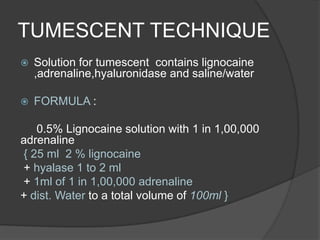
TUMESCENT TECHNIQUE
 Solution for tumescent contains lignocaine
,adrenaline,hyaluronidase and saline/water
 FORMULA :
0.5% Lignocaine solution with 1 in 1,00,000
adrenaline
{ 25 ml 2 % lignocaine
+ hyalase 1 to 2 ml
+ 1ml of 1 in 1,00,000 adrenaline
+ dist. Water to a total volume of 100ml }
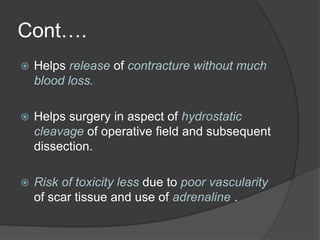
Cont….
 Helps release of contracture without much
blood loss.
 Helps surgery in aspect of hydrostatic
cleavage of operative field and subsequent
dissection.
 Risk of toxicity less due to poor vascularity
of scar tissue and use of adrenaline .
PARTING TAIL PIECE
 A 35 yr old female, weighing 60 kgs is posted for a dense
tough contracture involving anterolateral aspects of neck .
 Contracture released with tumescent + IM .Ketamine .
 Patient intubated with 7.5mm cuffed ET tube under deep
inhalational anaesthesia with O2 +N2O+ Isoflurane .
 4 mg vecuronium given .
 Surgery lasts two hours
 At the end, patient reversed as there are respiratory efforts
 Patient regains respirations but is deeply
drowsy , reflexes sluggish.
 Patient regains consciousness 12 hrs
after surgery.
WHAT HAS GONE WRONG ??

Post Burn Contracture Neck

  • 1.
    Dr. C.G.Raghuram Professor, Dept. ofAnaesthesiology, Osmania General Hospital, Hyderabad.
  • 2.
    PROBLEMS ASSOCIATED WITHPBC NECK  Grossly restricted neck movements  Patients are likely to be malnourished ,anemic and hypoproteinemic  Possibility of restricted mouth opening and narrowed nasal passages.  Difficult laryngoscopy and endotracheal intubation  Compromised airway  Psychiatric tendencies in patients and possible drug interactions in anaesthesia  Poor oral hygeine in patients
  • 3.
    RELEVANT ASPECTS IN HISTORY Duration of contractures  History of convulsions  Difficulty in breathing and swallowing  H/O motion sickness  H/O snoring  H/O epistaxis and bleeding from oral cavity  H/O psychiatric problems  H/O acid peptic disease and reflux
  • 4.
    RELEVANT EXAMINATION OF PATIENT Nature of contracture - soft - firm(hard)  Location of contracture  Duration of contracture  Extent of contracture ( sterno cleido mastoid involved?)  Is mouth opening restricted ?  Can the mandible be moved up and down  Are the nasal passages patent?  Is the patient dyspneic, can he lie down comfortably ?  Can he blow air through mouth and nose
  • 5.
    INVESTIGATIONS  SURGICAL PROFILE: Complete blood picture  Blood Grouping  Random blood sugar  Urea and Creatinine  Serum electrolytes • X-Ray chest –PA view • ECG – 12 lead • HbsAg ,HIV , HCV • THYROID PROFILE
  • 6.
    PREPARATION OF THE PATIENT Improve oral hygeine  Correct anemia and hypoproteinemia  H2 receptor antagonists, prokinetics  Anti emetics  Aggressive treatment of upper and lower respiratory tract infections
  • 7.
    PRE- MEDICATION GUIDELINES  Avoidheavy sedation.  Preserve respiration – drugs that depress respiration viz. narcotics are better avoided till airway is secured  I.M. glycopyrolate / atropine is better than I.V. premedication.  Continue H2 receptor blockers and antiemetics  Consider pre-op nasal decongestants – they help you in putting a naso-pharyngeal airway
  • 8.
    PRE MEDICATION (Cont..)  Usetopical viscous anaesthesia for oral cavity and pharynx before induction of anaesthesia - it helps in improving quality of anaesthesia  Consider superior laryngeal nerve block if hyoid and upper margin of thryiod cartilage are visible.- it reduces incidence of laryngospasm during anaesthesia
  • 9.
    USEFUL TIPS IN ANAESTHESIA Aim to have total control of the airway- that should be the ultimate goal  Preserve spontaneous respiration till trachea is intubated  Consider using nasopharyngeal airway, oro- pharyngeal airway, and laryngeal mask airway where ever feasible –these devices improve quality of anaesthesia.  Consider superficial cervical plexus block if contracture is situated in between sternomastoids- it gives useful analgesia for the operative field .
  • 10.
     I.M Ketamineis a more useful option than I.V. Ketamine in a dose of 2-5 mg/kg REASONS :  Analgesia lasts longer upto 30-45 mins .By which time the contracture release will mostly be released.  Less risk of resp. depression  Stable hemodynamics  Provides an ideal environment along with tumescent or regional technique.  Patient can be smoothly transitioned into an inhalational technique
  • 11.
    USEFUL TIPS (Cont…)  If using LMA , fix the LMA to the maxilla /upperlip .Never to the mandible.  Consider using a muscle relaxant only if mask/LMA ventilation is possible . Otherwise avoid them  Try endotracheal intubation in deep planes of inhalational anaesthesia.In spontaneous respiration as far as possible.  Consider bougies ,tube exchangers where ever laryngoscopy and endotracheal intubation obscures visibility.
  • 12.
     Fix E.Ttubes always to the maxilla .Fixing them to mandible can soak them and soil them with blood and secretions from the operative field and can also interfere with field of surgery .  Use narcotics like fentanyl etc ., only after securing access to trachea.  N.S.AIDS are very useful for post op analgesia .Hence use them.  Avoid narcotics , tramadol and metronidazole in patients with migraine and motion sickness.
  • 13.
    PRECAUTIONS IN THEPOST-OP PERIOD  Extubate only when sure.  Watch for airway obstruction .  Observe resp. pattern.  Use nasopharyngeal /oral airway if needed.  Anti-emetics to be continued post-op
  • 14.
    TUMESCENT TECHNIQUE  Solutionfor tumescent contains lignocaine ,adrenaline,hyaluronidase and saline/water  FORMULA : 0.5% Lignocaine solution with 1 in 1,00,000 adrenaline { 25 ml 2 % lignocaine + hyalase 1 to 2 ml + 1ml of 1 in 1,00,000 adrenaline + dist. Water to a total volume of 100ml }
  • 15.
    Cont….  Helps releaseof contracture without much blood loss.  Helps surgery in aspect of hydrostatic cleavage of operative field and subsequent dissection.  Risk of toxicity less due to poor vascularity of scar tissue and use of adrenaline .
  • 16.
    PARTING TAIL PIECE A 35 yr old female, weighing 60 kgs is posted for a dense tough contracture involving anterolateral aspects of neck .  Contracture released with tumescent + IM .Ketamine .  Patient intubated with 7.5mm cuffed ET tube under deep inhalational anaesthesia with O2 +N2O+ Isoflurane .  4 mg vecuronium given .  Surgery lasts two hours  At the end, patient reversed as there are respiratory efforts
  • 17.
     Patient regainsrespirations but is deeply drowsy , reflexes sluggish.  Patient regains consciousness 12 hrs after surgery. WHAT HAS GONE WRONG ??