

““‫من‬ ‫فيه‬ ‫ونفخت‬ ‫سويته‬ ‫فإذا‬‫من‬ ‫فيه‬ ‫ونفخت‬ ‫سويته‬ ‫فإذا‬
‫ساجدين‬ ‫له‬ ‫فقعوا‬ ‫روحي‬‫ساجدين‬ ‫له‬ ‫فقعوا‬ ‫روحي‬““
‫ص‬‫ص‬۷۲۷۲
Mechanical VentilationMechanical Ventilation
in Severe Airflowin Severe Airflow
ObstructionObstruction
Nabil Abouchala, MDNabil Abouchala, MD
ConsultantConsultant
Pulmonary & Critical Care MedicinePulmonary & Critical Care Medicine
abouhani@yahoo.comabouhani@yahoo.com
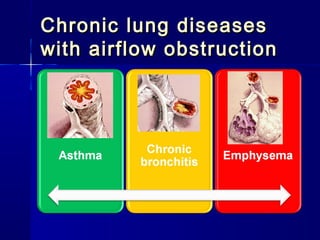
Chronic lung diseasesChronic lung diseases
with airflow obstructionwith airflow obstruction
Chronic lung diseasesChronic lung diseases
with airflow obstructionwith airflow obstruction
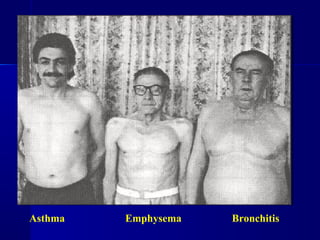
Asthma Emphysema Bronchitis
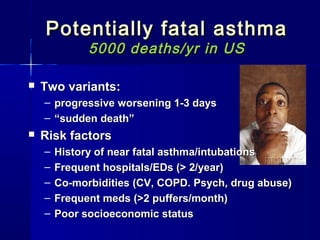
Potentially fatal asthmaPotentially fatal asthma
5000 deaths/yr in US5000 deaths/yr in US
 Two variants:Two variants:
– progressive worsening 1-3 daysprogressive worsening 1-3 days
– ““sudden death”sudden death”
 Risk factorsRisk factors
– History of near fatal asthma/intubationsHistory of near fatal asthma/intubations
– Frequent hospitals/EDs (> 2/year)Frequent hospitals/EDs (> 2/year)
– Co-morbidities (CV, COPD. Psych, drug abuse)Co-morbidities (CV, COPD. Psych, drug abuse)
– Frequent meds (>2 puffers/month)Frequent meds (>2 puffers/month)
– Poor socioeconomic statusPoor socioeconomic status
Ventilation inVentilation in
COPD/AsthmaCOPD/Asthma
Ventilation inVentilation in
COPD/AsthmaCOPD/Asthma
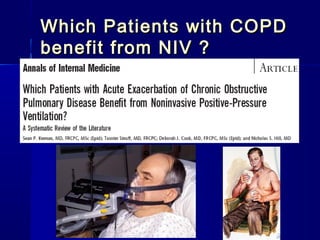
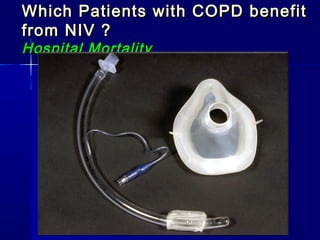
Which Patients with COPDWhich Patients with COPD
benefit from NIV ?benefit from NIV ?
Which Patients with COPD benefitWhich Patients with COPD benefit
from NIV ?from NIV ?
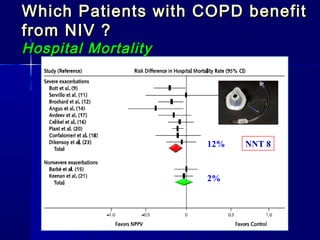
Hospital MortalityHospital Mortality
12%
2%
NNT 8
Which Patients with COPD benefitWhich Patients with COPD benefit
from NIV ?from NIV ?
Hospital MortalityHospital Mortality
12%
2%
NNT 8
Which Patients with COPD benefitWhich Patients with COPD benefit
from NIV ?from NIV ?
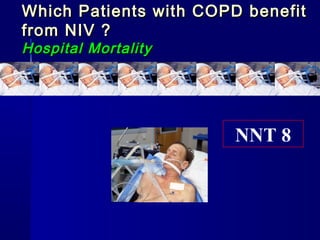
Hospital MortalityHospital Mortality
NNT 8
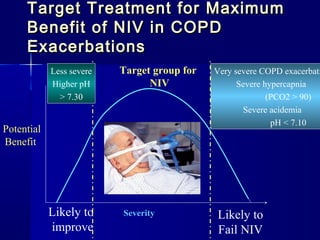
Target Treatment for MaximumTarget Treatment for Maximum
Benefit of NIV in COPDBenefit of NIV in COPD
ExacerbationsExacerbations
Likely to
improve
Severity Likely to
Fail NIV
Target group for
NIV
Potential
Benefit
Less severe
Higher pH
> 7.30
Very severe COPD exacerbati
Severe hypercapnia
(PCO2 > 90)
Severe acidemia
pH < 7.10
Ventilation inVentilation in
COPD/AsthmaCOPD/Asthma
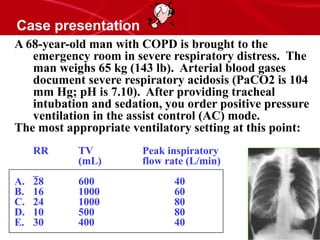
Case presentation
A 68-year-old man with COPD is brought to the
emergency room in severe respiratory distress. The
man weighs 65 kg (143 lb). Arterial blood gases
document severe respiratory acidosis (PaCO2 is 104
mm Hg; pH is 7.10). After providing tracheal
intubation and sedation, you order positive pressure
ventilation in the assist control (AC) mode.
The most appropriate ventilatory setting at this point:
RR TV Peak inspiratory
(mL) flow rate (L/min)
_
A. 28 600 40
B. 16 1000 60
C. 24 1000 80
D. 10 500 80
E. 30 400 40
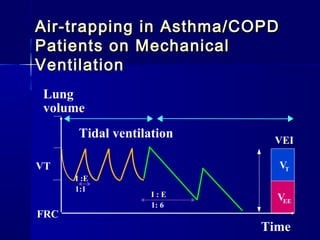
Tidal ventilation
Lung
volume
VT
FRC
VT
VEE
Time
VEI
I :E
1:1
I : E
1: 6
Air-trapping in Asthma/COPDAir-trapping in Asthma/COPD
Patients on MechanicalPatients on Mechanical
VentilationVentilation
Obstructive Airway DiseaseObstructive Airway Disease
 Beware of auto-PEEP!Beware of auto-PEEP!
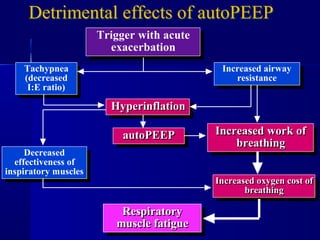
Detrimental effects of autoPEEPDetrimental effects of autoPEEP
Trigger with acute
exacerbation
Tachypnea
(decreased
I:E ratio)
Increased airway
resistance
Increased work of
breathing
Increased work of
breathing
HyperinflationHyperinflation
autoPEEPautoPEEP
Decreased
effectiveness of
inspiratory muscles
Increased oxygen cost of
breathing
Increased oxygen cost of
breathing
Respiratory
muscle fatigue
Respiratory
muscle fatigue
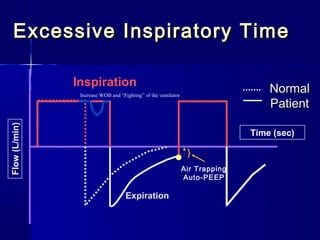
Excessive Inspiratory TimeExcessive Inspiratory Time
Inspiration
Expiration
NormalNormal
PatientPatient
Time (sec)
Flow(L/min)
Air Trapping
Auto-PEEP
}
Increase WOB and “Fighting” of the ventilator
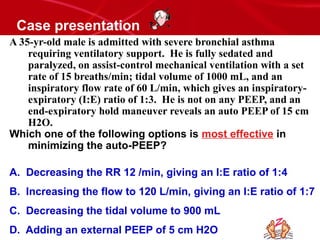
Case presentation
A 35-yr-old male is admitted with severe bronchial asthma
requiring ventilatory support. He is fully sedated and
paralyzed, on assist-control mechanical ventilation with a set
rate of 15 breaths/min; tidal volume of 1000 mL, and an
inspiratory flow rate of 60 L/min, which gives an inspiratory-
expiratory (I:E) ratio of 1:3. He is not on any PEEP, and an
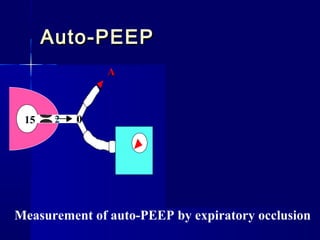
end-expiratory hold maneuver reveals an auto PEEP of 15 cm
H2O.
Which one of the following options is most effective in
minimizing the auto-PEEP?
A. Decreasing the RR 12 /min, giving an I:E ratio of 1:4
B. Increasing the flow to 120 L/min, giving an I:E ratio of 1:7
C. Decreasing the tidal volume to 900 mL
D. Adding an external PEEP of 5 cm H2O
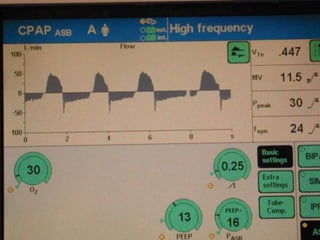
Auto-PEEPAuto-PEEP
15 2 0
AA
15 15 15
BB
Measurement of auto-PEEP by expiratory occlusion
Ventilation inVentilation in
COPD/AsthmaCOPD/Asthma
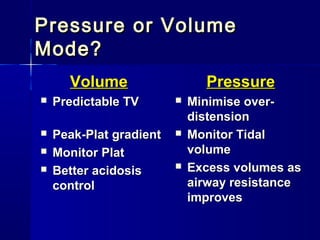
Pressure or VolumePressure or Volume
Mode?Mode?
VolumeVolume
 Predictable TVPredictable TV
 Peak-Plat gradientPeak-Plat gradient
 Monitor PlatMonitor Plat
 Better acidosisBetter acidosis
controlcontrol
PressurePressure
 Minimise over-Minimise over-
distensiondistension
 Monitor TidalMonitor Tidal
volumevolume
 Excess volumes asExcess volumes as
airway resistanceairway resistance
improvesimproves
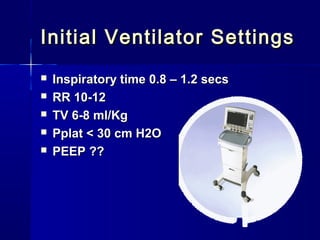
Initial Ventilator SettingsInitial Ventilator Settings
 Inspiratory time 0.8 – 1.2 secsInspiratory time 0.8 – 1.2 secs
 RR 10-12RR 10-12
 TV 6-8 ml/KgTV 6-8 ml/Kg
 Pplat < 30 cm H2OPplat < 30 cm H2O
 PEEP ??PEEP ??
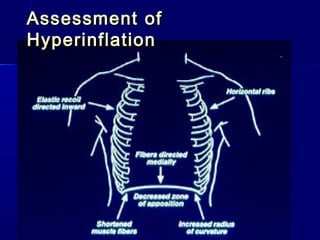
Assessment ofAssessment of
HyperinflationHyperinflation
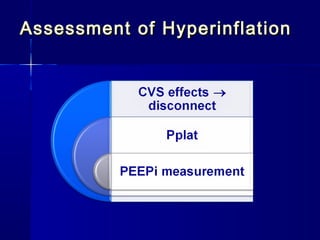
Assessment of HyperinflationAssessment of Hyperinflation
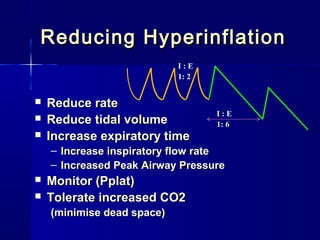
Reducing HyperinflationReducing Hyperinflation
 Reduce rateReduce rate
 Reduce tidal volumeReduce tidal volume
 Increase expiratory timeIncrease expiratory time
– Increase inspiratory flow rateIncrease inspiratory flow rate
– Increased Peak Airway PressureIncreased Peak Airway Pressure
 Monitor (Pplat)Monitor (Pplat)
 Tolerate increased CO2Tolerate increased CO2
(minimise dead space)(minimise dead space)
I : E
1: 6
I : E
1: 2
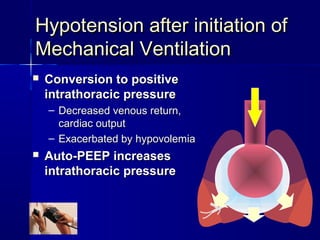
Hypotension after initiation ofHypotension after initiation of
Mechanical VentilationMechanical Ventilation
 Conversion to positiveConversion to positive
intrathoracic pressureintrathoracic pressure
– Decreased venous return,Decreased venous return,
cardiac outputcardiac output
– Exacerbated by hypovolemiaExacerbated by hypovolemia
 Auto-PEEP increasesAuto-PEEP increases
intrathoracic pressureintrathoracic pressure
Ventilation inVentilation in
COPD/AsthmaCOPD/Asthma
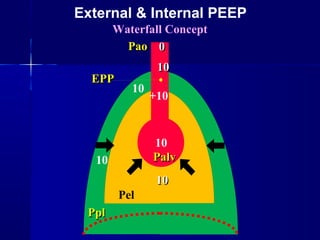
PplPpl
EPPEPP
Pel
PalvPalv
PaoPao
1010
10
+10
1010
10
00
Waterfall Concept
External & Internal PEEP
10
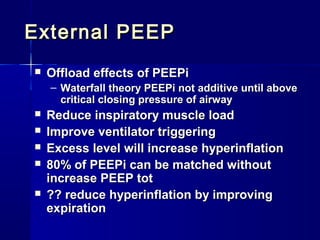
External PEEPExternal PEEP
 Offload effects of PEEPiOffload effects of PEEPi
– Waterfall theory PEEPi not additive until aboveWaterfall theory PEEPi not additive until above
critical closing pressure of airwaycritical closing pressure of airway
 Reduce inspiratory muscle loadReduce inspiratory muscle load
 Improve ventilator triggeringImprove ventilator triggering
 Excess level will increase hyperinflationExcess level will increase hyperinflation
 80% of PEEPi can be matched without80% of PEEPi can be matched without
increase PEEP totincrease PEEP tot
 ?? reduce hyperinflation by improving?? reduce hyperinflation by improving
expirationexpiration
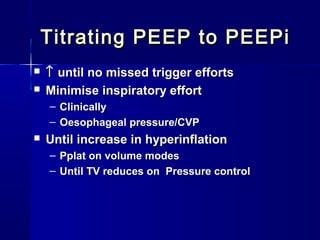
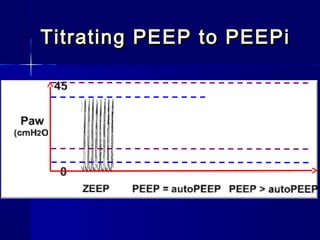
Titrating PEEP to PEEPiTitrating PEEP to PEEPi
 ↑↑ until no missed trigger effortsuntil no missed trigger efforts
 Minimise inspiratory effortMinimise inspiratory effort
– ClinicallyClinically
– Oesophageal pressure/CVPOesophageal pressure/CVP
 Until increase in hyperinflationUntil increase in hyperinflation
– Pplat on volume modesPplat on volume modes
– Until TV reduces on Pressure controlUntil TV reduces on Pressure control
Titrating PEEP to PEEPiTitrating PEEP to PEEPi
Ventilation inVentilation in
COPD/AsthmaCOPD/Asthma
TheophyllineTheophylline
Administration ofAdministration of
BronchodilatorsBronchodilators
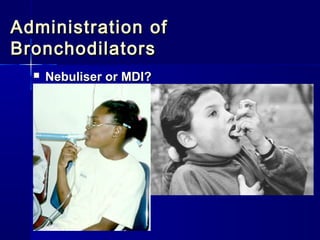
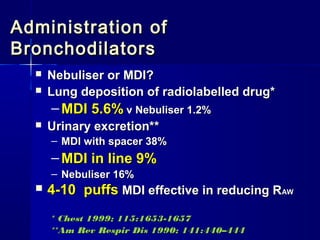
 Nebuliser or MDI?Nebuliser or MDI?
 Lung deposition of radiolabelled drug*Lung deposition of radiolabelled drug*
– MDI 5.6% v Nebuliser 1.2%MDI 5.6% v Nebuliser 1.2%
 Urinary excretion**Urinary excretion**
– MDI with spacer 38%MDI with spacer 38%
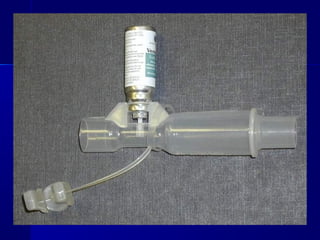
– MDI in line 9%MDI in line 9%
– Nebuliser 16%Nebuliser 16%
 4-10 puffs MDI effective in reducing R4-10 puffs MDI effective in reducing RAWAW
Administration ofAdministration of
BronchodilatorsBronchodilators
 Nebuliser or MDI?Nebuliser or MDI?
 Lung deposition of radiolabelled drug*Lung deposition of radiolabelled drug*
– MDI 5.6%MDI 5.6% v Nebuliser 1.2%v Nebuliser 1.2%
 Urinary excretion**Urinary excretion**
– MDI with spacer 38%MDI with spacer 38%
– MDI in line 9%MDI in line 9%
– Nebuliser 16%Nebuliser 16%
 4-10 puffs4-10 puffs MDI effective in reducing RMDI effective in reducing RAWAW
* Chest 1999; 115:1653-1657* Chest 1999; 115:1653-1657
**Am Rev Respir Dis 1990; 141:440–444**Am Rev Respir Dis 1990; 141:440–444
Outcome of Ventilation &Outcome of Ventilation &
COPDCOPD
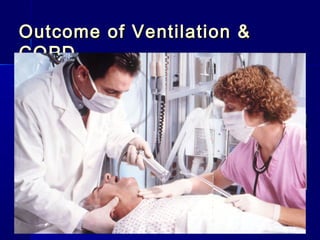
 166 patients requiring MV166 patients requiring MV
 Median duration 4.1 daysMedian duration 4.1 days
 9% required > 21 days9% required > 21 days
ventilationventilation
 Hospital mortality 28%Hospital mortality 28%
 9% discharged with9% discharged with
tracheostomytracheostomy ±± MVMV
 60% of MV time spent60% of MV time spent
weaningweaning
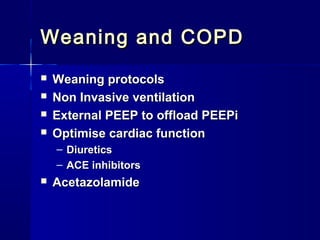
Weaning and COPDWeaning and COPD
 Weaning protocolsWeaning protocols
 Non Invasive ventilationNon Invasive ventilation
 External PEEP to offload PEEPiExternal PEEP to offload PEEPi
 Optimise cardiac functionOptimise cardiac function
– DiureticsDiuretics
– ACE inhibitorsACE inhibitors
 AcetazolamideAcetazolamide
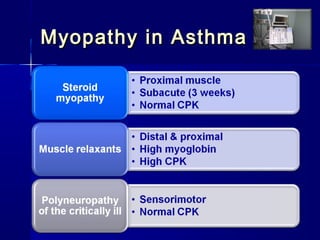
Myopathy in AsthmaMyopathy in Asthma
 Steroid myopathySteroid myopathy
 Muscle relaxantsMuscle relaxants
 Polyneuropathy of the critically illPolyneuropathy of the critically ill
Myopathy in AsthmaMyopathy in Asthma
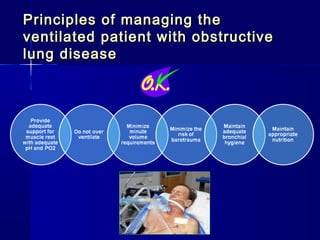
Principles of managing thePrinciples of managing the
ventilated patient with obstructiveventilated patient with obstructive
lung diseaselung disease

Mechanical ventilation in air flow obstruction

  • 1.
    ““‫من‬ ‫فيه‬ ‫ونفخت‬‫سويته‬ ‫فإذا‬‫من‬ ‫فيه‬ ‫ونفخت‬ ‫سويته‬ ‫فإذا‬ ‫ساجدين‬ ‫له‬ ‫فقعوا‬ ‫روحي‬‫ساجدين‬ ‫له‬ ‫فقعوا‬ ‫روحي‬““ ‫ص‬‫ص‬۷۲۷۲
  • 2.
    Mechanical VentilationMechanical Ventilation inSevere Airflowin Severe Airflow ObstructionObstruction Nabil Abouchala, MDNabil Abouchala, MD ConsultantConsultant Pulmonary & Critical Care MedicinePulmonary & Critical Care Medicine abouhani@yahoo.comabouhani@yahoo.com
  • 4.
    Chronic lung diseasesChroniclung diseases with airflow obstructionwith airflow obstruction
  • 5.
    Chronic lung diseasesChroniclung diseases with airflow obstructionwith airflow obstruction
  • 6.
  • 7.
    Potentially fatal asthmaPotentiallyfatal asthma 5000 deaths/yr in US5000 deaths/yr in US  Two variants:Two variants: – progressive worsening 1-3 daysprogressive worsening 1-3 days – ““sudden death”sudden death”  Risk factorsRisk factors – History of near fatal asthma/intubationsHistory of near fatal asthma/intubations – Frequent hospitals/EDs (> 2/year)Frequent hospitals/EDs (> 2/year) – Co-morbidities (CV, COPD. Psych, drug abuse)Co-morbidities (CV, COPD. Psych, drug abuse) – Frequent meds (>2 puffers/month)Frequent meds (>2 puffers/month) – Poor socioeconomic statusPoor socioeconomic status
  • 8.
  • 9.
  • 10.
    Which Patients withCOPDWhich Patients with COPD benefit from NIV ?benefit from NIV ?
  • 11.
    Which Patients withCOPD benefitWhich Patients with COPD benefit from NIV ?from NIV ? Hospital MortalityHospital Mortality 12% 2% NNT 8
  • 12.
    Which Patients withCOPD benefitWhich Patients with COPD benefit from NIV ?from NIV ? Hospital MortalityHospital Mortality 12% 2% NNT 8
  • 13.
    Which Patients withCOPD benefitWhich Patients with COPD benefit from NIV ?from NIV ? Hospital MortalityHospital Mortality NNT 8
  • 14.
    Target Treatment forMaximumTarget Treatment for Maximum Benefit of NIV in COPDBenefit of NIV in COPD ExacerbationsExacerbations Likely to improve Severity Likely to Fail NIV Target group for NIV Potential Benefit Less severe Higher pH > 7.30 Very severe COPD exacerbati Severe hypercapnia (PCO2 > 90) Severe acidemia pH < 7.10
  • 15.
  • 16.
    Case presentation A 68-year-oldman with COPD is brought to the emergency room in severe respiratory distress. The man weighs 65 kg (143 lb). Arterial blood gases document severe respiratory acidosis (PaCO2 is 104 mm Hg; pH is 7.10). After providing tracheal intubation and sedation, you order positive pressure ventilation in the assist control (AC) mode. The most appropriate ventilatory setting at this point: RR TV Peak inspiratory (mL) flow rate (L/min) _ A. 28 600 40 B. 16 1000 60 C. 24 1000 80 D. 10 500 80 E. 30 400 40
  • 17.
    Tidal ventilation Lung volume VT FRC VT VEE Time VEI I :E 1:1 I: E 1: 6 Air-trapping in Asthma/COPDAir-trapping in Asthma/COPD Patients on MechanicalPatients on Mechanical VentilationVentilation
  • 18.
    Obstructive Airway DiseaseObstructiveAirway Disease  Beware of auto-PEEP!Beware of auto-PEEP!
  • 19.
    Detrimental effects ofautoPEEPDetrimental effects of autoPEEP Trigger with acute exacerbation Tachypnea (decreased I:E ratio) Increased airway resistance Increased work of breathing Increased work of breathing HyperinflationHyperinflation autoPEEPautoPEEP Decreased effectiveness of inspiratory muscles Increased oxygen cost of breathing Increased oxygen cost of breathing Respiratory muscle fatigue Respiratory muscle fatigue
  • 21.
    Excessive Inspiratory TimeExcessiveInspiratory Time Inspiration Expiration NormalNormal PatientPatient Time (sec) Flow(L/min) Air Trapping Auto-PEEP } Increase WOB and “Fighting” of the ventilator
  • 22.
    Case presentation A 35-yr-oldmale is admitted with severe bronchial asthma requiring ventilatory support. He is fully sedated and paralyzed, on assist-control mechanical ventilation with a set rate of 15 breaths/min; tidal volume of 1000 mL, and an inspiratory flow rate of 60 L/min, which gives an inspiratory- expiratory (I:E) ratio of 1:3. He is not on any PEEP, and an end-expiratory hold maneuver reveals an auto PEEP of 15 cm H2O. Which one of the following options is most effective in minimizing the auto-PEEP? A. Decreasing the RR 12 /min, giving an I:E ratio of 1:4 B. Increasing the flow to 120 L/min, giving an I:E ratio of 1:7 C. Decreasing the tidal volume to 900 mL D. Adding an external PEEP of 5 cm H2O
  • 23.
    Auto-PEEPAuto-PEEP 15 2 0 AA 1515 15 BB Measurement of auto-PEEP by expiratory occlusion
  • 24.
  • 25.
    Pressure or VolumePressureor Volume Mode?Mode? VolumeVolume  Predictable TVPredictable TV  Peak-Plat gradientPeak-Plat gradient  Monitor PlatMonitor Plat  Better acidosisBetter acidosis controlcontrol PressurePressure  Minimise over-Minimise over- distensiondistension  Monitor TidalMonitor Tidal volumevolume  Excess volumes asExcess volumes as airway resistanceairway resistance improvesimproves
  • 26.
    Initial Ventilator SettingsInitialVentilator Settings  Inspiratory time 0.8 – 1.2 secsInspiratory time 0.8 – 1.2 secs  RR 10-12RR 10-12  TV 6-8 ml/KgTV 6-8 ml/Kg  Pplat < 30 cm H2OPplat < 30 cm H2O  PEEP ??PEEP ??
  • 27.
  • 28.
  • 29.
    Reducing HyperinflationReducing Hyperinflation Reduce rateReduce rate  Reduce tidal volumeReduce tidal volume  Increase expiratory timeIncrease expiratory time – Increase inspiratory flow rateIncrease inspiratory flow rate – Increased Peak Airway PressureIncreased Peak Airway Pressure  Monitor (Pplat)Monitor (Pplat)  Tolerate increased CO2Tolerate increased CO2 (minimise dead space)(minimise dead space) I : E 1: 6 I : E 1: 2
  • 30.
    Hypotension after initiationofHypotension after initiation of Mechanical VentilationMechanical Ventilation  Conversion to positiveConversion to positive intrathoracic pressureintrathoracic pressure – Decreased venous return,Decreased venous return, cardiac outputcardiac output – Exacerbated by hypovolemiaExacerbated by hypovolemia  Auto-PEEP increasesAuto-PEEP increases intrathoracic pressureintrathoracic pressure
  • 31.
  • 32.
  • 33.
    External PEEPExternal PEEP Offload effects of PEEPiOffload effects of PEEPi – Waterfall theory PEEPi not additive until aboveWaterfall theory PEEPi not additive until above critical closing pressure of airwaycritical closing pressure of airway  Reduce inspiratory muscle loadReduce inspiratory muscle load  Improve ventilator triggeringImprove ventilator triggering  Excess level will increase hyperinflationExcess level will increase hyperinflation  80% of PEEPi can be matched without80% of PEEPi can be matched without increase PEEP totincrease PEEP tot  ?? reduce hyperinflation by improving?? reduce hyperinflation by improving expirationexpiration
  • 34.
    Titrating PEEP toPEEPiTitrating PEEP to PEEPi  ↑↑ until no missed trigger effortsuntil no missed trigger efforts  Minimise inspiratory effortMinimise inspiratory effort – ClinicallyClinically – Oesophageal pressure/CVPOesophageal pressure/CVP  Until increase in hyperinflationUntil increase in hyperinflation – Pplat on volume modesPplat on volume modes – Until TV reduces on Pressure controlUntil TV reduces on Pressure control
  • 35.
    Titrating PEEP toPEEPiTitrating PEEP to PEEPi
  • 37.
  • 38.
  • 39.
    Administration ofAdministration of BronchodilatorsBronchodilators Nebuliser or MDI?Nebuliser or MDI?  Lung deposition of radiolabelled drug*Lung deposition of radiolabelled drug* – MDI 5.6% v Nebuliser 1.2%MDI 5.6% v Nebuliser 1.2%  Urinary excretion**Urinary excretion** – MDI with spacer 38%MDI with spacer 38% – MDI in line 9%MDI in line 9% – Nebuliser 16%Nebuliser 16%  4-10 puffs MDI effective in reducing R4-10 puffs MDI effective in reducing RAWAW
  • 40.
    Administration ofAdministration of BronchodilatorsBronchodilators Nebuliser or MDI?Nebuliser or MDI?  Lung deposition of radiolabelled drug*Lung deposition of radiolabelled drug* – MDI 5.6%MDI 5.6% v Nebuliser 1.2%v Nebuliser 1.2%  Urinary excretion**Urinary excretion** – MDI with spacer 38%MDI with spacer 38% – MDI in line 9%MDI in line 9% – Nebuliser 16%Nebuliser 16%  4-10 puffs4-10 puffs MDI effective in reducing RMDI effective in reducing RAWAW * Chest 1999; 115:1653-1657* Chest 1999; 115:1653-1657 **Am Rev Respir Dis 1990; 141:440–444**Am Rev Respir Dis 1990; 141:440–444
  • 42.
    Outcome of Ventilation&Outcome of Ventilation & COPDCOPD  166 patients requiring MV166 patients requiring MV  Median duration 4.1 daysMedian duration 4.1 days  9% required > 21 days9% required > 21 days ventilationventilation  Hospital mortality 28%Hospital mortality 28%  9% discharged with9% discharged with tracheostomytracheostomy ±± MVMV  60% of MV time spent60% of MV time spent weaningweaning
  • 43.
    Weaning and COPDWeaningand COPD  Weaning protocolsWeaning protocols  Non Invasive ventilationNon Invasive ventilation  External PEEP to offload PEEPiExternal PEEP to offload PEEPi  Optimise cardiac functionOptimise cardiac function – DiureticsDiuretics – ACE inhibitorsACE inhibitors  AcetazolamideAcetazolamide
  • 44.
    Myopathy in AsthmaMyopathyin Asthma  Steroid myopathySteroid myopathy  Muscle relaxantsMuscle relaxants  Polyneuropathy of the critically illPolyneuropathy of the critically ill
  • 45.
  • 46.
    Principles of managingthePrinciples of managing the ventilated patient with obstructiveventilated patient with obstructive lung diseaselung disease

Editor's Notes