Properties of acids and bases
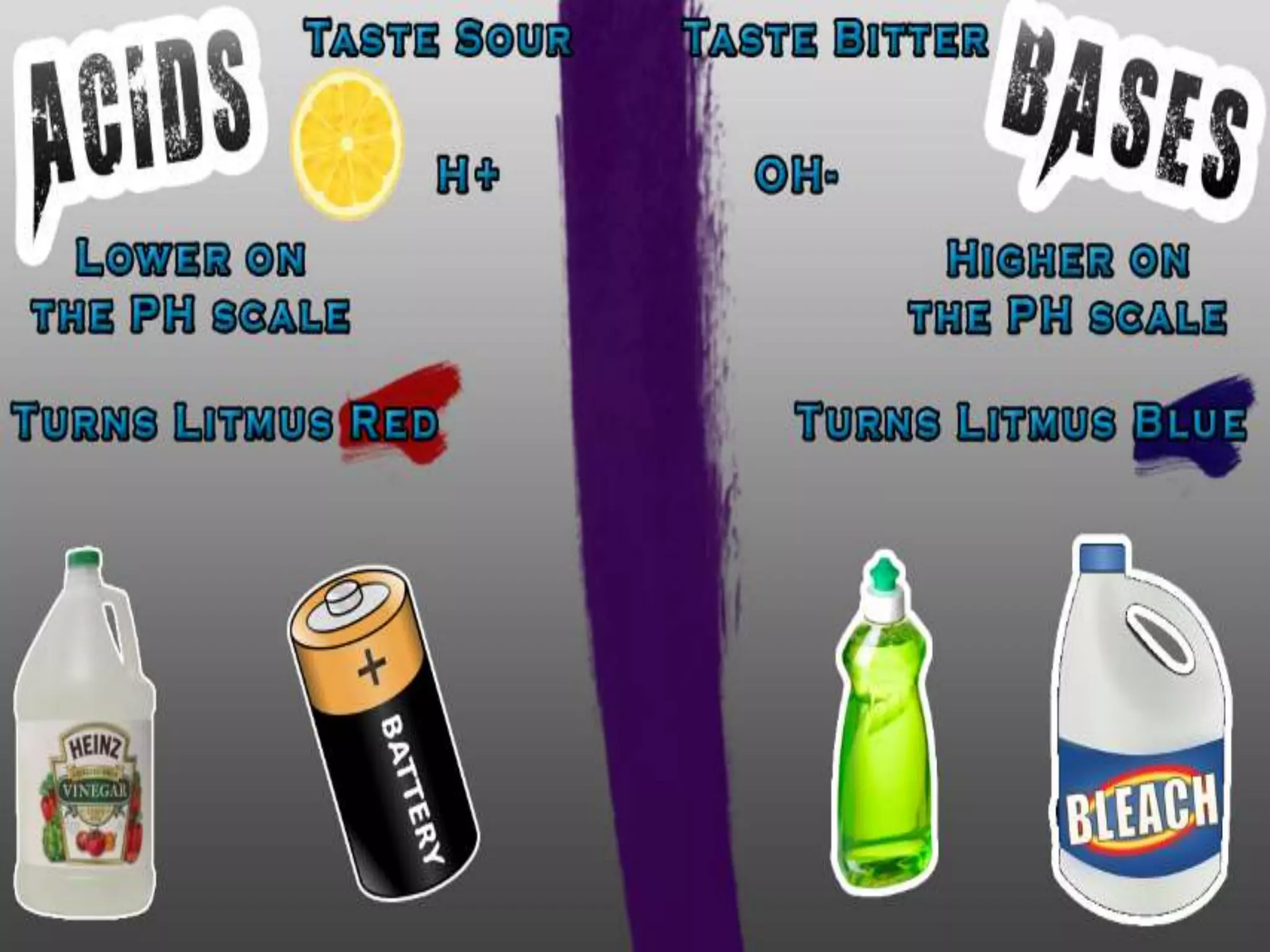
• Acids have a sour taste : e.g vinegar owes its
taste to acetic acid, and lemons and other
citrus fruits contain citric acids.
GENERAL PROPRTIES
Acids:
• Acids cause colour changes in plant dyes
• E.g change the colour of litmus from blue to
red.
• Acid react with certain metals e.g zinc,
magnesium, and iron to produce hydrogen
gas.
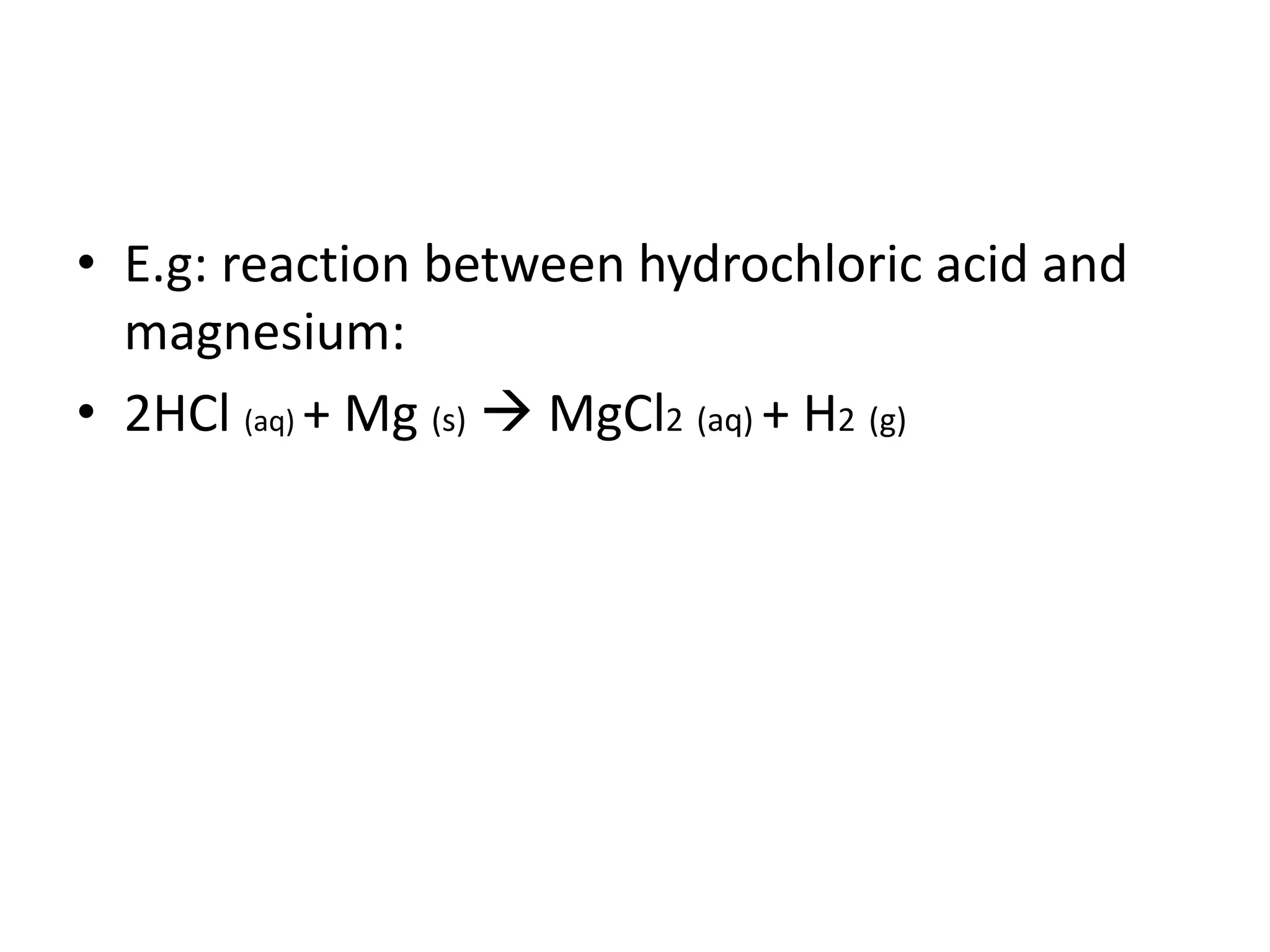
• E.g: reaction between hydrochloric acid and
magnesium:
• 2HCl (aq) + Mg (s)  MgCl2 (aq) + H2 (g)
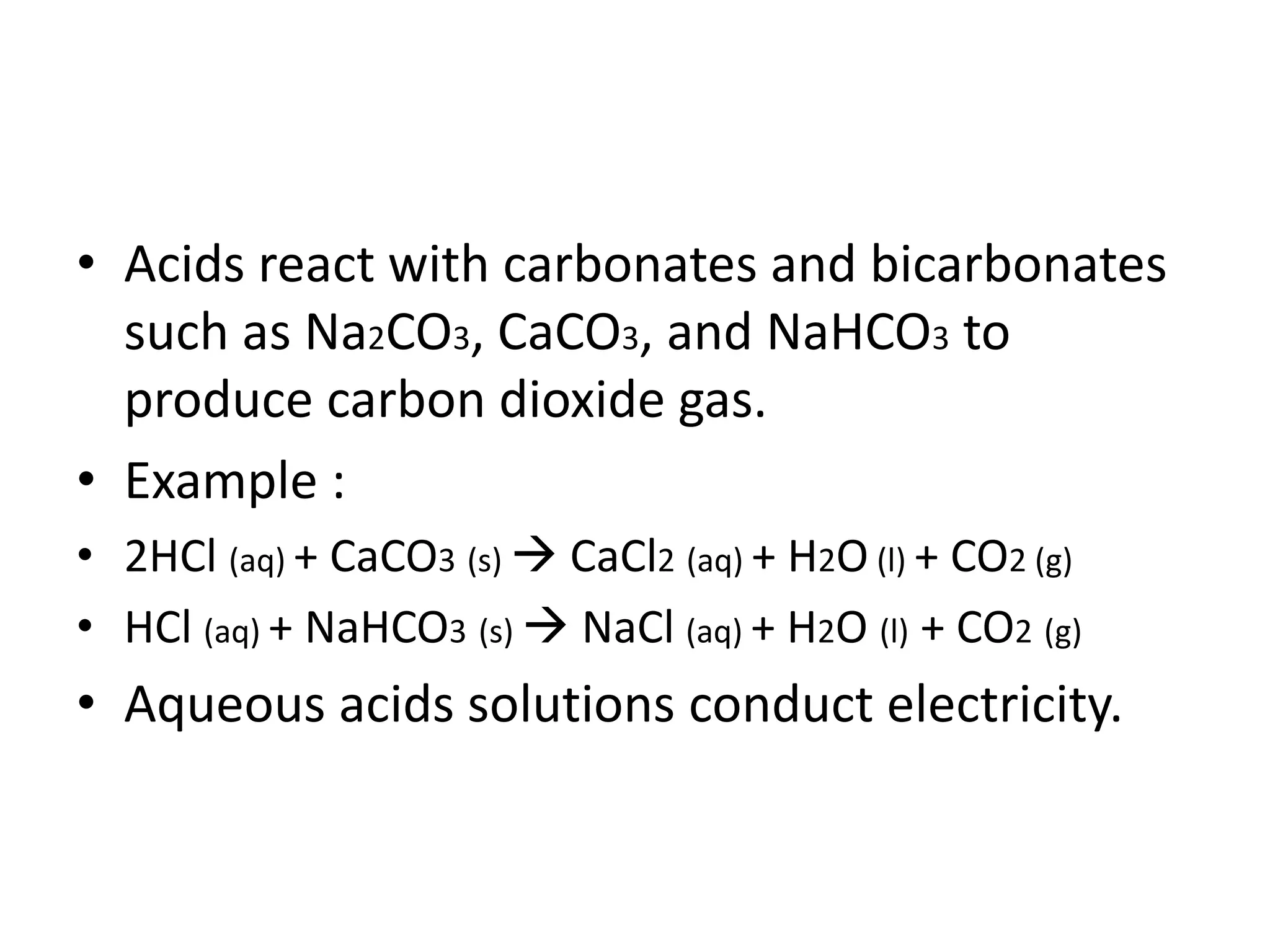
• Acids react with carbonates and bicarbonates
such as Na2CO3, CaCO3, and NaHCO3 to
produce carbon dioxide gas.
• Example :
• 2HCl (aq) + CaCO3 (s)  CaCl2 (aq) + H2O (l) + CO2 (g)
• HCl (aq) + NaHCO3 (s)  NaCl (aq) + H2O (l) + CO2 (g)
• Aqueous acids solutions conduct electricity.
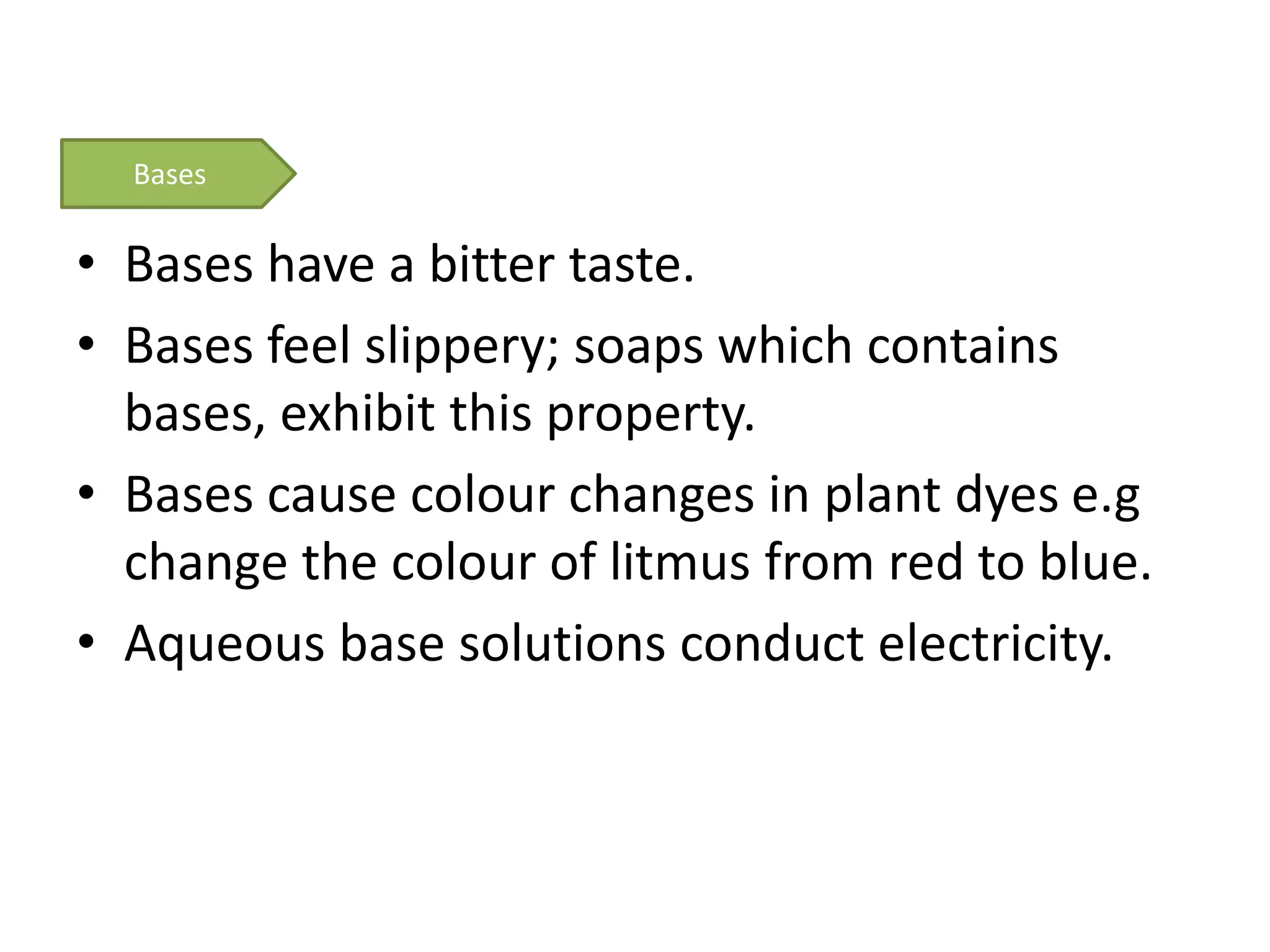
• Bases have a bitter taste.
• Bases feel slippery; soaps which contains
bases, exhibit this property.
• Bases cause colour changes in plant dyes e.g
change the colour of litmus from red to blue.
• Aqueous base solutions conduct electricity.
Bases
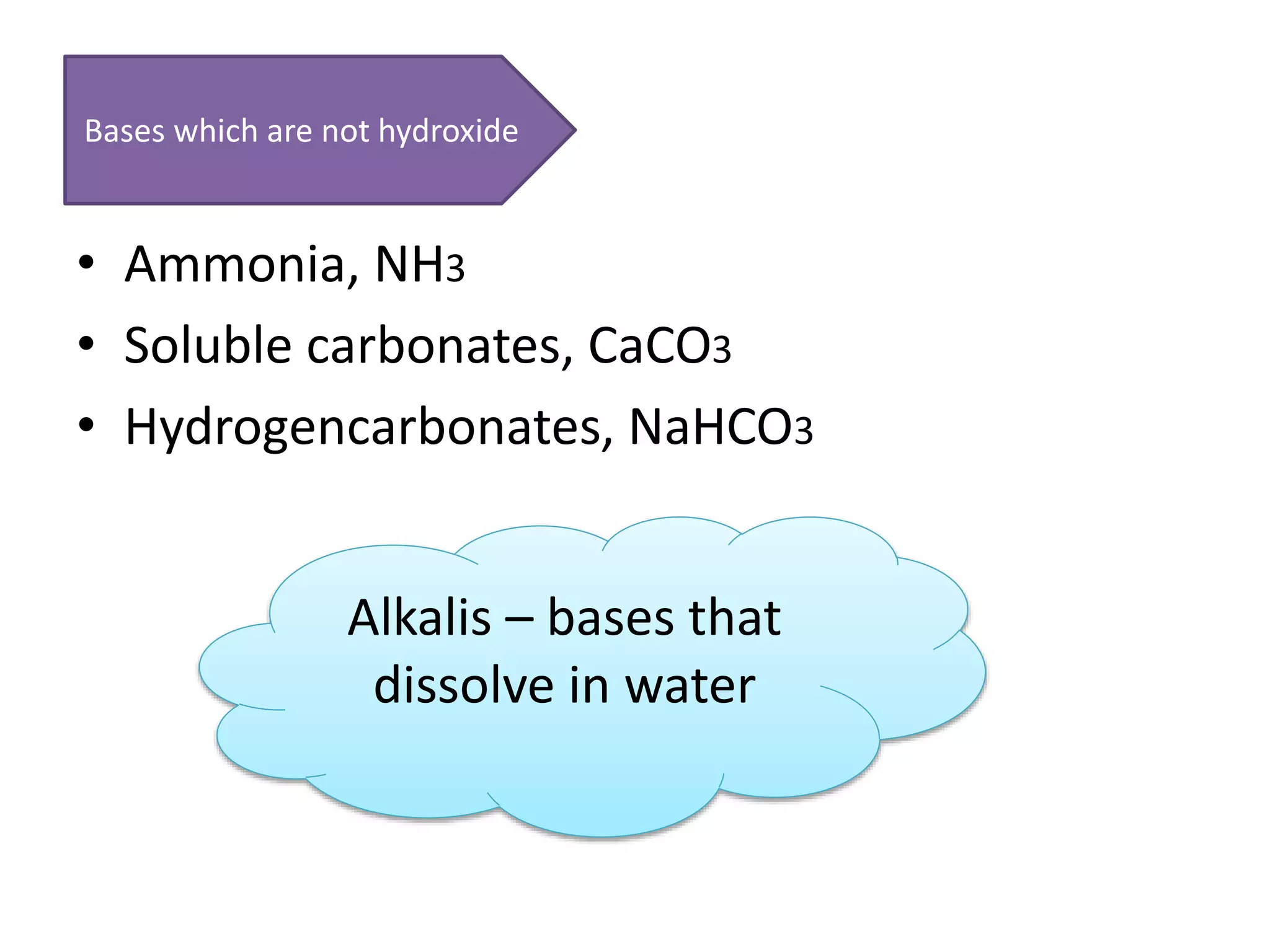
• Ammonia, NH3
• Soluble carbonates, CaCO3
• Hydrogencarbonates, NaHCO3
Bases which are not hydroxide
Alkalis – bases that
dissolve in water
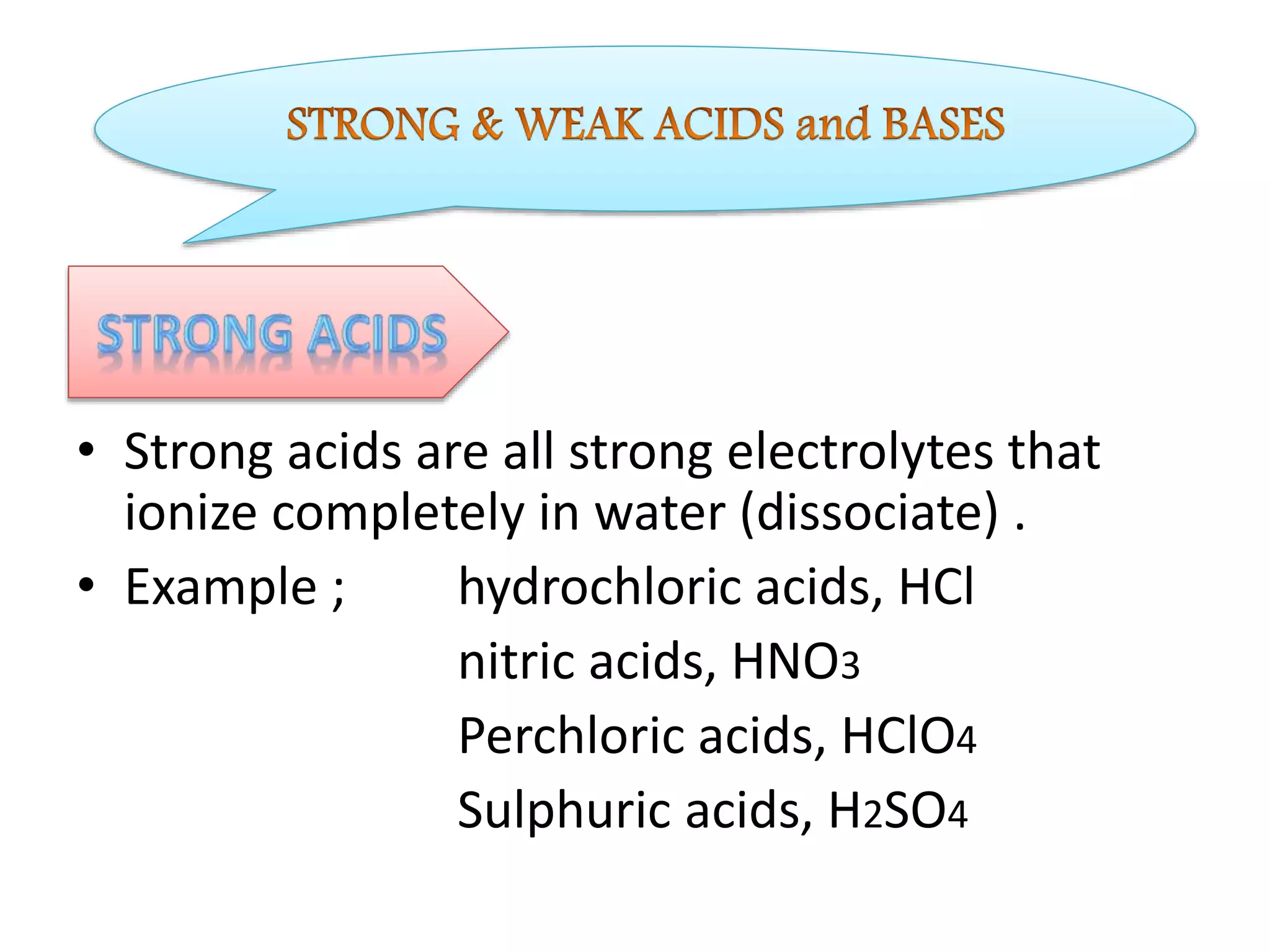
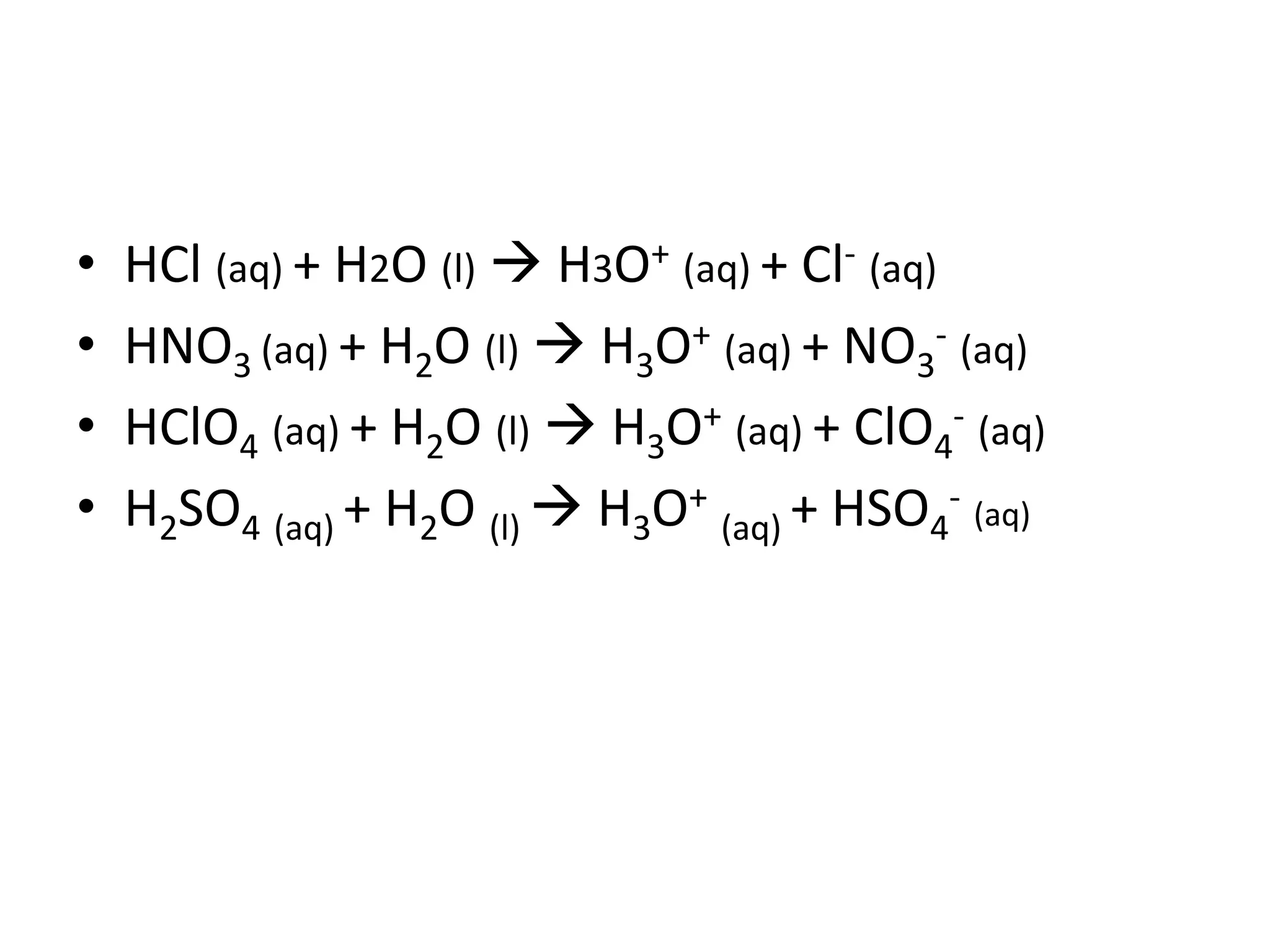
• Strong acids are all strong electrolytes that
ionize completely in water (dissociate) .
• Example ; hydrochloric acids, HCl
nitric acids, HNO3
Perchloric acids, HClO4
Sulphuric acids, H2SO4
• HCl (aq) + H2O (l)  H3O+ (aq) + Cl- (aq)
• HNO3 (aq) + H2O (l)  H3O+ (aq) + NO3
- (aq)
• HClO4 (aq) + H2O (l)  H3O+ (aq) + ClO4
- (aq)
• H2SO4 (aq) + H2O (l)  H3O+
(aq) + HSO4
- (aq)
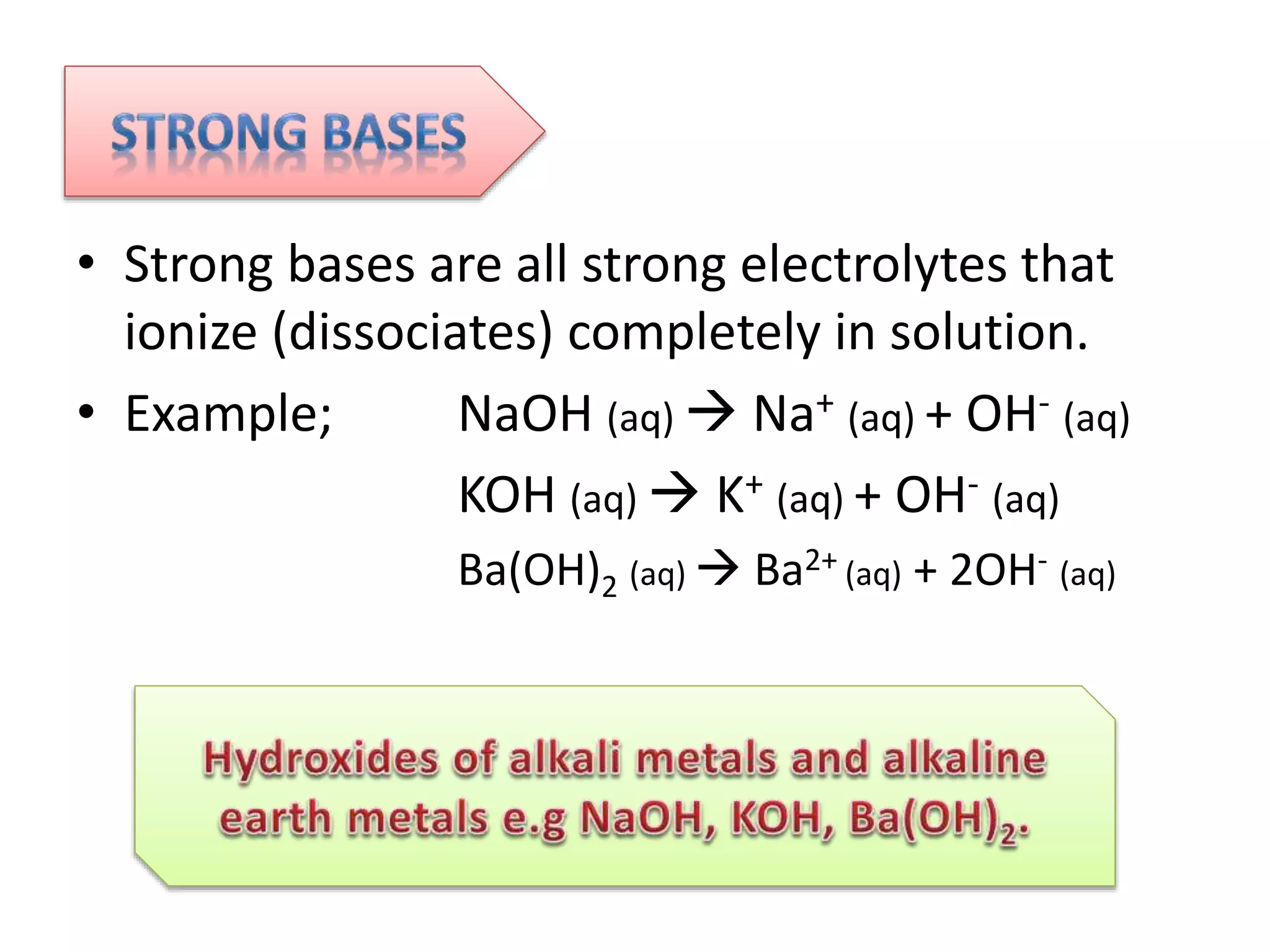
• Strong bases are all strong electrolytes that
ionize (dissociates) completely in solution.
• Example; NaOH (aq)  Na+ (aq) + OH- (aq)
KOH (aq)  K+ (aq) + OH- (aq)
Ba(OH)2 (aq)  Ba2+ (aq) + 2OH- (aq)
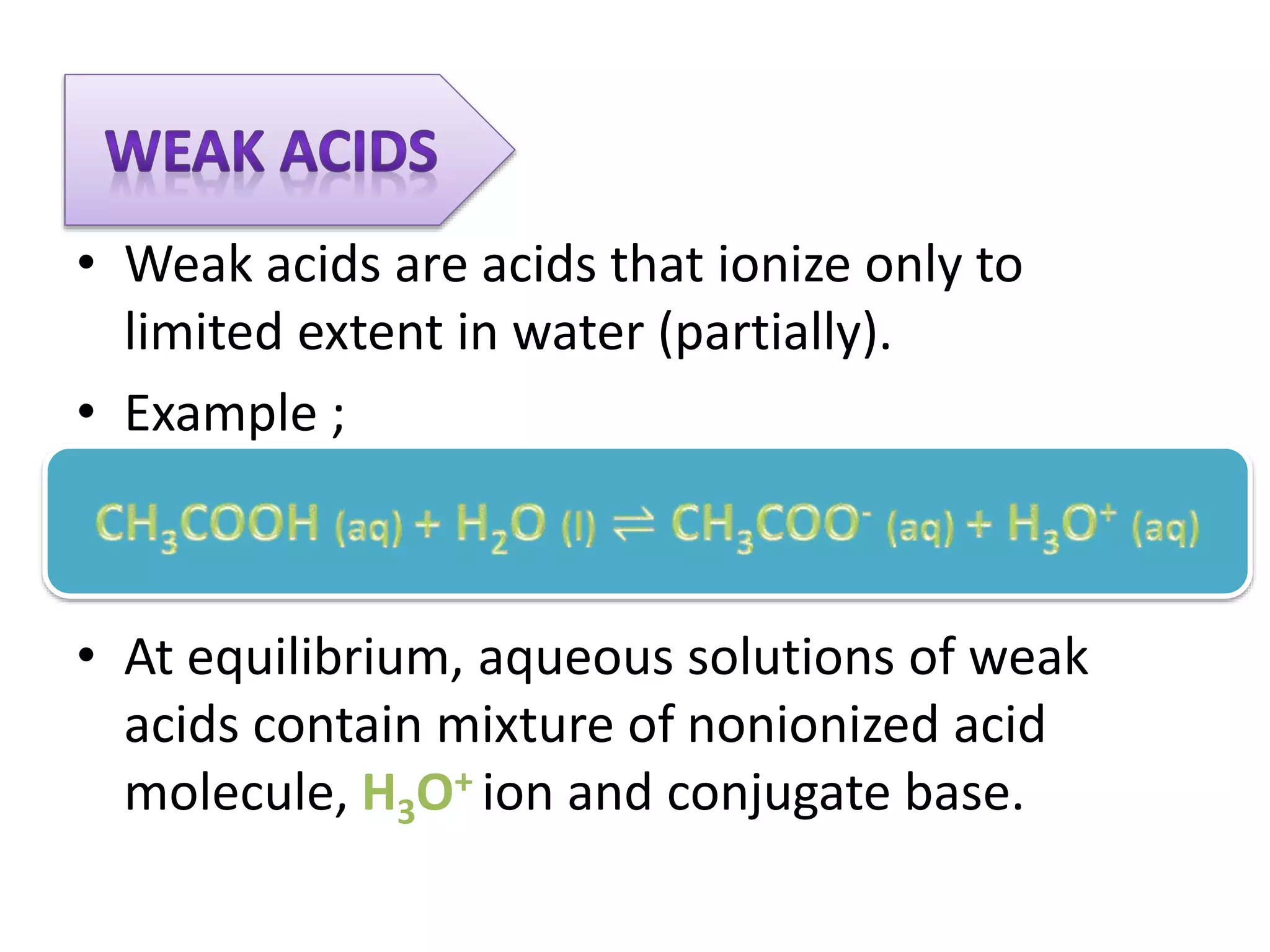
• Weak acids are acids that ionize only to
limited extent in water (partially).
• Example ;
• At equilibrium, aqueous solutions of weak
acids contain mixture of nonionized acid
molecule, H3O+ ion and conjugate base.
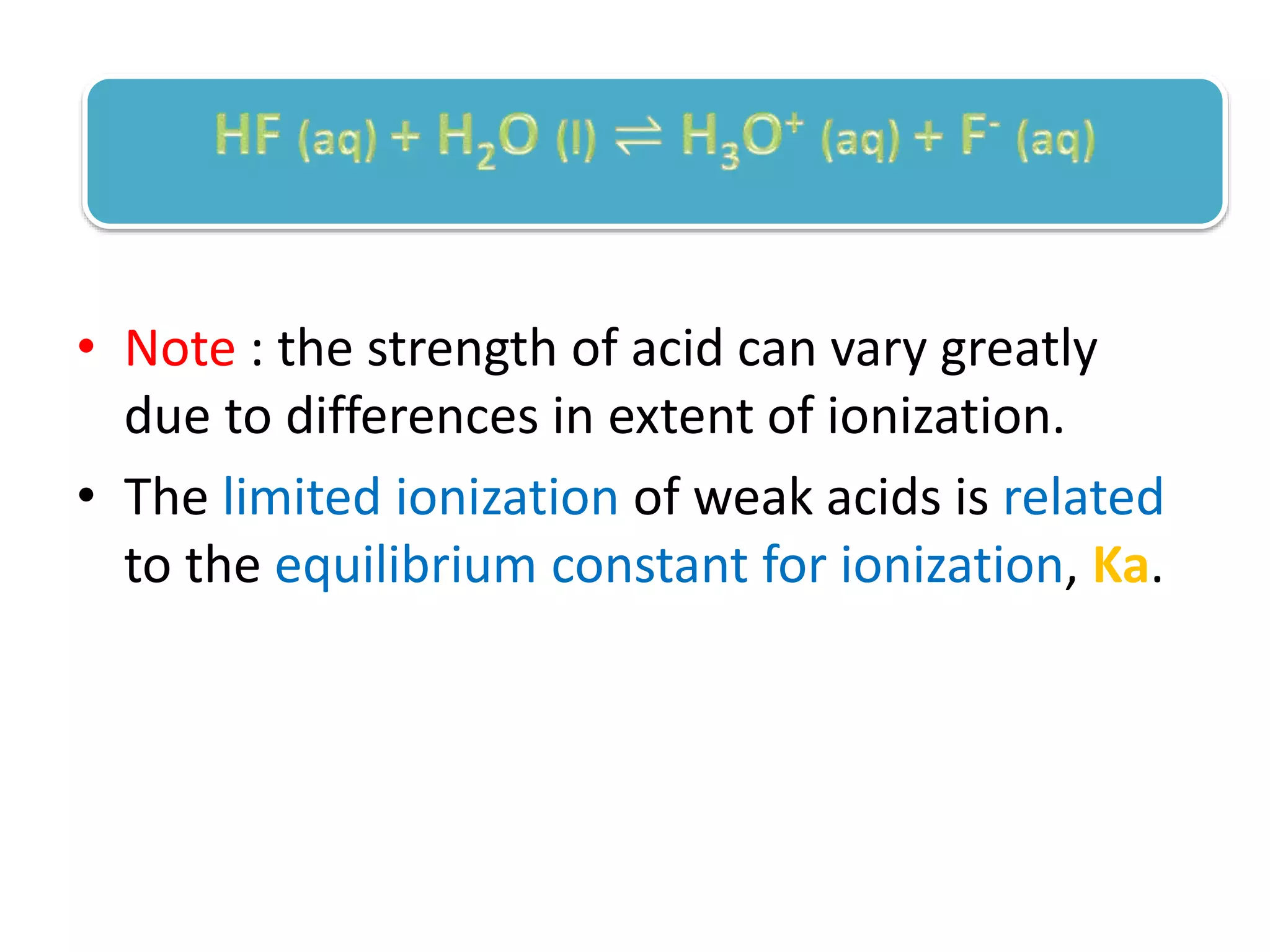
• Note : the strength of acid can vary greatly
due to differences in extent of ionization.
• The limited ionization of weak acids is related
to the equilibrium constant for ionization, Ka.
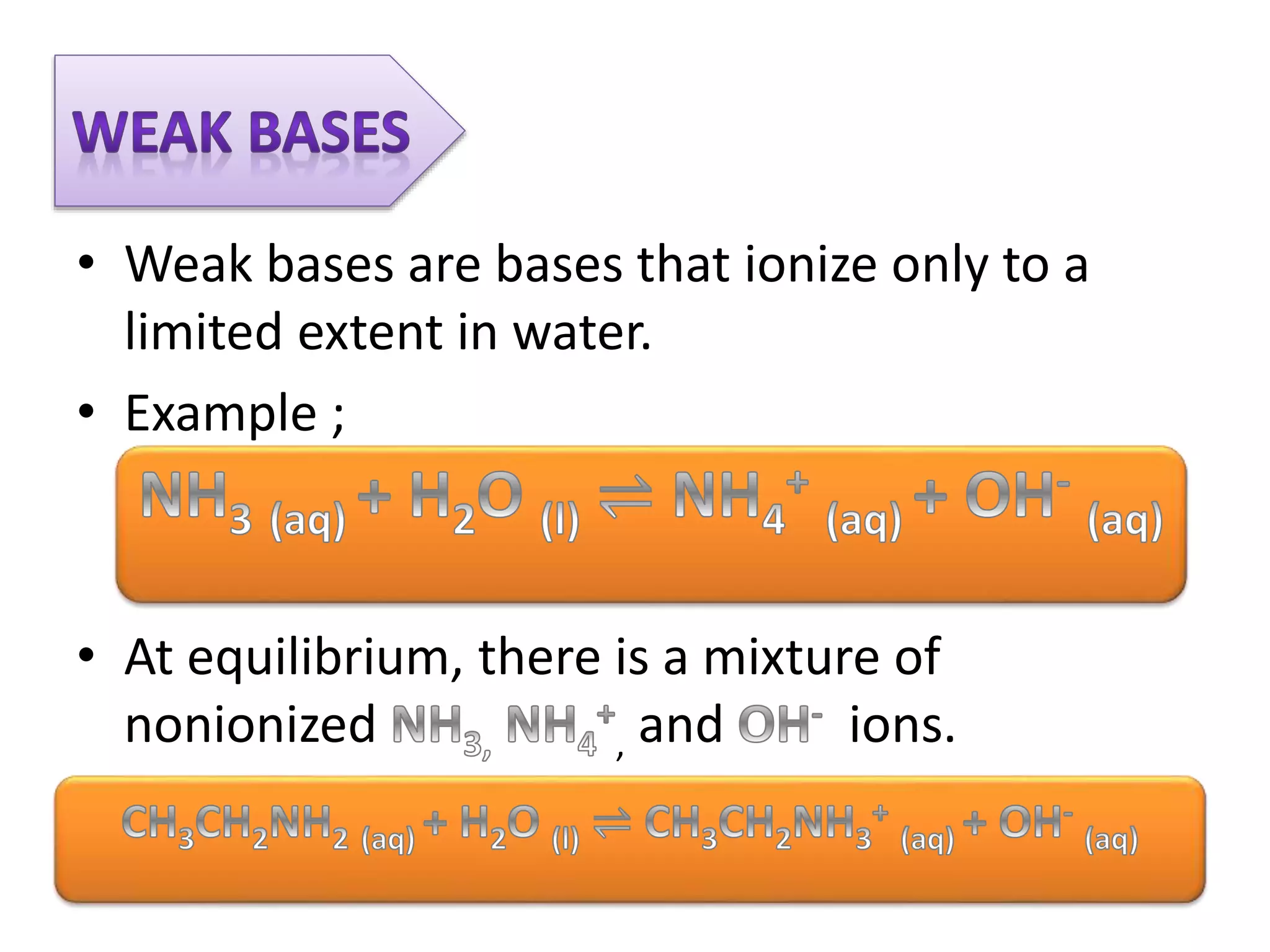
• Weak bases are bases that ionize only to a
limited extent in water.
• Example ;
• At equilibrium, there is a mixture of
nonionized , and ions.
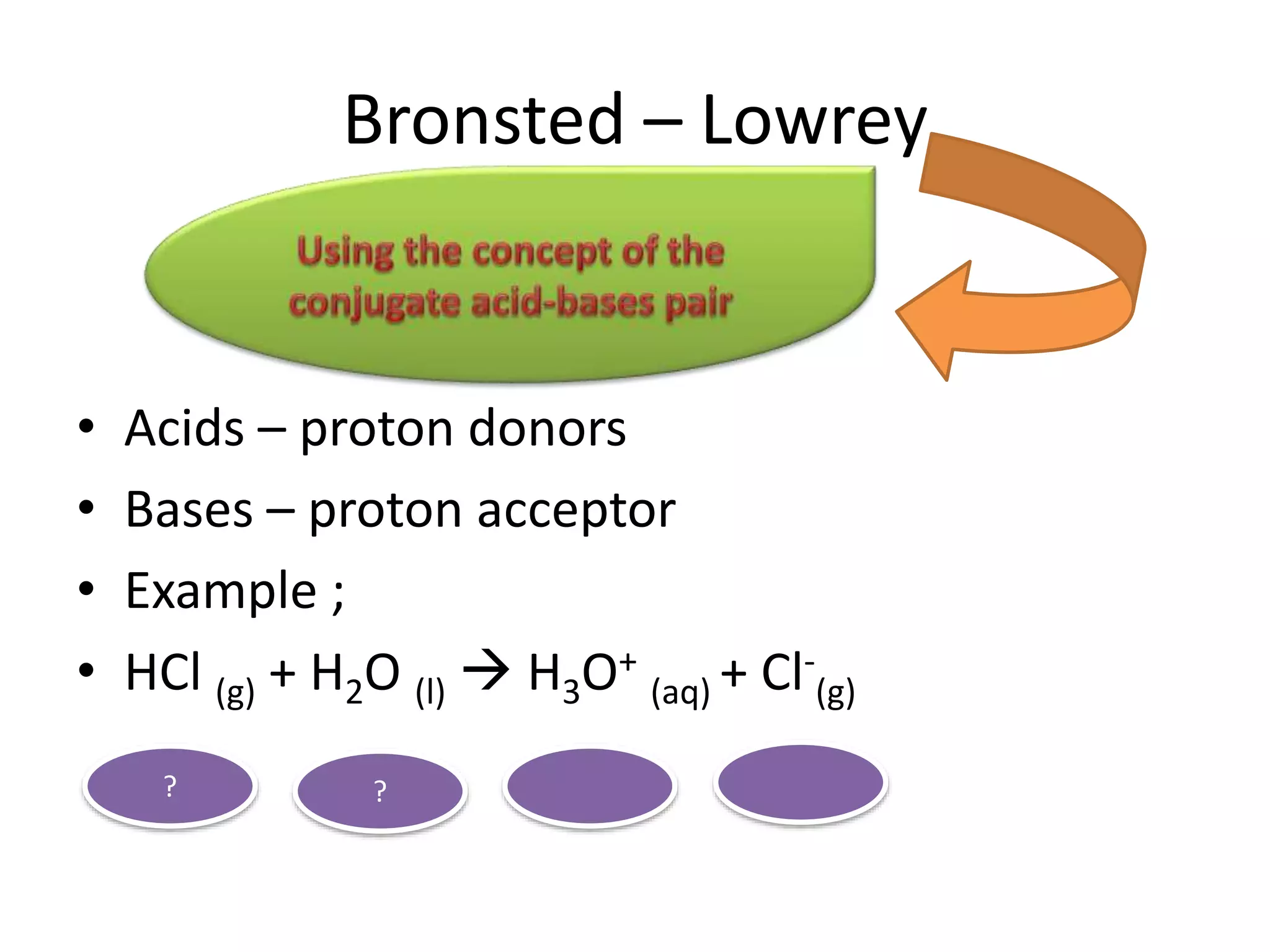
Bronsted – Lowrey
• Acids – proton donors
• Bases – proton acceptor
• Example ;
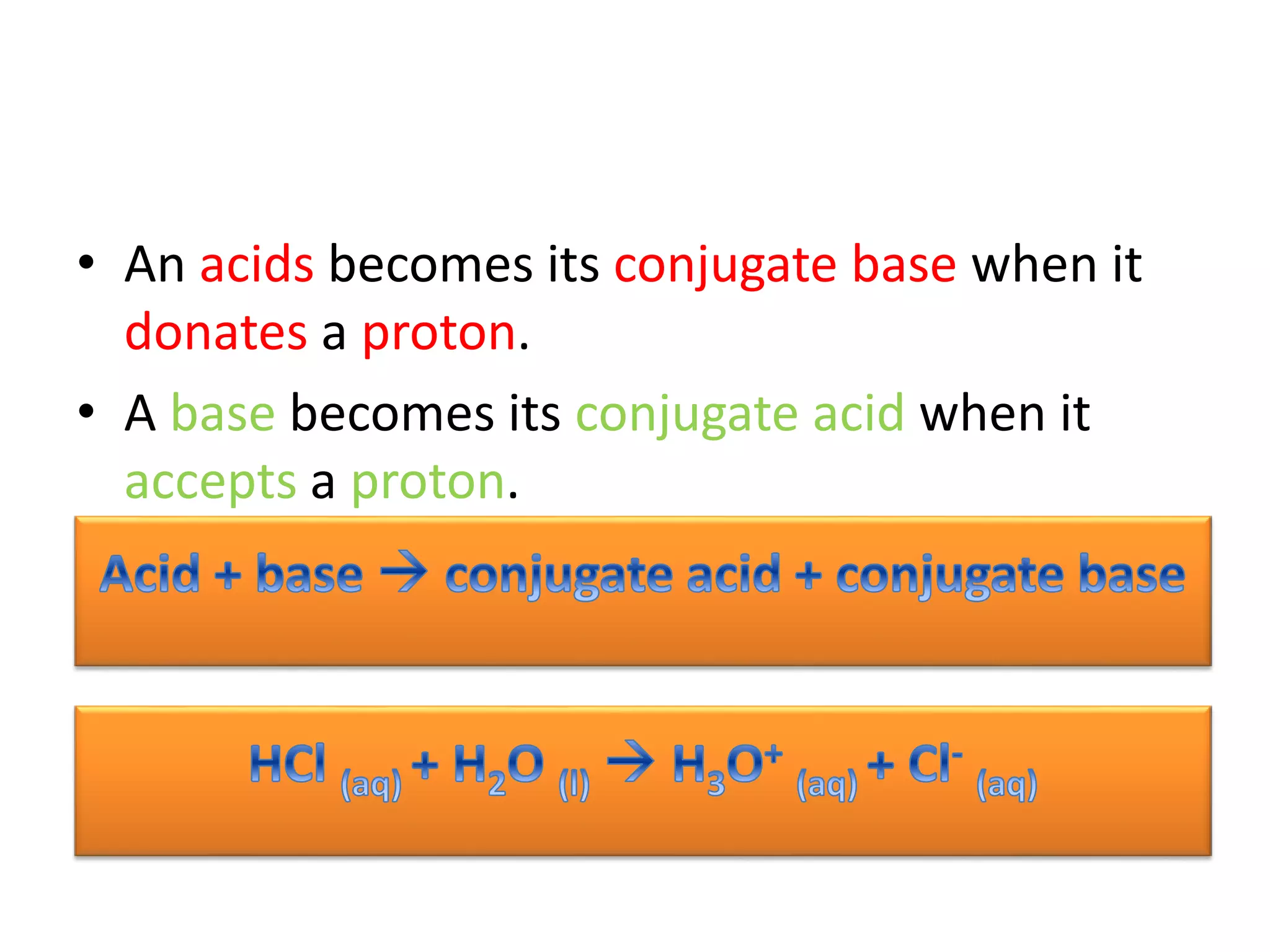
• HCl (g) + H2O (l)  H3O+
(aq) + Cl-
(g)
? ?
• An acids becomes its conjugate base when it
donates a proton.
• A base becomes its conjugate acid when it
accepts a proton.
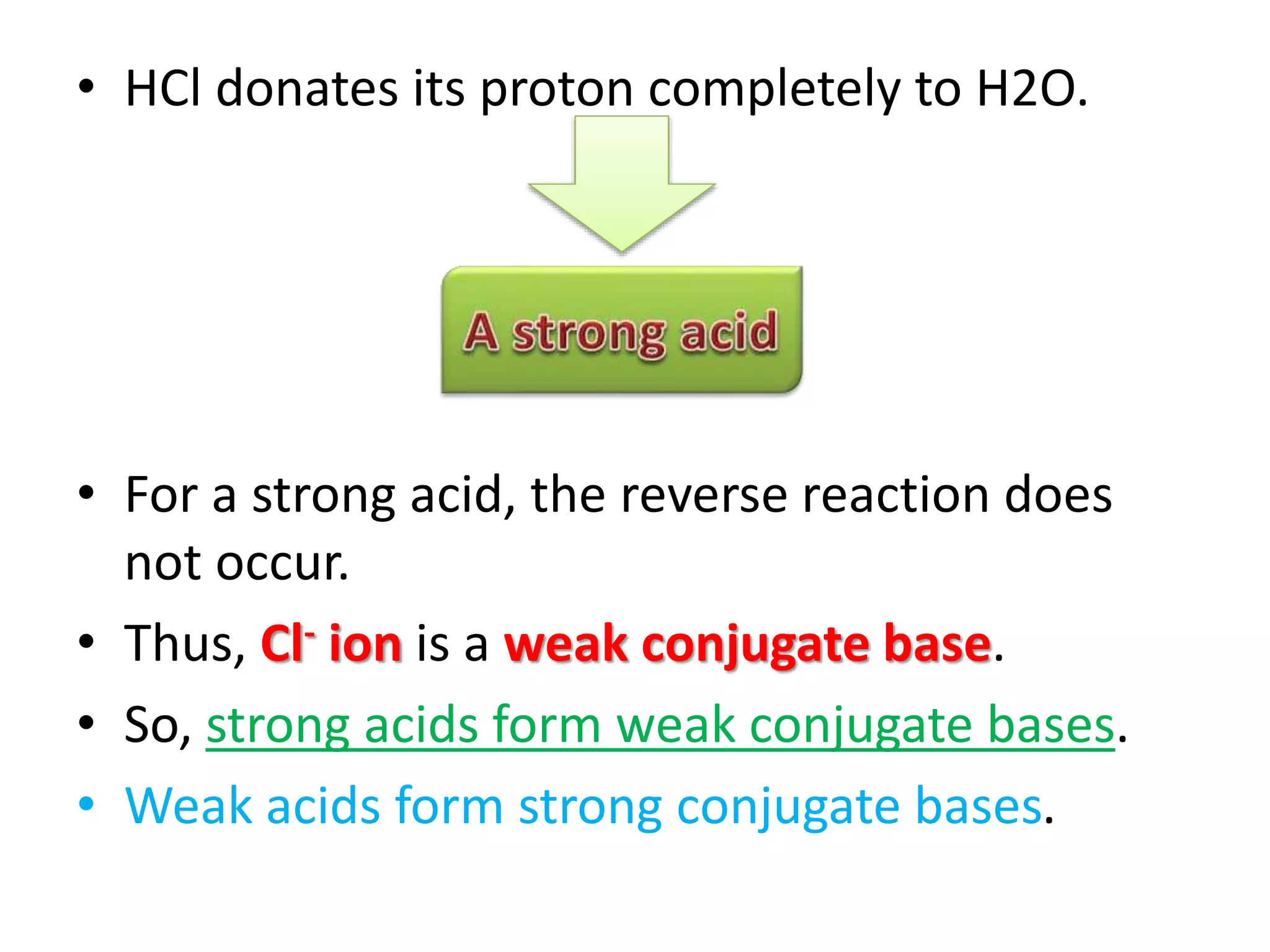
• HCl donates its proton completely to H2O.
• For a strong acid, the reverse reaction does
not occur.
• Thus, Cl- ion is a weak conjugate base.
• So, strong acids form weak conjugate bases.
• Weak acids form strong conjugate bases.
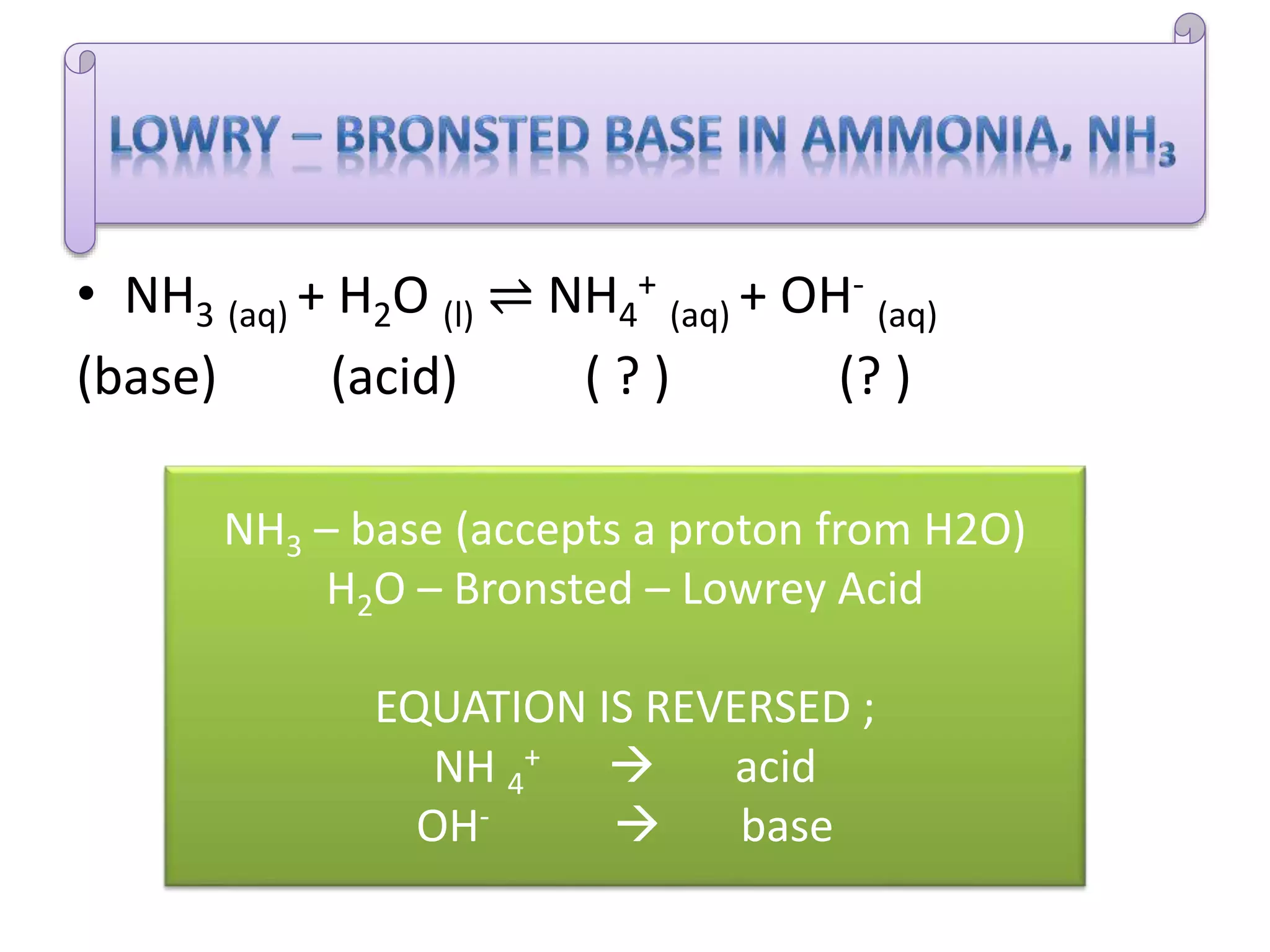
• NH3 (aq) + H2O (l) ⇌ NH4
+
(aq) + OH-
(aq)
(base) (acid) ( ? ) (? )
NH3 – base (accepts a proton from H2O)
H2O – Bronsted – Lowrey Acid
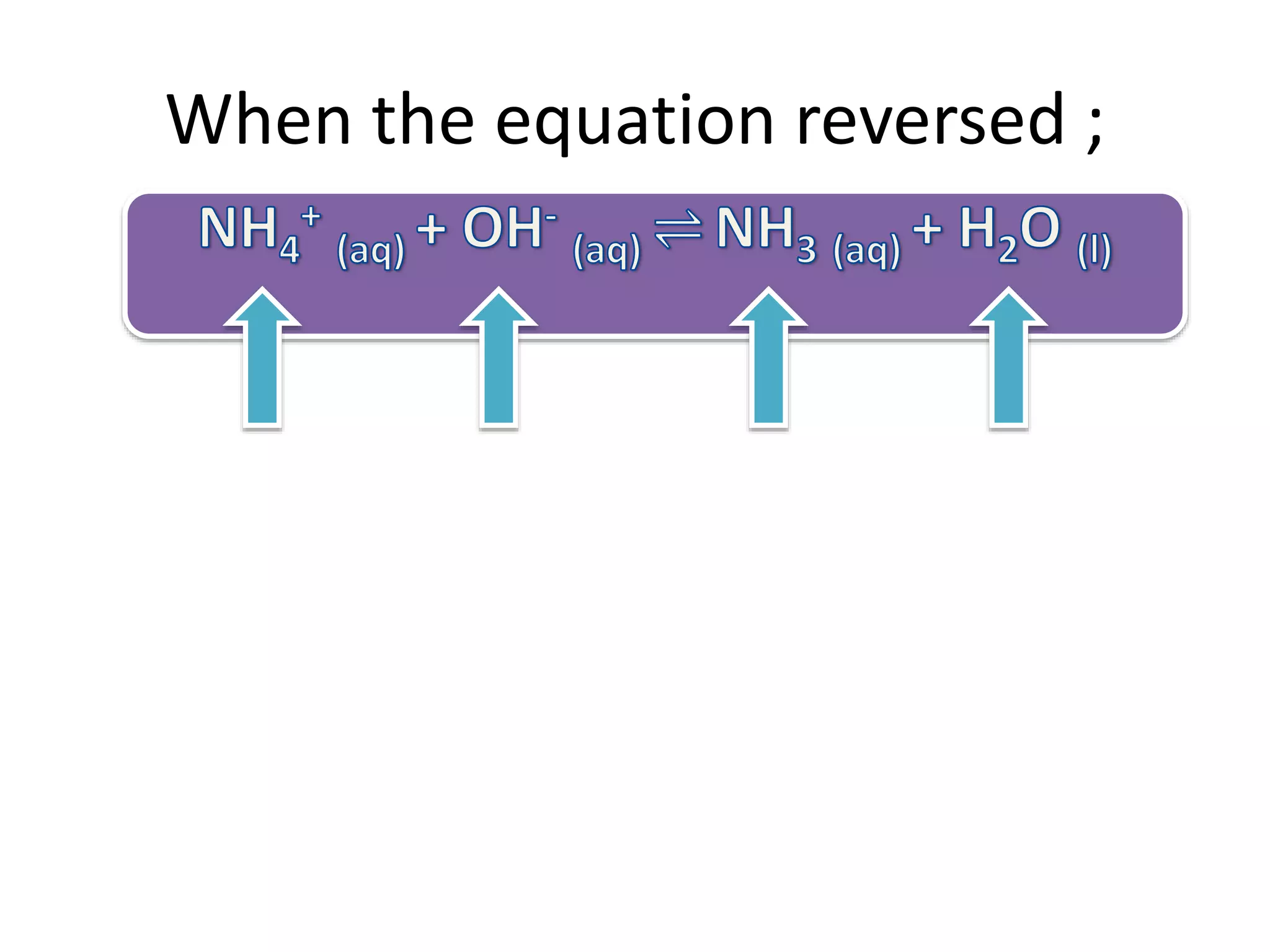
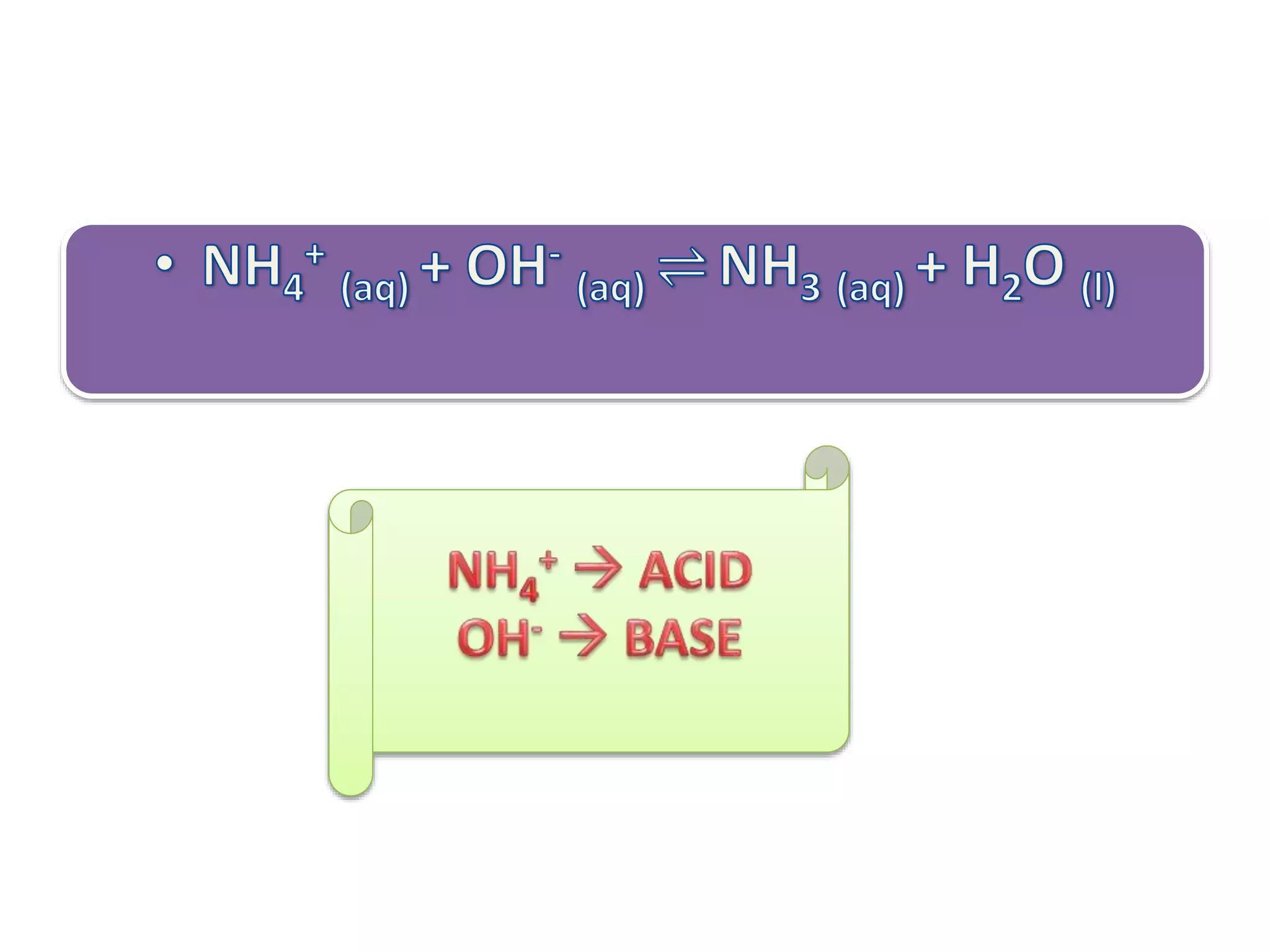
EQUATION IS REVERSED ;
NH 4
+  acid
OH-  base
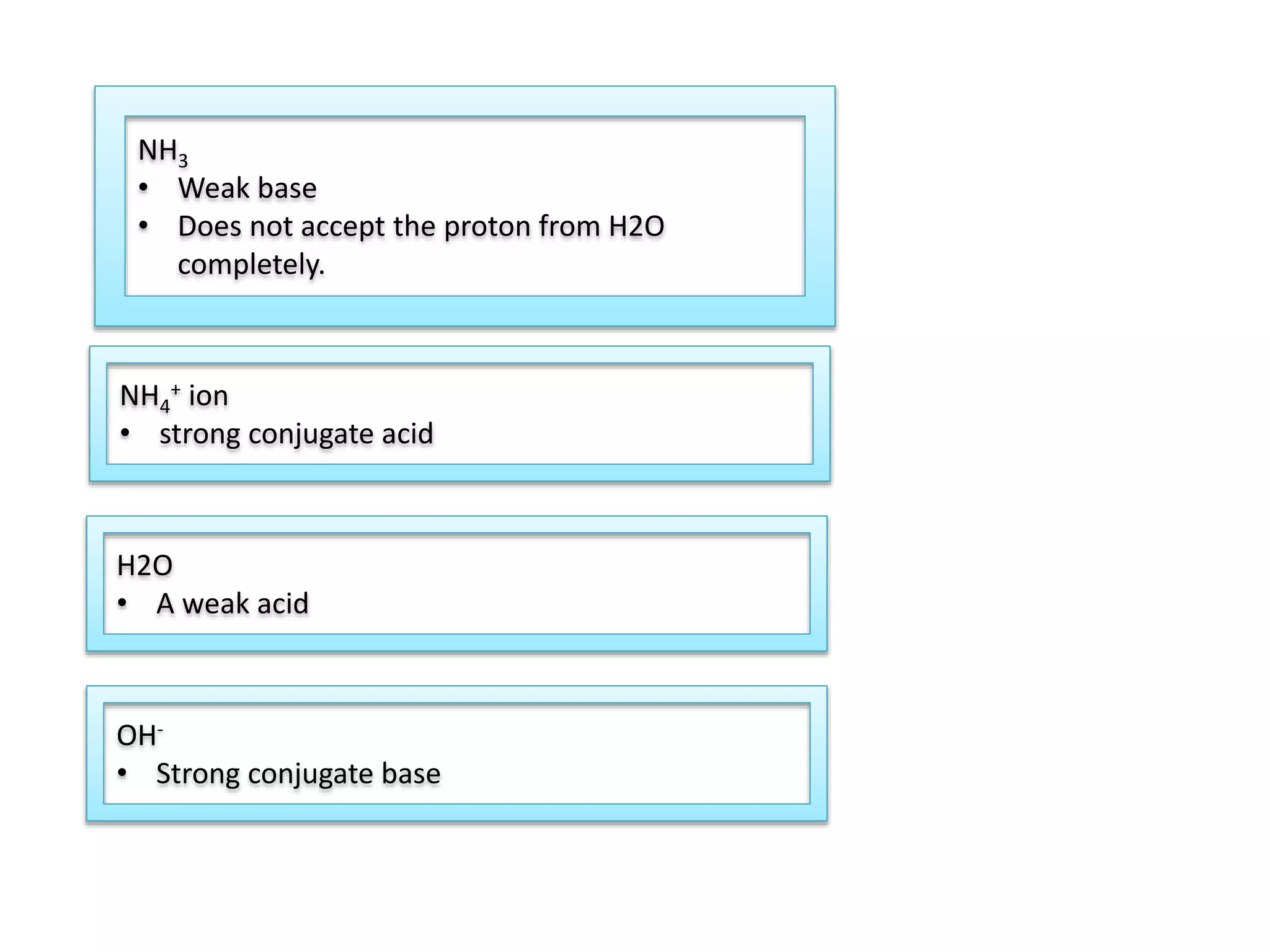
NH3
• Weak base
• Does not accept the proton from H2O
completely.
NH4
+ ion
• strong conjugate acid
H2O
• A weak acid
OH-
• Strong conjugate base
When the equation reversed ;
• The relative strength of an acid and its
conjugate base, and a base and its conjugate
acid.
• Explain why a strong acid or a strong base
dissociates completely in aqueous solution?
• Explain why weak acid or a weak base
dissociates partially in aqueous solution?
• A strong acid completely breaks apart to give
ions in solution (100% dissociation) whereas a
weak acid only slightly dissociates in solution
(perhaps less than 1%).
• A strong acid, when placed in water, will
almost fully ionise/dissociate straight away,
producing H+ (aq) ions from water.
• A weak acid will, however, only partially
dissociate into ions, leaving a high percentage
of unreacted molecules in the solution.
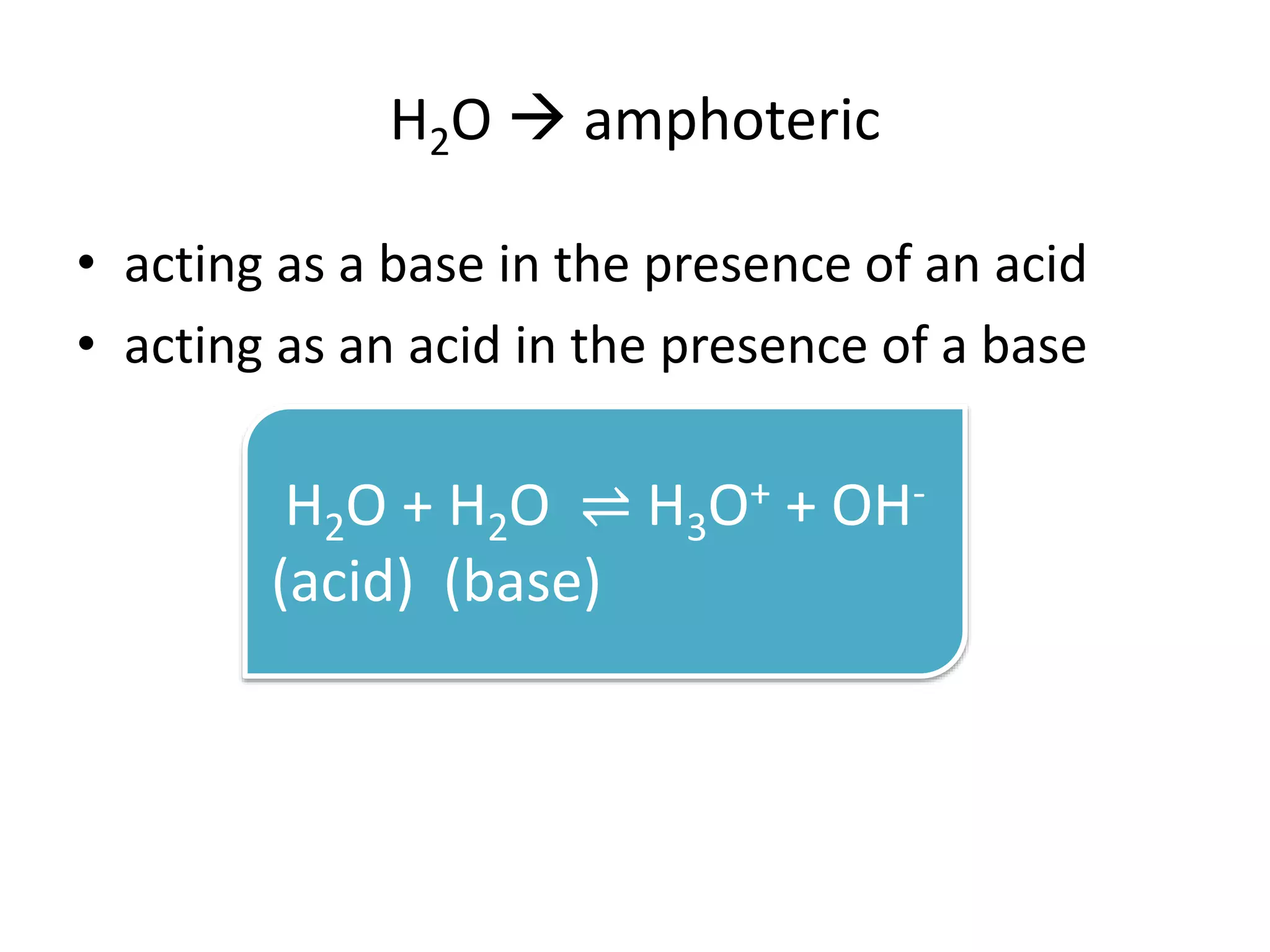
H2O  amphoteric
• acting as a base in the presence of an acid
• acting as an acid in the presence of a base
H2O + H2O ⇌ H3O+ + OH-
(acid) (base)
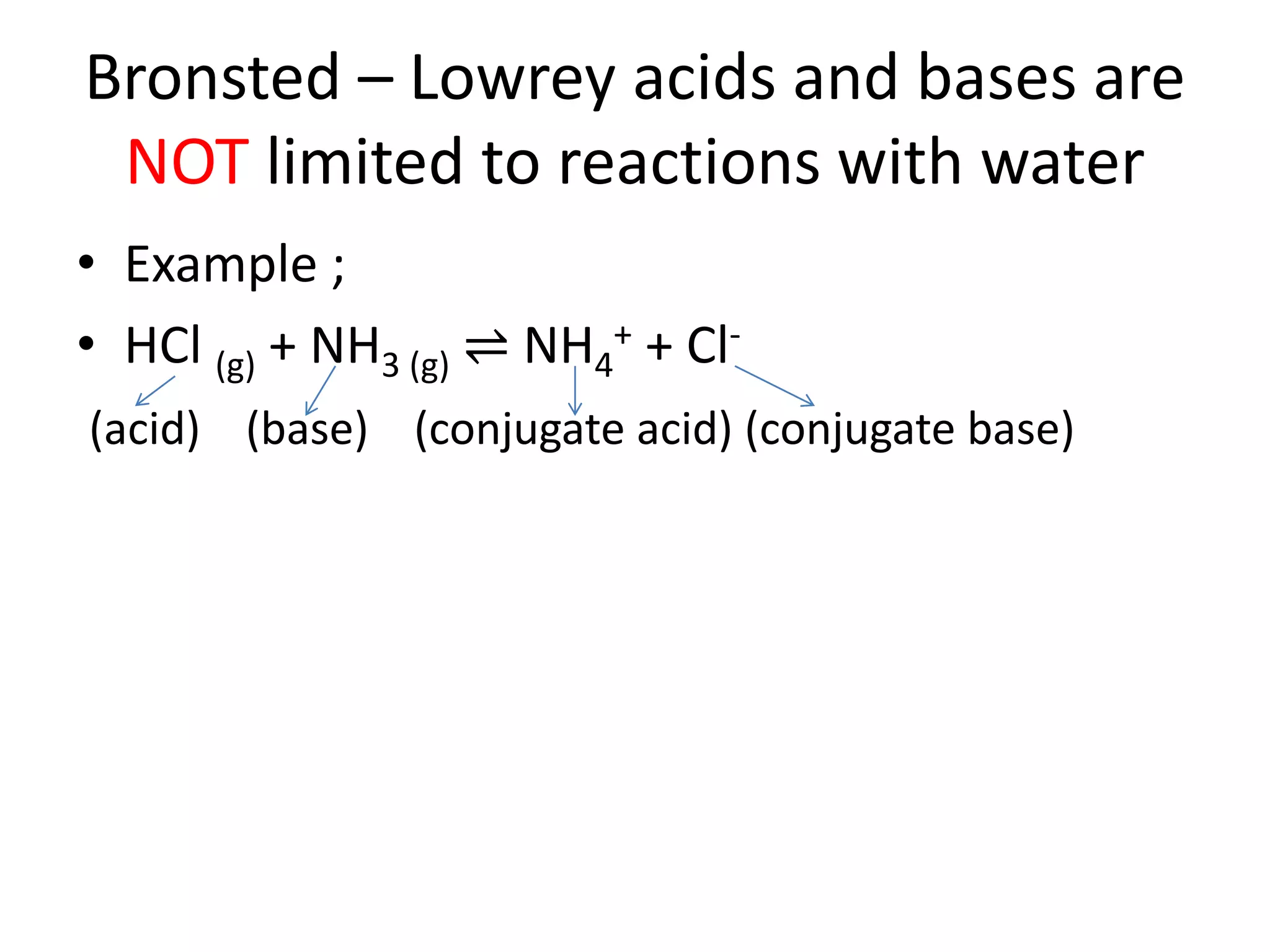
Bronsted – Lowrey acids and bases are
NOT limited to reactions with water
• Example ;
• HCl (g) + NH3 (g) ⇌ NH4
+ + Cl-
(acid) (base) (conjugate acid) (conjugate base)
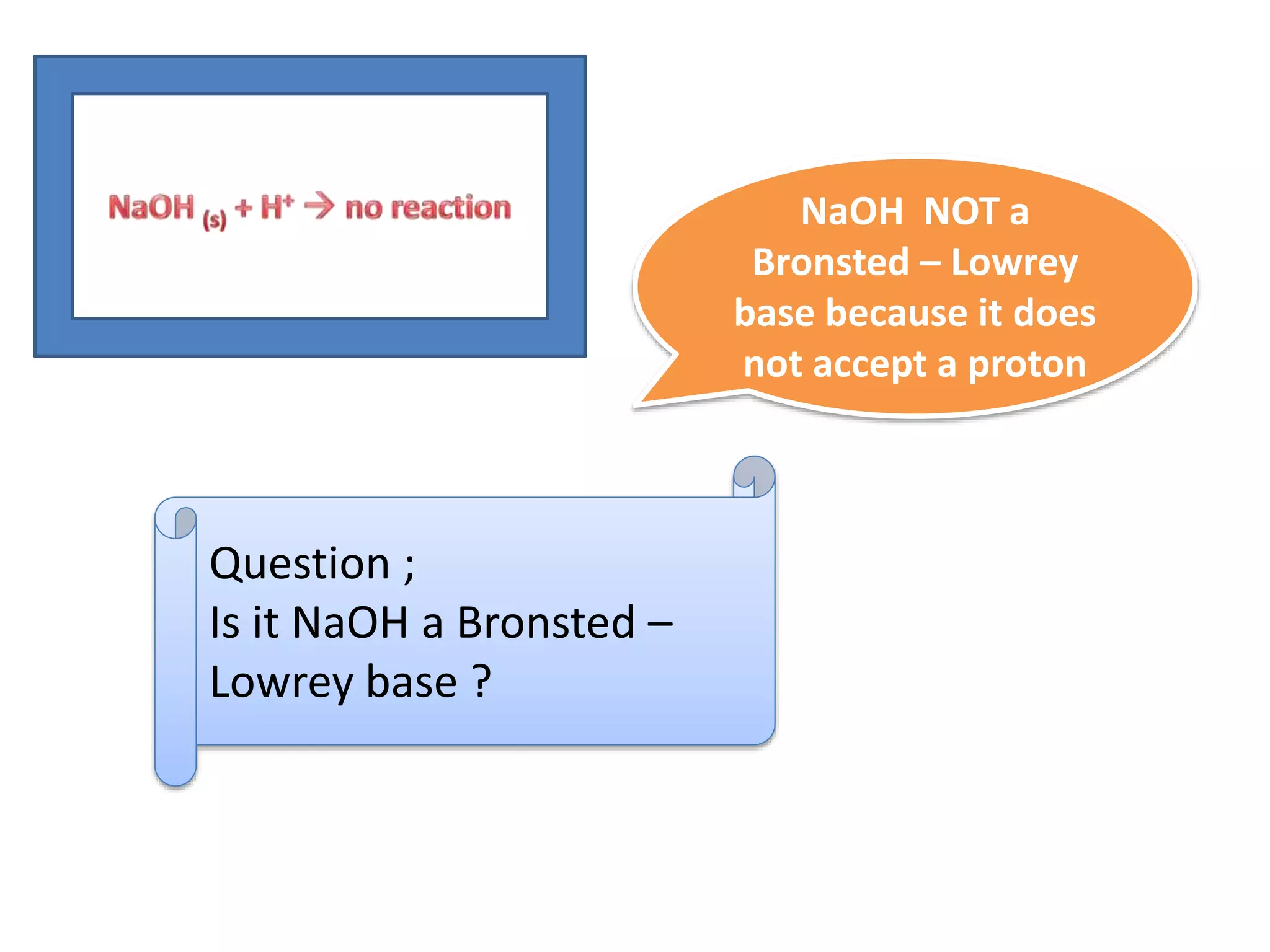
Question ;
Is it NaOH a Bronsted –
Lowrey base ?
NaOH NOT a
Bronsted – Lowrey
base because it does
not accept a proton
• Identify Bronsted – Lowrey acid, Bronsted –
Lowrey base, conjugate acid, or conjugate
base, from each of the following equation.
• H2CO3 + H2O ⇌ HCO3
- + H3O+
• NH4
+ + H2O ⇌ NH3 + H3O+
• CH3NH2 + H2O ⇌ CH3NH3
+ + OH-
• CH3COOH + H2O ⇌ CH3COO- + H3O+
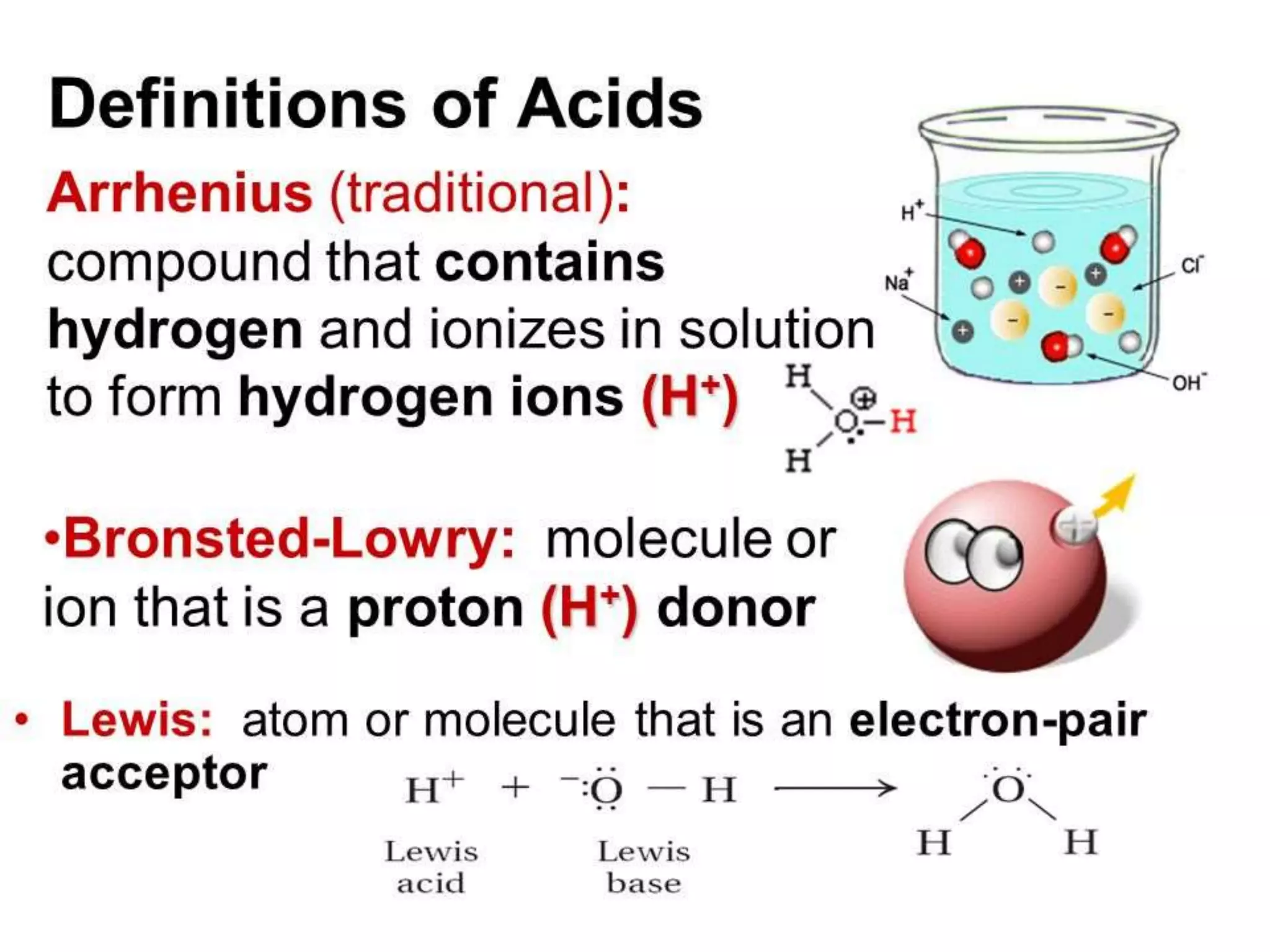
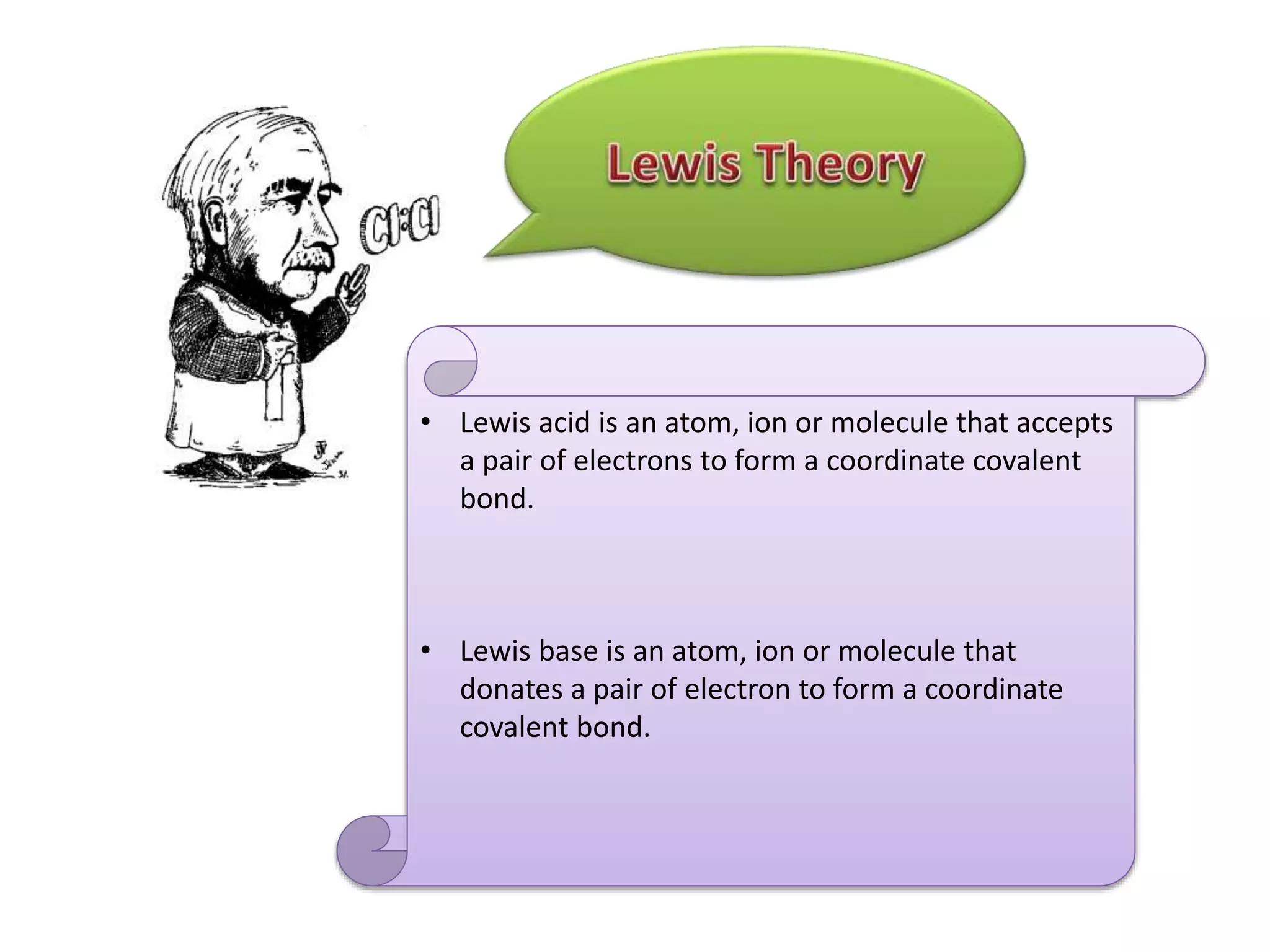
• Lewis acid is an atom, ion or molecule that accepts
a pair of electrons to form a coordinate covalent
bond.
• Lewis base is an atom, ion or molecule that
donates a pair of electron to form a coordinate
covalent bond.
Example ;
Lewis base Lewis acid
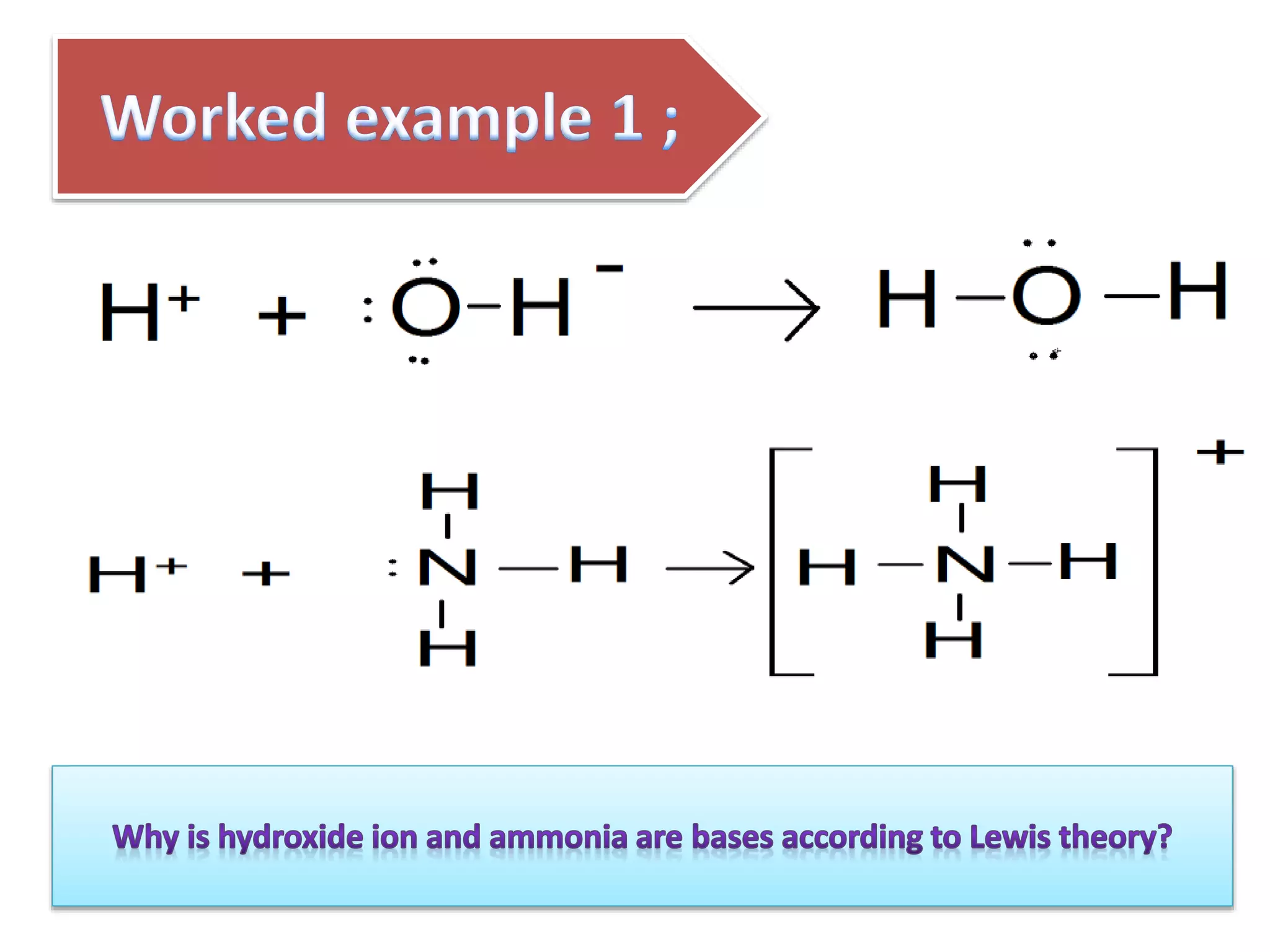
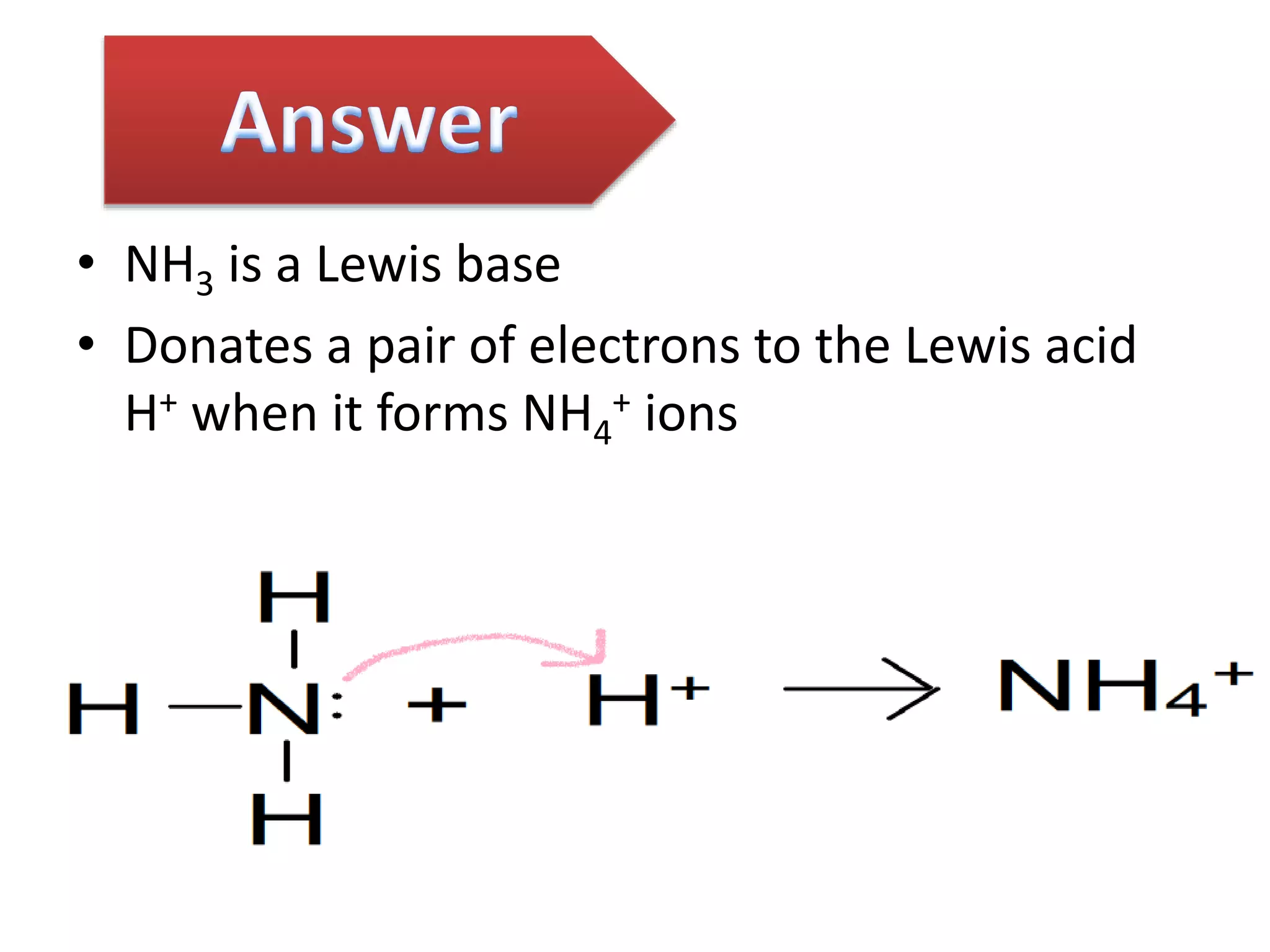
• NH3 is a Lewis base
• Donates a pair of electrons to the Lewis acid
H+ when it forms NH4
+ ions
• OH- Lewis base – donates a pair of electrons to
the Lewis acid H+ to form H2O molecule
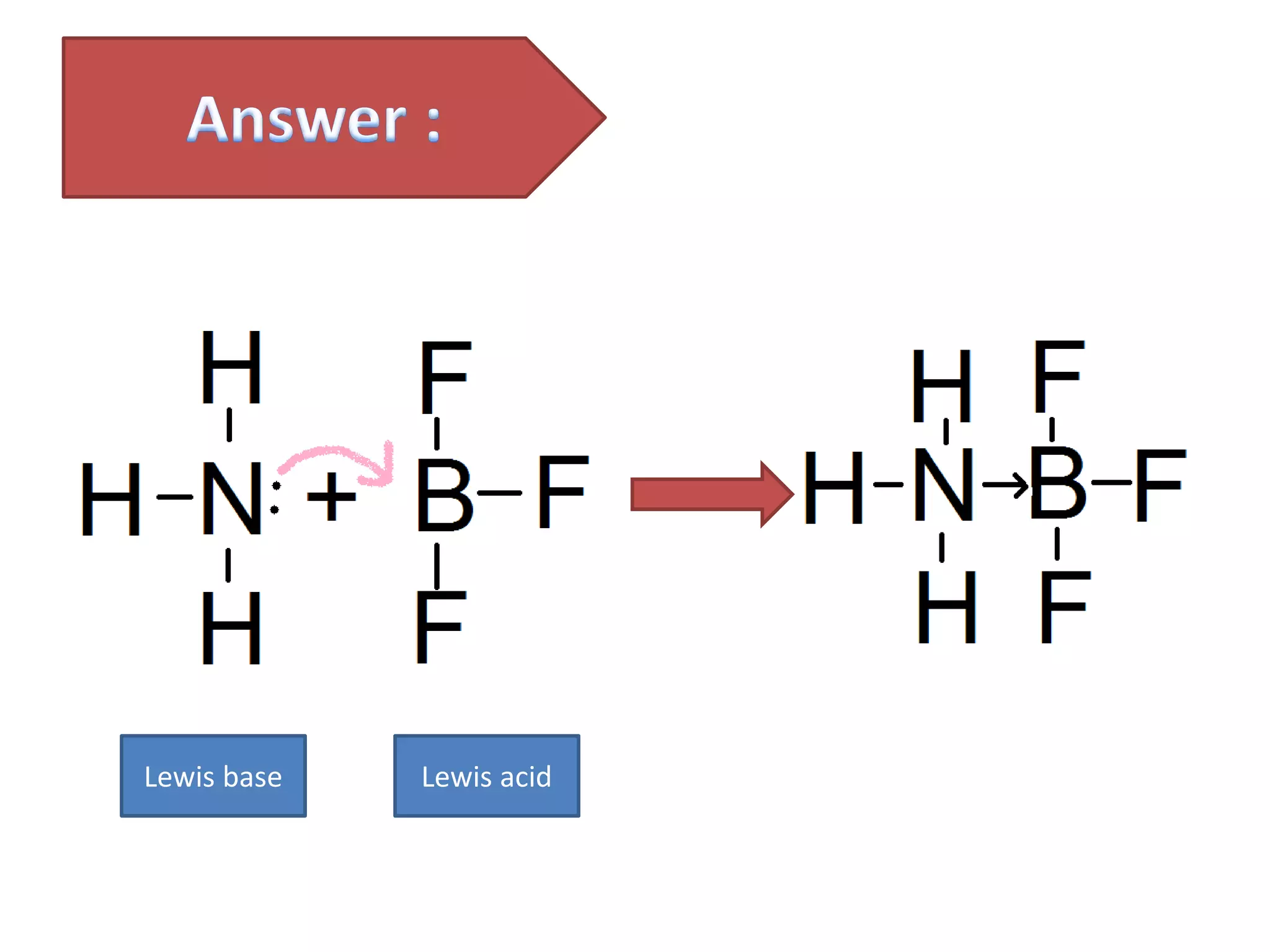
For the following reactions, identify
the Lewis acids and the Lewis base:
Lewis base Lewis acid

TOPIC 8 : Acids and Bases

  • 2.
    Properties of acidsand bases • Acids have a sour taste : e.g vinegar owes its taste to acetic acid, and lemons and other citrus fruits contain citric acids. GENERAL PROPRTIES Acids:
  • 3.
    • Acids causecolour changes in plant dyes • E.g change the colour of litmus from blue to red. • Acid react with certain metals e.g zinc, magnesium, and iron to produce hydrogen gas.
  • 4.
    • E.g: reactionbetween hydrochloric acid and magnesium: • 2HCl (aq) + Mg (s)  MgCl2 (aq) + H2 (g)
  • 5.
    • Acids reactwith carbonates and bicarbonates such as Na2CO3, CaCO3, and NaHCO3 to produce carbon dioxide gas. • Example : • 2HCl (aq) + CaCO3 (s)  CaCl2 (aq) + H2O (l) + CO2 (g) • HCl (aq) + NaHCO3 (s)  NaCl (aq) + H2O (l) + CO2 (g) • Aqueous acids solutions conduct electricity.
  • 6.
    • Bases havea bitter taste. • Bases feel slippery; soaps which contains bases, exhibit this property. • Bases cause colour changes in plant dyes e.g change the colour of litmus from red to blue. • Aqueous base solutions conduct electricity. Bases
  • 7.
    • Ammonia, NH3 •Soluble carbonates, CaCO3 • Hydrogencarbonates, NaHCO3 Bases which are not hydroxide Alkalis – bases that dissolve in water
  • 8.
    • Strong acidsare all strong electrolytes that ionize completely in water (dissociate) . • Example ; hydrochloric acids, HCl nitric acids, HNO3 Perchloric acids, HClO4 Sulphuric acids, H2SO4
  • 9.
    • HCl (aq)+ H2O (l)  H3O+ (aq) + Cl- (aq) • HNO3 (aq) + H2O (l)  H3O+ (aq) + NO3 - (aq) • HClO4 (aq) + H2O (l)  H3O+ (aq) + ClO4 - (aq) • H2SO4 (aq) + H2O (l)  H3O+ (aq) + HSO4 - (aq)
  • 10.
    • Strong basesare all strong electrolytes that ionize (dissociates) completely in solution. • Example; NaOH (aq)  Na+ (aq) + OH- (aq) KOH (aq)  K+ (aq) + OH- (aq) Ba(OH)2 (aq)  Ba2+ (aq) + 2OH- (aq)
  • 11.
    • Weak acidsare acids that ionize only to limited extent in water (partially). • Example ; • At equilibrium, aqueous solutions of weak acids contain mixture of nonionized acid molecule, H3O+ ion and conjugate base.
  • 12.
    • Note :the strength of acid can vary greatly due to differences in extent of ionization. • The limited ionization of weak acids is related to the equilibrium constant for ionization, Ka.
  • 13.
    • Weak basesare bases that ionize only to a limited extent in water. • Example ; • At equilibrium, there is a mixture of nonionized , and ions.
  • 17.
    Bronsted – Lowrey •Acids – proton donors • Bases – proton acceptor • Example ; • HCl (g) + H2O (l)  H3O+ (aq) + Cl- (g) ? ?
  • 18.
    • An acidsbecomes its conjugate base when it donates a proton. • A base becomes its conjugate acid when it accepts a proton.
  • 19.
    • HCl donatesits proton completely to H2O. • For a strong acid, the reverse reaction does not occur. • Thus, Cl- ion is a weak conjugate base. • So, strong acids form weak conjugate bases. • Weak acids form strong conjugate bases.
  • 20.
    • NH3 (aq)+ H2O (l) ⇌ NH4 + (aq) + OH- (aq) (base) (acid) ( ? ) (? ) NH3 – base (accepts a proton from H2O) H2O – Bronsted – Lowrey Acid EQUATION IS REVERSED ; NH 4 +  acid OH-  base
  • 21.
    NH3 • Weak base •Does not accept the proton from H2O completely. NH4 + ion • strong conjugate acid H2O • A weak acid OH- • Strong conjugate base
  • 22.
  • 24.
    • The relativestrength of an acid and its conjugate base, and a base and its conjugate acid. • Explain why a strong acid or a strong base dissociates completely in aqueous solution? • Explain why weak acid or a weak base dissociates partially in aqueous solution?
  • 25.
    • A strongacid completely breaks apart to give ions in solution (100% dissociation) whereas a weak acid only slightly dissociates in solution (perhaps less than 1%). • A strong acid, when placed in water, will almost fully ionise/dissociate straight away, producing H+ (aq) ions from water. • A weak acid will, however, only partially dissociate into ions, leaving a high percentage of unreacted molecules in the solution.
  • 26.
    H2O  amphoteric •acting as a base in the presence of an acid • acting as an acid in the presence of a base H2O + H2O ⇌ H3O+ + OH- (acid) (base)
  • 27.
    Bronsted – Lowreyacids and bases are NOT limited to reactions with water • Example ; • HCl (g) + NH3 (g) ⇌ NH4 + + Cl- (acid) (base) (conjugate acid) (conjugate base)
  • 28.
    Question ; Is itNaOH a Bronsted – Lowrey base ? NaOH NOT a Bronsted – Lowrey base because it does not accept a proton
  • 29.
    • Identify Bronsted– Lowrey acid, Bronsted – Lowrey base, conjugate acid, or conjugate base, from each of the following equation. • H2CO3 + H2O ⇌ HCO3 - + H3O+ • NH4 + + H2O ⇌ NH3 + H3O+ • CH3NH2 + H2O ⇌ CH3NH3 + + OH- • CH3COOH + H2O ⇌ CH3COO- + H3O+
  • 30.
    • Lewis acidis an atom, ion or molecule that accepts a pair of electrons to form a coordinate covalent bond. • Lewis base is an atom, ion or molecule that donates a pair of electron to form a coordinate covalent bond.
  • 31.
  • 34.
    • NH3 isa Lewis base • Donates a pair of electrons to the Lewis acid H+ when it forms NH4 + ions
  • 35.
    • OH- Lewisbase – donates a pair of electrons to the Lewis acid H+ to form H2O molecule
  • 36.
    For the followingreactions, identify the Lewis acids and the Lewis base:
  • 37.