UNIVERSIDAD AUTÓNOMA DE NUEVO LEON 
CIDEB 
 STAGE III: ACIDS AND BASES, 
OPPOSITES THAT NEUTRALIZE
 Formative Objective: The student solves 
theoretical and experimental problems 
related to acidic and basic solutions in daily 
life. Thinks about the negative effects of acid 
rain in the surroundings and propose 
possible solutions to this environmental 
phenomenon
ACIDS 
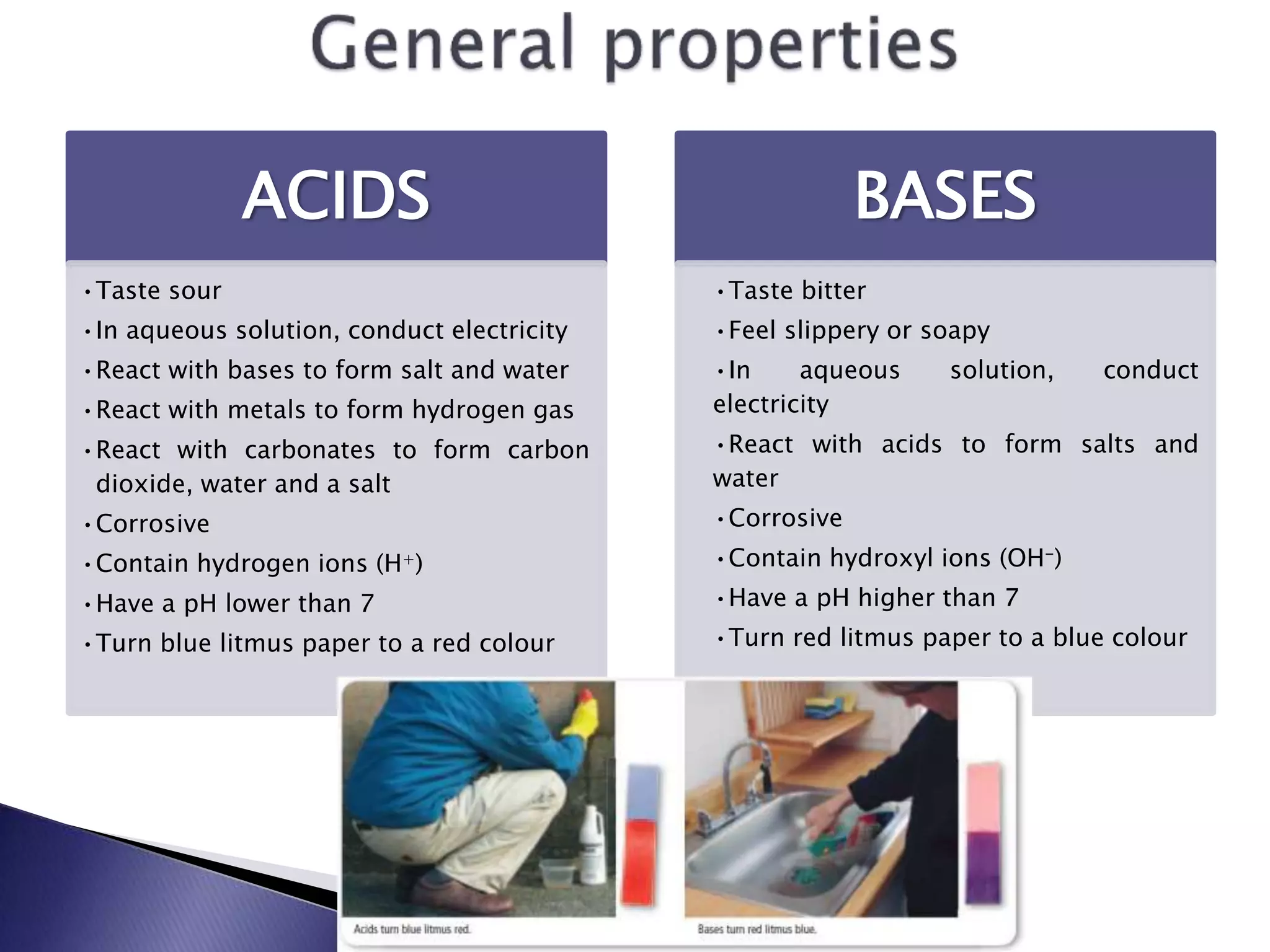
•Taste sour 
•In aqueous solution, conduct electricity 
•React with bases to form salt and water 
•React with metals to form hydrogen gas 
•React with carbonates to form carbon 
dioxide, water and a salt 
•Corrosive 
•Contain hydrogen ions (H+) 
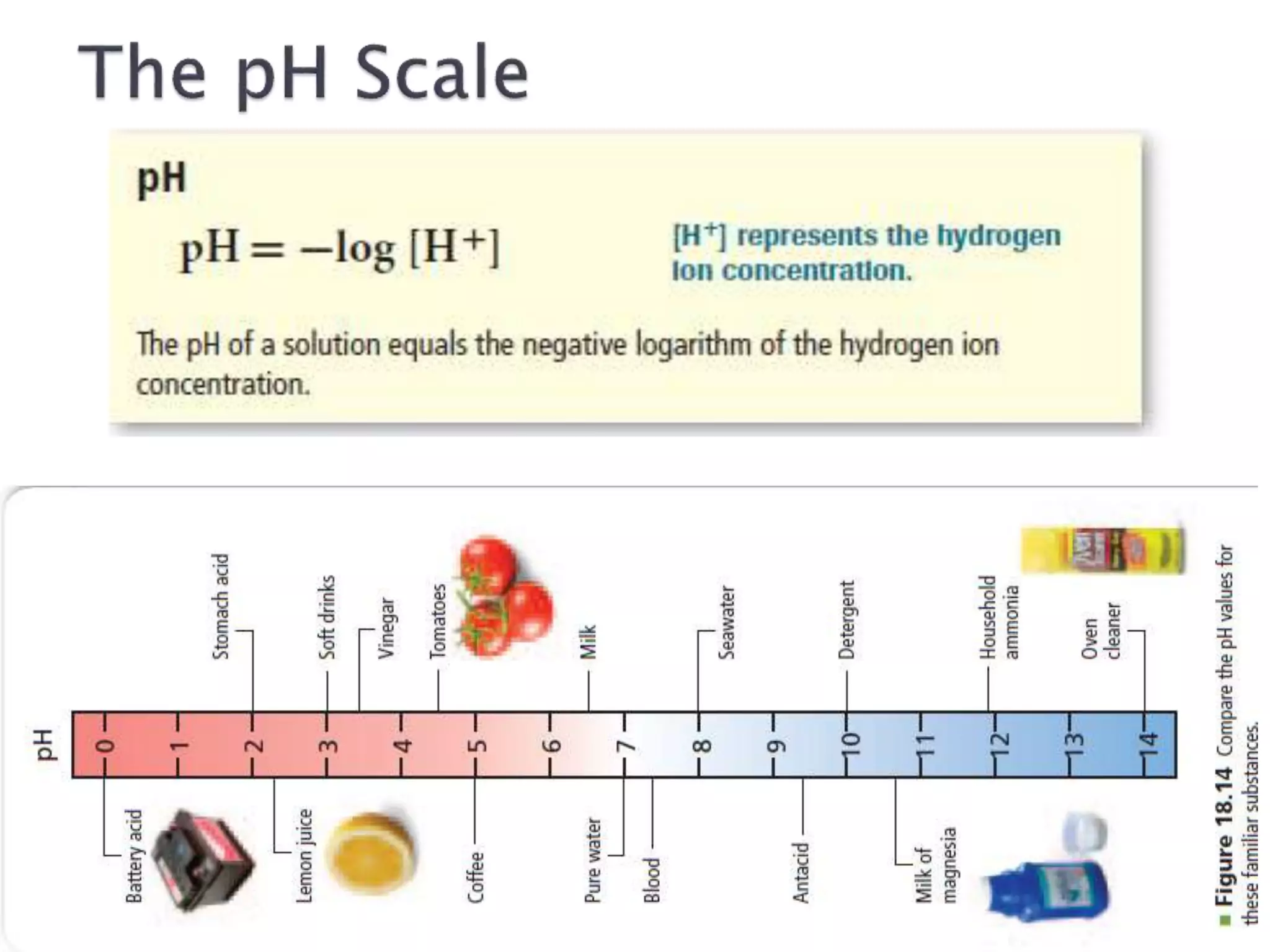
•Have a pH lower than 7 
•Turn blue litmus paper to a red colour 
BASES 
•Taste bitter 
•Feel slippery or soapy 
•In aqueous solution, conduct 
electricity 
•React with acids to form salts and 
water 
•Corrosive 
•Contain hydroxyl ions (OH-) 
•Have a pH higher than 7 
•Turn red litmus paper to a blue colour
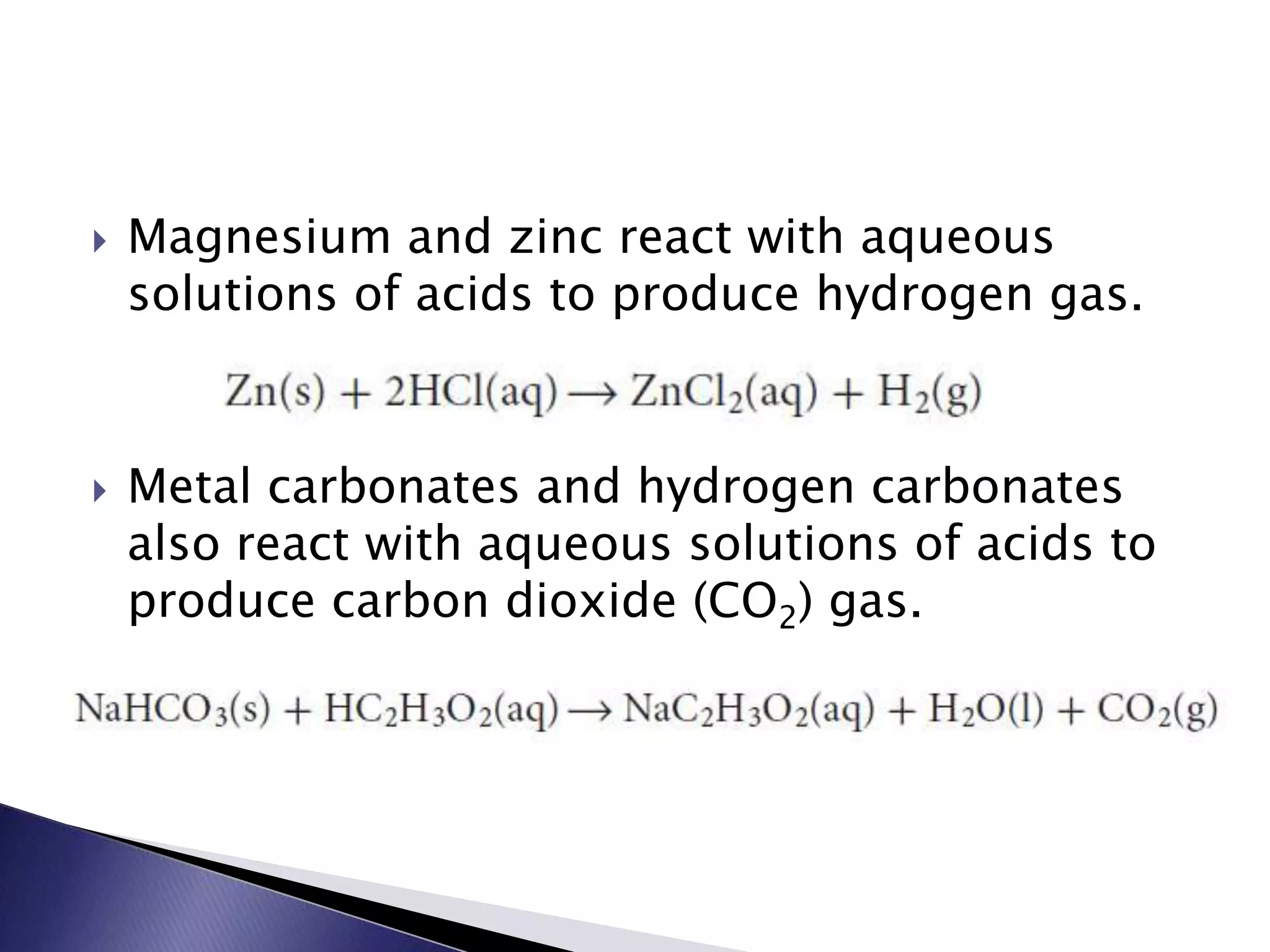
 Magnesium and zinc react with aqueous 
solutions of acids to produce hydrogen gas. 
 Metal carbonates and hydrogen carbonates 
also react with aqueous solutions of acids to 
produce carbon dioxide (CO2) gas.
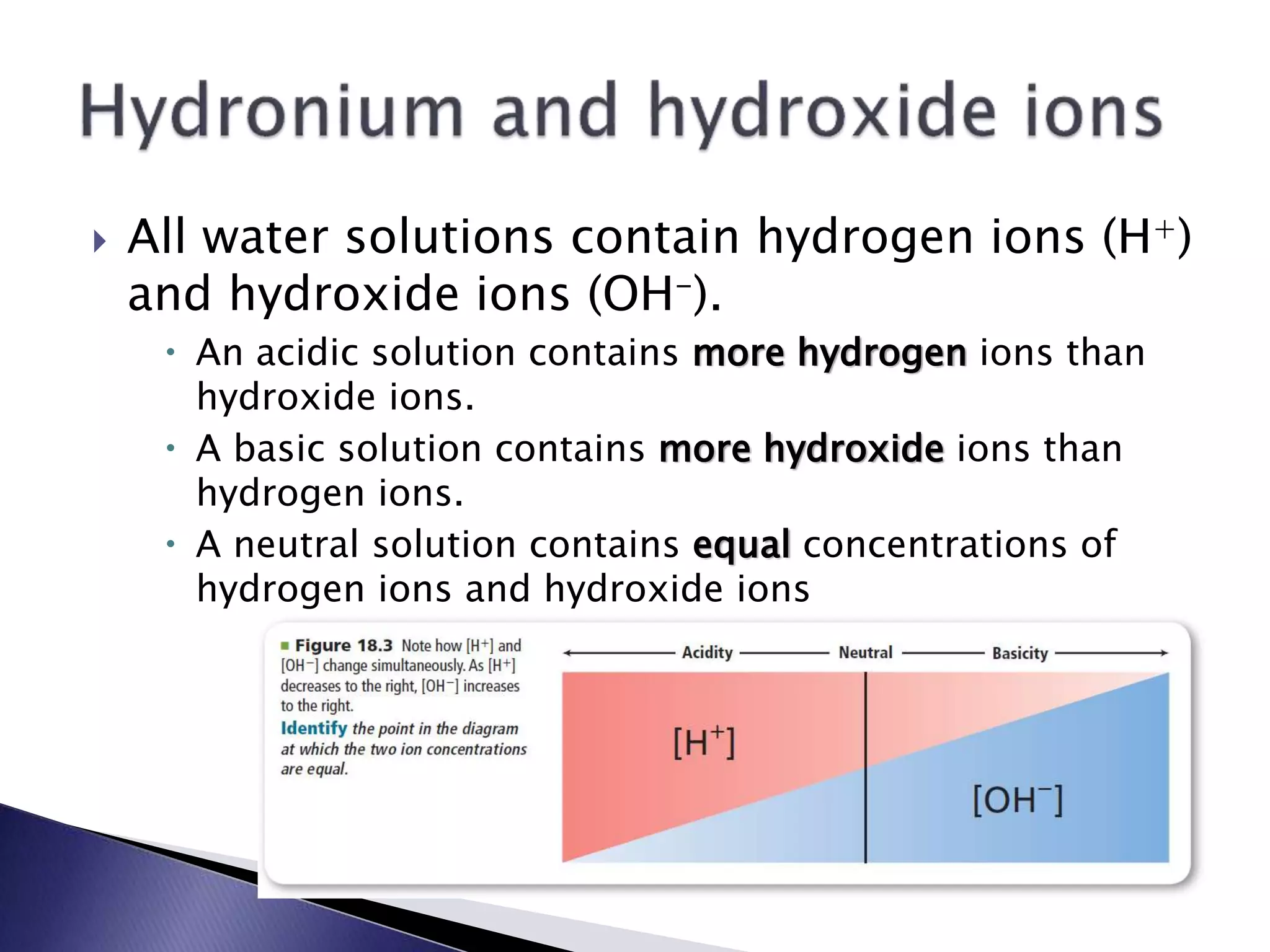
 All water solutions contain hydrogen ions (H+) 
and hydroxide ions (OH-). 
 An acidic solution contains more hydrogen ions than 
hydroxide ions. 
 A basic solution contains more hydroxide ions than 
hydrogen ions. 
 A neutral solution contains equal concentrations of 
hydrogen ions and hydroxide ions
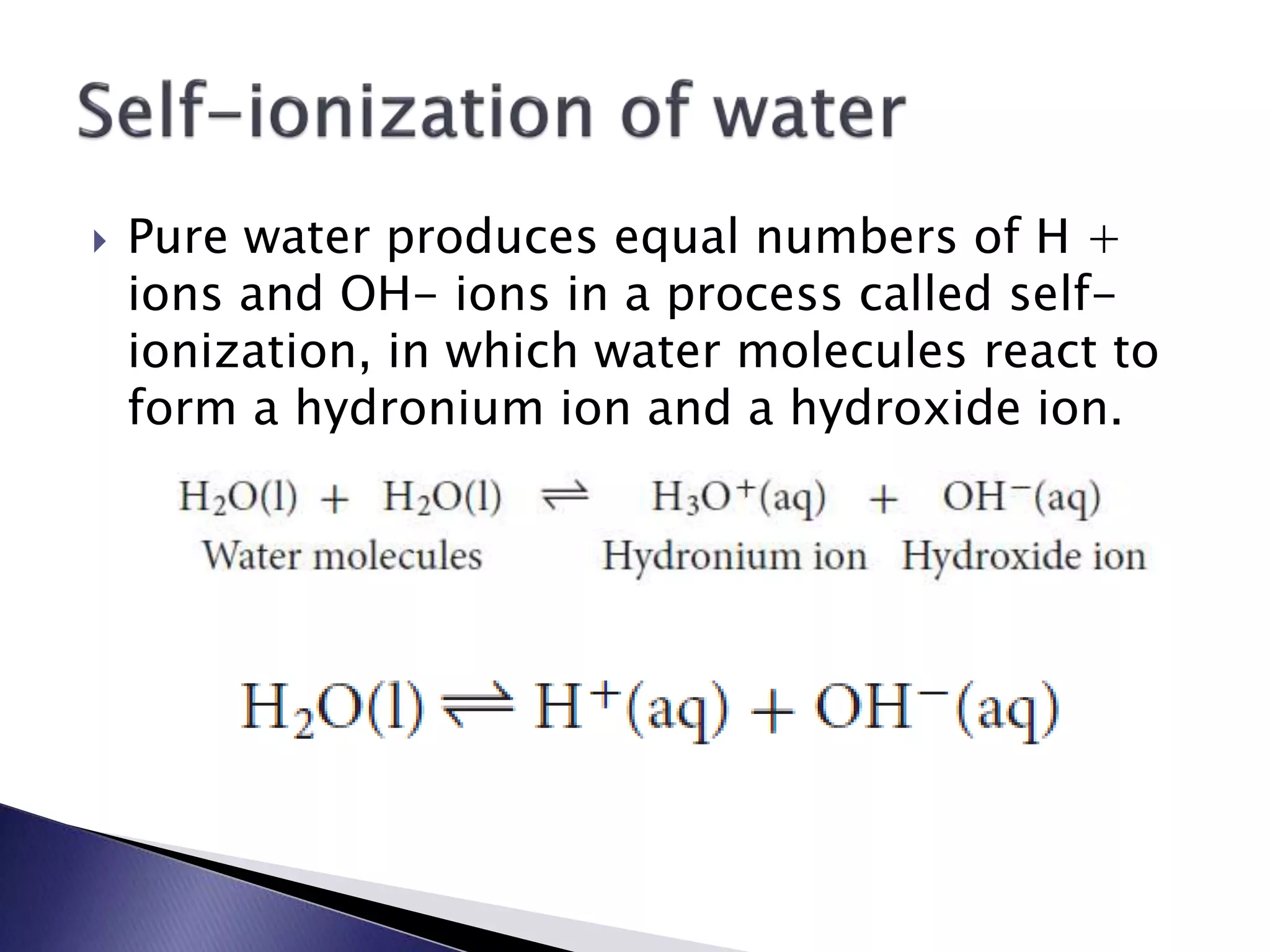
 Pure water produces equal numbers of H + 
ions and OH- ions in a process called self-ionization, 
in which water molecules react to 
form a hydronium ion and a hydroxide ion.
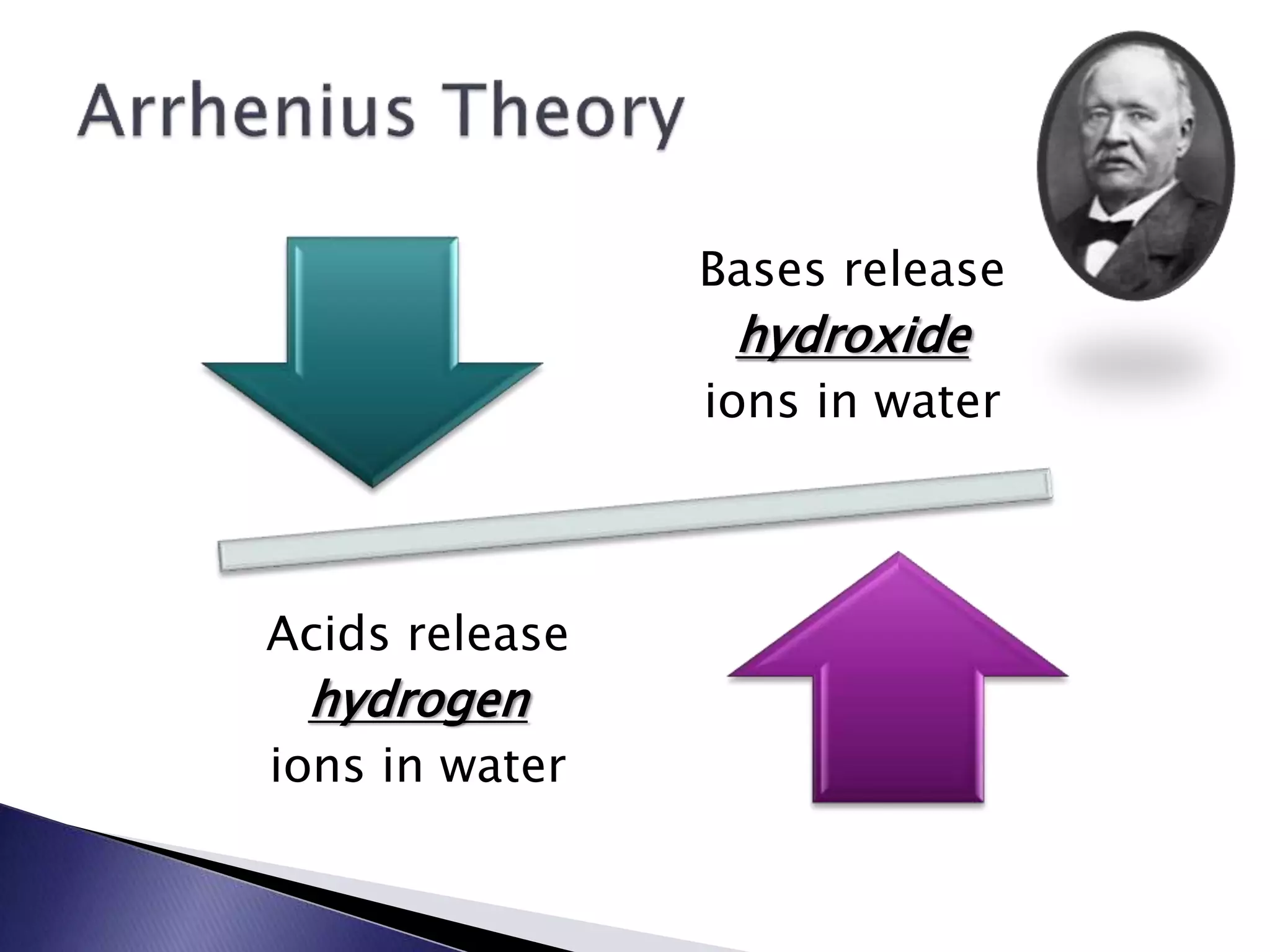
Bases release 
hydroxide 
ions in water 
Acids release 
hydrogen 
ions in water
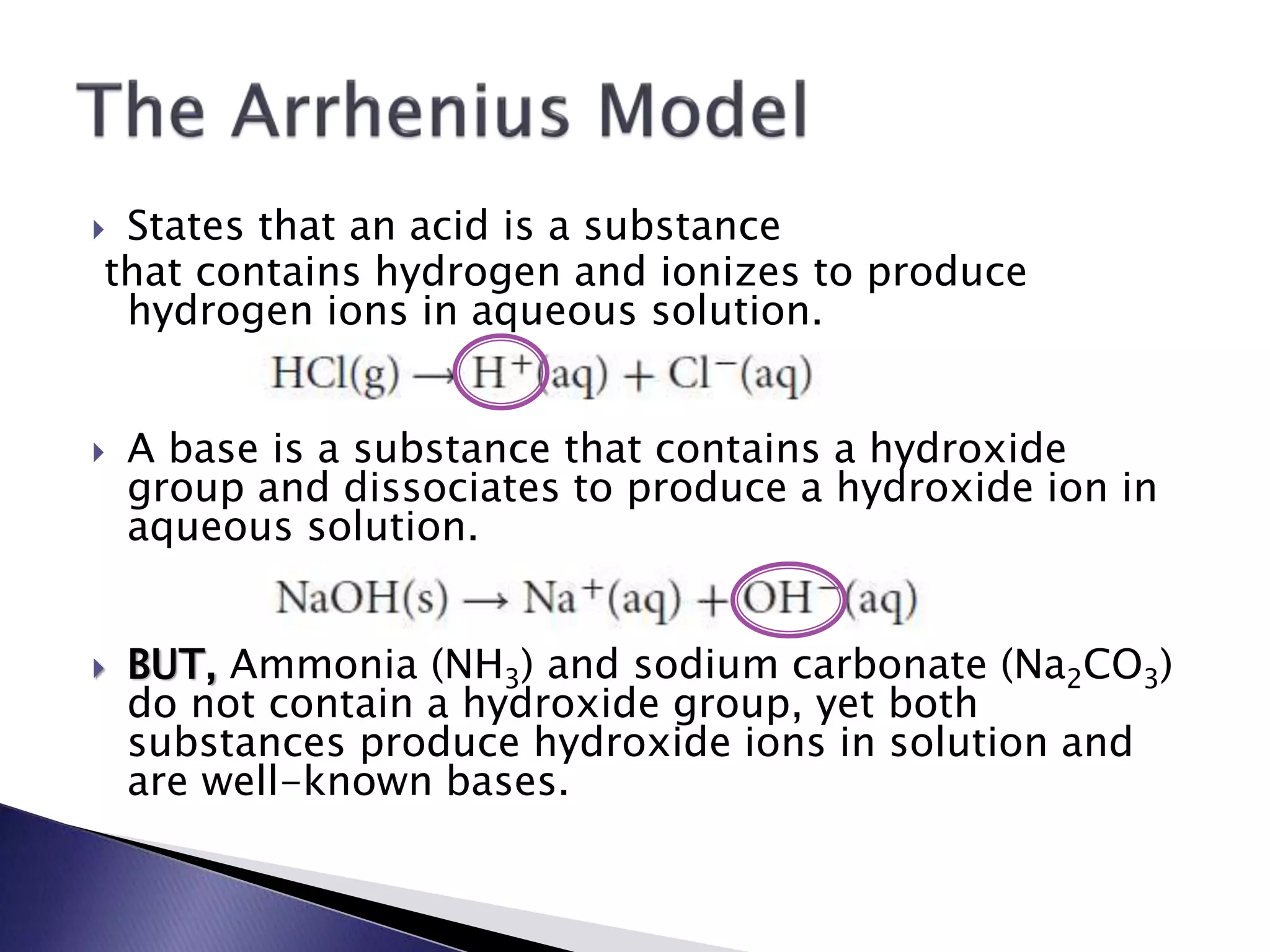
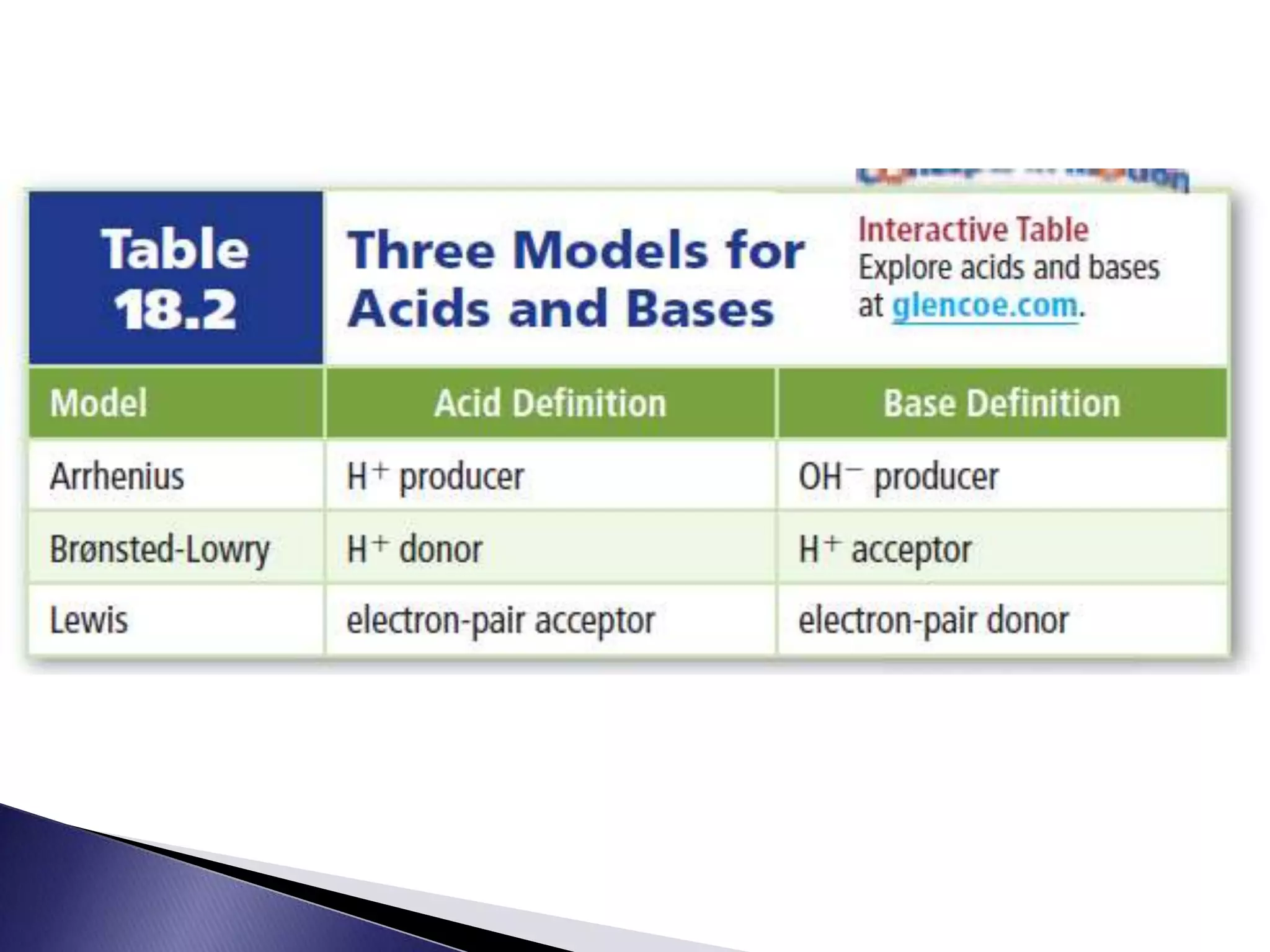
 States that an acid is a substance 
that contains hydrogen and ionizes to produce 
hydrogen ions in aqueous solution. 
 A base is a substance that contains a hydroxide 
group and dissociates to produce a hydroxide ion in 
aqueous solution. 
 BUT, Ammonia (NH3) and sodium carbonate (Na2CO3) 
do not contain a hydroxide group, yet both 
substances produce hydroxide ions in solution and 
are well-known bases.
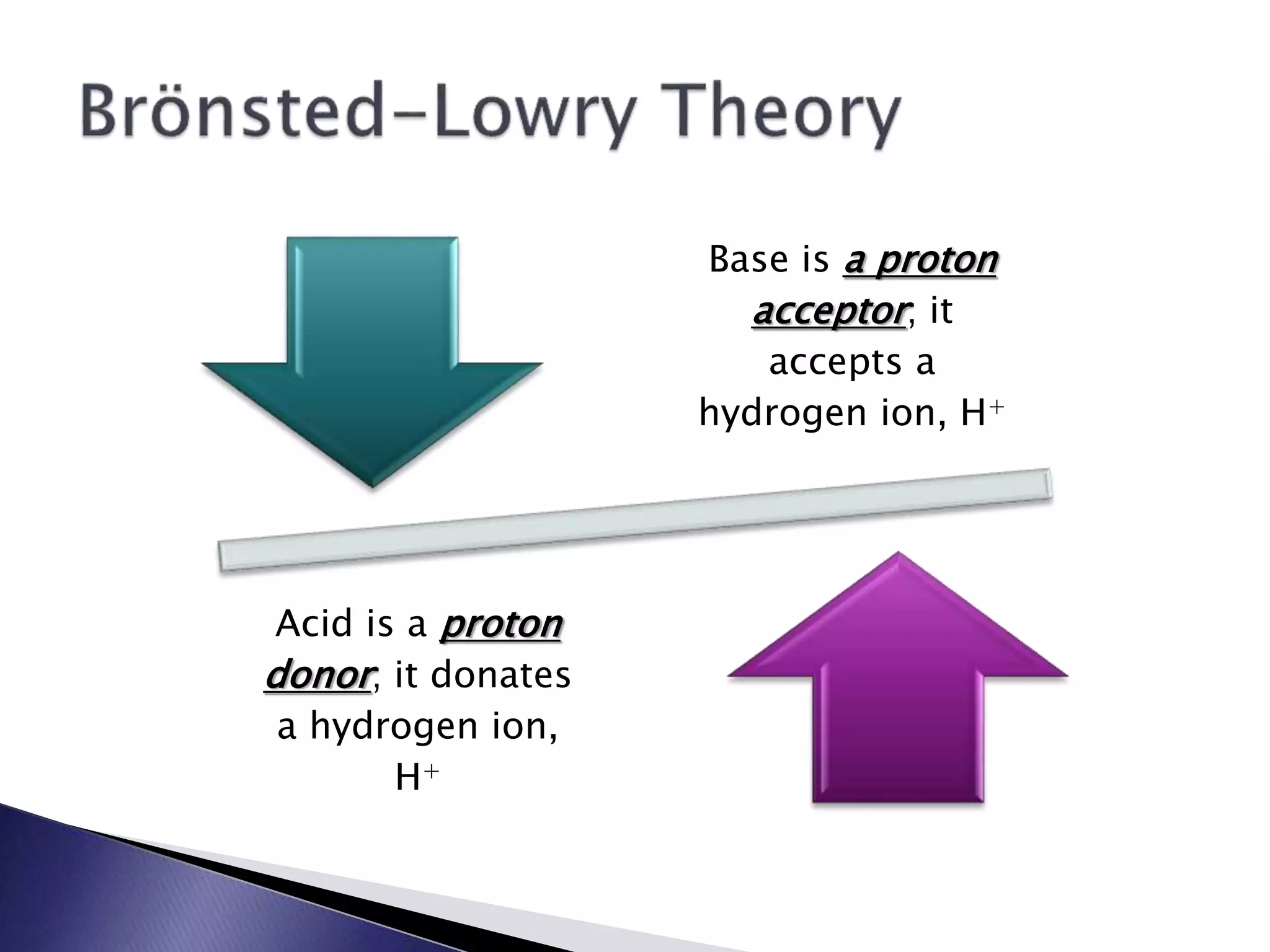
Base is a proton 
acceptor; it 
accepts a 
hydrogen ion, H+ 
Acid is a proton 
donor; it donates 
a hydrogen ion, 
H+
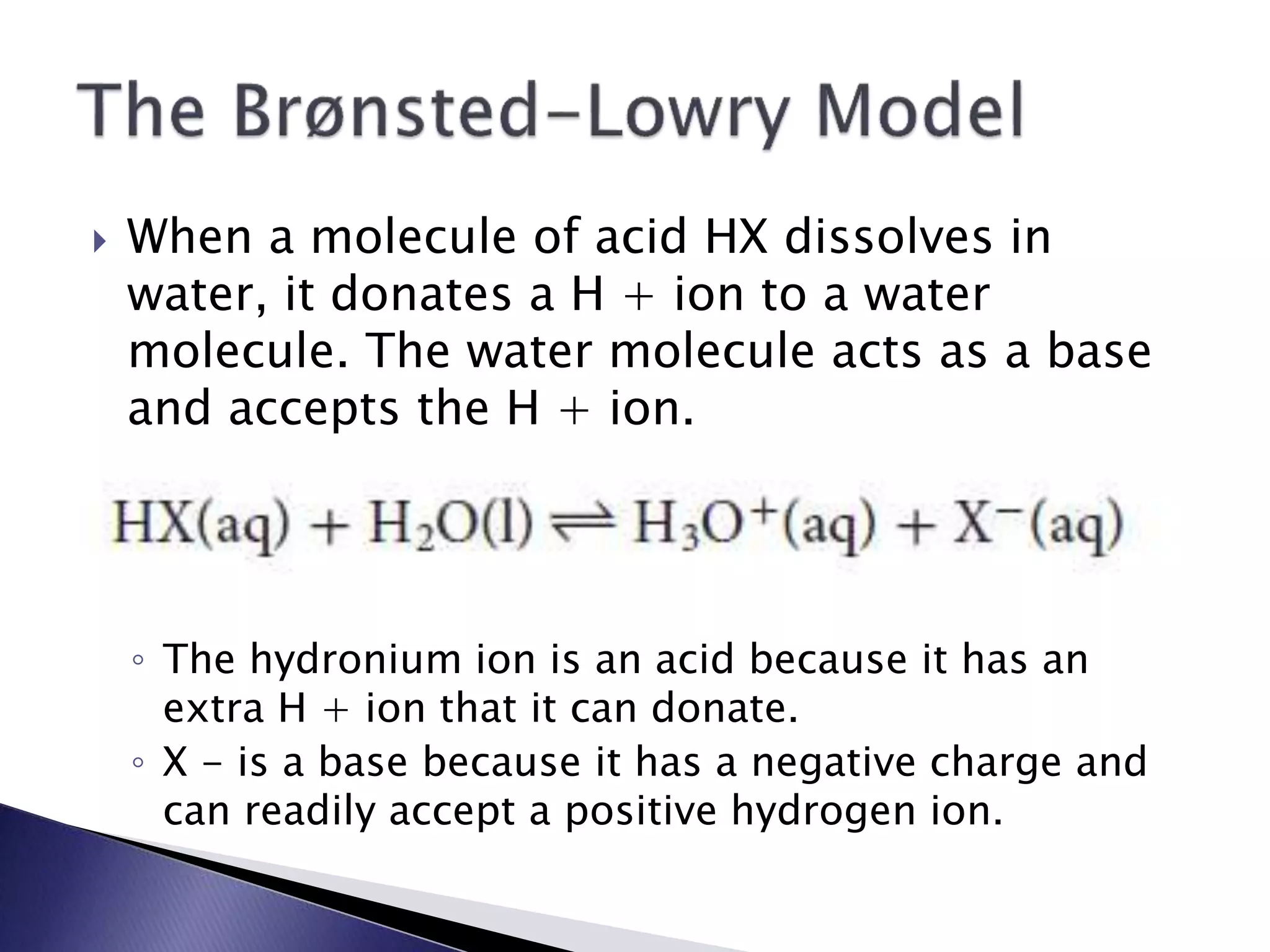
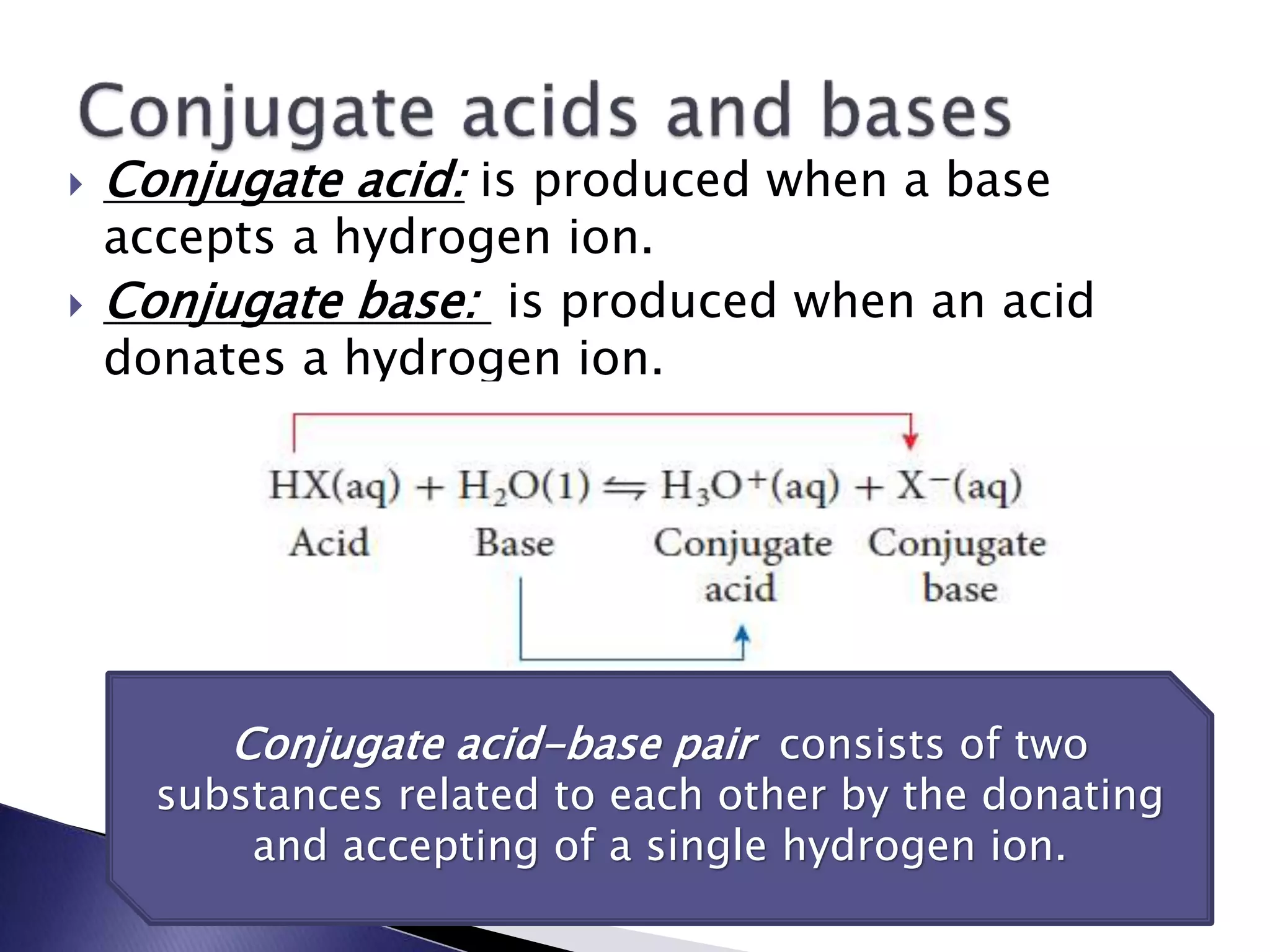
 When a molecule of acid HX dissolves in 
water, it donates a H + ion to a water 
molecule. The water molecule acts as a base 
and accepts the H + ion. 
◦ The hydronium ion is an acid because it has an 
extra H + ion that it can donate. 
◦ X - is a base because it has a negative charge and 
can readily accept a positive hydrogen ion.
 Conjugate acid: is produced when a base 
accepts a hydrogen ion. 
 Conjugate base: is produced when an acid 
donates a hydrogen ion. 
Conjugate acid-base pair consists of two 
substances related to each other by the donating 
and accepting of a single hydrogen ion.
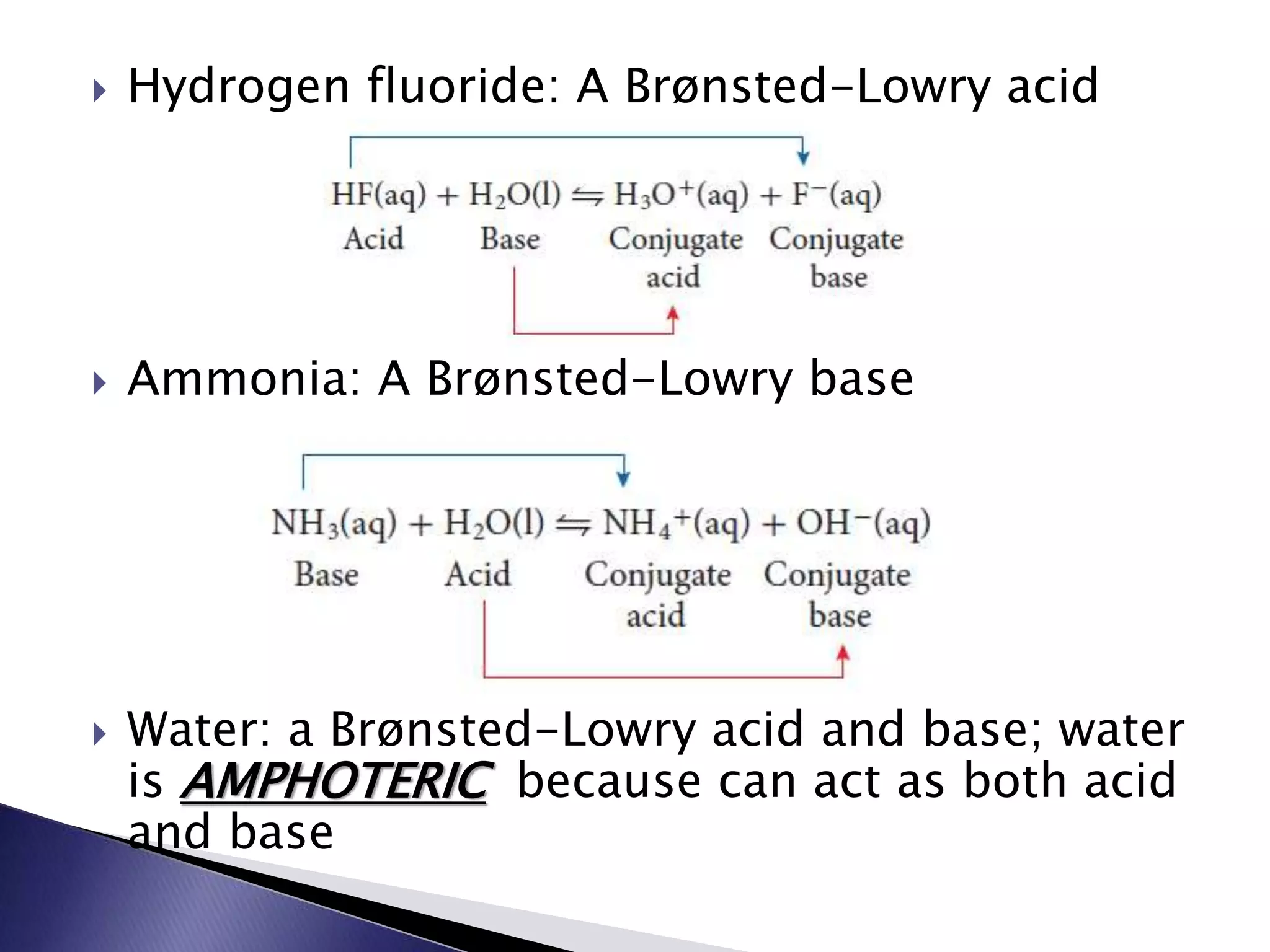
 Hydrogen fluoride: A Brønsted-Lowry acid 
 Ammonia: A Brønsted-Lowry base 
 Water: a Brønsted-Lowry acid and base; water 
is AMPHOTERIC because can act as both acid 
and base
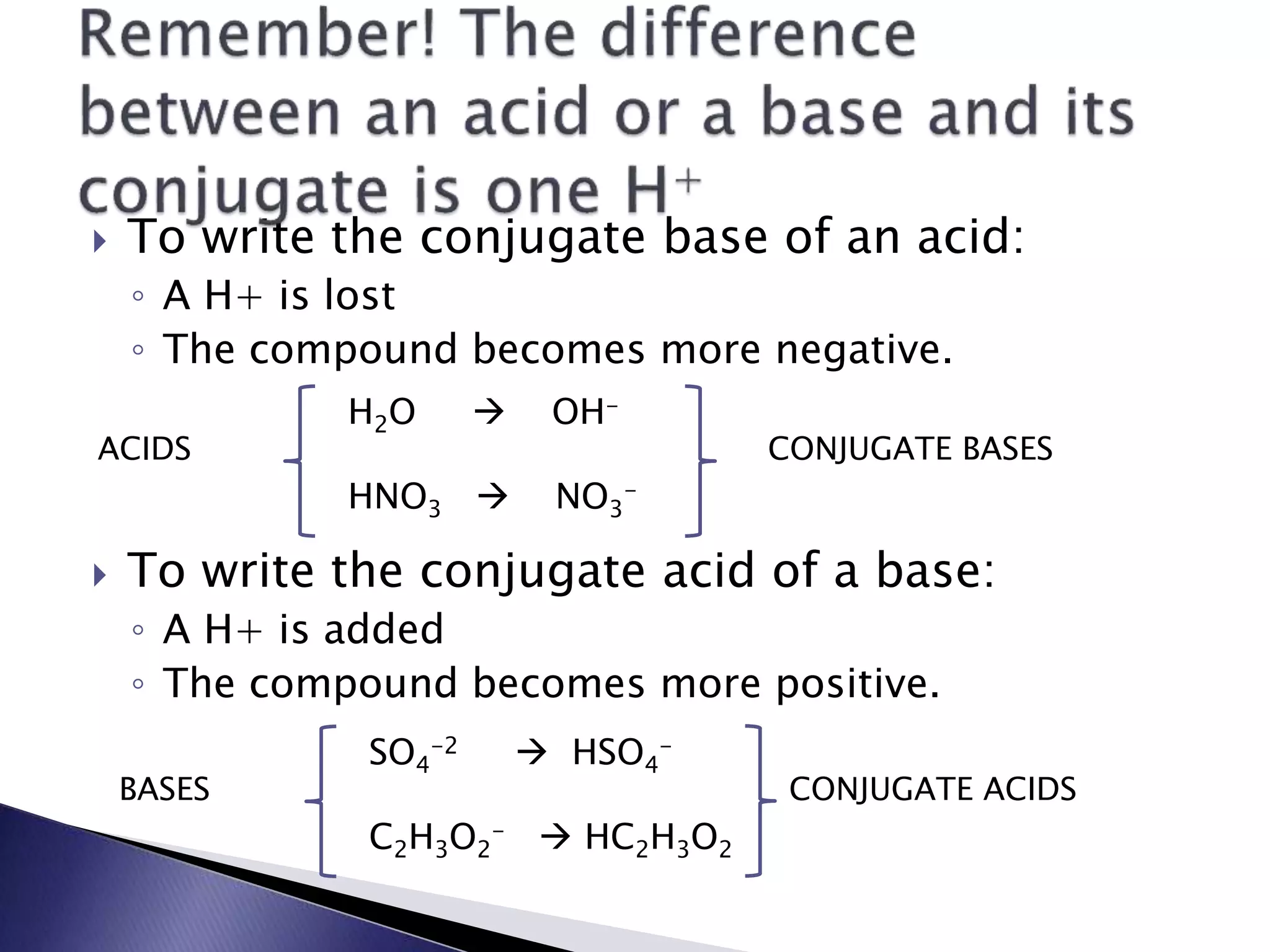
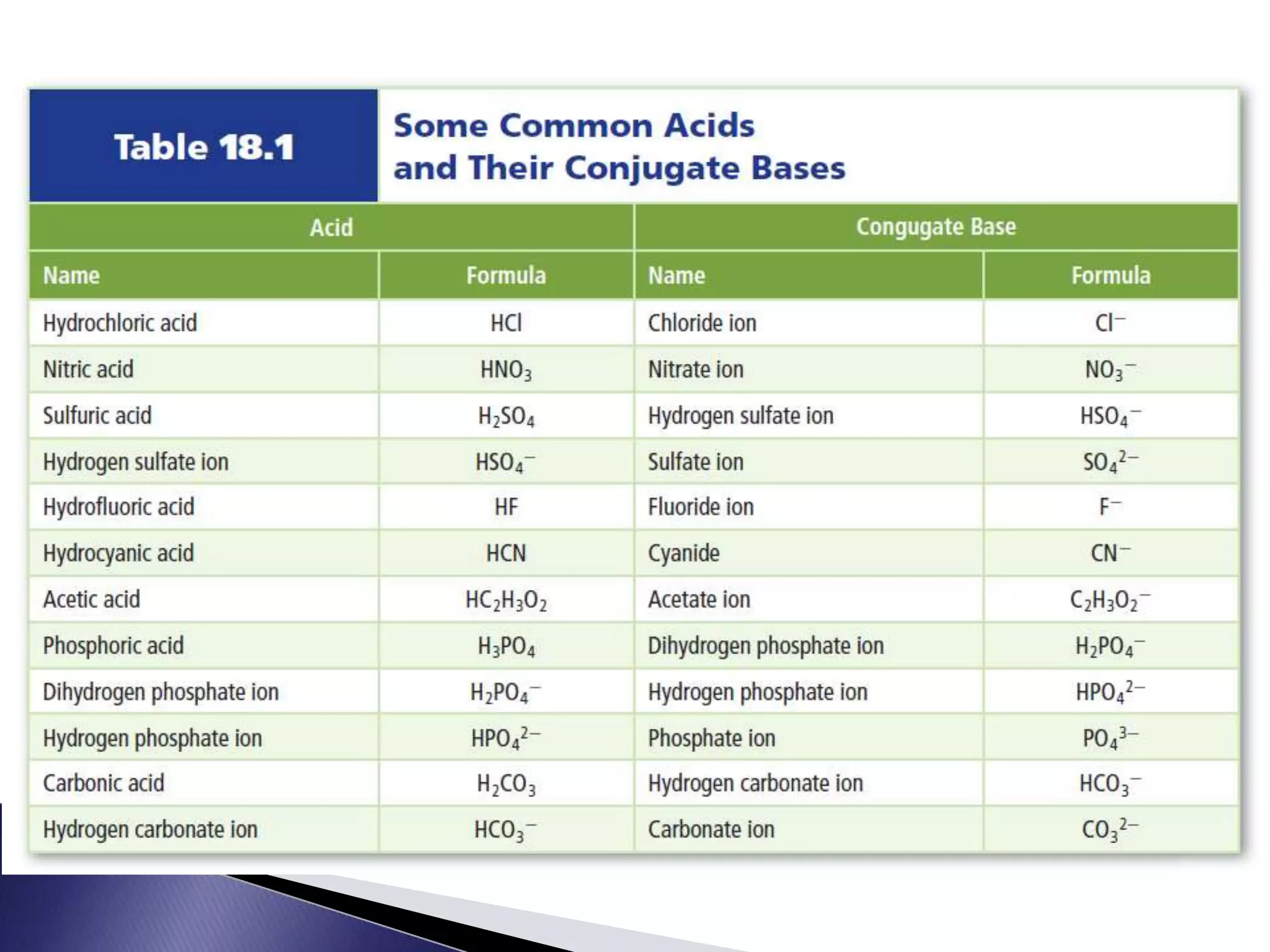
 To write the conjugate base of an acid: 
◦ A H+ is lost 
◦ The compound becomes more negative. 
H2O  OH-HNO 
ACIDS CONJUGATE BASES 
3 
- 
 NO3 
 To write the conjugate acid of a base: 
◦ A H+ is added 
◦ The compound becomes more positive. 
-2  HSO4 
SO4 
- 
BASES CONJUGATE ACIDS 
-  HC2H3O2 
C2H3O2
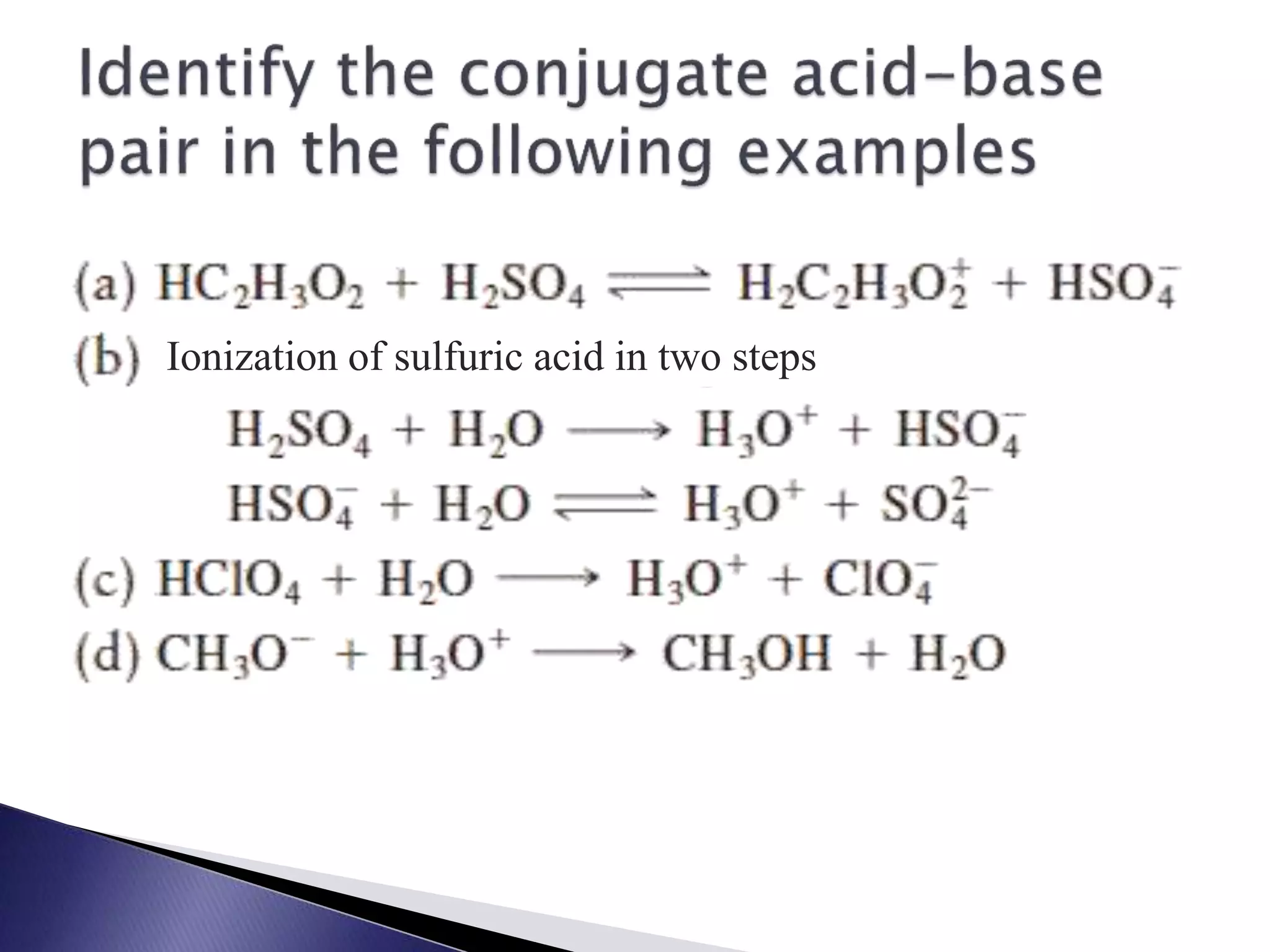
Ionization of sulfuric acid in two steps
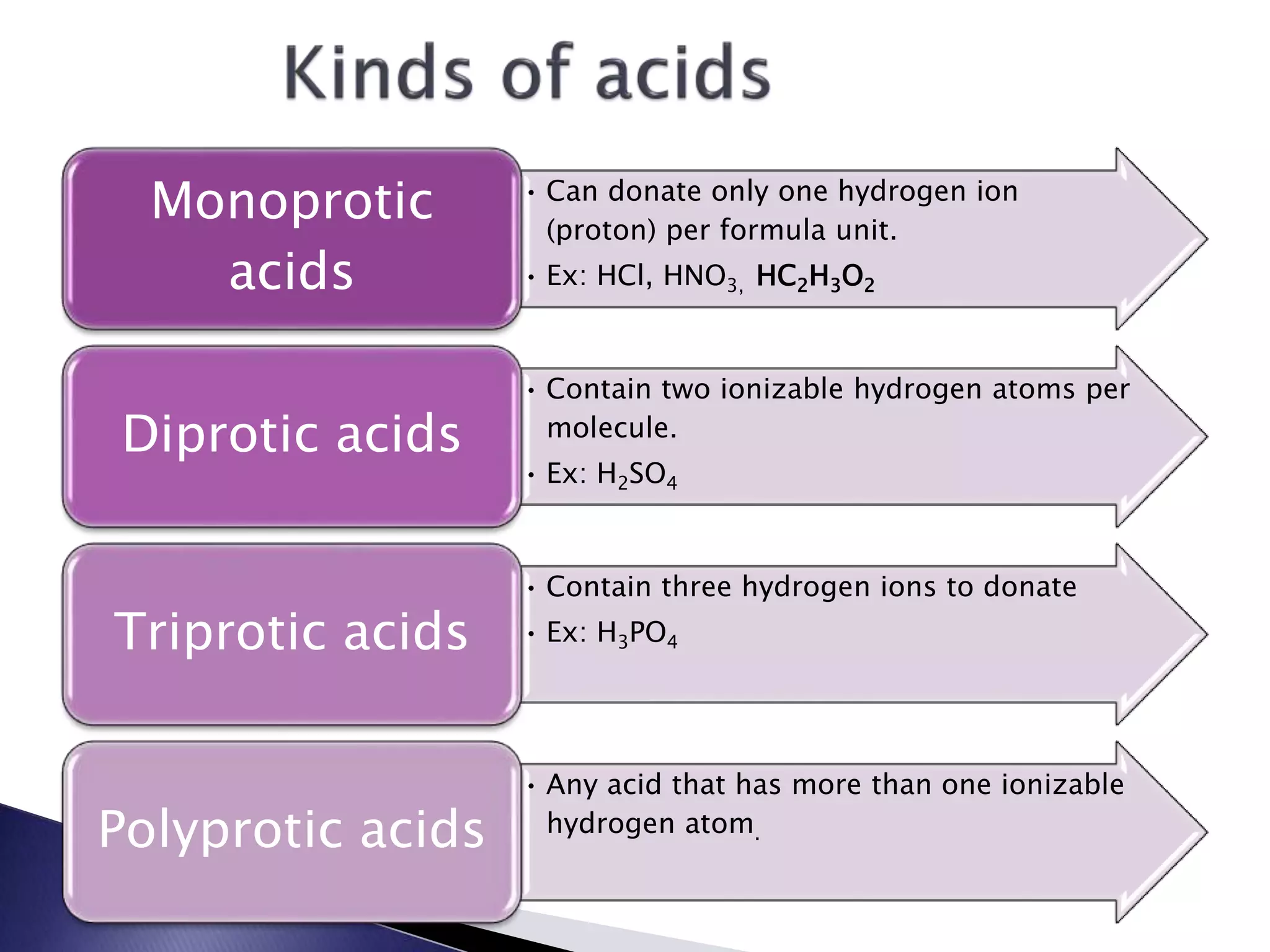
• Can donate only one hydrogen ion 
(proton) per formula unit. 
• Ex: HCl, HNO3, HC2H3O2 
Monoprotic 
acids 
• Contain two ionizable hydrogen atoms per 
molecule. 
• Ex: H2SO4 
Diprotic acids 
• Contain three hydrogen ions to donate 
Triprotic acids • Ex: H3PO4 
• Any acid that has more than one ionizable 
hydrogen atomPolyprotic acids .
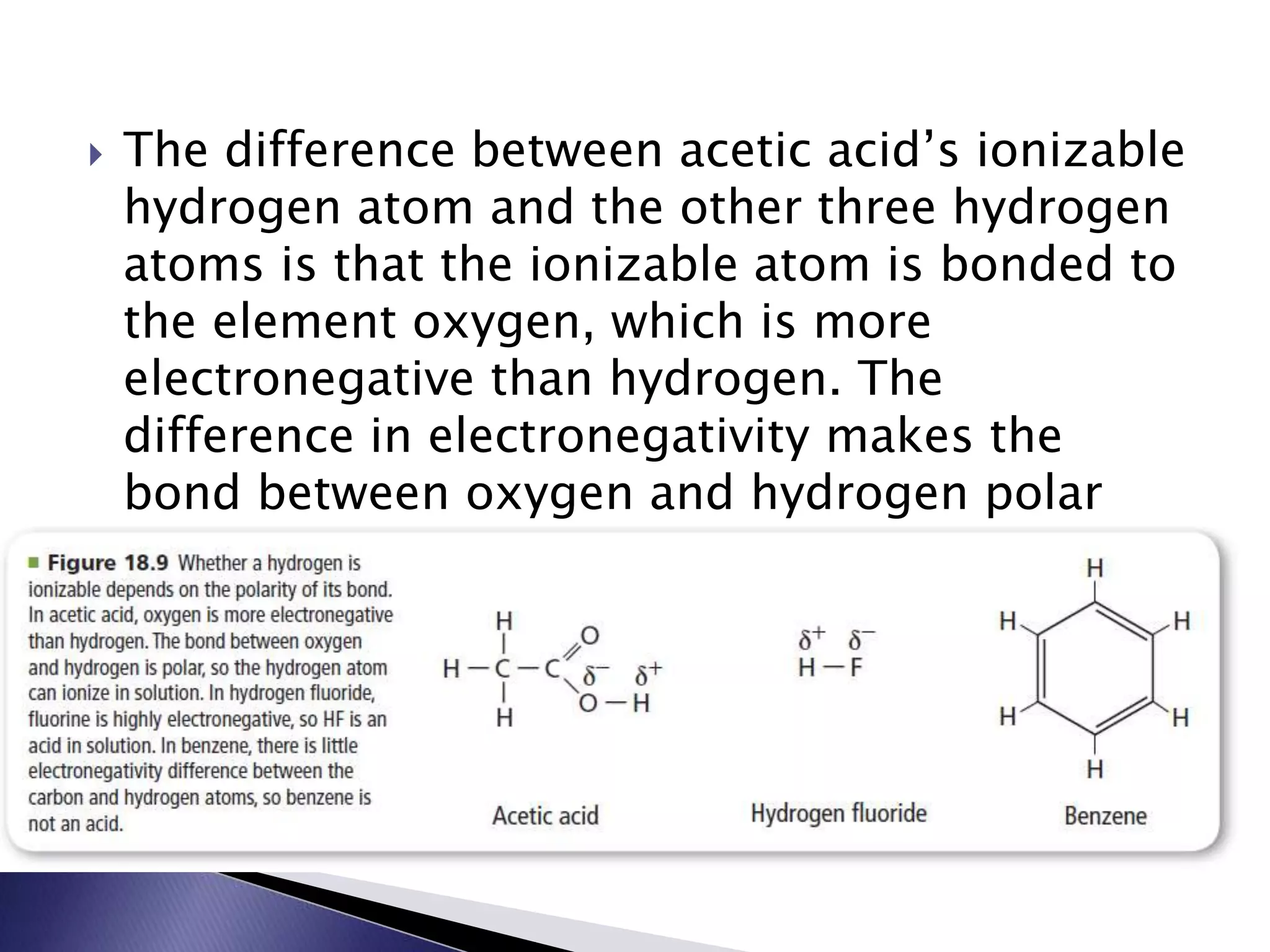
 The difference between acetic acid’s ionizable 
hydrogen atom and the other three hydrogen 
atoms is that the ionizable atom is bonded to 
the element oxygen, which is more 
electronegative than hydrogen. The 
difference in electronegativity makes the 
bond between oxygen and hydrogen polar
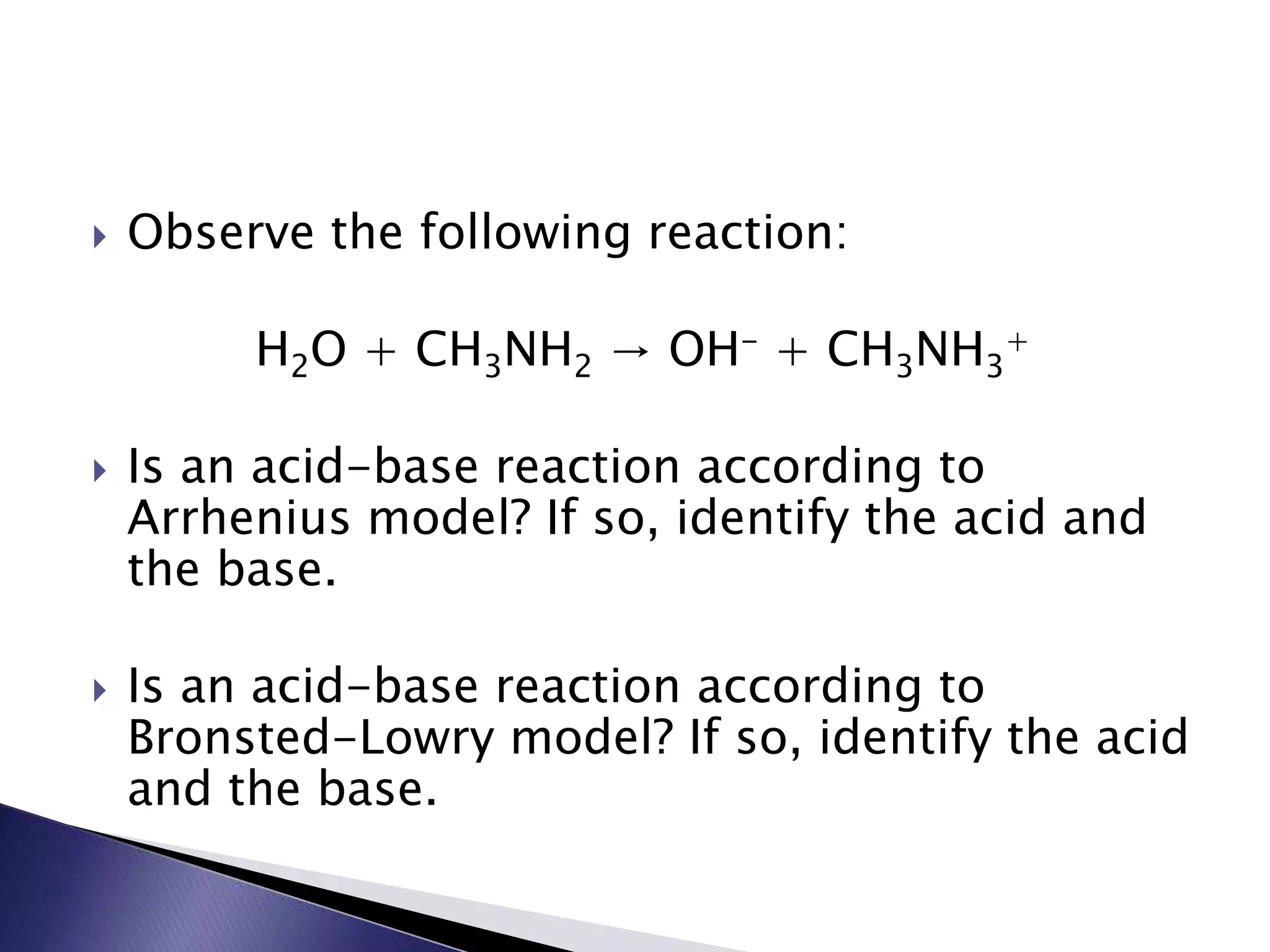
 Observe the following reaction: 
H2O + CH3NH2 → OH- + CH3NH3 
+ 
 Is an acid-base reaction according to 
Arrhenius model? If so, identify the acid and 
the base. 
 Is an acid-base reaction according to 
Bronsted-Lowry model? If so, identify the acid 
and the base.
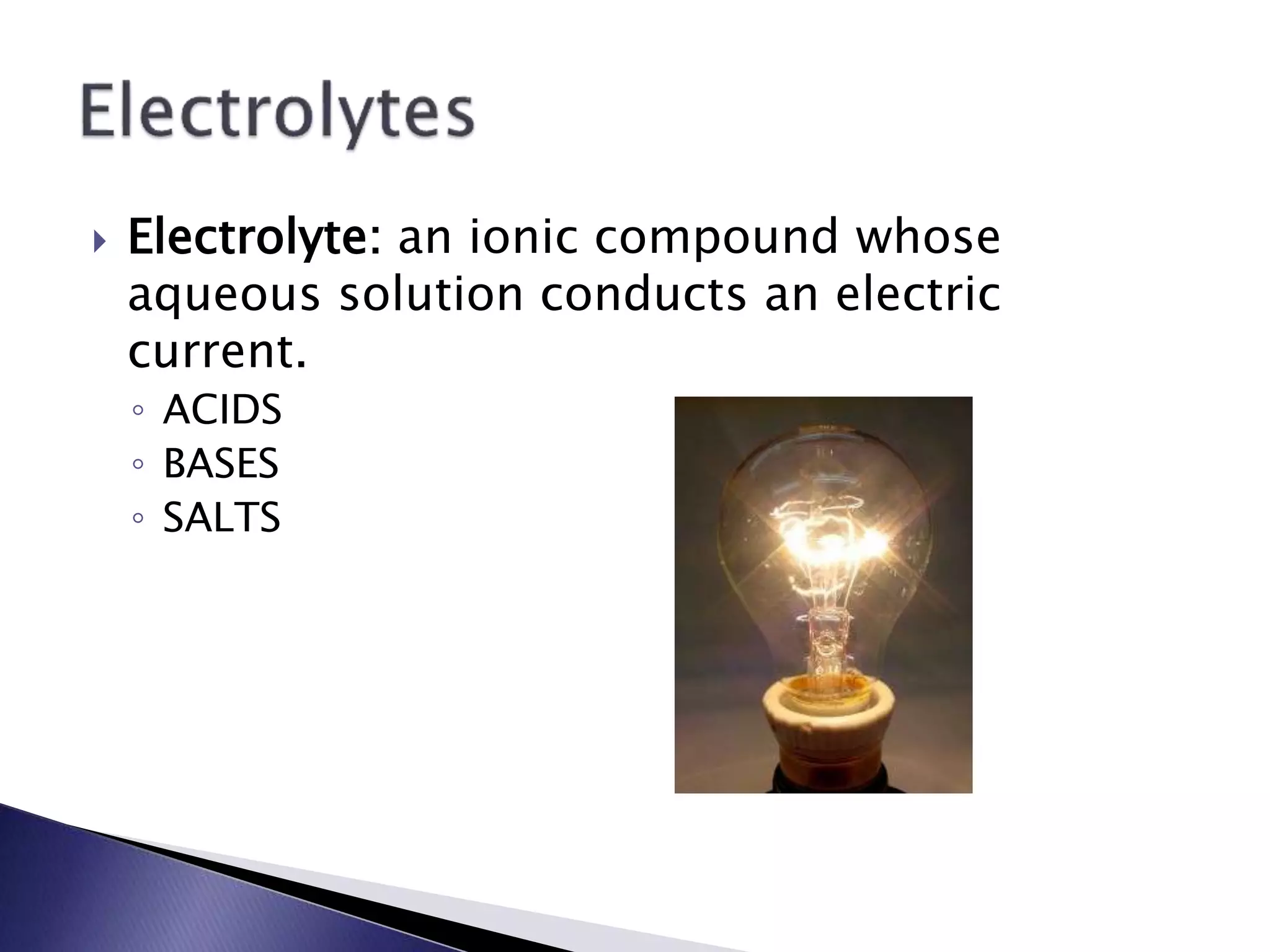
 Electrolyte: an ionic compound whose 
aqueous solution conducts an electric 
current. 
◦ ACIDS 
◦ BASES 
◦ SALTS
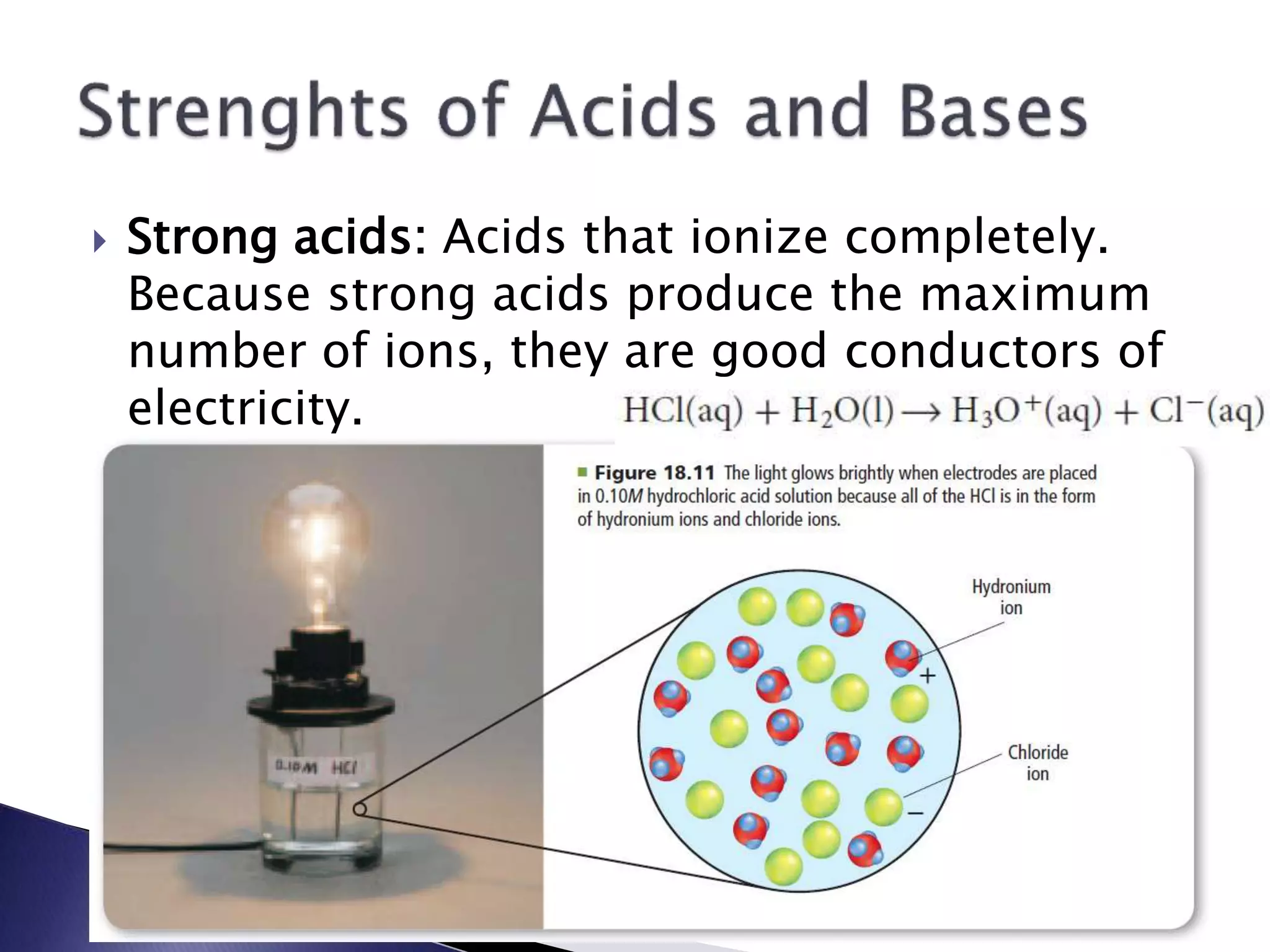
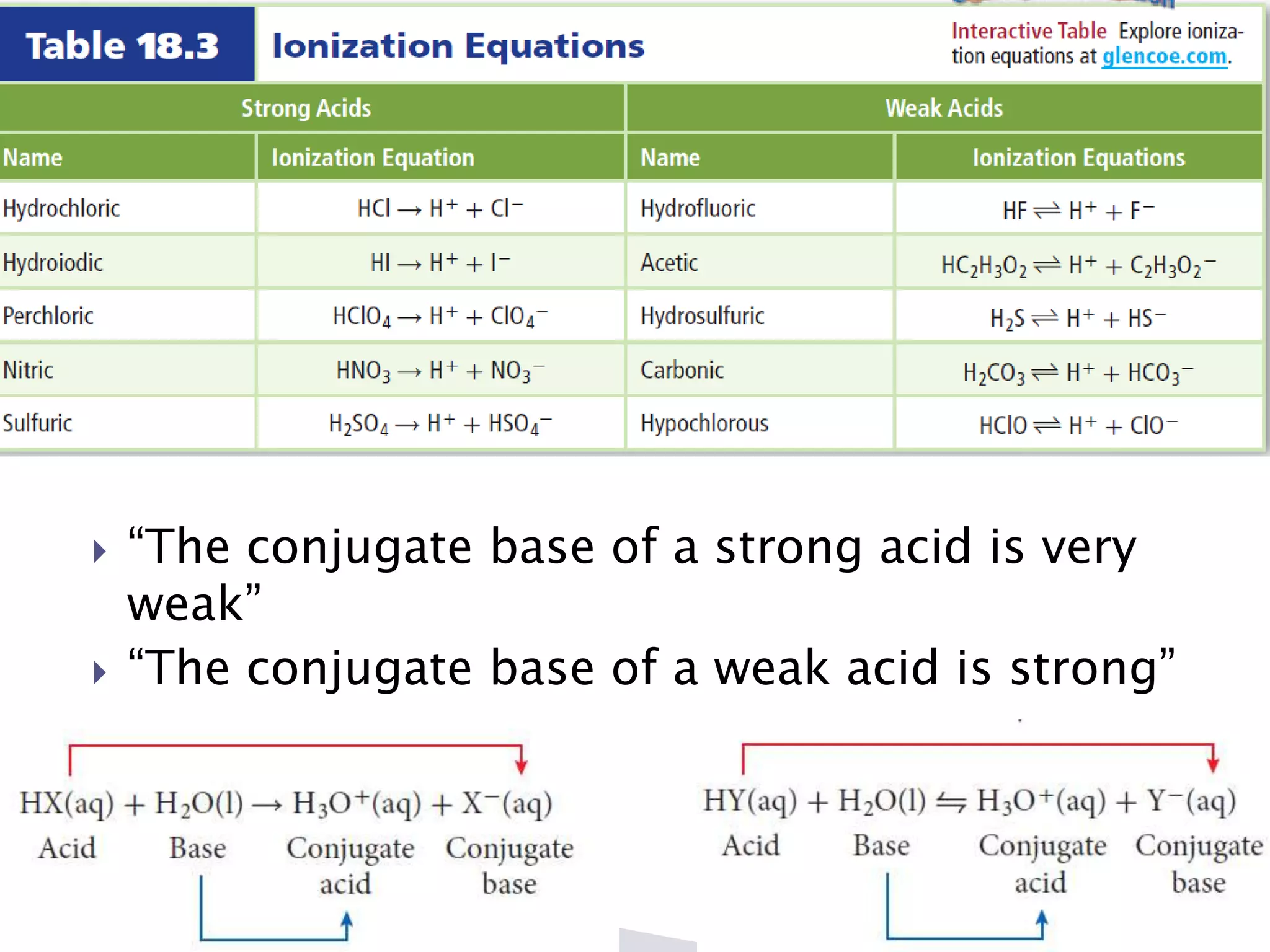
 Strong acids: Acids that ionize completely. 
Because strong acids produce the maximum 
number of ions, they are good conductors of 
electricity.
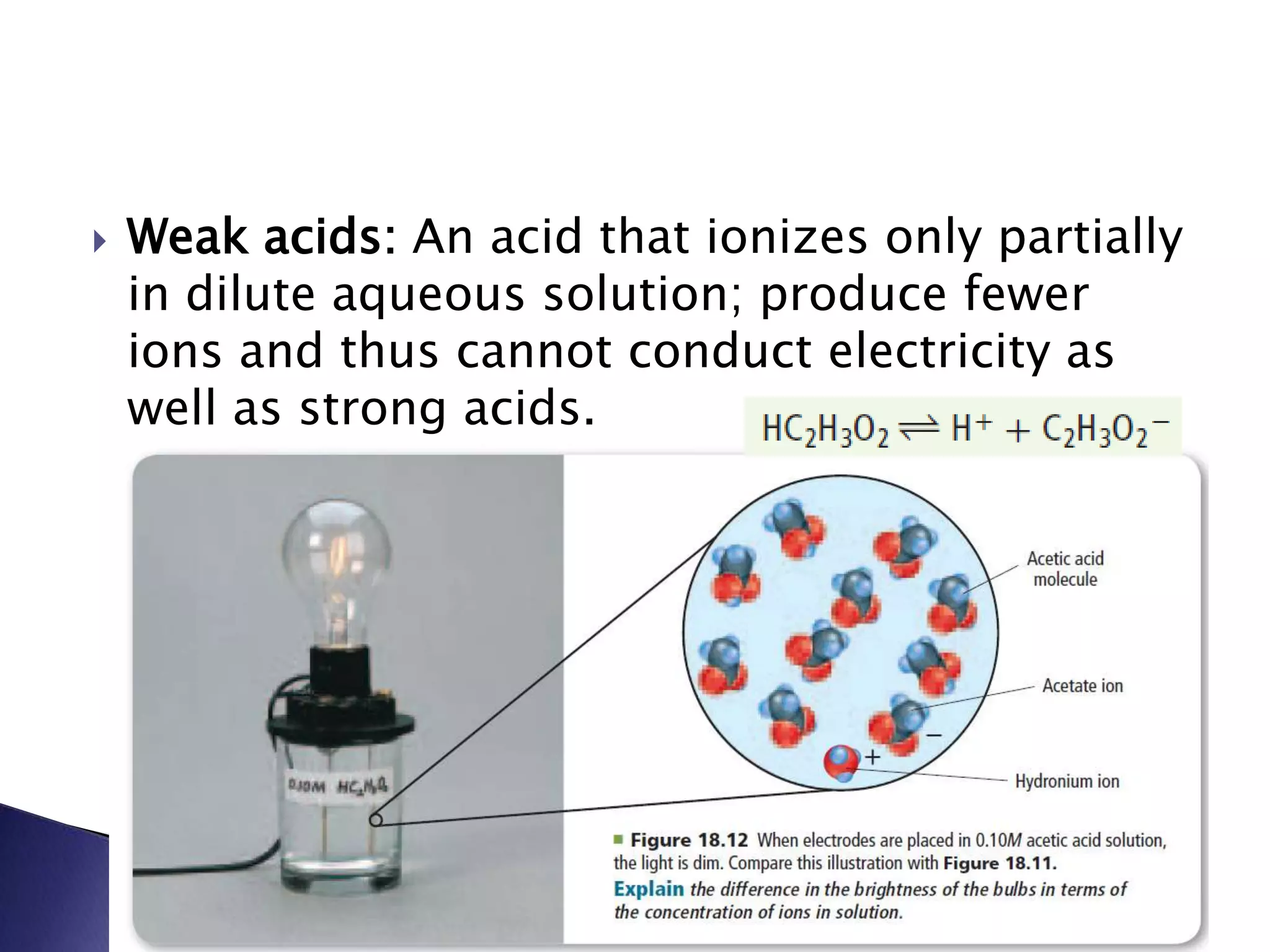
 Weak acids: An acid that ionizes only partially 
in dilute aqueous solution; produce fewer 
ions and thus cannot conduct electricity as 
well as strong acids.
 “The conjugate base of a strong acid is very 
weak” 
 “The conjugate base of a weak acid is strong”
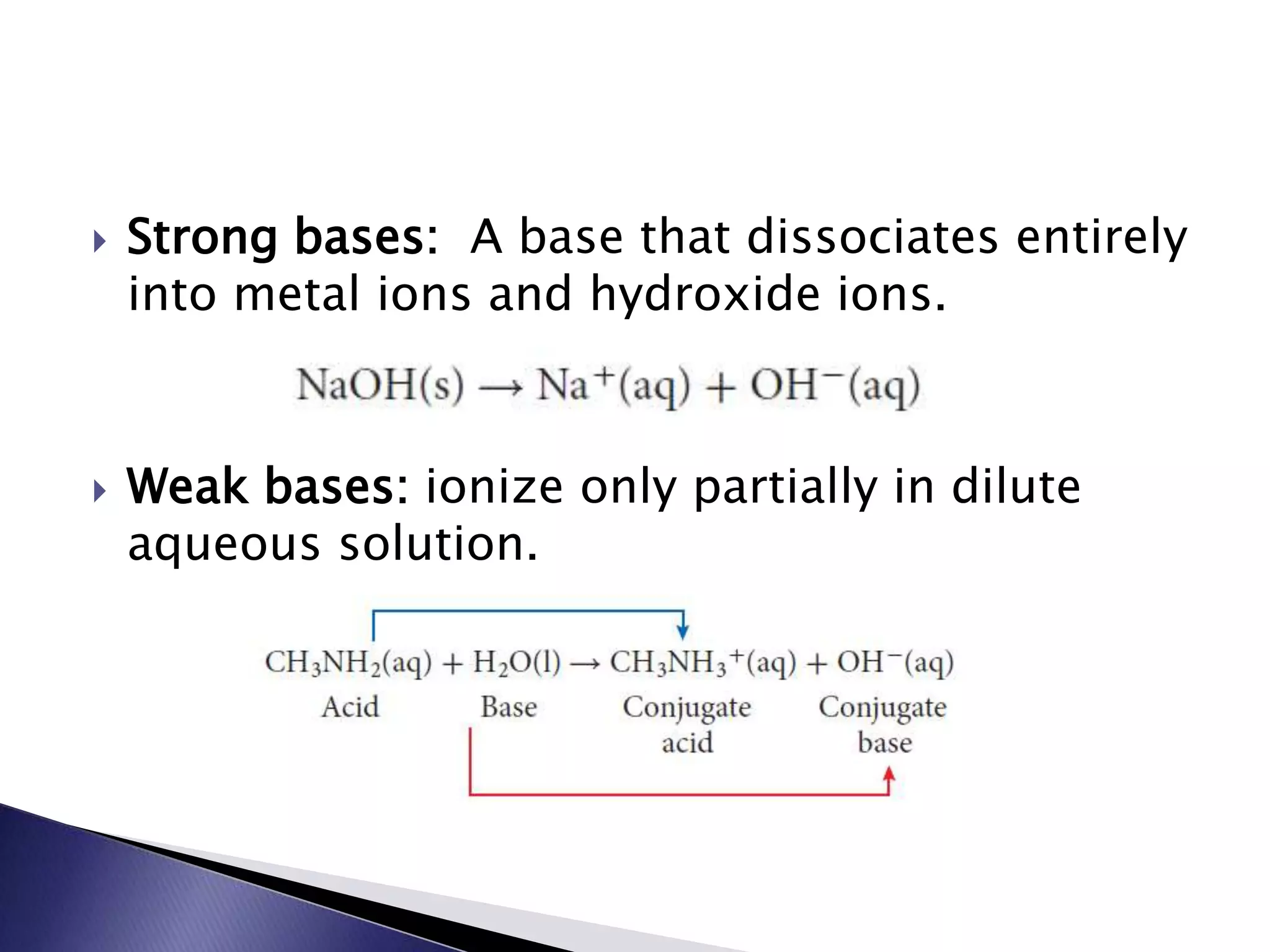
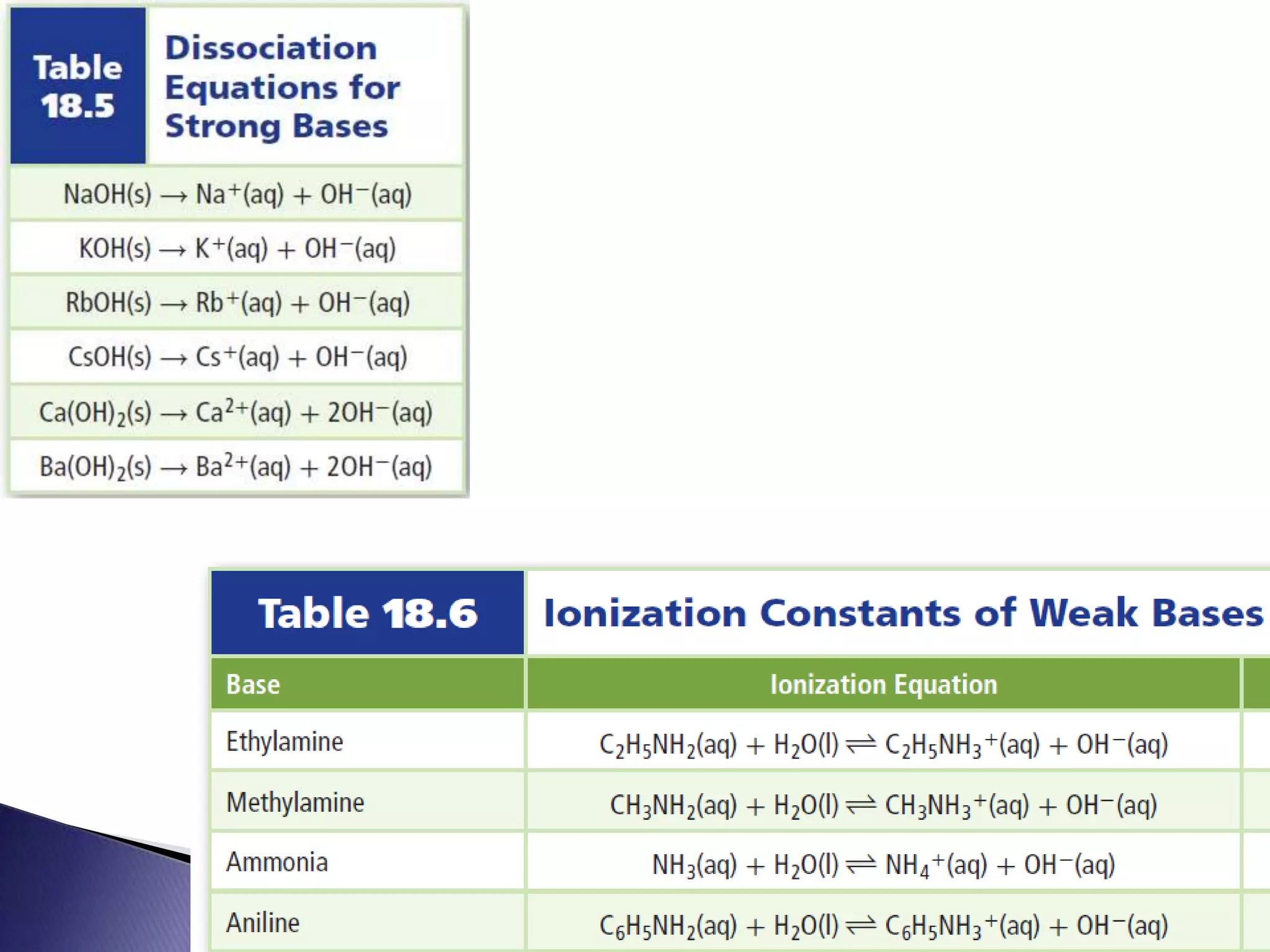
 Strong bases: A base that dissociates entirely 
into metal ions and hydroxide ions. 
 Weak bases: ionize only partially in dilute 
aqueous solution.
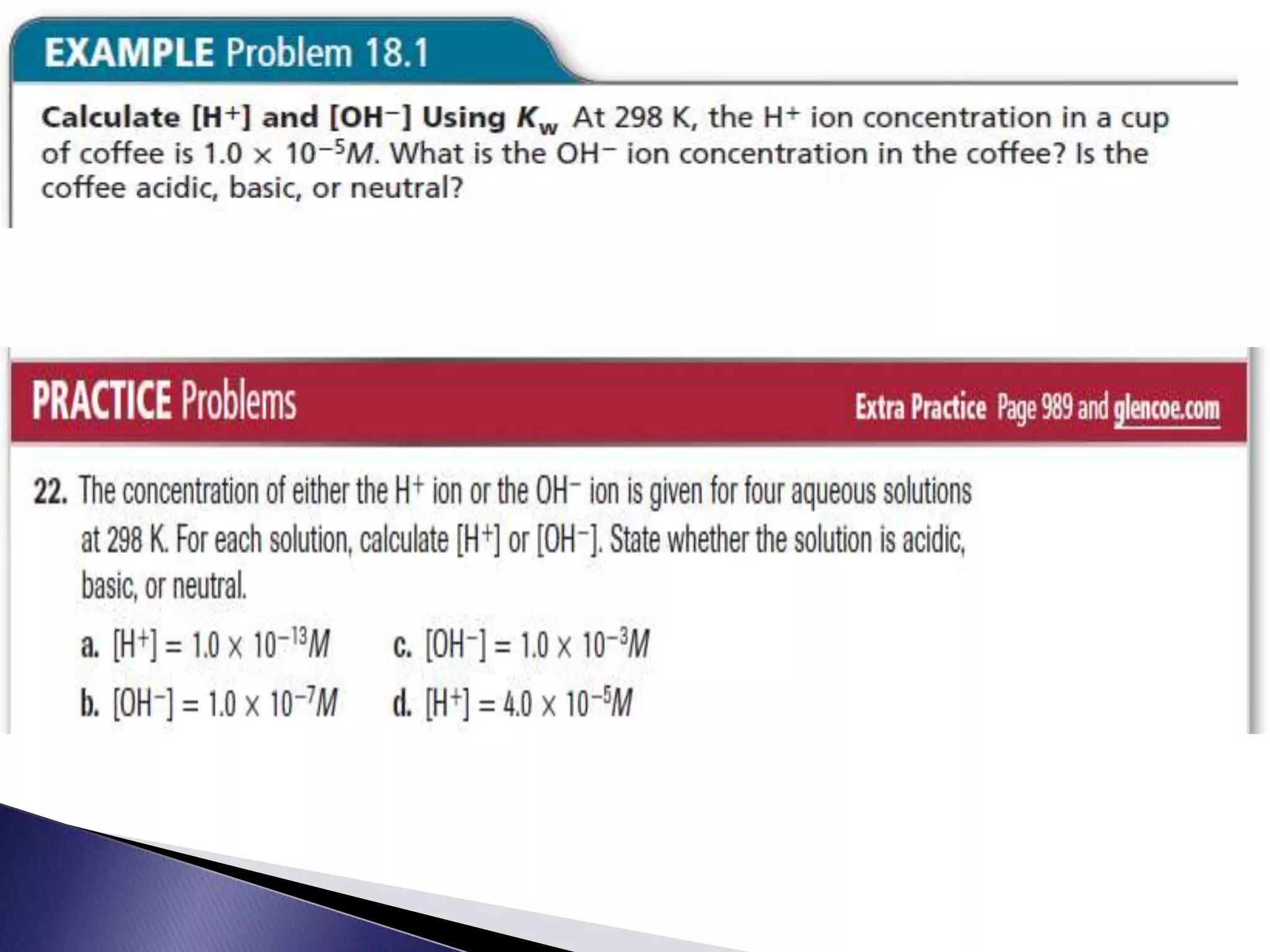
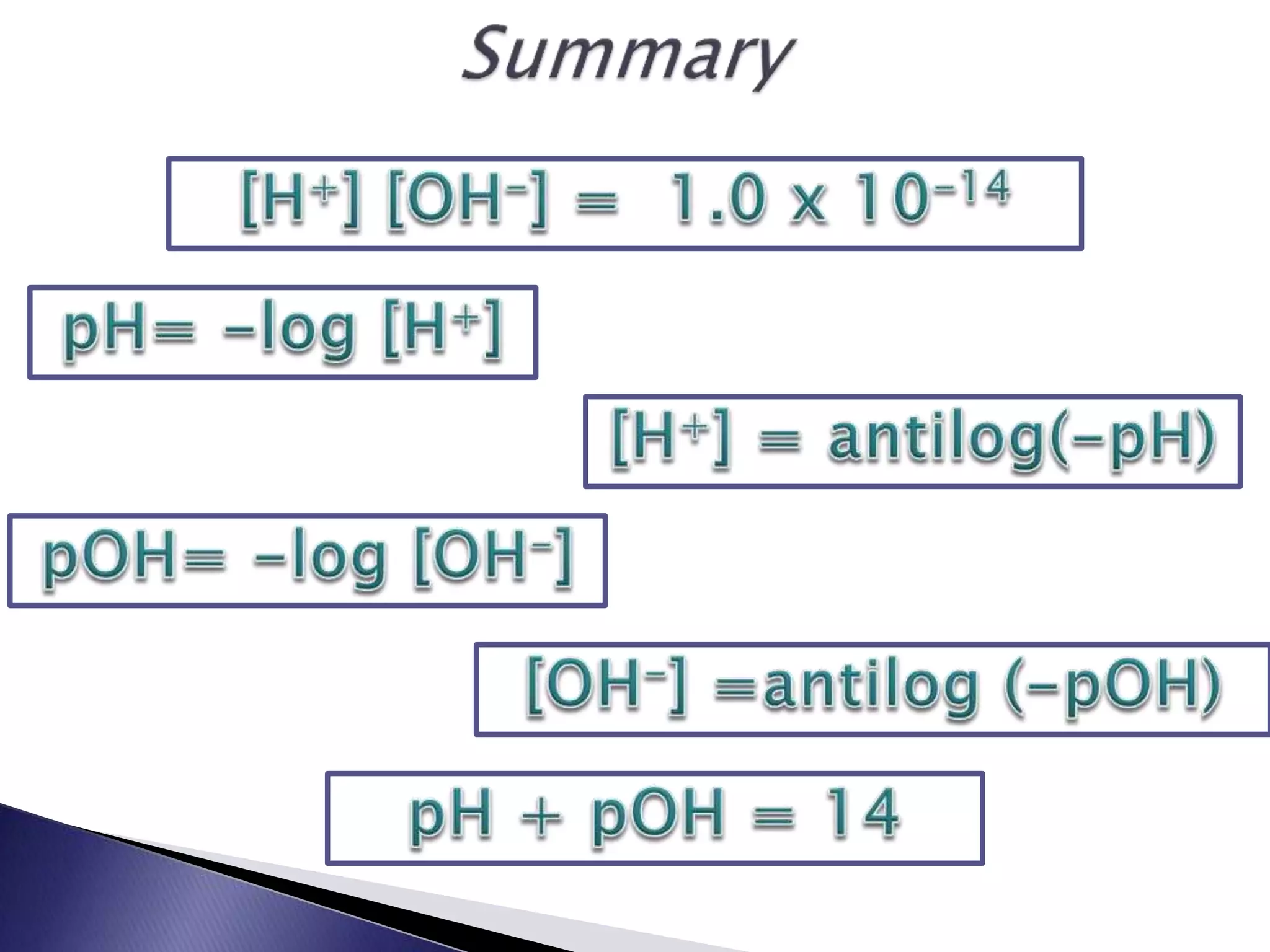
 Pure water contains equal concentrations of H+ and OH- ions 
produced by self-ionization. 
 The ion product constant for water is the value of the equilibrium 
constant expression for the self-ionization of water. 
In pure water at 25º C: 
[H3O+] = 1.0 x 10⁻⁷ M 
[OH-] = 1.0 x 10⁻⁷ M
 In pure water, the concentration of 
hydronium ions equals the concentration of 
hydroxide ions. This product is called the ion 
product constant of water Kw 
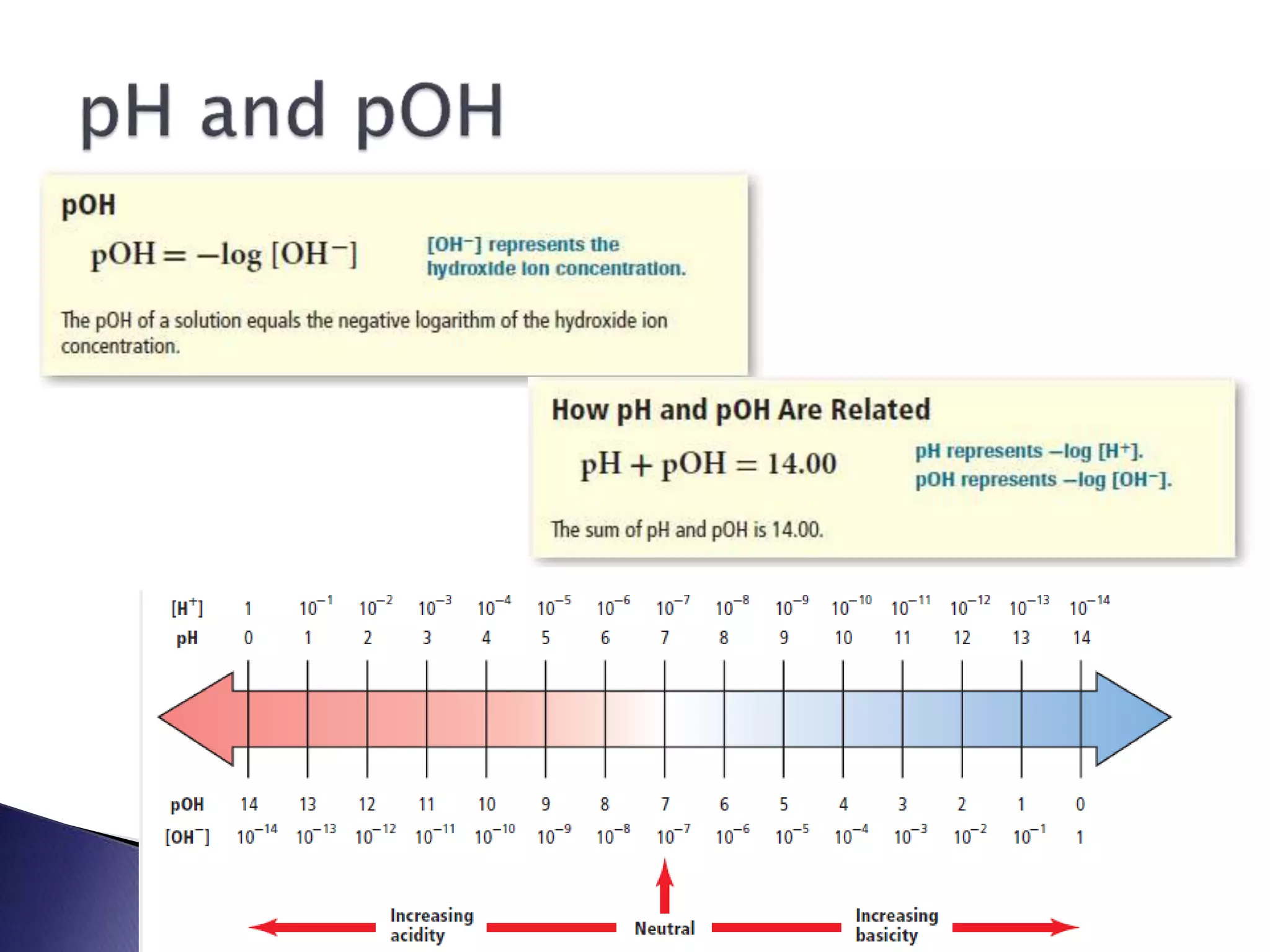
Acidic solutions • The [H+] is greater than 1.0 x 10⁻⁷ M 
Basic solutions • The [H+] is lower than 1.0 x 10⁻⁷ M 
• The [H+] is equal to 1.0 x 10⁻⁷ M 
Neutral 
solutions
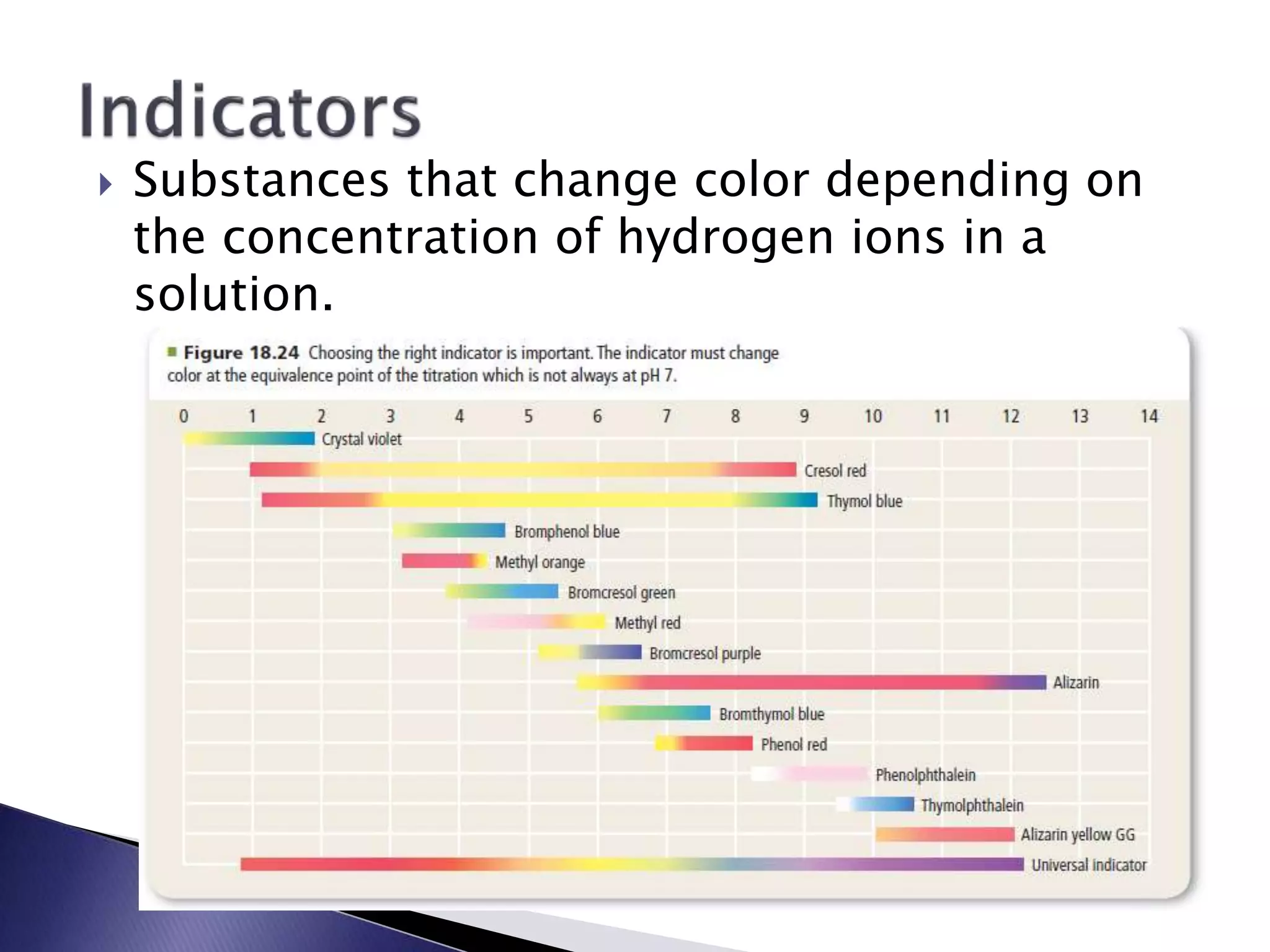
 Substances that change color depending on 
the concentration of hydrogen ions in a 
solution.
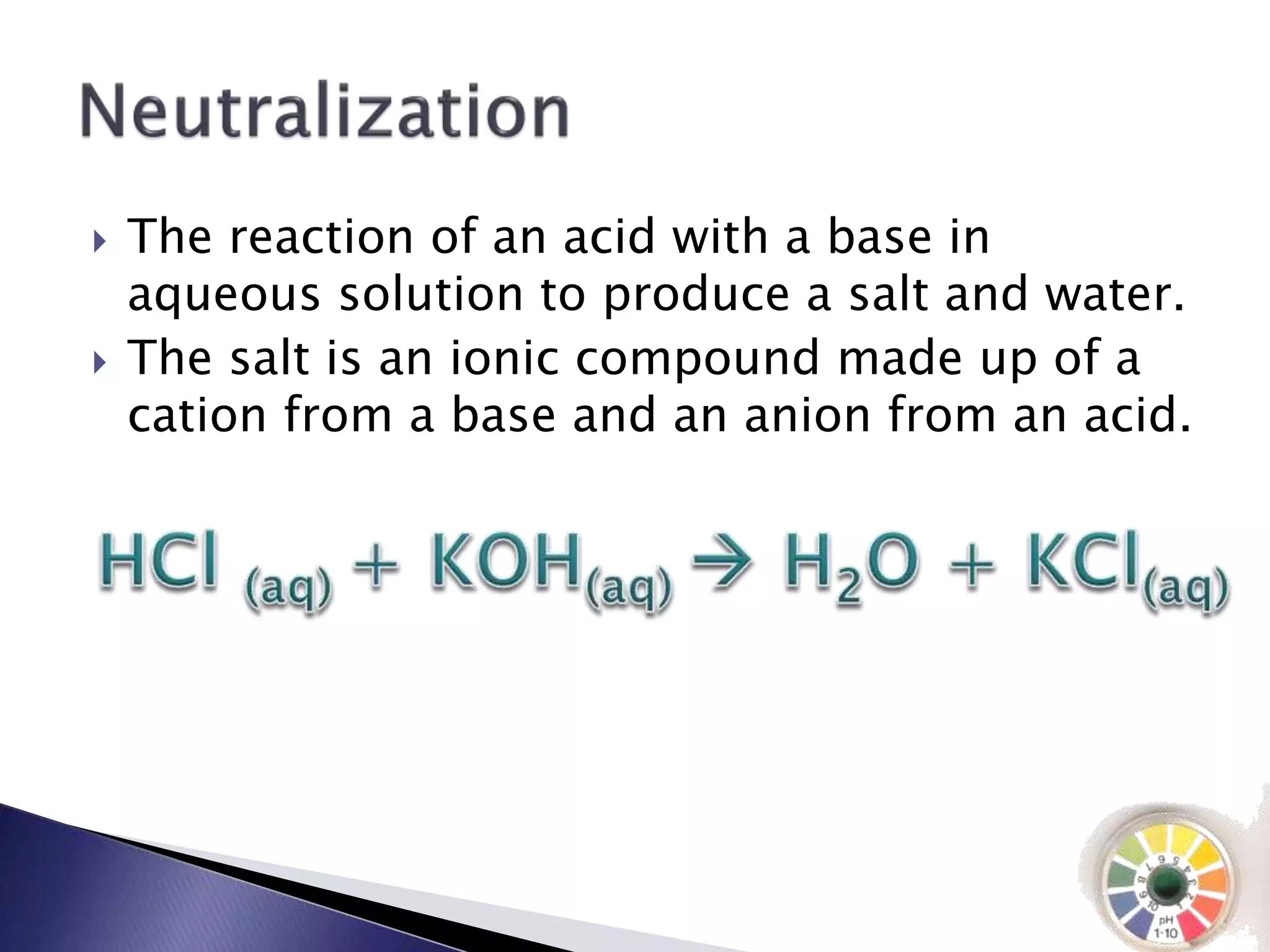
 The reaction of an acid with a base in 
aqueous solution to produce a salt and water. 
 The salt is an ionic compound made up of a 
cation from a base and an anion from an acid.
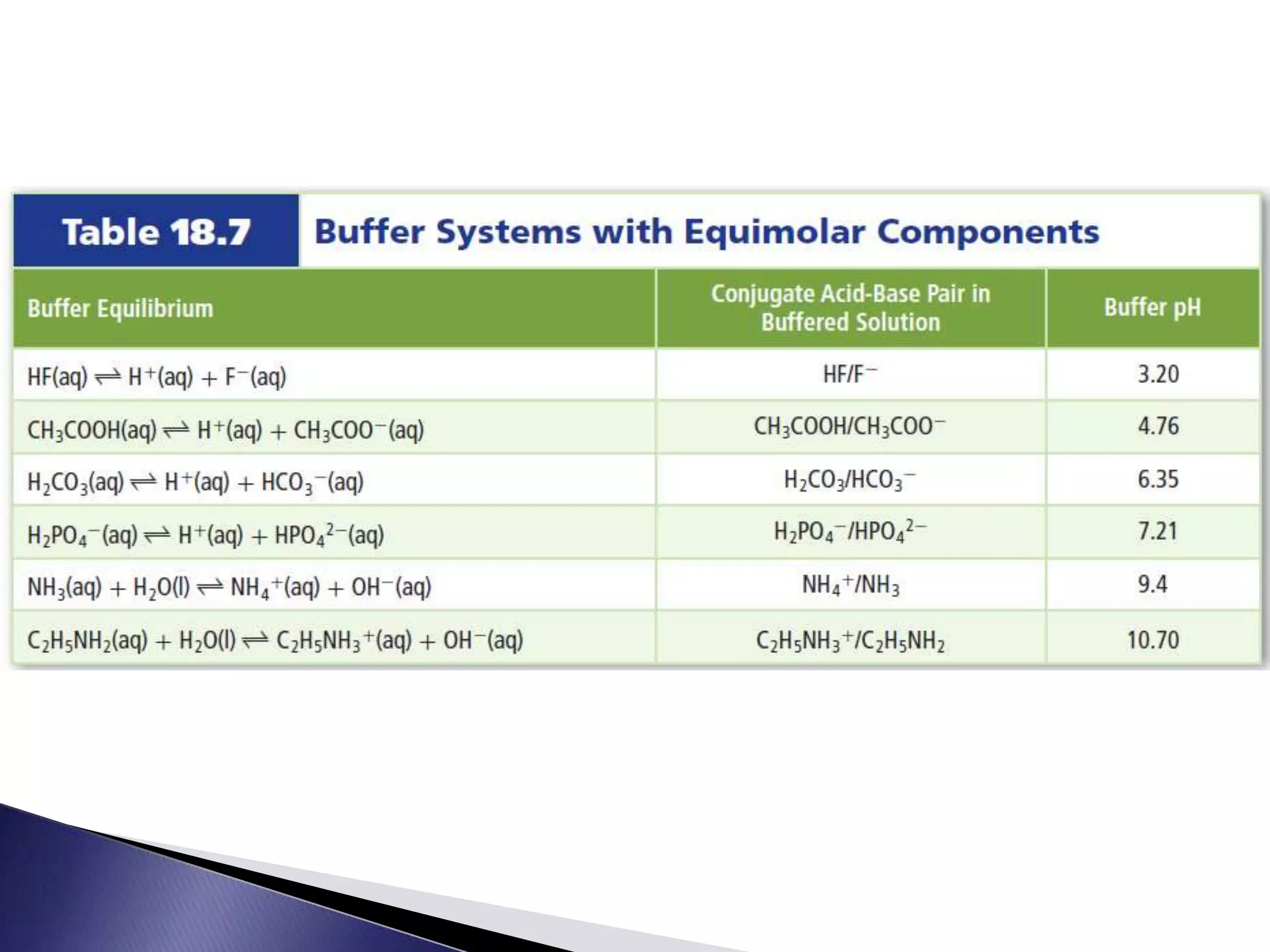
 Buffers are solutions that resist changes in pH 
when limited amounts of acid or base are 
added. 
 Is a mixture of a weak acid and its conjugate 
base or a weak base and its conjugate acid. 
 The mixture of ions and molecules in a buffer 
solution resists changes in pH by reacting 
with any hydrogen ions or hydroxide ions 
added to the buffered solution.
 A buffer solution’s capacity to resist pH 
change can be exceeded by the addition of 
too much acid or base. The amount of acid or 
base a buffer solution can absorb without a 
significant change in pH is called the buffer 
capacity of the solution. 
 The greater the concentrations of the 
buffering molecules and ions in the solution, 
the greater the solution’s buffer capacity.
Unit 3

Unit 3

  • 1.
    UNIVERSIDAD AUTÓNOMA DENUEVO LEON CIDEB  STAGE III: ACIDS AND BASES, OPPOSITES THAT NEUTRALIZE
  • 2.
     Formative Objective:The student solves theoretical and experimental problems related to acidic and basic solutions in daily life. Thinks about the negative effects of acid rain in the surroundings and propose possible solutions to this environmental phenomenon
  • 3.
    ACIDS •Taste sour •In aqueous solution, conduct electricity •React with bases to form salt and water •React with metals to form hydrogen gas •React with carbonates to form carbon dioxide, water and a salt •Corrosive •Contain hydrogen ions (H+) •Have a pH lower than 7 •Turn blue litmus paper to a red colour BASES •Taste bitter •Feel slippery or soapy •In aqueous solution, conduct electricity •React with acids to form salts and water •Corrosive •Contain hydroxyl ions (OH-) •Have a pH higher than 7 •Turn red litmus paper to a blue colour
  • 4.
     Magnesium andzinc react with aqueous solutions of acids to produce hydrogen gas.  Metal carbonates and hydrogen carbonates also react with aqueous solutions of acids to produce carbon dioxide (CO2) gas.
  • 5.
     All watersolutions contain hydrogen ions (H+) and hydroxide ions (OH-).  An acidic solution contains more hydrogen ions than hydroxide ions.  A basic solution contains more hydroxide ions than hydrogen ions.  A neutral solution contains equal concentrations of hydrogen ions and hydroxide ions
  • 6.
     Pure waterproduces equal numbers of H + ions and OH- ions in a process called self-ionization, in which water molecules react to form a hydronium ion and a hydroxide ion.
  • 7.
    Bases release hydroxide ions in water Acids release hydrogen ions in water
  • 8.
     States thatan acid is a substance that contains hydrogen and ionizes to produce hydrogen ions in aqueous solution.  A base is a substance that contains a hydroxide group and dissociates to produce a hydroxide ion in aqueous solution.  BUT, Ammonia (NH3) and sodium carbonate (Na2CO3) do not contain a hydroxide group, yet both substances produce hydroxide ions in solution and are well-known bases.
  • 9.
    Base is aproton acceptor; it accepts a hydrogen ion, H+ Acid is a proton donor; it donates a hydrogen ion, H+
  • 10.
     When amolecule of acid HX dissolves in water, it donates a H + ion to a water molecule. The water molecule acts as a base and accepts the H + ion. ◦ The hydronium ion is an acid because it has an extra H + ion that it can donate. ◦ X - is a base because it has a negative charge and can readily accept a positive hydrogen ion.
  • 11.
     Conjugate acid:is produced when a base accepts a hydrogen ion.  Conjugate base: is produced when an acid donates a hydrogen ion. Conjugate acid-base pair consists of two substances related to each other by the donating and accepting of a single hydrogen ion.
  • 12.
     Hydrogen fluoride:A Brønsted-Lowry acid  Ammonia: A Brønsted-Lowry base  Water: a Brønsted-Lowry acid and base; water is AMPHOTERIC because can act as both acid and base
  • 13.
     To writethe conjugate base of an acid: ◦ A H+ is lost ◦ The compound becomes more negative. H2O  OH-HNO ACIDS CONJUGATE BASES 3 -  NO3  To write the conjugate acid of a base: ◦ A H+ is added ◦ The compound becomes more positive. -2  HSO4 SO4 - BASES CONJUGATE ACIDS -  HC2H3O2 C2H3O2
  • 15.
    Ionization of sulfuricacid in two steps
  • 16.
    • Can donateonly one hydrogen ion (proton) per formula unit. • Ex: HCl, HNO3, HC2H3O2 Monoprotic acids • Contain two ionizable hydrogen atoms per molecule. • Ex: H2SO4 Diprotic acids • Contain three hydrogen ions to donate Triprotic acids • Ex: H3PO4 • Any acid that has more than one ionizable hydrogen atomPolyprotic acids .
  • 17.
     The differencebetween acetic acid’s ionizable hydrogen atom and the other three hydrogen atoms is that the ionizable atom is bonded to the element oxygen, which is more electronegative than hydrogen. The difference in electronegativity makes the bond between oxygen and hydrogen polar
  • 20.
     Observe thefollowing reaction: H2O + CH3NH2 → OH- + CH3NH3 +  Is an acid-base reaction according to Arrhenius model? If so, identify the acid and the base.  Is an acid-base reaction according to Bronsted-Lowry model? If so, identify the acid and the base.
  • 21.
     Electrolyte: anionic compound whose aqueous solution conducts an electric current. ◦ ACIDS ◦ BASES ◦ SALTS
  • 22.
     Strong acids:Acids that ionize completely. Because strong acids produce the maximum number of ions, they are good conductors of electricity.
  • 23.
     Weak acids:An acid that ionizes only partially in dilute aqueous solution; produce fewer ions and thus cannot conduct electricity as well as strong acids.
  • 24.
     “The conjugatebase of a strong acid is very weak”  “The conjugate base of a weak acid is strong”
  • 25.
     Strong bases:A base that dissociates entirely into metal ions and hydroxide ions.  Weak bases: ionize only partially in dilute aqueous solution.
  • 28.
     Pure watercontains equal concentrations of H+ and OH- ions produced by self-ionization.  The ion product constant for water is the value of the equilibrium constant expression for the self-ionization of water. In pure water at 25º C: [H3O+] = 1.0 x 10⁻⁷ M [OH-] = 1.0 x 10⁻⁷ M
  • 29.
     In purewater, the concentration of hydronium ions equals the concentration of hydroxide ions. This product is called the ion product constant of water Kw Acidic solutions • The [H+] is greater than 1.0 x 10⁻⁷ M Basic solutions • The [H+] is lower than 1.0 x 10⁻⁷ M • The [H+] is equal to 1.0 x 10⁻⁷ M Neutral solutions
  • 37.
     Substances thatchange color depending on the concentration of hydrogen ions in a solution.
  • 38.
     The reactionof an acid with a base in aqueous solution to produce a salt and water.  The salt is an ionic compound made up of a cation from a base and an anion from an acid.
  • 39.
     Buffers aresolutions that resist changes in pH when limited amounts of acid or base are added.  Is a mixture of a weak acid and its conjugate base or a weak base and its conjugate acid.  The mixture of ions and molecules in a buffer solution resists changes in pH by reacting with any hydrogen ions or hydroxide ions added to the buffered solution.
  • 40.
     A buffersolution’s capacity to resist pH change can be exceeded by the addition of too much acid or base. The amount of acid or base a buffer solution can absorb without a significant change in pH is called the buffer capacity of the solution.  The greater the concentrations of the buffering molecules and ions in the solution, the greater the solution’s buffer capacity.