Acid and Bases
Acid and Bases
Acid and Bases
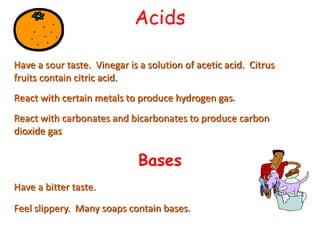
Acids
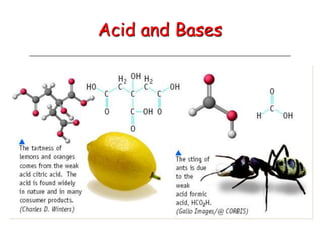
Have a sour taste. Vinegar is a solution of acetic acid. Citrus
fruits contain citric acid.
React with certain metals to produce hydrogen gas.
React with carbonates and bicarbonates to produce carbon
dioxide gas
Have a bitter taste.
Feel slippery. Many soaps contain bases.
Bases
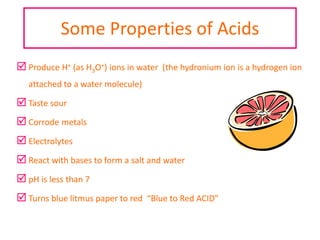
Some Properties of Acids
 Produce H+ (as H3O+) ions in water (the hydronium ion is a hydrogen ion
attached to a water molecule)
 Taste sour
 Corrode metals
 Electrolytes
 React with bases to form a salt and water
 pH is less than 7
 Turns blue litmus paper to red “Blue to Red ACID”
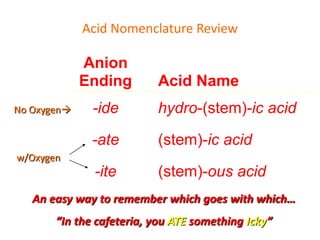
Anion
Ending Acid Name
-ide hydro-(stem)-ic acid
-ate (stem)-ic acid
-ite (stem)-ous acid
Acid Nomenclature Review
No Oxygen
w/Oxygen
An easy way to remember which goes with which…
“In the cafeteria, you ATE something Icky”
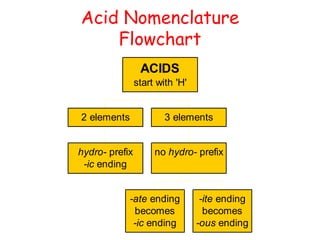
Acid Nomenclature
Flowchart
hydro- prefix
-ic ending
2 elements
-ate ending
becomes
-ic ending
-ite ending
becomes
-ous ending
no hydro- prefix
3 elements
ACIDS
start with 'H'
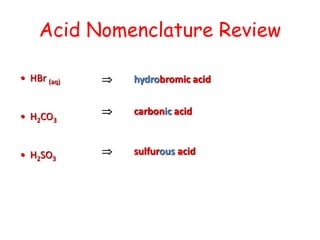
• HBr (aq)
• H2CO3
• H2SO3
 hydrobromic acid
 carbonic acid
 sulfurous acid
Acid Nomenclature Review
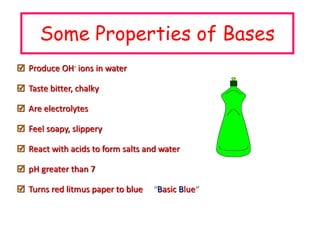
Some Properties of Bases
 Produce OH- ions in water
 Taste bitter, chalky
 Are electrolytes
 Feel soapy, slippery
 React with acids to form salts and water
 pH greater than 7
 Turns red litmus paper to blue “Basic Blue”
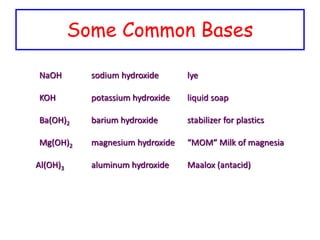
Some Common Bases
NaOH sodium hydroxide lye
KOH potassium hydroxide liquid soap
Ba(OH)2 barium hydroxide stabilizer for plastics
Mg(OH)2 magnesium hydroxide “MOM” Milk of magnesia
Al(OH)3 aluminum hydroxide Maalox (antacid)
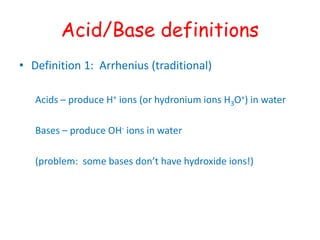
Acid/Base definitions
• Definition 1: Arrhenius (traditional)
Acids – produce H+ ions (or hydronium ions H3O+) in water
Bases – produce OH- ions in water
(problem: some bases don’t have hydroxide ions!)
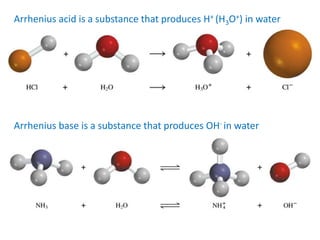
Arrhenius acid is a substance that produces H+ (H3O+) in water
Arrhenius base is a substance that produces OH- in water
Acid/Base Definitions
• Definition 2: Brønsted Lowry
Acids : proton donor
Bases : proton acceptor
A “proton” is really just a hydrogen atom
that has lost it’s electron!
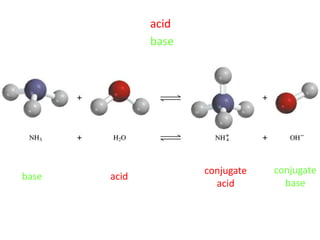
A Brønsted-Lowry acid is a proton donor
A Brønsted-Lowry base is a proton acceptor
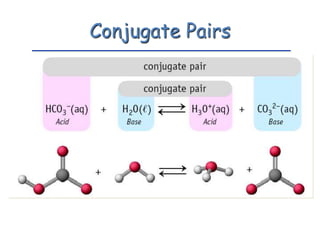
acid
conjugate
base
base
conjugate
acid
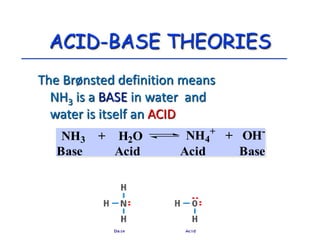
ACID-BASE THEORIES
The Brønsted definition means
NH3 is a BASE in water and
water is itself an ACID
Base
Acid
Acid
Base
NH4
+
+ OH-
NH3 + H2O
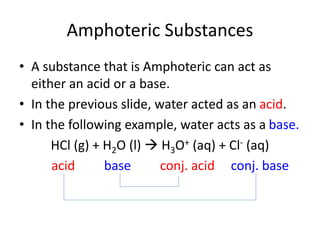
Amphoteric Substances
• A substance that is Amphoteric can act as
either an acid or a base.
• In the previous slide, water acted as an acid.
• In the following example, water acts as a base.
HCl (g) + H2O (l)  H3O+ (aq) + Cl- (aq)
acid base conj. acid conj. base
Conjugate Pairs
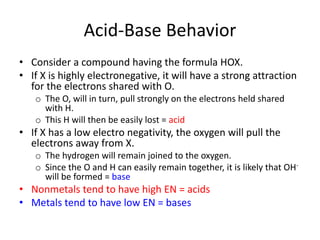
Acid-Base Behavior
• Consider a compound having the formula HOX.
• If X is highly electronegative, it will have a strong attraction
for the electrons shared with O.
o The O, will in turn, pull strongly on the electrons held shared
with H.
o This H will then be easily lost = acid
• If X has a low electro negativity, the oxygen will pull the
electrons away from X.
o The hydrogen will remain joined to the oxygen.
o Since the O and H can easily remain together, it is likely that OH-
will be formed = base
• Nonmetals tend to have high EN = acids
• Metals tend to have low EN = bases
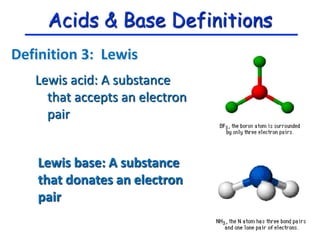
Acids & Base Definitions
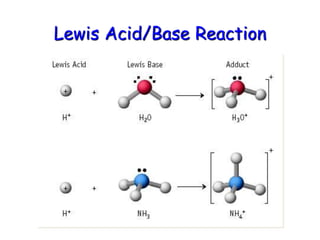
Lewis acid: A substance
that accepts an electron
pair
Lewis base: A substance
that donates an electron
pair
Definition 3: Lewis
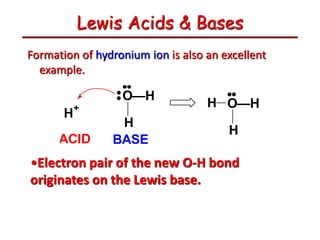
Formation of hydronium ion is also an excellent
example.
Lewis Acids & Bases
•Electron pair of the new O-H bond
originates on the Lewis base.
H
H
H
BASE
••
•
•••
O—H
O—H
H+
ACID
Lewis Acid/Base Reaction

Acid and Base Definitions.ppt

  • 1.
  • 2.
  • 3.
  • 4.
    Acids Have a sourtaste. Vinegar is a solution of acetic acid. Citrus fruits contain citric acid. React with certain metals to produce hydrogen gas. React with carbonates and bicarbonates to produce carbon dioxide gas Have a bitter taste. Feel slippery. Many soaps contain bases. Bases
  • 5.
    Some Properties ofAcids  Produce H+ (as H3O+) ions in water (the hydronium ion is a hydrogen ion attached to a water molecule)  Taste sour  Corrode metals  Electrolytes  React with bases to form a salt and water  pH is less than 7  Turns blue litmus paper to red “Blue to Red ACID”
  • 6.
    Anion Ending Acid Name -idehydro-(stem)-ic acid -ate (stem)-ic acid -ite (stem)-ous acid Acid Nomenclature Review No Oxygen w/Oxygen An easy way to remember which goes with which… “In the cafeteria, you ATE something Icky”
  • 7.
    Acid Nomenclature Flowchart hydro- prefix -icending 2 elements -ate ending becomes -ic ending -ite ending becomes -ous ending no hydro- prefix 3 elements ACIDS start with 'H'
  • 8.
    • HBr (aq) •H2CO3 • H2SO3  hydrobromic acid  carbonic acid  sulfurous acid Acid Nomenclature Review
  • 9.
    Some Properties ofBases  Produce OH- ions in water  Taste bitter, chalky  Are electrolytes  Feel soapy, slippery  React with acids to form salts and water  pH greater than 7  Turns red litmus paper to blue “Basic Blue”
  • 10.
    Some Common Bases NaOHsodium hydroxide lye KOH potassium hydroxide liquid soap Ba(OH)2 barium hydroxide stabilizer for plastics Mg(OH)2 magnesium hydroxide “MOM” Milk of magnesia Al(OH)3 aluminum hydroxide Maalox (antacid)
  • 11.
    Acid/Base definitions • Definition1: Arrhenius (traditional) Acids – produce H+ ions (or hydronium ions H3O+) in water Bases – produce OH- ions in water (problem: some bases don’t have hydroxide ions!)
  • 12.
    Arrhenius acid isa substance that produces H+ (H3O+) in water Arrhenius base is a substance that produces OH- in water
  • 13.
    Acid/Base Definitions • Definition2: Brønsted Lowry Acids : proton donor Bases : proton acceptor A “proton” is really just a hydrogen atom that has lost it’s electron!
  • 14.
    A Brønsted-Lowry acidis a proton donor A Brønsted-Lowry base is a proton acceptor acid conjugate base base conjugate acid
  • 15.
    ACID-BASE THEORIES The Brønsteddefinition means NH3 is a BASE in water and water is itself an ACID Base Acid Acid Base NH4 + + OH- NH3 + H2O
  • 16.
    Amphoteric Substances • Asubstance that is Amphoteric can act as either an acid or a base. • In the previous slide, water acted as an acid. • In the following example, water acts as a base. HCl (g) + H2O (l)  H3O+ (aq) + Cl- (aq) acid base conj. acid conj. base
  • 17.
  • 18.
    Acid-Base Behavior • Considera compound having the formula HOX. • If X is highly electronegative, it will have a strong attraction for the electrons shared with O. o The O, will in turn, pull strongly on the electrons held shared with H. o This H will then be easily lost = acid • If X has a low electro negativity, the oxygen will pull the electrons away from X. o The hydrogen will remain joined to the oxygen. o Since the O and H can easily remain together, it is likely that OH- will be formed = base • Nonmetals tend to have high EN = acids • Metals tend to have low EN = bases
  • 19.
    Acids & BaseDefinitions Lewis acid: A substance that accepts an electron pair Lewis base: A substance that donates an electron pair Definition 3: Lewis
  • 20.
    Formation of hydroniumion is also an excellent example. Lewis Acids & Bases •Electron pair of the new O-H bond originates on the Lewis base. H H H BASE •• • ••• O—H O—H H+ ACID
  • 21.