Presentation on
Acid, Base and Salts: Basic
concept
Presented by: Shisam Neupane
BPH, 1st semester
 Acids: Latin word “acidous” means sour
3 concepts have been supported till date for acid and
base:
1. Arrhenius concept
2. Bronsted-Lowry concept
3. Lewis concept
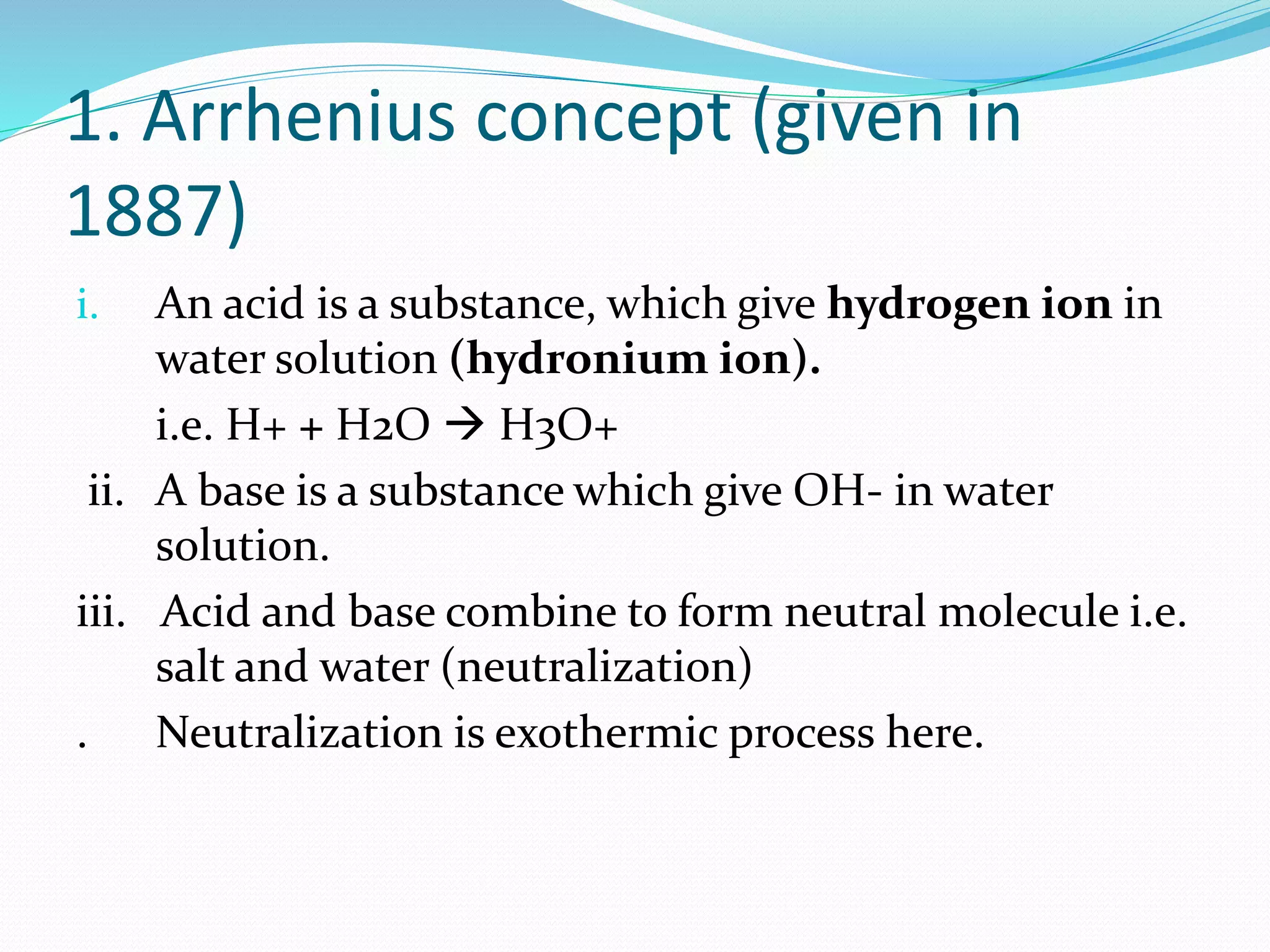
1. Arrhenius concept (given in
1887)
i. An acid is a substance, which give hydrogen ion in
water solution (hydronium ion).
i.e. H+ + H2O  H3O+
ii. A base is a substance which give OH- in water
solution.
iii. Acid and base combine to form neutral molecule i.e.
salt and water (neutralization)
. Neutralization is exothermic process here.
Limitations of Arr. concept
 Only for aqueous solution
 Acidic or basic nature of oxides isn’t explained
 Acidic or basic nature of salts isn’t explained
 No explanations for Amphoteric ions
Modified Arr. Concept
i. Basicity of acid: no. of replaceable H+ ion in
aq.solution
ii. Acidity of base: no. of replaceable OH- in aq.
solution
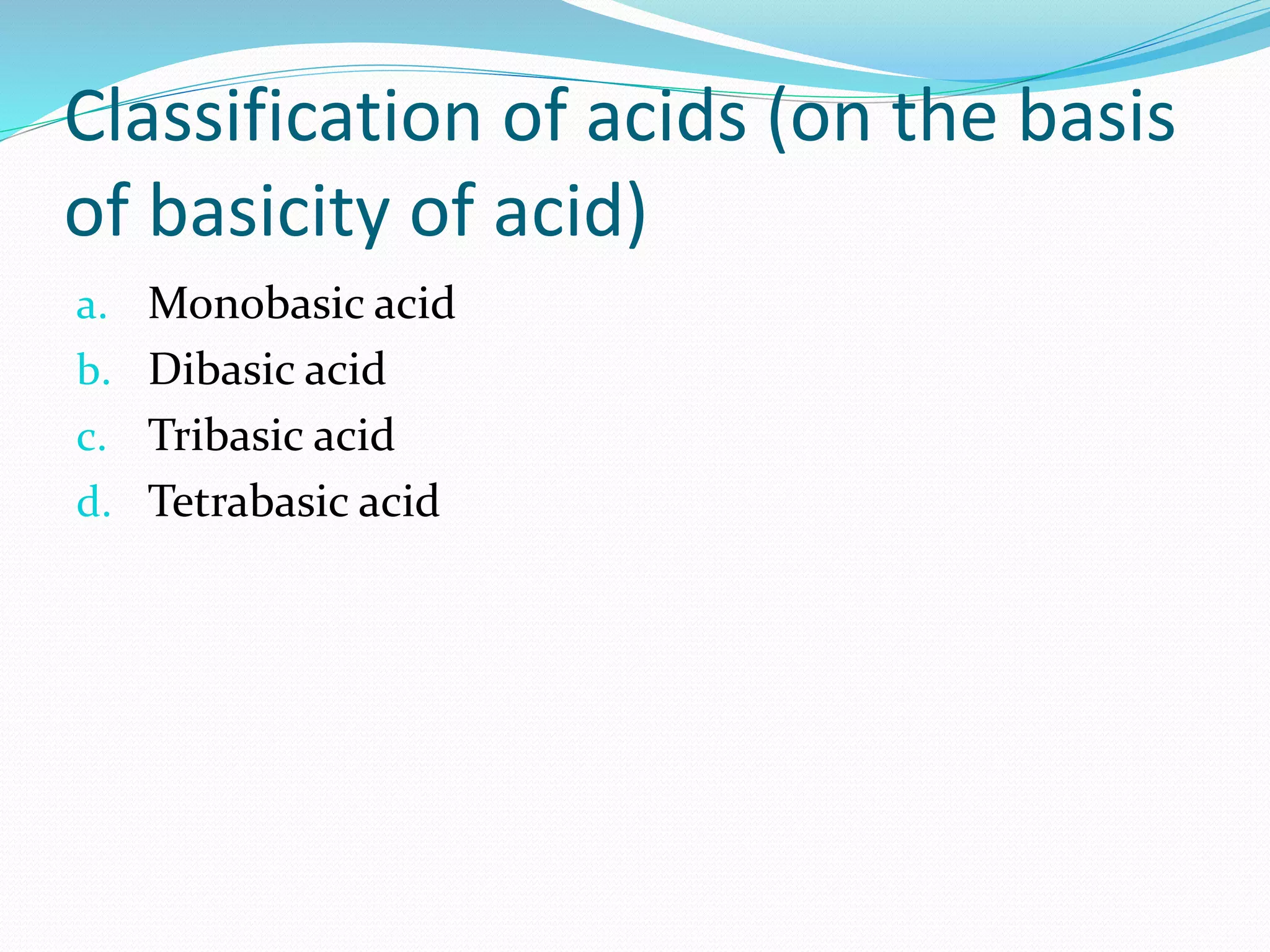
Classification of acids (on the basis
of basicity of acid)
a. Monobasic acid
b. Dibasic acid
c. Tribasic acid
d. Tetrabasic acid
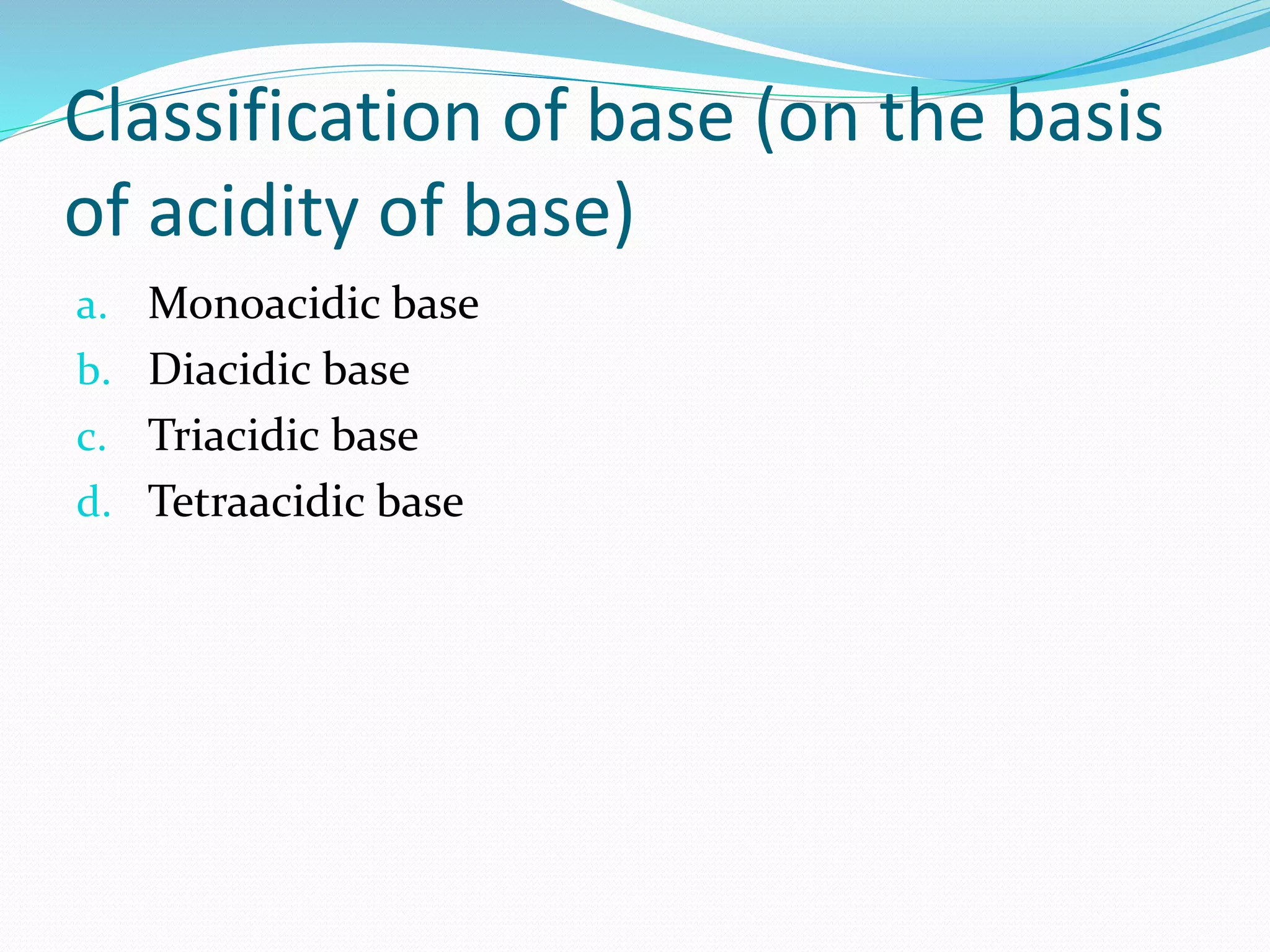
Classification of base (on the basis
of acidity of base)
a. Monoacidic base
b. Diacidic base
c. Triacidic base
d. Tetraacidic base
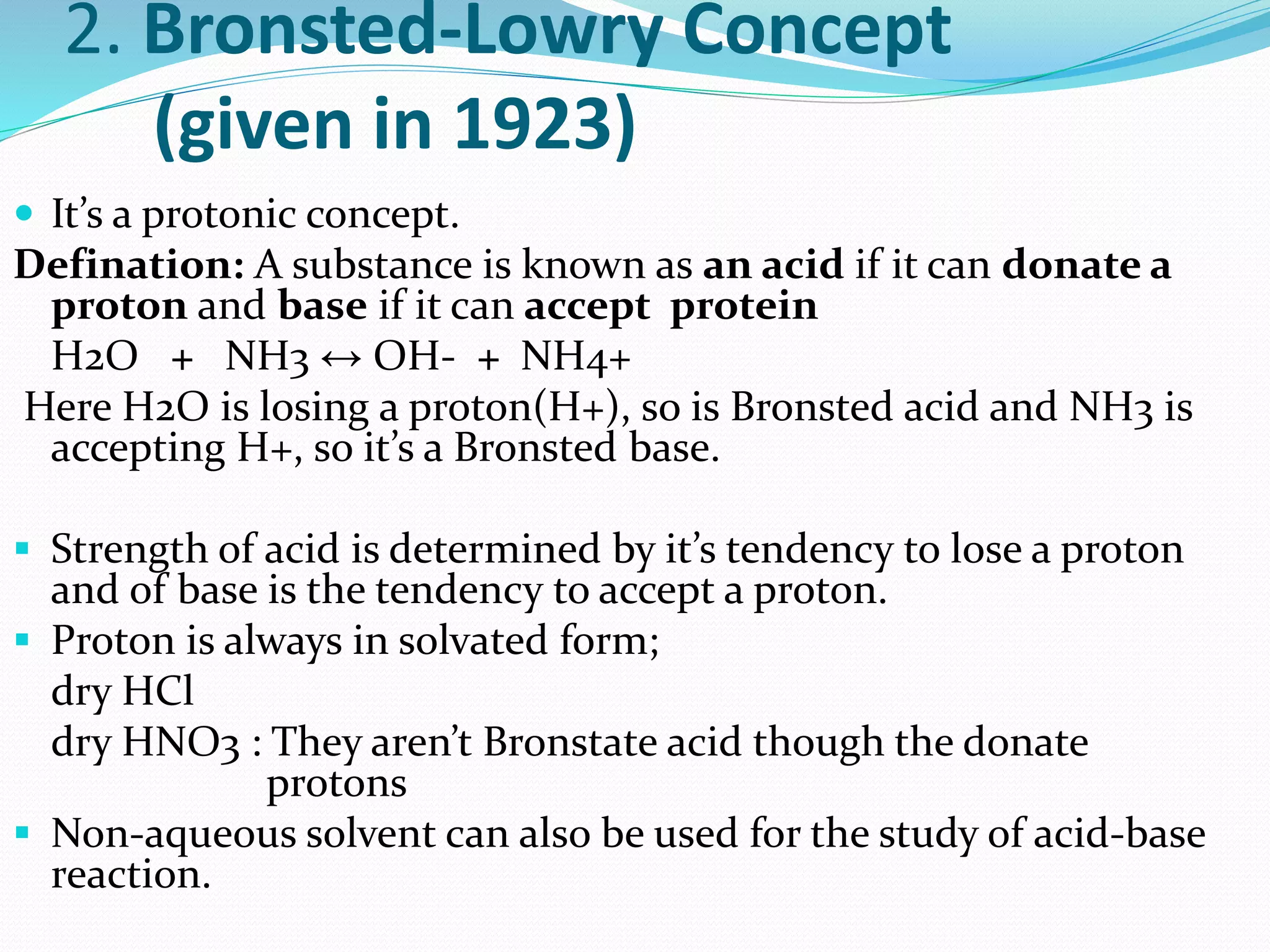
2. Bronsted-Lowry Concept
(given in 1923)
 It’s a protonic concept.
Defination: A substance is known as an acid if it can donate a
proton and base if it can accept protein
H2O + NH3 ↔ OH- + NH4+
Here H2O is losing a proton(H+), so is Bronsted acid and NH3 is
accepting H+, so it’s a Bronsted base.
 Strength of acid is determined by it’s tendency to lose a proton
and of base is the tendency to accept a proton.
 Proton is always in solvated form;
dry HCl
dry HNO3 : They aren’t Bronstate acid though the donate
protons
 Non-aqueous solvent can also be used for the study of acid-base
reaction.
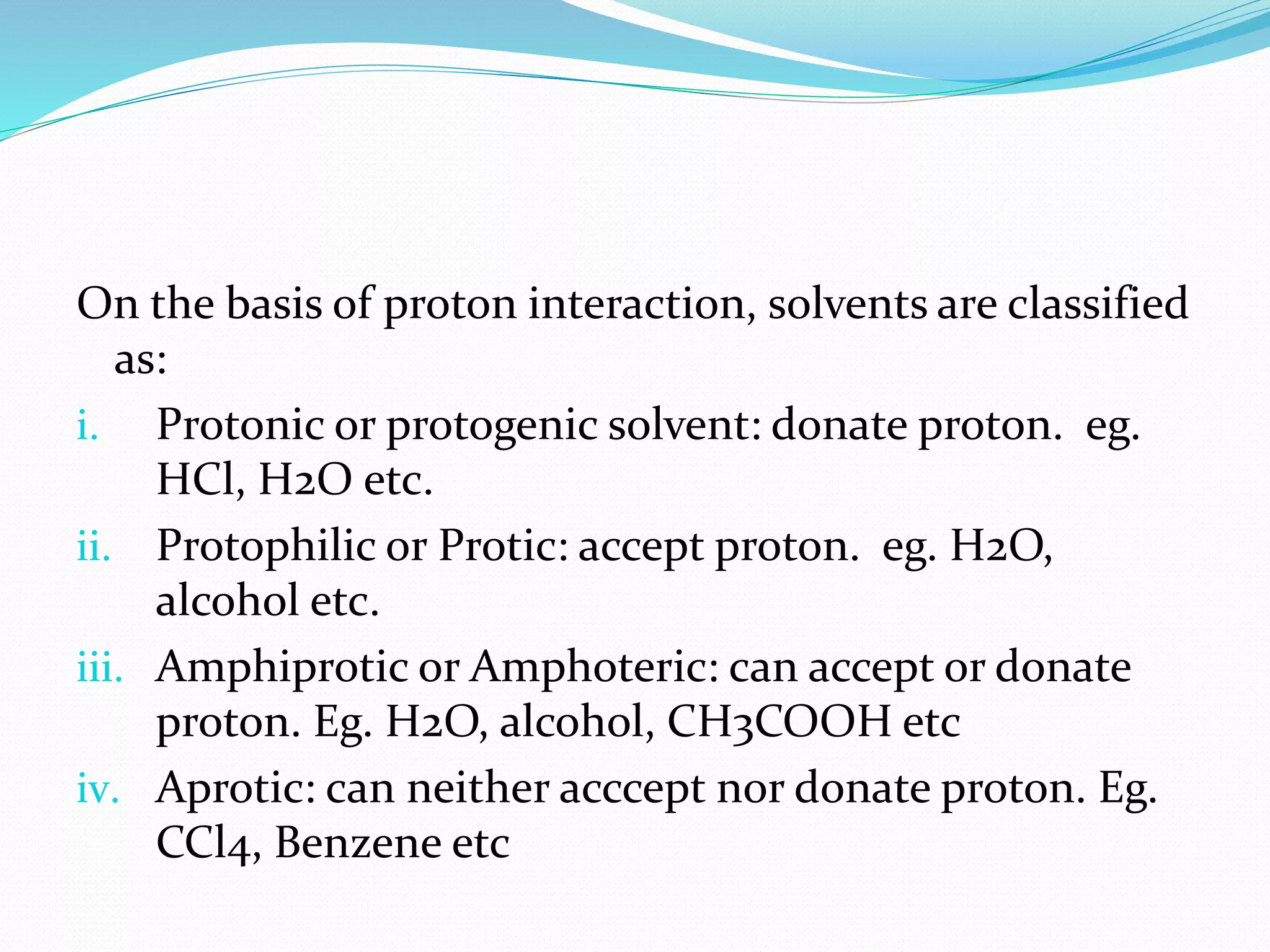
On the basis of proton interaction, solvents are classified
as:
i. Protonic or protogenic solvent: donate proton. eg.
HCl, H2O etc.
ii. Protophilic or Protic: accept proton. eg. H2O,
alcohol etc.
iii. Amphiprotic or Amphoteric: can accept or donate
proton. Eg. H2O, alcohol, CH3COOH etc
iv. Aprotic: can neither acccept nor donate proton. Eg.
CCl4, Benzene etc
Limitations of Bronsted-Lowry
Concept
 The most serious limitation of this concept is that it
can’t explain the acid-base reactions taking place in
non-protonic solvents like liq. SO2, liq.BF3, AlCl3,
POCl3 etc., in which no transfer of protons take place.
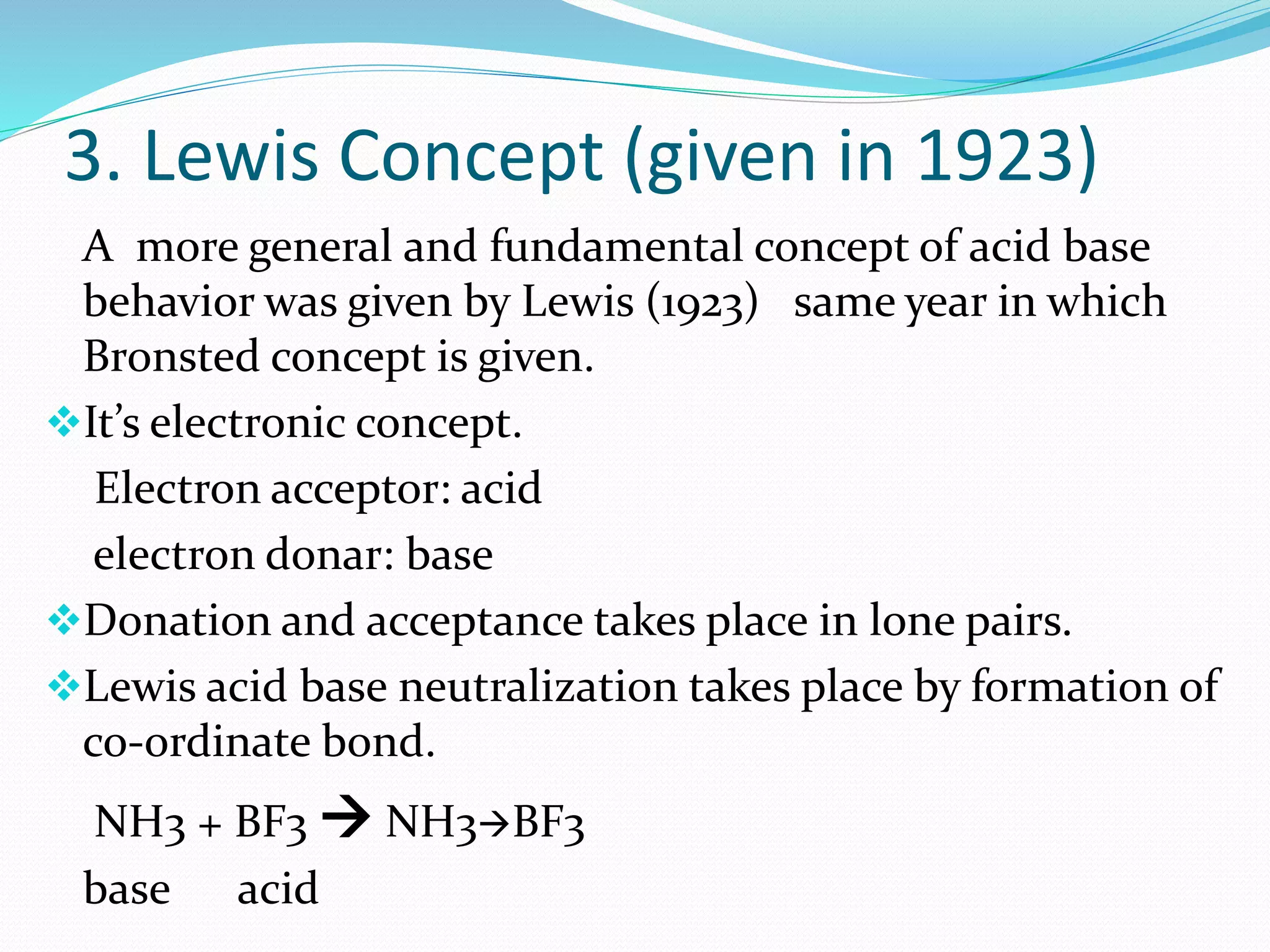
3. Lewis Concept (given in 1923)
A more general and fundamental concept of acid base
behavior was given by Lewis (1923) same year in which
Bronsted concept is given.
It’s electronic concept.
Electron acceptor: acid
electron donar: base
Donation and acceptance takes place in lone pairs.
Lewis acid base neutralization takes place by formation of
co-ordinate bond.
NH3 + BF3  NH3BF3
base acid
Conditions for Lewis Acids
i. Positively charged ions- Fe2+, Cu2+, Fe3+, Ag+, H+
etc
ii. Molecules in which the central atom has incomplete
octet
iii. Molecules in which the central atom has vacant d-
orbitals
iv. Molecules having multiple bond (or non metallic
oxides)
v. Acid salts: ZnCl2, CuSO4, FeCl3 etc.
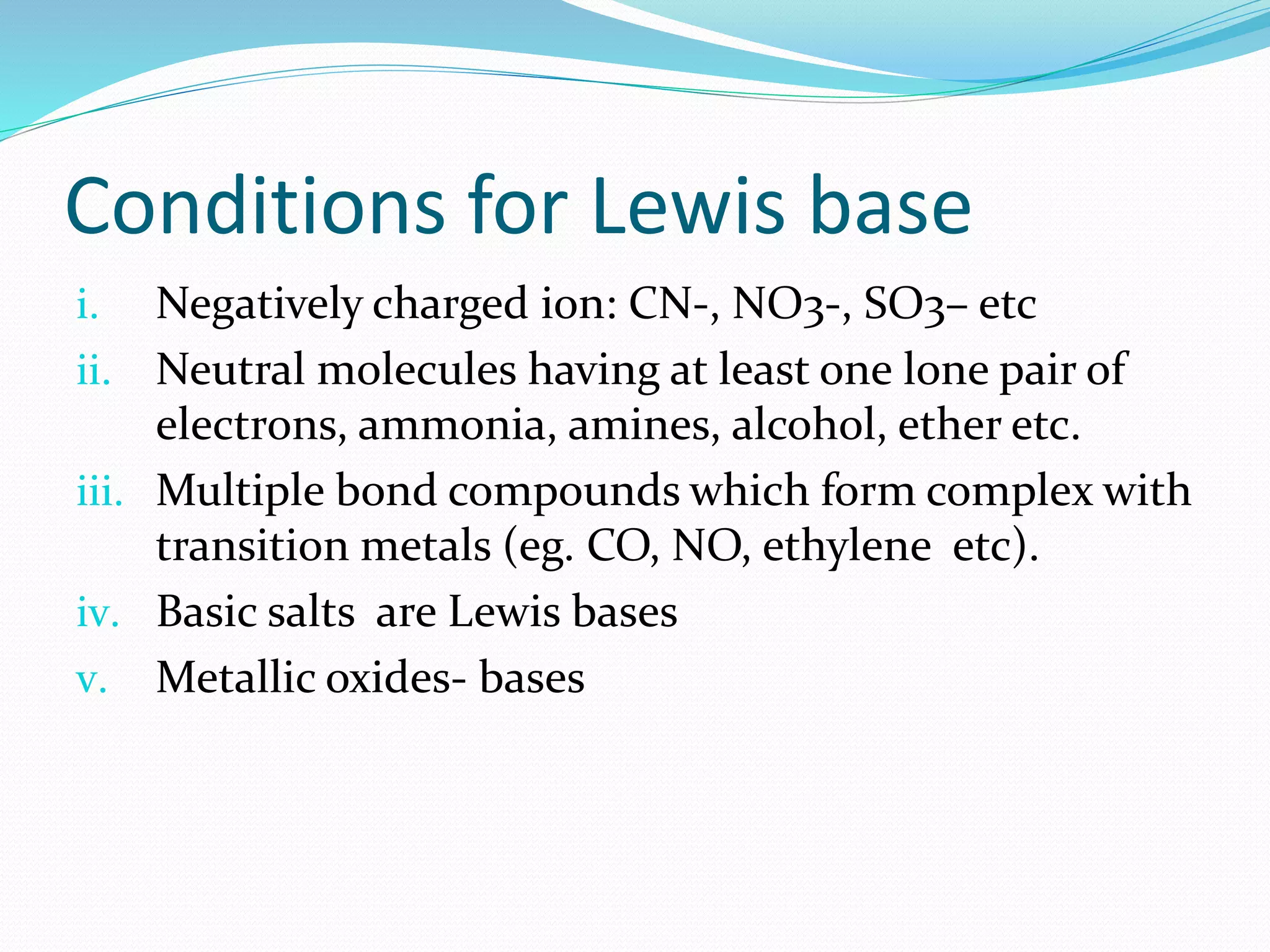
Conditions for Lewis base
i. Negatively charged ion: CN-, NO3-, SO3– etc
ii. Neutral molecules having at least one lone pair of
electrons, ammonia, amines, alcohol, ether etc.
iii. Multiple bond compounds which form complex with
transition metals (eg. CO, NO, ethylene etc).
iv. Basic salts are Lewis bases
v. Metallic oxides- bases
Limitations
It has several limitations;
a. It’s too general and includes all reactant which can
form coordinate bonds.
b. Relative strengths of acid and base can’t be explained
on the basis of Lewis concept.
Salt
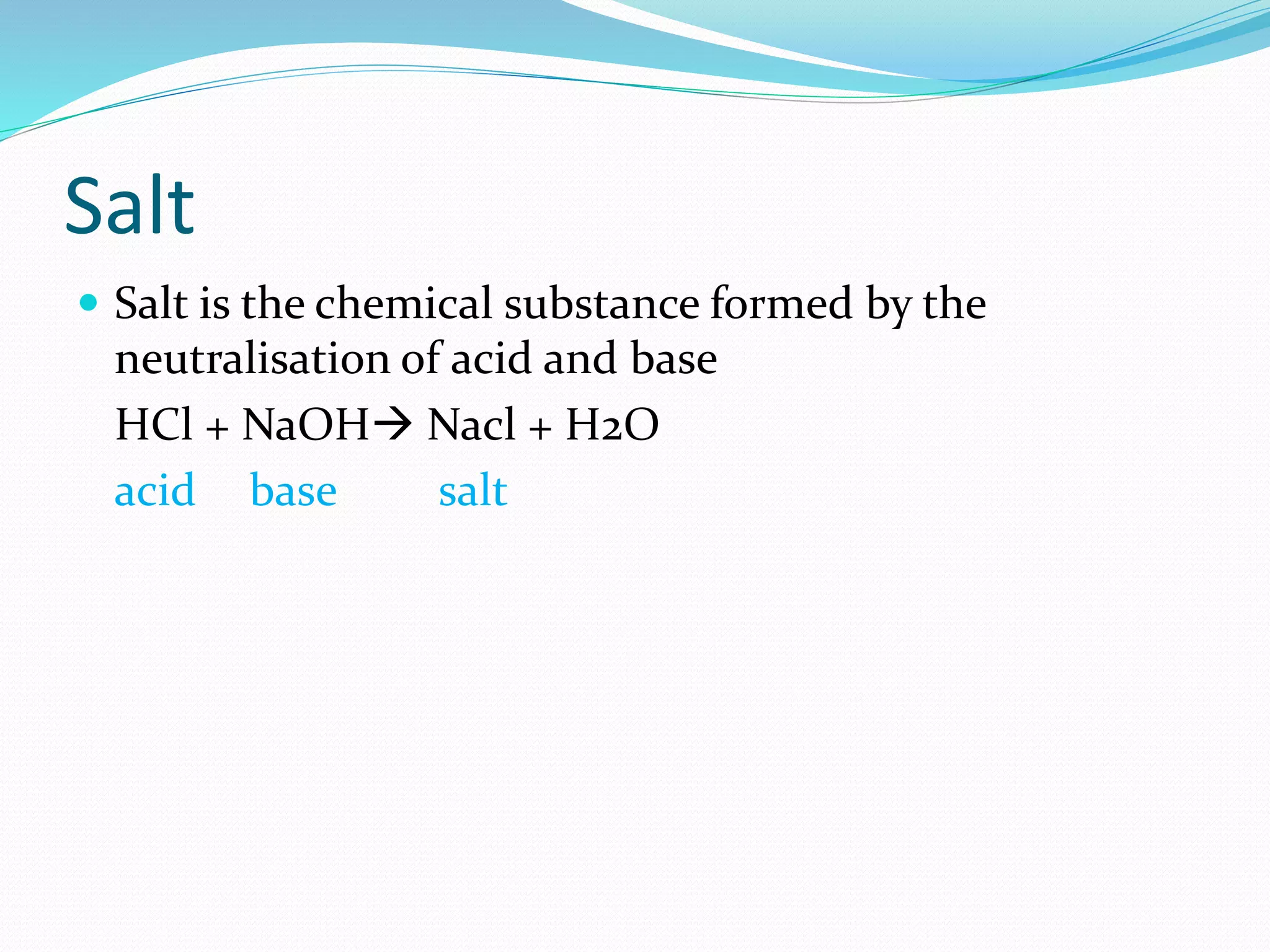
 Salt is the chemical substance formed by the
neutralisation of acid and base
HCl + NaOH Nacl + H2O
acid base salt
Types of salt
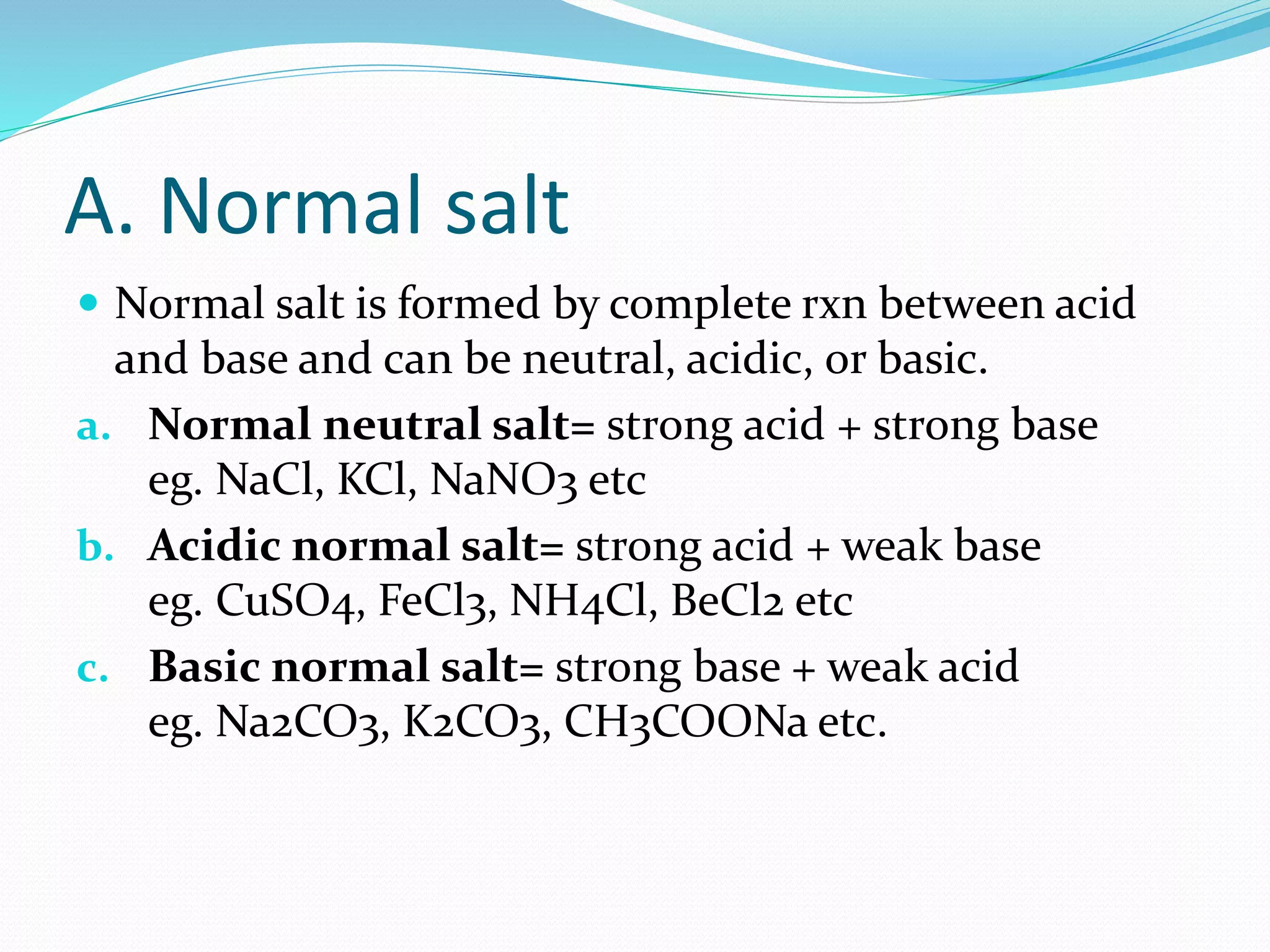
A. Normal salt
 Normal salt is formed by complete rxn between acid
and base and can be neutral, acidic, or basic.
a. Normal neutral salt= strong acid + strong base
eg. NaCl, KCl, NaNO3 etc
b. Acidic normal salt= strong acid + weak base
eg. CuSO4, FeCl3, NH4Cl, BeCl2 etc
c. Basic normal salt= strong base + weak acid
eg. Na2CO3, K2CO3, CH3COONa etc.
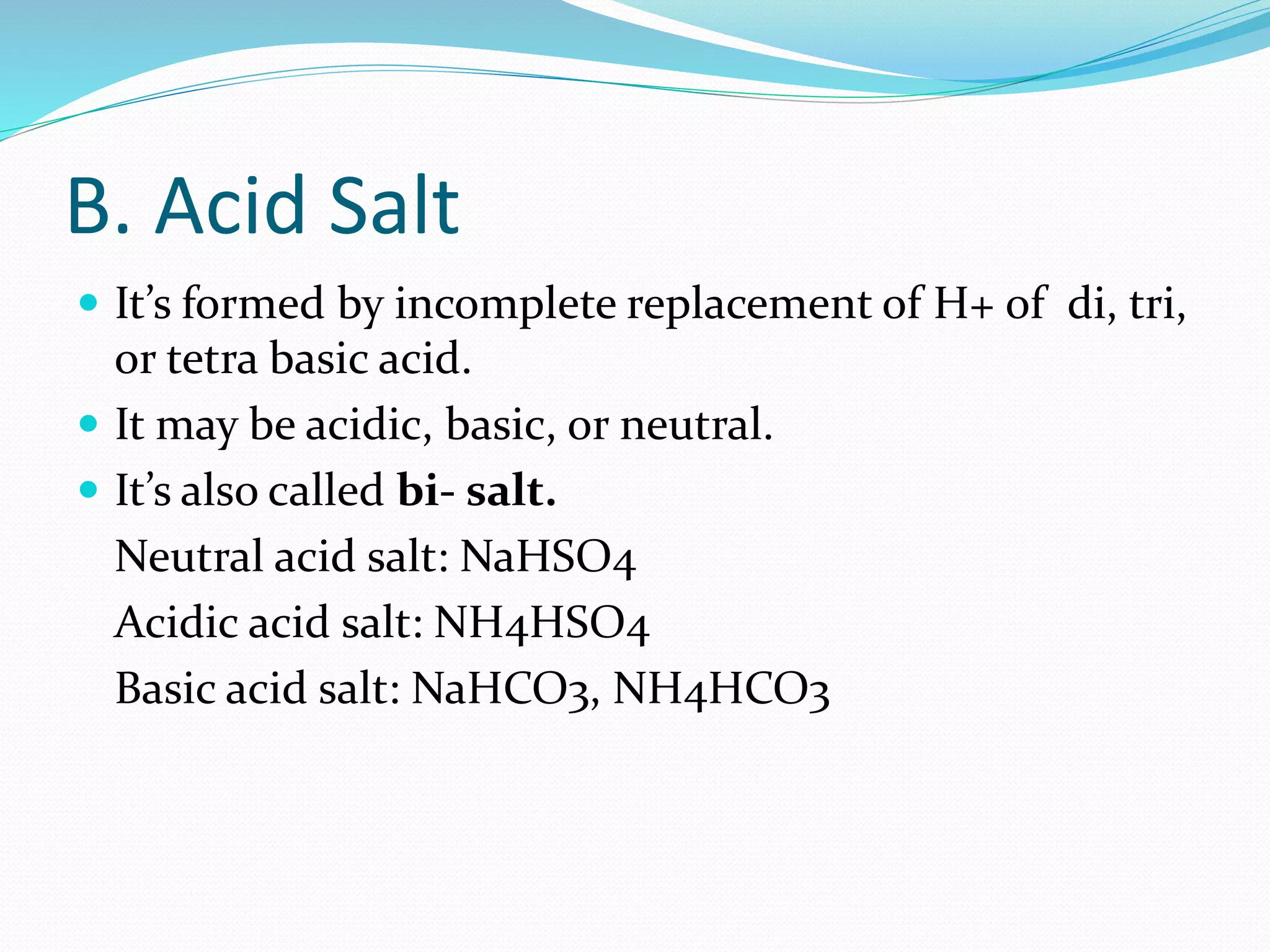
B. Acid Salt
 It’s formed by incomplete replacement of H+ of di, tri,
or tetra basic acid.
 It may be acidic, basic, or neutral.
 It’s also called bi- salt.
Neutral acid salt: NaHSO4
Acidic acid salt: NH4HSO4
Basic acid salt: NaHCO3, NH4HCO3
C. Base Salt
 It’s formed by the incomplete replacement of OH- from
polyacidic base and is always basic in nature. Eg.
2CuCO3, Cu(OH)2, Pb(OH)Cl
 Some base salt:
Malachite= CuCO3.Cu(OH)2
Azurite= 2CuCO3.Cu(OH)2 Basic copper carbonate
D. Mixed Salt
 In it there’s the presence of more than one cation or
more than one anion, when dissolved in water it gives
simple ion.
eg. Bleaching powder: CaOCl2
Ca2+, OCl-, Cl- = 3 ions
Microcosmic salt: NaNH4.HPO4.4H2O
Na+, NH4+, HPO4 = 3 ions
E. Double salt
 Mixed salt is formed by chemical rxn but double salt is
formed by only mixing of 2 simple salts in equimolar
solution, not by chemical rxn.
 It dissolves in water to give simple ions.
eg. FeSO4+ (NH4)2SO4 FeSO4.(NH4)2SO4.6H2O
1 : 1 Mohr’s salt(Ferrous ammonium sulphate)
Note: All double salts are mixed salts but all mixed salts are
not double salt.
F. Complex salt
 It’s formed by Lewis acid base rxn where central atom
is lewis acid while others are lewis base.
 It may be ionic (cationic or anionic) or neutral.
eg. K4[Fe(CN)6], alkaline K2HgI4 (Nessler’s Reagent)
Thank you!

Acid base concept

  • 1.
    Presentation on Acid, Baseand Salts: Basic concept Presented by: Shisam Neupane BPH, 1st semester
  • 2.
     Acids: Latinword “acidous” means sour 3 concepts have been supported till date for acid and base: 1. Arrhenius concept 2. Bronsted-Lowry concept 3. Lewis concept
  • 3.
    1. Arrhenius concept(given in 1887) i. An acid is a substance, which give hydrogen ion in water solution (hydronium ion). i.e. H+ + H2O  H3O+ ii. A base is a substance which give OH- in water solution. iii. Acid and base combine to form neutral molecule i.e. salt and water (neutralization) . Neutralization is exothermic process here.
  • 4.
    Limitations of Arr.concept  Only for aqueous solution  Acidic or basic nature of oxides isn’t explained  Acidic or basic nature of salts isn’t explained  No explanations for Amphoteric ions
  • 5.
    Modified Arr. Concept i.Basicity of acid: no. of replaceable H+ ion in aq.solution ii. Acidity of base: no. of replaceable OH- in aq. solution
  • 6.
    Classification of acids(on the basis of basicity of acid) a. Monobasic acid b. Dibasic acid c. Tribasic acid d. Tetrabasic acid
  • 7.
    Classification of base(on the basis of acidity of base) a. Monoacidic base b. Diacidic base c. Triacidic base d. Tetraacidic base
  • 8.
    2. Bronsted-Lowry Concept (givenin 1923)  It’s a protonic concept. Defination: A substance is known as an acid if it can donate a proton and base if it can accept protein H2O + NH3 ↔ OH- + NH4+ Here H2O is losing a proton(H+), so is Bronsted acid and NH3 is accepting H+, so it’s a Bronsted base.  Strength of acid is determined by it’s tendency to lose a proton and of base is the tendency to accept a proton.  Proton is always in solvated form; dry HCl dry HNO3 : They aren’t Bronstate acid though the donate protons  Non-aqueous solvent can also be used for the study of acid-base reaction.
  • 9.
    On the basisof proton interaction, solvents are classified as: i. Protonic or protogenic solvent: donate proton. eg. HCl, H2O etc. ii. Protophilic or Protic: accept proton. eg. H2O, alcohol etc. iii. Amphiprotic or Amphoteric: can accept or donate proton. Eg. H2O, alcohol, CH3COOH etc iv. Aprotic: can neither acccept nor donate proton. Eg. CCl4, Benzene etc
  • 10.
    Limitations of Bronsted-Lowry Concept The most serious limitation of this concept is that it can’t explain the acid-base reactions taking place in non-protonic solvents like liq. SO2, liq.BF3, AlCl3, POCl3 etc., in which no transfer of protons take place.
  • 11.
    3. Lewis Concept(given in 1923) A more general and fundamental concept of acid base behavior was given by Lewis (1923) same year in which Bronsted concept is given. It’s electronic concept. Electron acceptor: acid electron donar: base Donation and acceptance takes place in lone pairs. Lewis acid base neutralization takes place by formation of co-ordinate bond. NH3 + BF3  NH3BF3 base acid
  • 12.
    Conditions for LewisAcids i. Positively charged ions- Fe2+, Cu2+, Fe3+, Ag+, H+ etc ii. Molecules in which the central atom has incomplete octet iii. Molecules in which the central atom has vacant d- orbitals iv. Molecules having multiple bond (or non metallic oxides) v. Acid salts: ZnCl2, CuSO4, FeCl3 etc.
  • 13.
    Conditions for Lewisbase i. Negatively charged ion: CN-, NO3-, SO3– etc ii. Neutral molecules having at least one lone pair of electrons, ammonia, amines, alcohol, ether etc. iii. Multiple bond compounds which form complex with transition metals (eg. CO, NO, ethylene etc). iv. Basic salts are Lewis bases v. Metallic oxides- bases
  • 14.
    Limitations It has severallimitations; a. It’s too general and includes all reactant which can form coordinate bonds. b. Relative strengths of acid and base can’t be explained on the basis of Lewis concept.
  • 15.
    Salt  Salt isthe chemical substance formed by the neutralisation of acid and base HCl + NaOH Nacl + H2O acid base salt
  • 16.
  • 17.
    A. Normal salt Normal salt is formed by complete rxn between acid and base and can be neutral, acidic, or basic. a. Normal neutral salt= strong acid + strong base eg. NaCl, KCl, NaNO3 etc b. Acidic normal salt= strong acid + weak base eg. CuSO4, FeCl3, NH4Cl, BeCl2 etc c. Basic normal salt= strong base + weak acid eg. Na2CO3, K2CO3, CH3COONa etc.
  • 18.
    B. Acid Salt It’s formed by incomplete replacement of H+ of di, tri, or tetra basic acid.  It may be acidic, basic, or neutral.  It’s also called bi- salt. Neutral acid salt: NaHSO4 Acidic acid salt: NH4HSO4 Basic acid salt: NaHCO3, NH4HCO3
  • 19.
    C. Base Salt It’s formed by the incomplete replacement of OH- from polyacidic base and is always basic in nature. Eg. 2CuCO3, Cu(OH)2, Pb(OH)Cl  Some base salt: Malachite= CuCO3.Cu(OH)2 Azurite= 2CuCO3.Cu(OH)2 Basic copper carbonate
  • 20.
    D. Mixed Salt In it there’s the presence of more than one cation or more than one anion, when dissolved in water it gives simple ion. eg. Bleaching powder: CaOCl2 Ca2+, OCl-, Cl- = 3 ions Microcosmic salt: NaNH4.HPO4.4H2O Na+, NH4+, HPO4 = 3 ions
  • 21.
    E. Double salt Mixed salt is formed by chemical rxn but double salt is formed by only mixing of 2 simple salts in equimolar solution, not by chemical rxn.  It dissolves in water to give simple ions. eg. FeSO4+ (NH4)2SO4 FeSO4.(NH4)2SO4.6H2O 1 : 1 Mohr’s salt(Ferrous ammonium sulphate) Note: All double salts are mixed salts but all mixed salts are not double salt.
  • 22.
    F. Complex salt It’s formed by Lewis acid base rxn where central atom is lewis acid while others are lewis base.  It may be ionic (cationic or anionic) or neutral. eg. K4[Fe(CN)6], alkaline K2HgI4 (Nessler’s Reagent)
  • 23.