By
Mariam Manzoor
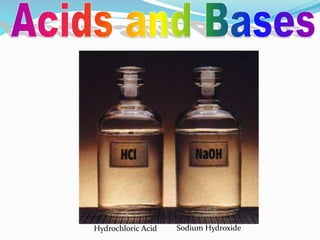
Hydrochloric Acid Sodium Hydroxide
Acids
 An acid is a substance that ionizes in water to
produce hydrogen ions (H+)
 The strength of an acid depends on how completely
the substance ionizes. Strong acids completely
ionize in water. Weak acids ionize only slightly.
Acids
 Produce H+ ions in water
 Have a sour taste
 Break down metals
 Formula starts with H
 Poisonous and corrosive to skin
 pH less than 7
 turn blue litmus red
 Dissolve in water to form solution which conduct electricity
 React with reactive metal metals to form salt and hydrogen (explained)
 Acids react with carbonates and hydrogen carbonates to form a salt,
water and carbon dioxide (explained)
 Acids react with metal oxides and hydroxides to form a salt and water
only(explained)
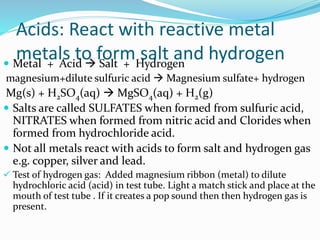
Acids: React with reactive metal
metals to form salt and hydrogen Metal + Acid  Salt + Hydrogen
magnesium+dilute sulfuric acid  Magnesium sulfate+ hydrogen
Mg(s) + H2SO4(aq)  MgSO4(aq) + H2(g)
 Salts are called SULFATES when formed from sulfuric acid,
NITRATES when formed from nitric acid and Clorides when
formed from hydrochloride acid.
 Not all metals react with acids to form salt and hydrogen gas
e.g. copper, silver and lead.
 Test of hydrogen gas: Added magnesium ribbon (metal) to dilute
hydrochloric acid (acid) in test tube. Light a match stick and place at the
mouth of test tube . If it creates a pop sound then then hydrogen gas is
present.
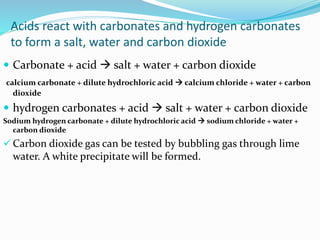
Acids react with carbonates and hydrogen carbonates
to form a salt, water and carbon dioxide
 Carbonate + acid  salt + water + carbon dioxide
calcium carbonate + dilute hydrochloric acid  calcium chloride + water + carbon
dioxide
 hydrogen carbonates + acid  salt + water + carbon dioxide
Sodium hydrogen carbonate + dilute hydrochloric acid  sodium chloride + water +
carbon dioxide
 Carbon dioxide gas can be tested by bubbling gas through lime
water. A white precipitate will be formed.
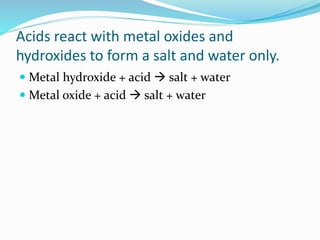
Acids react with metal oxides and
hydroxides to form a salt and water only.
 Metal hydroxide + acid  salt + water
 Metal oxide + acid  salt + water
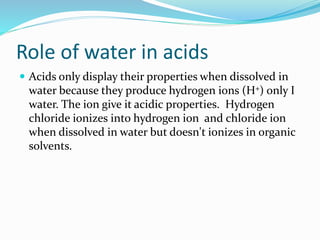
Role of water in acids
 Acids only display their properties when dissolved in
water because they produce hydrogen ions (H+) only I
water. The ion give it acidic properties. Hydrogen
chloride ionizes into hydrogen ion and chloride ion
when dissolved in water but doesn't ionizes in organic
solvents.
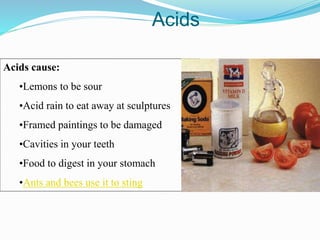
Acids cause:
•Lemons to be sour
•Acid rain to eat away at sculptures
•Framed paintings to be damaged
•Cavities in your teeth
•Food to digest in your stomach
•Ants and bees use it to sting
Acids
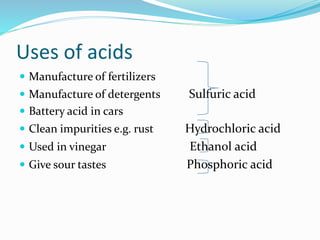
Uses of acids
 Manufacture of fertilizers
 Manufacture of detergents Sulfuric acid
 Battery acid in cars
 Clean impurities e.g. rust Hydrochloric acid
 Used in vinegar Ethanol acid
 Give sour tastes Phosphoric acid
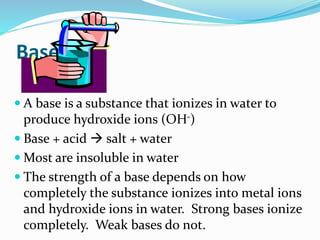
Base
 A base is a substance that ionizes in water to
produce hydroxide ions (OH-)
 Base + acid  salt + water
 Most are insoluble in water
 The strength of a base depends on how
completely the substance ionizes into metal ions
and hydroxide ions in water. Strong bases ionize
completely. Weak bases do not.
Alkalis
 An alkali is a base that is soluble in water. it produces
(OH-) in aqueous solution.
alkalis Produce OH- ions in water
 Have a bitter taste and a slippery feel
 Break down fats and oils
 Formula ends with OH
 Poisonous and corrosive to skin
 pH greater than 7
• turn red litmus blue
• React with acids to form salt and water
only.(explained)
• Heated with ammonium salts gives off ammonia
gas.(explained)
• React with a solution of one metal salt to give another
metal salt and metal hydroxide.(explained)
React with acids to form salt and
water only
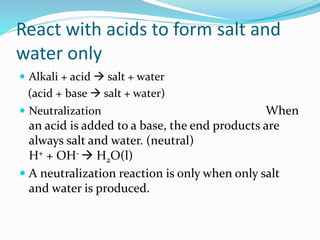
 Alkali + acid  salt + water
(acid + base  salt + water)
 Neutralization When
an acid is added to a base, the end products are
always salt and water. (neutral)
H+ + OH-  H2O(l)
 A neutralization reaction is only when only salt
and water is produced.
Heated with ammonium salts gives
off ammonia gas
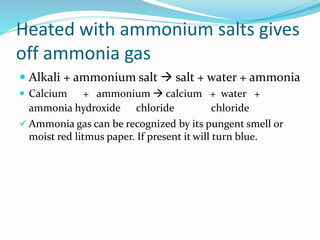
 Alkali + ammonium salt  salt + water + ammonia
 Calcium + ammonium  calcium + water +
ammonia hydroxide chloride chloride
 Ammonia gas can be recognized by its pungent smell or
moist red litmus paper. If present it will turn blue.
React with a solution of one metal salt to give
another metal salt and metal hydroxide
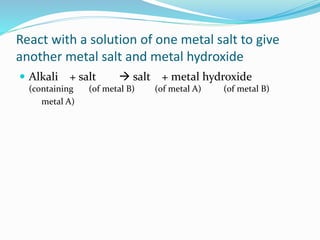
 Alkali + salt  salt + metal hydroxide
(containing (of metal B) (of metal A) (of metal B)
metal A)
Uses of Bases and Alkalis Magnesium oxide is uses as antacid for relieving
gastric pain and making refractory bricks.
 Sodium oxide and potassium hydroxide are used in
soaps
 Calcium hydroxide is used to reduce acidity of soil
 Ammonia solution is used to make fertilizers.
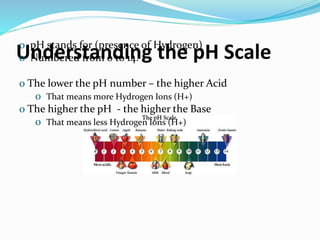
Understanding the pH Scaleo pH stands for (presence of Hydrogen)
o Numbered from 0 to 14.
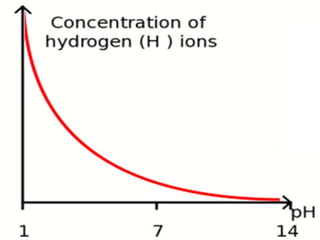
o The lower the pH number – the higher Acid
o That means more Hydrogen Ions (H+)
o The higher the pH - the higher the Base
o That means less Hydrogen Ions (H+)
How PH can be measured???
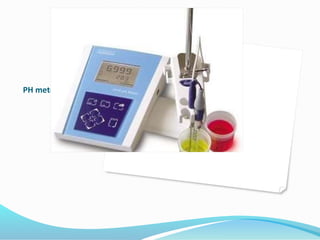
 PH meter
 PH sensor attached to a data logger
 Indicator (chemical compound)
 Litmus paper
Universal indicatior
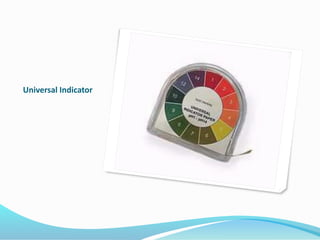
 It contains a mixture of dyes. It comes in form of a
solution or a pH paper. It gives different colours in
solution of different pH.
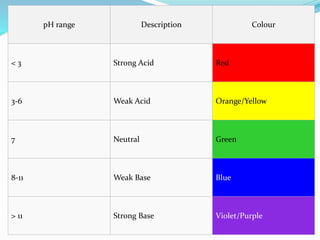
pH range Description Colour
< 3 Strong Acid Red
3-6 Weak Acid Orange/Yellow
7 Neutral Green
8-11 Weak Base Blue
> 11 Strong Base Violet/Purple
Universal Indicator
PH meter
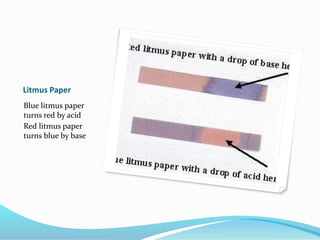
Litmus Paper
Blue litmus paper
turns red by acid
Red litmus paper
turns blue by base
Importance of PH
 PH in blood is 7.4 so a substance injected in it must have
ph the same. If ph is changed by one unit e.g. 8.3 then the
person dies.
 Ph of soil can vary from 4 to 8. it is important because it
controls the growth of a plant. Most will grow between
5 and 9. Most will grow when neutral or
slightly acidic. The ph of soil may become unsuitable by
adding more or less fertilizer and pollution in the air.
How can acidity of soil be
controlled
 Soil treated is too acidic can be treated with bases like
quicklime and slaked lime.
 This is known as liming the soil.
 Adding too much base is also not suitable.
What is an oxide?
 It is the compound of oxygen and another element.
They can be grouped in four types: acidic, basic,
amphoteric and neutral.
Acidic oxides
 Oxides of non-metal
 Acidic oxides are often gases at room temperature.
 Dissolve in water
 E.g. sulfur dioxide + water  sulfurous oxide
 Don’t react with acids
 React with alkalis to form salt and water
 Silicon dioxide is a acidic oxide although it is solid
at room temp. doesn’t dissolve in water but reacts
with hot concentrated sodium hydroxide to form
sodium silicate.
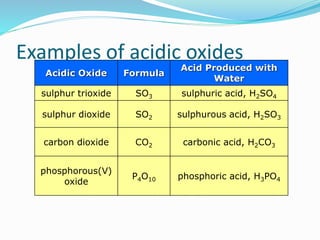
Examples of acidic oxides
Acidic Oxide Formula
Acid Produced with
Water
sulphur trioxide SO3 sulphuric acid, H2SO4
sulphur dioxide SO2 sulphurous acid, H2SO3
carbon dioxide CO2 carbonic acid, H2CO3
phosphorous(V)
oxide
P4O10 phosphoric acid, H3PO4
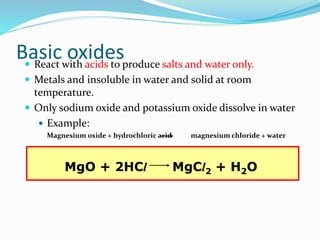
Basic oxides React with acids to produce salts and water only.
 Metals and insoluble in water and solid at room
temperature.
 Only sodium oxide and potassium oxide dissolve in water
 Example:
Magnesium oxide + hydrochloric acid magnesium chloride + water
MgO + 2HCl MgCl2 + H2O
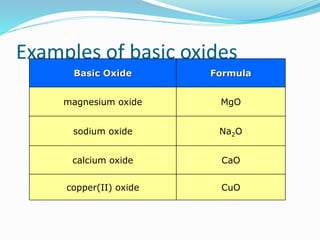
Examples of basic oxides
Basic Oxide Formula
magnesium oxide MgO
sodium oxide Na2O
calcium oxide CaO
copper(II) oxide CuO
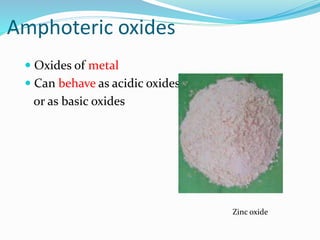
Amphoteric oxides
 Oxides of metal
 Can behave as acidic oxides
or as basic oxides
Zinc oxide
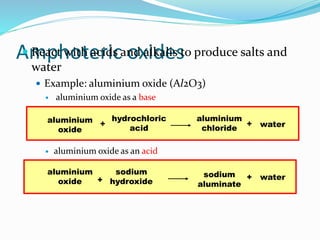
Amphoteric oxides React with acids and alkalis to produce salts and
water
 Example: aluminium oxide (Al2O3)
 aluminium oxide as a base
 aluminium oxide as an acid
hydrochloric
acid
aluminium
chloride water
aluminium
oxide
+ +
aluminium
oxide
sodium
hydroxide
sodium
aluminate
water+ +
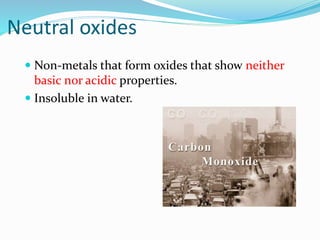
Neutral oxides
 Non-metals that form oxides that show neither
basic nor acidic properties.
 Insoluble in water.
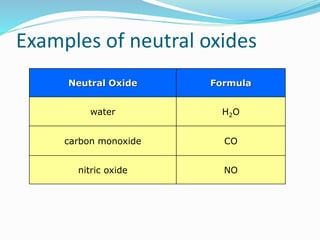
Examples of neutral oxides
Neutral Oxide Formula
water H2O
carbon monoxide CO
nitric oxide NO
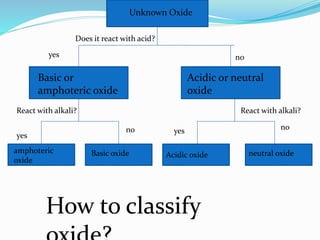
Unknown Oxide
Basic or
amphoteric oxide
Acidic or neutral
oxide
amphoteric
oxide
Basic oxide neutral oxideAcidic oxide
How to classify
Does it react with acid?
yes no
React with alkali?React with alkali?
yes
yes nono

Acids and bases

  • 1.
  • 2.
  • 3.
    Acids  An acidis a substance that ionizes in water to produce hydrogen ions (H+)  The strength of an acid depends on how completely the substance ionizes. Strong acids completely ionize in water. Weak acids ionize only slightly.
  • 4.
    Acids  Produce H+ions in water  Have a sour taste  Break down metals  Formula starts with H  Poisonous and corrosive to skin  pH less than 7  turn blue litmus red  Dissolve in water to form solution which conduct electricity  React with reactive metal metals to form salt and hydrogen (explained)  Acids react with carbonates and hydrogen carbonates to form a salt, water and carbon dioxide (explained)  Acids react with metal oxides and hydroxides to form a salt and water only(explained)
  • 5.
    Acids: React withreactive metal metals to form salt and hydrogen Metal + Acid  Salt + Hydrogen magnesium+dilute sulfuric acid  Magnesium sulfate+ hydrogen Mg(s) + H2SO4(aq)  MgSO4(aq) + H2(g)  Salts are called SULFATES when formed from sulfuric acid, NITRATES when formed from nitric acid and Clorides when formed from hydrochloride acid.  Not all metals react with acids to form salt and hydrogen gas e.g. copper, silver and lead.  Test of hydrogen gas: Added magnesium ribbon (metal) to dilute hydrochloric acid (acid) in test tube. Light a match stick and place at the mouth of test tube . If it creates a pop sound then then hydrogen gas is present.
  • 6.
    Acids react withcarbonates and hydrogen carbonates to form a salt, water and carbon dioxide  Carbonate + acid  salt + water + carbon dioxide calcium carbonate + dilute hydrochloric acid  calcium chloride + water + carbon dioxide  hydrogen carbonates + acid  salt + water + carbon dioxide Sodium hydrogen carbonate + dilute hydrochloric acid  sodium chloride + water + carbon dioxide  Carbon dioxide gas can be tested by bubbling gas through lime water. A white precipitate will be formed.
  • 7.
    Acids react withmetal oxides and hydroxides to form a salt and water only.  Metal hydroxide + acid  salt + water  Metal oxide + acid  salt + water
  • 8.
    Role of waterin acids  Acids only display their properties when dissolved in water because they produce hydrogen ions (H+) only I water. The ion give it acidic properties. Hydrogen chloride ionizes into hydrogen ion and chloride ion when dissolved in water but doesn't ionizes in organic solvents.
  • 9.
    Acids cause: •Lemons tobe sour •Acid rain to eat away at sculptures •Framed paintings to be damaged •Cavities in your teeth •Food to digest in your stomach •Ants and bees use it to sting Acids
  • 10.
    Uses of acids Manufacture of fertilizers  Manufacture of detergents Sulfuric acid  Battery acid in cars  Clean impurities e.g. rust Hydrochloric acid  Used in vinegar Ethanol acid  Give sour tastes Phosphoric acid
  • 11.
    Base  A baseis a substance that ionizes in water to produce hydroxide ions (OH-)  Base + acid  salt + water  Most are insoluble in water  The strength of a base depends on how completely the substance ionizes into metal ions and hydroxide ions in water. Strong bases ionize completely. Weak bases do not.
  • 12.
    Alkalis  An alkaliis a base that is soluble in water. it produces (OH-) in aqueous solution.
  • 13.
    alkalis Produce OH-ions in water  Have a bitter taste and a slippery feel  Break down fats and oils  Formula ends with OH  Poisonous and corrosive to skin  pH greater than 7 • turn red litmus blue • React with acids to form salt and water only.(explained) • Heated with ammonium salts gives off ammonia gas.(explained) • React with a solution of one metal salt to give another metal salt and metal hydroxide.(explained)
  • 14.
    React with acidsto form salt and water only  Alkali + acid  salt + water (acid + base  salt + water)  Neutralization When an acid is added to a base, the end products are always salt and water. (neutral) H+ + OH-  H2O(l)  A neutralization reaction is only when only salt and water is produced.
  • 15.
    Heated with ammoniumsalts gives off ammonia gas  Alkali + ammonium salt  salt + water + ammonia  Calcium + ammonium  calcium + water + ammonia hydroxide chloride chloride  Ammonia gas can be recognized by its pungent smell or moist red litmus paper. If present it will turn blue.
  • 16.
    React with asolution of one metal salt to give another metal salt and metal hydroxide  Alkali + salt  salt + metal hydroxide (containing (of metal B) (of metal A) (of metal B) metal A)
  • 17.
    Uses of Basesand Alkalis Magnesium oxide is uses as antacid for relieving gastric pain and making refractory bricks.  Sodium oxide and potassium hydroxide are used in soaps  Calcium hydroxide is used to reduce acidity of soil  Ammonia solution is used to make fertilizers.
  • 18.
    Understanding the pHScaleo pH stands for (presence of Hydrogen) o Numbered from 0 to 14. o The lower the pH number – the higher Acid o That means more Hydrogen Ions (H+) o The higher the pH - the higher the Base o That means less Hydrogen Ions (H+)
  • 20.
    How PH canbe measured???  PH meter  PH sensor attached to a data logger  Indicator (chemical compound)  Litmus paper
  • 21.
    Universal indicatior  Itcontains a mixture of dyes. It comes in form of a solution or a pH paper. It gives different colours in solution of different pH.
  • 22.
    pH range DescriptionColour < 3 Strong Acid Red 3-6 Weak Acid Orange/Yellow 7 Neutral Green 8-11 Weak Base Blue > 11 Strong Base Violet/Purple
  • 23.
  • 24.
  • 25.
    Litmus Paper Blue litmuspaper turns red by acid Red litmus paper turns blue by base
  • 26.
    Importance of PH PH in blood is 7.4 so a substance injected in it must have ph the same. If ph is changed by one unit e.g. 8.3 then the person dies.  Ph of soil can vary from 4 to 8. it is important because it controls the growth of a plant. Most will grow between 5 and 9. Most will grow when neutral or slightly acidic. The ph of soil may become unsuitable by adding more or less fertilizer and pollution in the air.
  • 27.
    How can acidityof soil be controlled  Soil treated is too acidic can be treated with bases like quicklime and slaked lime.  This is known as liming the soil.  Adding too much base is also not suitable.
  • 28.
    What is anoxide?  It is the compound of oxygen and another element. They can be grouped in four types: acidic, basic, amphoteric and neutral.
  • 29.
    Acidic oxides  Oxidesof non-metal  Acidic oxides are often gases at room temperature.  Dissolve in water  E.g. sulfur dioxide + water  sulfurous oxide  Don’t react with acids  React with alkalis to form salt and water  Silicon dioxide is a acidic oxide although it is solid at room temp. doesn’t dissolve in water but reacts with hot concentrated sodium hydroxide to form sodium silicate.
  • 30.
    Examples of acidicoxides Acidic Oxide Formula Acid Produced with Water sulphur trioxide SO3 sulphuric acid, H2SO4 sulphur dioxide SO2 sulphurous acid, H2SO3 carbon dioxide CO2 carbonic acid, H2CO3 phosphorous(V) oxide P4O10 phosphoric acid, H3PO4
  • 31.
    Basic oxides Reactwith acids to produce salts and water only.  Metals and insoluble in water and solid at room temperature.  Only sodium oxide and potassium oxide dissolve in water  Example: Magnesium oxide + hydrochloric acid magnesium chloride + water MgO + 2HCl MgCl2 + H2O
  • 32.
    Examples of basicoxides Basic Oxide Formula magnesium oxide MgO sodium oxide Na2O calcium oxide CaO copper(II) oxide CuO
  • 33.
    Amphoteric oxides  Oxidesof metal  Can behave as acidic oxides or as basic oxides Zinc oxide
  • 34.
    Amphoteric oxides Reactwith acids and alkalis to produce salts and water  Example: aluminium oxide (Al2O3)  aluminium oxide as a base  aluminium oxide as an acid hydrochloric acid aluminium chloride water aluminium oxide + + aluminium oxide sodium hydroxide sodium aluminate water+ +
  • 35.
    Neutral oxides  Non-metalsthat form oxides that show neither basic nor acidic properties.  Insoluble in water.
  • 36.
    Examples of neutraloxides Neutral Oxide Formula water H2O carbon monoxide CO nitric oxide NO
  • 37.
    Unknown Oxide Basic or amphotericoxide Acidic or neutral oxide amphoteric oxide Basic oxide neutral oxideAcidic oxide How to classify Does it react with acid? yes no React with alkali?React with alkali? yes yes nono