Chapter 5
 Acids, Bases, and
Acid-Base Reactions
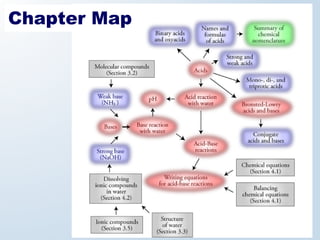
Chapter Map
Arrhenius Acid
   Definition
• An acid is a substance that
  generates hydronium ions, H3O+
  (often described as H+), when
  added to water.
• An acidic solution is a solution
  with a significant concentration of
  H3O+ ions.
Characteristics of
  Acids

• Acids have a sour taste.
• Acids turn litmus from blue to red.
• Acids react with bases.
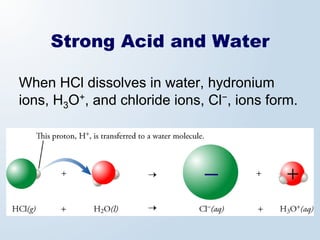
Strong Acid and Water

When HCl dissolves in water, hydronium
ions, H3O+, and chloride ions, Cl−, ions form.
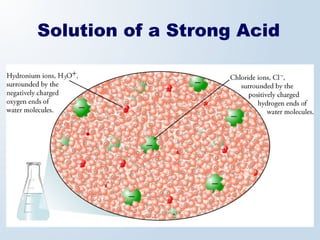
Solution of a Strong Acid
Types of Acids

• Binary acids have the general
  formula of HX(aq)
  – HF(aq), HCl(aq), HBr(aq), and HI(aq)
• Oxyacids have the general formula
  HaXbOc.
  – HNO3 and H2SO4
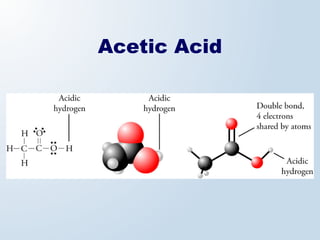
• Organic (carbon-based) acids
  – HC2H3O2
Acetic Acid
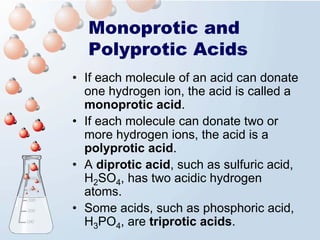
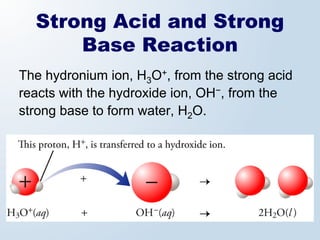
Monoprotic and
  Polyprotic Acids
• If each molecule of an acid can donate
  one hydrogen ion, the acid is called a
  monoprotic acid.
• If each molecule can donate two or
  more hydrogen ions, the acid is a
  polyprotic acid.
• A diprotic acid, such as sulfuric acid,
  H2SO4, has two acidic hydrogen
  atoms.
• Some acids, such as phosphoric acid,
  H3PO4, are triprotic acids.
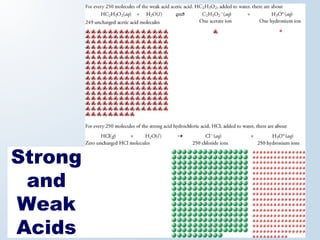
Strong and Weak Acids
• Strong Acid = due to a completion
  reaction with water, generates close
  to one H3O+ for each acid molecule
  added to water.
• Weak Acid = due to a reversible
  reaction with water, generates
  significantly less than one H3O+ for
  each molecule of acid added to
  water.
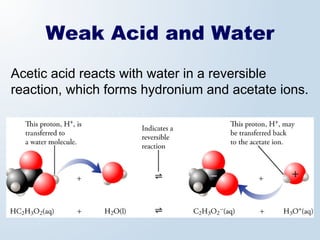
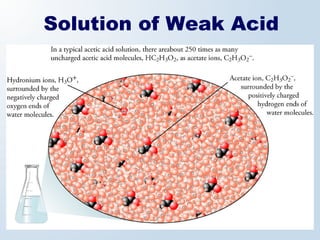
Weak Acid and Water
Acetic acid reacts with water in a reversible
reaction, which forms hydronium and acetate ions.
Solution of Weak Acid
Strong
 and
Weak
Acids
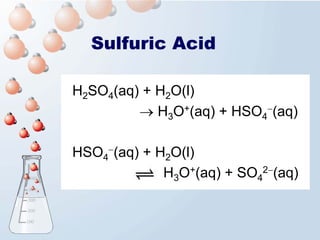
Sulfuric Acid

H2SO4(aq) + H2O(l)
         → H3O+(aq) + HSO4−(aq)

HSO4−(aq) + H2O(l)
             H3O+(aq) + SO42−(aq)
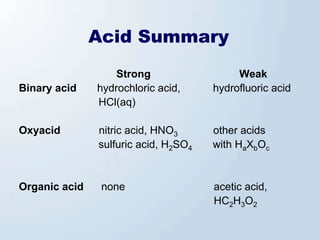
Acid Summary
                   Strong                  Weak
Binary acid    hydrochloric acid,     hydrofluoric acid
               HCl(aq)

Oxyacid        nitric acid, HNO3      other acids
               sulfuric acid, H2SO4   with HaXbOc


Organic acid    none                  acetic acid,
                                      HC2H3O2
Names and Formulas
  of Binary Acids

• Names have the general form of
  hydro(root)ic acid, such as
  hydrochloric acid.
• The formulas are usually followed
  by (aq), such as HCl(aq).
Names and Formulas
    for Oxyacids
• If enough H+ ions are added to a
  (root)ate polyatomic ion to completely
  neutralize its charge, the (root)ic acid is
  formed.
   – Nitrate, NO3−, goes to nitric acid, HNO3.
   – Sulfate, SO42−, goes to sulfuric acid, H2SO4.
     (Note the -ur- in the name.)
   – Phosphate, PO43−, goes to phosphoric acid,
     H3PO4. (Note the -or- in the name.)
Chemical
   Nomenclature

• General procedure for naming
  compounds (See Table 5.5 in the
  text.)
  – Step 1: Decide what type of
    compound the name or formula
    represents.
  – Step 2: Apply the rules for writing
    the name or formula for that type of
    compound.
Arrhenius Base
   Definitions

• A base is a substance that
  generates OH− when added to
  water.
• A basic solution is a solution with
  a significant concentration of OH−
  ions.
Characteristics of
   Bases

• Bases have a bitter taste.
• Bases feel slippery on your fingers.
• Bases turn litmus from red to blue.
• Bases react with acids.
Strong Bases
• Strong Base = due to a completion
  reaction with water, generates close to
  one (or more) OH− for each formula unit of
  base added to water.
  – Metal hydroxides are strong bases.
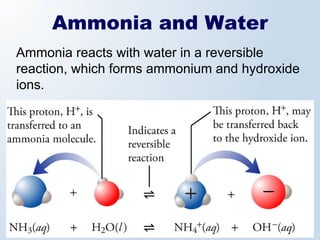
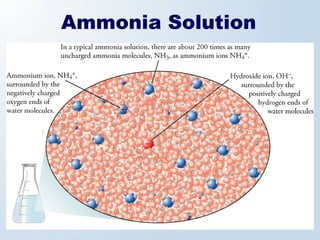
Ammonia and Water
Ammonia reacts with water in a reversible
reaction, which forms ammonium and hydroxide
ions.
Weak Base
• Weak Base = due to a reversible reaction
  with water, generates significantly less
  than one OH− for each formula unit of
  base added to water.
  – Ammonia and ionic compounds that
    contain CO32− or HCO3− are weak
    bases.
Ammonia Solution
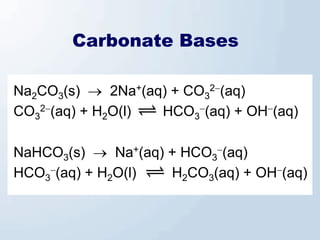
Carbonate Bases

Na2CO3(s) → 2Na+(aq) + CO32−(aq)
CO32−(aq) + H2O(l) HCO3−(aq) + OH−(aq)

NaHCO3(s) → Na+(aq) + HCO3−(aq)
HCO3−(aq) + H2O(l)  H2CO3(aq) + OH−(aq)
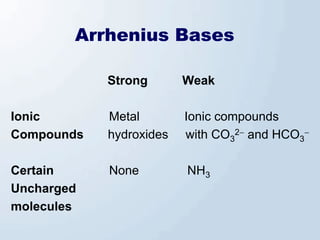
Arrhenius Bases

            Strong       Weak

Ionic       Metal        Ionic compounds
Compounds   hydroxides   with CO32− and HCO3−

Certain     None         NH3
Uncharged
molecules
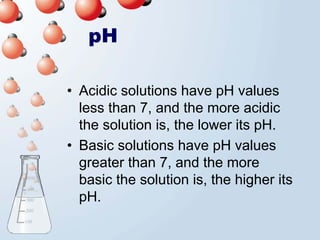
pH

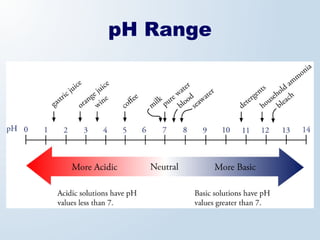
• Acidic solutions have pH values
  less than 7, and the more acidic
  the solution is, the lower its pH.
• Basic solutions have pH values
  greater than 7, and the more
  basic the solution is, the higher its
  pH.
pH Range
Neutralization
  Reactions

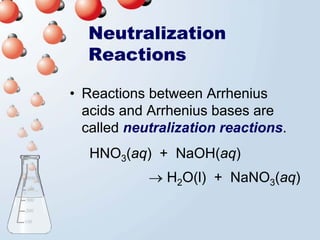
• Reactions between Arrhenius
  acids and Arrhenius bases are
  called neutralization reactions.
   HNO3(aq) + NaOH(aq)
            → H2O(l) + NaNO3(aq)
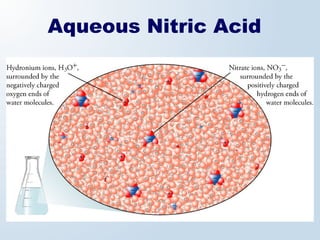
Aqueous Nitric Acid
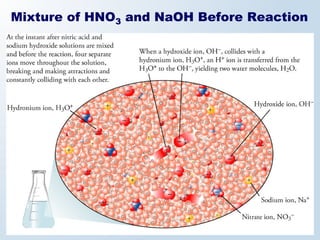
Mixture of HNO3 and NaOH Before Reaction
Strong Acid and Strong
      Base Reaction
The hydronium ion, H3O+, from the strong acid
reacts with the hydroxide ion, OH−, from the
strong base to form water, H2O.
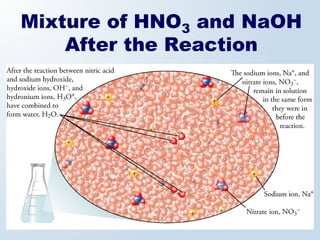
Mixture of HNO3 and NaOH
    After the Reaction
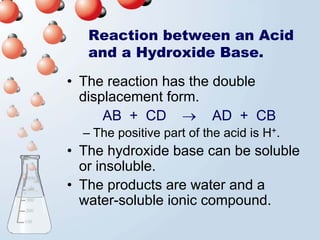
Reaction between an Acid
   and a Hydroxide Base.

• The reaction has the double
  displacement form.
      AB + CD → AD + CB
  – The positive part of the acid is H+.
• The hydroxide base can be soluble
  or insoluble.
• The products are water and a
  water-soluble ionic compound.
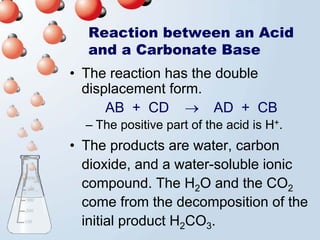
Reaction between an Acid
  and a Carbonate Base
• The reaction has the double
  displacement form.
      AB + CD → AD + CB
  – The positive part of the acid is H+.
• The products are water, carbon
  dioxide, and a water-soluble ionic
  compound. The H2O and the CO2
  come from the decomposition of the
  initial product H2CO3.
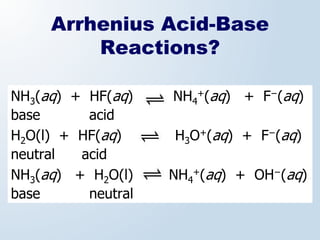
Arrhenius Acid-Base
         Reactions?

NH3(aq) + HF(aq)    NH4+(aq) + F−(aq)
base      acid
H2O(l) + HF(aq)     H3O+(aq) + F−(aq)
neutral  acid
NH3(aq) + H2O(l)    NH4+(aq) + OH−(aq)
base      neutral
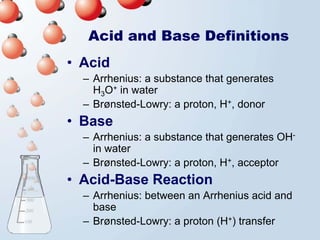
Acid and Base Definitions
• Acid
  – Arrhenius: a substance that generates
    H3O+ in water
  – Brønsted-Lowry: a proton, H+, donor
• Base
  – Arrhenius: a substance that generates OH-
    in water
  – Brønsted-Lowry: a proton, H+, acceptor
• Acid-Base Reaction
  – Arrhenius: between an Arrhenius acid and
    base
  – Brønsted-Lowry: a proton (H+) transfer
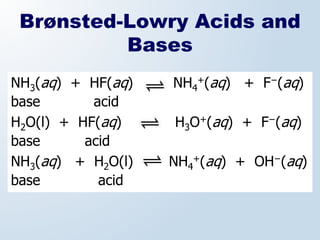
Brønsted-Lowry Acids and
          Bases
NH3(aq) + HF(aq)   NH4+(aq) + F−(aq)
base       acid
H2O(l) + HF(aq)    H3O+(aq) + F−(aq)
base      acid
NH3(aq) + H2O(l)   NH4+(aq) + OH−(aq)
base        acid
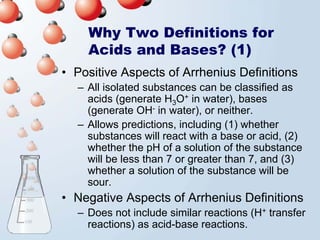
Why Two Definitions for
    Acids and Bases? (1)
• Positive Aspects of Arrhenius Definitions
  – All isolated substances can be classified as
    acids (generate H3O+ in water), bases
    (generate OH- in water), or neither.
  – Allows predictions, including (1) whether
    substances will react with a base or acid, (2)
    whether the pH of a solution of the substance
    will be less than 7 or greater than 7, and (3)
    whether a solution of the substance will be
    sour.
• Negative Aspects of Arrhenius Definitions
  – Does not include similar reactions (H+ transfer
    reactions) as acid-base reactions.
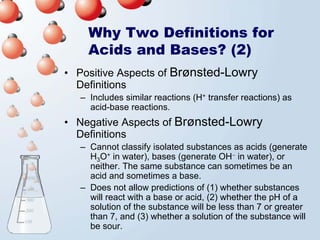
Why Two Definitions for
    Acids and Bases? (2)
• Positive Aspects of Brønsted-Lowry
  Definitions
  – Includes similar reactions (H+ transfer reactions) as
    acid-base reactions.
• Negative Aspects of Brønsted-Lowry
  Definitions
  – Cannot classify isolated substances as acids (generate
    H3O+ in water), bases (generate OH− in water), or
    neither. The same substance can sometimes be an
    acid and sometimes a base.
  – Does not allow predictions of (1) whether substances
    will react with a base or acid, (2) whether the pH of a
    solution of the substance will be less than 7 or greater
    than 7, and (3) whether a solution of the substance will
    be sour.
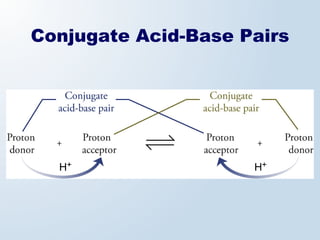
Conjugate Acid-Base Pairs
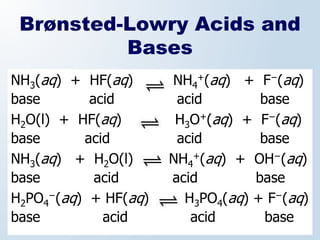
Brønsted-Lowry Acids and
          Bases
NH3(aq) + HF(aq)      NH4+(aq) + F−(aq)
base       acid        acid        base
H2O(l) + HF(aq)        H3O+(aq) + F−(aq)
base      acid         acid        base
NH3(aq) + H2O(l)      NH4+(aq) + OH−(aq)
base        acid      acid        base
H2PO4−(aq) + HF(aq)     H3PO4(aq) + F−(aq)
base         acid        acid       base
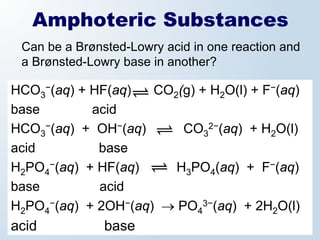
Amphoteric Substances
 Can be a Brønsted-Lowry acid in one reaction and
 a Brønsted-Lowry base in another?

HCO3−(aq) + HF(aq)   CO2(g) + H2O(l) + F−(aq)
base        acid
HCO3−(aq) + OH−(aq)      CO32−(aq) + H2O(l)
acid         base
H2PO4−(aq) + HF(aq)     H3PO4(aq) + F−(aq)
base         acid
H2PO4−(aq) + 2OH−(aq) → PO43−(aq) + 2H2O(l)
acid           base

5 bishop

  • 1.
    Chapter 5 Acids,Bases, and Acid-Base Reactions
  • 2.
  • 3.
    Arrhenius Acid Definition • An acid is a substance that generates hydronium ions, H3O+ (often described as H+), when added to water. • An acidic solution is a solution with a significant concentration of H3O+ ions.
  • 4.
    Characteristics of Acids • Acids have a sour taste. • Acids turn litmus from blue to red. • Acids react with bases.
  • 5.
    Strong Acid andWater When HCl dissolves in water, hydronium ions, H3O+, and chloride ions, Cl−, ions form.
  • 6.
    Solution of aStrong Acid
  • 7.
    Types of Acids •Binary acids have the general formula of HX(aq) – HF(aq), HCl(aq), HBr(aq), and HI(aq) • Oxyacids have the general formula HaXbOc. – HNO3 and H2SO4 • Organic (carbon-based) acids – HC2H3O2
  • 8.
  • 9.
    Monoprotic and Polyprotic Acids • If each molecule of an acid can donate one hydrogen ion, the acid is called a monoprotic acid. • If each molecule can donate two or more hydrogen ions, the acid is a polyprotic acid. • A diprotic acid, such as sulfuric acid, H2SO4, has two acidic hydrogen atoms. • Some acids, such as phosphoric acid, H3PO4, are triprotic acids.
  • 10.
    Strong and WeakAcids • Strong Acid = due to a completion reaction with water, generates close to one H3O+ for each acid molecule added to water. • Weak Acid = due to a reversible reaction with water, generates significantly less than one H3O+ for each molecule of acid added to water.
  • 11.
    Weak Acid andWater Acetic acid reacts with water in a reversible reaction, which forms hydronium and acetate ions.
  • 12.
  • 13.
  • 14.
    Sulfuric Acid H2SO4(aq) +H2O(l) → H3O+(aq) + HSO4−(aq) HSO4−(aq) + H2O(l) H3O+(aq) + SO42−(aq)
  • 15.
    Acid Summary Strong Weak Binary acid hydrochloric acid, hydrofluoric acid HCl(aq) Oxyacid nitric acid, HNO3 other acids sulfuric acid, H2SO4 with HaXbOc Organic acid none acetic acid, HC2H3O2
  • 16.
    Names and Formulas of Binary Acids • Names have the general form of hydro(root)ic acid, such as hydrochloric acid. • The formulas are usually followed by (aq), such as HCl(aq).
  • 17.
    Names and Formulas for Oxyacids • If enough H+ ions are added to a (root)ate polyatomic ion to completely neutralize its charge, the (root)ic acid is formed. – Nitrate, NO3−, goes to nitric acid, HNO3. – Sulfate, SO42−, goes to sulfuric acid, H2SO4. (Note the -ur- in the name.) – Phosphate, PO43−, goes to phosphoric acid, H3PO4. (Note the -or- in the name.)
  • 18.
    Chemical Nomenclature • General procedure for naming compounds (See Table 5.5 in the text.) – Step 1: Decide what type of compound the name or formula represents. – Step 2: Apply the rules for writing the name or formula for that type of compound.
  • 19.
    Arrhenius Base Definitions • A base is a substance that generates OH− when added to water. • A basic solution is a solution with a significant concentration of OH− ions.
  • 20.
    Characteristics of Bases • Bases have a bitter taste. • Bases feel slippery on your fingers. • Bases turn litmus from red to blue. • Bases react with acids.
  • 21.
    Strong Bases • StrongBase = due to a completion reaction with water, generates close to one (or more) OH− for each formula unit of base added to water. – Metal hydroxides are strong bases.
  • 22.
    Ammonia and Water Ammoniareacts with water in a reversible reaction, which forms ammonium and hydroxide ions.
  • 23.
    Weak Base • WeakBase = due to a reversible reaction with water, generates significantly less than one OH− for each formula unit of base added to water. – Ammonia and ionic compounds that contain CO32− or HCO3− are weak bases.
  • 24.
  • 25.
    Carbonate Bases Na2CO3(s) →2Na+(aq) + CO32−(aq) CO32−(aq) + H2O(l) HCO3−(aq) + OH−(aq) NaHCO3(s) → Na+(aq) + HCO3−(aq) HCO3−(aq) + H2O(l) H2CO3(aq) + OH−(aq)
  • 26.
    Arrhenius Bases Strong Weak Ionic Metal Ionic compounds Compounds hydroxides with CO32− and HCO3− Certain None NH3 Uncharged molecules
  • 27.
    pH • Acidic solutionshave pH values less than 7, and the more acidic the solution is, the lower its pH. • Basic solutions have pH values greater than 7, and the more basic the solution is, the higher its pH.
  • 28.
  • 29.
    Neutralization Reactions •Reactions between Arrhenius acids and Arrhenius bases are called neutralization reactions. HNO3(aq) + NaOH(aq) → H2O(l) + NaNO3(aq)
  • 30.
  • 31.
    Mixture of HNO3and NaOH Before Reaction
  • 32.
    Strong Acid andStrong Base Reaction The hydronium ion, H3O+, from the strong acid reacts with the hydroxide ion, OH−, from the strong base to form water, H2O.
  • 33.
    Mixture of HNO3and NaOH After the Reaction
  • 34.
    Reaction between anAcid and a Hydroxide Base. • The reaction has the double displacement form. AB + CD → AD + CB – The positive part of the acid is H+. • The hydroxide base can be soluble or insoluble. • The products are water and a water-soluble ionic compound.
  • 35.
    Reaction between anAcid and a Carbonate Base • The reaction has the double displacement form. AB + CD → AD + CB – The positive part of the acid is H+. • The products are water, carbon dioxide, and a water-soluble ionic compound. The H2O and the CO2 come from the decomposition of the initial product H2CO3.
  • 36.
    Arrhenius Acid-Base Reactions? NH3(aq) + HF(aq) NH4+(aq) + F−(aq) base acid H2O(l) + HF(aq) H3O+(aq) + F−(aq) neutral acid NH3(aq) + H2O(l) NH4+(aq) + OH−(aq) base neutral
  • 37.
    Acid and BaseDefinitions • Acid – Arrhenius: a substance that generates H3O+ in water – Brønsted-Lowry: a proton, H+, donor • Base – Arrhenius: a substance that generates OH- in water – Brønsted-Lowry: a proton, H+, acceptor • Acid-Base Reaction – Arrhenius: between an Arrhenius acid and base – Brønsted-Lowry: a proton (H+) transfer
  • 38.
    Brønsted-Lowry Acids and Bases NH3(aq) + HF(aq) NH4+(aq) + F−(aq) base acid H2O(l) + HF(aq) H3O+(aq) + F−(aq) base acid NH3(aq) + H2O(l) NH4+(aq) + OH−(aq) base acid
  • 39.
    Why Two Definitionsfor Acids and Bases? (1) • Positive Aspects of Arrhenius Definitions – All isolated substances can be classified as acids (generate H3O+ in water), bases (generate OH- in water), or neither. – Allows predictions, including (1) whether substances will react with a base or acid, (2) whether the pH of a solution of the substance will be less than 7 or greater than 7, and (3) whether a solution of the substance will be sour. • Negative Aspects of Arrhenius Definitions – Does not include similar reactions (H+ transfer reactions) as acid-base reactions.
  • 40.
    Why Two Definitionsfor Acids and Bases? (2) • Positive Aspects of Brønsted-Lowry Definitions – Includes similar reactions (H+ transfer reactions) as acid-base reactions. • Negative Aspects of Brønsted-Lowry Definitions – Cannot classify isolated substances as acids (generate H3O+ in water), bases (generate OH− in water), or neither. The same substance can sometimes be an acid and sometimes a base. – Does not allow predictions of (1) whether substances will react with a base or acid, (2) whether the pH of a solution of the substance will be less than 7 or greater than 7, and (3) whether a solution of the substance will be sour.
  • 41.
  • 42.
    Brønsted-Lowry Acids and Bases NH3(aq) + HF(aq) NH4+(aq) + F−(aq) base acid acid base H2O(l) + HF(aq) H3O+(aq) + F−(aq) base acid acid base NH3(aq) + H2O(l) NH4+(aq) + OH−(aq) base acid acid base H2PO4−(aq) + HF(aq) H3PO4(aq) + F−(aq) base acid acid base
  • 43.
    Amphoteric Substances Canbe a Brønsted-Lowry acid in one reaction and a Brønsted-Lowry base in another? HCO3−(aq) + HF(aq) CO2(g) + H2O(l) + F−(aq) base acid HCO3−(aq) + OH−(aq) CO32−(aq) + H2O(l) acid base H2PO4−(aq) + HF(aq) H3PO4(aq) + F−(aq) base acid H2PO4−(aq) + 2OH−(aq) → PO43−(aq) + 2H2O(l) acid base