Bangaram. Darling
in my heart
 Acids






Introduction
Properties
Classification
Preparation
Uses in daily life

 Bases






Introduction
Properties
Classification
Preparation
Uses in daily life

 Salts






Introduction
Properties
Classification
Preparation
Uses in daily life

 Ph Scale
 Queries

Introduction
Acids
Introduction :
There are several methods of defining acids and
bases. While these definitions don't contradict
each other, they do vary in how
inclusive they are. Antoine Lavoisier,
Humphry Davy, and Justus Liebig also made
observations regarding acids and bases,
but didn't formalize definitions.
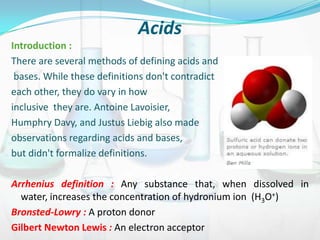
Arrhenius definition : Any substance that, when dissolved in
water, increases the concentration of hydronium ion (H3O+)
Bronsted-Lowry : A proton donor
Gilbert Newton Lewis : An electron acceptor
Properties of acids
 taste sour (don't taste them!)... the word 'acid' comes






from the Latin acere, which means 'sour'
acids change litmus (a blue vegetable dye) from blue to
red
their aqueous (water) solutions conduct electric
current (are electrolytes)
react with bases to form salts and water
evolve hydrogen gas (H2) upon reaction with an active
metal (such as alkali metals, alkaline earth metals,
zinc, aluminum)
Classification of acids:
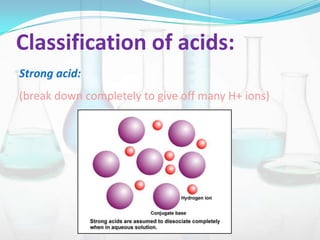
Strong acid:
(break down completely to give off many H+ ions)
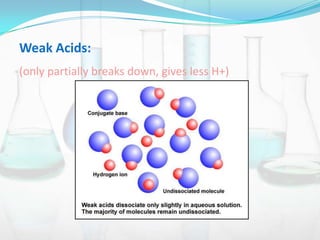
Weak Acids:
(only partially breaks down, gives less H+)
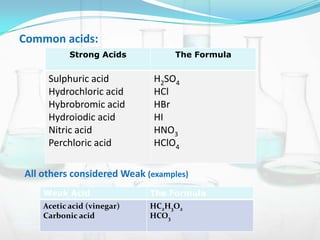
Common acids:
Strong Acids

Sulphuric acid
Hydrochloric acid
Hybrobromic acid
Hydroiodic acid
Nitric acid
Perchloric acid

The Formula

H2SO4
HCl
HBr
HI
HNO3
HClO4

All others considered Weak (examples)
Weak Acid

The Formula

Acetic acid (vinegar)
Carbonic acid

HC2H3O2
HCO3
Preparation of Acids
There are several methods of preparation of acids. These include the following:
 By the reaction between an acidic oxide of a non-metal (acid anhydride)
and water.
SO2(g) + H2O(l) → H2SO3(aq) Trioxosulphate(IV)
P4O10(s) + 2H2O(l) → 4HPO3(aq) Trioxophosphate(V)




Displacement of a weaker of more volatile acid from its salt by a stronger
or less volatile acid.
NaCl(s) + H2SO4(aq) → NaHSO4(aq) + HCl(aq)
Na2B4O7(s) (Borax) + H2SO4(aq) + 5H2O(l) →
Na2SO4(aq) + 4H3BO3(aq) (trioxoborate(III) acid)
Displacement of insoluble sulphide from a metallic salt by hydrogen
sulphide.
Pb(C2H3O2)2(aq) + H2S(g) → PbS(s) + 2CH3COOH(aq) (Ethanoic acid)
Uses of Acids
Acids have numerous uses, some of which include:
 HCl in stomach
 H2SO4 in car batteries, as drying agent’

 HNO3 in manufacturing of fertilizers
 Ethanoic acid in food industry
 Fatty acids in soap making
 Ascorbic acid in medicine
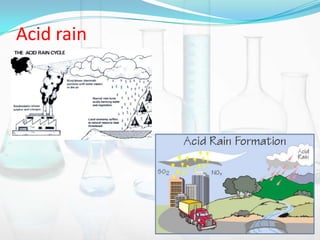
Acid rain
Bases
Svante Arrhenius:
 bases produce OH- ions in aqueous solutions.
 water required, so only allows for aqueous solutions
 only hydroxide bases are allowed; required to produce hydrogen
ions
Brønsted – Lowry:
 bases are proton acceptors
 bases besides hydroxides are permissible
Gilbert Newton Lewis:
 bases are electron pair donors
 least restrictive of acid-base definitions
Properties of Bases
 taste bitter (don't taste them!)
 feel slippery or soapy (don't arbitrarily touch them!)
 bases don't change the color of litmus; they can turn

red (acidified) litmus back to blue
 their aqueous (water) solutions conduct and electric
current (are electrolytes)
 react with acids to form salts and water
Classification of Basis:
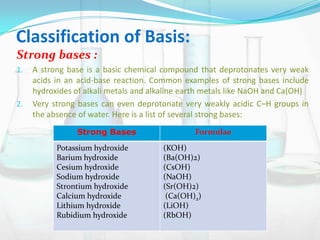
Strong bases :
1.

2.

A strong base is a basic chemical compound that deprotonates very weak
acids in an acid-base reaction. Common examples of strong bases include
hydroxides of alkali metals and alkaline earth metals like NaOH and Ca(OH)
Very strong bases can even deprotonate very weakly acidic C–H groups in
the absence of water. Here is a list of several strong bases:
Strong Bases
Potassium hydroxide
Barium hydroxide
Cesium hydroxide
Sodium hydroxide
Strontium hydroxide
Calcium hydroxide
Lithium hydroxide
Rubidium hydroxide

Formulae
(KOH)
(Ba(OH)2)
(CsOH)
(NaOH)
(Sr(OH)2)
(Ca(OH)2)
(LiOH)
(RbOH)
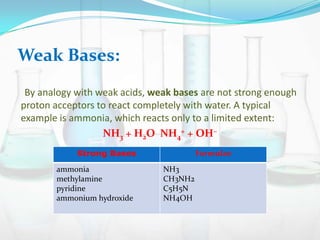
Weak Bases:
By analogy with weak acids, weak bases are not strong enough
proton acceptors to react completely with water. A typical
example is ammonia, which reacts only to a limited extent:
NH3 + H2O NH4+ + OH–
Strong Bases
ammonia
methylamine
pyridine
ammonium hydroxide

Formulae
NH3
CH3NH2
C5H5N
NH4OH
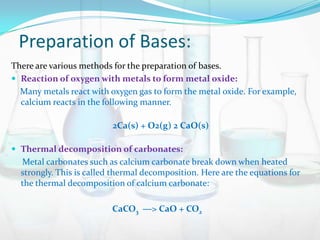
Preparation of Bases:
There are various methods for the preparation of bases.
 Reaction of oxygen with metals to form metal oxide:
Many metals react with oxygen gas to form the metal oxide. For example,
calcium reacts in the following manner.
2Ca(s) + O2(g) 2 CaO(s)
 Thermal decomposition of carbonates:

Metal carbonates such as calcium carbonate break down when heated
strongly. This is called thermal decomposition. Here are the equations for
the thermal decomposition of calcium carbonate:
CaCO3 ―> CaO + CO2
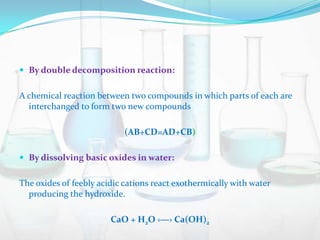
 By double decomposition reaction:

A chemical reaction between two compounds in which parts of each are
interchanged to form two new compounds
(AB+CD=AD+CB)
 By dissolving basic oxides in water:

The oxides of feebly acidic cations react exothermically with water
producing the hydroxide.
CaO + H2O ‹―› Ca(OH)2
Uses of Bases:
 Sodium hydroxide (caustic soda) is used in the manufacture of soap. It is

used in petroleum-refining; in making medicines, paper, pulp, etc. It is
used in making rayon.

 Calcium hydroxide is also known as slaked lime. It is used to neutralize

acid in water supplies; in the manufacture of bleaching powder; as a
dressing material for acid burns; as an antidote for food poisoning; in the
preparation of fungicides and in the mixture of whitewash. It is mixed with
sand and water to make mortar which is used in the construction of
buildings. It is also used by farmers on the fields to neutralize the harmful
effects of acid rain.

 Ammonium hydroxide is used to remove ink spots from clothes and to

remove grease from window-panes. It is used in the cosmetic industry.

 Alkalis are used in alkaline batteries. Generally, potassium hydroxide is

used in such batteries.
Salts
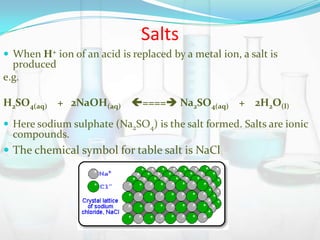
 When H+ ion of an acid is replaced by a metal ion, a salt is

produced
e.g.

H2SO4(aq) + 2NaOH(aq) ==== Na2SO4(aq) + 2H2O(l)
 Here sodium sulphate (Na2SO4) is the salt formed. Salts are ionic

compounds.

 The chemical symbol for table salt is NaCl
Properties of salts
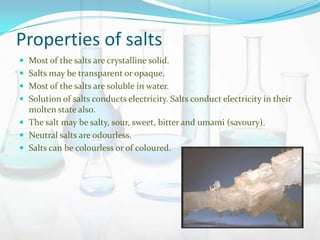
 Most of the salts are crystalline solid.
 Salts may be transparent or opaque.

 Most of the salts are soluble in water.
 Solution of salts conducts electricity. Salts conduct electricity in their

molten state also.
 The salt may be salty, sour, sweet, bitter and umami (savoury).
 Neutral salts are odourless.
 Salts can be colourless or of coloured.
Classification of Salts
There are different kinds of salts. These include:
1. Normal salt
The hydrogen ions of the acid are completely replaced by metallic ions .
Examples are NaCl, CuSO4, KNO3, and CaCO3. Normal salts are
electrically neutral.
2. Acid salt
The salt still has hydrogen atom(s) from an acid which can further be
replaced by metallic ions. Examples include: NaHSO4, NaHCO3 and
NaHS
3. Basic salt
The salt contains hydroxides together with metallic ions and negative ions
from an acid. Examples are basic zinc chloride, ZnOHCl, basic
magnesium chloride.
4. Double salt
Salt that ionizes to produce three different types of ions in
solution, two of these are usually positively charged and the
other negatively charged. Examples are ammonium iron(II)
tetraoxosulphate(VI) hexahydrate, (NH4)2 Fe(SO4)2.6H2O;
potash alum or aluminium potassium tetraoxosulphate(VI)
dodecahydrate, KAl(SO4)2. 12H2O; and chrome alum or
chromium(III) potassium tetraoxosulphate(VI) dodecahydrate,
KCr(SO4)2. 12H2O.
5. Complex salt
The salt contains complex ions, i.e. ions consisting of a charged
group of atoms. Examples are sodium tetrahydroxozincate(II)
Na2Zn(OH)4(aq)2Na+(aq)+Zn(OH)2-4(aq)
potassium hexacyanoferrate(II)
K4Fe(CN)6(aq)4K+(aq)+[Fe(CN)6]4-(aq)
Preparation of salts
Hydrolysis of Salts
When salts dissolve in water they are hydrolyzed. The reaction between a salt
and water to give either acidic or basic solution is known as hydrolysis.
Hydrolysis involves the split of water molecules into its ions, H+ and OH-.
These ions then get attracted to the opposite ions of the salt. The degree of
attraction determines which ion, i.e. H+ or OH- will be more in solution,
thereby resulting in the solution being acidic (more H+ in solution) or basic
(more OH- in solution) or neutral (equal conc. of H+ and OH- in solution).
The nature of the resultant solutions depends on the nature of the salts:
Salts formed from strong acids and strong bases (example, NaCl – HCl +
NaOH)
These salts give neutral solutions (the H+ and OH- an attracted to the opposite
ions of the salt in the same degree). Example, for the hydrolysis of NaCl,
H+ and OH- ions are attracted at equal ease to Cl- and Na+ respectively to
from HCl and NaOH.
Therefore, the solution contains equal concentration of H+ and OH- ions.
Salts formed from strong acids and weak bases (example, NH4Cl –
HCl + NH3)
Solutions of these salts are acidic (i.e. conc. of H+ is more than that of
OH-). The OH- ions are attracted more to the positive ions of the salts
than the H+ ions are attracted to the negative ions.
Example, for the hydrolysis of NH4Cl, OH- ions are attracted more to
NH4+ than H+ ions attracted to Cl- ions. Hence, there is more
concentration of H+ ions in solution, which results in the solution
being acidic.
Salts formed from weak acids and strong bases (e.g. NaHCO3 –
NaOH + H2CO3 ; Na2CO3 – NaOH + H2CO3)
The solutions are basic (i.e. the concentration of OH- ions is more than
that of H+ ions). This is because H+ ions are more attracted to the
negative ions of the salt than OH- ions attracted to the positive ions of
the salt.
lt will be acidic if the acid salt is formed from a strong
acid, example, NaHSO4 (the hydrogen atom will be furnished in
solution as the only positive ion).
Salts formed from weak acids and weak bases (e.g. (NH4)2CO3)
The solutions of these salts are neutral (equal attraction between the
positive ions of the salt and OH- ions of water; and the negative ions of
salt and H+ ions of water. Hence equal concentration of H+ and OH- are
in solution).
Example, when NaCl is hydrolysed, it produces HCl and NaOH - from
which it was initially produced with the elimination of water
molecules.
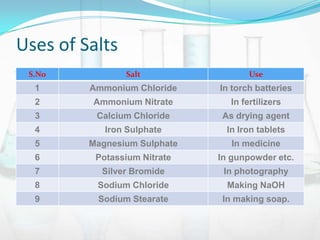
Uses of Salts
S.No

Salt

Use

1

Ammonium Chloride

In torch batteries

2

Ammonium Nitrate

In fertilizers

3

Calcium Chloride

As drying agent

4

Iron Sulphate

In Iron tablets

5

Magnesium Sulphate

In medicine

6

Potassium Nitrate

In gunpowder etc.

7

Silver Bromide

In photography

8

Sodium Chloride

Making NaOH

9

Sodium Stearate

In making soap.
pH Scale
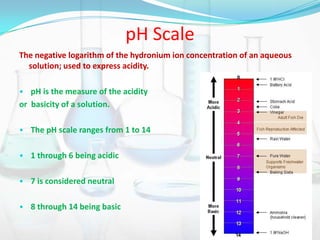
The negative logarithm of the hydronium ion concentration of an aqueous
solution; used to express acidity.
• pH is the measure of the acidity

or basicity of a solution.
• The pH scale ranges from 1 to 14
• 1 through 6 being acidic
• 7 is considered neutral
• 8 through 14 being basic
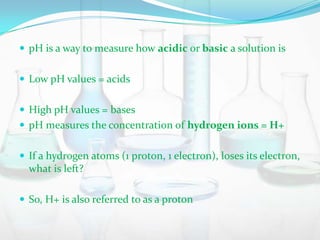
 pH is a way to measure how acidic or basic a solution is
 Low pH values = acids
 High pH values = bases
 pH measures the concentration of hydrogen ions = H+
 If a hydrogen atoms (1 proton, 1 electron), loses its electron,

what is left?
 So, H+ is also referred to as a proton
The pH scale ranges from 1 to 10-14 mol/L or from 1 to 14.

pH = - log [H3O+]
1 2 3 4 5 6 7 8 9 10 11 12 13 14
acid
neutral
base
Manipulating pH
Algebraic manipulation of:

pH = - log [H3O+]
allows for:

[H3O+] = 10-pH
If pH is a measure of the hydronium ion concentration
then the same equations could be used to describe the
hydroxide (base) concentration.

[OH-] = 10-pOH

pOH = - log [OH-]

thus:

pH + pOH = 14 ; the entire pH range!
Summary
• ACID - A class of compounds whose water solutions taste

sour, turn blue litmus to red, and react with bases to form
salts.
• BASE - A class of compounds that taste bitter, feel slippery

in water solution, turn red litmus to blue, and react with
acids to form salts.
• Salt - These are items that are neither acids or bases.
Acids bases and salts

Acids bases and salts

  • 1.
  • 2.
     Acids      Introduction Properties Classification Preparation Uses indaily life  Bases      Introduction Properties Classification Preparation Uses in daily life  Salts      Introduction Properties Classification Preparation Uses in daily life  Ph Scale  Queries Introduction
  • 3.
    Acids Introduction : There areseveral methods of defining acids and bases. While these definitions don't contradict each other, they do vary in how inclusive they are. Antoine Lavoisier, Humphry Davy, and Justus Liebig also made observations regarding acids and bases, but didn't formalize definitions. Arrhenius definition : Any substance that, when dissolved in water, increases the concentration of hydronium ion (H3O+) Bronsted-Lowry : A proton donor Gilbert Newton Lewis : An electron acceptor
  • 4.
    Properties of acids taste sour (don't taste them!)... the word 'acid' comes     from the Latin acere, which means 'sour' acids change litmus (a blue vegetable dye) from blue to red their aqueous (water) solutions conduct electric current (are electrolytes) react with bases to form salts and water evolve hydrogen gas (H2) upon reaction with an active metal (such as alkali metals, alkaline earth metals, zinc, aluminum)
  • 5.
    Classification of acids: Strongacid: (break down completely to give off many H+ ions)
  • 6.
    Weak Acids: (only partiallybreaks down, gives less H+)
  • 7.
    Common acids: Strong Acids Sulphuricacid Hydrochloric acid Hybrobromic acid Hydroiodic acid Nitric acid Perchloric acid The Formula H2SO4 HCl HBr HI HNO3 HClO4 All others considered Weak (examples) Weak Acid The Formula Acetic acid (vinegar) Carbonic acid HC2H3O2 HCO3
  • 8.
    Preparation of Acids Thereare several methods of preparation of acids. These include the following:  By the reaction between an acidic oxide of a non-metal (acid anhydride) and water. SO2(g) + H2O(l) → H2SO3(aq) Trioxosulphate(IV) P4O10(s) + 2H2O(l) → 4HPO3(aq) Trioxophosphate(V)   Displacement of a weaker of more volatile acid from its salt by a stronger or less volatile acid. NaCl(s) + H2SO4(aq) → NaHSO4(aq) + HCl(aq) Na2B4O7(s) (Borax) + H2SO4(aq) + 5H2O(l) → Na2SO4(aq) + 4H3BO3(aq) (trioxoborate(III) acid) Displacement of insoluble sulphide from a metallic salt by hydrogen sulphide. Pb(C2H3O2)2(aq) + H2S(g) → PbS(s) + 2CH3COOH(aq) (Ethanoic acid)
  • 9.
    Uses of Acids Acidshave numerous uses, some of which include:  HCl in stomach  H2SO4 in car batteries, as drying agent’  HNO3 in manufacturing of fertilizers  Ethanoic acid in food industry  Fatty acids in soap making  Ascorbic acid in medicine
  • 10.
  • 11.
    Bases Svante Arrhenius:  basesproduce OH- ions in aqueous solutions.  water required, so only allows for aqueous solutions  only hydroxide bases are allowed; required to produce hydrogen ions Brønsted – Lowry:  bases are proton acceptors  bases besides hydroxides are permissible Gilbert Newton Lewis:  bases are electron pair donors  least restrictive of acid-base definitions
  • 12.
    Properties of Bases taste bitter (don't taste them!)  feel slippery or soapy (don't arbitrarily touch them!)  bases don't change the color of litmus; they can turn red (acidified) litmus back to blue  their aqueous (water) solutions conduct and electric current (are electrolytes)  react with acids to form salts and water
  • 13.
    Classification of Basis: Strongbases : 1. 2. A strong base is a basic chemical compound that deprotonates very weak acids in an acid-base reaction. Common examples of strong bases include hydroxides of alkali metals and alkaline earth metals like NaOH and Ca(OH) Very strong bases can even deprotonate very weakly acidic C–H groups in the absence of water. Here is a list of several strong bases: Strong Bases Potassium hydroxide Barium hydroxide Cesium hydroxide Sodium hydroxide Strontium hydroxide Calcium hydroxide Lithium hydroxide Rubidium hydroxide Formulae (KOH) (Ba(OH)2) (CsOH) (NaOH) (Sr(OH)2) (Ca(OH)2) (LiOH) (RbOH)
  • 14.
    Weak Bases: By analogywith weak acids, weak bases are not strong enough proton acceptors to react completely with water. A typical example is ammonia, which reacts only to a limited extent: NH3 + H2O NH4+ + OH– Strong Bases ammonia methylamine pyridine ammonium hydroxide Formulae NH3 CH3NH2 C5H5N NH4OH
  • 15.
    Preparation of Bases: Thereare various methods for the preparation of bases.  Reaction of oxygen with metals to form metal oxide: Many metals react with oxygen gas to form the metal oxide. For example, calcium reacts in the following manner. 2Ca(s) + O2(g) 2 CaO(s)  Thermal decomposition of carbonates: Metal carbonates such as calcium carbonate break down when heated strongly. This is called thermal decomposition. Here are the equations for the thermal decomposition of calcium carbonate: CaCO3 ―> CaO + CO2
  • 16.
     By doubledecomposition reaction: A chemical reaction between two compounds in which parts of each are interchanged to form two new compounds (AB+CD=AD+CB)  By dissolving basic oxides in water: The oxides of feebly acidic cations react exothermically with water producing the hydroxide. CaO + H2O ‹―› Ca(OH)2
  • 17.
    Uses of Bases: Sodium hydroxide (caustic soda) is used in the manufacture of soap. It is used in petroleum-refining; in making medicines, paper, pulp, etc. It is used in making rayon.  Calcium hydroxide is also known as slaked lime. It is used to neutralize acid in water supplies; in the manufacture of bleaching powder; as a dressing material for acid burns; as an antidote for food poisoning; in the preparation of fungicides and in the mixture of whitewash. It is mixed with sand and water to make mortar which is used in the construction of buildings. It is also used by farmers on the fields to neutralize the harmful effects of acid rain.  Ammonium hydroxide is used to remove ink spots from clothes and to remove grease from window-panes. It is used in the cosmetic industry.  Alkalis are used in alkaline batteries. Generally, potassium hydroxide is used in such batteries.
  • 18.
    Salts  When H+ion of an acid is replaced by a metal ion, a salt is produced e.g. H2SO4(aq) + 2NaOH(aq) ==== Na2SO4(aq) + 2H2O(l)  Here sodium sulphate (Na2SO4) is the salt formed. Salts are ionic compounds.  The chemical symbol for table salt is NaCl
  • 19.
    Properties of salts Most of the salts are crystalline solid.  Salts may be transparent or opaque.  Most of the salts are soluble in water.  Solution of salts conducts electricity. Salts conduct electricity in their molten state also.  The salt may be salty, sour, sweet, bitter and umami (savoury).  Neutral salts are odourless.  Salts can be colourless or of coloured.
  • 20.
    Classification of Salts Thereare different kinds of salts. These include: 1. Normal salt The hydrogen ions of the acid are completely replaced by metallic ions . Examples are NaCl, CuSO4, KNO3, and CaCO3. Normal salts are electrically neutral. 2. Acid salt The salt still has hydrogen atom(s) from an acid which can further be replaced by metallic ions. Examples include: NaHSO4, NaHCO3 and NaHS 3. Basic salt The salt contains hydroxides together with metallic ions and negative ions from an acid. Examples are basic zinc chloride, ZnOHCl, basic magnesium chloride.
  • 21.
    4. Double salt Saltthat ionizes to produce three different types of ions in solution, two of these are usually positively charged and the other negatively charged. Examples are ammonium iron(II) tetraoxosulphate(VI) hexahydrate, (NH4)2 Fe(SO4)2.6H2O; potash alum or aluminium potassium tetraoxosulphate(VI) dodecahydrate, KAl(SO4)2. 12H2O; and chrome alum or chromium(III) potassium tetraoxosulphate(VI) dodecahydrate, KCr(SO4)2. 12H2O. 5. Complex salt The salt contains complex ions, i.e. ions consisting of a charged group of atoms. Examples are sodium tetrahydroxozincate(II) Na2Zn(OH)4(aq)2Na+(aq)+Zn(OH)2-4(aq) potassium hexacyanoferrate(II) K4Fe(CN)6(aq)4K+(aq)+[Fe(CN)6]4-(aq)
  • 22.
    Preparation of salts Hydrolysisof Salts When salts dissolve in water they are hydrolyzed. The reaction between a salt and water to give either acidic or basic solution is known as hydrolysis. Hydrolysis involves the split of water molecules into its ions, H+ and OH-. These ions then get attracted to the opposite ions of the salt. The degree of attraction determines which ion, i.e. H+ or OH- will be more in solution, thereby resulting in the solution being acidic (more H+ in solution) or basic (more OH- in solution) or neutral (equal conc. of H+ and OH- in solution). The nature of the resultant solutions depends on the nature of the salts: Salts formed from strong acids and strong bases (example, NaCl – HCl + NaOH) These salts give neutral solutions (the H+ and OH- an attracted to the opposite ions of the salt in the same degree). Example, for the hydrolysis of NaCl, H+ and OH- ions are attracted at equal ease to Cl- and Na+ respectively to from HCl and NaOH. Therefore, the solution contains equal concentration of H+ and OH- ions.
  • 23.
    Salts formed fromstrong acids and weak bases (example, NH4Cl – HCl + NH3) Solutions of these salts are acidic (i.e. conc. of H+ is more than that of OH-). The OH- ions are attracted more to the positive ions of the salts than the H+ ions are attracted to the negative ions. Example, for the hydrolysis of NH4Cl, OH- ions are attracted more to NH4+ than H+ ions attracted to Cl- ions. Hence, there is more concentration of H+ ions in solution, which results in the solution being acidic. Salts formed from weak acids and strong bases (e.g. NaHCO3 – NaOH + H2CO3 ; Na2CO3 – NaOH + H2CO3) The solutions are basic (i.e. the concentration of OH- ions is more than that of H+ ions). This is because H+ ions are more attracted to the negative ions of the salt than OH- ions attracted to the positive ions of the salt. lt will be acidic if the acid salt is formed from a strong acid, example, NaHSO4 (the hydrogen atom will be furnished in solution as the only positive ion).
  • 24.
    Salts formed fromweak acids and weak bases (e.g. (NH4)2CO3) The solutions of these salts are neutral (equal attraction between the positive ions of the salt and OH- ions of water; and the negative ions of salt and H+ ions of water. Hence equal concentration of H+ and OH- are in solution). Example, when NaCl is hydrolysed, it produces HCl and NaOH - from which it was initially produced with the elimination of water molecules.
  • 25.
    Uses of Salts S.No Salt Use 1 AmmoniumChloride In torch batteries 2 Ammonium Nitrate In fertilizers 3 Calcium Chloride As drying agent 4 Iron Sulphate In Iron tablets 5 Magnesium Sulphate In medicine 6 Potassium Nitrate In gunpowder etc. 7 Silver Bromide In photography 8 Sodium Chloride Making NaOH 9 Sodium Stearate In making soap.
  • 26.
    pH Scale The negativelogarithm of the hydronium ion concentration of an aqueous solution; used to express acidity. • pH is the measure of the acidity or basicity of a solution. • The pH scale ranges from 1 to 14 • 1 through 6 being acidic • 7 is considered neutral • 8 through 14 being basic
  • 27.
     pH isa way to measure how acidic or basic a solution is  Low pH values = acids  High pH values = bases  pH measures the concentration of hydrogen ions = H+  If a hydrogen atoms (1 proton, 1 electron), loses its electron, what is left?  So, H+ is also referred to as a proton
  • 28.
    The pH scaleranges from 1 to 10-14 mol/L or from 1 to 14. pH = - log [H3O+] 1 2 3 4 5 6 7 8 9 10 11 12 13 14 acid neutral base
  • 29.
    Manipulating pH Algebraic manipulationof: pH = - log [H3O+] allows for: [H3O+] = 10-pH If pH is a measure of the hydronium ion concentration then the same equations could be used to describe the hydroxide (base) concentration. [OH-] = 10-pOH pOH = - log [OH-] thus: pH + pOH = 14 ; the entire pH range!
  • 30.
    Summary • ACID -A class of compounds whose water solutions taste sour, turn blue litmus to red, and react with bases to form salts. • BASE - A class of compounds that taste bitter, feel slippery in water solution, turn red litmus to blue, and react with acids to form salts. • Salt - These are items that are neither acids or bases.