Maintenance Management
 Modern maintenance management is
not to repair broken equipment rapidly.
Modern maintenance management is to
keep the equipment running at high
capacity and produce quality products at
lowest cost possible.
 Maintenance is a set of organized
activities that are carried out in order to
keep the item in its best operational
condition with minimum cost required.
Maintenance Objectives
 Efficient use of maintenance personnel and
equipments.
 Maximize useful life of equipment
 To increase functional reliability of production
facilities.
 To enable desired quality through correctly
adjusted, serviced and operated equipment's.
 To maximize the useful life of equipment's.
 To minimize cost of production.
 To minimize frequency of interruptions.
 To enhance the safety of manpower.
Areas of maintenance management
Civil Maintenance
Mechanical maintenance
Electrical Maintenance
Impact of Poor Maintenance
1. Production capacity:
 Machines idled by breakdowns cannot produce,
thus the capacity of the system is reduced
2. Production costs:
 Labor costs per unit rise because of idle labor due
to machine breakdowns. When machine
malfunctions result in scrap, unit labor and material
costs increase.
3. Product and service quality:
 Poorly maintained equipment's produce low quality
products. Equipment's that have not been properly
maintained have frequent break downs and cannot
provide adequate service to customers.
CONT…
4. Employee or customer safety:
 Worn-out equipment is likely to fail at any
moment and these failures can cause injuries to
the workers, working on those equipments.
Products such as two wheelers and
automobiles, if not serviced periodically, can
break down suddenly and cause injuries to the
stress
5. Customer satisfaction:
 When production equipments break own,
products often can not be produced according
to the master production schedules, due to work
stoppages. This will lead to delayed deliveries of
products to the customers.
Maintenance
Planned
Maintenance
Preventive
Maintenance
Running
maintenance
Shutdown
maintenance
Scheduled
maintenance
Corrective
Maintenance
Breakdown
maintenance
Shutdown
maintenancePredictive
Maintenance
Unplanned
maintenance
Emergence
maintenance

TYPES OF
MAINTANANCE M

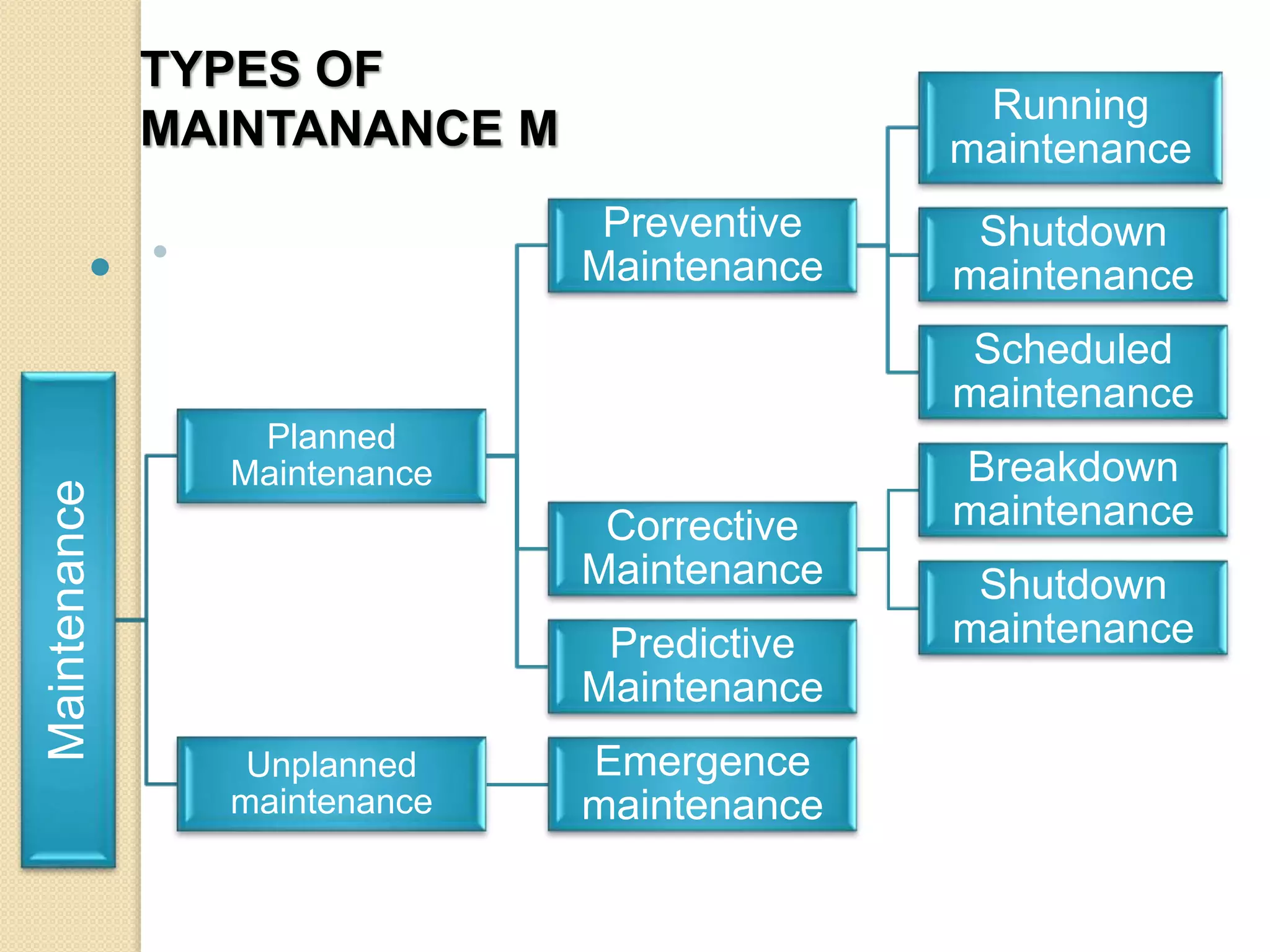
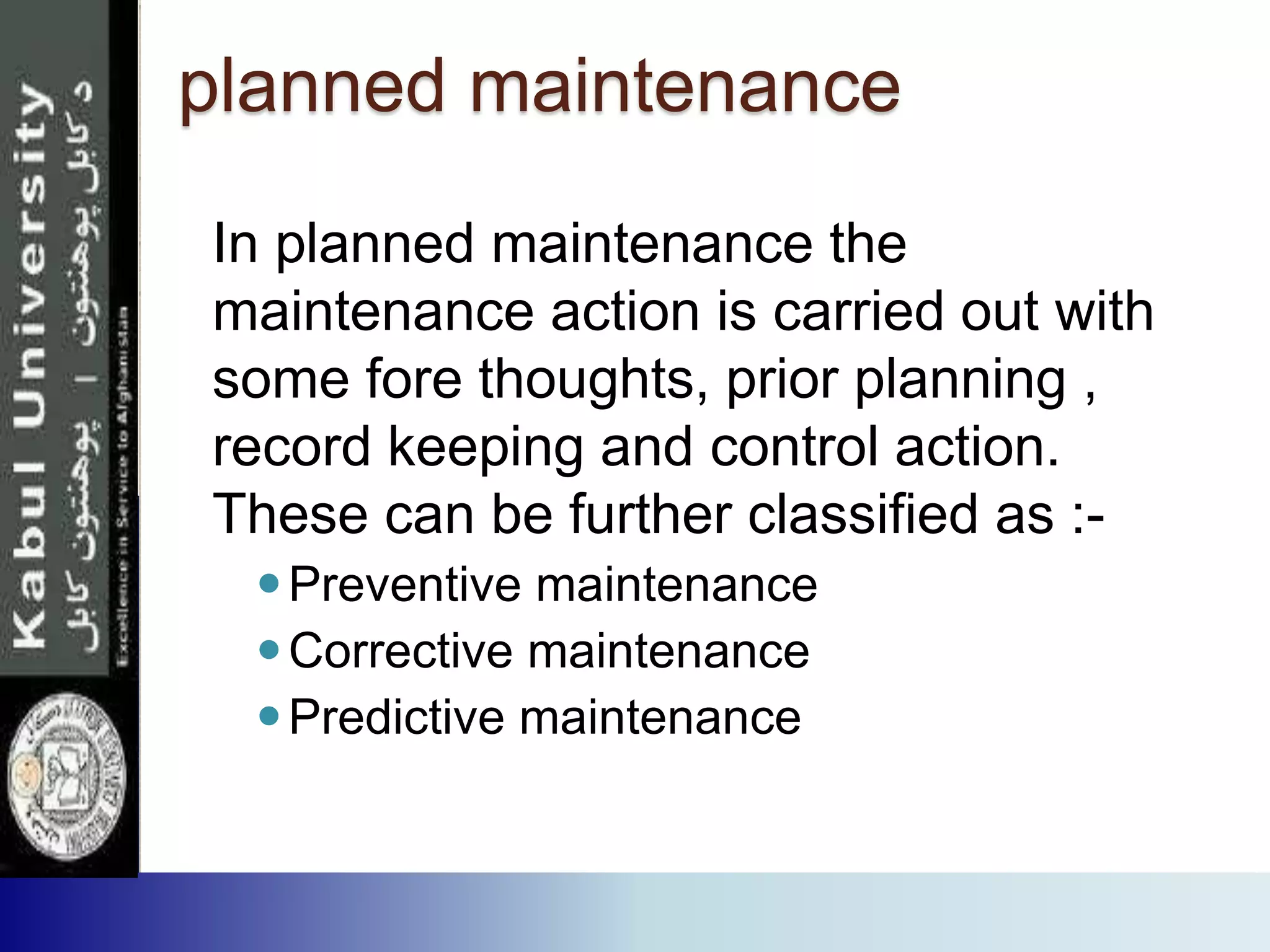
planned maintenance
In planned maintenance the
maintenance action is carried out with
some fore thoughts, prior planning ,
record keeping and control action.
These can be further classified as :-
Preventive maintenance
Corrective maintenance
Predictive maintenance
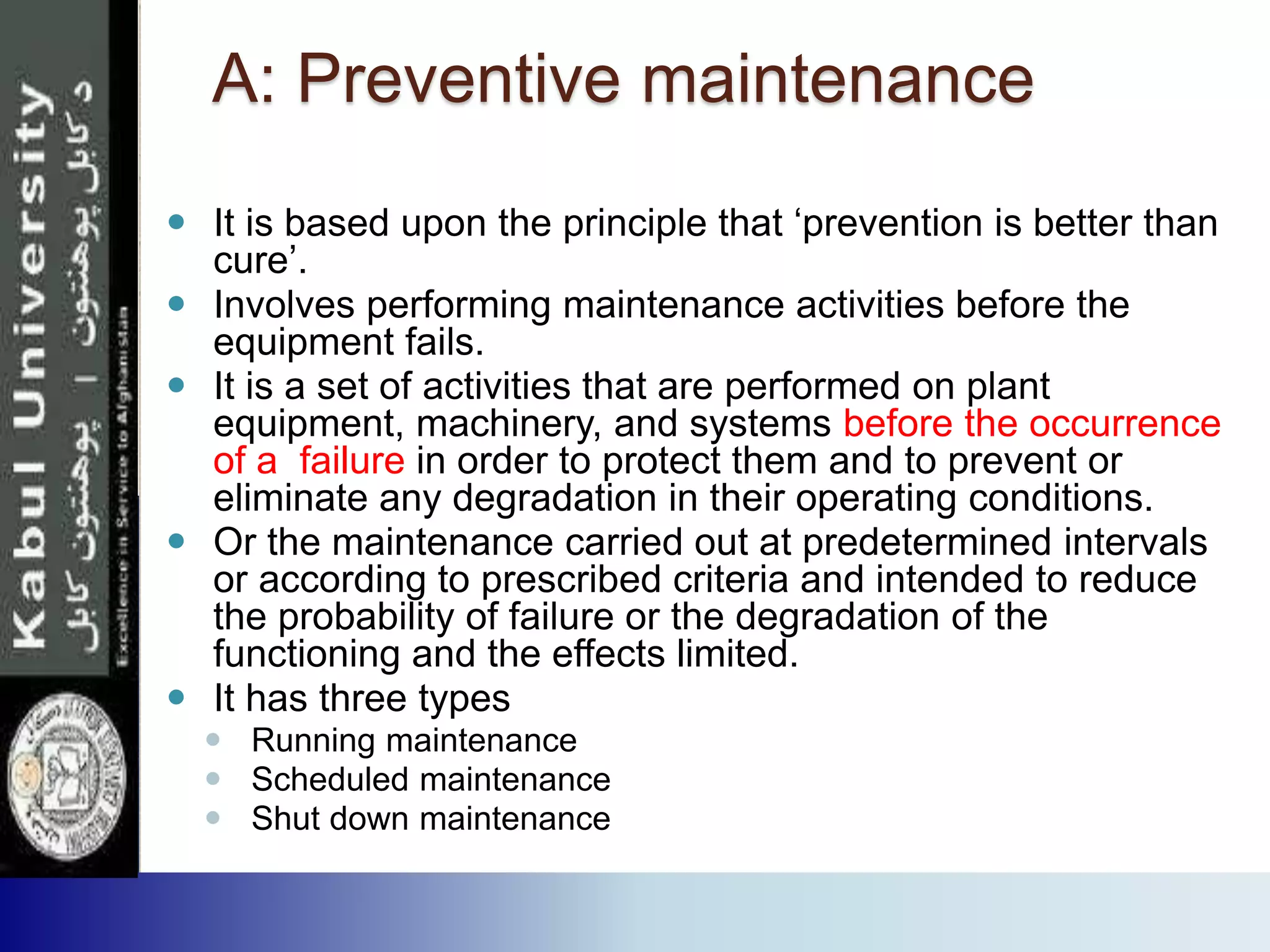
A: Preventive maintenance
 It is based upon the principle that ‘prevention is better than
cure’.
 Involves performing maintenance activities before the
equipment fails.
 It is a set of activities that are performed on plant
equipment, machinery, and systems before the occurrence
of a failure in order to protect them and to prevent or
eliminate any degradation in their operating conditions.
 Or the maintenance carried out at predetermined intervals
or according to prescribed criteria and intended to reduce
the probability of failure or the degradation of the
functioning and the effects limited.
 It has three types
 Running maintenance
 Scheduled maintenance
 Shut down maintenance
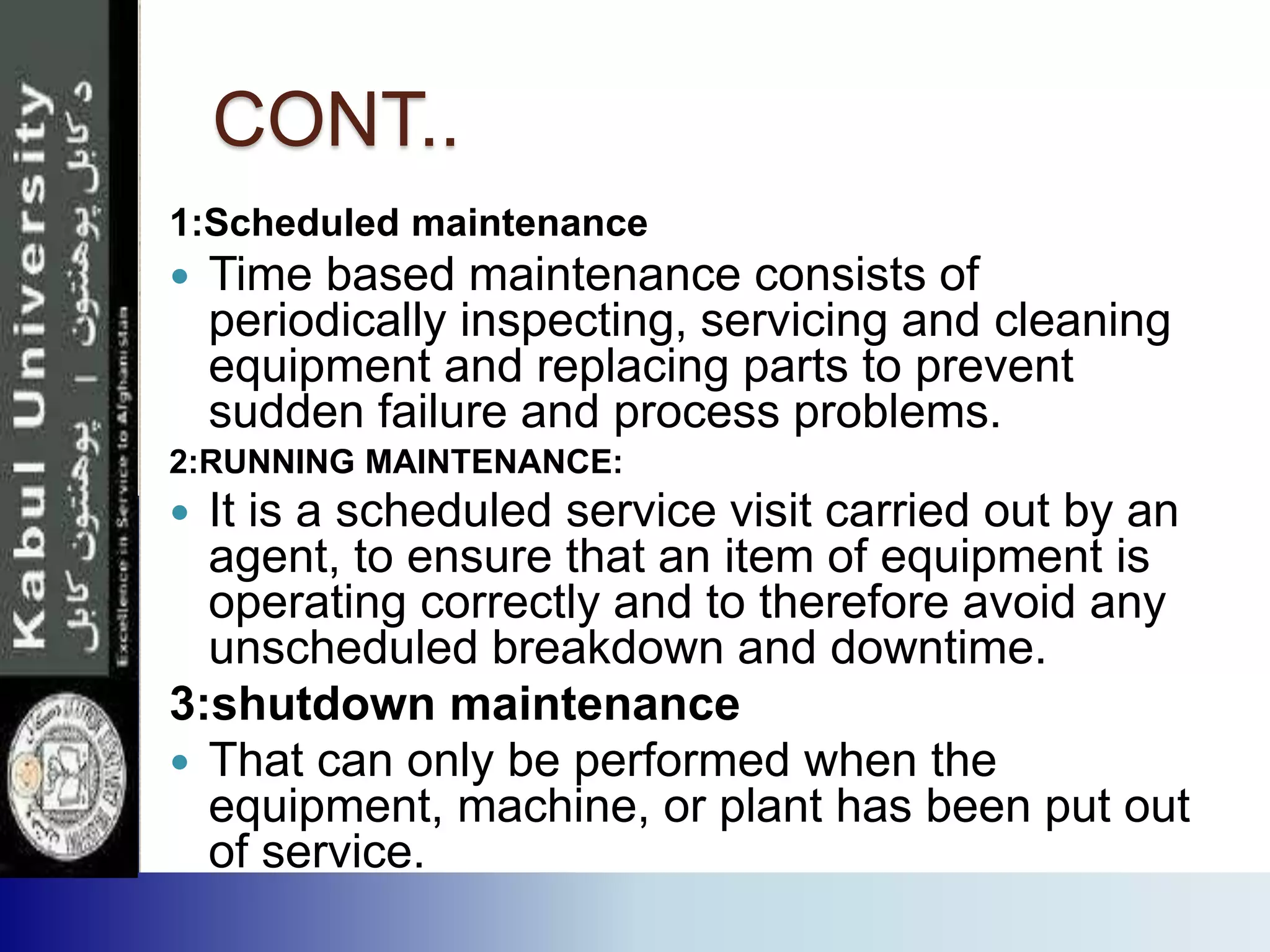
CONT..
1:Scheduled maintenance
 Time based maintenance consists of
periodically inspecting, servicing and cleaning
equipment and replacing parts to prevent
sudden failure and process problems.
2:RUNNING MAINTENANCE:
 It is a scheduled service visit carried out by an
agent, to ensure that an item of equipment is
operating correctly and to therefore avoid any
unscheduled breakdown and downtime.
3:shutdown maintenance
 That can only be performed when the
equipment, machine, or plant has been put out
of service.
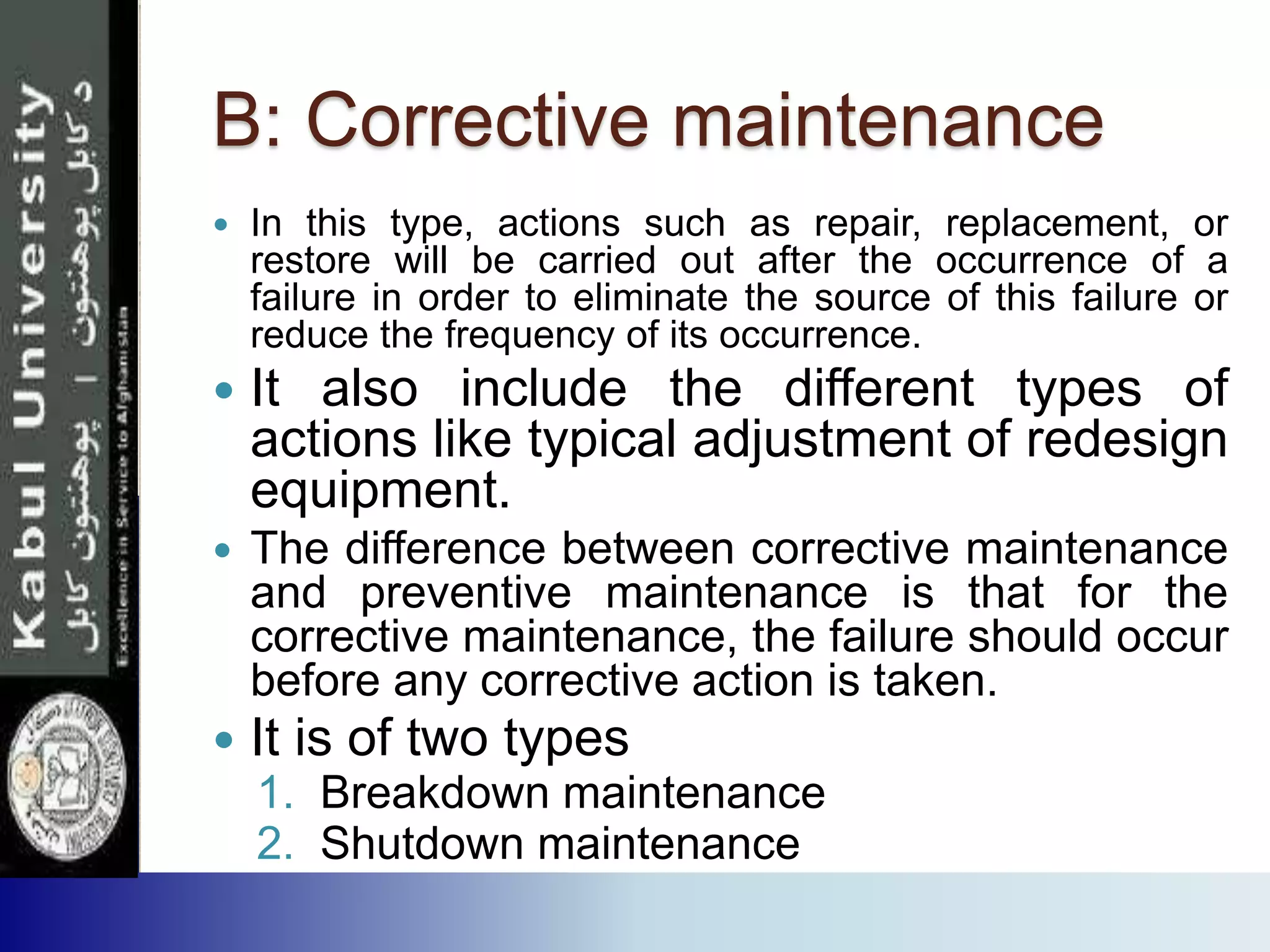
B: Corrective maintenance
 In this type, actions such as repair, replacement, or
restore will be carried out after the occurrence of a
failure in order to eliminate the source of this failure or
reduce the frequency of its occurrence.
 It also include the different types of
actions like typical adjustment of redesign
equipment.
 The difference between corrective maintenance
and preventive maintenance is that for the
corrective maintenance, the failure should occur
before any corrective action is taken.
 It is of two types
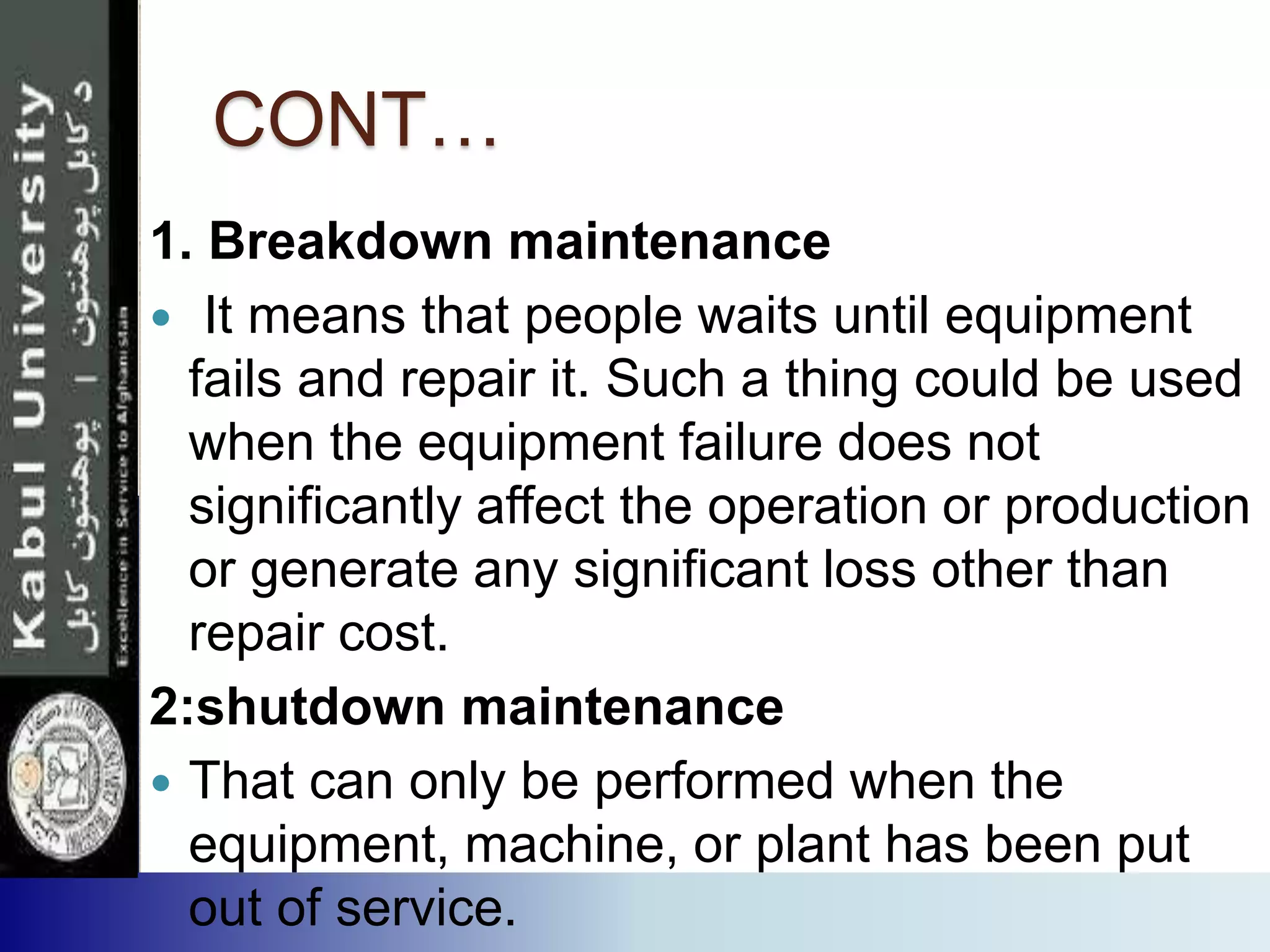
1. Breakdown maintenance
2. Shutdown maintenance
CONT…
1. Breakdown maintenance
 It means that people waits until equipment
fails and repair it. Such a thing could be used
when the equipment failure does not
significantly affect the operation or production
or generate any significant loss other than
repair cost.
2:shutdown maintenance
 That can only be performed when the
equipment, machine, or plant has been put
out of service.
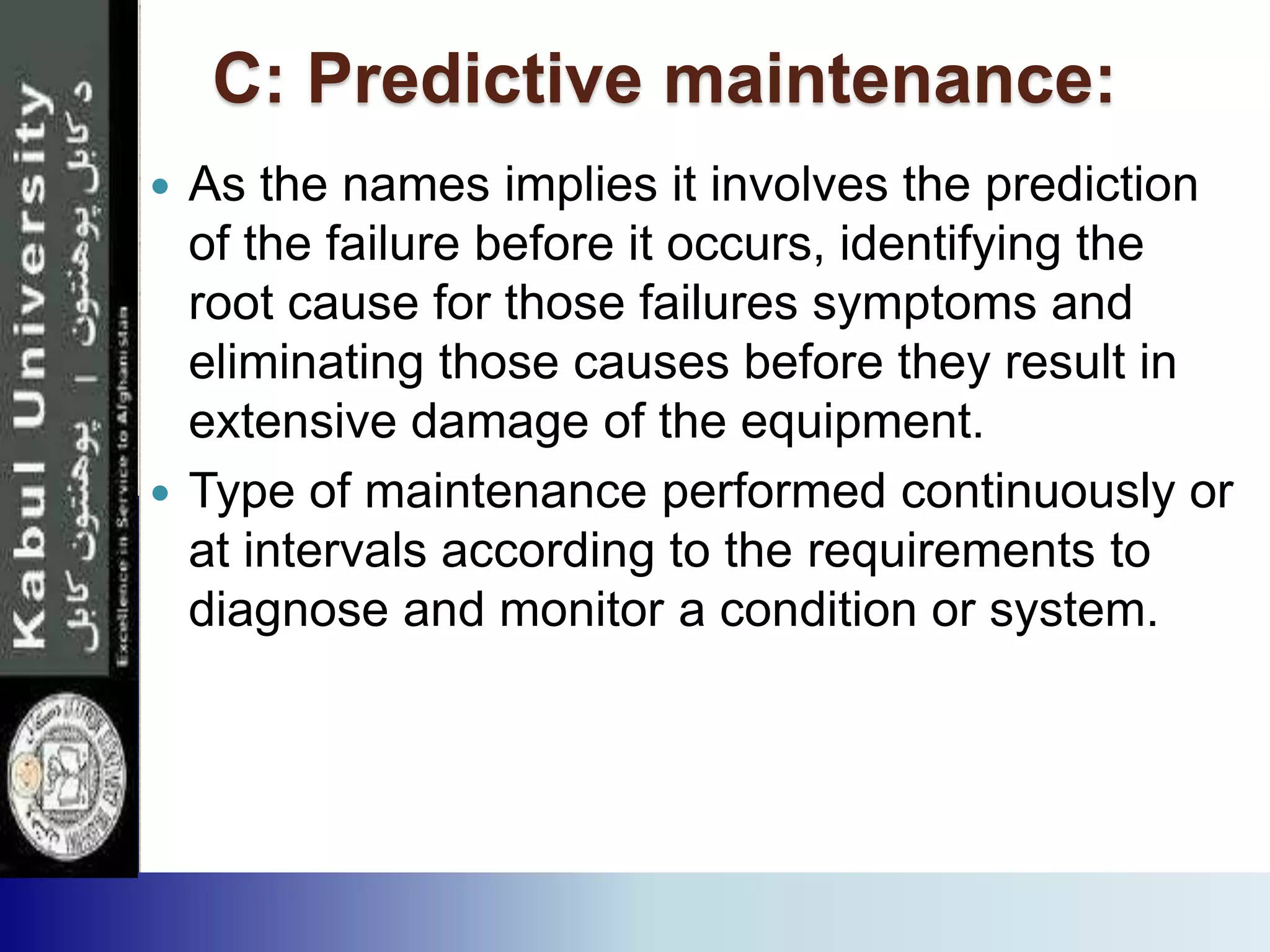
C: Predictive maintenance:
 As the names implies it involves the prediction
of the failure before it occurs, identifying the
root cause for those failures symptoms and
eliminating those causes before they result in
extensive damage of the equipment.
 Type of maintenance performed continuously or
at intervals according to the requirements to
diagnose and monitor a condition or system.
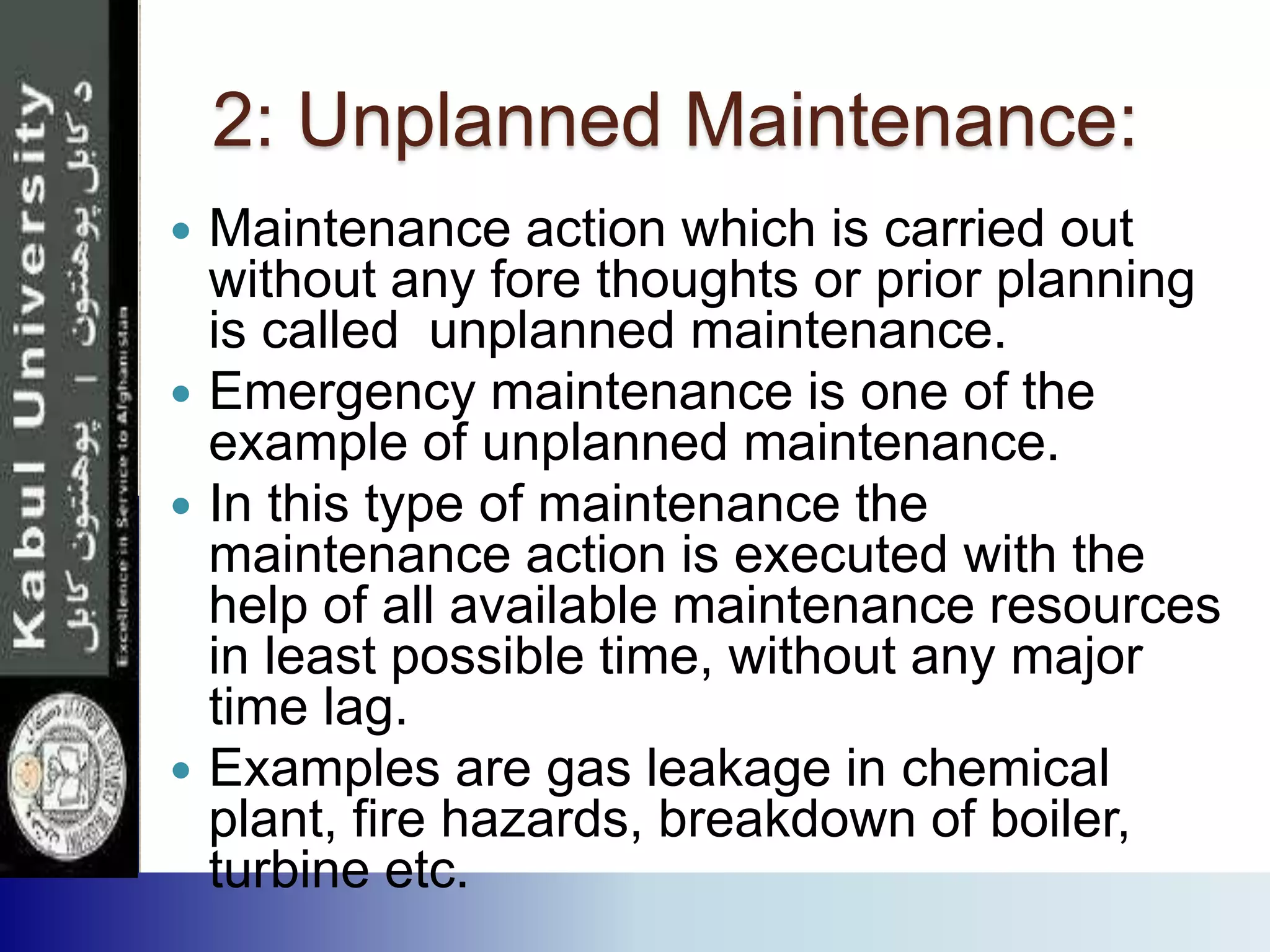
2: Unplanned Maintenance:
 Maintenance action which is carried out
without any fore thoughts or prior planning
is called unplanned maintenance.
 Emergency maintenance is one of the
example of unplanned maintenance.
 In this type of maintenance the
maintenance action is executed with the
help of all available maintenance resources
in least possible time, without any major
time lag.
 Examples are gas leakage in chemical
plant, fire hazards, breakdown of boiler,
turbine etc.
• PREPARED BY
• NIAZ SAHIL ZURMATI
STUDENT OF: BBA AT KABUL
UNIVERSITY
• E-MAIL:
NIAZ.0077@GMAIL.COM
•
NIAZ.0077@YAHOO.COM
• TWITTER:
HTTPS://TWITTER.COM/NIAZSAHIL
• FACEBOOK
HTTPS://WWW.FACEBOOK.COM/NIAZ
.SAHIL007
Maintenance Management (presentation)

Maintenance Management (presentation)

  • 1.
  • 3.
    Maintenance Management  Modernmaintenance management is not to repair broken equipment rapidly. Modern maintenance management is to keep the equipment running at high capacity and produce quality products at lowest cost possible.  Maintenance is a set of organized activities that are carried out in order to keep the item in its best operational condition with minimum cost required.
  • 4.
    Maintenance Objectives  Efficientuse of maintenance personnel and equipments.  Maximize useful life of equipment  To increase functional reliability of production facilities.  To enable desired quality through correctly adjusted, serviced and operated equipment's.  To maximize the useful life of equipment's.  To minimize cost of production.  To minimize frequency of interruptions.  To enhance the safety of manpower.
  • 5.
    Areas of maintenancemanagement Civil Maintenance Mechanical maintenance Electrical Maintenance
  • 6.
    Impact of PoorMaintenance 1. Production capacity:  Machines idled by breakdowns cannot produce, thus the capacity of the system is reduced 2. Production costs:  Labor costs per unit rise because of idle labor due to machine breakdowns. When machine malfunctions result in scrap, unit labor and material costs increase. 3. Product and service quality:  Poorly maintained equipment's produce low quality products. Equipment's that have not been properly maintained have frequent break downs and cannot provide adequate service to customers.
  • 7.
    CONT… 4. Employee orcustomer safety:  Worn-out equipment is likely to fail at any moment and these failures can cause injuries to the workers, working on those equipments. Products such as two wheelers and automobiles, if not serviced periodically, can break down suddenly and cause injuries to the stress 5. Customer satisfaction:  When production equipments break own, products often can not be produced according to the master production schedules, due to work stoppages. This will lead to delayed deliveries of products to the customers.
  • 8.
  • 9.
    planned maintenance In plannedmaintenance the maintenance action is carried out with some fore thoughts, prior planning , record keeping and control action. These can be further classified as :- Preventive maintenance Corrective maintenance Predictive maintenance
  • 10.
    A: Preventive maintenance It is based upon the principle that ‘prevention is better than cure’.  Involves performing maintenance activities before the equipment fails.  It is a set of activities that are performed on plant equipment, machinery, and systems before the occurrence of a failure in order to protect them and to prevent or eliminate any degradation in their operating conditions.  Or the maintenance carried out at predetermined intervals or according to prescribed criteria and intended to reduce the probability of failure or the degradation of the functioning and the effects limited.  It has three types  Running maintenance  Scheduled maintenance  Shut down maintenance
  • 11.
    CONT.. 1:Scheduled maintenance  Timebased maintenance consists of periodically inspecting, servicing and cleaning equipment and replacing parts to prevent sudden failure and process problems. 2:RUNNING MAINTENANCE:  It is a scheduled service visit carried out by an agent, to ensure that an item of equipment is operating correctly and to therefore avoid any unscheduled breakdown and downtime. 3:shutdown maintenance  That can only be performed when the equipment, machine, or plant has been put out of service.
  • 12.
    B: Corrective maintenance In this type, actions such as repair, replacement, or restore will be carried out after the occurrence of a failure in order to eliminate the source of this failure or reduce the frequency of its occurrence.  It also include the different types of actions like typical adjustment of redesign equipment.  The difference between corrective maintenance and preventive maintenance is that for the corrective maintenance, the failure should occur before any corrective action is taken.  It is of two types 1. Breakdown maintenance 2. Shutdown maintenance
  • 13.
    CONT… 1. Breakdown maintenance It means that people waits until equipment fails and repair it. Such a thing could be used when the equipment failure does not significantly affect the operation or production or generate any significant loss other than repair cost. 2:shutdown maintenance  That can only be performed when the equipment, machine, or plant has been put out of service.
  • 14.
    C: Predictive maintenance: As the names implies it involves the prediction of the failure before it occurs, identifying the root cause for those failures symptoms and eliminating those causes before they result in extensive damage of the equipment.  Type of maintenance performed continuously or at intervals according to the requirements to diagnose and monitor a condition or system.
  • 15.
    2: Unplanned Maintenance: Maintenance action which is carried out without any fore thoughts or prior planning is called unplanned maintenance.  Emergency maintenance is one of the example of unplanned maintenance.  In this type of maintenance the maintenance action is executed with the help of all available maintenance resources in least possible time, without any major time lag.  Examples are gas leakage in chemical plant, fire hazards, breakdown of boiler, turbine etc.
  • 16.
    • PREPARED BY •NIAZ SAHIL ZURMATI STUDENT OF: BBA AT KABUL UNIVERSITY • E-MAIL: NIAZ.0077@GMAIL.COM • NIAZ.0077@YAHOO.COM • TWITTER: HTTPS://TWITTER.COM/NIAZSAHIL • FACEBOOK HTTPS://WWW.FACEBOOK.COM/NIAZ .SAHIL007