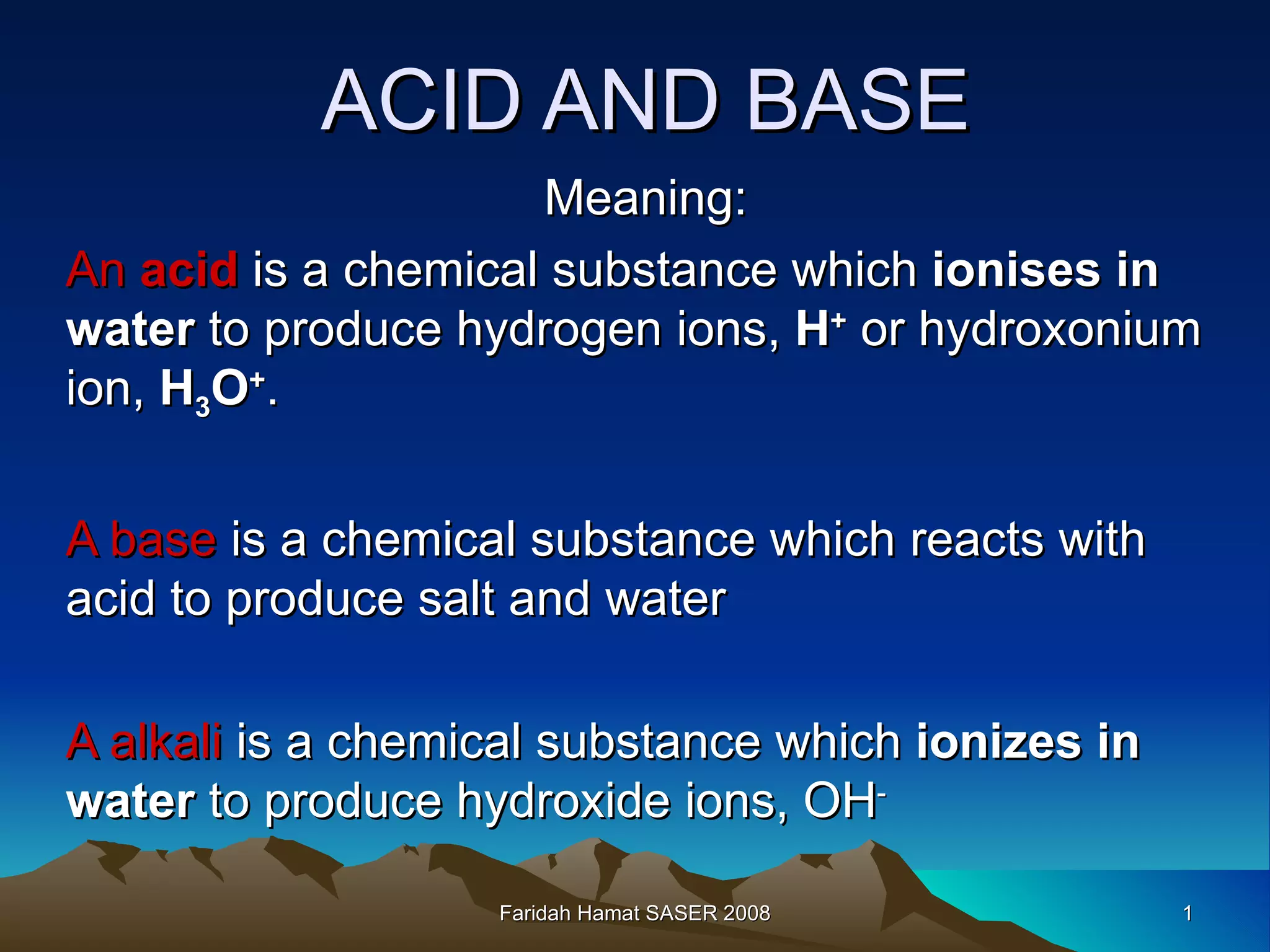
ACID AND BASE Meaning: An  acid  is a chemical substance which  ionises in water  to produce hydrogen ions,  H +  or hydroxonium ion,  H 3 O + .  A base  is a chemical substance which reacts with acid to produce salt and water A alkali  is a chemical substance which  ionizes in water  to produce hydroxide ions, OH - Faridah Hamat SASER 2008
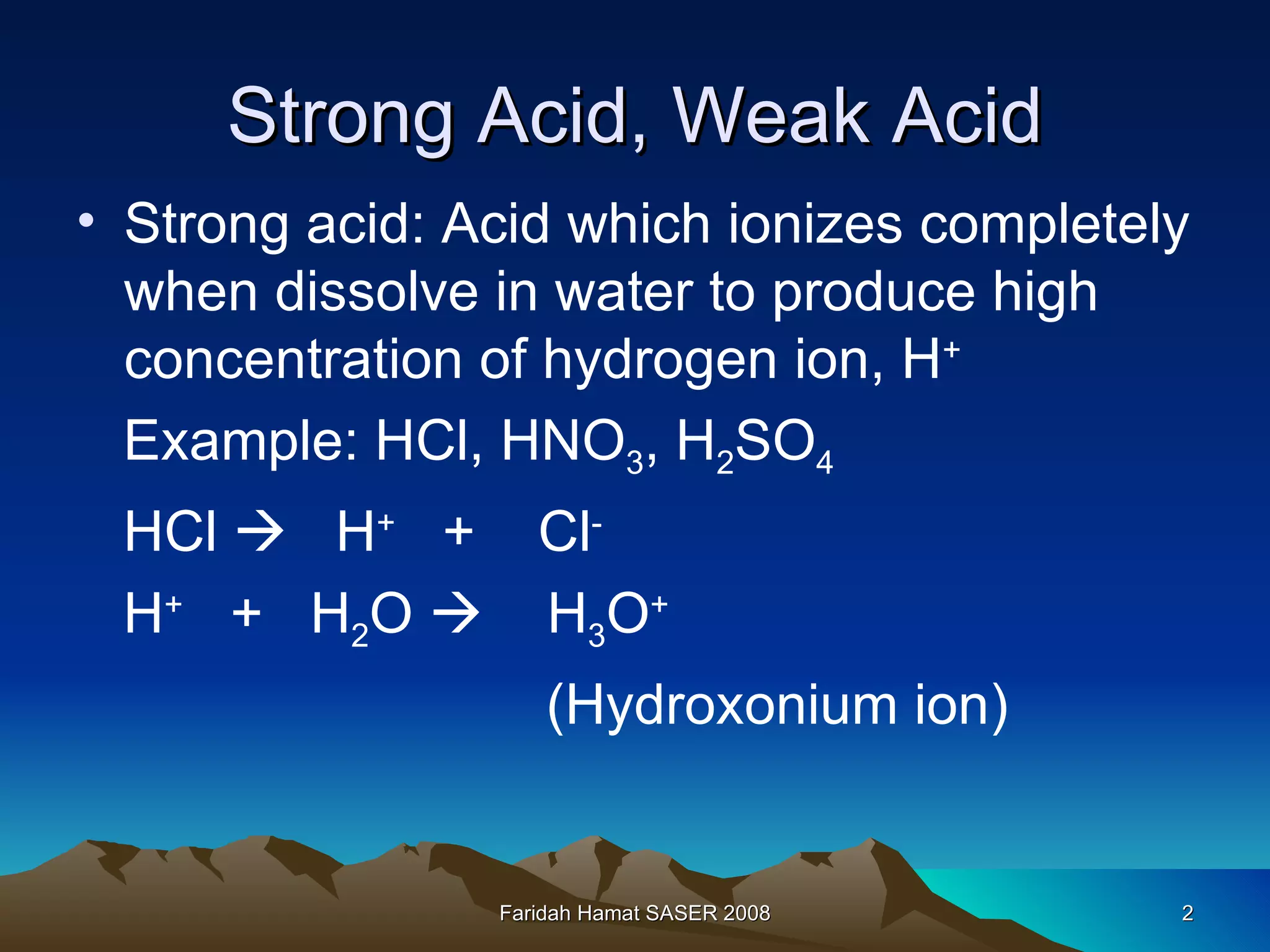
Strong Acid, Weak Acid Strong acid: Acid which ionizes completely when dissolve in water to produce high concentration of hydrogen ion, H + Example: HCl, HNO 3 , H 2 SO 4 HCl     H +   +  Cl - H +   +  H 2 O     H 3 O + (Hydroxonium ion) Faridah Hamat SASER 2008
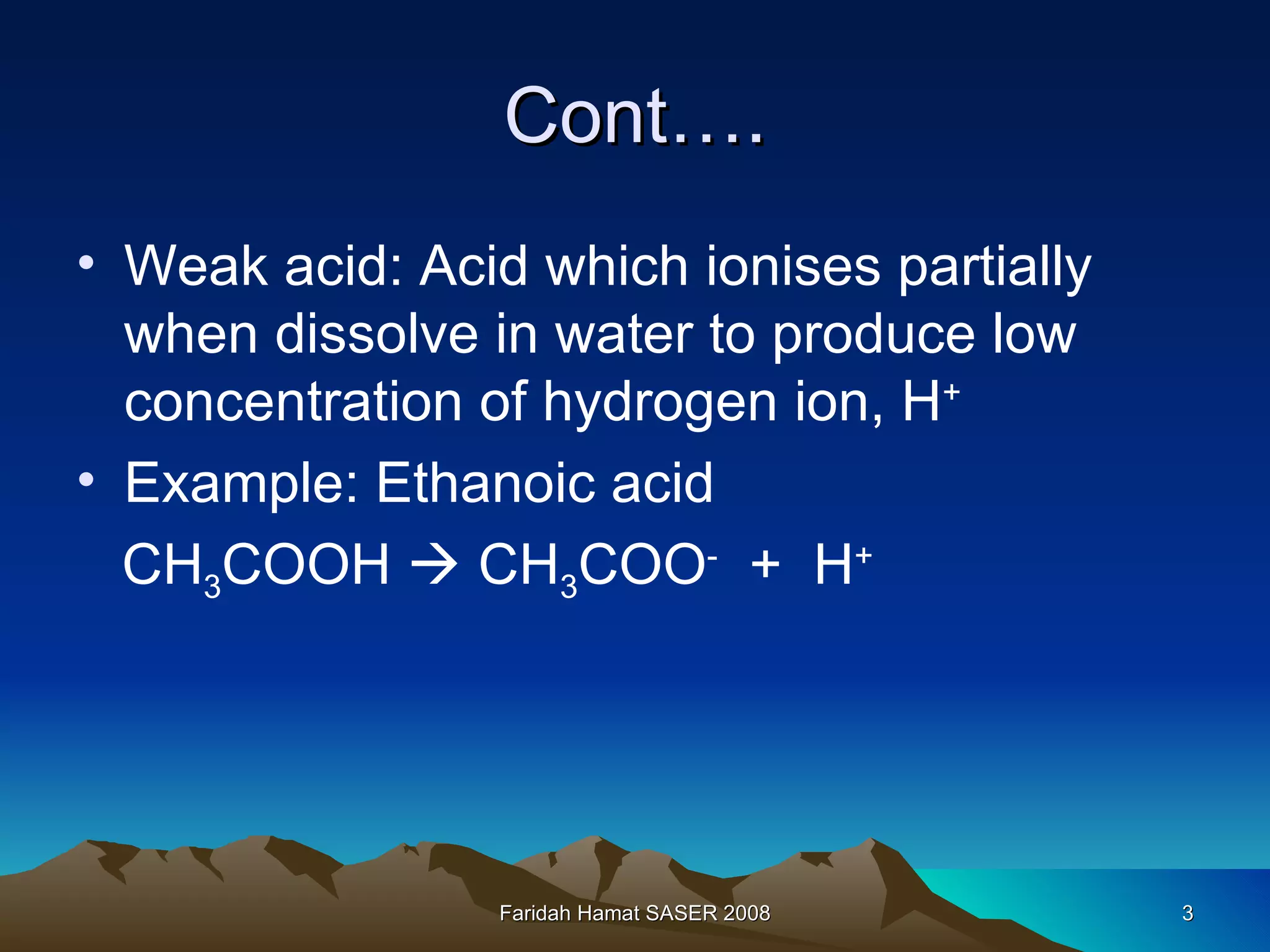
Cont…. Weak acid: Acid which ionises partially when dissolve in water to produce low concentration of hydrogen ion, H + Example: Ethanoic acid CH 3 COOH    CH 3 COO -   +  H + Faridah Hamat SASER 2008
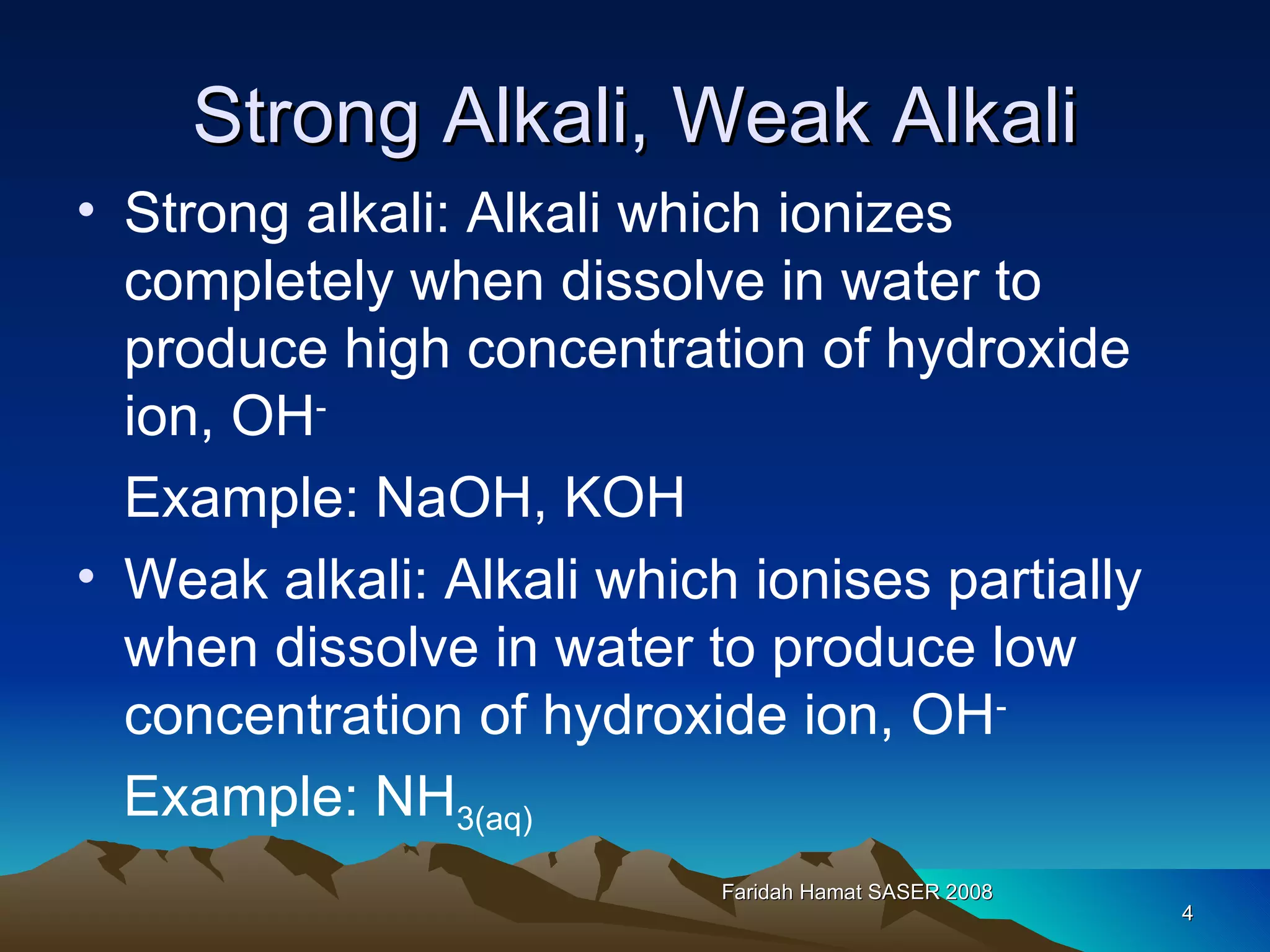
Strong Alkali, Weak Alkali Strong alkali: Alkali which ionizes completely when dissolve in water to produce high concentration of hydroxide ion, OH - Example: NaOH, KOH Weak alkali: Alkali which ionises partially when dissolve in water to produce low concentration of hydroxide ion, OH - Example: NH 3(aq) Faridah Hamat SASER 2008
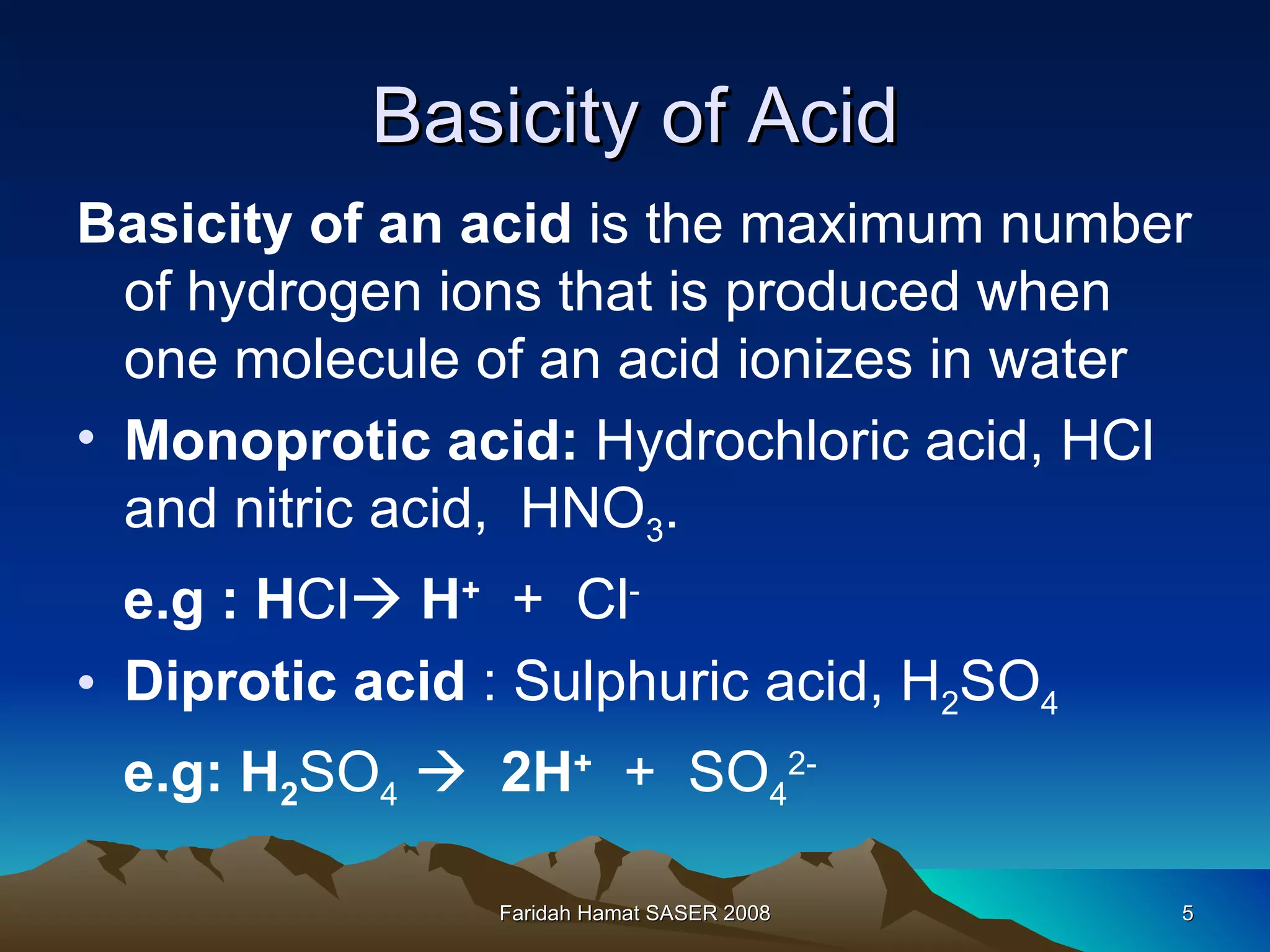
Basicity of Acid Basicity   of an acid  is the maximum number of hydrogen ions that is produced when one molecule of an acid ionizes in water Monoprotic acid:  Hydrochloric acid, HCl and nitric acid,  HNO 3 .  e.g : H Cl    H +   +  Cl - Diprotic acid  : Sulphuric acid, H 2 SO 4 e.g: H 2 SO 4      2H +   +  SO 4 2- Faridah Hamat SASER 2008
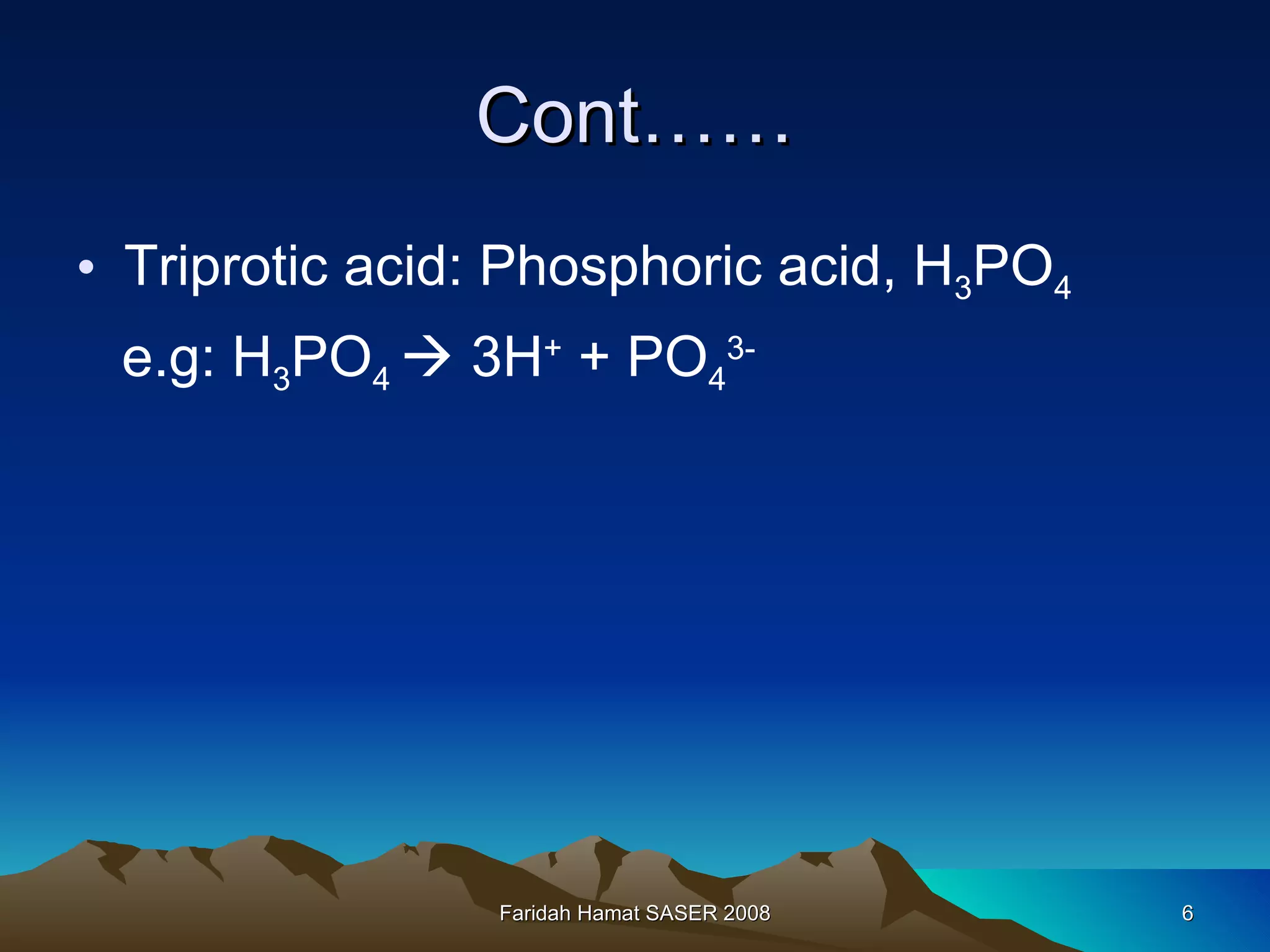
Cont…… Triprotic acid: Phosphoric acid, H 3 PO 4 e.g: H 3 PO 4    3H +  + PO 4 3- Faridah Hamat SASER 2008
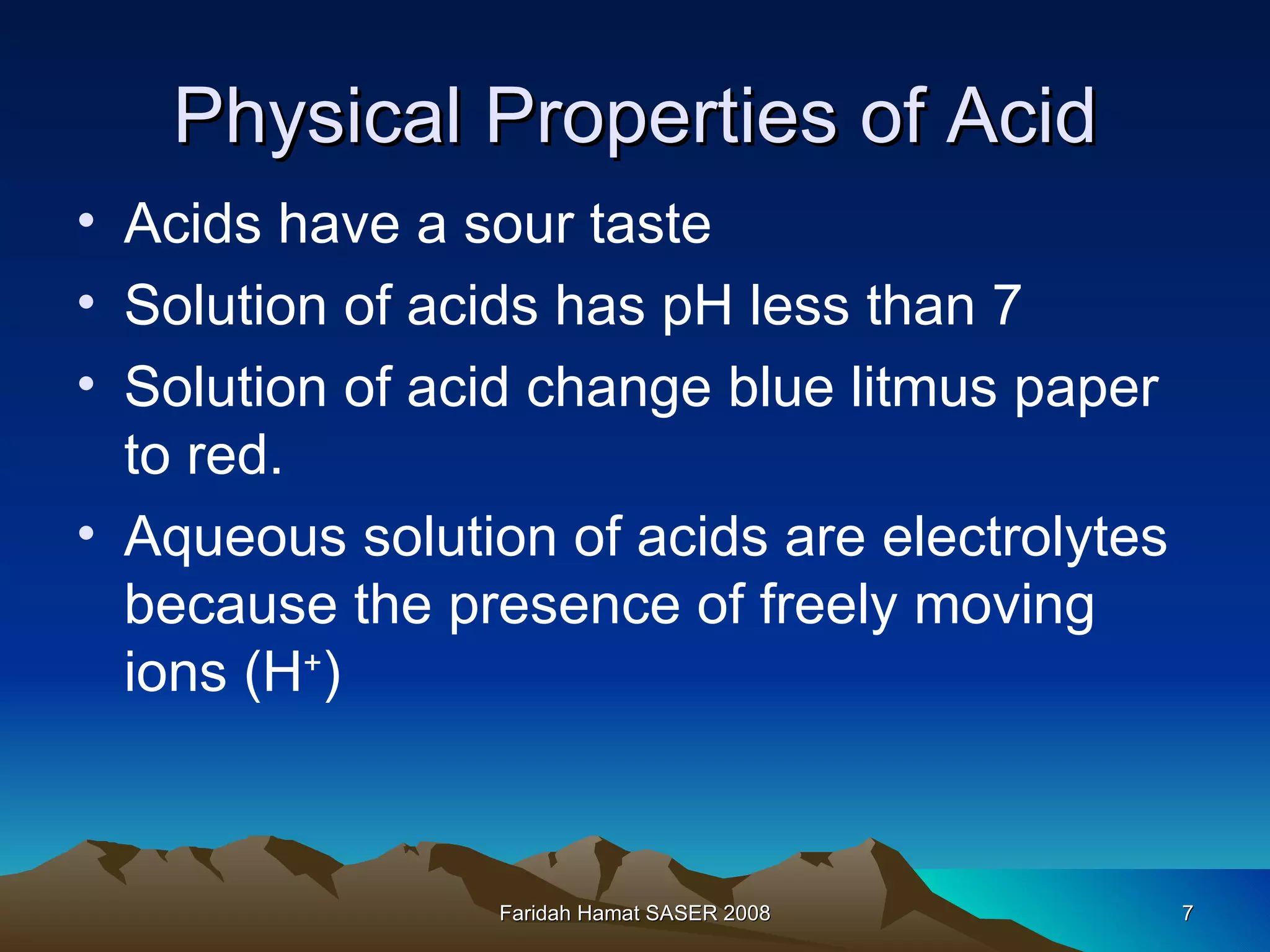
Physical Properties of Acid Acids have a sour taste Solution of acids has pH less than 7 Solution of acid change blue litmus paper to red. Aqueous solution of acids are electrolytes because the presence of freely moving ions (H + ) Faridah Hamat SASER 2008
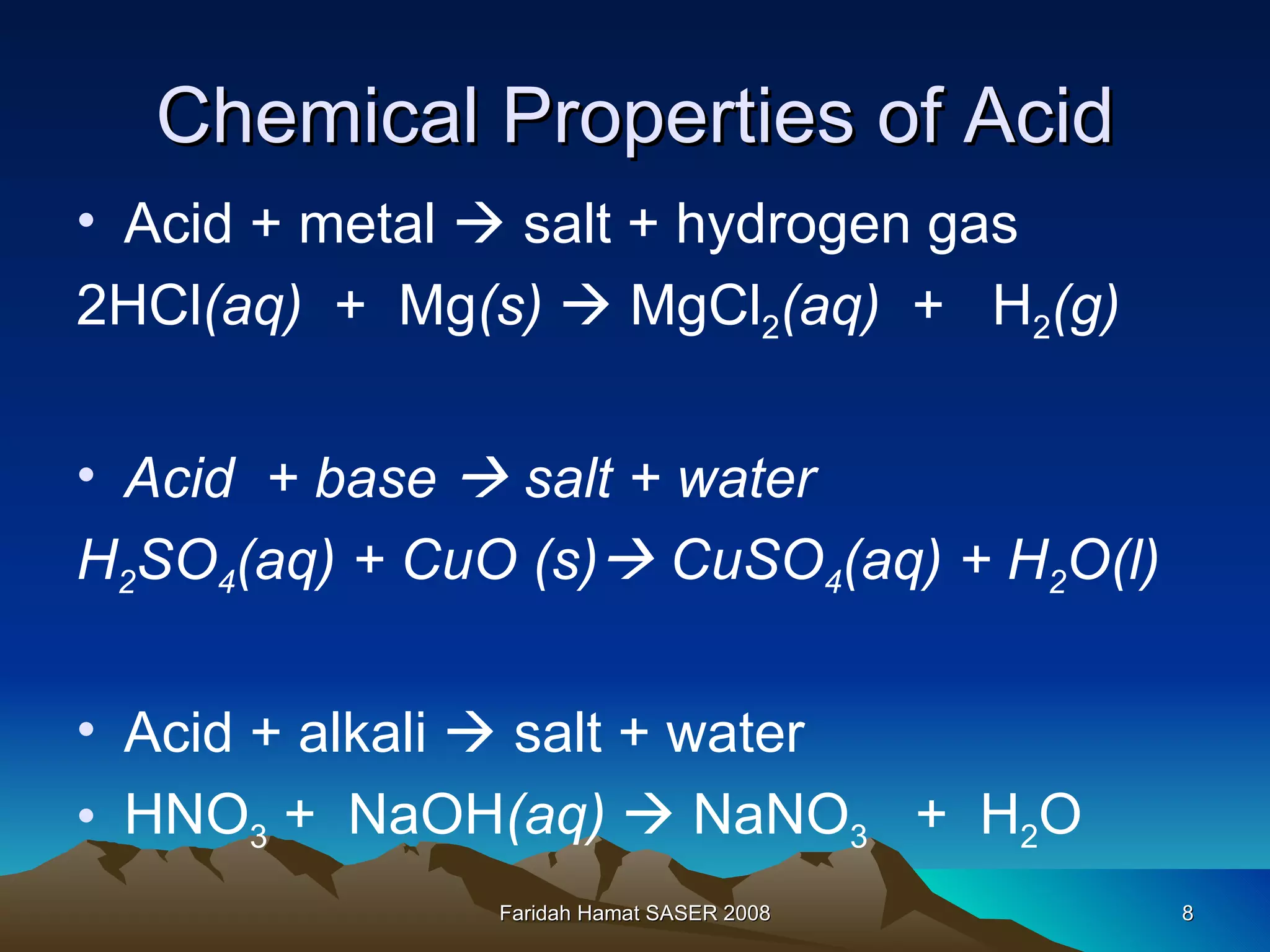
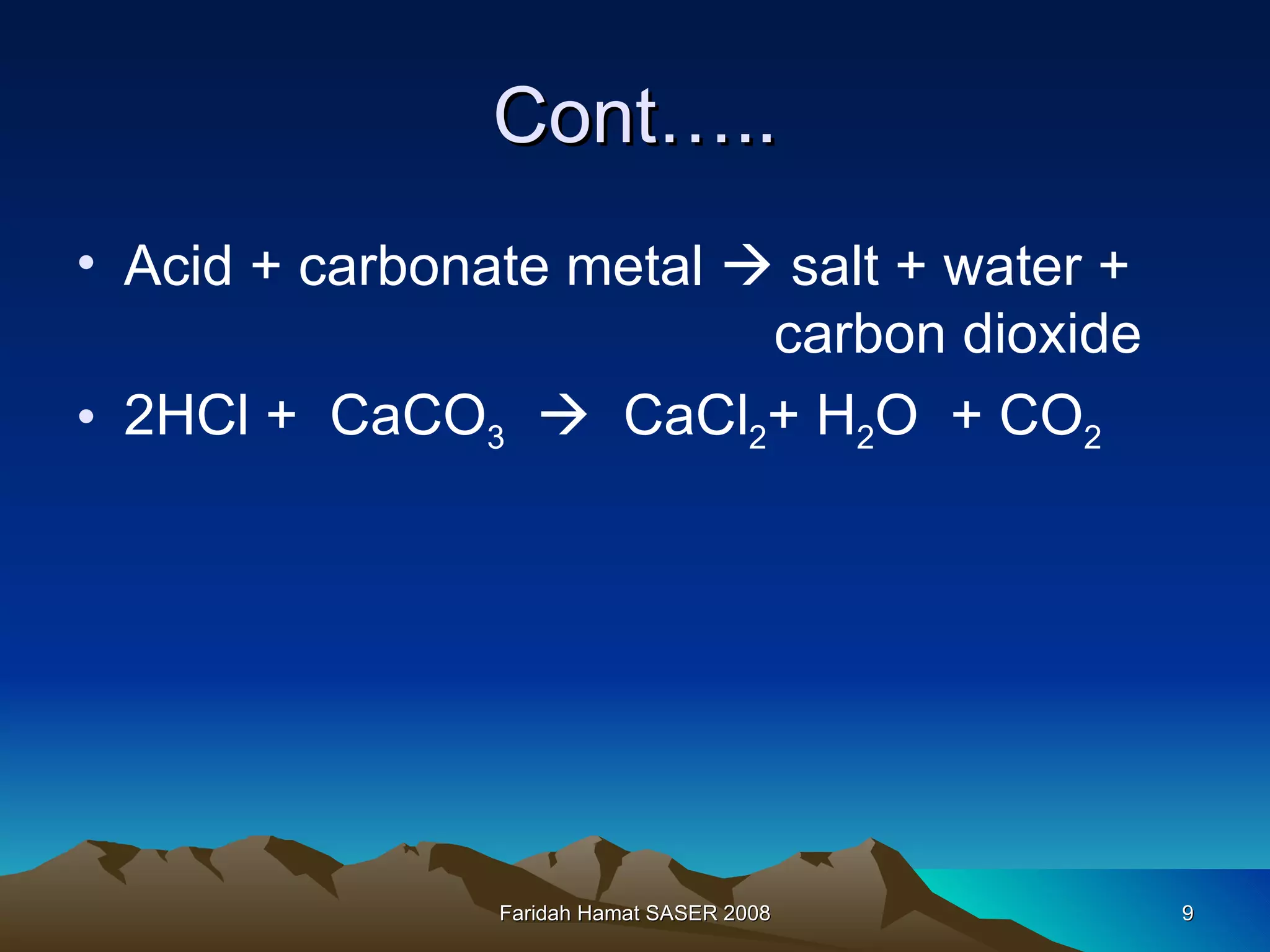
Chemical Properties of Acid Acid + metal    salt + hydrogen gas 2HCl (aq)   +  Mg (s)     MgCl 2 (aq)   +  H 2 (g) Acid  + base    salt + water H 2 SO 4 (aq) + CuO (s)   CuSO 4 (aq) + H 2 O(l) Acid + alkali    salt + water HNO 3  +  NaOH (aq)     NaNO 3   +  H 2 O Faridah Hamat SASER 2008
Cont….. Acid + carbonate metal    salt + water +    carbon dioxide 2HCl +  CaCO 3      CaCl 2 + H 2 O  + CO 2 Faridah Hamat SASER 2008
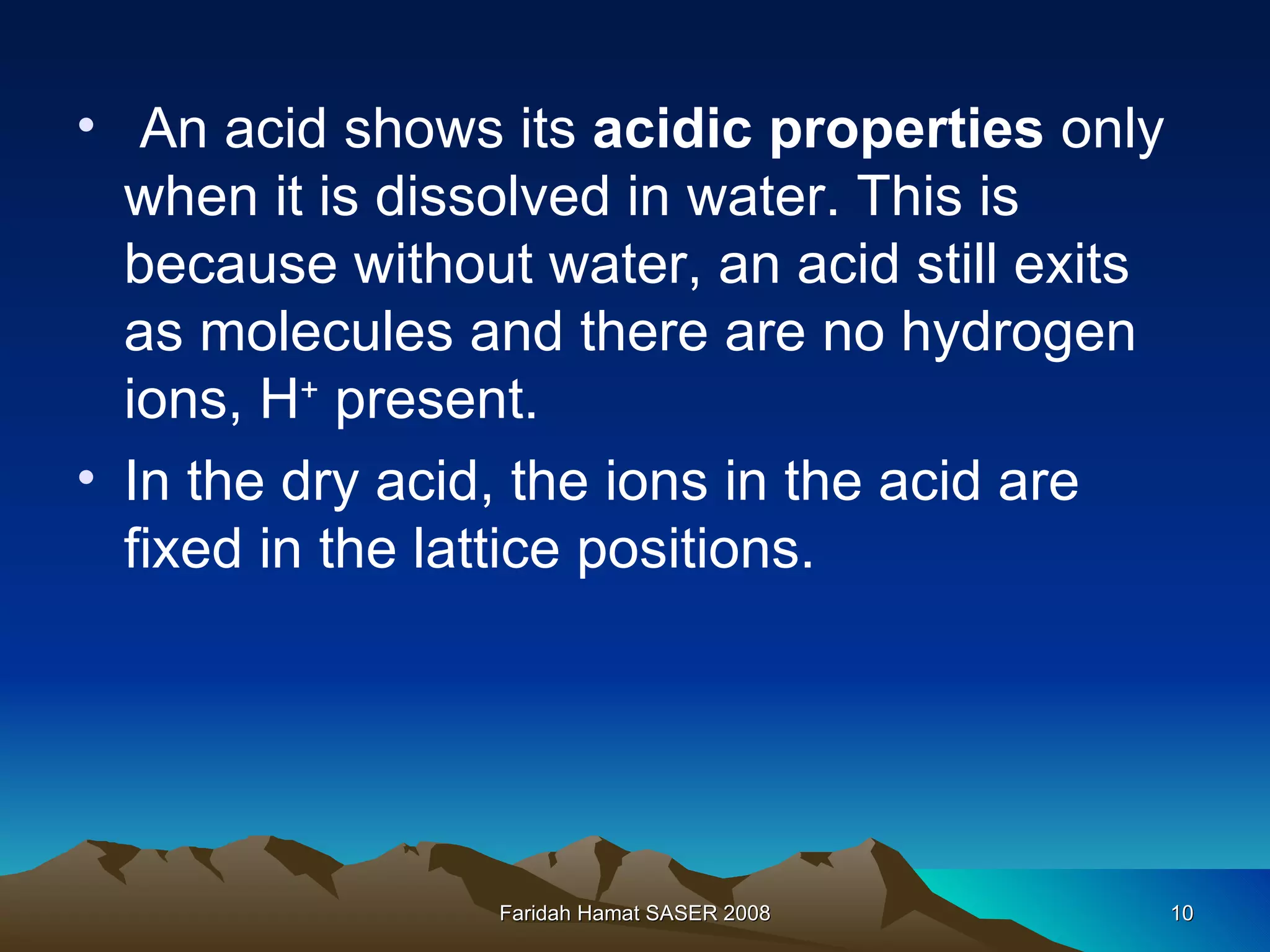
An acid shows its  acidic properties  only when it is dissolved in water. This is because without water, an acid still exits as molecules and there are no hydrogen ions, H +  present.  In the dry acid, the ions in the acid are fixed in the lattice positions.  Faridah Hamat SASER 2008
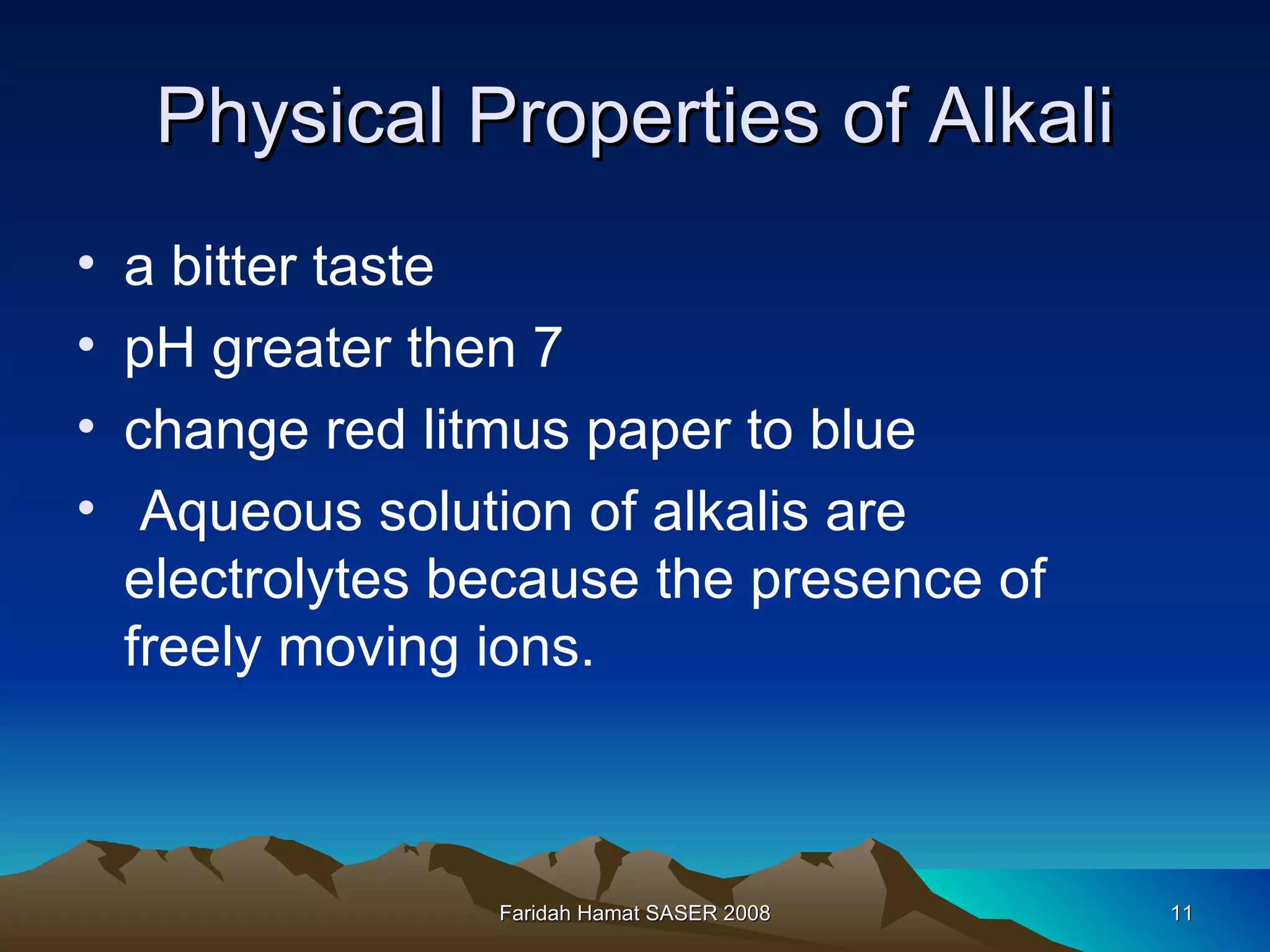
Physical Properties of Alkali a bitter taste pH greater then 7 change red litmus paper to blue Aqueous solution of alkalis are electrolytes because the presence of freely moving ions. Faridah Hamat SASER 2008
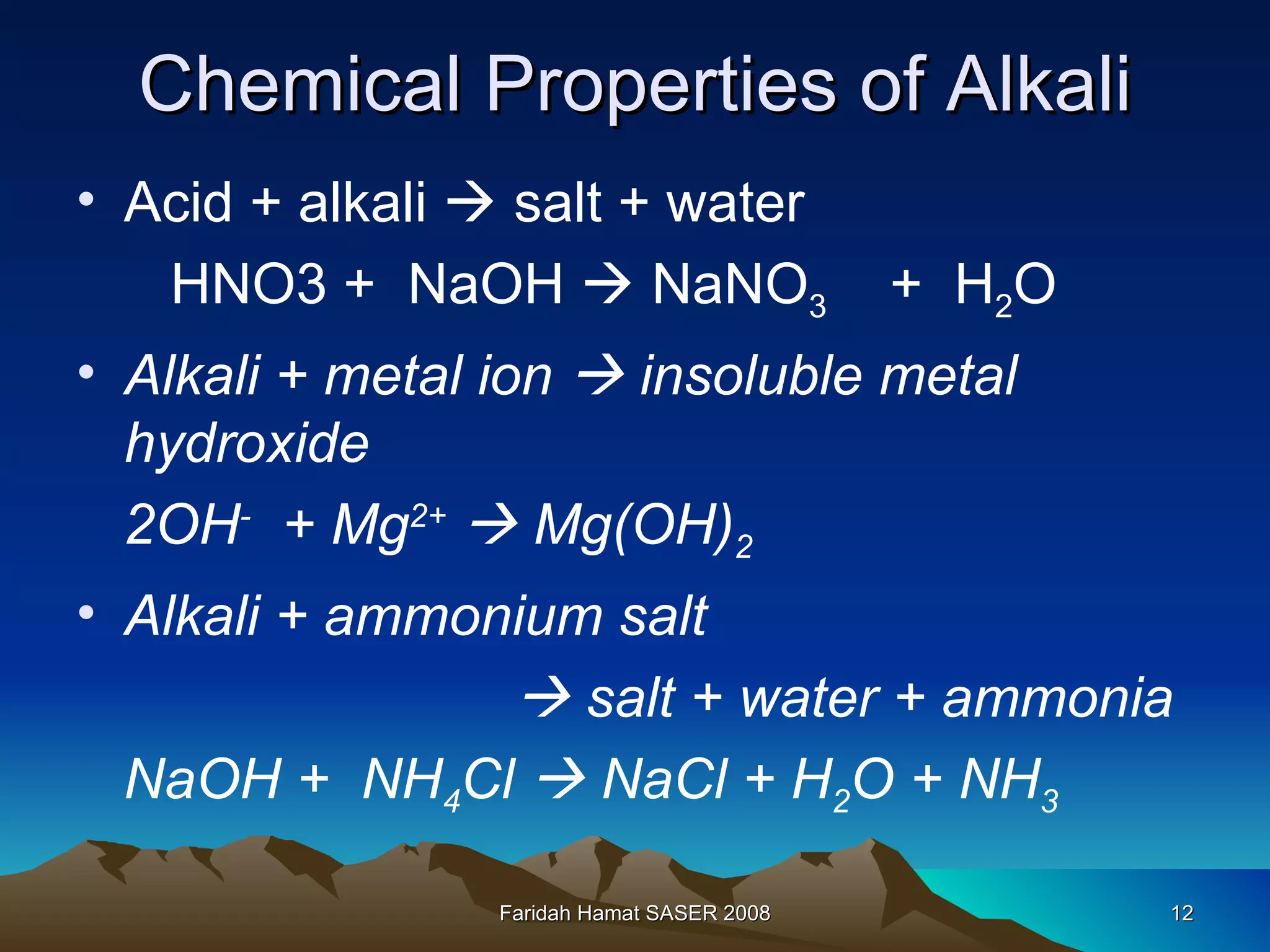
Chemical Properties of Alkali Acid + alkali    salt + water HNO3 +  NaOH    NaNO 3   +  H 2 O Alkali + metal ion    insoluble metal hydroxide 2OH -   + Mg 2+     Mg(OH) 2 Alkali + ammonium salt    salt + water + ammonia NaOH +  NH 4 Cl    NaCl + H 2 O + NH 3 Faridah Hamat SASER 2008
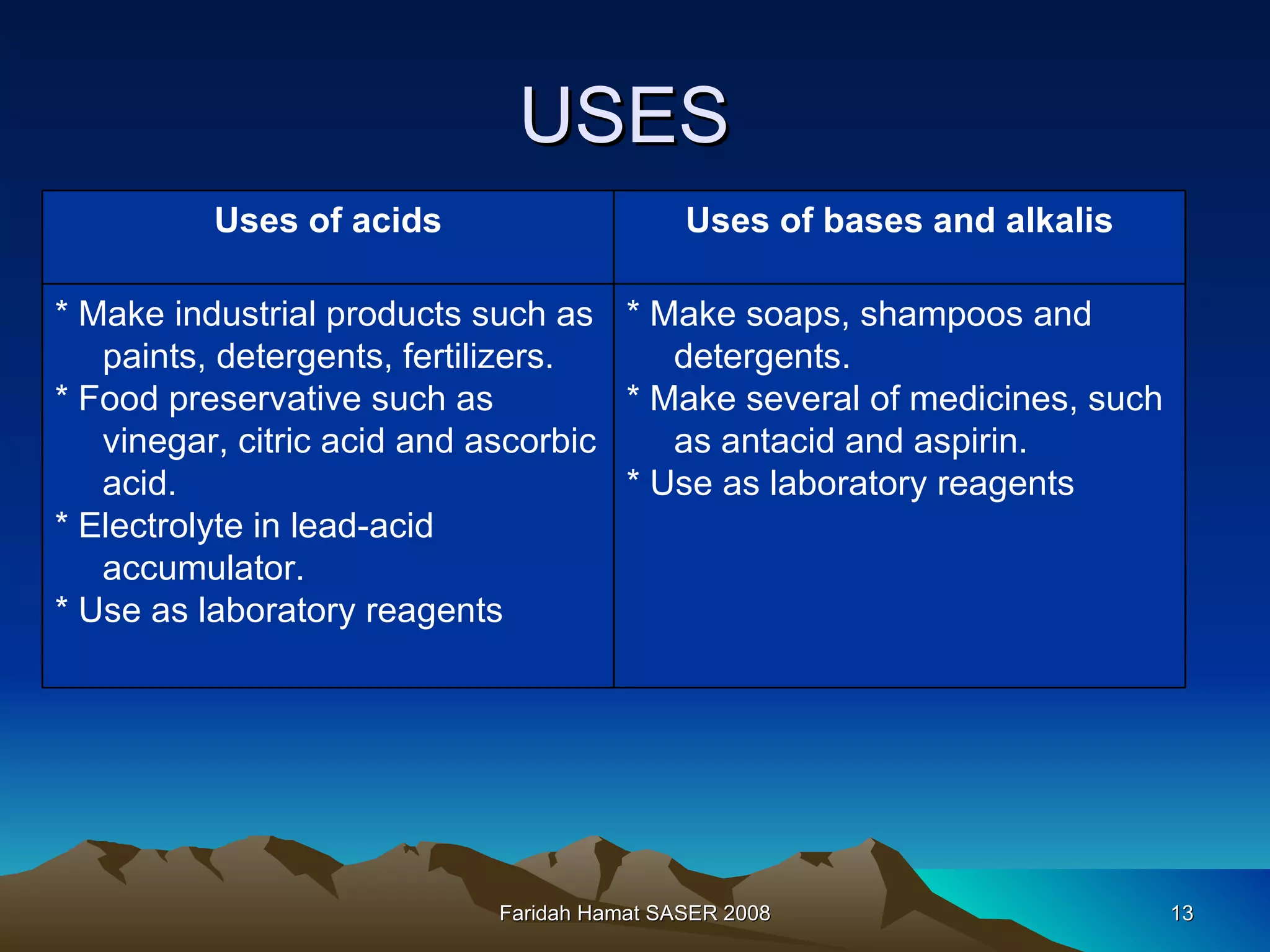
USES  Faridah Hamat SASER 2008 Uses of acids Uses of bases and alkalis * Make industrial products such as paints, detergents, fertilizers.  * Food preservative such as vinegar, citric acid and ascorbic acid. * Electrolyte in lead-acid accumulator. * Use as laboratory reagents * Make soaps, shampoos and detergents. * Make several of medicines, such as antacid and aspirin. * Use as laboratory reagents
Molarity (mol dm -3 ) =  Number of Mole   Volume, dm 3 Example:  Calculate the molarity of 0.4 moles sulphuric acid in 250cm 3  solution. Solution : Number of mole  =  MV 1000 Molarity  = number of mole x 1000   =  0.4 x 1000    250   250 =  1.6 mol dm -3 CONCENTRATION Faridah Hamat SASER 2008
PREPARED BY: PN. FARIDAH BINTI HAMAT SASER Faridah Hamat SASER 2008

Acid And Base

  • 1.
    ACID AND BASEMeaning: An acid is a chemical substance which ionises in water to produce hydrogen ions, H + or hydroxonium ion, H 3 O + . A base is a chemical substance which reacts with acid to produce salt and water A alkali is a chemical substance which ionizes in water to produce hydroxide ions, OH - Faridah Hamat SASER 2008
  • 2.
    Strong Acid, WeakAcid Strong acid: Acid which ionizes completely when dissolve in water to produce high concentration of hydrogen ion, H + Example: HCl, HNO 3 , H 2 SO 4 HCl  H + + Cl - H + + H 2 O  H 3 O + (Hydroxonium ion) Faridah Hamat SASER 2008
  • 3.
    Cont…. Weak acid:Acid which ionises partially when dissolve in water to produce low concentration of hydrogen ion, H + Example: Ethanoic acid CH 3 COOH  CH 3 COO - + H + Faridah Hamat SASER 2008
  • 4.
    Strong Alkali, WeakAlkali Strong alkali: Alkali which ionizes completely when dissolve in water to produce high concentration of hydroxide ion, OH - Example: NaOH, KOH Weak alkali: Alkali which ionises partially when dissolve in water to produce low concentration of hydroxide ion, OH - Example: NH 3(aq) Faridah Hamat SASER 2008
  • 5.
    Basicity of AcidBasicity of an acid is the maximum number of hydrogen ions that is produced when one molecule of an acid ionizes in water Monoprotic acid: Hydrochloric acid, HCl and nitric acid, HNO 3 . e.g : H Cl  H + + Cl - Diprotic acid : Sulphuric acid, H 2 SO 4 e.g: H 2 SO 4  2H + + SO 4 2- Faridah Hamat SASER 2008
  • 6.
    Cont…… Triprotic acid:Phosphoric acid, H 3 PO 4 e.g: H 3 PO 4  3H + + PO 4 3- Faridah Hamat SASER 2008
  • 7.
    Physical Properties ofAcid Acids have a sour taste Solution of acids has pH less than 7 Solution of acid change blue litmus paper to red. Aqueous solution of acids are electrolytes because the presence of freely moving ions (H + ) Faridah Hamat SASER 2008
  • 8.
    Chemical Properties ofAcid Acid + metal  salt + hydrogen gas 2HCl (aq) + Mg (s)  MgCl 2 (aq) + H 2 (g) Acid + base  salt + water H 2 SO 4 (aq) + CuO (s)  CuSO 4 (aq) + H 2 O(l) Acid + alkali  salt + water HNO 3 + NaOH (aq)  NaNO 3 + H 2 O Faridah Hamat SASER 2008
  • 9.
    Cont….. Acid +carbonate metal  salt + water + carbon dioxide 2HCl + CaCO 3  CaCl 2 + H 2 O + CO 2 Faridah Hamat SASER 2008
  • 10.
    An acid showsits acidic properties only when it is dissolved in water. This is because without water, an acid still exits as molecules and there are no hydrogen ions, H + present. In the dry acid, the ions in the acid are fixed in the lattice positions. Faridah Hamat SASER 2008
  • 11.
    Physical Properties ofAlkali a bitter taste pH greater then 7 change red litmus paper to blue Aqueous solution of alkalis are electrolytes because the presence of freely moving ions. Faridah Hamat SASER 2008
  • 12.
    Chemical Properties ofAlkali Acid + alkali  salt + water HNO3 + NaOH  NaNO 3 + H 2 O Alkali + metal ion  insoluble metal hydroxide 2OH - + Mg 2+  Mg(OH) 2 Alkali + ammonium salt  salt + water + ammonia NaOH + NH 4 Cl  NaCl + H 2 O + NH 3 Faridah Hamat SASER 2008
  • 13.
    USES FaridahHamat SASER 2008 Uses of acids Uses of bases and alkalis * Make industrial products such as paints, detergents, fertilizers. * Food preservative such as vinegar, citric acid and ascorbic acid. * Electrolyte in lead-acid accumulator. * Use as laboratory reagents * Make soaps, shampoos and detergents. * Make several of medicines, such as antacid and aspirin. * Use as laboratory reagents
  • 14.
    Molarity (mol dm-3 ) = Number of Mole Volume, dm 3 Example: Calculate the molarity of 0.4 moles sulphuric acid in 250cm 3 solution. Solution : Number of mole = MV 1000 Molarity = number of mole x 1000 = 0.4 x 1000 250 250 = 1.6 mol dm -3 CONCENTRATION Faridah Hamat SASER 2008
  • 15.
    PREPARED BY: PN.FARIDAH BINTI HAMAT SASER Faridah Hamat SASER 2008