Accommodative and VergenceAccommodative and Vergence
DysfunctionDysfunction
Binocular Vision II
Rabindra Adhikary
ravinems@iom.edu.np
AccommodationAccommodation
Process by which refractive power of
eyes is altered to ensure a clear
retinal image
Association with
– Convergence
– Pupillary Miosis
Near triad
ConvergenceConvergence
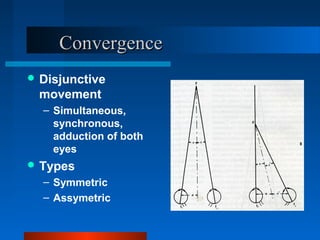
 Disjunctive
movement
– Simultaneous,
synchronous,
adduction of both
eyes
 Types
– Symmetric
– Assymetric
ConvergenceConvergence
Unit of measurement
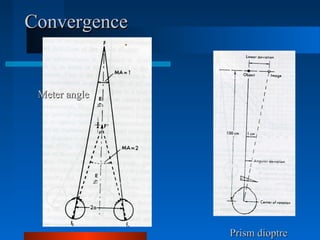
– Meter angle (MA)
• The amount of convergence required for
each eye to fixate an object located at a
distance from the eyes in the median plane
• Numerically the reciprocal of fixation
distance in meter
– Clinical measurement – Prism Diopter
• 1pd = ? degree
ConvergenceConvergence
Prism dioptrePrism dioptre
Meter angleMeter angle
ConvergenceConvergence
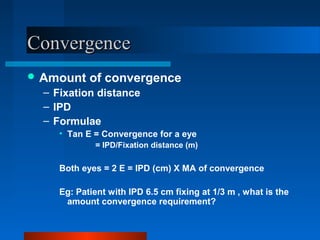
 Amount of convergence
– Fixation distance
– IPD
– Formulae
• Tan E = Convergence for a eye
= IPD/Fixation distance (m)
Both eyes = 2 E = IPD (cm) X MA of convergence
Eg: Patient with IPD 6.5 cm fixing at 1/3 m , what is the
amount convergence requirement?
ConvergenceConvergence
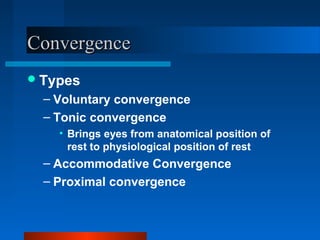
Types
– Voluntary convergence
– Tonic convergence
• Brings eyes from anatomical position of
rest to physiological position of rest
– Accommodative Convergence
– Proximal convergence
Accommodative Convergence &Accommodative Convergence &
AC/A RatioAC/A Ratio
 Convergence elicited by Accomm.
– Amount = AC/A ratio
• The convergence response of an individual to an unit
stimulus of accommodation
• Unit = ∆/D
• Normal range = 4 to 6
– Value above 6 = excessive accommodative convergenc
– Value below 4= Insufficiency
– Calculation
• Heterophoria method
• Gradient Method
• Haploscopic method
• Graphical Method
AC/A ratio calculationAC/A ratio calculation
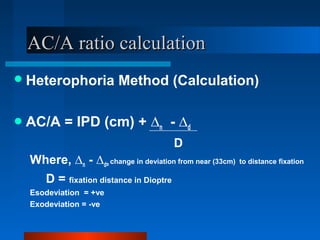
Heterophoria Method (Calculation)
AC/A = IPD (cm) + ∆n - ∆d
D
Where, ∆n - ∆d= change in deviation from near (33cm) to distance fixation
D = fixation distance in Dioptre
Esodeviation = +ve
Exodeviation = -ve
AC/A ratio calculationAC/A ratio calculation
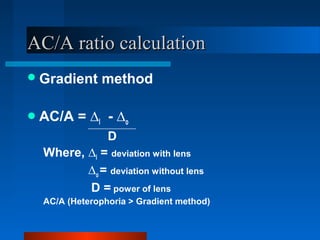
Gradient method
AC/A = ∆l - ∆o
D
Where, ∆l = deviation with lens
∆o = deviation without lens
D = power of lens
AC/A (Heterophoria > Gradient method)
Classification of AccommodativeClassification of Accommodative
DysfunctionDysfunction
Accommodative Insufficiency
Accommodation fatigue
Accommodative Infacility
Paralysis of Accommodation
Spasm of Accommodation
– Pseudomyopia
Classification of VergenceClassification of Vergence
DysfunctionDysfunction
 Convergence insufficiency
 Divergence Excess
 Basic Exophoria
 Convergence Excess
 Divergence Insufficiency
 Basic Esophoria
 Fusional Vergence Dysfunction
 Vertical Phorias
Accommodative Dysfunctions (AD)Accommodative Dysfunctions (AD)
Accommodation begins at 4 months
of age
Accommodative dysfunction
– response is less than needed for a
given stimulus
Normal accommodative systems is
resistant to fatigue
Signs and Symptoms:Signs and Symptoms:
1.Accommodative insufficiency (AI)1.Accommodative insufficiency (AI)
 Blurred vision, difficulty reading, irritability, poor
concentration
 Asthenopia at end of day
 Excessive convergence might occur in
attempting to accommodate – AC/A relationship
 Amplitude of Accommodation is less than
expected for patient’s age
 Usually fail the flipper test (+/- 2.00D)
 Positive Relative Accommodation (PRA) is less
than –1.50D
Signs and Symptoms:Signs and Symptoms:
2. Accommodation fatigue (AF)2. Accommodation fatigue (AF)
 Blurred vision after prolonged near work
 Accommodative system fails to sustain
accommodation
 S& S ]
– Like Acc. Insufficiency
– except Amp.Acc. is normal
 Amp. Acc. on repeated testing reduces
 Usually fails flipper test (+/- 2.00D)
 Decreased PRA
Signs and Symptoms:Signs and Symptoms:
3. Accommodative Infacility3. Accommodative Infacility
Poor ease in change of
accommodation stimulus
– Pts c/o distance blurring after
prolonged near work and/or
– near blur after prolonged distance work
Fail flipper test (+/- 2.00D)
Might have normal AA
Abnormal Both PRA or NRA
Signs and Symptoms:Signs and Symptoms:
4. Paralysis of accommodation4. Paralysis of accommodation
 Non- presbyopic patient
– loses accommodation monocularly or
binocularly
 Complain : blur
 Paralysis can be caused by many factors:
– Trauma, toxicity, Adie’s Pupil, neuropathy,
drugs (cycloplegic agents)
 Etiology should be known if possible
Signs and Symptoms:Signs and Symptoms:
5. Accommodation spasm5. Accommodation spasm
 Eyes over-accommodates for a stimulus
 Constant parasympathetic innervations of the
near reflex
– Usually not associated with organic disease
 Etiology might be psychogenic
 Distance VA can also be impaired
– Pseudomyopia
Note:
The term accommodative excess can also be used
interchangeably
Etiology: Vergence DysfunctionEtiology: Vergence Dysfunction
1. Convergence insufficiency: Controversial etiology
– Exo deviation at near > distance by 8 Pd
– Low AC/A ratio
– Cause
• Believed to be breakdown of accommodative-convergence
relationship
1. Divergence Excess:
– Exo deviation at distance > near by 8 Pd
– High AC/A ratio
– Innervation etiology
– Condition increases the peripheral field of view
• when patient manifests a strabismus
1. Basic Exophoria
– Equal amount of exo for both distance
– Normal AC/A
Etiology: Vergence DysfunctionsEtiology: Vergence Dysfunctions
4. Convergence excess:
– Eso deviation Near > Distance
– Due to high AC/A ratio
– Increase with age in child
5. Divergence insufficiency
– Eso deviation Distance > near
– Due to high tonic esophoria
– Does not change with time
6. Basic esophoria
– Develops early in life (6-9 months)
– Genetic predisposition
– Normal AC/A
Signs and Symptoms:Signs and Symptoms:
1. Convergence Insufficiency1. Convergence Insufficiency
 Most common symptoms?
 Low Positive Fusional Convergence (10PD
or less)
 79% are exophoric, 18% orthophoric and
3% are esophoric
 Low NPC
 Low AC/A
 Low NRA
– Failure with (+) lenses or the +/- 2.00 flipper
test
Signs and Symptoms:Signs and Symptoms:
2. Divergence Excess2. Divergence Excess
 May be asymptomatic
– Deep suppression
– Anomalous correspondence
 Diplopia and asthenopia
 Distance blur if pt over-accommodates at
distance
 High AC/A ratio
 Normal NPC
 Adequate Positive Fusional Convergence
at near and normal stereopsis at near
Signs and Symptoms:Signs and Symptoms:
3. Basic Exophoria3. Basic Exophoria
Same signs and symptoms as DE
Same angle of deviation at distance
and near
This patient believed to be have
DE , , has acquired CI
Signs and Symptoms:Signs and Symptoms:
4. Convergence Excess4. Convergence Excess
Symptoms of CE?
– Not all have symptoms and asthenopia
Low Fusional divergence amplitudes
at near
Low PRA (less than –1.50 D)
High AC/A ratio
Signs and Symptoms:Signs and Symptoms:
5. Divergence Insufficiency5. Divergence Insufficiency
Low Fusional Divergence Amplitudes
at distance
Low AC/A ratios
Reports diplopia or blur at distance
Signs and Symptoms:Signs and Symptoms:
6. Basic esophoria6. Basic esophoria
At which distance does pt report
symptoms?
Fusional divergence amplitudes not
large enough to compensate
esophoria
Signs and Symptoms:Signs and Symptoms:
Fusional Vergence dysfunctionFusional Vergence dysfunction
 Reduced fusional vergence amplitudes in
divergence and convergence
– Do not have significant Heterophoria
 Most have accommodative problems too
– Fixation Disparity Curve: very narrow with flat
zone indicating poor Vergence adaptation
Treatment Thoughts:Treatment Thoughts:
 Early treatment is important not necessary for
success
– Some can become strabismic especially during
critical period of development
 Not age dependent or restricted
– Motivated 60 year old
– 10 year old
 Does not cause learning disabilities, but…
– Contributes to learning problems
– Vergence anomalies reduce reading scores
– Earlier treatment can help with academic success for
students
Diagnostic procedures:Diagnostic procedures: this is notthis is not
comprehensive (just ones I want to stress to you)comprehensive (just ones I want to stress to you)
Cover Test
– small target to control accommodation
Versions
– Attention to elevation and adduction
– Which muscles most affected?
– Use alternating CT with prism
neutralization in field of question
Diagnostic procedures:Diagnostic procedures:
NPC
– RAF rule
Fusional Vergence Amplitudes (near
and far)
– Measure BI (divergence) first
– Use Accommodative target for near
– Report first blur. Why?
Diagnostic procedures:Diagnostic procedures: this is notthis is not
comprehensive (just ones I want to stress to you)comprehensive (just ones I want to stress to you)
 NRA/PRA
– Measure accommodation with a fixed amount
of convergence
– How does (+) lenses change fusional
vergences?
– How does (-) lenses affect Fusional vergence?
– When a patient reports
• first blur with (+) lenses, First blur with (-) lenses?
Diagnostic procedures:Diagnostic procedures: this is notthis is not
comprehensive (just ones I want to stress to you)comprehensive (just ones I want to stress to you)
Accommodative Amplitude and
Facility
– Monocular
– Push up
– Minus lens method
– +/- flipper
Diagnostic procedures:Diagnostic procedures: this is notthis is not
comprehensive (just ones I want to stress to you)comprehensive (just ones I want to stress to you)
Supplemental Tests:
AC/A ratio: Normal = 4-6:1
– Calculated method
– Gradient method
Supplemental Tests, cont.Supplemental Tests, cont.
Fixation Disparity/Associated Phoria
–Fixation Disparity:
– direct measurement of
misalignment of eyes that occurs
when vision is single and binocular
and clear.
–Associate Phoria:
– amount of prism needed to
neutralize FD
Supplemental Tests, cont.Supplemental Tests, cont.
Vergence Facility
– Prism flippers (16 PD BO and 8 PD BI)
– Mean values are 8 cycles/min for
children 5-8 years
– 13 cycles/min for children age 7-14
years
Supplemental Tests, cont.Supplemental Tests, cont.
Accommodative Lag
– MEM retinoscopy (objective)
– Nott retinoscopy
– Fused cross-cylinder (subjective)
Treatment OptionsTreatment Options
 Optical correction
– FULL CORRECTION (CYCLOPLEGIC)
 Vision Therapy/Orthoptics
 Medical/pharmaceutical treatment
 Surgery
ReferencesReferences
Binocular Vision & Ocular Motility –
Von Noorden
Orthopitc Management of strabismus
Lab manual for BSV – Bill B. Rainey
WWW.

Accommodative and vergence dysfunction

  • 1.
    Accommodative and VergenceAccommodativeand Vergence DysfunctionDysfunction Binocular Vision II Rabindra Adhikary ravinems@iom.edu.np
  • 2.
    AccommodationAccommodation Process by whichrefractive power of eyes is altered to ensure a clear retinal image Association with – Convergence – Pupillary Miosis Near triad
  • 3.
  • 4.
    ConvergenceConvergence Unit of measurement –Meter angle (MA) • The amount of convergence required for each eye to fixate an object located at a distance from the eyes in the median plane • Numerically the reciprocal of fixation distance in meter – Clinical measurement – Prism Diopter • 1pd = ? degree
  • 5.
  • 6.
    ConvergenceConvergence  Amount ofconvergence – Fixation distance – IPD – Formulae • Tan E = Convergence for a eye = IPD/Fixation distance (m) Both eyes = 2 E = IPD (cm) X MA of convergence Eg: Patient with IPD 6.5 cm fixing at 1/3 m , what is the amount convergence requirement?
  • 7.
    ConvergenceConvergence Types – Voluntary convergence –Tonic convergence • Brings eyes from anatomical position of rest to physiological position of rest – Accommodative Convergence – Proximal convergence
  • 8.
    Accommodative Convergence &AccommodativeConvergence & AC/A RatioAC/A Ratio  Convergence elicited by Accomm. – Amount = AC/A ratio • The convergence response of an individual to an unit stimulus of accommodation • Unit = ∆/D • Normal range = 4 to 6 – Value above 6 = excessive accommodative convergenc – Value below 4= Insufficiency – Calculation • Heterophoria method • Gradient Method • Haploscopic method • Graphical Method
  • 9.
    AC/A ratio calculationAC/Aratio calculation Heterophoria Method (Calculation) AC/A = IPD (cm) + ∆n - ∆d D Where, ∆n - ∆d= change in deviation from near (33cm) to distance fixation D = fixation distance in Dioptre Esodeviation = +ve Exodeviation = -ve
  • 10.
    AC/A ratio calculationAC/Aratio calculation Gradient method AC/A = ∆l - ∆o D Where, ∆l = deviation with lens ∆o = deviation without lens D = power of lens AC/A (Heterophoria > Gradient method)
  • 11.
    Classification of AccommodativeClassificationof Accommodative DysfunctionDysfunction Accommodative Insufficiency Accommodation fatigue Accommodative Infacility Paralysis of Accommodation Spasm of Accommodation – Pseudomyopia
  • 12.
    Classification of VergenceClassificationof Vergence DysfunctionDysfunction  Convergence insufficiency  Divergence Excess  Basic Exophoria  Convergence Excess  Divergence Insufficiency  Basic Esophoria  Fusional Vergence Dysfunction  Vertical Phorias
  • 13.
    Accommodative Dysfunctions (AD)AccommodativeDysfunctions (AD) Accommodation begins at 4 months of age Accommodative dysfunction – response is less than needed for a given stimulus Normal accommodative systems is resistant to fatigue
  • 14.
    Signs and Symptoms:Signsand Symptoms: 1.Accommodative insufficiency (AI)1.Accommodative insufficiency (AI)  Blurred vision, difficulty reading, irritability, poor concentration  Asthenopia at end of day  Excessive convergence might occur in attempting to accommodate – AC/A relationship  Amplitude of Accommodation is less than expected for patient’s age  Usually fail the flipper test (+/- 2.00D)  Positive Relative Accommodation (PRA) is less than –1.50D
  • 15.
    Signs and Symptoms:Signsand Symptoms: 2. Accommodation fatigue (AF)2. Accommodation fatigue (AF)  Blurred vision after prolonged near work  Accommodative system fails to sustain accommodation  S& S ] – Like Acc. Insufficiency – except Amp.Acc. is normal  Amp. Acc. on repeated testing reduces  Usually fails flipper test (+/- 2.00D)  Decreased PRA
  • 16.
    Signs and Symptoms:Signsand Symptoms: 3. Accommodative Infacility3. Accommodative Infacility Poor ease in change of accommodation stimulus – Pts c/o distance blurring after prolonged near work and/or – near blur after prolonged distance work Fail flipper test (+/- 2.00D) Might have normal AA Abnormal Both PRA or NRA
  • 17.
    Signs and Symptoms:Signsand Symptoms: 4. Paralysis of accommodation4. Paralysis of accommodation  Non- presbyopic patient – loses accommodation monocularly or binocularly  Complain : blur  Paralysis can be caused by many factors: – Trauma, toxicity, Adie’s Pupil, neuropathy, drugs (cycloplegic agents)  Etiology should be known if possible
  • 18.
    Signs and Symptoms:Signsand Symptoms: 5. Accommodation spasm5. Accommodation spasm  Eyes over-accommodates for a stimulus  Constant parasympathetic innervations of the near reflex – Usually not associated with organic disease  Etiology might be psychogenic  Distance VA can also be impaired – Pseudomyopia Note: The term accommodative excess can also be used interchangeably
  • 19.
    Etiology: Vergence DysfunctionEtiology:Vergence Dysfunction 1. Convergence insufficiency: Controversial etiology – Exo deviation at near > distance by 8 Pd – Low AC/A ratio – Cause • Believed to be breakdown of accommodative-convergence relationship 1. Divergence Excess: – Exo deviation at distance > near by 8 Pd – High AC/A ratio – Innervation etiology – Condition increases the peripheral field of view • when patient manifests a strabismus 1. Basic Exophoria – Equal amount of exo for both distance – Normal AC/A
  • 20.
    Etiology: Vergence DysfunctionsEtiology:Vergence Dysfunctions 4. Convergence excess: – Eso deviation Near > Distance – Due to high AC/A ratio – Increase with age in child 5. Divergence insufficiency – Eso deviation Distance > near – Due to high tonic esophoria – Does not change with time 6. Basic esophoria – Develops early in life (6-9 months) – Genetic predisposition – Normal AC/A
  • 21.
    Signs and Symptoms:Signsand Symptoms: 1. Convergence Insufficiency1. Convergence Insufficiency  Most common symptoms?  Low Positive Fusional Convergence (10PD or less)  79% are exophoric, 18% orthophoric and 3% are esophoric  Low NPC  Low AC/A  Low NRA – Failure with (+) lenses or the +/- 2.00 flipper test
  • 22.
    Signs and Symptoms:Signsand Symptoms: 2. Divergence Excess2. Divergence Excess  May be asymptomatic – Deep suppression – Anomalous correspondence  Diplopia and asthenopia  Distance blur if pt over-accommodates at distance  High AC/A ratio  Normal NPC  Adequate Positive Fusional Convergence at near and normal stereopsis at near
  • 23.
    Signs and Symptoms:Signsand Symptoms: 3. Basic Exophoria3. Basic Exophoria Same signs and symptoms as DE Same angle of deviation at distance and near This patient believed to be have DE , , has acquired CI
  • 24.
    Signs and Symptoms:Signsand Symptoms: 4. Convergence Excess4. Convergence Excess Symptoms of CE? – Not all have symptoms and asthenopia Low Fusional divergence amplitudes at near Low PRA (less than –1.50 D) High AC/A ratio
  • 25.
    Signs and Symptoms:Signsand Symptoms: 5. Divergence Insufficiency5. Divergence Insufficiency Low Fusional Divergence Amplitudes at distance Low AC/A ratios Reports diplopia or blur at distance
  • 26.
    Signs and Symptoms:Signsand Symptoms: 6. Basic esophoria6. Basic esophoria At which distance does pt report symptoms? Fusional divergence amplitudes not large enough to compensate esophoria
  • 27.
    Signs and Symptoms:Signsand Symptoms: Fusional Vergence dysfunctionFusional Vergence dysfunction  Reduced fusional vergence amplitudes in divergence and convergence – Do not have significant Heterophoria  Most have accommodative problems too – Fixation Disparity Curve: very narrow with flat zone indicating poor Vergence adaptation
  • 28.
    Treatment Thoughts:Treatment Thoughts: Early treatment is important not necessary for success – Some can become strabismic especially during critical period of development  Not age dependent or restricted – Motivated 60 year old – 10 year old  Does not cause learning disabilities, but… – Contributes to learning problems – Vergence anomalies reduce reading scores – Earlier treatment can help with academic success for students
  • 29.
    Diagnostic procedures:Diagnostic procedures:this is notthis is not comprehensive (just ones I want to stress to you)comprehensive (just ones I want to stress to you) Cover Test – small target to control accommodation Versions – Attention to elevation and adduction – Which muscles most affected? – Use alternating CT with prism neutralization in field of question
  • 30.
    Diagnostic procedures:Diagnostic procedures: NPC –RAF rule Fusional Vergence Amplitudes (near and far) – Measure BI (divergence) first – Use Accommodative target for near – Report first blur. Why?
  • 31.
    Diagnostic procedures:Diagnostic procedures:this is notthis is not comprehensive (just ones I want to stress to you)comprehensive (just ones I want to stress to you)  NRA/PRA – Measure accommodation with a fixed amount of convergence – How does (+) lenses change fusional vergences? – How does (-) lenses affect Fusional vergence? – When a patient reports • first blur with (+) lenses, First blur with (-) lenses?
  • 32.
    Diagnostic procedures:Diagnostic procedures:this is notthis is not comprehensive (just ones I want to stress to you)comprehensive (just ones I want to stress to you) Accommodative Amplitude and Facility – Monocular – Push up – Minus lens method – +/- flipper
  • 33.
    Diagnostic procedures:Diagnostic procedures:this is notthis is not comprehensive (just ones I want to stress to you)comprehensive (just ones I want to stress to you) Supplemental Tests: AC/A ratio: Normal = 4-6:1 – Calculated method – Gradient method
  • 34.
    Supplemental Tests, cont.SupplementalTests, cont. Fixation Disparity/Associated Phoria –Fixation Disparity: – direct measurement of misalignment of eyes that occurs when vision is single and binocular and clear. –Associate Phoria: – amount of prism needed to neutralize FD
  • 35.
    Supplemental Tests, cont.SupplementalTests, cont. Vergence Facility – Prism flippers (16 PD BO and 8 PD BI) – Mean values are 8 cycles/min for children 5-8 years – 13 cycles/min for children age 7-14 years
  • 36.
    Supplemental Tests, cont.SupplementalTests, cont. Accommodative Lag – MEM retinoscopy (objective) – Nott retinoscopy – Fused cross-cylinder (subjective)
  • 37.
    Treatment OptionsTreatment Options Optical correction – FULL CORRECTION (CYCLOPLEGIC)  Vision Therapy/Orthoptics  Medical/pharmaceutical treatment  Surgery
  • 38.
    ReferencesReferences Binocular Vision &Ocular Motility – Von Noorden Orthopitc Management of strabismus Lab manual for BSV – Bill B. Rainey WWW.

Editor's Notes

  • #31 Once the target is blurred, the patient is no longer using fusional vergence, but also accommodative vergence
  • #35 Advantage: allows binocular conditions while other tests interrupts fusion