CONVERGENCE & ITS ANOMALIES
BIPIN KOIRALA
IOM , MMC
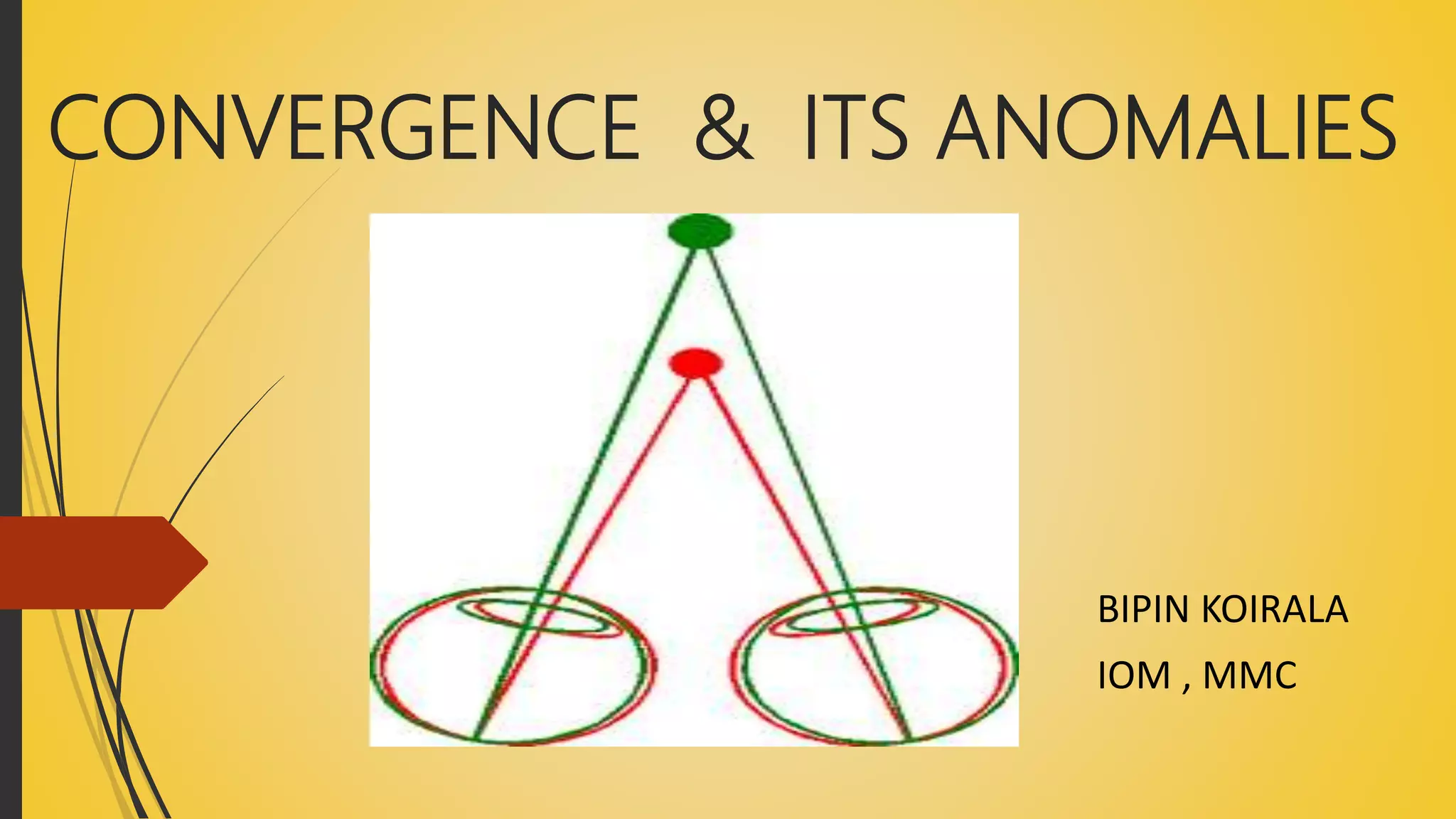
Convergence
Definition : It is disjugate movement of eyes in which eye move
inwards so that lines of sight will intersect in front of eyes.
A.k.a synchronous adduction of each eye.
Helps to maintain bifoveal single vision at any fixation
distances.
Contd.
 Amplitude of convergence doesn’t detoriate with age like
accommodation does.
But some convergence might reduce under certain abnormal
circumstances.
Power or reserve of convergence can be increased by orthoptic
exercises.
Symmetrical vs Asymmetrical convergence
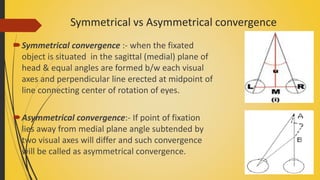
Symmetrical convergence :- when the fixated
object is situated in the sagittal (medial) plane of
head & equal angles are formed b/w each visual
axes and perpendicular line erected at midpoint of
line connecting center of rotation of eyes.
Asymmetrical convergence:- If point of fixation
lies away from medial plane angle subtended by
two visual axes will differ and such convergence
will be called as asymmetrical convergence.
Near point of convergence ( NPC )
Closest point at which an object can be seen singly during bifoveal vision.
In other words nearest point on which eyes can converge.
It doesn’t changes with age
It is much close to eyes compared to near point of accommodation.
In clinical practice NPC of 10 cm is considered adequate.
Its normal value might range from 4cm to 16 cm (As per clinical visual optics)
But as compared to young age convergence is reduced
in older age probably due to reduction in
Accommodative convergence.
Range of convergence & Amplitude of convergence.
Range of convergence:- It is distance b/w far point of convergence and
neat point of convergence.
Amplitude of convergence:- Difference in power exerted to maintain
the eye in position of rest and in position of maximum convergence.
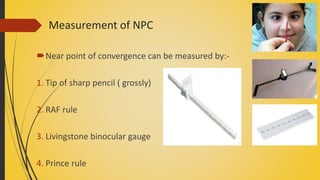
Measurement of NPC
Near point of convergence can be measured by:-
1. Tip of sharp pencil ( grossly)
2. RAF rule
3. Livingstone binocular gauge
4. Prince rule
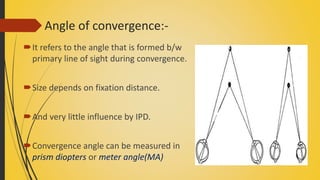
Angle of convergence:-
It refers to the angle that is formed b/w
primary line of sight during convergence.
Size depends on fixation distance.
And very little influence by IPD.
Convergence angle can be measured in
prism diopters or meter angle(MA)
Measurement units of convergence.
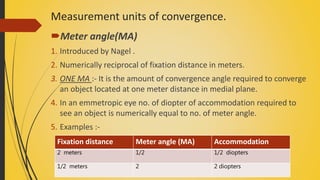
Meter angle(MA)
1. Introduced by Nagel .
2. Numerically reciprocal of fixation distance in meters.
3. ONE MA :- It is the amount of convergence angle required to converge
an object located at one meter distance in medial plane.
4. In an emmetropic eye no. of diopter of accommodation required to
see an object is numerically equal to no. of meter angle.
5. Examples :-
Fixation distance Meter angle (MA) Accommodation
2 meters 1/2 1/2 diopters
1/2 meters 2 2 diopters
Contd..
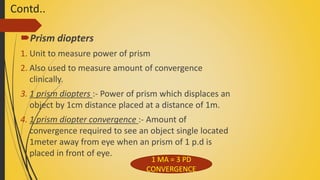
Prism diopters
1. Unit to measure power of prism
2. Also used to measure amount of convergence
clinically.
3. 1 prism diopters :- Power of prism which displaces an
object by 1cm distance placed at a distance of 1m.
4. 1 prism diopter convergence :- Amount of
convergence required to see an object single located
1meter away from eye when an prism of 1 p.d is
placed in front of eye.
1 MA = 3 PD
CONVERGENCE
Types of convergence
Voluntary convergence
 Convergence of eye at our own will.
 Different entity from reflex convergence.
 Some consider voluntary convergence is attained by accommodating eye
more with out accommodating stimulus.
 Examples :- converging eye to reduce nystagmus , some comedian apply
voluntary convergence to obtain crossed eyes.
Contd..
Reflex convergence
Types of reflex convergences are:-
1. Tonic convergence
2. Fusional convergence
3. Accommodative convergence
4. Proximal convergence
Tonic convergence
 Occurs due to normal muscle tone of EOMs.
 Helps to bring eye from anatomical diverged position to physiological
position.
 Tonic convergence is unrelated with fusion and object proximity.
 Tonic convergence decreases with age passes.
 Emotional energy is found to rise tonic convergence.
 Tonic convergence can be eliminated by patching(30 mins) or deep
anesthesia.
Fusional convergence
 Part of reflex convergence
 Ensures similar images are imaged on corresponding retinal points.
 It is mainly induced by bitemporal image disparity.
 No refractive changes seen in eye during fusional convergence.
 Involuntary mechanism to obtain bifoveal fixation
 Magnitude of it is 35 pd at near and 18 pd at distance.
 Fusional convergence can be improved by orthoptic exercises.
Proximal convergence
 A.k.a reflex instrumental convergence
 Induced by proximity of object of regard.
 Also seems to be initiated by psychological factor.
 It is also induced when person feels he is looking at near object
although he is not doing so.
 Proximal convergence has linear relationship with change in fixation
distance.
 Example of proximal convergence is eso-deviation measure by
synaptophore is greater than as measured by prism for same subject.
Accommodative convergence
 Convergence induced when a person accommodates
 Induced or stimulated by blurred retinal image.
 Independent of binocular vision ie can even occur in one eye blind
or occluding one eye.
 It has linear relationship with change in fixation distance
 AC/A will better define accommodative convergence.
Anomalies of convergence.
Convergence insufficiency (CI)
1. Inability to maintain or obtain adequate convergence over certain period
time without undue effort.
2. Commonest cause of asthenopia.
Etiology
1. Idiopathic ( developmental delay ,wide IPD )
2. Refractive errors ( High hyperopia , Myopia )
3. Presbyopia or pts corrected recently for Presbyopia
4. Muscular imbalance (A/w Exophoria ,IXT )
5. Consecutive CI ( Recession of MR, resection of LR )
Contd.
Clinical features:-
Commonly seen in school children's , prolonged near workers, prescise
workers like jewelers, painters. And pts are presented with a symptom
complex called Asthenopia.
1. Symptoms of muscle fatigue includes eye ache , headache , eyestrain,
difficulty to change focus itching burning sensn.
2. Symptoms of difficulty to maintain binocular vision include intermittent
diplopia , blurred near vision and crowing of letters, symptomatic relief
gained on closing one eye .
Diagnostic points:-
CI can be confirmed by following diagnostic points
1. Remote NPC i.e. more than 10 cm
2. Reduced fusional convergence for near
3. Reduced prism convergence value
4. Sometimes associated with Exophoria at near and orthophoria at distance
5. NPA remains normal mostly( so pts with CI suspect must necessarily
measured for NPA
Convergence paralysis :-
It is defined as total lack of ability to overcome base out prism.
Uncommon condition confused with convergence insufficiency.
Etiology :-
Occurs secondary to organic disease of brain especially at corpora
quadrigemina and nuclei of 3rd cranial nerve .
Clinical features:-
1. Complete absence of convergence
2. Exotropia and crossed diplopia on attempted near fixation
3. Adduction remains normal .
4. Accommodation is usually normal but reduced and absent sometimes.
Parinauds syndrome:- convergence paresis a/w vertical gaze palsy
Pretectum posterior commissure syndrome also a/w convergence
paralysis
Diagnostic points of convergence paralysis ( Bielschowsky,s
criteria)
1. Evidence of intra cranial disease
2. Crossed diplopia on attempted near fixation
3. Reproducible findings on subsequent examinations
4. Preservation of accomodation and pupillary rxn
Differential diagnosis:-
 Often confused with functional convergence insufficiency so must
be differentiated from it by using base out prisms.
 In this prism base out test pts with paralysis will have diplopia
immediately but pts with CI can cope certain value of prism power.
Treatment of convergence paralysis:-
Base in prism to eliminate diplopia at near.
Plus lens along with base in prism to the patients having
accomodation weakness
Occlusion of one eye at near work to eliminate diplopia.
Eye surgery is contraindicated.
Convergence spasm
 Condition characterized by intermittent episode of maximum convergence usually
associated with accommodative spasm.
 Etiology
1. Functional causes ( associated with hysteria and neurosis )
2. Organic causes ( organic lesions , head traumas , pituitary adenomas )
 Clinical features:-
1. Extreme convergence ( intermittent )
2. Homonymous diplopia
3. Blurring of vision due to accommodative spasm ( near triad)
4. Miosis ( near triad)
5. High induced myopia (> 5D)
Management
Neurological evaluation needed
Psychiatrical evaluation revels hysteria or neurosis
Treatment of functional spasm of convergene includes
1. Prolonged atropinization
2. Alternate monocular occlusion ( alternative of atropinization)
Therapies to improve near point of convergence are.
 Advancement exercise like pencil push up exercise.
 Jump convergence exercise with spot card & brock string ex.
Therapies to improve amplitude of fusional convergence.
 Convergence exercise with prism
 Convergence exercise with Major Amblyoscope
 Convergence card (Albee dot exersise)
 Convergence exercise with diploscope
 Cat stereogram ex in uncrossed position.
References:-
Primary care optometry by Theodore Grosvernor
Squint & orthoptics by AK khurana
Clinical visual optics by Bennett & Rabbetts
Thank you

Convergence & its anomalies

  • 1.
    CONVERGENCE & ITSANOMALIES BIPIN KOIRALA IOM , MMC
  • 2.
    Convergence Definition : Itis disjugate movement of eyes in which eye move inwards so that lines of sight will intersect in front of eyes. A.k.a synchronous adduction of each eye. Helps to maintain bifoveal single vision at any fixation distances.
  • 3.
    Contd.  Amplitude ofconvergence doesn’t detoriate with age like accommodation does. But some convergence might reduce under certain abnormal circumstances. Power or reserve of convergence can be increased by orthoptic exercises.
  • 4.
    Symmetrical vs Asymmetricalconvergence Symmetrical convergence :- when the fixated object is situated in the sagittal (medial) plane of head & equal angles are formed b/w each visual axes and perpendicular line erected at midpoint of line connecting center of rotation of eyes. Asymmetrical convergence:- If point of fixation lies away from medial plane angle subtended by two visual axes will differ and such convergence will be called as asymmetrical convergence.
  • 5.
    Near point ofconvergence ( NPC ) Closest point at which an object can be seen singly during bifoveal vision. In other words nearest point on which eyes can converge. It doesn’t changes with age It is much close to eyes compared to near point of accommodation. In clinical practice NPC of 10 cm is considered adequate. Its normal value might range from 4cm to 16 cm (As per clinical visual optics) But as compared to young age convergence is reduced in older age probably due to reduction in Accommodative convergence.
  • 6.
    Range of convergence& Amplitude of convergence. Range of convergence:- It is distance b/w far point of convergence and neat point of convergence. Amplitude of convergence:- Difference in power exerted to maintain the eye in position of rest and in position of maximum convergence.
  • 7.
    Measurement of NPC Nearpoint of convergence can be measured by:- 1. Tip of sharp pencil ( grossly) 2. RAF rule 3. Livingstone binocular gauge 4. Prince rule
  • 8.
    Angle of convergence:- Itrefers to the angle that is formed b/w primary line of sight during convergence. Size depends on fixation distance. And very little influence by IPD. Convergence angle can be measured in prism diopters or meter angle(MA)
  • 9.
    Measurement units ofconvergence. Meter angle(MA) 1. Introduced by Nagel . 2. Numerically reciprocal of fixation distance in meters. 3. ONE MA :- It is the amount of convergence angle required to converge an object located at one meter distance in medial plane. 4. In an emmetropic eye no. of diopter of accommodation required to see an object is numerically equal to no. of meter angle. 5. Examples :- Fixation distance Meter angle (MA) Accommodation 2 meters 1/2 1/2 diopters 1/2 meters 2 2 diopters
  • 10.
    Contd.. Prism diopters 1. Unitto measure power of prism 2. Also used to measure amount of convergence clinically. 3. 1 prism diopters :- Power of prism which displaces an object by 1cm distance placed at a distance of 1m. 4. 1 prism diopter convergence :- Amount of convergence required to see an object single located 1meter away from eye when an prism of 1 p.d is placed in front of eye. 1 MA = 3 PD CONVERGENCE
  • 11.
    Types of convergence Voluntaryconvergence  Convergence of eye at our own will.  Different entity from reflex convergence.  Some consider voluntary convergence is attained by accommodating eye more with out accommodating stimulus.  Examples :- converging eye to reduce nystagmus , some comedian apply voluntary convergence to obtain crossed eyes.
  • 12.
    Contd.. Reflex convergence Types ofreflex convergences are:- 1. Tonic convergence 2. Fusional convergence 3. Accommodative convergence 4. Proximal convergence
  • 13.
    Tonic convergence  Occursdue to normal muscle tone of EOMs.  Helps to bring eye from anatomical diverged position to physiological position.  Tonic convergence is unrelated with fusion and object proximity.  Tonic convergence decreases with age passes.  Emotional energy is found to rise tonic convergence.  Tonic convergence can be eliminated by patching(30 mins) or deep anesthesia.
  • 14.
    Fusional convergence  Partof reflex convergence  Ensures similar images are imaged on corresponding retinal points.  It is mainly induced by bitemporal image disparity.  No refractive changes seen in eye during fusional convergence.  Involuntary mechanism to obtain bifoveal fixation  Magnitude of it is 35 pd at near and 18 pd at distance.  Fusional convergence can be improved by orthoptic exercises.
  • 15.
    Proximal convergence  A.k.areflex instrumental convergence  Induced by proximity of object of regard.  Also seems to be initiated by psychological factor.  It is also induced when person feels he is looking at near object although he is not doing so.  Proximal convergence has linear relationship with change in fixation distance.  Example of proximal convergence is eso-deviation measure by synaptophore is greater than as measured by prism for same subject.
  • 16.
    Accommodative convergence  Convergenceinduced when a person accommodates  Induced or stimulated by blurred retinal image.  Independent of binocular vision ie can even occur in one eye blind or occluding one eye.  It has linear relationship with change in fixation distance  AC/A will better define accommodative convergence.
  • 17.
    Anomalies of convergence. Convergenceinsufficiency (CI) 1. Inability to maintain or obtain adequate convergence over certain period time without undue effort. 2. Commonest cause of asthenopia. Etiology 1. Idiopathic ( developmental delay ,wide IPD ) 2. Refractive errors ( High hyperopia , Myopia ) 3. Presbyopia or pts corrected recently for Presbyopia 4. Muscular imbalance (A/w Exophoria ,IXT ) 5. Consecutive CI ( Recession of MR, resection of LR )
  • 18.
    Contd. Clinical features:- Commonly seenin school children's , prolonged near workers, prescise workers like jewelers, painters. And pts are presented with a symptom complex called Asthenopia. 1. Symptoms of muscle fatigue includes eye ache , headache , eyestrain, difficulty to change focus itching burning sensn. 2. Symptoms of difficulty to maintain binocular vision include intermittent diplopia , blurred near vision and crowing of letters, symptomatic relief gained on closing one eye .
  • 19.
    Diagnostic points:- CI canbe confirmed by following diagnostic points 1. Remote NPC i.e. more than 10 cm 2. Reduced fusional convergence for near 3. Reduced prism convergence value 4. Sometimes associated with Exophoria at near and orthophoria at distance 5. NPA remains normal mostly( so pts with CI suspect must necessarily measured for NPA
  • 20.
    Convergence paralysis :- Itis defined as total lack of ability to overcome base out prism. Uncommon condition confused with convergence insufficiency. Etiology :- Occurs secondary to organic disease of brain especially at corpora quadrigemina and nuclei of 3rd cranial nerve . Clinical features:- 1. Complete absence of convergence 2. Exotropia and crossed diplopia on attempted near fixation 3. Adduction remains normal . 4. Accommodation is usually normal but reduced and absent sometimes.
  • 21.
    Parinauds syndrome:- convergenceparesis a/w vertical gaze palsy Pretectum posterior commissure syndrome also a/w convergence paralysis Diagnostic points of convergence paralysis ( Bielschowsky,s criteria) 1. Evidence of intra cranial disease 2. Crossed diplopia on attempted near fixation 3. Reproducible findings on subsequent examinations 4. Preservation of accomodation and pupillary rxn
  • 22.
    Differential diagnosis:-  Oftenconfused with functional convergence insufficiency so must be differentiated from it by using base out prisms.  In this prism base out test pts with paralysis will have diplopia immediately but pts with CI can cope certain value of prism power.
  • 23.
    Treatment of convergenceparalysis:- Base in prism to eliminate diplopia at near. Plus lens along with base in prism to the patients having accomodation weakness Occlusion of one eye at near work to eliminate diplopia. Eye surgery is contraindicated.
  • 24.
    Convergence spasm  Conditioncharacterized by intermittent episode of maximum convergence usually associated with accommodative spasm.  Etiology 1. Functional causes ( associated with hysteria and neurosis ) 2. Organic causes ( organic lesions , head traumas , pituitary adenomas )  Clinical features:- 1. Extreme convergence ( intermittent ) 2. Homonymous diplopia 3. Blurring of vision due to accommodative spasm ( near triad) 4. Miosis ( near triad) 5. High induced myopia (> 5D)
  • 25.
    Management Neurological evaluation needed Psychiatricalevaluation revels hysteria or neurosis Treatment of functional spasm of convergene includes 1. Prolonged atropinization 2. Alternate monocular occlusion ( alternative of atropinization)
  • 26.
    Therapies to improvenear point of convergence are.  Advancement exercise like pencil push up exercise.  Jump convergence exercise with spot card & brock string ex. Therapies to improve amplitude of fusional convergence.  Convergence exercise with prism  Convergence exercise with Major Amblyoscope  Convergence card (Albee dot exersise)  Convergence exercise with diploscope  Cat stereogram ex in uncrossed position.
  • 27.
    References:- Primary care optometryby Theodore Grosvernor Squint & orthoptics by AK khurana Clinical visual optics by Bennett & Rabbetts Thank you

Editor's Notes

  • #4 But convergence reduces with reaching presbyopic periods bec
  • #6 Npc will measure all type of convergences.ie fusional accommodative as well as proximal .
  • #18 Hyperopia cannot overcome such high arror by accommodating so CI develops ,,, myopia doesn’t need to accommodate for near so CI develops , Presbyopia develops CI becoz NPC moves away and need to converge near is no more necessary . Similiary recently corrected presbyopes develop CI due reliving of accommodative effort..