PRESENTATION
Pseudostrabismus nd Heterophoria
Presented by dr sehrish
Pgr eye unit 2
PSEUDOSTRABISMUS
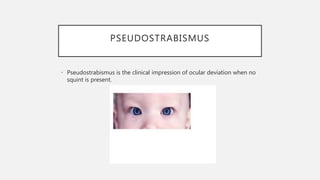
• Pseudostrabismus is the clinical impression of ocular deviation when no
squint is present.
CLASIFFICATION
• Pseudoexotropia
• Pseudoesotropia
• Pseudohypertropia
• Pseudohypotropia
CAUSES OF PSEUDOSTRABISMUS
• Abnormal angel of kappa
• Abnormal facial features
• Abnormal orbital features
ANGEL OF KAPPA
• Anatomical axis: the axis that passes through the
centre of the pupil nd centre of lense is called optical
axis.
• Visual axis:the axis that pass from the fovea to the
point of fixation
• in binocular singel vision (BSV) the visual axis
intersect at the point of fixation nd images are
aligned by the fusion reflex nd binocular
responsive cells in the visual cortex to give BSV.
• Angel of kappa: the angel between anatomical
axis nd visual axis is called angel of kappa.
• Alpha angel:the angel between anatomical axis
nd visual axis at the nodal point is called alpha
angel.
• Gamma angel:the angel between anatomical
axis nd visual axis at the centre of rotation is
called angel of gamma.
• Positive angel of kappa:when the fovea is deviated temporally then the
angel of kappa is positive.
• Corneal reflex is nasally.
• Pseudoexotropia.
• Negative angel of kappa:when the fovea is deviated Nasally then the
angel of kappa becomes negative.
• Corneal reflex is temporal
• Pseudoesotropia
PSEUDOESOTROPIA
• Causes of pseudoesotropia are following.
• 1) negative angel of kappa macula is deviated nasally which produces
temporal corneal reflex producing pseudoesotropia
• 2)prominent epicanthal folds white sclera of eye hides nasally giving the
appearance of pseudoesotropia
• 3)decreased interpupillary distance giving the appearance of
pseudoesotropia
• 4)narrow palpebral fissure
• 5)Enophthalmos.
PSEUDOEXOTROPIA
• Causes of pseudoexotropia are following:
• 1)positive angel of kappa Fovea is displaced temporally giving nasal
corneal reflex nd appearance of pseudoexotropia.
• 2)narrow lateral epicanthals
• 3)large interpupillary distance
• 4)large palberal fissure height
• 5)Exophthalmos.
PSEUDOHYPERTROPIA
/PSEUDOHYPOTROPIA
• Pseudohypertropia/pseudohypitropia:
• Causes of pseudohypertropia are ptosis in which covering of upper eyelid
gives the appearance of pseudohypertropia
• Covering of inferior iris by inferior lid gives the appearance of
pseudohypotropia.
• Asymmetrical facial appearance can give rise to pseudohypertropia or
hypotropia
• Iris coloboma gives the appearance of pseudohypo or Hypertropia
• Heterochromia gives the appearance of Pseudohypertropia or
pseudohypotropia
DIAGNOSIS OF PSEUDOSTEABISMUS
• Must be defferiantiated from true strabismus by following tests:
• Cover test in case of pseudostrabismus no movement is seen on cover
test
• Steropsis
• Visual acuity.
• History
• Physical examination including the facial features ,lid position,bridge of
nose,nd facial symmetry.
MANAGEMENT
• If diagnosis of pseudostrabismus is made counselling of family members
is made about how to differentiate true strabismus from
pseudostrabismus.
• If patient develops signs of true strabismus followup should be
performed .
• Pseudoesotropia resolves by 3 to 4 years because epicanthal folds
becomes less prominent due to expansion of nasal bridge
• If risk factors like hyperopia of 2D Is present followup should be
performed after every 6 to 12 months.
VERGENCE ABNORMALITIES
• Convergence :
• Ability of both eyes to move inward or medially for clear near work or
symptom free near work in which lines of sight will intersect infront of
eyes.
CONVERGENCE INSUFFICIENCY
• Convergence insuficiency:
• Convergence Insuficiency is defined as the inability to maintain or obtain
convergence without undue effort
CAUSES OF CONVERGENCE
INSUFFICIENCY
• 1)idiopathic e.g developmental delay or wide interpupillary distance .
• 2)presbyopia
• 3)muscular incordinance
• 4)consecutive I.e medial rectus ression or lateral rectus resection
• 5)Refractive error e.g hyperopia or myopia.
• Most common in students ,or those who need clear near vision e.g
students,prolonged near work ,precise near work e.g jwellers nd
painters.
• Symptoms include
• Difficulty for clear near vision ,blurring of vision for close work ,eye strain
,headache,crowding of words ,relief from pain on closing one eye.
• Treatment include :
• Orthoptic exercises,
• Use of base in prisms.
ACCOMODATION INSUFICIENCY
• Acomodation:
• Accomodation is the ability to focus at near or maintain Focus of near
objects.
• Accomodative power is less than the normal physiological limit for the
patient age
• Causes of accomodative insufficiency are Seclerosis of lense ,weakness of
ciliary muscles,prolonged near work,reading very small letters,More desk
work in children.
• Symptoms of accomodative insuficiency include blurring of vision,headache
,eye strain
• Treatment is near vision spectacles nd accomodative exercises.
DIVERGENCE INSUFFICIENCY
• Divergence:
• Divergence is the ability of both eyes to move simultaneously outward
or in opposite direction while focusing on far object
• Divergence insufficiency;
• Divergence insufficiency is the presence of high esotropia or high
esophoria at distance nd low esotropia or esophoria at near vision.
CAUSES OF DIVERGENCE INSUFFICIENCY
• Several causes of divergence insufficiency are local
trauma,cerebrovascular accidents,stroke,nd space occupying lesion.
• Or the cause may be neurological diseases.
• Divergence insufficiency should be differentiated from sixth nerve
palsy
NEAR REFLEX INSUFFICIENCY
• Near reflex:
• Near reflex is a triad of convergence,accomodation nd miosis to see near objects
clearly .
• Near reflex insufficiency:
• Parasesis of near reflex presents as convergence nd accomodation insuficiency
• Mydriasis may be seen on attempted near fixation
• Complete paralysis of near reflex insufficiency:
• Convergence nd accomodation cannot be initiated
• Etiology is mid brain disease,head trauma or it may be of functional origin.
• Treatment is base in prisms ,orthoptic exercises nd botulinum toxin.
HETEROPHORIA
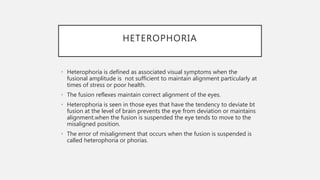
• Heterophoria is defined as associated visual symptoms when the
fusional amplitude is not sufficient to maintain alignment particularly at
times of stress or poor health.
• The fusion reflexes maintain correct alignment of the eyes.
• Heterophoria is seen in those eyes that have the tendency to deviate bt
fusion at the level of brain prevents the eye from deviation or maintains
alignment.when the fusion is suspended the eye tends to move to the
misaligned position.
• The error of misalignment that occurs when the fusion is suspended is
called heterophoria or phorias.
ESOPHORIA
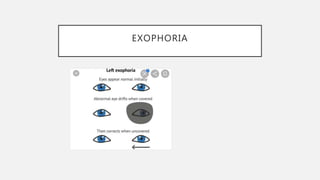
EXOPHORIA
• In heterophoria the eyes are kept aligned by motor fusion nd sensory
fusion.In most cases the sensory fusion develops normally nd motor
fusion plays role in the alignment of eyes.
• In cases of large heterophoria sensory fusion is suppressed.
• If the sensory fusion is suppressed by an obstacle Or distortion then
motor fusion will be prevented nd variable degree of deviation is seen .
If the obstacle to sensory fusion is removed then motor fusion reflex is
established nd deviation is latent called heterophoria.
• If the fusion fails to develop then the deviation is manifest called
heterotropia.
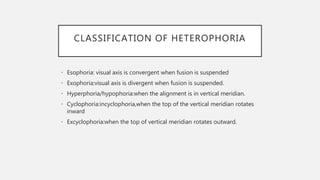
CLASSIFICATION OF HETEROPHORIA
• Esophoria: visual axis is convergent when fusion is suspended
• Exophoria:visual axis is divergent when fusion is suspended.
• Hyperphoria/hypophoria:when the alignment is in vertical meridian.
• Cyclophoria:incyclophoria,when the top of the vertical meridian rotates
inward
• Excyclophoria:when the top of vertical meridian rotates outward.
• Distance phoria:
• The point of fixation is about 6 m
• Near phoris:
• The point of fixation is about 30 to 40 cm.
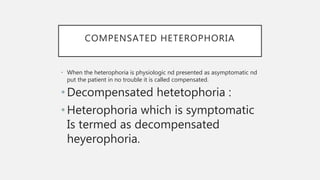
COMPENSATED HETEROPHORIA
• When the heterophoria is physiologic nd presented as asymptomatic nd
put the patient in no trouble it is called compensated.
•Decompensated hetetophoria :
•Heterophoria which is symptomatic
Is termed as decompensated
heyerophoria.
SYMPTOMS
• Patient presents with
• Headache
• Blurring of vision
• Diplopia
• Asthenopia
• Crowding of words.
DIAGNOSIS
• Diagnosis is made by following tests
• Cover uncover test
• Alternate cover test
• Maddox rod test
• Maddox wing test
• Stereopsis.
• Measurement of amplitude of fusion by synaptophore or with prisms.
TREATMENT OF HETEROPHORIA
• 1)orthoptic assessment
• 2)correction of refractive error
• 3)base out prisms.
• 4)surgry may be required for larger deviations.

strabismus

  • 1.
  • 2.
    PSEUDOSTRABISMUS • Pseudostrabismus isthe clinical impression of ocular deviation when no squint is present.
  • 3.
    CLASIFFICATION • Pseudoexotropia • Pseudoesotropia •Pseudohypertropia • Pseudohypotropia
  • 4.
    CAUSES OF PSEUDOSTRABISMUS •Abnormal angel of kappa • Abnormal facial features • Abnormal orbital features
  • 5.
  • 6.
    • Anatomical axis:the axis that passes through the centre of the pupil nd centre of lense is called optical axis. • Visual axis:the axis that pass from the fovea to the point of fixation • in binocular singel vision (BSV) the visual axis intersect at the point of fixation nd images are aligned by the fusion reflex nd binocular responsive cells in the visual cortex to give BSV.
  • 7.
    • Angel ofkappa: the angel between anatomical axis nd visual axis is called angel of kappa. • Alpha angel:the angel between anatomical axis nd visual axis at the nodal point is called alpha angel. • Gamma angel:the angel between anatomical axis nd visual axis at the centre of rotation is called angel of gamma.
  • 8.
    • Positive angelof kappa:when the fovea is deviated temporally then the angel of kappa is positive. • Corneal reflex is nasally. • Pseudoexotropia. • Negative angel of kappa:when the fovea is deviated Nasally then the angel of kappa becomes negative. • Corneal reflex is temporal • Pseudoesotropia
  • 9.
    PSEUDOESOTROPIA • Causes ofpseudoesotropia are following. • 1) negative angel of kappa macula is deviated nasally which produces temporal corneal reflex producing pseudoesotropia • 2)prominent epicanthal folds white sclera of eye hides nasally giving the appearance of pseudoesotropia • 3)decreased interpupillary distance giving the appearance of pseudoesotropia • 4)narrow palpebral fissure • 5)Enophthalmos.
  • 10.
    PSEUDOEXOTROPIA • Causes ofpseudoexotropia are following: • 1)positive angel of kappa Fovea is displaced temporally giving nasal corneal reflex nd appearance of pseudoexotropia. • 2)narrow lateral epicanthals • 3)large interpupillary distance • 4)large palberal fissure height • 5)Exophthalmos.
  • 11.
    PSEUDOHYPERTROPIA /PSEUDOHYPOTROPIA • Pseudohypertropia/pseudohypitropia: • Causesof pseudohypertropia are ptosis in which covering of upper eyelid gives the appearance of pseudohypertropia • Covering of inferior iris by inferior lid gives the appearance of pseudohypotropia. • Asymmetrical facial appearance can give rise to pseudohypertropia or hypotropia • Iris coloboma gives the appearance of pseudohypo or Hypertropia • Heterochromia gives the appearance of Pseudohypertropia or pseudohypotropia
  • 12.
    DIAGNOSIS OF PSEUDOSTEABISMUS •Must be defferiantiated from true strabismus by following tests: • Cover test in case of pseudostrabismus no movement is seen on cover test • Steropsis • Visual acuity. • History • Physical examination including the facial features ,lid position,bridge of nose,nd facial symmetry.
  • 13.
    MANAGEMENT • If diagnosisof pseudostrabismus is made counselling of family members is made about how to differentiate true strabismus from pseudostrabismus. • If patient develops signs of true strabismus followup should be performed . • Pseudoesotropia resolves by 3 to 4 years because epicanthal folds becomes less prominent due to expansion of nasal bridge • If risk factors like hyperopia of 2D Is present followup should be performed after every 6 to 12 months.
  • 14.
    VERGENCE ABNORMALITIES • Convergence: • Ability of both eyes to move inward or medially for clear near work or symptom free near work in which lines of sight will intersect infront of eyes.
  • 15.
    CONVERGENCE INSUFFICIENCY • Convergenceinsuficiency: • Convergence Insuficiency is defined as the inability to maintain or obtain convergence without undue effort
  • 16.
    CAUSES OF CONVERGENCE INSUFFICIENCY •1)idiopathic e.g developmental delay or wide interpupillary distance . • 2)presbyopia • 3)muscular incordinance • 4)consecutive I.e medial rectus ression or lateral rectus resection • 5)Refractive error e.g hyperopia or myopia. • Most common in students ,or those who need clear near vision e.g students,prolonged near work ,precise near work e.g jwellers nd painters.
  • 17.
    • Symptoms include •Difficulty for clear near vision ,blurring of vision for close work ,eye strain ,headache,crowding of words ,relief from pain on closing one eye. • Treatment include : • Orthoptic exercises, • Use of base in prisms.
  • 18.
    ACCOMODATION INSUFICIENCY • Acomodation: •Accomodation is the ability to focus at near or maintain Focus of near objects. • Accomodative power is less than the normal physiological limit for the patient age • Causes of accomodative insufficiency are Seclerosis of lense ,weakness of ciliary muscles,prolonged near work,reading very small letters,More desk work in children. • Symptoms of accomodative insuficiency include blurring of vision,headache ,eye strain • Treatment is near vision spectacles nd accomodative exercises.
  • 19.
    DIVERGENCE INSUFFICIENCY • Divergence: •Divergence is the ability of both eyes to move simultaneously outward or in opposite direction while focusing on far object • Divergence insufficiency; • Divergence insufficiency is the presence of high esotropia or high esophoria at distance nd low esotropia or esophoria at near vision.
  • 20.
    CAUSES OF DIVERGENCEINSUFFICIENCY • Several causes of divergence insufficiency are local trauma,cerebrovascular accidents,stroke,nd space occupying lesion. • Or the cause may be neurological diseases. • Divergence insufficiency should be differentiated from sixth nerve palsy
  • 21.
    NEAR REFLEX INSUFFICIENCY •Near reflex: • Near reflex is a triad of convergence,accomodation nd miosis to see near objects clearly . • Near reflex insufficiency: • Parasesis of near reflex presents as convergence nd accomodation insuficiency • Mydriasis may be seen on attempted near fixation • Complete paralysis of near reflex insufficiency: • Convergence nd accomodation cannot be initiated • Etiology is mid brain disease,head trauma or it may be of functional origin. • Treatment is base in prisms ,orthoptic exercises nd botulinum toxin.
  • 22.
    HETEROPHORIA • Heterophoria isdefined as associated visual symptoms when the fusional amplitude is not sufficient to maintain alignment particularly at times of stress or poor health. • The fusion reflexes maintain correct alignment of the eyes. • Heterophoria is seen in those eyes that have the tendency to deviate bt fusion at the level of brain prevents the eye from deviation or maintains alignment.when the fusion is suspended the eye tends to move to the misaligned position. • The error of misalignment that occurs when the fusion is suspended is called heterophoria or phorias.
  • 23.
  • 24.
  • 25.
    • In heterophoriathe eyes are kept aligned by motor fusion nd sensory fusion.In most cases the sensory fusion develops normally nd motor fusion plays role in the alignment of eyes. • In cases of large heterophoria sensory fusion is suppressed. • If the sensory fusion is suppressed by an obstacle Or distortion then motor fusion will be prevented nd variable degree of deviation is seen . If the obstacle to sensory fusion is removed then motor fusion reflex is established nd deviation is latent called heterophoria. • If the fusion fails to develop then the deviation is manifest called heterotropia.
  • 26.
    CLASSIFICATION OF HETEROPHORIA •Esophoria: visual axis is convergent when fusion is suspended • Exophoria:visual axis is divergent when fusion is suspended. • Hyperphoria/hypophoria:when the alignment is in vertical meridian. • Cyclophoria:incyclophoria,when the top of the vertical meridian rotates inward • Excyclophoria:when the top of vertical meridian rotates outward.
  • 27.
    • Distance phoria: •The point of fixation is about 6 m • Near phoris: • The point of fixation is about 30 to 40 cm.
  • 28.
    COMPENSATED HETEROPHORIA • Whenthe heterophoria is physiologic nd presented as asymptomatic nd put the patient in no trouble it is called compensated. •Decompensated hetetophoria : •Heterophoria which is symptomatic Is termed as decompensated heyerophoria.
  • 30.
    SYMPTOMS • Patient presentswith • Headache • Blurring of vision • Diplopia • Asthenopia • Crowding of words.
  • 31.
    DIAGNOSIS • Diagnosis ismade by following tests • Cover uncover test • Alternate cover test • Maddox rod test • Maddox wing test • Stereopsis. • Measurement of amplitude of fusion by synaptophore or with prisms.
  • 33.
    TREATMENT OF HETEROPHORIA •1)orthoptic assessment • 2)correction of refractive error • 3)base out prisms. • 4)surgry may be required for larger deviations.