MEASUREMENT OF
HETEROPHORIA AND
HETEROTROPIA
Presenter: Junu Shrestha
2nd year
B . Optom
12th May 2013
Moderator:
Gauri Sankar Shrestha
5/3/2014 1
Contents
 Introduction
 Detection of phoria and tropia
Position of the globes
Observation of head position
 Determination of presence of deviation
 Measurement of deviation
Objective methods
Subjective methods
5/3/2014 2
HETEROPHORIA
 Hetero- different
 Phoria – physiological position of rest
 Is the condition of eye in which the directions that
the eyes are pointing are not consistent with each
other
 Is a latent strabismus in which visual axes are
normally directed to the point of fixation but
deviate when the eyes are dissociated.
Introduction
5/3/2014 3
 The tendency of the lines of sight to deviate from the
relative positions necessary to maintain single binocular
vision for a given distance of fixation,
this tendency being identified by the occurrence of an
actual deviation in the absence of an adequate stimulus
to fusion and
occuring in variously designated forms according to the
relative direction or orientation of the deviation.
5/3/2014 4
Compensating heterophoria
 Is the condition where heterophoria is asymptomatic.
 When fusional reserve is used to compensate for
heterophoria. It is aka compensating vergence.
5/3/2014 5
Decompensating heterophoria
 When heterophoria is not overcome by fusional
vergence, signs and symptoms appear
 It may lead to squint or stabismus
5/3/2014 6
B
Angle of heterophoria
Exophoria showing divergence or abduction behind
the cover
5/3/2014 7
 If the visual axes are found to be parallel when the
patient views a distant object and all stimuli to
fusion have been eliminated, the condition is called
ORTHOPHORIA.
 if the visual axes converge toward one another –
ESOPHORIA.
 If the visual axes diverge away from one another –
EXOPHORIA.
 If one of the visual axis deviates above or below –
HYPERPHORIA.
5/3/2014 8
HETEROTROPIA
 Is the manifest deviation in which fusional control is
absent (motor fusion)
 Aka squint or strabismus
5/3/2014 9
Concomitant strabismus
 The deviation does not vary in size with direction of
gaze or fixating eye
 Aka comitant strabismus
5/3/2014 10
Noncomitant strabismus
 The deviation varies in size with direction of gaze or
fixating eye
 Most incomitant strabismus is paralytic or restrictive
5/3/2014 11
 Heterotropia can be
HORIZONTAL- esotropia or exotropia
VERTICAL- hypertropia or hypotropia
TORSIONAL- incyclo or excyclodeviation
Combined horizontal, vertical and/or torsional
5/3/2014 12
Angle of
Heterotropia
B
Left exotropia, showing adduction of the deviating left eye to take up
fixation and corresponding abduction of the right eye behind cover
LE RE5/3/2014 13
DETECTION OF PHORIA & TROPIA
 POSITION OF THE GLOBES
 Estimating the relative position of the eye is to have
the pt. fixate a penlight at near vision and then at
distance
 If reflected images from the 2 corneas appear
centered under both conditions – visual axes are
aligned
5/3/2014 14
 An angle kappa is formed by failure of the
pupillary and visual axes of the eye to coincide.
 Pupillary axis- line passing through the centre of the
apparent pupil perpendicular to the cornea.
 Visual axis – aka line of sight, connects the fovea
with the fixation point.
 Angle kappa is formed at the intersection of these
two axes at the center of the entrance pupil.
5/3/2014 15
 The pupillary axis touches the posterior pole of the
globe slightly nasal and inferior to the fovea
The corneal reflection of a penlight is not centered but lies
slightly nasal to the center positive angle kappa
If the fovea’s position is nasal to the point at which the
optical axis cuts the globe’s posterior pole, the corneal
reflection of a light will appear to lie on the temporal
side of the pupillary center negative angle kappa
5/3/2014 16
O
F
5/3/2014 17
 In high myopia, peudoesotropia is seen due to nasal
displacement of the fovea.
 In Retinopathy of prematurity, the macula is pulled
in the temporal direction, resulting in positive angle
kappa aka pseudoexotropia.
5/3/2014 18
Size of angle Kappa
 Positive angle kappa ranges - 3.5° to 6.0°
average 5.082° in emmetropic eyes
 In hypermetropic eyes - 6.0° to 9.0°
average - 7.55°
 In myopic eyes – 2.0° may even be negative
Donders FC; On the anomalies of Accommodation and Refraction of the Eye
5/3/2014 19
Clinical significance
 Since angle may simulate , conceal or exaggerate a
deviation, the angle kappa must be considered to
obtain the best estimate of the actual deviation.
5/3/2014 20
Observation of head posture
 Pts with comitant horizontal heterotropias have
normal head position.
 In nystagmus, the frequency and amplitude may
reduce or dampens in certain direction where the
visual acuity is optimal. Head is turned to that
direction when looking straight ahead.
 Pt having high U/L amblyopia turn their head away
from amblyopic eye
5/3/2014 21
 Abnormal head positions in connection with
incomitant and paretic deviations are usually
assumed to obtain binocular co-operation or to
avoid diplopia.
 “The pt chooses the least inconvenient position of
the head by which the paretic muscle is sufficiently
relieved so that binocular single vision can be
obtained.”
-Bielschowsky
5/3/2014 22
Determination of presence of deviation
COVER TEST
 Differentiates
 orthotropia from an ocular deviation
 The deviation is latent or manifest
 The direction of deviation
 The fixation behaviour
 Whether visual acuity is significantly decreased in one
eye
5/3/2014 23
 A cover is placed briefly before the eye that appears to
fixate while the pt looks a small object, or a 6/9 VA
target
 Performed for distance and near.
 Covering one eye of a patient with normal binocular
vision interrupts fusion
 Eg. If a pt has heterotropia and the fixating eye is
covered, the opposite eye will move from heterotropic
position to take up fixation and the covered eye will
make a corresponding movement in accordance with
Hering’s law.
5/3/2014 24
 If there is no manifest deviation i.e. no movement of the
fellow eye when either eye is covered, a cover-uncover
test will determine the latent deviation.
 The covered eye is examined just after uncover.
 Eg. If a pt has heterophria, the covered eye will deviate
in the direction of the heterophoric position. When the
eye is uncovered , it will move in opposite direction to
reestablish binocular fixation.
5/3/2014 25
The possible results of the cover and cover-
uncover test are
 On covering the seemingly fixating eye:
 No movement of the other eye- there was binocular fixation
before cover
 Movement of redress of the other eye: a manifest deviation
was present before cover
5/3/2014 26
 On uncovering the eye:
 Movement of redress of the uncovered eye (fusional
movement), no movement of the other eye:
heterophoria is present
 No movement of either eye; uncovered eye deviated;
opposite eye continues to fixate: alternating
heterotropia is present
 Uncovered eye makes movement of redress and
assumes fixation with one eye; preference of fixation
with one eye: a U/L heterotropia is present.
5/3/2014 27
Modified Cover Test
 Introduced by Speilmann
 A translucent occluder is used.
 Covering both eyes with translucent occluders permits a
quick preliminary determination of whether an
esotropia is of refractive –accommodative or non-
accommodative origin.
5/3/2014 28
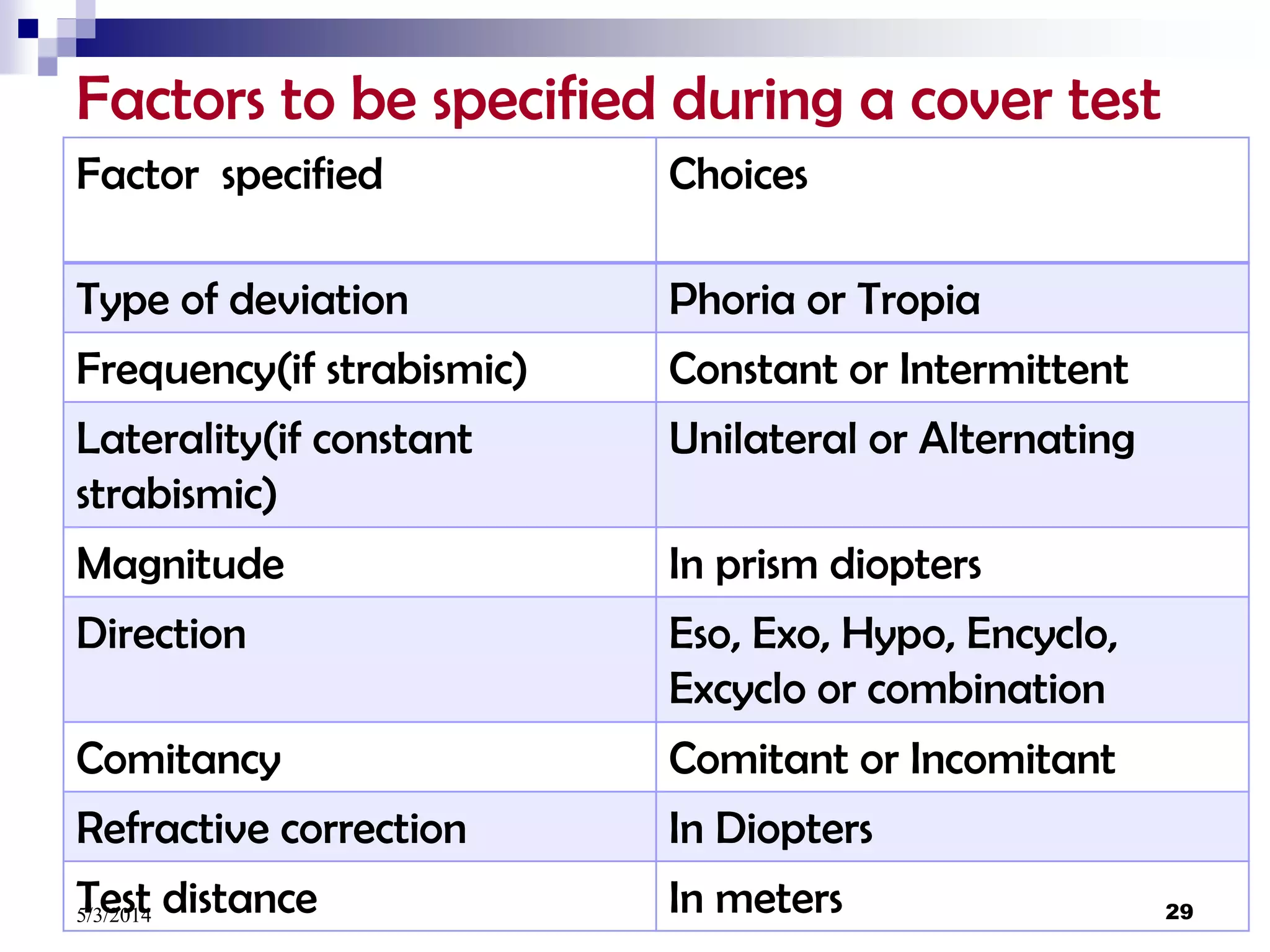
Factors to be specified during a cover test
Factor specified Choices
Type of deviation Phoria or Tropia
Frequency(if strabismic) Constant or Intermittent
Laterality(if constant
strabismic)
Unilateral or Alternating
Magnitude In prism diopters
Direction Eso, Exo, Hypo, Encyclo,
Excyclo or combination
Comitancy Comitant or Incomitant
Refractive correction In Diopters
Test distance In meters5/3/2014 29
Subjective Tests
Diplopia test
 Red Glass test
 Tangent screen
 Maddox Rod
 Maddox Wing
 Maddox double rod test
Haploscopic test
 Lancaster R-G test
Von Graefe method
Measurement of Deviation
Objective tests
Prism and cover test
Major Amblyoscope
Corneal reflection tests
 Hirschberg Method
 Krimsky’s Method
Ophthalmoscopy and
fundus photorgaphy
5/3/2014 30
OBJECTIVE TESTS
5/3/2014 31
PRISM and COVER TEST
 Principle: there will be no
movement of the eyes when
the selected prism causes
the image to fall on the fovea.
 A cover is placed alternating in front of each eye while
the pt maintains fixation. The eye that is uncovered
makes a movement of redress in the direction opposite
that of the deviation.
5/3/2014 32
 To measure esotropia, the prism must be placed
base out, for an exotropia – base in, for aright
hypertropia – base down in front of RE or base up
in front of LE.
 Reduces the movement of redress and the prism
strength is increased until the movement is offset.
 In pts with horizontal and vertical deviation, 1st the
horizontal deviation is neutralised with prism and
then to vertical deviation.
5/3/2014 33
Physiologic basis
 Redress in the prism and cover test is a psycooptical
reflex movement that occurs when the eye fixates.
 The sensory origin of this reflex movement is from
the stimulation of a peripheral retinal area in the
deviated eye by the fixation object.
 To place the fixated image on the fovea
5/3/2014 34
 Movement is quantitative and is directly
proportional to the distance of the fovea from the
stimulated peripheral retina.
 Placing prisms of increasing power in front of the
eyes brings the image of the fixated object closer to
the fovea, causing a corresponding decrease in
movement of redress.
5/3/2014 35
 Adequate fixation target and a technique that
ensures relaxed accommodation and maximum
dissociation is used.
 For distance fixation 6/9 VA symbol and a picture
target for near.
 At 6m the stimuli to accommodation and
convergence are assumed to be zero (although the
actual stimulus to accommodation is 0.17D and for
convergence is 1p.d.)at 40cm the stimulus to
accommodation is 2.50D to convergence is 15p.d.(for
IPD 64mm)
5/3/2014 36
Limitations of prism cover test
1. Presupposes accurate fixation and cannot be
performed if the deviating eye is blind or has
grossly eccentric fixation. In EF, the test provides
wrong measurements as the movement of redress
stops when the stimulus falls on the eccentric retinal
area not the fovea.
2. With loose prisms, when a low prism is added to a
high power prism, the arithmetic addition doesnot
give the resultant power
5/3/2014 37
3.The amount of deviation measured by an
ophthalmic lenses is variable depending on
position(how the prism is held). Eg a 40 glass
prism with a posterior face held in frontal position
gives only 32 of effect.
 Glass prisms are calibrated for use in the
prentice position, i.e. the posterior face of
the prism is perpendicular to the line of
sight of the deviating eye.
 Plastic prisms are calibrated for use in
the frontal plane position i.e. parallel
to the infraorbital rim.
5/3/2014 38
4.When measuring large angle horizontal deviation
with a prism bar, even slight oblique shifts of the bar
can include a vertical displacement of the image,
mimic a vertical deviation and cause vertical
diplopia
5.Spectacle lenses affects the measurement of
strabismic deviation. Plus lenses decrease and minus
lenses increase the measured deviation.
 Becomes clinically significant with powers of more than
5D
5/3/2014 39
MEASUREMENT with the MAJOR AMBLYOSCOPE
Consists of
1. Chinrest
2. Forehead rest
3. Two tubes carrying targets seen through an
angled eye-piece one for each eye
5/3/2014 40
SYNAPTOPHORE
5/3/2014 41
 Tubes are placed horizontally and supported by a
column
 Distance between the tubes can be adjusted -
correspond accurately to the pt’s IPD.
 The axis of tube is in line with the center of rotation
of the eyes.
 Adjustments for vertical separation of targets and
cyclorotational adjustments
 Illumination system
 Increase or decrease stimulus luminance
5/3/2014 42
 Position of targets is fixed in focal plane of a +6.0D
or +6.5D lens so that they are at optical infinity
 To induce accommodation, auxilliary minus lenses
are placed in front of the eye pieces
 Deviation is measured by moving the arms of the
major amblyoscope into the position that images of
the target fall on the respective foveal areas.
5/3/2014 43
 The arms are moved until there is no further fixation
movement of the eyes in an alternate cover
test.(either by actual covering or by alternately
extinguishing the light on one side of the instrument)
 Horizontal deviations are compensated for by
moving the synaptophore arms, vertical deviations
by elevating or depressing the synaptophore
pictures.
5/3/2014 44
 When one eye is deeply amblyopic without the
capacity for fixation the angle can be determined
by shifting the synaptophore arm in front of the
amblyopic eye until the corneal reflex is centered in
the pupil
1.If corneal fixation is present, place one arm at zero
and the other at presumed angle of deviation.
Both pictures are illuminated. Pt fixates on center of
one picture.5/3/2014 45
This picture is shut off and the examiner observes
whether the other eye makes a fixation movement.
The arms are shifted until no fixation movement is
visible.
Between each phase, both pictures are illuminated so
that binocular vision is possible.
Aka monocular cover test or the simultaneous prism
cover test.
5/3/2014 46
2.Both pictures are shown alternately and the
synaptophore arms are adjusted until no refixation
movement develops.
Aka Alternate cover test and alternate prism cover
test since no binocular vision is possible.
5/3/2014 47
CORNEAL REFLECTION TESTS
 Estimation/ measurement of the deviation by
observing the first purkinje image
 Especially preferred when:
The deviated eye is blind or has low VA
In young children, unable to maintain fixation for
a longer than a moment
The amount of deviation cannot be determined
by the prism and cover test or by any subjective
tests.
5/3/2014 48
 Pt is instructed to watch a penlight held at 40cm by
the examiner
 Observes the corneal reflexes in the pts eye
 If no tropia exists, each corneal reflex will be located
approx 0.5mm nasal to the center of the pupil.
5/3/2014 49
 The corneal reflection is on the nasal side of the
deviated eye in exotropia, on the temporal side in
the esotropia, below the corneal center in
hypertropia and above it in hypotropia.
5/3/2014 50
Hirschberg Method
 When both eyes unoccluded and the pt still fixates
the penlight, the position of the corneal reflexes in
both eyes under binocular condition is noted and is
compared with the corresponding positions and with
the corresponding position under monocular
condition.
5/3/2014 51
 “Each 1mm of decentration of the corneal reflection
correspond to 7° of deviation of the visual axis.”
Hirschberg
 1mm displacement ~7 or 15
Brodie 1987
 1mm displacement~20-22
Hasebe at al 1998
5/3/2014 52
5/3/2014 53
Krimsky’s method
 Prism is used to change the position of the corneal
reflection in the deviating eye.
 Amount of prism needed to reposition corneal
reflection in the deviating eye to the angle lambda
5/3/2014 54
 A penlight is held 50cm in
the midplane
 Prism bar is placed in front
of the fixating eye and is
increased until the corneal
reflection in the deviating
eye moves to angle lambda
position.5/3/2014 55
OPHTHALMOSCOPY and FUNDUS
PHOTOGRAPHY
 Fovea – 0.3 dd below a horizontal line extending
through the geometric center of optic disc.
Excyclotropia
Incyclotropia
5/3/2014 56
SUBJECTIVE TESTS
 Based on
Diploscopic principle
Haploscopic principle
5/3/2014 57
DIPLOPIA TEST
 Determination of the subjective localization of a
single object point imaged on the fovea of the
fixating eye and on extrafoveal retinal area in the
other eye
 In esotropia, where the image of the fixation point
in the deviated eye falls on a nasal area nasal to the
fovea, there should be uncrossed diplopia.
5/3/2014 58
 In exotropia, where the image of the fixation point
in the deviated eye falls on a retinal area temporal
to the fovea, there should be crossed diplopia.
 If retinal correspondence is normal, double images
not only should be properly oriented but also should
have a distance equal to the angle of squint.
5/3/2014 59
 The distance of the double images is then a measure
of the deviation; but with spontaneous diplopia, it is
difficult for the patient to state whether the images
are crossed or uncrossed.
 The two visual fields must be separated.
5/3/2014 60
Red glass test
 A red glass is placed in front of one eye.
 Pt fixates a small light source and states whether the
red light is to the right or to the left and above or
below the white light.
 If the white fixation light is in the center of the
maddox cross, pt must state the numbers near
which the red light is seen.
5/3/2014 61
 Red glass dissociate the light in addition to
differentiate the two fields.
 Dissociation is important in
 Hetrophoria
 Intermittent heterotropia
5/3/2014 62
 The red glass must be dark enough to make it
impossible for the pt to see anything but the red
fixation light to prevent fusional impulses from the
surrounding of the fixation light.
 Generally the filter is placed before the fixating eye,
which is less likely to suppress the darkened image
of fixation light.
5/3/2014 63
5/3/2014 64
Tangent screen test
 Introduced by Freeman
 A green maddox rod is held before the pt’s right
eye while the left eye views a scale of red
transilluminated number.
 The white light at the center of the scale produces
the streak, while the red numbers and green
coloured rod eliminate the additional streaks thet
would otherwise have been caused if white number
had been used.
5/3/2014 65
 The scale calibrated in prism dioptres for the
assumed testing distance, is placed obliquely, and
hence may be used to measure both horizontal and
vertical deviations.
 Odd numbers are used on one side of the spot and
even numbers on the other.
5/3/2014 66
Maddox rod
 Consists of small glass rods(a series of planoconvex
cylinders in red or white) causes an astigmatic
elongation of the fixation light and may be placed
to produce a vertical or horizontal streak to
measure the horizontal and
vertical deviation.
5/3/2014 67
 A streak image- oriented 90 from the axis of the
cylinders
 Performed with refractive correction .
5/3/2014 68
Vertical rod to measure the vertical
deviation
 Maddox rod is oriented vertically infront of one eye
and a measuring prism in other
 Starting with 8 or 10 prism base up or base down
prism the amount of prism power is gradually
reduced until pt reports the horizontal streak goes
through the spot
5/3/2014 69
 The magnitude, hyper eye ,test distance, refractive
correction and technique should be recorded for the
vertical deviation
5/3/2014 70
Horizontal rod to measure lateral phoria
 Both methods for near and distance
 Stabilization of accommodation is not significant for
vertical deviations because fluctuation of deviations
affect only the horizontal angle
 Can be assessed by
 Thorington method
5/3/2014 71
 Uses horizontally oriented distance test chart having
a spot light in center and numbers or letters
extending on either side
 Horizontally oriented Maddox rod is placed in front
of one eye and the pt is asked to report the position
of the vertical streak, the number letter or through
the spot.
H G F E D C B A 0 1 2 3 4 5 6 7 8
5/3/2014 72
 Because each prism diopter of deviation at
6m results in a tangent distance of 6cm, to have 1
steps, the no. or letters must be placed 6cm apart
5/3/2014 73
 Maddox rod on RE
 Numbers on right side
If light streak pass through no.
Uncrossed diplopia- esophoria
through letters
Crossed diplopia- exophoria
5/3/2014 74
H G F E D C B A 0 1 2 4 5 6 7 8
 Can also be used at 40cm
 At 40cm, each prism diopter of power is represented
by a deviation of 0.4cm.
 Can also be designed to measure the vertical phoria
by aligning the numbers and letters vertically above
and below the light source.
5/3/2014 75
 Since this method uses no. and letters, which exerts
some control over accommodation this test doesnot
present the problem of lack of control of
accommodation
5/3/2014 76
775/3/2014
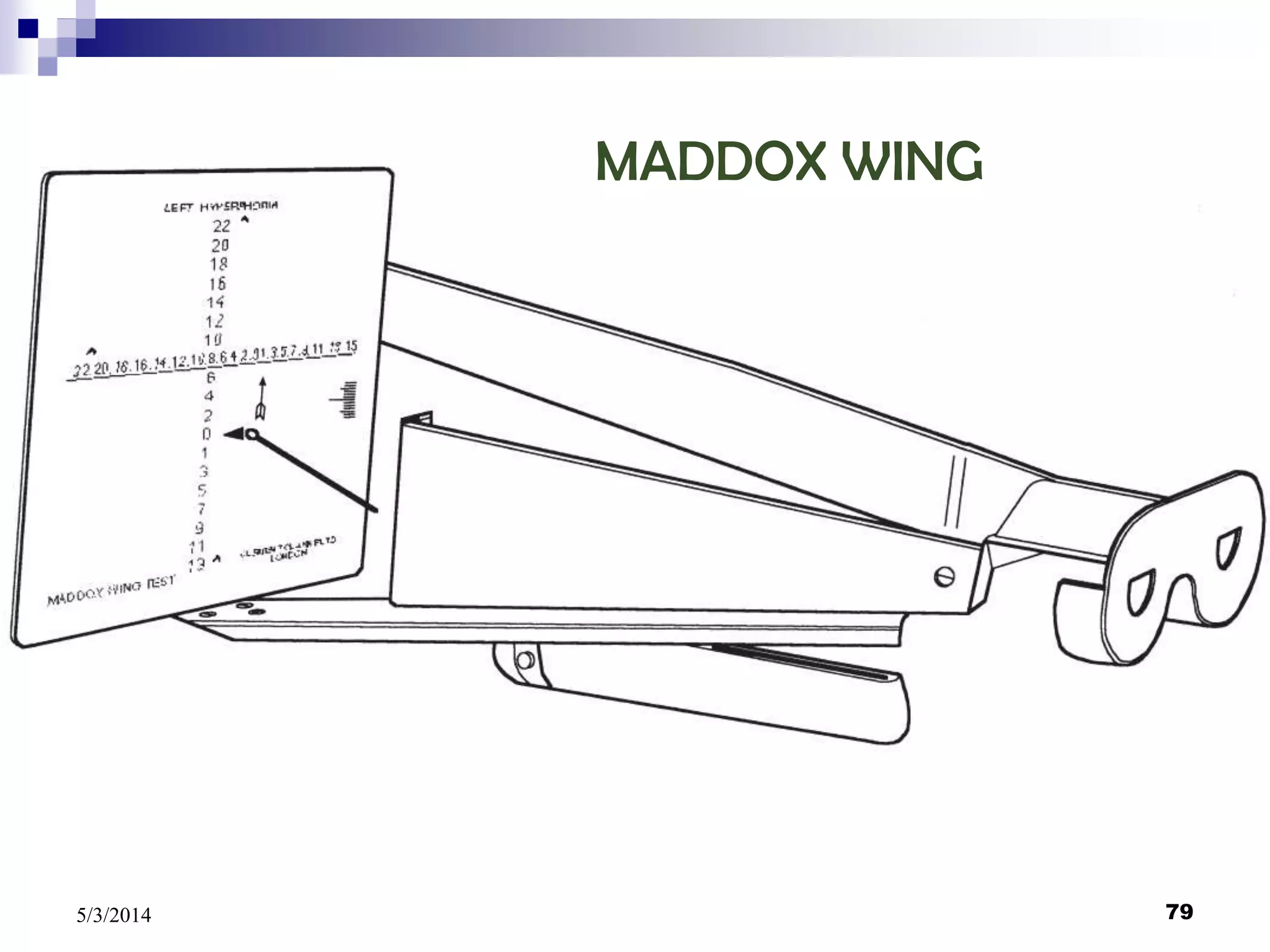
Maddox wing
 For amount of heterophoria in near fixation
 A vertical arrow is presented to one eye and a
horizontal tangent scale to the other to give the
measurement of the horizontal phoria .
 A horizontal arrow and vertical scale are used to
measure the vertical imbalance.
 Scales are mounted at the fixed viewing distance of
1/3m.
5/3/2014 78
MADDOX WING
5/3/2014 79
Maddox double rod test
 Quantitative determination of cyclodeviation
 Red and white maddox rods are placed in the trial
frame. Red before RE and white before LE.
 Direction of glass rods is aligned with the 90° mark
of trial frame
5/3/2014 80
 A spot light is shown, for which the pt sees horizontal
streaks.
 A vertical prism may be added to separate the
images for easier identification.
 If one line appears slanted toward the nose,
excyclotropia of RE is present.
 Maddox rod is turned until the red line is seen parallel
with the white line. E.g. toward the 100° mark of the right
trial frame, 10° right exotropia is present
5/3/2014 81
5/3/2014 82
Bagolini striated glasses
•Produce an image of a streak
of light, perpendicular to the
axis of striations when viewing
a spot light.
•Axes of striation at 90°
•If two lines fuse- no
cyclotropia
•If not the amount by which
the glasses are turned gives the
direction and amount of
cyclotropia
5/3/2014 83
HAPLOSCOPIC TESTS
 Two test objects rather than one are presented to
the patient
 assumption: NRC
 Visual field of two eyes are differentiated and
dissociated by presenting different target with major
abmlyoscope
 Each eye with different colour filter
 Polaroid projection
5/3/2014 84
Lancaster test / R-G test
 Uses a window shade type of screen (ruled into
squares of 7cm) so that at distance of 2m each
square subtends approx 2°
 Pt red green reversible googles
 2 projectors are used
 Red with examiner
 Green patient
 Image formed by projector are linear
5/3/2014 85
 In NRC the streaks will be separated objectively on
the screen by an amount corresponding to the
deviation of the visual axes.
 Since the projected image is a line, the pts response
may indicate the presence of cyclotropia when the
streak is tilted.
 Tilt of the retinal image is opposite to the tilt of the
horizontal line as seen by the observer.
5/3/2014 86
 When the line is seen slanted toward the nose, an
excyclodeviation is present.
 The line is always tilted in the direction in which the
offending muscle would rotate the eye if it were
acting alone.
5/3/2014 87
Von Graefe Method
 The method of phoria measurement in which a
dissociating prism is placed in front of one eye and a
measuring prism in front of the other eye.
 The dissociating prism should be strong enough to
cause diplopia
5/3/2014 88
 A base down prism is placed in front of one eye
causes the image on the retina to be displaced
downward, below the macular area, so the object
that formerly was seen straight ahead is then seen
as being displaced upward
5/3/2014 89
Measuring lateral phoria
 Target: vertical line of 20/20 letters
 A vertical prism of 7 or 8 is placed in front of one
eye
 A base in prism as the measuring prism in other eye
5/3/2014 90
 If BU in LE and BI in RE, lower image towards left is
seen by left eye and upper image towards right is
seen by right eye.
 At this point, two procedures can be used
 Alignment method
 Flash method
5/3/2014 91
Alignment method
 The strength of the BI prism is decreased until both
images are on same line.
 0 - orthophoric
 But if the measuring prism indicates BI prism at
alignment the pt is exophoric and if it indicates BO
the pt is esophoric
5/3/2014 92
Flash method
 The prism strength is decreased but the eye is
occluded in doing so.
 It prevents the continuous viewing of the charts
preventing the chance of fusion.
5/3/2014 93
Measuring vertical phoria
 When dissociating for the vertical phoria
measurement, base in prism is used.
 Eyes are able to make much larger fusional
convergence movements than fusional divergence
movements.
 15 BI in one eye and a measuring prism BU or BD
in other eye.
5/3/2014 94
 Target: a horizontal row of 20/20 letters on the
chart at 6m or 40cm.
 Pt is asked to report when the two rows of letters
are on the same level.
 Prism power is reduced until the patient reports
alignment.
5/3/2014 95
 If the measuring prism is BD in LE, and if alignment
obtained at
 0 - orthophoria
 BD - left hyperphoria
 BU -Rt hyperphoria
5/3/2014 96
References
1. Binocular vision and ocular motility- Gunrter K
Von Noorden
2. Primary care optometry- Theodore Grossvenor
3. Clinical orthoptics-Fiona J. Rowe
4. Clinical visual optics-Bennett & Rabbetts
5. Internet
5/3/2014 97
Thank you...
5/3/2014 98

Heterophoria n tropia

  • 1.
    MEASUREMENT OF HETEROPHORIA AND HETEROTROPIA Presenter:Junu Shrestha 2nd year B . Optom 12th May 2013 Moderator: Gauri Sankar Shrestha 5/3/2014 1
  • 2.
    Contents  Introduction  Detectionof phoria and tropia Position of the globes Observation of head position  Determination of presence of deviation  Measurement of deviation Objective methods Subjective methods 5/3/2014 2
  • 3.
    HETEROPHORIA  Hetero- different Phoria – physiological position of rest  Is the condition of eye in which the directions that the eyes are pointing are not consistent with each other  Is a latent strabismus in which visual axes are normally directed to the point of fixation but deviate when the eyes are dissociated. Introduction 5/3/2014 3
  • 4.
     The tendencyof the lines of sight to deviate from the relative positions necessary to maintain single binocular vision for a given distance of fixation, this tendency being identified by the occurrence of an actual deviation in the absence of an adequate stimulus to fusion and occuring in variously designated forms according to the relative direction or orientation of the deviation. 5/3/2014 4
  • 5.
    Compensating heterophoria  Isthe condition where heterophoria is asymptomatic.  When fusional reserve is used to compensate for heterophoria. It is aka compensating vergence. 5/3/2014 5
  • 6.
    Decompensating heterophoria  Whenheterophoria is not overcome by fusional vergence, signs and symptoms appear  It may lead to squint or stabismus 5/3/2014 6
  • 7.
    B Angle of heterophoria Exophoriashowing divergence or abduction behind the cover 5/3/2014 7
  • 8.
     If thevisual axes are found to be parallel when the patient views a distant object and all stimuli to fusion have been eliminated, the condition is called ORTHOPHORIA.  if the visual axes converge toward one another – ESOPHORIA.  If the visual axes diverge away from one another – EXOPHORIA.  If one of the visual axis deviates above or below – HYPERPHORIA. 5/3/2014 8
  • 9.
    HETEROTROPIA  Is themanifest deviation in which fusional control is absent (motor fusion)  Aka squint or strabismus 5/3/2014 9
  • 10.
    Concomitant strabismus  Thedeviation does not vary in size with direction of gaze or fixating eye  Aka comitant strabismus 5/3/2014 10
  • 11.
    Noncomitant strabismus  Thedeviation varies in size with direction of gaze or fixating eye  Most incomitant strabismus is paralytic or restrictive 5/3/2014 11
  • 12.
     Heterotropia canbe HORIZONTAL- esotropia or exotropia VERTICAL- hypertropia or hypotropia TORSIONAL- incyclo or excyclodeviation Combined horizontal, vertical and/or torsional 5/3/2014 12
  • 13.
    Angle of Heterotropia B Left exotropia,showing adduction of the deviating left eye to take up fixation and corresponding abduction of the right eye behind cover LE RE5/3/2014 13
  • 14.
    DETECTION OF PHORIA& TROPIA  POSITION OF THE GLOBES  Estimating the relative position of the eye is to have the pt. fixate a penlight at near vision and then at distance  If reflected images from the 2 corneas appear centered under both conditions – visual axes are aligned 5/3/2014 14
  • 15.
     An anglekappa is formed by failure of the pupillary and visual axes of the eye to coincide.  Pupillary axis- line passing through the centre of the apparent pupil perpendicular to the cornea.  Visual axis – aka line of sight, connects the fovea with the fixation point.  Angle kappa is formed at the intersection of these two axes at the center of the entrance pupil. 5/3/2014 15
  • 16.
     The pupillaryaxis touches the posterior pole of the globe slightly nasal and inferior to the fovea The corneal reflection of a penlight is not centered but lies slightly nasal to the center positive angle kappa If the fovea’s position is nasal to the point at which the optical axis cuts the globe’s posterior pole, the corneal reflection of a light will appear to lie on the temporal side of the pupillary center negative angle kappa 5/3/2014 16
  • 17.
  • 18.
     In highmyopia, peudoesotropia is seen due to nasal displacement of the fovea.  In Retinopathy of prematurity, the macula is pulled in the temporal direction, resulting in positive angle kappa aka pseudoexotropia. 5/3/2014 18
  • 19.
    Size of angleKappa  Positive angle kappa ranges - 3.5° to 6.0° average 5.082° in emmetropic eyes  In hypermetropic eyes - 6.0° to 9.0° average - 7.55°  In myopic eyes – 2.0° may even be negative Donders FC; On the anomalies of Accommodation and Refraction of the Eye 5/3/2014 19
  • 20.
    Clinical significance  Sinceangle may simulate , conceal or exaggerate a deviation, the angle kappa must be considered to obtain the best estimate of the actual deviation. 5/3/2014 20
  • 21.
    Observation of headposture  Pts with comitant horizontal heterotropias have normal head position.  In nystagmus, the frequency and amplitude may reduce or dampens in certain direction where the visual acuity is optimal. Head is turned to that direction when looking straight ahead.  Pt having high U/L amblyopia turn their head away from amblyopic eye 5/3/2014 21
  • 22.
     Abnormal headpositions in connection with incomitant and paretic deviations are usually assumed to obtain binocular co-operation or to avoid diplopia.  “The pt chooses the least inconvenient position of the head by which the paretic muscle is sufficiently relieved so that binocular single vision can be obtained.” -Bielschowsky 5/3/2014 22
  • 23.
    Determination of presenceof deviation COVER TEST  Differentiates  orthotropia from an ocular deviation  The deviation is latent or manifest  The direction of deviation  The fixation behaviour  Whether visual acuity is significantly decreased in one eye 5/3/2014 23
  • 24.
     A coveris placed briefly before the eye that appears to fixate while the pt looks a small object, or a 6/9 VA target  Performed for distance and near.  Covering one eye of a patient with normal binocular vision interrupts fusion  Eg. If a pt has heterotropia and the fixating eye is covered, the opposite eye will move from heterotropic position to take up fixation and the covered eye will make a corresponding movement in accordance with Hering’s law. 5/3/2014 24
  • 25.
     If thereis no manifest deviation i.e. no movement of the fellow eye when either eye is covered, a cover-uncover test will determine the latent deviation.  The covered eye is examined just after uncover.  Eg. If a pt has heterophria, the covered eye will deviate in the direction of the heterophoric position. When the eye is uncovered , it will move in opposite direction to reestablish binocular fixation. 5/3/2014 25
  • 26.
    The possible resultsof the cover and cover- uncover test are  On covering the seemingly fixating eye:  No movement of the other eye- there was binocular fixation before cover  Movement of redress of the other eye: a manifest deviation was present before cover 5/3/2014 26
  • 27.
     On uncoveringthe eye:  Movement of redress of the uncovered eye (fusional movement), no movement of the other eye: heterophoria is present  No movement of either eye; uncovered eye deviated; opposite eye continues to fixate: alternating heterotropia is present  Uncovered eye makes movement of redress and assumes fixation with one eye; preference of fixation with one eye: a U/L heterotropia is present. 5/3/2014 27
  • 28.
    Modified Cover Test Introduced by Speilmann  A translucent occluder is used.  Covering both eyes with translucent occluders permits a quick preliminary determination of whether an esotropia is of refractive –accommodative or non- accommodative origin. 5/3/2014 28
  • 29.
    Factors to bespecified during a cover test Factor specified Choices Type of deviation Phoria or Tropia Frequency(if strabismic) Constant or Intermittent Laterality(if constant strabismic) Unilateral or Alternating Magnitude In prism diopters Direction Eso, Exo, Hypo, Encyclo, Excyclo or combination Comitancy Comitant or Incomitant Refractive correction In Diopters Test distance In meters5/3/2014 29
  • 30.
    Subjective Tests Diplopia test Red Glass test  Tangent screen  Maddox Rod  Maddox Wing  Maddox double rod test Haploscopic test  Lancaster R-G test Von Graefe method Measurement of Deviation Objective tests Prism and cover test Major Amblyoscope Corneal reflection tests  Hirschberg Method  Krimsky’s Method Ophthalmoscopy and fundus photorgaphy 5/3/2014 30
  • 31.
  • 32.
    PRISM and COVERTEST  Principle: there will be no movement of the eyes when the selected prism causes the image to fall on the fovea.  A cover is placed alternating in front of each eye while the pt maintains fixation. The eye that is uncovered makes a movement of redress in the direction opposite that of the deviation. 5/3/2014 32
  • 33.
     To measureesotropia, the prism must be placed base out, for an exotropia – base in, for aright hypertropia – base down in front of RE or base up in front of LE.  Reduces the movement of redress and the prism strength is increased until the movement is offset.  In pts with horizontal and vertical deviation, 1st the horizontal deviation is neutralised with prism and then to vertical deviation. 5/3/2014 33
  • 34.
    Physiologic basis  Redressin the prism and cover test is a psycooptical reflex movement that occurs when the eye fixates.  The sensory origin of this reflex movement is from the stimulation of a peripheral retinal area in the deviated eye by the fixation object.  To place the fixated image on the fovea 5/3/2014 34
  • 35.
     Movement isquantitative and is directly proportional to the distance of the fovea from the stimulated peripheral retina.  Placing prisms of increasing power in front of the eyes brings the image of the fixated object closer to the fovea, causing a corresponding decrease in movement of redress. 5/3/2014 35
  • 36.
     Adequate fixationtarget and a technique that ensures relaxed accommodation and maximum dissociation is used.  For distance fixation 6/9 VA symbol and a picture target for near.  At 6m the stimuli to accommodation and convergence are assumed to be zero (although the actual stimulus to accommodation is 0.17D and for convergence is 1p.d.)at 40cm the stimulus to accommodation is 2.50D to convergence is 15p.d.(for IPD 64mm) 5/3/2014 36
  • 37.
    Limitations of prismcover test 1. Presupposes accurate fixation and cannot be performed if the deviating eye is blind or has grossly eccentric fixation. In EF, the test provides wrong measurements as the movement of redress stops when the stimulus falls on the eccentric retinal area not the fovea. 2. With loose prisms, when a low prism is added to a high power prism, the arithmetic addition doesnot give the resultant power 5/3/2014 37
  • 38.
    3.The amount ofdeviation measured by an ophthalmic lenses is variable depending on position(how the prism is held). Eg a 40 glass prism with a posterior face held in frontal position gives only 32 of effect.  Glass prisms are calibrated for use in the prentice position, i.e. the posterior face of the prism is perpendicular to the line of sight of the deviating eye.  Plastic prisms are calibrated for use in the frontal plane position i.e. parallel to the infraorbital rim. 5/3/2014 38
  • 39.
    4.When measuring largeangle horizontal deviation with a prism bar, even slight oblique shifts of the bar can include a vertical displacement of the image, mimic a vertical deviation and cause vertical diplopia 5.Spectacle lenses affects the measurement of strabismic deviation. Plus lenses decrease and minus lenses increase the measured deviation.  Becomes clinically significant with powers of more than 5D 5/3/2014 39
  • 40.
    MEASUREMENT with theMAJOR AMBLYOSCOPE Consists of 1. Chinrest 2. Forehead rest 3. Two tubes carrying targets seen through an angled eye-piece one for each eye 5/3/2014 40
  • 41.
  • 42.
     Tubes areplaced horizontally and supported by a column  Distance between the tubes can be adjusted - correspond accurately to the pt’s IPD.  The axis of tube is in line with the center of rotation of the eyes.  Adjustments for vertical separation of targets and cyclorotational adjustments  Illumination system  Increase or decrease stimulus luminance 5/3/2014 42
  • 43.
     Position oftargets is fixed in focal plane of a +6.0D or +6.5D lens so that they are at optical infinity  To induce accommodation, auxilliary minus lenses are placed in front of the eye pieces  Deviation is measured by moving the arms of the major amblyoscope into the position that images of the target fall on the respective foveal areas. 5/3/2014 43
  • 44.
     The armsare moved until there is no further fixation movement of the eyes in an alternate cover test.(either by actual covering or by alternately extinguishing the light on one side of the instrument)  Horizontal deviations are compensated for by moving the synaptophore arms, vertical deviations by elevating or depressing the synaptophore pictures. 5/3/2014 44
  • 45.
     When oneeye is deeply amblyopic without the capacity for fixation the angle can be determined by shifting the synaptophore arm in front of the amblyopic eye until the corneal reflex is centered in the pupil 1.If corneal fixation is present, place one arm at zero and the other at presumed angle of deviation. Both pictures are illuminated. Pt fixates on center of one picture.5/3/2014 45
  • 46.
    This picture isshut off and the examiner observes whether the other eye makes a fixation movement. The arms are shifted until no fixation movement is visible. Between each phase, both pictures are illuminated so that binocular vision is possible. Aka monocular cover test or the simultaneous prism cover test. 5/3/2014 46
  • 47.
    2.Both pictures areshown alternately and the synaptophore arms are adjusted until no refixation movement develops. Aka Alternate cover test and alternate prism cover test since no binocular vision is possible. 5/3/2014 47
  • 48.
    CORNEAL REFLECTION TESTS Estimation/ measurement of the deviation by observing the first purkinje image  Especially preferred when: The deviated eye is blind or has low VA In young children, unable to maintain fixation for a longer than a moment The amount of deviation cannot be determined by the prism and cover test or by any subjective tests. 5/3/2014 48
  • 49.
     Pt isinstructed to watch a penlight held at 40cm by the examiner  Observes the corneal reflexes in the pts eye  If no tropia exists, each corneal reflex will be located approx 0.5mm nasal to the center of the pupil. 5/3/2014 49
  • 50.
     The cornealreflection is on the nasal side of the deviated eye in exotropia, on the temporal side in the esotropia, below the corneal center in hypertropia and above it in hypotropia. 5/3/2014 50
  • 51.
    Hirschberg Method  Whenboth eyes unoccluded and the pt still fixates the penlight, the position of the corneal reflexes in both eyes under binocular condition is noted and is compared with the corresponding positions and with the corresponding position under monocular condition. 5/3/2014 51
  • 52.
     “Each 1mmof decentration of the corneal reflection correspond to 7° of deviation of the visual axis.” Hirschberg  1mm displacement ~7 or 15 Brodie 1987  1mm displacement~20-22 Hasebe at al 1998 5/3/2014 52
  • 53.
  • 54.
    Krimsky’s method  Prismis used to change the position of the corneal reflection in the deviating eye.  Amount of prism needed to reposition corneal reflection in the deviating eye to the angle lambda 5/3/2014 54
  • 55.
     A penlightis held 50cm in the midplane  Prism bar is placed in front of the fixating eye and is increased until the corneal reflection in the deviating eye moves to angle lambda position.5/3/2014 55
  • 56.
    OPHTHALMOSCOPY and FUNDUS PHOTOGRAPHY Fovea – 0.3 dd below a horizontal line extending through the geometric center of optic disc. Excyclotropia Incyclotropia 5/3/2014 56
  • 57.
    SUBJECTIVE TESTS  Basedon Diploscopic principle Haploscopic principle 5/3/2014 57
  • 58.
    DIPLOPIA TEST  Determinationof the subjective localization of a single object point imaged on the fovea of the fixating eye and on extrafoveal retinal area in the other eye  In esotropia, where the image of the fixation point in the deviated eye falls on a nasal area nasal to the fovea, there should be uncrossed diplopia. 5/3/2014 58
  • 59.
     In exotropia,where the image of the fixation point in the deviated eye falls on a retinal area temporal to the fovea, there should be crossed diplopia.  If retinal correspondence is normal, double images not only should be properly oriented but also should have a distance equal to the angle of squint. 5/3/2014 59
  • 60.
     The distanceof the double images is then a measure of the deviation; but with spontaneous diplopia, it is difficult for the patient to state whether the images are crossed or uncrossed.  The two visual fields must be separated. 5/3/2014 60
  • 61.
    Red glass test A red glass is placed in front of one eye.  Pt fixates a small light source and states whether the red light is to the right or to the left and above or below the white light.  If the white fixation light is in the center of the maddox cross, pt must state the numbers near which the red light is seen. 5/3/2014 61
  • 62.
     Red glassdissociate the light in addition to differentiate the two fields.  Dissociation is important in  Hetrophoria  Intermittent heterotropia 5/3/2014 62
  • 63.
     The redglass must be dark enough to make it impossible for the pt to see anything but the red fixation light to prevent fusional impulses from the surrounding of the fixation light.  Generally the filter is placed before the fixating eye, which is less likely to suppress the darkened image of fixation light. 5/3/2014 63
  • 64.
  • 65.
    Tangent screen test Introduced by Freeman  A green maddox rod is held before the pt’s right eye while the left eye views a scale of red transilluminated number.  The white light at the center of the scale produces the streak, while the red numbers and green coloured rod eliminate the additional streaks thet would otherwise have been caused if white number had been used. 5/3/2014 65
  • 66.
     The scalecalibrated in prism dioptres for the assumed testing distance, is placed obliquely, and hence may be used to measure both horizontal and vertical deviations.  Odd numbers are used on one side of the spot and even numbers on the other. 5/3/2014 66
  • 67.
    Maddox rod  Consistsof small glass rods(a series of planoconvex cylinders in red or white) causes an astigmatic elongation of the fixation light and may be placed to produce a vertical or horizontal streak to measure the horizontal and vertical deviation. 5/3/2014 67
  • 68.
     A streakimage- oriented 90 from the axis of the cylinders  Performed with refractive correction . 5/3/2014 68
  • 69.
    Vertical rod tomeasure the vertical deviation  Maddox rod is oriented vertically infront of one eye and a measuring prism in other  Starting with 8 or 10 prism base up or base down prism the amount of prism power is gradually reduced until pt reports the horizontal streak goes through the spot 5/3/2014 69
  • 70.
     The magnitude,hyper eye ,test distance, refractive correction and technique should be recorded for the vertical deviation 5/3/2014 70
  • 71.
    Horizontal rod tomeasure lateral phoria  Both methods for near and distance  Stabilization of accommodation is not significant for vertical deviations because fluctuation of deviations affect only the horizontal angle  Can be assessed by  Thorington method 5/3/2014 71
  • 72.
     Uses horizontallyoriented distance test chart having a spot light in center and numbers or letters extending on either side  Horizontally oriented Maddox rod is placed in front of one eye and the pt is asked to report the position of the vertical streak, the number letter or through the spot. H G F E D C B A 0 1 2 3 4 5 6 7 8 5/3/2014 72
  • 73.
     Because eachprism diopter of deviation at 6m results in a tangent distance of 6cm, to have 1 steps, the no. or letters must be placed 6cm apart 5/3/2014 73
  • 74.
     Maddox rodon RE  Numbers on right side If light streak pass through no. Uncrossed diplopia- esophoria through letters Crossed diplopia- exophoria 5/3/2014 74 H G F E D C B A 0 1 2 4 5 6 7 8 H G F E D C B A 0 1 2 4 5 6 7 8
  • 75.
     Can alsobe used at 40cm  At 40cm, each prism diopter of power is represented by a deviation of 0.4cm.  Can also be designed to measure the vertical phoria by aligning the numbers and letters vertically above and below the light source. 5/3/2014 75
  • 76.
     Since thismethod uses no. and letters, which exerts some control over accommodation this test doesnot present the problem of lack of control of accommodation 5/3/2014 76
  • 77.
  • 78.
    Maddox wing  Foramount of heterophoria in near fixation  A vertical arrow is presented to one eye and a horizontal tangent scale to the other to give the measurement of the horizontal phoria .  A horizontal arrow and vertical scale are used to measure the vertical imbalance.  Scales are mounted at the fixed viewing distance of 1/3m. 5/3/2014 78
  • 79.
  • 80.
    Maddox double rodtest  Quantitative determination of cyclodeviation  Red and white maddox rods are placed in the trial frame. Red before RE and white before LE.  Direction of glass rods is aligned with the 90° mark of trial frame 5/3/2014 80
  • 81.
     A spotlight is shown, for which the pt sees horizontal streaks.  A vertical prism may be added to separate the images for easier identification.  If one line appears slanted toward the nose, excyclotropia of RE is present.  Maddox rod is turned until the red line is seen parallel with the white line. E.g. toward the 100° mark of the right trial frame, 10° right exotropia is present 5/3/2014 81
  • 82.
  • 83.
    Bagolini striated glasses •Producean image of a streak of light, perpendicular to the axis of striations when viewing a spot light. •Axes of striation at 90° •If two lines fuse- no cyclotropia •If not the amount by which the glasses are turned gives the direction and amount of cyclotropia 5/3/2014 83
  • 84.
    HAPLOSCOPIC TESTS  Twotest objects rather than one are presented to the patient  assumption: NRC  Visual field of two eyes are differentiated and dissociated by presenting different target with major abmlyoscope  Each eye with different colour filter  Polaroid projection 5/3/2014 84
  • 85.
    Lancaster test /R-G test  Uses a window shade type of screen (ruled into squares of 7cm) so that at distance of 2m each square subtends approx 2°  Pt red green reversible googles  2 projectors are used  Red with examiner  Green patient  Image formed by projector are linear 5/3/2014 85
  • 86.
     In NRCthe streaks will be separated objectively on the screen by an amount corresponding to the deviation of the visual axes.  Since the projected image is a line, the pts response may indicate the presence of cyclotropia when the streak is tilted.  Tilt of the retinal image is opposite to the tilt of the horizontal line as seen by the observer. 5/3/2014 86
  • 87.
     When theline is seen slanted toward the nose, an excyclodeviation is present.  The line is always tilted in the direction in which the offending muscle would rotate the eye if it were acting alone. 5/3/2014 87
  • 88.
    Von Graefe Method The method of phoria measurement in which a dissociating prism is placed in front of one eye and a measuring prism in front of the other eye.  The dissociating prism should be strong enough to cause diplopia 5/3/2014 88
  • 89.
     A basedown prism is placed in front of one eye causes the image on the retina to be displaced downward, below the macular area, so the object that formerly was seen straight ahead is then seen as being displaced upward 5/3/2014 89
  • 90.
    Measuring lateral phoria Target: vertical line of 20/20 letters  A vertical prism of 7 or 8 is placed in front of one eye  A base in prism as the measuring prism in other eye 5/3/2014 90
  • 91.
     If BUin LE and BI in RE, lower image towards left is seen by left eye and upper image towards right is seen by right eye.  At this point, two procedures can be used  Alignment method  Flash method 5/3/2014 91
  • 92.
    Alignment method  Thestrength of the BI prism is decreased until both images are on same line.  0 - orthophoric  But if the measuring prism indicates BI prism at alignment the pt is exophoric and if it indicates BO the pt is esophoric 5/3/2014 92
  • 93.
    Flash method  Theprism strength is decreased but the eye is occluded in doing so.  It prevents the continuous viewing of the charts preventing the chance of fusion. 5/3/2014 93
  • 94.
    Measuring vertical phoria When dissociating for the vertical phoria measurement, base in prism is used.  Eyes are able to make much larger fusional convergence movements than fusional divergence movements.  15 BI in one eye and a measuring prism BU or BD in other eye. 5/3/2014 94
  • 95.
     Target: ahorizontal row of 20/20 letters on the chart at 6m or 40cm.  Pt is asked to report when the two rows of letters are on the same level.  Prism power is reduced until the patient reports alignment. 5/3/2014 95
  • 96.
     If themeasuring prism is BD in LE, and if alignment obtained at  0 - orthophoria  BD - left hyperphoria  BU -Rt hyperphoria 5/3/2014 96
  • 97.
    References 1. Binocular visionand ocular motility- Gunrter K Von Noorden 2. Primary care optometry- Theodore Grossvenor 3. Clinical orthoptics-Fiona J. Rowe 4. Clinical visual optics-Bennett & Rabbetts 5. Internet 5/3/2014 97
  • 98.