CONVERGENCE
AND
IT’S ANOMALIES
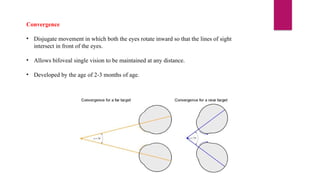
Convergence
• Disjugate movement in which both the eyes rotate inward so that the lines of sight
intersect in front of the eyes.
• Allows bifoveal single vision to be maintained at any distance.
• Developed by the age of 2-3 months of age.
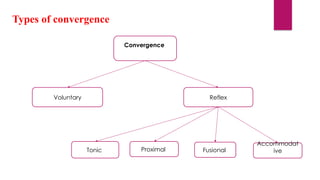
Convergence
Voluntary Reflex
Tonic Proximal Fusional
Accommodat
ive
Types of convergence
Tonic convergence
 Results from the inherent tone of the EOM
 Independent of fusion or object proximity
 Most prominent in childhood and decreases with age
 Emotional energy level may affect the tonic convergence
 Disappears under deep general anesthesia
Fusional convergence
 Also called Positive fusional convergence.
 Ensure that similar retinal images are projected on to the corresponding retinal areas.
 Occurs without a change in refractive state of the eye
 Initiated by a bitemporal retinal image disparity.
 The normal fusional convergence amplitude for distance is about 18 D and for near it is 35 D.
 Fusional convergence helps to control exo-phoria (latent divergent squint).
 The fusional convergence may be decreased by fatigue or illness, converting a phoria into a tropia.
 The amplitude of fusional convergence can be improved by orthoptic exercises.
Accommodative convergence
 Occurs when the eyes accommodate or when a nerve impulse to accommodate is discharged to the
eyes. Thus, the stimulus for accommodative convergence is blurred retinal images rather than the
retinal disparity that stimulates fusional conver-gence.
 The accommodative convergence is a part of the triad of synkinetic near reflex complex - other two
components of this nerve synkinesis being accommodation and miosis.
 The quantitative relationship between the accommodative convergence and accommodation is
expressed as the accommodative convergence/ accommodation (AC/A) ratio.
Proximal convergence
 This component of reflex convergence is induced by the proximitof the object of regard or the
awareness of the proximity of a near object.
 appears to be initiated by psychological factors, since it occurs also when a subject just believes
that he or she is looking at a near object, although he or she actually is not.
 For example, while using the haploscope optically set at infinity, proximal convergence is often
induced.
 There exists a linear inverse relationship between proximal convergence and the changes in
fixation distance.
Near Point of Convergence (NPC)
• NPC is closer than the near point of accommodation (NPA).
• Closest point where an object can be seen singly with bifoveal vision.
• Normally less than 8 cm.Far
Point of Convergence
• Relative position of the eyes when completely at rest.
• Typically at infinity.
• Eyes may be slightly divergent at rest, causing the far point of convergence to be negative (behind the
eyes).
Range of Convergence
The distance between the far point of convergence and the NPC.
Amplitude of Convergence
The difference in convergence power required to maintain the eyes in their position of test versus their maximum
convergence position.
ANOMALIES OF CONVERGENCE
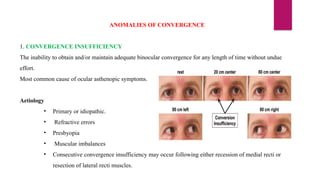
1. CONVERGENCE INSUFFICIENCY
The inability to obtain and/or maintain adequate binocular convergence for any length of time without undue
effort.
Most common cause of ocular asthenopic symptoms.
Aetiology
• Primary or idiopathic.
• Refractive errors
• Presbyopia
• Muscular imbalances
• Consecutive convergence insufficiency may occur following either recession of medial recti or
resection of lateral recti muscles.
Clinical Features
1. Symptoms of Muscular Fatigue
Continuous use of neuromuscular power, especially noticeable with near work.
Common complaints
• Eyestrain and tension around the eyes.
• Headache and eye ache after prolonged near work, relieved by resting the eyes.
• Some patients may experience migraines.
• Difficulty shifting focus between distant and near objects.
• Itching, burning, soreness of the eyes, and nasal conjunctival redness after prolonged close work.
2. Symptoms Due to Failure to Maintain Binocular Vision
• Blurred near vision and crowding of words while reading.
• Intermittent crossed diplopia (double vision) during near work under fatigue.
• A common coping mechanism is closing or covering one eye while reading to relieve visual strain.
Diagnosis of Convergence Insufficiency
1. Remote NPC: NPC greater than 10 cm from baseline.
2. Decreased Fusional Convergence: Difficulty attaining 30° of convergence on synoptophore;
fusional convergence less than 15-20 at near.
3. Prism Convergence: Low prism convergence with normal prism divergence.
4. Exophoria at Near: May show exophoria at near with orthophoria at distance.
Measure exodeviation in all gaze positions, especially downgaze.
5. Normal NPA: NPA corresponds to age, ruling out combined convergence and accommodation
insufficiency. Rarely, accommodative spasm can occur.
Differential Diagnosis:
1.Convergence Insufficiency vs. Convergence Paralysis:
• Convergence paralysis: Total inability to overcome BO prism; pupillary constriction without
convergence.
• Convergence insufficiency: Pupillary constriction followed by dilation when convergence fails.
2.Convergence Insufficiency vs. Accommodative Effort Syndrome:
• Convergence insufficiency: Exophoria at near, -3 D test helps, plus lenses worsen.
• Accommodative effort syndrome: Esophoria at near, -3 D test fails, plus lenses improve.
Treatment
1. Optical treatment
Proper refraction should be carried out and correct glasses should be prescribed for any associated refractive error.
2. Ortho-optic treatment
First documented by Von Graele in 1855
Aim to improve the binocular convergence and to increase the amplitude of fusional convergence.
a. Exercise to improve NPC
• Advancement exercises
• Jump convergence exercises
b. Exercise to increase Amplitude of Fusional Convergence
• Convergence exercises with prism
• Convergence exercises using synaptophore
• Exercises using convergence card
• Computer-based convergence exercises
• Convergence exercises using diploscope
c. Training of voluntary convergences
d. Relaxation exercises
• Divergence exercises on synaptophore
• Divergence exercises with prism
3. Prismotherapy
• BI prisms reading glasses or bifocals with prism in the lower segment are useful as relieving prisms.
• Releiving prisms and bifocals should be avoided in younger patients.
4. Surgical treatment
2. CONVERGENCE INSUFFICIENCYASSOCIATED WITH ACCOMMODATIVE INSUFFICIENCY
Convergence insufficiency in some patients may be secondary to accommodation insufficiency. Therefore, before
treating the patient for a functional convergence insufficiency, it is important to rule out associated accommodation
insufficiency.
Aetiology
Secondary convergence insufficiency associated with primary accommodation insufficiency has been reported
to occur in following conditions:
1. Early Adie syndrome
2. Sequelae to head trauma, particularly posterior occipital or whiplash injury,
3. Subclinical viral encephalopathies,
4. Infectious mononucleosis,
5. Diphtheria and
6. As a conversion reaction
Clinical Features
1. Symptoms of the patients are similar to those of functional
convergence insufficiency.
2. NPC is reduced
3. NPA is reduced drastically
4. AC/A ratio may be low or even absent.
Treatment
1.Orthoptic Exercises
Exercises alone are usually not very effective. They should be combined with reading glasses for best results.
Reading Glasses
• Plus lenses for reading combined with base-in (BI) prism are the preferred treatment.
• The prescription should be adjusted based on the patient's needs, using the minimal power
necessary for comfortable vision.
• Fresnel membrane prisms can be attached to bifocal lenses for flexibility, as frequent changes
may be needed before final adjustment.
2.Surgery
Surgery is rarely indicated but may involve medial rectus resection, followed by bifocal prescriptions in
untreatable cases
3. CONVERGENCE PARALYSIS
• Total inability to overcome base-out (BO) prisms.
• Rare condition, different from the more common functional convergence insufficiency.
Aetiology:
 Secondary to organic brain diseases in the corpora quadrigemina or third cranial
nerve nucleus.
 Associated conditions include:
• Head injury
• Encephalitis
• Multiple sclerosis
• Tabes dorsalis
• Narcolepsy
• Brain tumors
Clinical Features
• Complete absence of convergence with sudden onset.
• Exotropia and crossed diplopia only during near fixation.
• Normal adduction.
• Normal accommodation, though it may be reduced in some cases.
• Parinaud syndrome: Convergence paralysis with vertical gaze paralysis.
• Pretectum-Posterior Commissure Syndrome (dorsal midbrain syndrome) may include:
a. Convergence paralysis
b. Vertical gaze paralysis
c. Light-near dissociation of pupils
d. Sometimes bilateral fourth nerve palsy
e. Lid retraction
Diagnosis (Bielschowsky's Criteria):
1. Evidence of intracranial disease.
2. Sudden onset of crossed diplopia at near.
3. Consistent findings on repeat examinations.
4. Normal accommodation and pupillary reaction during convergence attempts.
Differential Diagnosis:
Differentiate from functional convergence insufficiency with BO prisms:
• Convergence paralysis: Immediate diplopia with BO prism.
• Convergence insufficiency: Some convergence amplitude can be demonstrated.
Treatment:
1.Base-in (BI) prisms at near to reduce diplopia.
2.Plus lenses with BI prisms for patients with accommodative weakness.
3.Occlusion of one eye for those unable to achieve comfortable binocular vision.
4.Eye muscle surgery is contraindicated
4. CONVERGENCE SPASM
Convergence spasm refers to a condition characterized by
intermittent episodes of maximal convergence usually
associated with spasm of accommodation.
Aetiology
• Functional Causes: Most cases are due to hysteria or
neurosis.
• Organic Causes: Rarely caused by head trauma,
encephalitis, pituitary adenomas, posterior fossa
neurofibroma, Arnold-Chiari malformation.
Clinical Features:
 Episodic in nature, with patients being normal between episodes.
 During an episode, the following features may be seen:
• Extreme Convergence.
• Homonymous Diplopia: Intermittent double vision.
• Blurred Vision: Especially for near tasks, due to spasm of accommodation, causing difficulty in
reading.
• Miosis: Pupils become constricted as part of the near reflex.
• Induced Myopia: Up to 6 D of myopia (confirmed by retinoscopy) and reduced distance visual acuity.
 A psychiatric evaluation may reveal underlying hysteria or neurosis.
Management:
 Neurological Evaluation: To rule out rare organic causes.
 Treatment:
• Prolonged atropinization with plus lenses in the lower segment of bifocals for near tasks.
• Alternate monocular occlusion as an alternative to atropinization.
• Psychiatric work-up and therapy for underlying functional causes.
Convergence and it’s anomalies PRESENTATION

Convergence and it’s anomalies PRESENTATION

  • 1.
  • 2.
    Convergence • Disjugate movementin which both the eyes rotate inward so that the lines of sight intersect in front of the eyes. • Allows bifoveal single vision to be maintained at any distance. • Developed by the age of 2-3 months of age.
  • 3.
    Convergence Voluntary Reflex Tonic ProximalFusional Accommodat ive Types of convergence
  • 4.
    Tonic convergence  Resultsfrom the inherent tone of the EOM  Independent of fusion or object proximity  Most prominent in childhood and decreases with age  Emotional energy level may affect the tonic convergence  Disappears under deep general anesthesia
  • 5.
    Fusional convergence  Alsocalled Positive fusional convergence.  Ensure that similar retinal images are projected on to the corresponding retinal areas.  Occurs without a change in refractive state of the eye  Initiated by a bitemporal retinal image disparity.  The normal fusional convergence amplitude for distance is about 18 D and for near it is 35 D.  Fusional convergence helps to control exo-phoria (latent divergent squint).  The fusional convergence may be decreased by fatigue or illness, converting a phoria into a tropia.  The amplitude of fusional convergence can be improved by orthoptic exercises.
  • 6.
    Accommodative convergence  Occurswhen the eyes accommodate or when a nerve impulse to accommodate is discharged to the eyes. Thus, the stimulus for accommodative convergence is blurred retinal images rather than the retinal disparity that stimulates fusional conver-gence.  The accommodative convergence is a part of the triad of synkinetic near reflex complex - other two components of this nerve synkinesis being accommodation and miosis.  The quantitative relationship between the accommodative convergence and accommodation is expressed as the accommodative convergence/ accommodation (AC/A) ratio.
  • 7.
    Proximal convergence  Thiscomponent of reflex convergence is induced by the proximitof the object of regard or the awareness of the proximity of a near object.  appears to be initiated by psychological factors, since it occurs also when a subject just believes that he or she is looking at a near object, although he or she actually is not.  For example, while using the haploscope optically set at infinity, proximal convergence is often induced.  There exists a linear inverse relationship between proximal convergence and the changes in fixation distance.
  • 8.
    Near Point ofConvergence (NPC) • NPC is closer than the near point of accommodation (NPA). • Closest point where an object can be seen singly with bifoveal vision. • Normally less than 8 cm.Far Point of Convergence • Relative position of the eyes when completely at rest. • Typically at infinity. • Eyes may be slightly divergent at rest, causing the far point of convergence to be negative (behind the eyes). Range of Convergence The distance between the far point of convergence and the NPC. Amplitude of Convergence The difference in convergence power required to maintain the eyes in their position of test versus their maximum convergence position.
  • 9.
    ANOMALIES OF CONVERGENCE 1.CONVERGENCE INSUFFICIENCY The inability to obtain and/or maintain adequate binocular convergence for any length of time without undue effort. Most common cause of ocular asthenopic symptoms. Aetiology • Primary or idiopathic. • Refractive errors • Presbyopia • Muscular imbalances • Consecutive convergence insufficiency may occur following either recession of medial recti or resection of lateral recti muscles.
  • 10.
    Clinical Features 1. Symptomsof Muscular Fatigue Continuous use of neuromuscular power, especially noticeable with near work. Common complaints • Eyestrain and tension around the eyes. • Headache and eye ache after prolonged near work, relieved by resting the eyes. • Some patients may experience migraines. • Difficulty shifting focus between distant and near objects. • Itching, burning, soreness of the eyes, and nasal conjunctival redness after prolonged close work. 2. Symptoms Due to Failure to Maintain Binocular Vision • Blurred near vision and crowding of words while reading. • Intermittent crossed diplopia (double vision) during near work under fatigue. • A common coping mechanism is closing or covering one eye while reading to relieve visual strain.
  • 11.
    Diagnosis of ConvergenceInsufficiency 1. Remote NPC: NPC greater than 10 cm from baseline. 2. Decreased Fusional Convergence: Difficulty attaining 30° of convergence on synoptophore; fusional convergence less than 15-20 at near. 3. Prism Convergence: Low prism convergence with normal prism divergence. 4. Exophoria at Near: May show exophoria at near with orthophoria at distance. Measure exodeviation in all gaze positions, especially downgaze. 5. Normal NPA: NPA corresponds to age, ruling out combined convergence and accommodation insufficiency. Rarely, accommodative spasm can occur.
  • 12.
    Differential Diagnosis: 1.Convergence Insufficiencyvs. Convergence Paralysis: • Convergence paralysis: Total inability to overcome BO prism; pupillary constriction without convergence. • Convergence insufficiency: Pupillary constriction followed by dilation when convergence fails. 2.Convergence Insufficiency vs. Accommodative Effort Syndrome: • Convergence insufficiency: Exophoria at near, -3 D test helps, plus lenses worsen. • Accommodative effort syndrome: Esophoria at near, -3 D test fails, plus lenses improve.
  • 13.
    Treatment 1. Optical treatment Properrefraction should be carried out and correct glasses should be prescribed for any associated refractive error. 2. Ortho-optic treatment First documented by Von Graele in 1855 Aim to improve the binocular convergence and to increase the amplitude of fusional convergence. a. Exercise to improve NPC • Advancement exercises • Jump convergence exercises b. Exercise to increase Amplitude of Fusional Convergence • Convergence exercises with prism • Convergence exercises using synaptophore • Exercises using convergence card • Computer-based convergence exercises • Convergence exercises using diploscope
  • 15.
    c. Training ofvoluntary convergences d. Relaxation exercises • Divergence exercises on synaptophore • Divergence exercises with prism 3. Prismotherapy • BI prisms reading glasses or bifocals with prism in the lower segment are useful as relieving prisms. • Releiving prisms and bifocals should be avoided in younger patients. 4. Surgical treatment
  • 16.
    2. CONVERGENCE INSUFFICIENCYASSOCIATEDWITH ACCOMMODATIVE INSUFFICIENCY Convergence insufficiency in some patients may be secondary to accommodation insufficiency. Therefore, before treating the patient for a functional convergence insufficiency, it is important to rule out associated accommodation insufficiency. Aetiology Secondary convergence insufficiency associated with primary accommodation insufficiency has been reported to occur in following conditions: 1. Early Adie syndrome 2. Sequelae to head trauma, particularly posterior occipital or whiplash injury, 3. Subclinical viral encephalopathies, 4. Infectious mononucleosis, 5. Diphtheria and 6. As a conversion reaction
  • 17.
    Clinical Features 1. Symptomsof the patients are similar to those of functional convergence insufficiency. 2. NPC is reduced 3. NPA is reduced drastically 4. AC/A ratio may be low or even absent.
  • 18.
    Treatment 1.Orthoptic Exercises Exercises aloneare usually not very effective. They should be combined with reading glasses for best results. Reading Glasses • Plus lenses for reading combined with base-in (BI) prism are the preferred treatment. • The prescription should be adjusted based on the patient's needs, using the minimal power necessary for comfortable vision. • Fresnel membrane prisms can be attached to bifocal lenses for flexibility, as frequent changes may be needed before final adjustment. 2.Surgery Surgery is rarely indicated but may involve medial rectus resection, followed by bifocal prescriptions in untreatable cases
  • 19.
    3. CONVERGENCE PARALYSIS •Total inability to overcome base-out (BO) prisms. • Rare condition, different from the more common functional convergence insufficiency. Aetiology:  Secondary to organic brain diseases in the corpora quadrigemina or third cranial nerve nucleus.  Associated conditions include: • Head injury • Encephalitis • Multiple sclerosis • Tabes dorsalis • Narcolepsy • Brain tumors
  • 20.
    Clinical Features • Completeabsence of convergence with sudden onset. • Exotropia and crossed diplopia only during near fixation. • Normal adduction. • Normal accommodation, though it may be reduced in some cases. • Parinaud syndrome: Convergence paralysis with vertical gaze paralysis. • Pretectum-Posterior Commissure Syndrome (dorsal midbrain syndrome) may include: a. Convergence paralysis b. Vertical gaze paralysis c. Light-near dissociation of pupils d. Sometimes bilateral fourth nerve palsy e. Lid retraction
  • 21.
    Diagnosis (Bielschowsky's Criteria): 1.Evidence of intracranial disease. 2. Sudden onset of crossed diplopia at near. 3. Consistent findings on repeat examinations. 4. Normal accommodation and pupillary reaction during convergence attempts. Differential Diagnosis: Differentiate from functional convergence insufficiency with BO prisms: • Convergence paralysis: Immediate diplopia with BO prism. • Convergence insufficiency: Some convergence amplitude can be demonstrated.
  • 22.
    Treatment: 1.Base-in (BI) prismsat near to reduce diplopia. 2.Plus lenses with BI prisms for patients with accommodative weakness. 3.Occlusion of one eye for those unable to achieve comfortable binocular vision. 4.Eye muscle surgery is contraindicated
  • 23.
    4. CONVERGENCE SPASM Convergencespasm refers to a condition characterized by intermittent episodes of maximal convergence usually associated with spasm of accommodation. Aetiology • Functional Causes: Most cases are due to hysteria or neurosis. • Organic Causes: Rarely caused by head trauma, encephalitis, pituitary adenomas, posterior fossa neurofibroma, Arnold-Chiari malformation.
  • 24.
    Clinical Features:  Episodicin nature, with patients being normal between episodes.  During an episode, the following features may be seen: • Extreme Convergence. • Homonymous Diplopia: Intermittent double vision. • Blurred Vision: Especially for near tasks, due to spasm of accommodation, causing difficulty in reading. • Miosis: Pupils become constricted as part of the near reflex. • Induced Myopia: Up to 6 D of myopia (confirmed by retinoscopy) and reduced distance visual acuity.  A psychiatric evaluation may reveal underlying hysteria or neurosis.
  • 25.
    Management:  Neurological Evaluation:To rule out rare organic causes.  Treatment: • Prolonged atropinization with plus lenses in the lower segment of bifocals for near tasks. • Alternate monocular occlusion as an alternative to atropinization. • Psychiatric work-up and therapy for underlying functional causes.