Variables:
Types and Operational Definitions
Rabindra Adhikary
ravinems@iom.edu.np
M. Optom, 1st Batch (2019)
Tilganga Institute of Ophthalmology
Pokhara University
Facilitator: Mohan Krishna Shrestha, TIO Date: 13 June 2019
Main Topic: Unit III: Problem identification formulation of research objectives
and hypothesis (as part of M.Optom Curriculum of Pokhara University, Nepal)
variables
• Learning Objectives:
– Define and explain variables
– Define and explain the operational definitions of
variables with example
What is a variable
• Image, perception or a concept
– Which is measurable (Measurability)
– Whose value is variable (Variability)
• Key to Quantitative research
• Provides rational ground (after analysis) to
come to a conclusion
Kerlinger:
• ‘A variable is a property that takes on different
values. Putting it redundantly, a variable is
something that varies ... A variable is a symbol
to which numerals or values are attached’
(1986)
• Black and Champion define a variable as
‘rational units of analysis that can assume any
one of a number of designated sets of values’
(1976)
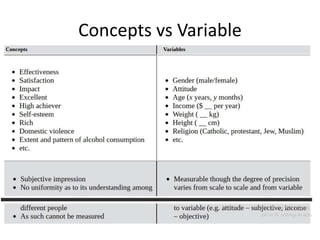
Concepts vs Variable
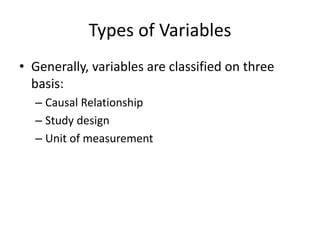
Types of Variables
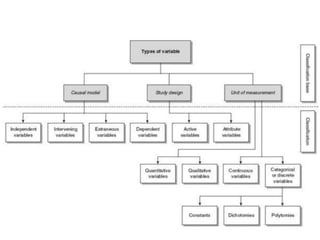
• Generally, variables are classified on three
basis:
– Causal Relationship
– Study design
– Unit of measurement
Casual Relationship
• Change variable (Independent)
– Brings about change in the phenomenon or situation
under observation
• Outcome variable (Dependent)
– Effects or consequences of change variables
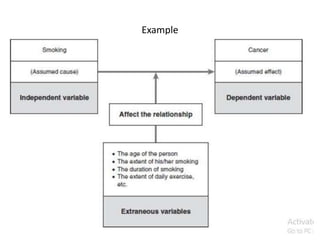
• Influencing variable (Extraneous)
– Influences or affects the link between cause-and-
effect variables
• Linking Variable (Intervening)
– Necessary to complete the relationship between
cause and effect variables
• Intervening variables, also called confounding
variables because it links the independent and
independent variables
– What was the actual cause?
• Necessary to establish the link between
dependent and independent variables
Types of variables in causal
relationship
Example
Variables
from the viewpoint of study design
• Active Variables
– Can be controlled, changed or manipulated
– Contents, structure, testability
• Attribute variables
– Can’t be manipulated, changed or controlled
– Age, weight, gender, etc
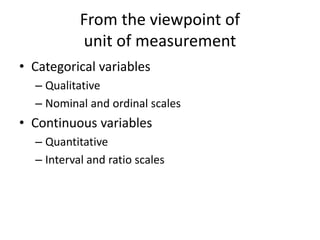
From the viewpoint of
unit of measurement
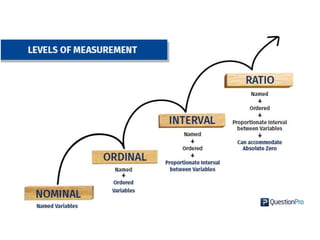
• Categorical variables
– Qualitative
– Nominal and ordinal scales
• Continuous variables
– Quantitative
– Interval and ratio scales
Video 1
Video 2
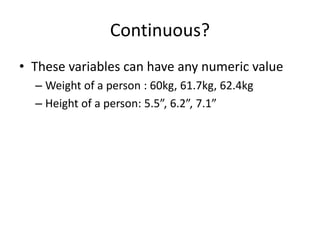
Continuous?
• These variables can have any numeric value
– Weight of a person : 60kg, 61.7kg, 62.4kg
– Height of a person: 5.5”, 6.2”, 7.1”
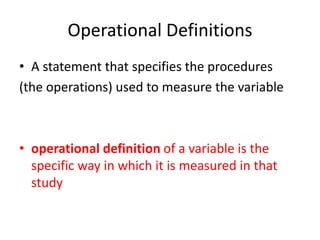
Operational Definitions
• A statement that specifies the procedures
(the operations) used to measure the variable
• operational definition of a variable is the
specific way in which it is measured in that
study
Example
• Intelligence
– Use 5 min
– Execute task
??
• Physical Attractiveness
• Depression
(ask questions to the audience to set the
operational definitions of these variables)
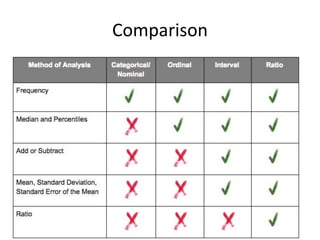
Comparison
Thank You

Variables: Types and Operational Definitions

  • 1.
    Variables: Types and OperationalDefinitions Rabindra Adhikary ravinems@iom.edu.np M. Optom, 1st Batch (2019) Tilganga Institute of Ophthalmology Pokhara University Facilitator: Mohan Krishna Shrestha, TIO Date: 13 June 2019 Main Topic: Unit III: Problem identification formulation of research objectives and hypothesis (as part of M.Optom Curriculum of Pokhara University, Nepal)
  • 2.
    variables • Learning Objectives: –Define and explain variables – Define and explain the operational definitions of variables with example
  • 3.
    What is avariable • Image, perception or a concept – Which is measurable (Measurability) – Whose value is variable (Variability) • Key to Quantitative research • Provides rational ground (after analysis) to come to a conclusion
  • 4.
    Kerlinger: • ‘A variableis a property that takes on different values. Putting it redundantly, a variable is something that varies ... A variable is a symbol to which numerals or values are attached’ (1986)
  • 5.
    • Black andChampion define a variable as ‘rational units of analysis that can assume any one of a number of designated sets of values’ (1976)
  • 6.
  • 7.
    Types of Variables •Generally, variables are classified on three basis: – Causal Relationship – Study design – Unit of measurement
  • 9.
    Casual Relationship • Changevariable (Independent) – Brings about change in the phenomenon or situation under observation • Outcome variable (Dependent) – Effects or consequences of change variables • Influencing variable (Extraneous) – Influences or affects the link between cause-and- effect variables • Linking Variable (Intervening) – Necessary to complete the relationship between cause and effect variables
  • 10.
    • Intervening variables,also called confounding variables because it links the independent and independent variables – What was the actual cause? • Necessary to establish the link between dependent and independent variables
  • 11.
    Types of variablesin causal relationship
  • 12.
  • 13.
    Variables from the viewpointof study design • Active Variables – Can be controlled, changed or manipulated – Contents, structure, testability • Attribute variables – Can’t be manipulated, changed or controlled – Age, weight, gender, etc
  • 14.
    From the viewpointof unit of measurement • Categorical variables – Qualitative – Nominal and ordinal scales • Continuous variables – Quantitative – Interval and ratio scales
  • 15.
  • 16.
  • 17.
    Continuous? • These variablescan have any numeric value – Weight of a person : 60kg, 61.7kg, 62.4kg – Height of a person: 5.5”, 6.2”, 7.1”
  • 18.
    Operational Definitions • Astatement that specifies the procedures (the operations) used to measure the variable • operational definition of a variable is the specific way in which it is measured in that study
  • 19.
    Example • Intelligence – Use5 min – Execute task
  • 20.
    ?? • Physical Attractiveness •Depression (ask questions to the audience to set the operational definitions of these variables)
  • 22.
  • 23.