Accommodation:
measurement & its
anomalies
2
 the process by which the crystalline
lens changes its power
Definition
3
Accommodation
Near Object -- Accommodation
Object at Infinity --No Accommodation
4
 Training (somewhat dependent)
 Age (highly dependent)
The amount of accommodation
available depends upon
5
 Accommodation is mediated by
parasympathetic stimulation of
the ciliary body under the innervation
of the IIIrd cranial or oculomotor
nerve, arising in the midbrain.
Physiology of
Accommodation
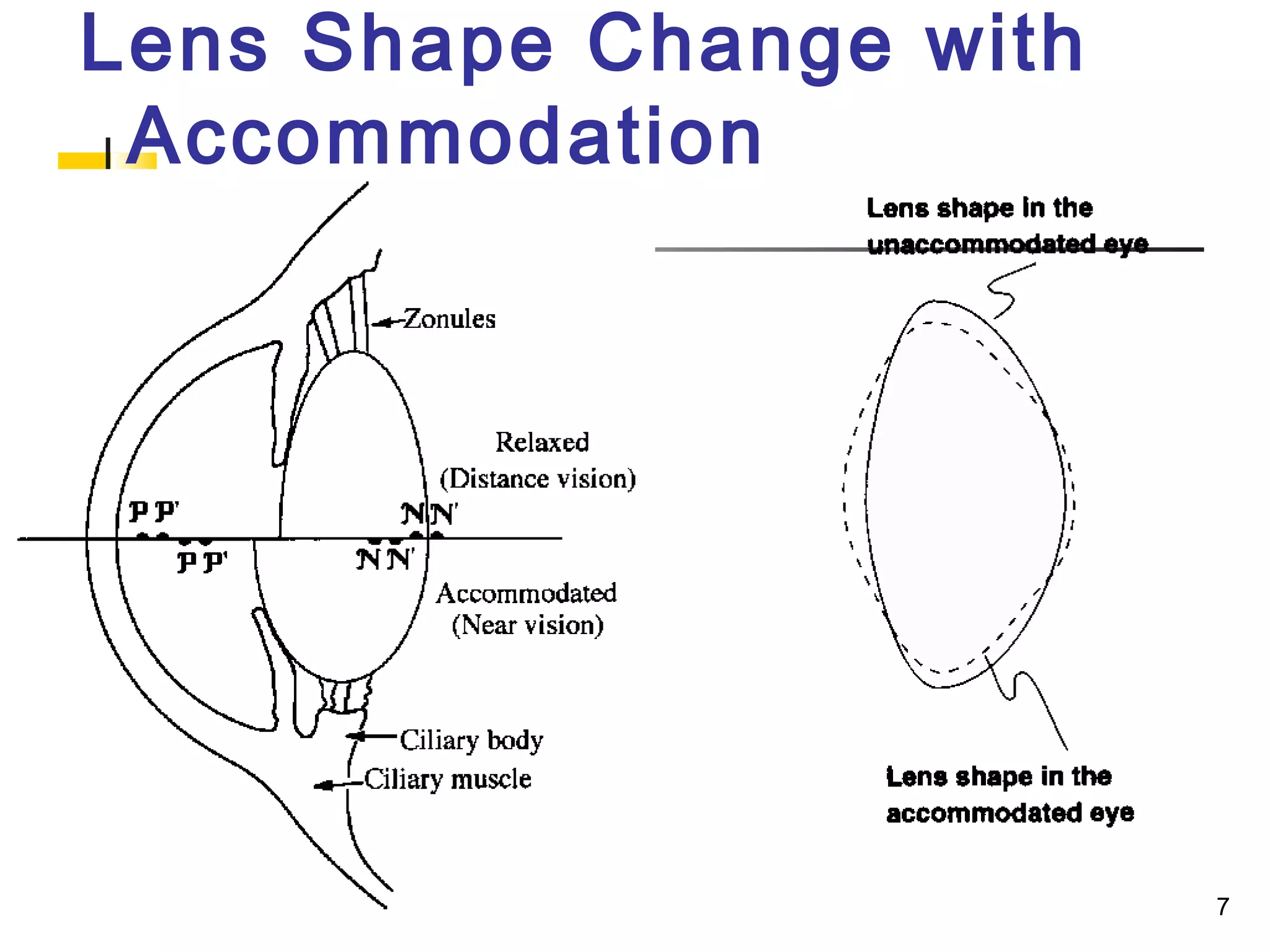
7
Lens Shape Change with
Accommodation
Effective Stimuli for
Accommodation
Retinal Blur
• Accommodation occurs to improve the contrast
and clarity of the retinal image
:optical reflex accommodation
Components of
Accommodation
1. Tonic Accommodation
2. Convergence Accommodation
3. Proximal Accommodation
4. Reflex Accommodation
5. Voluntary Accommodation
10
 The resting state of accommodation
 The amount of accommodation present in the
absence of a stimulus due to ciliary muscle
tone as a result of low degree of neural
activity
 In youth this is about 1 to 2 D

reduces with age
Tonic accommodation
11
 amount of accommodation
stimulated by convergence
Convergence
Accommodation
12
 The reaction time for
convergence is about 0.2 s,
almost twice as fast as that for
accommodation
 accommodation lags behind and
takes its cue from convergence.
Lag Time
Measurement of AC/A
 Calculation method (Heterophoria
method)
 AC/A = PD + n+ d / D
 Where, D = testing distance
 Gradient method
 AC/A = n+ d / D
 Where, D = Power of the lens
 Graphical method
 Normal Value: 4/1 to 6/1
15
 The amount of accommodation induced by
the subject's awareness of the proximity of
an object.
 In instruments such as autorefractors, it
interferes with the objective measurement of
refractive error
 Autorefractors tend to give readings

overcorrections for myopia

undercorrections for hyperopia.
Proximal accommodation
16
 The normal involuntary response
to blur which maintains a clear
image
Reflex accommodation
18
 When there is no visual input to stimulate
accommodation, accommodation does not
go to a zero level as one might expect, but
rather to an intermediate level
 in dense fog or a clear blue sky
experienced by pilots at high altitudes
 Between 1 D and 2 D of myopia develops
within ten seconds of viewing an empty
field – empty field or space myopia
Other types:
Empty Field Accommodation
19
 occurs in darkness
 The dark focus of accommodation is
responsible for night myopia, in which
the eye tends to accommodate too
much for a given object distance when
lighting levels are low
 One study found a mean dark focus of
1.52 D (SD = 0.77)
Other types:
Dark Focus of Accommodation
20
 A full clinical examination
 includes assessment of accommodative
function in four parameters

amplitude of accommodation

lag of accommodation

accommodative facility

relative accommodation
Clinical Measurement of
Accommodation
21
 The maximum amount by which the eye
can change its power
 The dioptric difference between the
punctum proximum and the punctum
remotum
 e.g:

if the far point is 50 cm in front of the spectacle
plane and the punctum proximum is 8 cm in front of
it, the amplitude is:
 Ans:
 AA = (1/kpr
)-(1/kpp
) = (1/-0.5m)-(1/-0.08m)
= +10.5D
Amplitude of
Accommodation
23
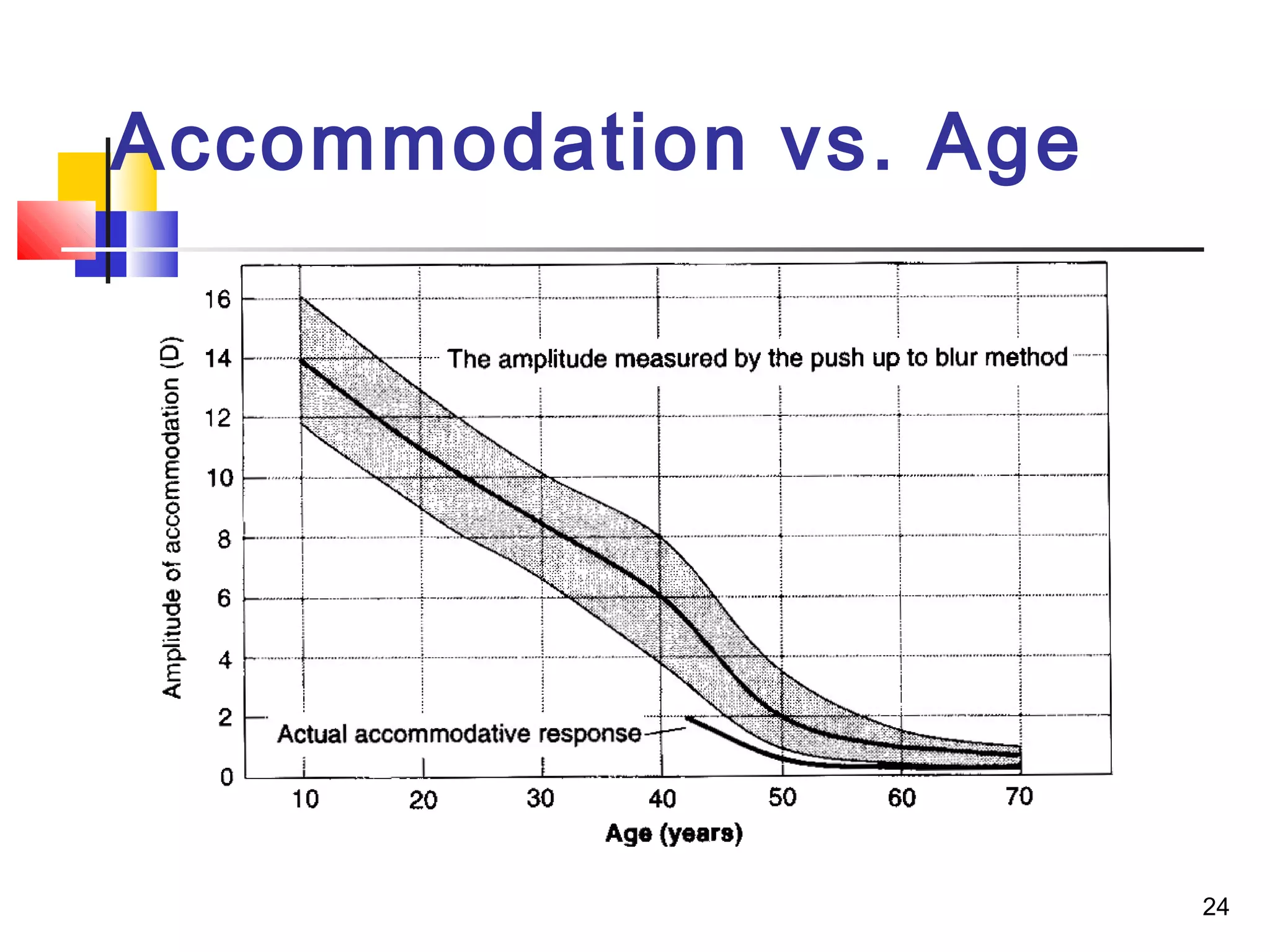
 The amplitude of accommodation
declines throughout life until at about
50 or 60 years of age when it becomes
zero
Amplitude of
Accommodation
24
Accommodation vs. Age
25
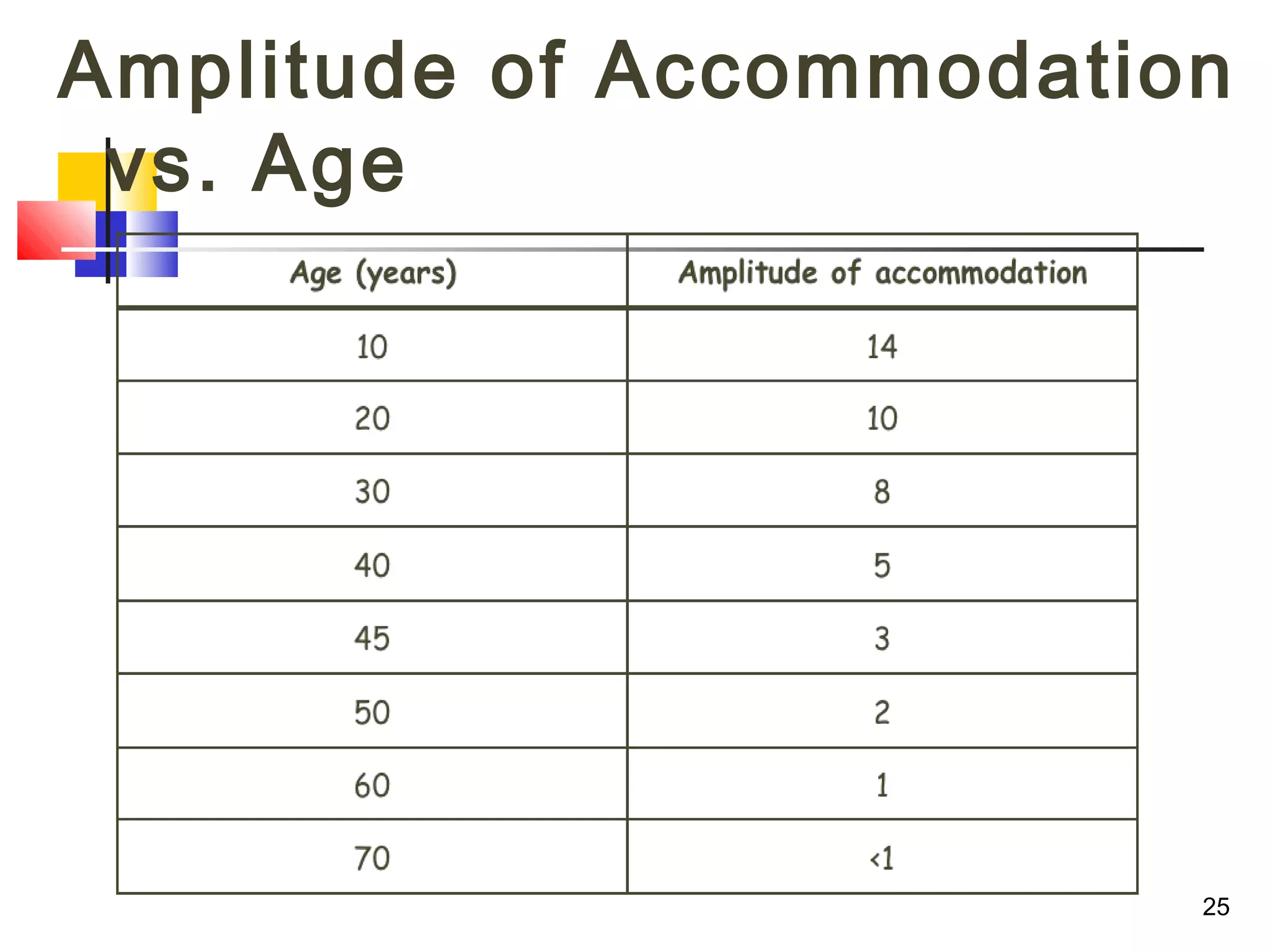
Amplitude of Accommodation
vs. Age
26
Amplitude of
Accommodation vs. Age
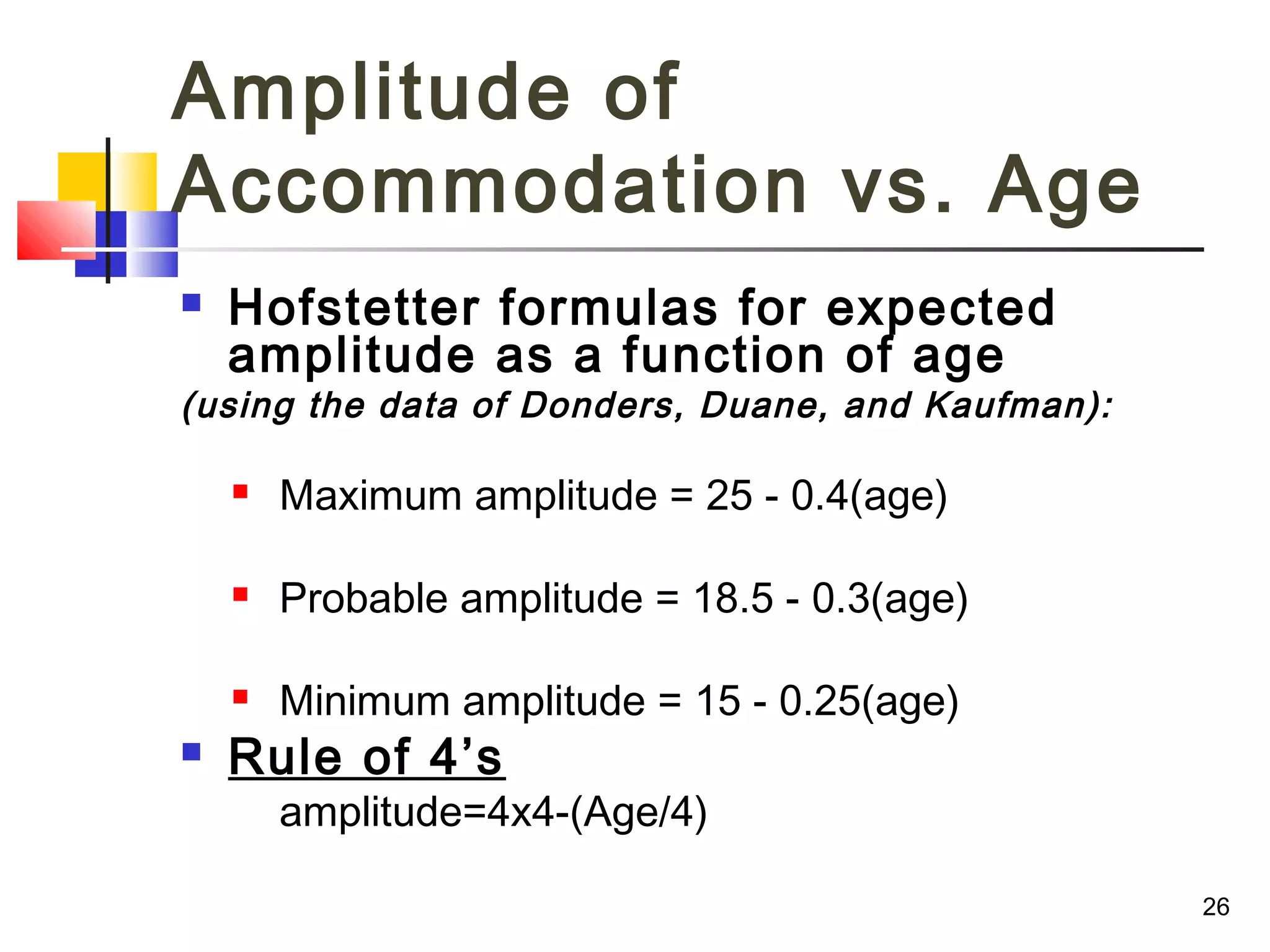
 Hofstetter formulas for expected
amplitude as a function of age
(using the data of Donders, Duane, and Kaufman):
 Maximum amplitude = 25 - 0.4(age)
 Probable amplitude = 18.5 - 0.3(age)
 Minimum amplitude = 15 - 0.25(age)
 Rule of 4’s
amplitude=4x4-(Age/4)
27
 Lag of accommodation can be assessed
clinically
 Dynamic retinoscopy
 near bichrome test
 the near cross cylinder test
 Normal Lag: +0.50 or +0.75 diopters
 High Lag: +1.00 diopters or higher
 Decreased Lag: +0.25 diopters or less
Lag of Accommodation
Anomalies of
Accommodation
 Accommodation Insufficiency
 Accommodation Infacility
 Accommodative Fatigue
 Latent Hyperopia
 Accommodative Spasm
(Pseudomyopia)
 Presbyopia (? Physiological
conditions)
Accommodation
Insufficiency
 Accommodative response is
significantly less than accommodative
stimulus
 Symptoms:
 Blur & asthenopia
 Feature
 Inability to clear minus lens
Accommodation
Insufficiency
 Causes:
 Drug: alcohol, Cycloplegics, CNS
stimulants, marijuana, antihistamines
 Ocular diseases: Glaucoma, Iris sphincter
tear, trauma, Adie’s syndrome, Horner
syndrome, Herpes Zoster
 Diabetes, sinusitis, multiple sclerosis,
dental caries, tonsillitis, Wilson disease
 Arsenic/ lead poisoning
Accommodation
Insufficiency
 Management:
 Correct refractive error : small hyperopia/
astigmatism
 Near add: NRA + PRA/ 2 or
accommodative lag value
 Vision training

Lens rock with +/- flippers

Brock string (Jump vergence)
Accommodation Infacility
 Slow or difficult accommodative response
to dioptric change in stimulus
 Symptoms
 Inability to change focus from near to distance & vice
versa
 Asthenopia
 Feature:
 Fail miserably when trying to clear plus &
minus lenses (flippers) < 8 cycles per minute
Accommodation Infacility
Management
 Spectacle correction
 Near add:
 Due to Low NRA & PRA won’t benefit
 Vision therapy:
 Flippers
 Brock string (Jump vergence)
Accommodative Fatigue
 Inability of the eye to adequately
sustain sufficient accommodation
over an extended time period.
 Symptoms:
 Blurring of near vision after some
time, and inability to focus again
 Asthenopia
 Feature:
 Difficulty to clear plus lenses
Accommodative Fatigue
 Management
 Spectacle correction
 Near add:

Benefit with plus lens
 Vision therapy:
 Flippers
 Brock string (Jump vergence)
Latent Hyperopia
 Portion of total hyperopia compensated
by accommodation (tonicity of the
ciliary muscle
 Symptoms:
 Inability to do near work for long (focusing
problem)
 Asthenopia
 Need to do cyclorefraction
 Correct refractive error : small hyperopia/
astigmatism
Accommodative Spasm
(Pseudomyopia)
 Due to ciliary muscle spasm, inability of
the eye to relax accommodation
 Results in pseudomyopia
 Symptoms
 Typical myopic complain (distance blur)
 Frontal headache (asthenopia)
 Poor response to all the tests which
need to relax accommodation (unable
to clear plus lens)
Accommodative Spasm
(Pseudomyopia)
 Management:
 Spectacle correction: cycloplegic refraction
 Correction of small hyperopia/ astigmatism
 Minus lens for distance blur will compound
the problem
44
 The blur during near vision resulting
from the normal decrease in amplitude
of accommodation with age
 sometimes quantitatively defined as
an amplitude of accommodation less
than 5 D, which is the point at which
many patients become symptomatic
 This usually occurs at about 40 or 45
years of age
Presbyopia
45
 Presbyopia that has advanced to
the point that the ability to
accommodate is completely
absent is known as absolute
presbyopia
 Absolute presbyopia is reached
between 50 and 60 years of age
Absolute Presbyopia
46
 The treatment for presbyopia is
the addition of plus power for use
when viewing near objects
 This is usually in the form of
reading glasses, bifocal
spectacles, or multifocal
spectacle lenses.
Treatment for Presbyopia

Accommodation: measurement and its anomalies

  • 1.
  • 2.
    2  the processby which the crystalline lens changes its power Definition
  • 3.
    3 Accommodation Near Object --Accommodation Object at Infinity --No Accommodation
  • 4.
    4  Training (somewhatdependent)  Age (highly dependent) The amount of accommodation available depends upon
  • 5.
    5  Accommodation ismediated by parasympathetic stimulation of the ciliary body under the innervation of the IIIrd cranial or oculomotor nerve, arising in the midbrain. Physiology of Accommodation
  • 7.
    7 Lens Shape Changewith Accommodation
  • 8.
    Effective Stimuli for Accommodation RetinalBlur • Accommodation occurs to improve the contrast and clarity of the retinal image :optical reflex accommodation
  • 9.
    Components of Accommodation 1. TonicAccommodation 2. Convergence Accommodation 3. Proximal Accommodation 4. Reflex Accommodation 5. Voluntary Accommodation
  • 10.
    10  The restingstate of accommodation  The amount of accommodation present in the absence of a stimulus due to ciliary muscle tone as a result of low degree of neural activity  In youth this is about 1 to 2 D  reduces with age Tonic accommodation
  • 11.
    11  amount ofaccommodation stimulated by convergence Convergence Accommodation
  • 12.
    12  The reactiontime for convergence is about 0.2 s, almost twice as fast as that for accommodation  accommodation lags behind and takes its cue from convergence. Lag Time
  • 13.
    Measurement of AC/A Calculation method (Heterophoria method)  AC/A = PD + n+ d / D  Where, D = testing distance  Gradient method  AC/A = n+ d / D  Where, D = Power of the lens  Graphical method  Normal Value: 4/1 to 6/1
  • 14.
    15  The amountof accommodation induced by the subject's awareness of the proximity of an object.  In instruments such as autorefractors, it interferes with the objective measurement of refractive error  Autorefractors tend to give readings  overcorrections for myopia  undercorrections for hyperopia. Proximal accommodation
  • 15.
    16  The normalinvoluntary response to blur which maintains a clear image Reflex accommodation
  • 16.
    18  When thereis no visual input to stimulate accommodation, accommodation does not go to a zero level as one might expect, but rather to an intermediate level  in dense fog or a clear blue sky experienced by pilots at high altitudes  Between 1 D and 2 D of myopia develops within ten seconds of viewing an empty field – empty field or space myopia Other types: Empty Field Accommodation
  • 17.
    19  occurs indarkness  The dark focus of accommodation is responsible for night myopia, in which the eye tends to accommodate too much for a given object distance when lighting levels are low  One study found a mean dark focus of 1.52 D (SD = 0.77) Other types: Dark Focus of Accommodation
  • 18.
    20  A fullclinical examination  includes assessment of accommodative function in four parameters  amplitude of accommodation  lag of accommodation  accommodative facility  relative accommodation Clinical Measurement of Accommodation
  • 19.
    21  The maximumamount by which the eye can change its power  The dioptric difference between the punctum proximum and the punctum remotum  e.g:  if the far point is 50 cm in front of the spectacle plane and the punctum proximum is 8 cm in front of it, the amplitude is:  Ans:  AA = (1/kpr )-(1/kpp ) = (1/-0.5m)-(1/-0.08m) = +10.5D Amplitude of Accommodation
  • 20.
    23  The amplitudeof accommodation declines throughout life until at about 50 or 60 years of age when it becomes zero Amplitude of Accommodation
  • 21.
  • 22.
  • 23.
    26 Amplitude of Accommodation vs.Age  Hofstetter formulas for expected amplitude as a function of age (using the data of Donders, Duane, and Kaufman):  Maximum amplitude = 25 - 0.4(age)  Probable amplitude = 18.5 - 0.3(age)  Minimum amplitude = 15 - 0.25(age)  Rule of 4’s amplitude=4x4-(Age/4)
  • 24.
    27  Lag ofaccommodation can be assessed clinically  Dynamic retinoscopy  near bichrome test  the near cross cylinder test  Normal Lag: +0.50 or +0.75 diopters  High Lag: +1.00 diopters or higher  Decreased Lag: +0.25 diopters or less Lag of Accommodation
  • 25.
    Anomalies of Accommodation  AccommodationInsufficiency  Accommodation Infacility  Accommodative Fatigue  Latent Hyperopia  Accommodative Spasm (Pseudomyopia)  Presbyopia (? Physiological conditions)
  • 26.
    Accommodation Insufficiency  Accommodative responseis significantly less than accommodative stimulus  Symptoms:  Blur & asthenopia  Feature  Inability to clear minus lens
  • 27.
    Accommodation Insufficiency  Causes:  Drug:alcohol, Cycloplegics, CNS stimulants, marijuana, antihistamines  Ocular diseases: Glaucoma, Iris sphincter tear, trauma, Adie’s syndrome, Horner syndrome, Herpes Zoster  Diabetes, sinusitis, multiple sclerosis, dental caries, tonsillitis, Wilson disease  Arsenic/ lead poisoning
  • 28.
    Accommodation Insufficiency  Management:  Correctrefractive error : small hyperopia/ astigmatism  Near add: NRA + PRA/ 2 or accommodative lag value  Vision training  Lens rock with +/- flippers  Brock string (Jump vergence)
  • 29.
    Accommodation Infacility  Slowor difficult accommodative response to dioptric change in stimulus  Symptoms  Inability to change focus from near to distance & vice versa  Asthenopia  Feature:  Fail miserably when trying to clear plus & minus lenses (flippers) < 8 cycles per minute
  • 30.
    Accommodation Infacility Management  Spectaclecorrection  Near add:  Due to Low NRA & PRA won’t benefit  Vision therapy:  Flippers  Brock string (Jump vergence)
  • 31.
    Accommodative Fatigue  Inabilityof the eye to adequately sustain sufficient accommodation over an extended time period.  Symptoms:  Blurring of near vision after some time, and inability to focus again  Asthenopia  Feature:  Difficulty to clear plus lenses
  • 32.
    Accommodative Fatigue  Management Spectacle correction  Near add:  Benefit with plus lens  Vision therapy:  Flippers  Brock string (Jump vergence)
  • 33.
    Latent Hyperopia  Portionof total hyperopia compensated by accommodation (tonicity of the ciliary muscle  Symptoms:  Inability to do near work for long (focusing problem)  Asthenopia  Need to do cyclorefraction  Correct refractive error : small hyperopia/ astigmatism
  • 34.
    Accommodative Spasm (Pseudomyopia)  Dueto ciliary muscle spasm, inability of the eye to relax accommodation  Results in pseudomyopia  Symptoms  Typical myopic complain (distance blur)  Frontal headache (asthenopia)  Poor response to all the tests which need to relax accommodation (unable to clear plus lens)
  • 35.
    Accommodative Spasm (Pseudomyopia)  Management: Spectacle correction: cycloplegic refraction  Correction of small hyperopia/ astigmatism  Minus lens for distance blur will compound the problem
  • 36.
    44  The blurduring near vision resulting from the normal decrease in amplitude of accommodation with age  sometimes quantitatively defined as an amplitude of accommodation less than 5 D, which is the point at which many patients become symptomatic  This usually occurs at about 40 or 45 years of age Presbyopia
  • 37.
    45  Presbyopia thathas advanced to the point that the ability to accommodate is completely absent is known as absolute presbyopia  Absolute presbyopia is reached between 50 and 60 years of age Absolute Presbyopia
  • 38.
    46  The treatmentfor presbyopia is the addition of plus power for use when viewing near objects  This is usually in the form of reading glasses, bifocal spectacles, or multifocal spectacle lenses. Treatment for Presbyopia