Heterophoria
Most binocular anomalies result in the misalignment of the
visual axes.
The fusion reflex maintains correct alignment of the two
eyes.
If this fusion reflex is suspended the eyes will adopt the
‘fusion free’ position and a measurable deviation of the visual
axes will occur in.
The error of alignment that takes place when fusion is
suspended is called heterophoria or phoria.
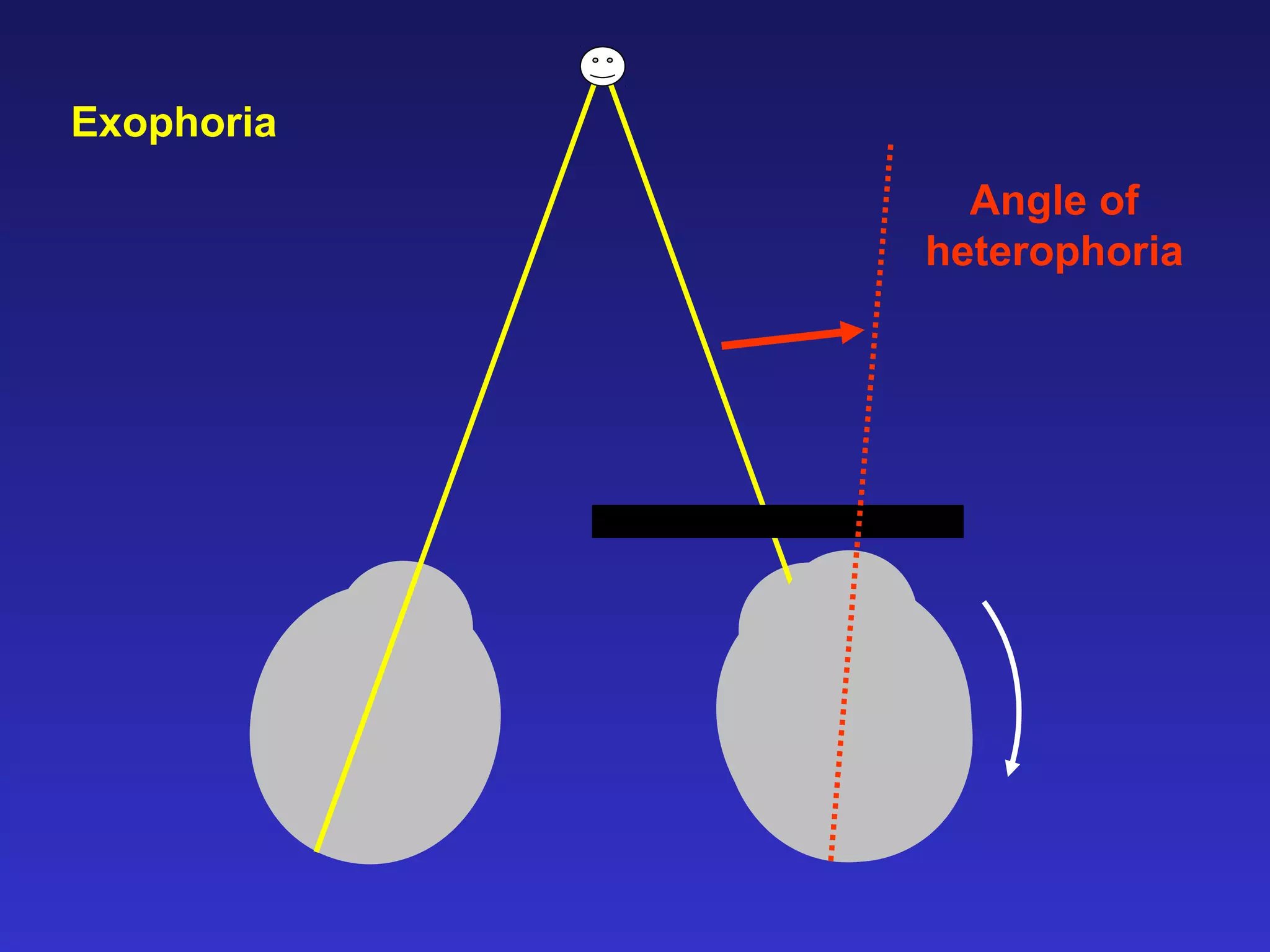
Angle of
heterophoria
Exophoria
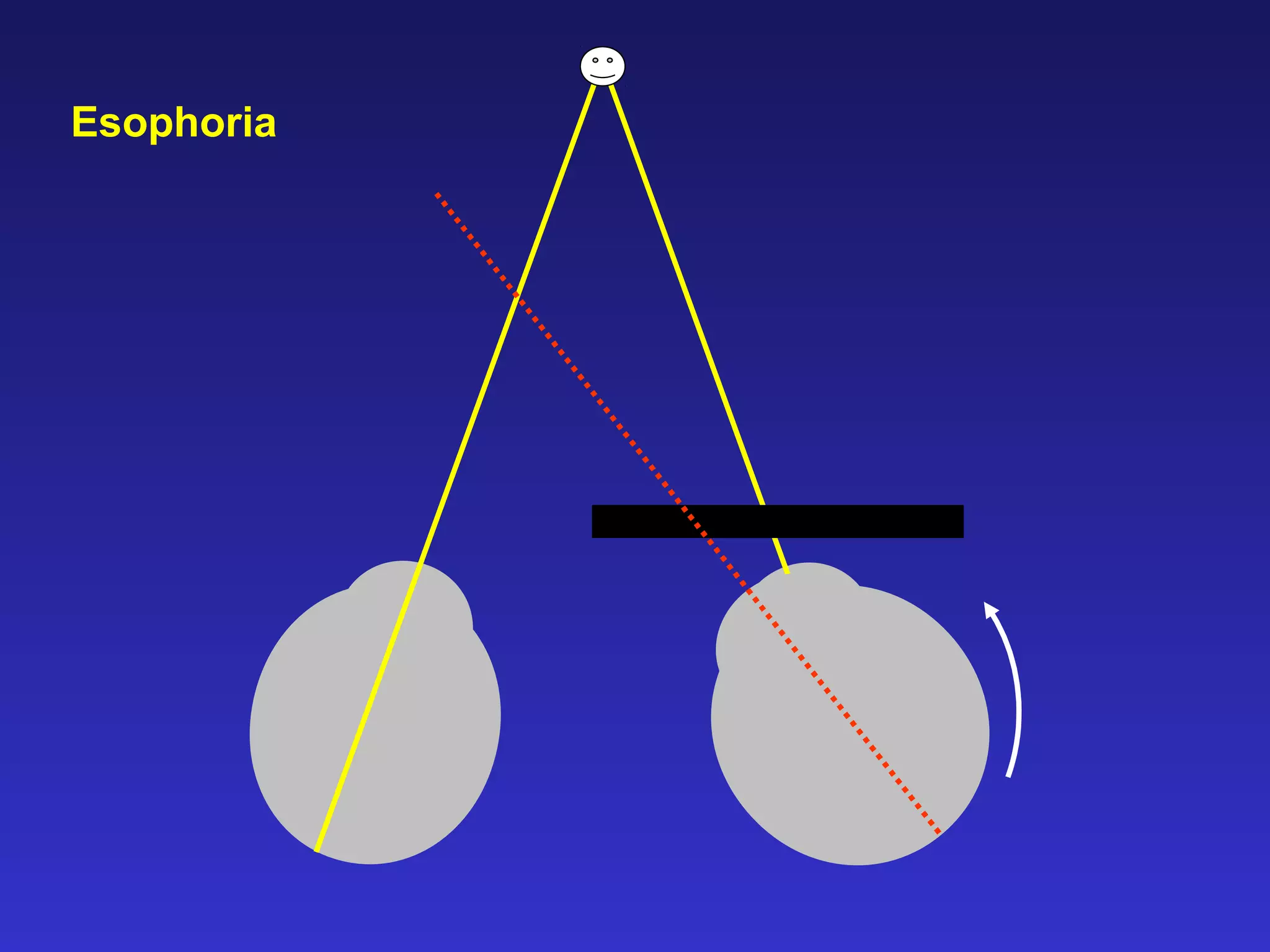
Esophoria
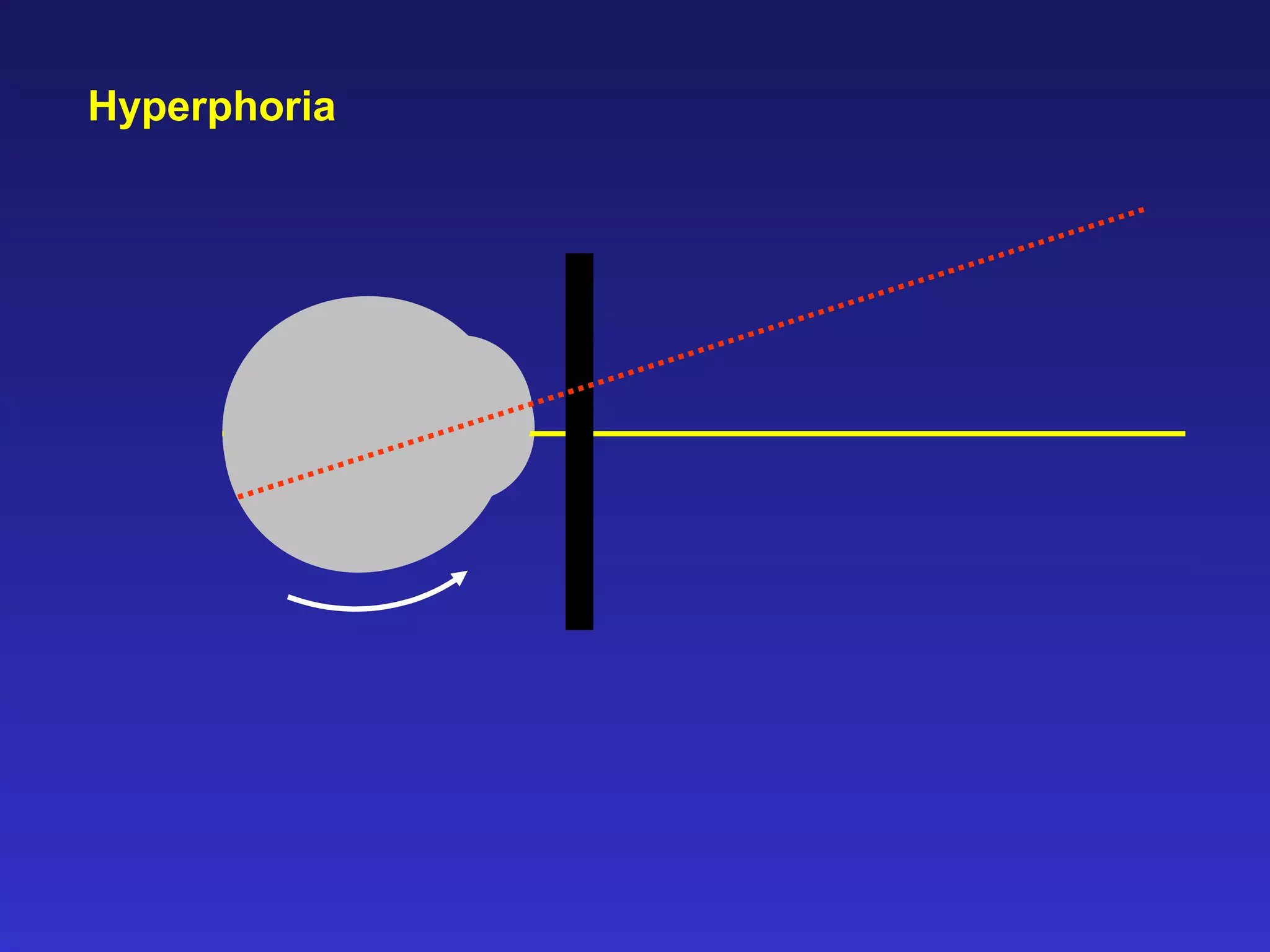
Hyperphoria
A phoria may be viewed as a measure of the error between the desired
alignment of the eyes and the position produced by the actions of tonic,
accommodative and proximal convergence.
In distance fixation (assuming emmetropia) the phoria will represent the
error between the position of the eyes produced by tonic convergence,
and parallelism
In near fixation the phoria represents the error between the position of
the eyes produced by tonic, accommodative and proximal convergence
and the vergence required for the fixation distance.
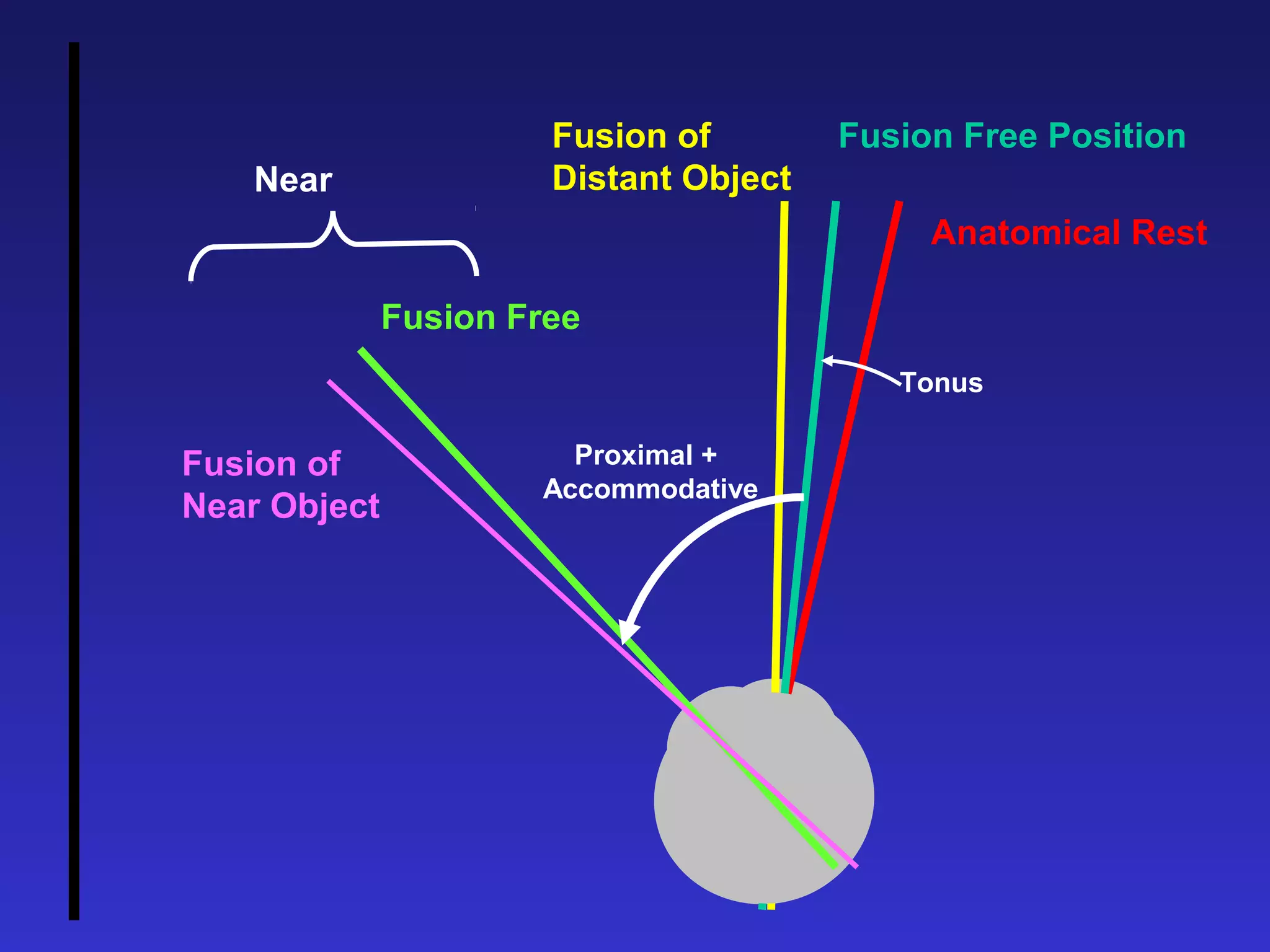
Anatomical Rest
Fusion Free PositionFusion of
Distant ObjectNear
Fusion Free
Fusion of
Near Object
Tonus
Proximal +
Accommodative
In heterophoria the eyes are kept aligned by motor fusion and hence
sensory fusion should develop normally
in cases of large heterophoria sensory problems may occur e.g.
suppression or reduced stereopsis.
Small heterophorias are usually asymptomatic indeed most people have
some degree of heterophoria that can be considered as physiological, or
normal.
The likelihood of symptoms increases with the size of the deviation and
may include: asthenopia, headaches and diplopia. Increased severity
and/or frequency of symptoms imply poor compensation.
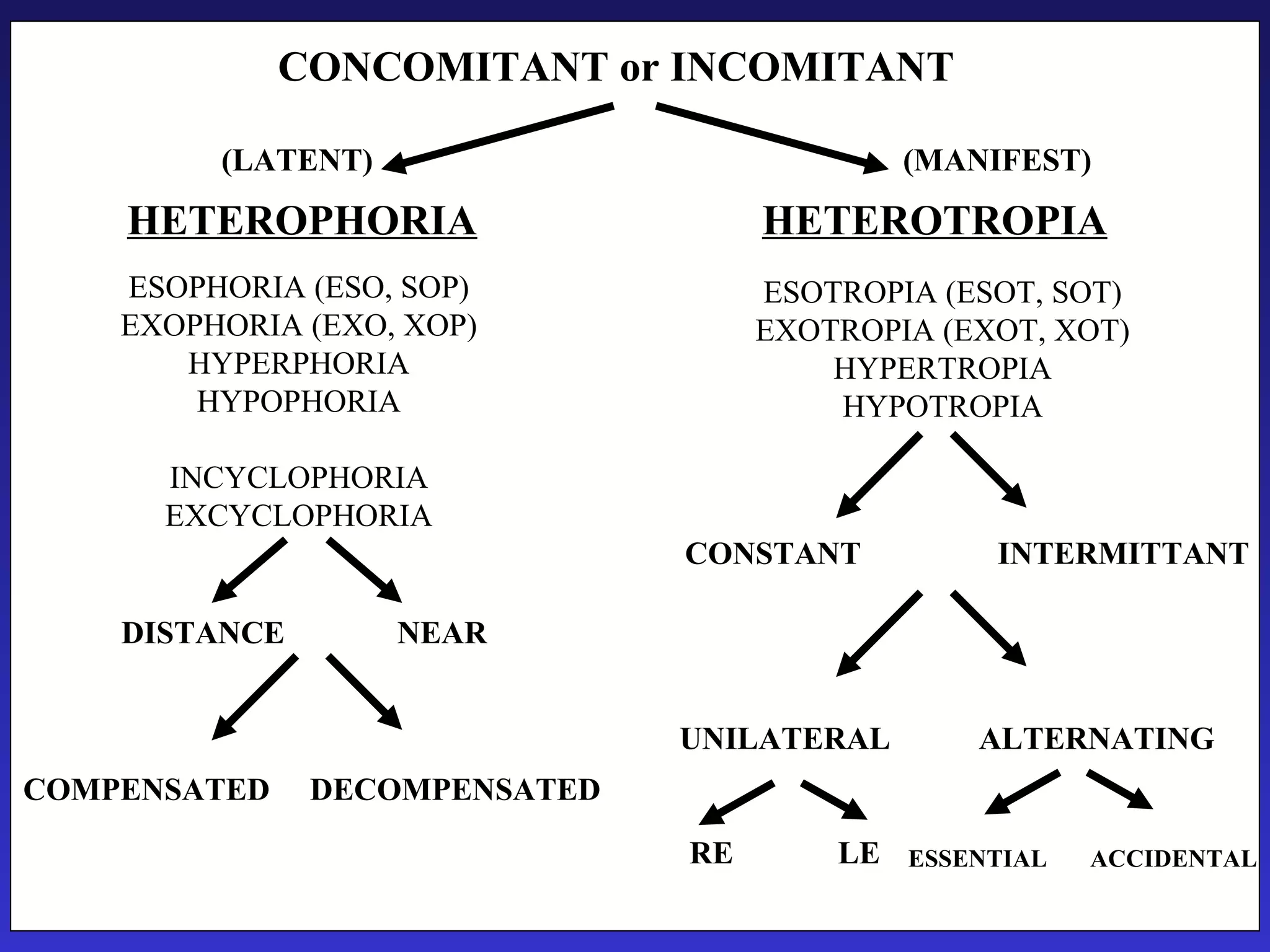
Classification of Heterophoria
CONCOMITANT or INCOMITANT
HETEROPHORIA HETEROTROPIA
(LATENT) (MANIFEST)
ESOPHORIA (ESO, SOP)
EXOPHORIA (EXO, XOP)
HYPERPHORIA
HYPOPHORIA
INCYCLOPHORIA
EXCYCLOPHORIA
DISTANCE NEAR
COMPENSATED DECOMPENSATED
ESOTROPIA (ESOT, SOT)
EXOTROPIA (EXOT, XOT)
HYPERTROPIA
HYPOTROPIA
CONSTANT INTERMITTANT
UNILATERAL ALTERNATING
RE LE ESSENTIAL ACCIDENTAL
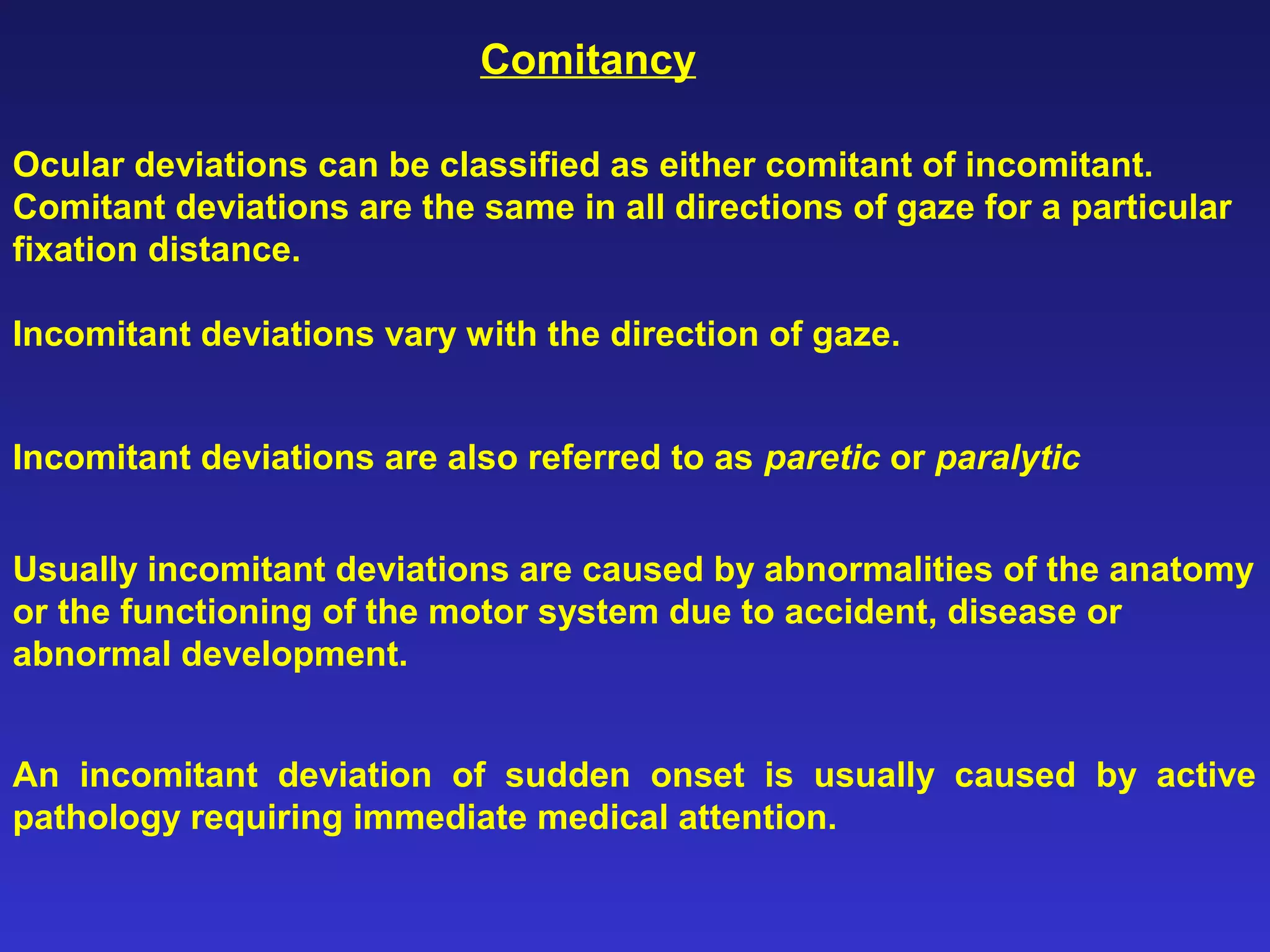
Ocular deviations can be classified as either comitant of incomitant.
Comitant deviations are the same in all directions of gaze for a particular
fixation distance.
Comitancy
Incomitant deviations vary with the direction of gaze.
Incomitant deviations are also referred to as paretic or paralytic
Usually incomitant deviations are caused by abnormalities of the anatomy
or the functioning of the motor system due to accident, disease or
abnormal development.
An incomitant deviation of sudden onset is usually caused by active
pathology requiring immediate medical attention.
Latent vs Manifest
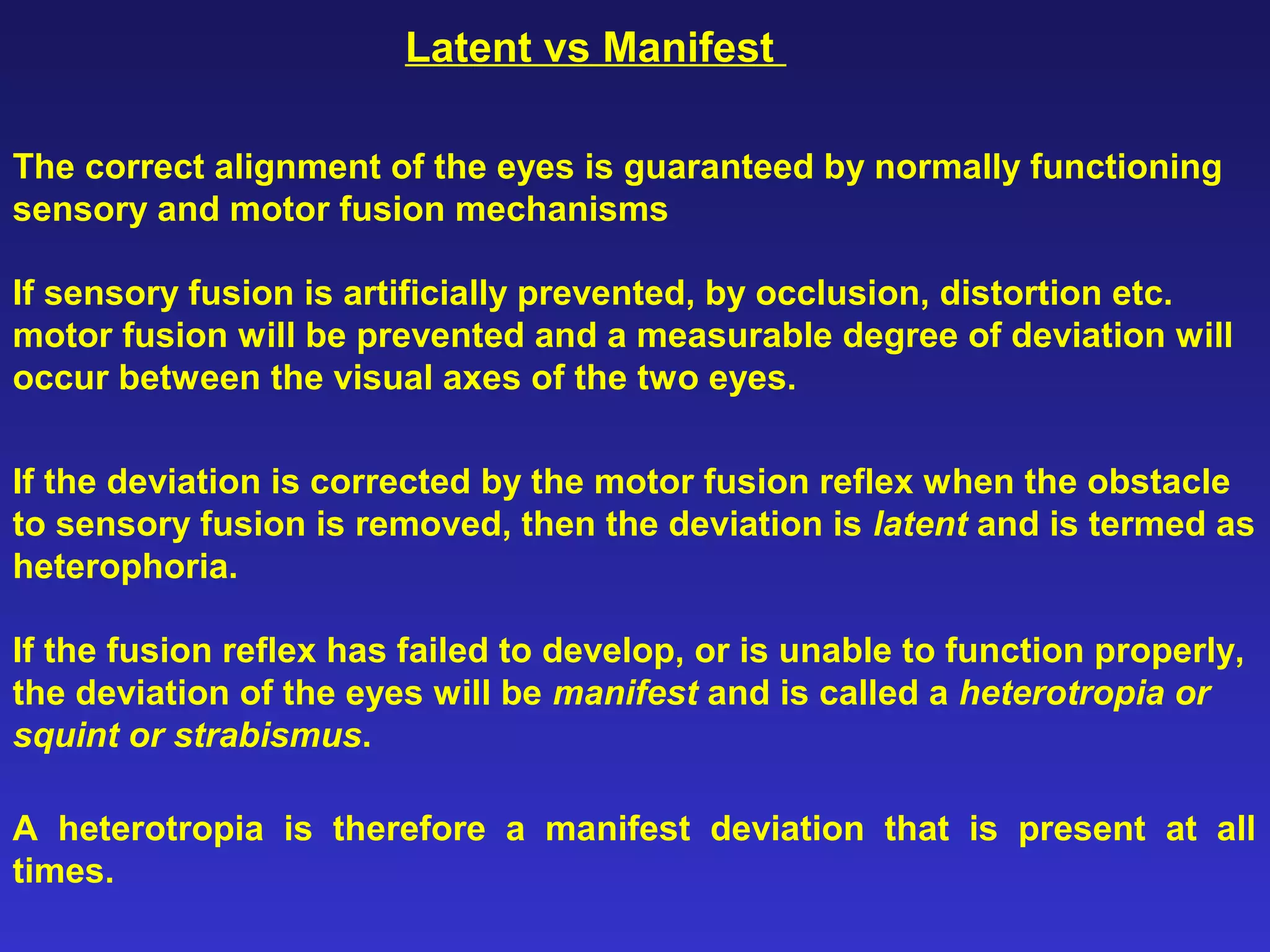
The correct alignment of the eyes is guaranteed by normally functioning
sensory and motor fusion mechanisms
If sensory fusion is artificially prevented, by occlusion, distortion etc.
motor fusion will be prevented and a measurable degree of deviation will
occur between the visual axes of the two eyes.
If the deviation is corrected by the motor fusion reflex when the obstacle
to sensory fusion is removed, then the deviation is latent and is termed as
heterophoria.
If the fusion reflex has failed to develop, or is unable to function properly,
the deviation of the eyes will be manifest and is called a heterotropia or
squint or strabismus.
A heterotropia is therefore a manifest deviation that is present at all
times.
Classification with Respect to Direction
Esophoria visual axes are convergent when the eyes are dissociated
Exophoria visual axes are divergent when the eyes are dissociated
Hyperphoria visual axes are vertically misaligned when the eyes
are dissociated;
(the convention is to specify the hyperphoric eye).
Cyclophoria the eyes rotate about the visual axis when the eyes
are dissociated; if the top of the primary vertical
meridian rotates nasally it is termed incyclophoria,
and if it rotates temporally, excyclophoria.
Straight active position
Versional pattern
Incyclophoria
Excyclophoria
RE LE
Non-dissociated state
cover
uncover
RE moves up
RE moves down
Right hyperphoria = Left hypophoria
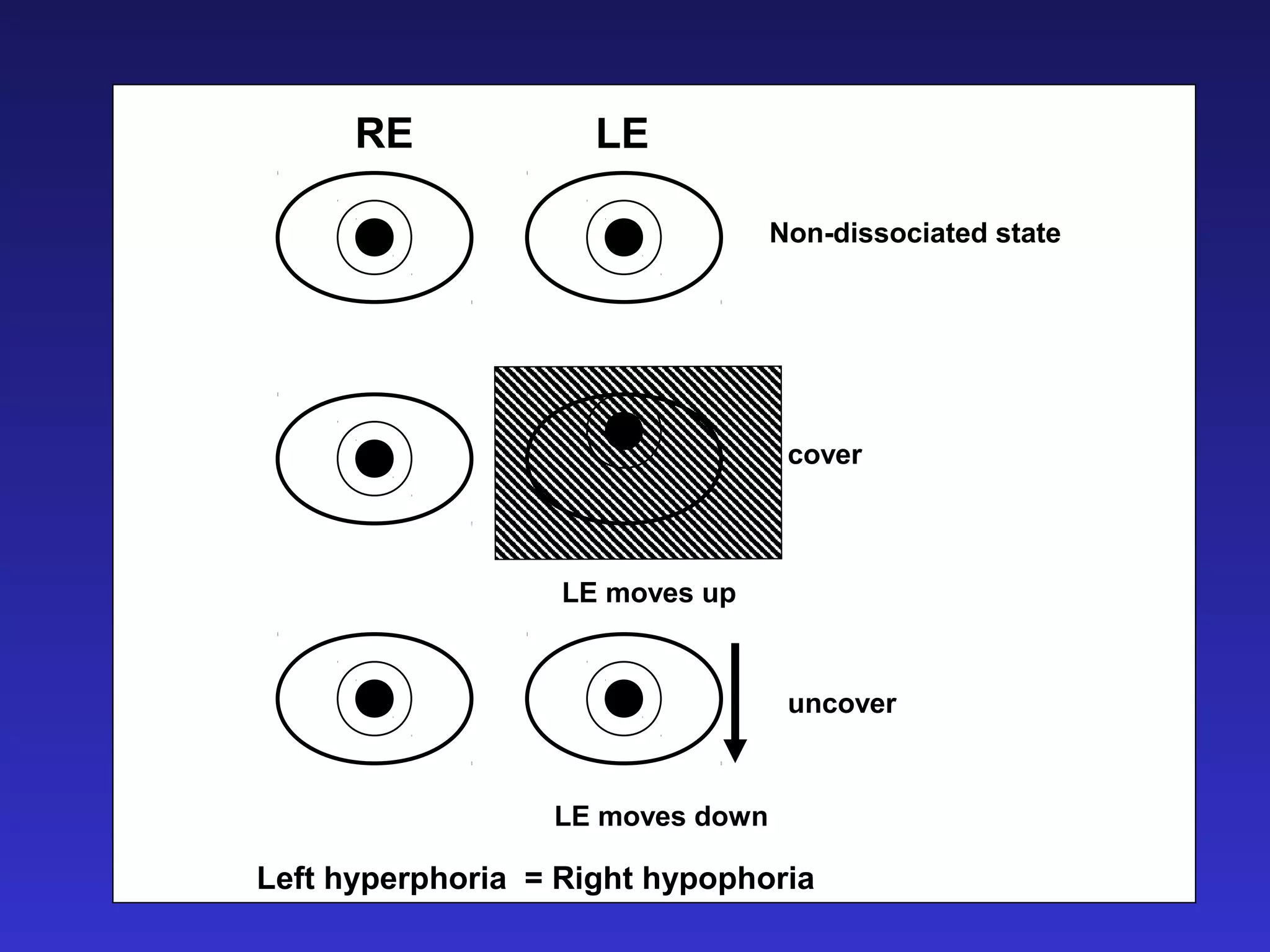
RE LE
Non-dissociated state
cover
uncover
LE moves up
LE moves down
Left hyperphoria = Right hypophoria
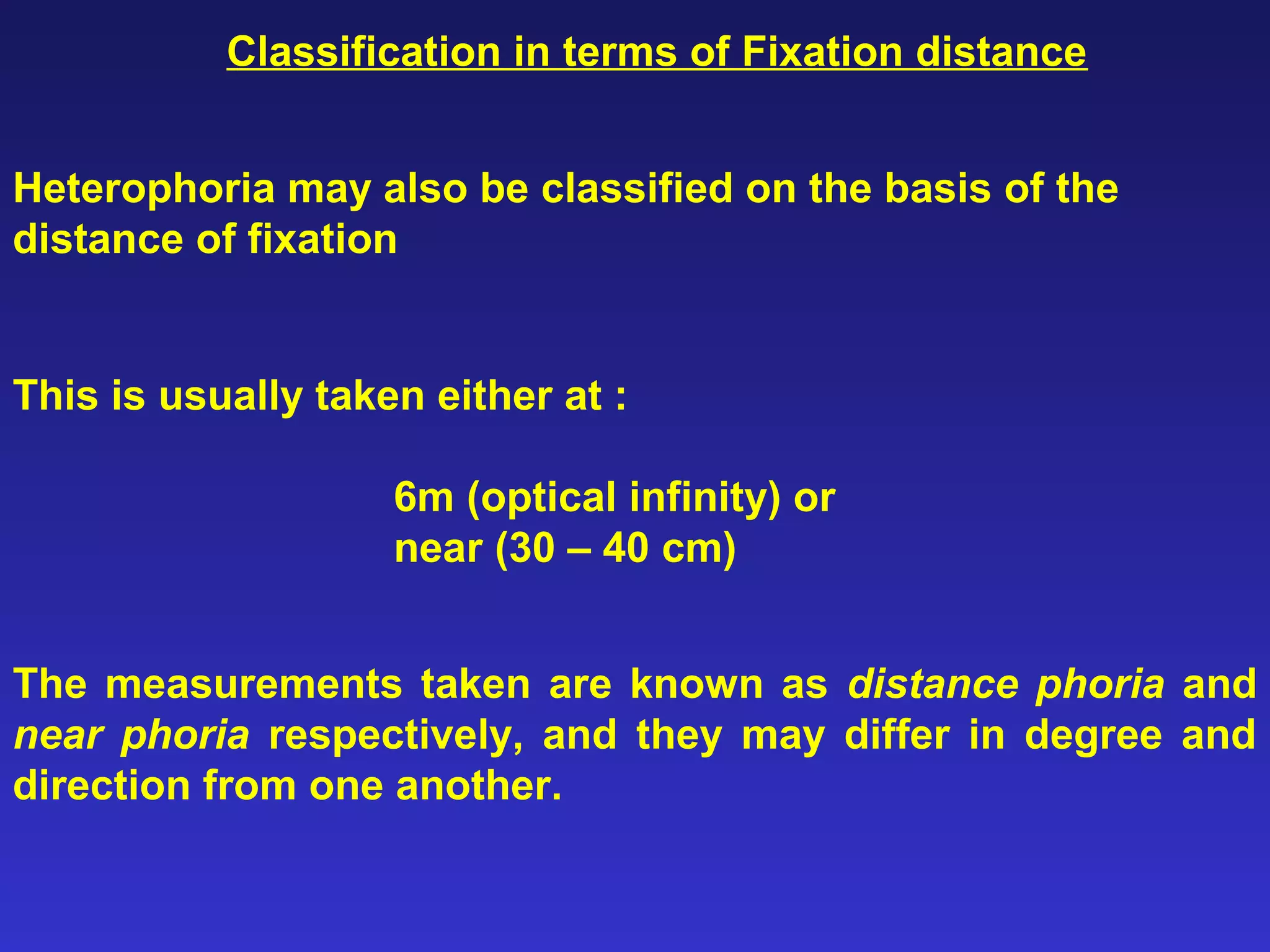
Heterophoria may also be classified on the basis of the
distance of fixation
Classification in terms of Fixation distance
This is usually taken either at :
6m (optical infinity) or
near (30 – 40 cm)
The measurements taken are known as distance phoria and
near phoria respectively, and they may differ in degree and
direction from one another.
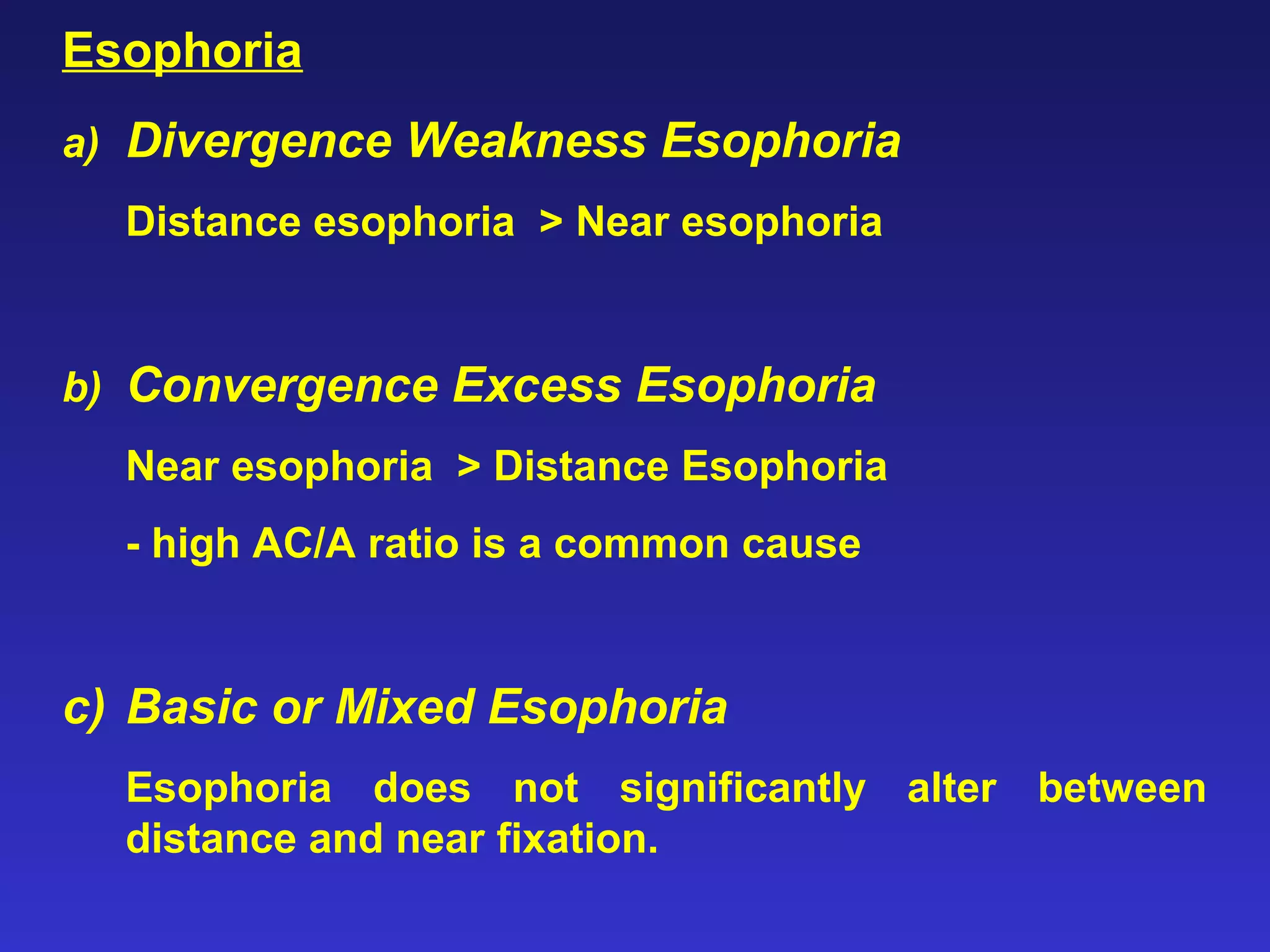
Esophoria
a) Divergence Weakness Esophoria
Distance esophoria > Near esophoria
b) Convergence Excess Esophoria
Near esophoria > Distance Esophoria
- high AC/A ratio is a common cause
c) Basic or Mixed Esophoria
Esophoria does not significantly alter between
distance and near fixation.
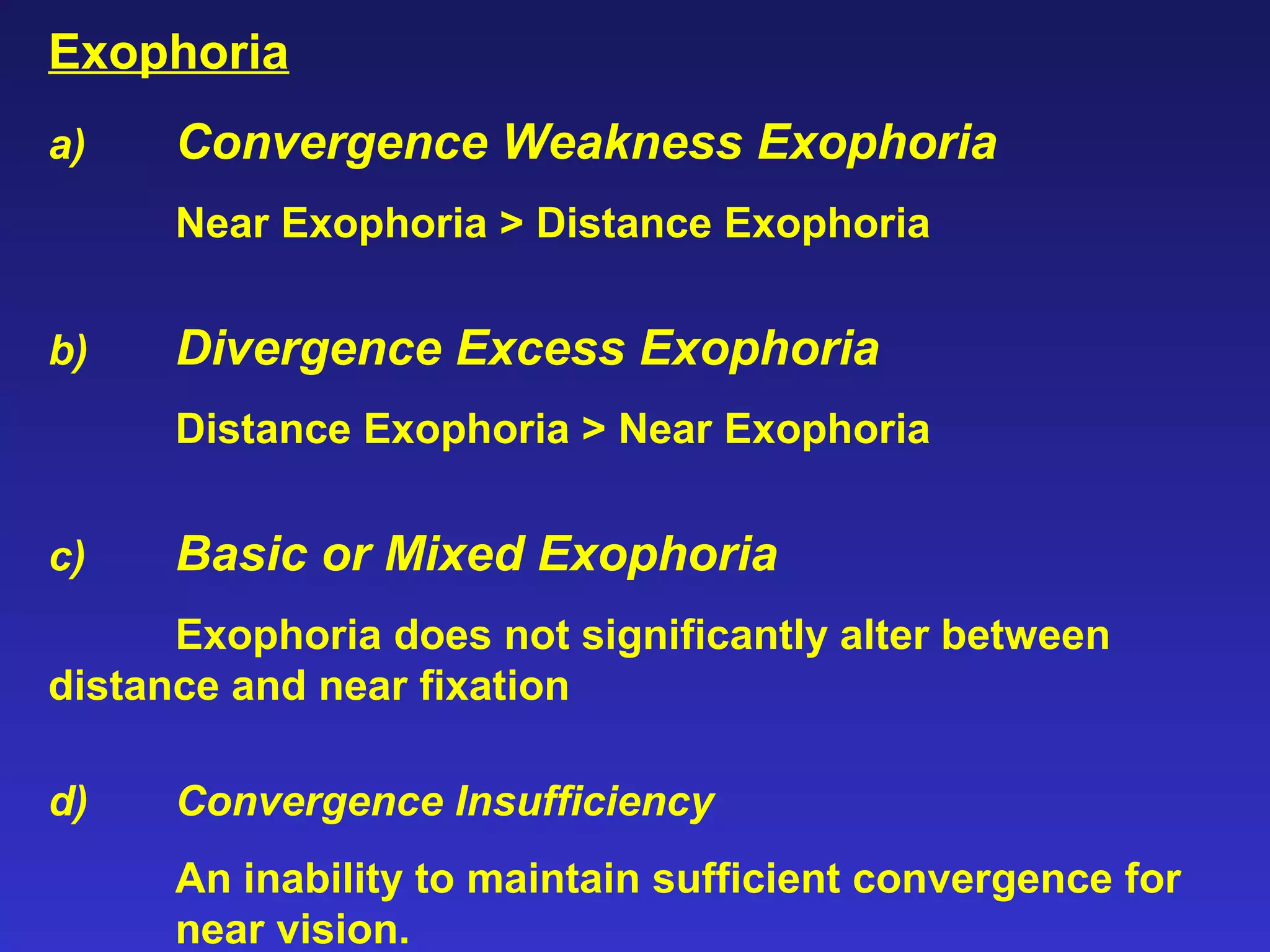
Exophoria
a) Convergence Weakness Exophoria
Near Exophoria > Distance Exophoria
b) Divergence Excess Exophoria
Distance Exophoria > Near Exophoria
c) Basic or Mixed Exophoria
Exophoria does not significantly alter between
distance and near fixation
d) Convergence Insufficiency
An inability to maintain sufficient convergence for
near vision.
Compensated vs Decompensated
Heterophoria
In clinical terms this is probably the most important classification of
heterophoria is whether it is compensated or decompensated.
Heterophoria in many cases is a physiological norm and is asymptomatic
and gives the individual no trouble
i.e. → compensated
Sometimes however the phoria may lead to the patient complaining of
symptoms
When the binocular system is under stress due to the presence of a
phoria then it is said to be decompensated.
Decompensated phorias may require clinical treatment.
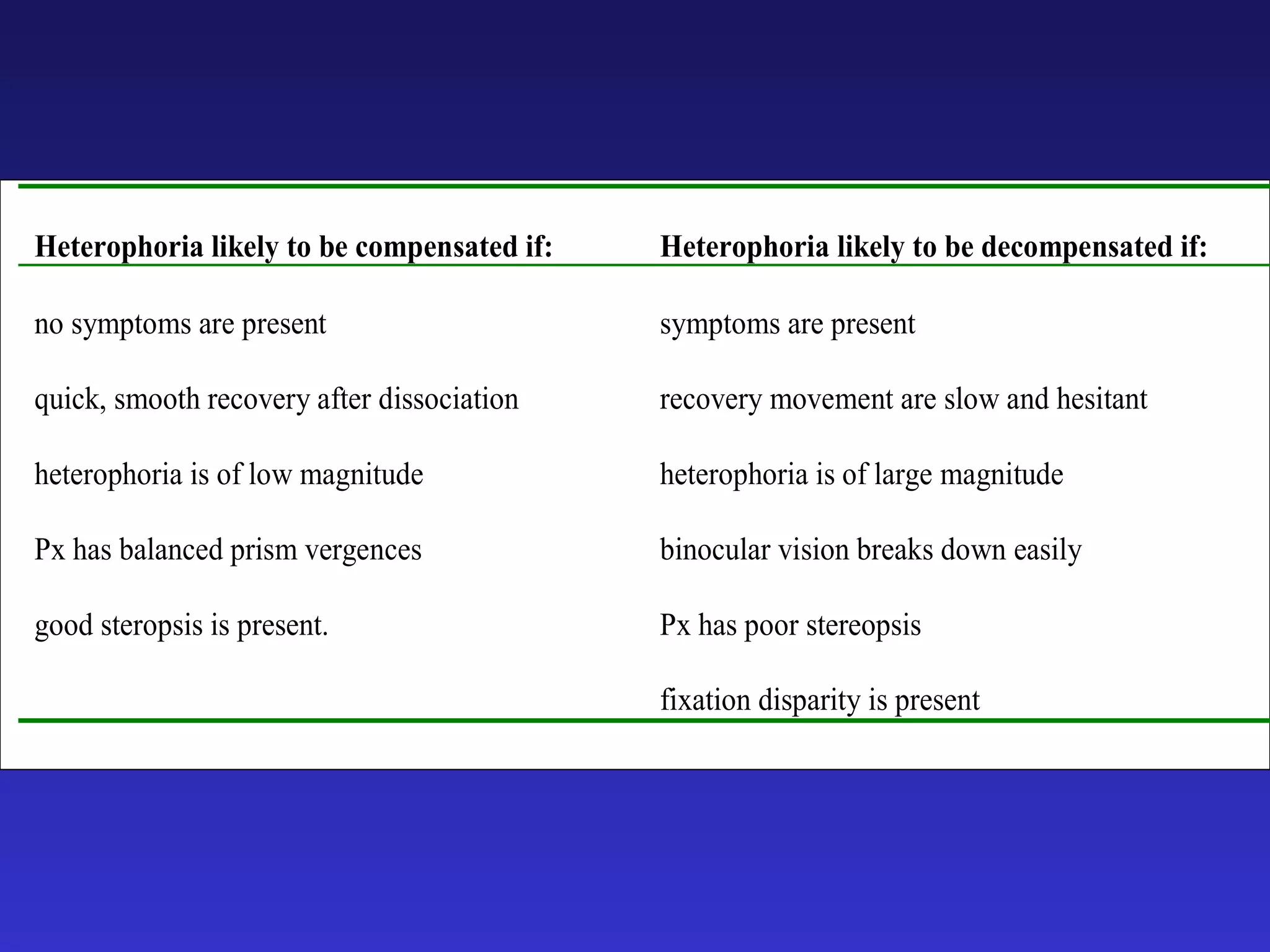
Heterophoria likely to be compensated if: Heterophoria likely to be decompensated if:
no symptoms are present
quick, smooth recovery after dissociation
heterophoria is of low magnitude
Px has balanced prism vergences
good steropsis is present.
symptoms are present
recovery movement are slow and hesitant
heterophoria is of large magnitude
binocular vision breaks down easily
Px has poor stereopsis
fixation disparity is present
A large number of cases of heterophoria may be due to a lack
of co-ordination of the accommodative and convergence
mechanisms
If the AC/A ratio is abnormal, the amount of accommodative
convergence may be inappropriate for the fixation distance,
and a phoria will result.
A small degree of exophoria at near is considered normal,
since the AC/A ratio is seldom large enough to provide all the
convergence for near fixation.
Accommodative Heterophoria
A high AC/A ratio will tend to produce less exophoria at near,
and may even produce esophoria.
A low AC/A ratio will produce greater than normal exophoria
at near
Uncorrected hypermetropia may produce esophoria at
distance and near
Uncorrected myopia tends to produce exophoria at near.
Accommodative Heterophoria
1 Asymmetry in the orbital structures – abnormalities in
the shape and inclination of the orbits.
2 Variations in the amount and position of orbital fat and
connective tissue.
3 Variation in the elasticity of the muscle fascia and
ligaments
4 Abnormalities in the muscle length and position of
insertion of the muscles.
Anatomical Heterophoria
Neurogenic Heterophoria
The amount of tonic convergence present in an individual may affect the
distance phoria.
The variation of tonic convergence with age may also affect the
magnitude of the phoria throughout life.
The variation of tonic convergence with age may be deduced from the
effects of monocular blindness at various ages.
If blindness of one eye occurs:
1at birth – eye diverges
2during infancy – eye converges
3during middle life – eye remains relatively straight
4during old age – eye diverges
Incidence of Heterophoria
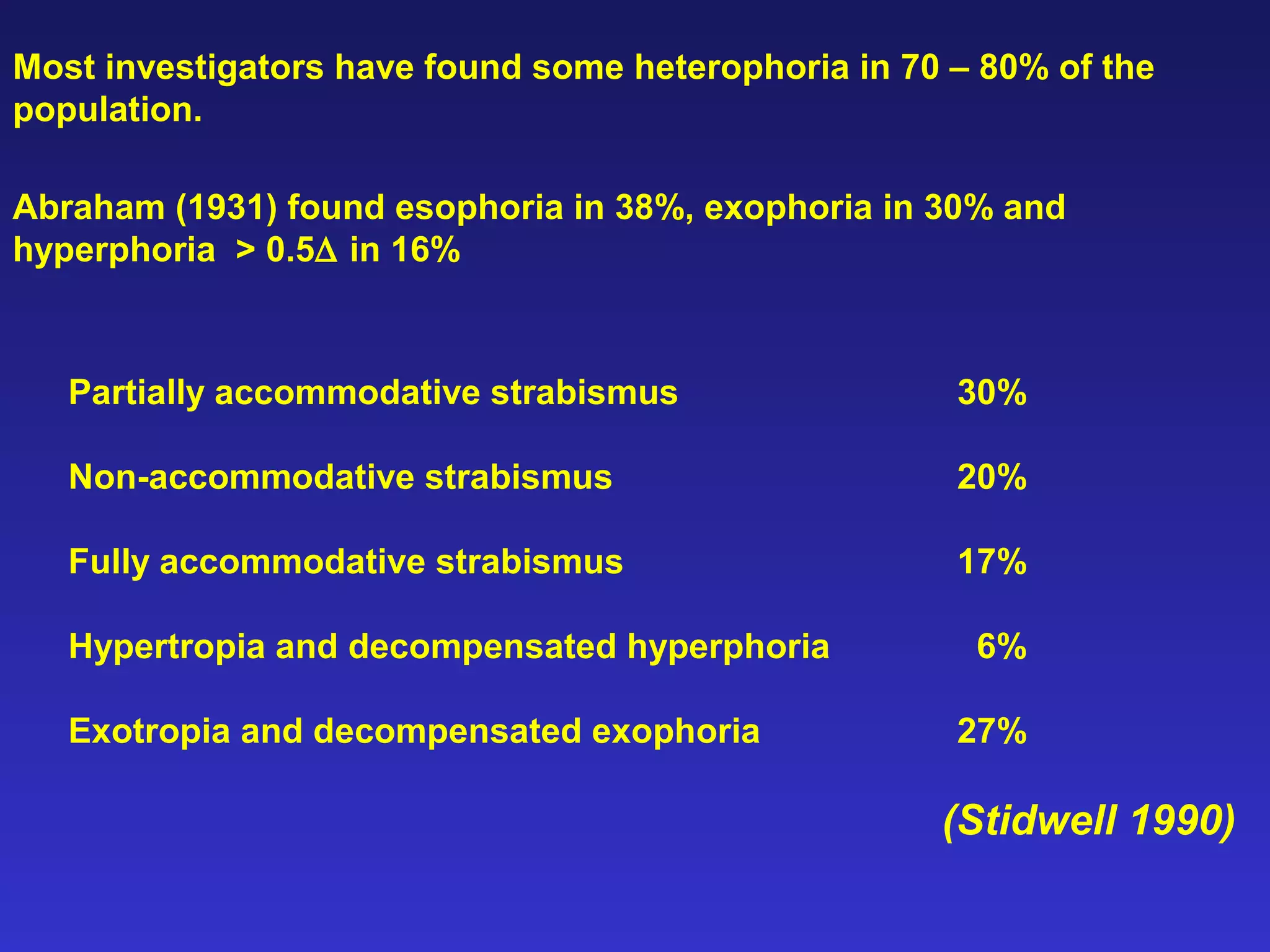
Most investigators have found some heterophoria in 70 – 80% of the
population.
Abraham (1931) found esophoria in 38%, exophoria in 30% and
hyperphoria > 0.5∆ in 16%
Partially accommodative strabismus 30%
Non-accommodative strabismus 20%
Fully accommodative strabismus 17%
Hypertropia and decompensated hyperphoria 6%
Exotropia and decompensated exophoria 27%
(Stidwell 1990)

Heterophoria2

  • 1.
  • 2.
    Most binocular anomaliesresult in the misalignment of the visual axes. The fusion reflex maintains correct alignment of the two eyes. If this fusion reflex is suspended the eyes will adopt the ‘fusion free’ position and a measurable deviation of the visual axes will occur in. The error of alignment that takes place when fusion is suspended is called heterophoria or phoria.
  • 3.
  • 4.
  • 5.
  • 6.
    A phoria maybe viewed as a measure of the error between the desired alignment of the eyes and the position produced by the actions of tonic, accommodative and proximal convergence. In distance fixation (assuming emmetropia) the phoria will represent the error between the position of the eyes produced by tonic convergence, and parallelism In near fixation the phoria represents the error between the position of the eyes produced by tonic, accommodative and proximal convergence and the vergence required for the fixation distance.
  • 7.
    Anatomical Rest Fusion FreePositionFusion of Distant ObjectNear Fusion Free Fusion of Near Object Tonus Proximal + Accommodative
  • 8.
    In heterophoria theeyes are kept aligned by motor fusion and hence sensory fusion should develop normally in cases of large heterophoria sensory problems may occur e.g. suppression or reduced stereopsis. Small heterophorias are usually asymptomatic indeed most people have some degree of heterophoria that can be considered as physiological, or normal. The likelihood of symptoms increases with the size of the deviation and may include: asthenopia, headaches and diplopia. Increased severity and/or frequency of symptoms imply poor compensation.
  • 9.
  • 10.
    CONCOMITANT or INCOMITANT HETEROPHORIAHETEROTROPIA (LATENT) (MANIFEST) ESOPHORIA (ESO, SOP) EXOPHORIA (EXO, XOP) HYPERPHORIA HYPOPHORIA INCYCLOPHORIA EXCYCLOPHORIA DISTANCE NEAR COMPENSATED DECOMPENSATED ESOTROPIA (ESOT, SOT) EXOTROPIA (EXOT, XOT) HYPERTROPIA HYPOTROPIA CONSTANT INTERMITTANT UNILATERAL ALTERNATING RE LE ESSENTIAL ACCIDENTAL
  • 11.
    Ocular deviations canbe classified as either comitant of incomitant. Comitant deviations are the same in all directions of gaze for a particular fixation distance. Comitancy Incomitant deviations vary with the direction of gaze. Incomitant deviations are also referred to as paretic or paralytic Usually incomitant deviations are caused by abnormalities of the anatomy or the functioning of the motor system due to accident, disease or abnormal development. An incomitant deviation of sudden onset is usually caused by active pathology requiring immediate medical attention.
  • 12.
    Latent vs Manifest Thecorrect alignment of the eyes is guaranteed by normally functioning sensory and motor fusion mechanisms If sensory fusion is artificially prevented, by occlusion, distortion etc. motor fusion will be prevented and a measurable degree of deviation will occur between the visual axes of the two eyes. If the deviation is corrected by the motor fusion reflex when the obstacle to sensory fusion is removed, then the deviation is latent and is termed as heterophoria. If the fusion reflex has failed to develop, or is unable to function properly, the deviation of the eyes will be manifest and is called a heterotropia or squint or strabismus. A heterotropia is therefore a manifest deviation that is present at all times.
  • 13.
    Classification with Respectto Direction Esophoria visual axes are convergent when the eyes are dissociated Exophoria visual axes are divergent when the eyes are dissociated Hyperphoria visual axes are vertically misaligned when the eyes are dissociated; (the convention is to specify the hyperphoric eye). Cyclophoria the eyes rotate about the visual axis when the eyes are dissociated; if the top of the primary vertical meridian rotates nasally it is termed incyclophoria, and if it rotates temporally, excyclophoria.
  • 14.
  • 15.
  • 16.
    RE LE Non-dissociated state cover uncover REmoves up RE moves down Right hyperphoria = Left hypophoria
  • 17.
    RE LE Non-dissociated state cover uncover LEmoves up LE moves down Left hyperphoria = Right hypophoria
  • 18.
    Heterophoria may alsobe classified on the basis of the distance of fixation Classification in terms of Fixation distance This is usually taken either at : 6m (optical infinity) or near (30 – 40 cm) The measurements taken are known as distance phoria and near phoria respectively, and they may differ in degree and direction from one another.
  • 19.
    Esophoria a) Divergence WeaknessEsophoria Distance esophoria > Near esophoria b) Convergence Excess Esophoria Near esophoria > Distance Esophoria - high AC/A ratio is a common cause c) Basic or Mixed Esophoria Esophoria does not significantly alter between distance and near fixation.
  • 20.
    Exophoria a) Convergence WeaknessExophoria Near Exophoria > Distance Exophoria b) Divergence Excess Exophoria Distance Exophoria > Near Exophoria c) Basic or Mixed Exophoria Exophoria does not significantly alter between distance and near fixation d) Convergence Insufficiency An inability to maintain sufficient convergence for near vision.
  • 21.
  • 22.
    In clinical termsthis is probably the most important classification of heterophoria is whether it is compensated or decompensated. Heterophoria in many cases is a physiological norm and is asymptomatic and gives the individual no trouble i.e. → compensated Sometimes however the phoria may lead to the patient complaining of symptoms When the binocular system is under stress due to the presence of a phoria then it is said to be decompensated. Decompensated phorias may require clinical treatment.
  • 23.
    Heterophoria likely tobe compensated if: Heterophoria likely to be decompensated if: no symptoms are present quick, smooth recovery after dissociation heterophoria is of low magnitude Px has balanced prism vergences good steropsis is present. symptoms are present recovery movement are slow and hesitant heterophoria is of large magnitude binocular vision breaks down easily Px has poor stereopsis fixation disparity is present
  • 24.
    A large numberof cases of heterophoria may be due to a lack of co-ordination of the accommodative and convergence mechanisms If the AC/A ratio is abnormal, the amount of accommodative convergence may be inappropriate for the fixation distance, and a phoria will result. A small degree of exophoria at near is considered normal, since the AC/A ratio is seldom large enough to provide all the convergence for near fixation. Accommodative Heterophoria
  • 25.
    A high AC/Aratio will tend to produce less exophoria at near, and may even produce esophoria. A low AC/A ratio will produce greater than normal exophoria at near Uncorrected hypermetropia may produce esophoria at distance and near Uncorrected myopia tends to produce exophoria at near. Accommodative Heterophoria
  • 26.
    1 Asymmetry inthe orbital structures – abnormalities in the shape and inclination of the orbits. 2 Variations in the amount and position of orbital fat and connective tissue. 3 Variation in the elasticity of the muscle fascia and ligaments 4 Abnormalities in the muscle length and position of insertion of the muscles. Anatomical Heterophoria
  • 27.
    Neurogenic Heterophoria The amountof tonic convergence present in an individual may affect the distance phoria. The variation of tonic convergence with age may also affect the magnitude of the phoria throughout life. The variation of tonic convergence with age may be deduced from the effects of monocular blindness at various ages. If blindness of one eye occurs: 1at birth – eye diverges 2during infancy – eye converges 3during middle life – eye remains relatively straight 4during old age – eye diverges
  • 28.
  • 29.
    Most investigators havefound some heterophoria in 70 – 80% of the population. Abraham (1931) found esophoria in 38%, exophoria in 30% and hyperphoria > 0.5∆ in 16% Partially accommodative strabismus 30% Non-accommodative strabismus 20% Fully accommodative strabismus 17% Hypertropia and decompensated hyperphoria 6% Exotropia and decompensated exophoria 27% (Stidwell 1990)