SPHERICAL SCLs FITTING
PRESENTED BY –
MEGHNA VERMA
CONTENTS -
INTRODUCTION
• Soft contact lenses are more flexible than rigid lenses, and can be gently rolled or
folded without damaging the lens.
• Soft contact lenses rely on their water content to transmit oxygen through the
lens to the cornea.
• Higher water content lenses allowed more oxygen to the cornea.
ALTERNATIVES NAMES-
• Hydrophilic
• Hydrogel
• Limbal
• Pliable
Range of TDs -
ØT = 13 – 15 mm
Most common TDs –
ØT = 13.5 – 14.5 mm
• SCLs should always be larger than the cornea with a BOZR flatter than the cornea.
• Lens movement, which is generated by the blinking action of the lids.
FITTING REQUIREMENTS
 FITTING REQUIREMENTS-
• Centre on the eye
• Conform to the anterior eye
• Move adequately
• Cover the cornea in all eye positions
 PERFORMANCE REQUIREMENTS-
• Produce good and stable vision
• Provide minimal physiological disturbance
• Be wearable for practical periods
• Be comfortable
CENTRATION
A well centred soft contact lens based on two systems-
a. Cartesian system
b. Binasal system
In Cartesian system, for RE +x is a nasal side while for LE +x is a temporal side &
for RE –x is a temporal side while LE –x is a nasal side & +y is up & -y is down.
In Binasal system, for RE/LE +x is always nasal side while –x is temporal side and
+y is upside and -y is downside.
DECENTRED SOFT LENSES-
 A lens which is too loose will generally be excessively mobile & will not centre
well. Loose lens only decentres significantly on downgaze. The lens is almost
certainly uncomfortable & the Vn must be affected bcoz some of the lens
periphery wil cover the pupil zone.
ALTERING LENS FIT
WHAT GOVERNS LENS FIT?
• Relationship b/w sagittal height of the lens & anterior eye.
• Anterior eye topography.
• Blink induced negative pressure under the lens.
• Lid characteristics, lid/lens interaction.
• Physical properties of the lens
- Physical properties of the material
- Prescription
- Thickness
- Lens design
T To alter the fit of a lens the relationship
b/w sagittal height of the lens & the
anterior eye must be changed.
In most cases, a successful fit requires
the inner sagittal height of a lens to
be greater than that of the ant. eye.
 The sagittal height of a lens can be
altered by changing the BOZR, total
diameter or both.
- Lenses having the same sagittal height
& the total diameter will not
necessarily exhibit similar behavior
if the back surface design are different..
PARAMETER SELECTION –
1) Total diameter
2) BOZR
3) Centre thickness
4) Optic zone diameter
5) Water content
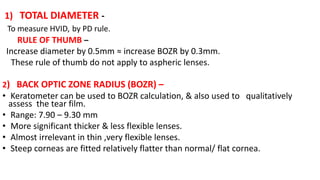
1) TOTAL DIAMETER -
To measure HVID, by PD rule.
RULE OF THUMB –
Increase diameter by 0.5mm ≈ increase BOZR by 0.3mm.
These rule of thumb do not apply to aspheric lenses.
2) BACK OPTIC ZONE RADIUS (BOZR) –
• Keratometer can be used to BOZR calculation, & also used to qualitatively
assess the tear film.
• Range: 7.90 – 9.30 mm
• More significant thicker & less flexible lenses.
• Almost irrelevant in thin ,very flexible lenses.
• Steep corneas are fitted relatively flatter than normal/ flat cornea.
• Usually 2-4 BOZRs for each diameter.
• More rigid materials require more fitting increments & fitting steps may be
smaller, e.g. 0.2mm steps rather than more common 0.3mm steps.
• Less rigid materials require fewer increments & fitting steps may be larger,
e.g. 0.4mm steps rather than 0.3mm steps.
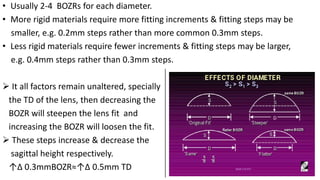
 It all factors remain unaltered, specially
the TD of the lens, then decreasing the
BOZR will steepen the lens fit and
increasing the BOZR will loosen the fit.
 These steps increase & decrease the
sagittal height respectively.
↑∆ 0.3mmBOZR≈↑∆ 0.5mm TD
3) CENTRE THICKNESS –
It is based on-
• Back vertex power
• Dk/t
• Duration of wearing period
• Durability
• Handling
THICKNESS DESCRIPTION –
For spherical, minus lenses –
< 0.06 mm – ultra thin
0.06 – 0.10mm – thin
0.10 – 0.15mm – standard
> 0.15mm – thick
Toric , plus lenses have their centre thickness governed by BVP & lens design.
EFFECT OF THICKNESS CHANGE ON LENS FIT –
• Thick lenses interact more with the lids and therefore move more on a blink.
• Thick lenses/ thick edges will also result in greater lens decentration.
• Thin lenses interact less with the lids and tend to move less.
• Thin lenses/thin edges will also tend to centre better & be more comfortable.
• The effect of BVP on the thickness, in high minus Rx can not be ignored.
4) OPTIC ZONE DIAMETER –
• Also known as front optic zone diameter (FOZD)
• Usually 8 - 11 mm
• For high prescription, as small as 7.5 mm
• Must take pupil size in photopic/scotopic illumination.
• The Rx may choice - if Rx is low then larger & if Rx is high then smaller
EFFECT OF FOZD ON LENS FIT –
• Smaller FOZDs results in a more flexible periphery & decreasing lens movement.
• Reduction in periphery rigidity may allow the lens to decentre more.
• Larger FOZDs results in a less flexible periphery & greater lens movement.
• Rigid periphery may allow the lens to less decentre.
5) WATER CONTENT –
• In higher powers, higher water content for Dk/t advantage.
• In lower powers, low water content for easier handling & greater rigidity or
greater durability.
• Final choice is compromise b/w oxygen availability, lens handling & durability.
EFFECT OF CHANGING THE WATER CONTENT –
• Increase water content may decrease lens movement.
• Others factors affected include-
- Dk/t
- Durability
- Lens thickness
- Deposit resistance
LENS RIGIDITY –
• Chemistry
• Water content
• Thickness
• Material properties
 Lens rigidity least with –
• Thinner lenses
• Spin cast manufacture
• High water contents
 Lens rigidity greatest with –
• Thick lenses
• Low water contents
• Materials with MMA / PVA
EMPIRICAL PRESCRIBING
Pt. data required for lens choice –
• HVID
• Keratometric reading
• Spectacle prescription
• Vertex distance
• Inter palpebral aperture
ADVANTAGES –
• Simple & quick for the practitioner.
• Cheaper for manufacturer.
• No lens maintenance by practitioner.
• No public health issue with trial lens reuse.
DISADVANTAGES –
• Exceptions always exist.
• Patient do not experience lens wear before delivery.
• Practitioner can not observe patient’s response to lenses.
• Practitioner seen to be abdicating their responsibility.
• Accuracy of outcome.
THE TRIAL FIT
ADVANTAGES –
• Allows the feel of a lens to be experienced.
• Patient reaction is assessable.
• Needs to be performed in average illumination.
• Performed in low to moderate magnification.
• Now easier and safer – disposable trial lenses.
TRIAL LENS SETTLING PERIOD –
• Record assessment after lenses settle.
• Settling period normally 5 minutes.
• Further assessment may be necessary after 3-4 hours.
ASSESSMENT DURING LENS TRIAL –
• Lens centration
• Position & movement on blink with eye in –
- Primary position
- Lateral gaze
- Up gaze
- Rapid & extreme lateral eye movements
• Lower lid push up test in primary gaze –
- Observe ease of moving lens from its static position
- Speed of recentration following intentional displacement
- Observe the quality of centration after displacement
• Edge condition, buckling & pleating & lifting ( when lens is flat/ lens inside out).
CORNEAL COVERAGE
NEED FOR CORNEAL COVERAGE –
 Optical
• Centration
• Shape regularity
• Post lens tear film uniformity
 Machanical
• Prevent corneal trauma
• Prevent limbal trauma
• Prevent conjunctival trauma
 Physiological
• Corneal exposure
• Corneal dessication
• Tear film disturbances, lens & eye wettability
 Comfort
 About 1mm symmetrical overlap is ideal
EFFECT OF A BLINK
TOO FLAT –
Vision is blurred immediately after a
blink.
TOO STEEP –
Vision is clear immediately after
a blink.
LENS MOVEMENT
MOVEMENT REQUIREMENT
• Removes and disperses ocular debris
• Promotes tear exchange
• Possibly aids epithelial wetting by mucin spreading and smoothing
Lens movement depends on –
• Lens type
• Lens design
• Physical properties of lens material ( rigidity)
• Fitting relationship
• Lid factors
• Anterior eye topography
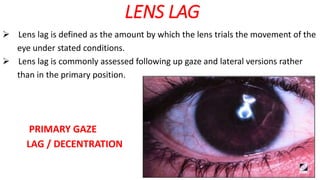
LENS LAG
 Lens lag is defined as the amount by which the lens trials the movement of the
eye under stated conditions.
 Lens lag is commonly assessed following up gaze and lateral versions rather
than in the primary position.
PRIMARY GAZE
LAG / DECENTRATION
LATERAL VERSION
LAG
UP-GAZE LENS
LAG
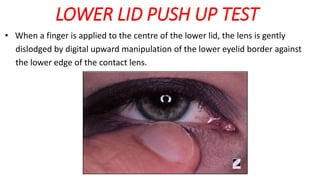
LOWER LID PUSH UP TEST
• When a finger is applied to the centre of the lower lid, the lens is gently
dislodged by digital upward manipulation of the lower eyelid border against
the lower edge of the contact lens.
LENS FIT
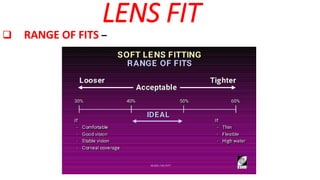
 RANGE OF FITS –
 UNACCEPTABLE SIGNS –
• Lens edge curling/ wrinkling – too loose.
• Conjunctival indentation – too tight.
• Excessive movement produce visual disturbances.
• Excessive decentration produce flat/loose fitting lens.
 EXCESSIVE TIGHTNESS –
• Lens immobile even when lower lid push up manipulation attempted.
• Conjunctival indentation at lens edge.
• Blood flow constriction in peri limbal vesselsunder lens periphery.
• Lens grade inflammation.
• Vision better immediately after a blink.s
 EXCESSIVE LOOSENESS –
• If extreme, lens will not stay in eye.
• Excessive lens movement.
• Wrinkling / buckling of lens edge.
• If decentred, vision variable but worse immediately after blink.
• If lens centred, blink may make little or no difference.
• Inferior lens decentration even in primary eye position.
• Lens may slip off cornea in up gaze blink.
• Subjective discomfort due to lens mobility.
FINAL DICISIONS
It is required –
• Total diameter
• Back optic zone diameter (BOZD)
• Back vertex power (BVP)
• Centre thickness
• Tint selections
Spherical soft contact lens fitting

Spherical soft contact lens fitting

  • 1.
  • 2.
  • 3.
    INTRODUCTION • Soft contactlenses are more flexible than rigid lenses, and can be gently rolled or folded without damaging the lens. • Soft contact lenses rely on their water content to transmit oxygen through the lens to the cornea. • Higher water content lenses allowed more oxygen to the cornea. ALTERNATIVES NAMES- • Hydrophilic • Hydrogel • Limbal • Pliable
  • 4.
    Range of TDs- ØT = 13 – 15 mm Most common TDs – ØT = 13.5 – 14.5 mm • SCLs should always be larger than the cornea with a BOZR flatter than the cornea. • Lens movement, which is generated by the blinking action of the lids.
  • 5.
    FITTING REQUIREMENTS  FITTINGREQUIREMENTS- • Centre on the eye • Conform to the anterior eye • Move adequately • Cover the cornea in all eye positions  PERFORMANCE REQUIREMENTS- • Produce good and stable vision • Provide minimal physiological disturbance • Be wearable for practical periods • Be comfortable
  • 6.
    CENTRATION A well centredsoft contact lens based on two systems- a. Cartesian system b. Binasal system In Cartesian system, for RE +x is a nasal side while for LE +x is a temporal side & for RE –x is a temporal side while LE –x is a nasal side & +y is up & -y is down. In Binasal system, for RE/LE +x is always nasal side while –x is temporal side and +y is upside and -y is downside. DECENTRED SOFT LENSES-  A lens which is too loose will generally be excessively mobile & will not centre well. Loose lens only decentres significantly on downgaze. The lens is almost certainly uncomfortable & the Vn must be affected bcoz some of the lens periphery wil cover the pupil zone.
  • 8.
    ALTERING LENS FIT WHATGOVERNS LENS FIT? • Relationship b/w sagittal height of the lens & anterior eye. • Anterior eye topography. • Blink induced negative pressure under the lens. • Lid characteristics, lid/lens interaction. • Physical properties of the lens - Physical properties of the material - Prescription - Thickness - Lens design
  • 9.
    T To alterthe fit of a lens the relationship b/w sagittal height of the lens & the anterior eye must be changed. In most cases, a successful fit requires the inner sagittal height of a lens to be greater than that of the ant. eye.  The sagittal height of a lens can be altered by changing the BOZR, total diameter or both.
  • 10.
    - Lenses havingthe same sagittal height & the total diameter will not necessarily exhibit similar behavior if the back surface design are different.. PARAMETER SELECTION – 1) Total diameter 2) BOZR 3) Centre thickness 4) Optic zone diameter 5) Water content
  • 11.
    1) TOTAL DIAMETER- To measure HVID, by PD rule. RULE OF THUMB – Increase diameter by 0.5mm ≈ increase BOZR by 0.3mm. These rule of thumb do not apply to aspheric lenses. 2) BACK OPTIC ZONE RADIUS (BOZR) – • Keratometer can be used to BOZR calculation, & also used to qualitatively assess the tear film. • Range: 7.90 – 9.30 mm • More significant thicker & less flexible lenses. • Almost irrelevant in thin ,very flexible lenses. • Steep corneas are fitted relatively flatter than normal/ flat cornea.
  • 12.
    • Usually 2-4BOZRs for each diameter. • More rigid materials require more fitting increments & fitting steps may be smaller, e.g. 0.2mm steps rather than more common 0.3mm steps. • Less rigid materials require fewer increments & fitting steps may be larger, e.g. 0.4mm steps rather than 0.3mm steps.  It all factors remain unaltered, specially the TD of the lens, then decreasing the BOZR will steepen the lens fit and increasing the BOZR will loosen the fit.  These steps increase & decrease the sagittal height respectively. ↑∆ 0.3mmBOZR≈↑∆ 0.5mm TD
  • 13.
    3) CENTRE THICKNESS– It is based on- • Back vertex power • Dk/t • Duration of wearing period • Durability • Handling THICKNESS DESCRIPTION – For spherical, minus lenses – < 0.06 mm – ultra thin 0.06 – 0.10mm – thin 0.10 – 0.15mm – standard > 0.15mm – thick Toric , plus lenses have their centre thickness governed by BVP & lens design.
  • 14.
    EFFECT OF THICKNESSCHANGE ON LENS FIT – • Thick lenses interact more with the lids and therefore move more on a blink. • Thick lenses/ thick edges will also result in greater lens decentration. • Thin lenses interact less with the lids and tend to move less. • Thin lenses/thin edges will also tend to centre better & be more comfortable. • The effect of BVP on the thickness, in high minus Rx can not be ignored.
  • 15.
    4) OPTIC ZONEDIAMETER – • Also known as front optic zone diameter (FOZD) • Usually 8 - 11 mm • For high prescription, as small as 7.5 mm • Must take pupil size in photopic/scotopic illumination. • The Rx may choice - if Rx is low then larger & if Rx is high then smaller EFFECT OF FOZD ON LENS FIT – • Smaller FOZDs results in a more flexible periphery & decreasing lens movement. • Reduction in periphery rigidity may allow the lens to decentre more. • Larger FOZDs results in a less flexible periphery & greater lens movement. • Rigid periphery may allow the lens to less decentre.
  • 16.
    5) WATER CONTENT– • In higher powers, higher water content for Dk/t advantage. • In lower powers, low water content for easier handling & greater rigidity or greater durability. • Final choice is compromise b/w oxygen availability, lens handling & durability. EFFECT OF CHANGING THE WATER CONTENT – • Increase water content may decrease lens movement. • Others factors affected include- - Dk/t - Durability - Lens thickness - Deposit resistance
  • 17.
    LENS RIGIDITY – •Chemistry • Water content • Thickness • Material properties  Lens rigidity least with – • Thinner lenses • Spin cast manufacture • High water contents  Lens rigidity greatest with – • Thick lenses • Low water contents • Materials with MMA / PVA
  • 18.
    EMPIRICAL PRESCRIBING Pt. datarequired for lens choice – • HVID • Keratometric reading • Spectacle prescription • Vertex distance • Inter palpebral aperture ADVANTAGES – • Simple & quick for the practitioner. • Cheaper for manufacturer. • No lens maintenance by practitioner. • No public health issue with trial lens reuse.
  • 19.
    DISADVANTAGES – • Exceptionsalways exist. • Patient do not experience lens wear before delivery. • Practitioner can not observe patient’s response to lenses. • Practitioner seen to be abdicating their responsibility. • Accuracy of outcome.
  • 20.
    THE TRIAL FIT ADVANTAGES– • Allows the feel of a lens to be experienced. • Patient reaction is assessable. • Needs to be performed in average illumination. • Performed in low to moderate magnification. • Now easier and safer – disposable trial lenses. TRIAL LENS SETTLING PERIOD – • Record assessment after lenses settle. • Settling period normally 5 minutes. • Further assessment may be necessary after 3-4 hours.
  • 21.
    ASSESSMENT DURING LENSTRIAL – • Lens centration • Position & movement on blink with eye in – - Primary position - Lateral gaze - Up gaze - Rapid & extreme lateral eye movements • Lower lid push up test in primary gaze – - Observe ease of moving lens from its static position - Speed of recentration following intentional displacement - Observe the quality of centration after displacement • Edge condition, buckling & pleating & lifting ( when lens is flat/ lens inside out).
  • 22.
    CORNEAL COVERAGE NEED FORCORNEAL COVERAGE –  Optical • Centration • Shape regularity • Post lens tear film uniformity  Machanical • Prevent corneal trauma • Prevent limbal trauma • Prevent conjunctival trauma
  • 23.
     Physiological • Cornealexposure • Corneal dessication • Tear film disturbances, lens & eye wettability  Comfort  About 1mm symmetrical overlap is ideal
  • 24.
    EFFECT OF ABLINK TOO FLAT – Vision is blurred immediately after a blink. TOO STEEP – Vision is clear immediately after a blink.
  • 25.
    LENS MOVEMENT MOVEMENT REQUIREMENT •Removes and disperses ocular debris • Promotes tear exchange • Possibly aids epithelial wetting by mucin spreading and smoothing Lens movement depends on – • Lens type • Lens design • Physical properties of lens material ( rigidity) • Fitting relationship • Lid factors • Anterior eye topography
  • 26.
    LENS LAG  Lenslag is defined as the amount by which the lens trials the movement of the eye under stated conditions.  Lens lag is commonly assessed following up gaze and lateral versions rather than in the primary position. PRIMARY GAZE LAG / DECENTRATION
  • 27.
  • 28.
    LOWER LID PUSHUP TEST • When a finger is applied to the centre of the lower lid, the lens is gently dislodged by digital upward manipulation of the lower eyelid border against the lower edge of the contact lens.
  • 29.
    LENS FIT  RANGEOF FITS –
  • 30.
     UNACCEPTABLE SIGNS– • Lens edge curling/ wrinkling – too loose. • Conjunctival indentation – too tight. • Excessive movement produce visual disturbances. • Excessive decentration produce flat/loose fitting lens.  EXCESSIVE TIGHTNESS – • Lens immobile even when lower lid push up manipulation attempted. • Conjunctival indentation at lens edge. • Blood flow constriction in peri limbal vesselsunder lens periphery. • Lens grade inflammation. • Vision better immediately after a blink.s
  • 31.
     EXCESSIVE LOOSENESS– • If extreme, lens will not stay in eye. • Excessive lens movement. • Wrinkling / buckling of lens edge. • If decentred, vision variable but worse immediately after blink. • If lens centred, blink may make little or no difference. • Inferior lens decentration even in primary eye position. • Lens may slip off cornea in up gaze blink. • Subjective discomfort due to lens mobility.
  • 32.
    FINAL DICISIONS It isrequired – • Total diameter • Back optic zone diameter (BOZD) • Back vertex power (BVP) • Centre thickness • Tint selections