Beginner’s Guide:
Spherical & Cylindrical Lenses
Rabindra Adhikary
ravinems@iom.edu.np
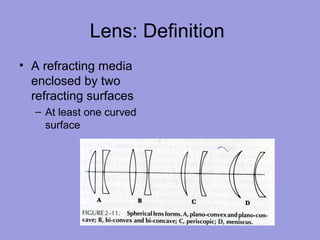
Lens: Definition
• A refracting media
enclosed by two
refracting surfaces
– At least one curved
surface
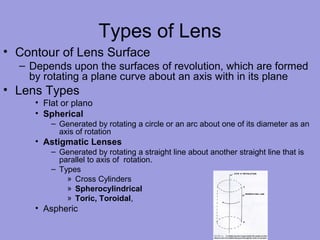
Types of Lens
• Contour of Lens Surface
– Depends upon the surfaces of revolution, which are formed
by rotating a plane curve about an axis with in its plane
• Lens Types
• Flat or plano
• Spherical
– Generated by rotating a circle or an arc about one of its diameter as an
axis of rotation
• Astigmatic Lenses
– Generated by rotating a straight line about another straight line that is
parallel to axis of rotation.
– Types
» Cross Cylinders
» Spherocylindrical
» Toric, Toroidal,
• Aspheric
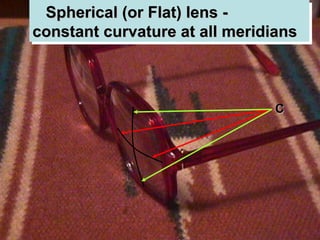
Spherical (or Flat) lens -Spherical (or Flat) lens -
constant curvature at all meridiansconstant curvature at all meridians
Spherical (or Flat) lens -Spherical (or Flat) lens -
constant curvature at all meridiansconstant curvature at all meridians
CC
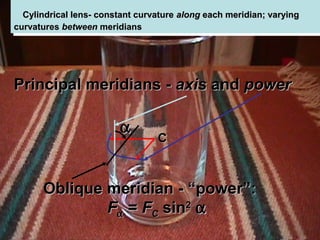
Cylindrical lens- constant curvatureCylindrical lens- constant curvature alongalong each meridian; varyingeach meridian; varying
curvaturescurvatures betweenbetween meridiansmeridians
Cylindrical lens- constant curvatureCylindrical lens- constant curvature alongalong each meridian; varyingeach meridian; varying
curvaturescurvatures betweenbetween meridiansmeridians
CC
Principal meridians -Principal meridians - axisaxis andand powerpower
Oblique meridian - “power”:Oblique meridian - “power”:
FFαα == FFCC sinsin22
αα
αα
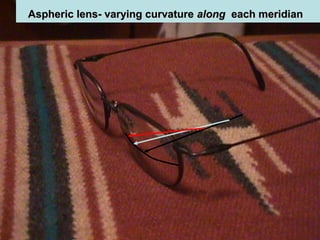
Aspheric lens- varying curvatureAspheric lens- varying curvature alongalong each meridianeach meridian
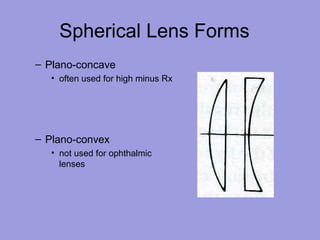
Spherical Lens Forms
– Plano-concave
• often used for high minus Rx
– Plano-convex
• not used for ophthalmic
lenses
Spherical lens forms
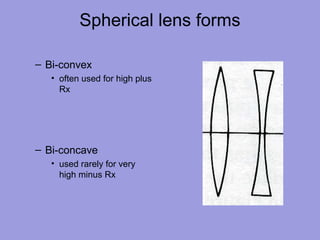
– Bi-convex
• often used for high plus
Rx
– Bi-concave
• used rarely for very
high minus Rx
Spherical lens forms
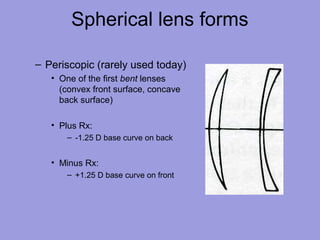
– Periscopic (rarely used today)
• One of the first bent lenses
(convex front surface, concave
back surface)
• Plus Rx:
– -1.25 D base curve on back
• Minus Rx:
– +1.25 D base curve on front
Spherical lens forms
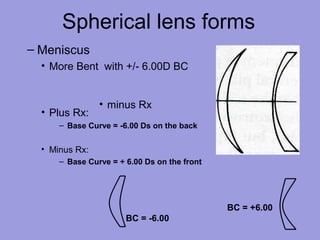
– Meniscus
• More Bent with +/- 6.00D BC
• Plus Rx:
– Base Curve = -6.00 Ds on the back
• Minus Rx:
– Base Curve = + 6.00 Ds on the front
• minus Rx
BC = -6.00
BC = +6.00
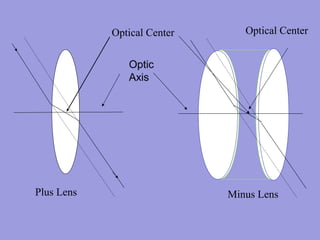
Optical Axis v. Optical Center of
a Lens
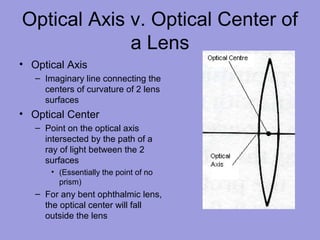
• Optical Axis
– Imaginary line connecting the
centers of curvature of 2 lens
surfaces
• Optical Center
– Point on the optical axis
intersected by the path of a
ray of light between the 2
surfaces
• (Essentially the point of no
prism)
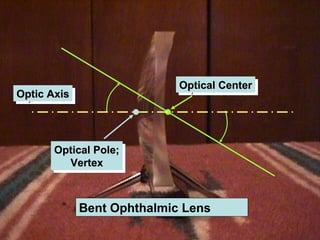
– For any bent ophthalmic lens,
the optical center will fall
outside the lens
Optic
Axis
Plus Lens Minus Lens
Optical Center Optical Center
Optical CenterOptical CenterOptical CenterOptical Center
Optic AxisOptic AxisOptic AxisOptic Axis
Optical Pole;Optical Pole;
VertexVertex
Optical Pole;Optical Pole;
VertexVertex
Bent Ophthalmic Lens
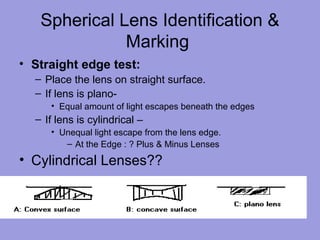
Spherical Lens Identification &
Marking
• Straight edge test:
– Place the lens on straight surface.
– If lens is plano-
• Equal amount of light escapes beneath the edges
– If lens is cylindrical –
• Unequal light escape from the lens edge.
– At the Edge : ? Plus & Minus Lenses
• Cylindrical Lenses??
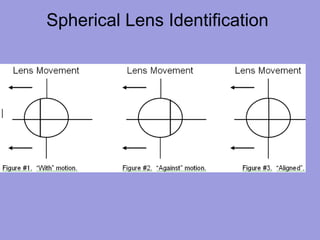
Spherical Lens Identification
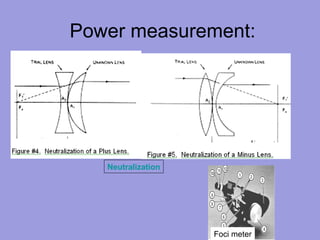
Power measurement:
Neutralization
Foci meter
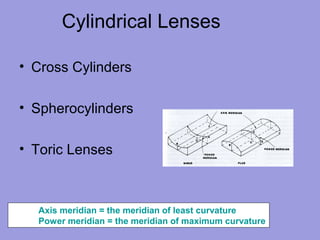
Cylindrical Lenses
• Cross Cylinders
• Spherocylinders
• Toric Lenses
Axis meridian = the meridian of least curvature
Power meridian = the meridian of maximum curvature
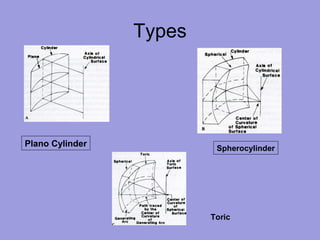
Types
Plano Cylinder Spherocylinder
Toric
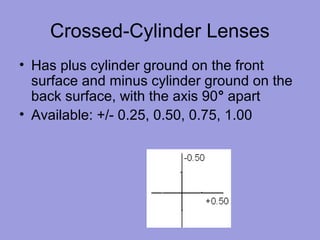
Crossed-Cylinder Lenses
• Has plus cylinder ground on the front
surface and minus cylinder ground on the
back surface, with the axis 90° apart
• Available: +/- 0.25, 0.50, 0.75, 1.00
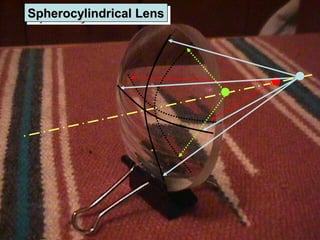
Spherocylindrical LensSpherocylindrical LensSpherocylindrical LensSpherocylindrical Lens
Astigmatic Lenses
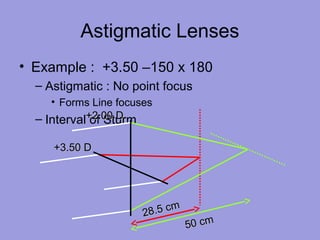
• Example : +3.50 –150 x 180
– Astigmatic : No point focus
• Forms Line focuses
– Interval of Sturm
+3.50 D+3.50 D
+2.00 D+2.00 D
28.5 cm
28.5 cm
50 cm50 cm
Astigmatic Lenses
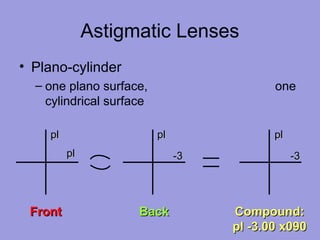
• Plano-cylinder
– one plano surface, one
cylindrical surface
plpl
plpl
FrontFront
plpl
-3-3
BackBack
plpl
-3-3
Compound:Compound:
pl -3.00 x090pl -3.00 x090
Astigmatic Lenses
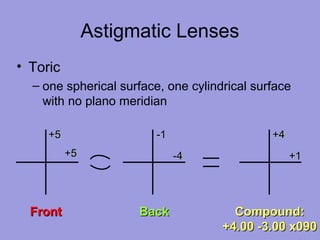
• Toric
– one spherical surface, one cylindrical surface
with no plano meridian
+5+5
+5+5
FrontFront
-1-1
-4-4
BackBack
+4+4
+1+1
Compound:Compound:
+4.00 -3.00 x090+4.00 -3.00 x090
Astigmatic Lenses
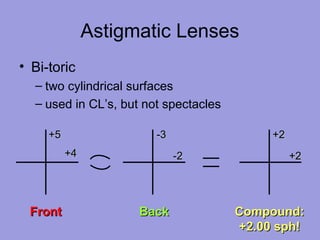
• Bi-toric
– two cylindrical surfaces
– used in CL’s, but not spectacles
+5+5
+4+4
FrontFront
-3-3
-2-2
BackBack
+2+2
+2+2
Compound:Compound:
+2.00 sph!+2.00 sph!
Astigmatic Lenses
• Obliquely crossed cylinders
– Cylinders that are NOT 0 or 90 deg apart
require special solutions
Crossed-Cylinder Lenses
• Has plus cylinder ground on the front
surface and minus cylinder ground on the
back surface, with the axis 90° apart
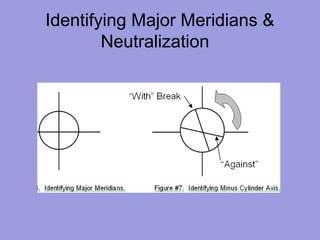
Identifying Major Meridians &
Neutralization
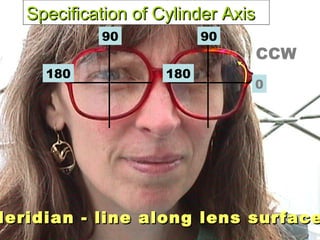
Meridian - line along lens surfaceMeridian - line along lens surface
90 90
180 180
CCW
0
Specification of Cylinder AxisSpecification of Cylinder Axis
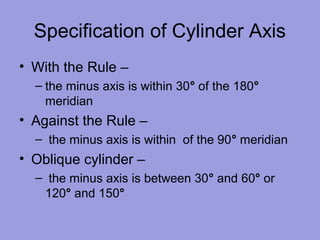
Specification of Cylinder Axis
• With the Rule –
– the minus axis is within 30° of the 180°
meridian
• Against the Rule –
– the minus axis is within of the 90° meridian
• Oblique cylinder –
– the minus axis is between 30° and 60° or
120° and 150°
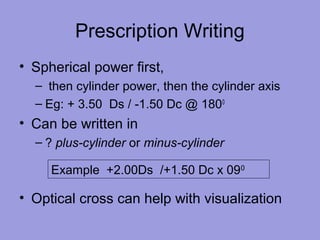
Prescription Writing
• Spherical power first,
– then cylinder power, then the cylinder axis
– Eg: + 3.50 Ds / -1.50 Dc @ 1800
• Can be written in
– ? plus-cylinder or minus-cylinder
• Optical cross can help with visualization
Example +2.00Ds /+1.50 Dc x 090
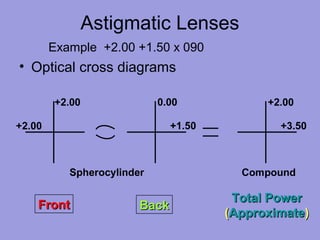
Astigmatic Lenses
• Optical cross diagrams
FrontFront BackBack
Total PowerTotal Power
((ApproximateApproximate))
Example +2.00 +1.50 x 090
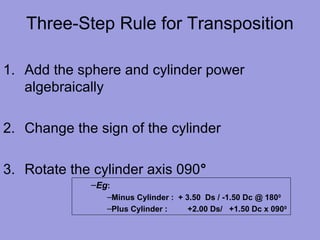
Three-Step Rule for Transposition
1. Add the sphere and cylinder power
algebraically
2. Change the sign of the cylinder
3. Rotate the cylinder axis 090°
–Eg:
–Minus Cylinder : + 3.50 Ds / -1.50 Dc @ 1800
–Plus Cylinder : +2.00 Ds/ +1.50 Dc x 0900
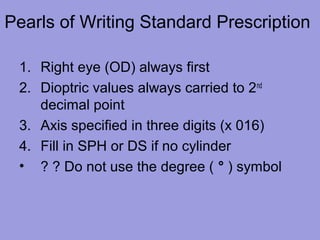
Pearls of Writing Standard Prescription
1. Right eye (OD) always first
2. Dioptric values always carried to 2nd
decimal point
3. Axis specified in three digits (x 016)
4. Fill in SPH or DS if no cylinder
• ? ? Do not use the degree ( ° ) symbol
34
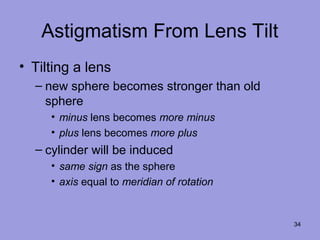
Astigmatism From Lens Tilt
• Tilting a lens
– new sphere becomes stronger than old
sphere
• minus lens becomes more minus
• plus lens becomes more plus
– cylinder will be induced
• same sign as the sphere
• axis equal to meridian of rotation
35
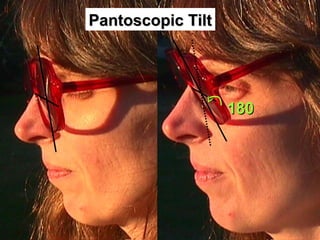
Pantoscopic TiltPantoscopic Tilt
180180
36
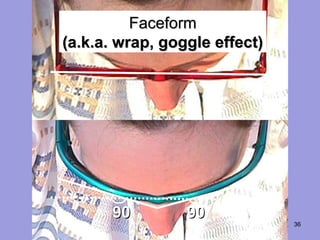
FaceformFaceform
(a.k.a. wrap, goggle effect)(a.k.a. wrap, goggle effect)
9090 9090
37
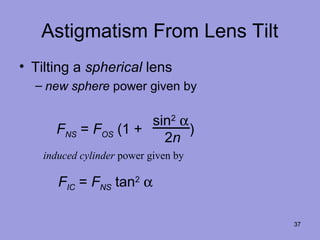
Astigmatism From Lens Tilt
• Tilting a spherical lens
– new sphere power given by
FIC = FNS tan2
α
FNS = FOS (1 + )
sin2
α
2n
induced cylinder power given by
38
Problem 3aProblem 3a
A +8.00 D lens has 20 degA +8.00 D lens has 20 deg
pantoscopicpantoscopic tilt. What is the newtilt. What is the new
power?power?
F = F
n
= +
N S O S (
s in
)
( ) (
s in
[ . ]
)
1
2
8 0 0 1
2 0
2 1 5 2 3
2
2
+
+
α
.
= +8.31 D
39
Problem 3aProblem 3a (cont’d)(cont’d)
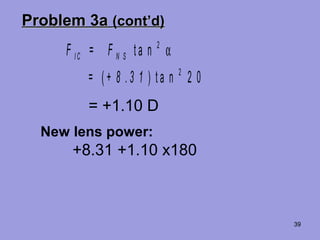
F = F
= + 8 . 3 1
I C N S t a n
( ) t a n
2
2
2 0
α
= +1.10 D
New lens power:
+8.31 +1.10 x180
40
Problem 3bProblem 3b
A -10.00 D lens has 10 degA -10.00 D lens has 10 deg
faceformfaceform tilt. What is the newtilt. What is the new
power?power?
F = F
n
=
N S O S (
s in
)
( ) (
s in
[ . ]
)
1
2
1 0 0 0 1
1 0
2 1 5 2 3
2
2
+
− +
α
.
= -10.10 D
41
Problem 3bProblem 3b (cont’d)(cont’d)
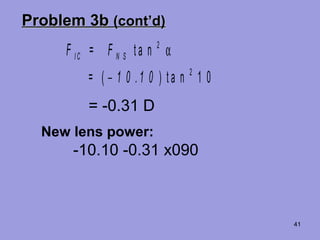
F = F
= 1 0 . 1 0
I C N S t a n
( ) t a n
2
2
1 0
α
−
= -0.31 D
New lens power:
-10.10 -0.31 x090
42
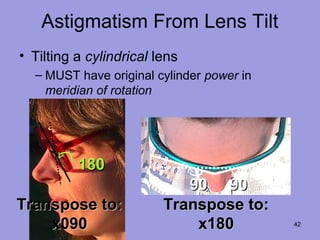
9090 9090
180180
Astigmatism From Lens Tilt
• Tilting a cylindrical lens
– MUST have original cylinder power in
meridian of rotation
Transpose to:Transpose to:
x090x090
Transpose to:Transpose to:
x180x180
Spherical Equivalent
• “Average” power of an ophthalmic lens
– Determined by combining one-half the cylindrical
power with the spherical power
• EG: + 4.50 Ds/ -1.50 Dc x 040
• ?? Spherical Equivalent = ??
Spherical Equivalent:
Significance
• Adjusting the cylinder and sphere to
ease patient adaptation to a new
spectacle Rx
• Determining the total plus at near
– when a prebyope’s spectacle Rx is
changing

Beginner’s Guide: Spherical & Cylindrical Lenses

  • 1.
    Beginner’s Guide: Spherical &Cylindrical Lenses Rabindra Adhikary ravinems@iom.edu.np
  • 2.
    Lens: Definition • Arefracting media enclosed by two refracting surfaces – At least one curved surface
  • 3.
    Types of Lens •Contour of Lens Surface – Depends upon the surfaces of revolution, which are formed by rotating a plane curve about an axis with in its plane • Lens Types • Flat or plano • Spherical – Generated by rotating a circle or an arc about one of its diameter as an axis of rotation • Astigmatic Lenses – Generated by rotating a straight line about another straight line that is parallel to axis of rotation. – Types » Cross Cylinders » Spherocylindrical » Toric, Toroidal, • Aspheric
  • 4.
    Spherical (or Flat)lens -Spherical (or Flat) lens - constant curvature at all meridiansconstant curvature at all meridians Spherical (or Flat) lens -Spherical (or Flat) lens - constant curvature at all meridiansconstant curvature at all meridians CC
  • 5.
    Cylindrical lens- constantcurvatureCylindrical lens- constant curvature alongalong each meridian; varyingeach meridian; varying curvaturescurvatures betweenbetween meridiansmeridians Cylindrical lens- constant curvatureCylindrical lens- constant curvature alongalong each meridian; varyingeach meridian; varying curvaturescurvatures betweenbetween meridiansmeridians CC Principal meridians -Principal meridians - axisaxis andand powerpower Oblique meridian - “power”:Oblique meridian - “power”: FFαα == FFCC sinsin22 αα αα
  • 6.
    Aspheric lens- varyingcurvatureAspheric lens- varying curvature alongalong each meridianeach meridian
  • 7.
    Spherical Lens Forms –Plano-concave • often used for high minus Rx – Plano-convex • not used for ophthalmic lenses
  • 8.
    Spherical lens forms –Bi-convex • often used for high plus Rx – Bi-concave • used rarely for very high minus Rx
  • 9.
    Spherical lens forms –Periscopic (rarely used today) • One of the first bent lenses (convex front surface, concave back surface) • Plus Rx: – -1.25 D base curve on back • Minus Rx: – +1.25 D base curve on front
  • 10.
    Spherical lens forms –Meniscus • More Bent with +/- 6.00D BC • Plus Rx: – Base Curve = -6.00 Ds on the back • Minus Rx: – Base Curve = + 6.00 Ds on the front • minus Rx BC = -6.00 BC = +6.00
  • 11.
    Optical Axis v.Optical Center of a Lens • Optical Axis – Imaginary line connecting the centers of curvature of 2 lens surfaces • Optical Center – Point on the optical axis intersected by the path of a ray of light between the 2 surfaces • (Essentially the point of no prism) – For any bent ophthalmic lens, the optical center will fall outside the lens
  • 12.
    Optic Axis Plus Lens MinusLens Optical Center Optical Center
  • 13.
    Optical CenterOptical CenterOpticalCenterOptical Center Optic AxisOptic AxisOptic AxisOptic Axis Optical Pole;Optical Pole; VertexVertex Optical Pole;Optical Pole; VertexVertex Bent Ophthalmic Lens
  • 14.
    Spherical Lens Identification& Marking • Straight edge test: – Place the lens on straight surface. – If lens is plano- • Equal amount of light escapes beneath the edges – If lens is cylindrical – • Unequal light escape from the lens edge. – At the Edge : ? Plus & Minus Lenses • Cylindrical Lenses??
  • 15.
  • 16.
  • 17.
    Cylindrical Lenses • CrossCylinders • Spherocylinders • Toric Lenses Axis meridian = the meridian of least curvature Power meridian = the meridian of maximum curvature
  • 18.
  • 19.
    Crossed-Cylinder Lenses • Hasplus cylinder ground on the front surface and minus cylinder ground on the back surface, with the axis 90° apart • Available: +/- 0.25, 0.50, 0.75, 1.00
  • 20.
  • 21.
    Astigmatic Lenses • Example: +3.50 –150 x 180 – Astigmatic : No point focus • Forms Line focuses – Interval of Sturm +3.50 D+3.50 D +2.00 D+2.00 D 28.5 cm 28.5 cm 50 cm50 cm
  • 22.
    Astigmatic Lenses • Plano-cylinder –one plano surface, one cylindrical surface plpl plpl FrontFront plpl -3-3 BackBack plpl -3-3 Compound:Compound: pl -3.00 x090pl -3.00 x090
  • 23.
    Astigmatic Lenses • Toric –one spherical surface, one cylindrical surface with no plano meridian +5+5 +5+5 FrontFront -1-1 -4-4 BackBack +4+4 +1+1 Compound:Compound: +4.00 -3.00 x090+4.00 -3.00 x090
  • 24.
    Astigmatic Lenses • Bi-toric –two cylindrical surfaces – used in CL’s, but not spectacles +5+5 +4+4 FrontFront -3-3 -2-2 BackBack +2+2 +2+2 Compound:Compound: +2.00 sph!+2.00 sph!
  • 25.
    Astigmatic Lenses • Obliquelycrossed cylinders – Cylinders that are NOT 0 or 90 deg apart require special solutions
  • 26.
    Crossed-Cylinder Lenses • Hasplus cylinder ground on the front surface and minus cylinder ground on the back surface, with the axis 90° apart
  • 27.
  • 28.
    Meridian - linealong lens surfaceMeridian - line along lens surface 90 90 180 180 CCW 0 Specification of Cylinder AxisSpecification of Cylinder Axis
  • 29.
    Specification of CylinderAxis • With the Rule – – the minus axis is within 30° of the 180° meridian • Against the Rule – – the minus axis is within of the 90° meridian • Oblique cylinder – – the minus axis is between 30° and 60° or 120° and 150°
  • 30.
    Prescription Writing • Sphericalpower first, – then cylinder power, then the cylinder axis – Eg: + 3.50 Ds / -1.50 Dc @ 1800 • Can be written in – ? plus-cylinder or minus-cylinder • Optical cross can help with visualization Example +2.00Ds /+1.50 Dc x 090
  • 31.
    Astigmatic Lenses • Opticalcross diagrams FrontFront BackBack Total PowerTotal Power ((ApproximateApproximate)) Example +2.00 +1.50 x 090
  • 32.
    Three-Step Rule forTransposition 1. Add the sphere and cylinder power algebraically 2. Change the sign of the cylinder 3. Rotate the cylinder axis 090° –Eg: –Minus Cylinder : + 3.50 Ds / -1.50 Dc @ 1800 –Plus Cylinder : +2.00 Ds/ +1.50 Dc x 0900
  • 33.
    Pearls of WritingStandard Prescription 1. Right eye (OD) always first 2. Dioptric values always carried to 2nd decimal point 3. Axis specified in three digits (x 016) 4. Fill in SPH or DS if no cylinder • ? ? Do not use the degree ( ° ) symbol
  • 34.
    34 Astigmatism From LensTilt • Tilting a lens – new sphere becomes stronger than old sphere • minus lens becomes more minus • plus lens becomes more plus – cylinder will be induced • same sign as the sphere • axis equal to meridian of rotation
  • 35.
  • 36.
    36 FaceformFaceform (a.k.a. wrap, goggleeffect)(a.k.a. wrap, goggle effect) 9090 9090
  • 37.
    37 Astigmatism From LensTilt • Tilting a spherical lens – new sphere power given by FIC = FNS tan2 α FNS = FOS (1 + ) sin2 α 2n induced cylinder power given by
  • 38.
    38 Problem 3aProblem 3a A+8.00 D lens has 20 degA +8.00 D lens has 20 deg pantoscopicpantoscopic tilt. What is the newtilt. What is the new power?power? F = F n = + N S O S ( s in ) ( ) ( s in [ . ] ) 1 2 8 0 0 1 2 0 2 1 5 2 3 2 2 + + α . = +8.31 D
  • 39.
    39 Problem 3aProblem 3a(cont’d)(cont’d) F = F = + 8 . 3 1 I C N S t a n ( ) t a n 2 2 2 0 α = +1.10 D New lens power: +8.31 +1.10 x180
  • 40.
    40 Problem 3bProblem 3b A-10.00 D lens has 10 degA -10.00 D lens has 10 deg faceformfaceform tilt. What is the newtilt. What is the new power?power? F = F n = N S O S ( s in ) ( ) ( s in [ . ] ) 1 2 1 0 0 0 1 1 0 2 1 5 2 3 2 2 + − + α . = -10.10 D
  • 41.
    41 Problem 3bProblem 3b(cont’d)(cont’d) F = F = 1 0 . 1 0 I C N S t a n ( ) t a n 2 2 1 0 α − = -0.31 D New lens power: -10.10 -0.31 x090
  • 42.
    42 9090 9090 180180 Astigmatism FromLens Tilt • Tilting a cylindrical lens – MUST have original cylinder power in meridian of rotation Transpose to:Transpose to: x090x090 Transpose to:Transpose to: x180x180
  • 43.
    Spherical Equivalent • “Average”power of an ophthalmic lens – Determined by combining one-half the cylindrical power with the spherical power • EG: + 4.50 Ds/ -1.50 Dc x 040 • ?? Spherical Equivalent = ??
  • 44.
    Spherical Equivalent: Significance • Adjustingthe cylinder and sphere to ease patient adaptation to a new spectacle Rx • Determining the total plus at near – when a prebyope’s spectacle Rx is changing