Presenter
Definition
 Non-Accommodative Esotropia or Non-Accommodative convergent Squint
refers to the ESO-DEVIATIONS which are not primarily elicited by the direct
influence of ACCOMMODATION.
 Characterized by
-Comitant Esotropia
-Acquired
-Onset after 6 months to 5 years
-Small to large angle deviation
-little or no hyperopia
-Normal AC/A ratio
-No neurologic or systemic sign or symptoms
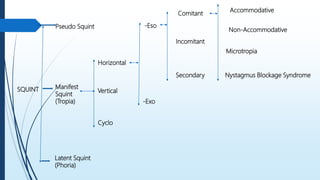
SQUINT
Pseudo Squint
Manifest
Squint
(Tropia)
Latent Squint
(Phoria)
Horizontal
Vertical
Cyclo
-Eso
-Exo
Comitant
Incomitant
Secondary
Accommodative
Non-Accommodative
Microtropia
Nystagmus Blockage Syndrome
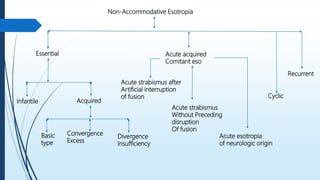
Non-Accommodative Esotropia
Essential
Infantile Acquired
Basic
type
Convergence
Excess
Divergence
Insufficiency
Acute acquired
Comitant eso
Acute strabismus after
Artificial interruption
of fusion
Acute strabismus
Without Preceding
disruption
Of fusion
Acute esotropia
of neurologic origin
Cyclic
Recurrent
A. Essential
B. Acute Acquired Comitant
A. 1.ESSENTIAL INFANTILE ESOTROPIA
-Esotropia unilateral or bilateral
-occurs after birth within 6 months
Etiology
-Primary cause idiopathic
-Secondary causes are :
>Primary motor dysfunction associated with poor fusion
>family history of strabismus
>born prematurely
>a seizure disorder of hydrocephalus
FIXATION PATTERN INVESTIGATION
. Doll’s eye movement
. Alternate Patching
ASSOCIATED FACTOTS
 Nystagmus; both manifest (rare) and latent (common)
 Amblyopia ; not common
 Inferior oblique Over Action
 Abnormal Head Posture
 DVD OR DHD
 Asymmetric Optokinetic Nystagmus
Placing object on lateral side
Clinical Features
 Amount of Deviation =30- 40
 Onset = after birth – 6 months (75% 2-3 months)
 Fixation Pattern = cross fixation
 Visual Acuity = Normal or Equal in Both Eyes
 Refractive Error = may or may not present
TREATMENT
 Muscle Surgery – first check for associated factors and then wait for 6- 7 months for
surgery
 Bilateral MR Recession or LR Resection
 A. 2. ESSENTIAL Acquired Esotropia
a. Basic
b. Convergence
c. Divergence Insufficiency
a. Basic Esotropia
- Comitant Esotropia
- Amount of deviation is almost equal for distance and near in optically corrected eye
- Normal AC/A ratio
Etiology
-Innervational imbalance in muscle Excessive Tonic convergence
Muscle Imbalance
Improper Muscle Tone
CLINICAL FEATURES
Onset = after 6 months – 5 years
Amount of Deviation = almost equal for distance and near
Normal AC/A ratio
NPA within normal limit
Refractive Error = Hyperopia or Emmetropia
TREATMENT
(No glasses or miotics are helpful)
-First treat amblyopia
-Muscle Surgery (BL MR recession but depends on surgeon)
 b. Convergence Excess Esotropia
- Comitant Esotropia
- More deviation at near than distance
-Divergence is normal ( Deviation at distance is neutralized)
-Not associated with any refractive error or High AC/A ratio
Etiology
Increased Innervational Tone of Converging Muscle
Clinical Features
 onset – 1 to 5 years of age
 AC/A ratio is normal
 NPA is normal
 Amount of Deviation is more at near than distance
 Refractive Error may be Hyperopic or else EMMETROPIC
 TREATMENT
Muscle Surgery ( BL MR Recession but depends on surgeon)
 C. DIVERGENCE INSUFFICIENCY ESOTROPIA
Comitant esotropia in which deviation is more in distance than near and is associated
with the weakening of the diverging muscle.
- Convergence for near is normal
- Chances of amblyopia is high
Etiology
Innervational imbalance in muscle action
Clinical Features
- After 6 months to any age
- AC/A ratio is normal
- NPA is normal
- Amount of deviation is more at distance than near
- Refractive Error is not associated
 TREATMENT
Muscle Surgery is not reliable
Spectacles with BO prisms are helpful
Spectacle to be worn when distance vision is needed
 B. ACUTE ACQUIRED COMITANT ESOTROPIA
 Comitant esotropia which is always associated with diplopia.
 It has acute onset and so can occur at any age.
 It is not associated with paralysis of muscle
B.1. ACUTE STRABISMUS AFTER ARTIFICIAL INTERRUPTION OF FUSION
Patients may have no history of Squint.
Esotropia occurs after interruption of FUSION.
Fusion breakdown conditions are :-
i. Prolonged bandaging or Patching
ii. Occlusion in refractive amblyopia
iii. Swelling of eyelid followed by trauma
Postulate ; initially patients have ESOPHORIA which was being controlled
by well self functioning fusion.
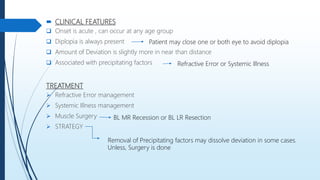
 CLINICAL FEATURES
 Onset is acute , can occur at any age group
 Diplopia is always present
 Amount of Deviation is slightly more in near than distance
 Associated with precipitating factors
TREATMENT
 Refractive Error management
 Systemic Illness management
 Muscle Surgery
 STRATEGY
Patient may close one or both eye to avoid diplopia
Refractive Error or Systemic Illness
BL MR Recession or BL LR Resection
Removal of Precipitating factors may dissolve deviation in some cases.
Unless, Surgery is done
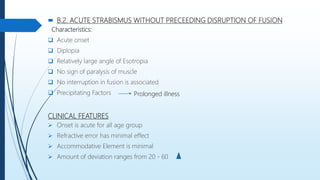
 B.2. ACUTE STRABISMUS WITHOUT PRECEEDING DISRUPTION OF FUSION
Characteristics:
 Acute onset
 Diplopia
 Relatively large angle of Esotropia
 No sign of paralysis of muscle
 No interruption in fusion is associated
 Precipitating Factors
CLINICAL FEATURES
 Onset is acute for all age group
 Refractive error has minimal effect
 Accommodative Element is minimal
 Amount of deviation ranges from 20 - 60
Prolonged illness
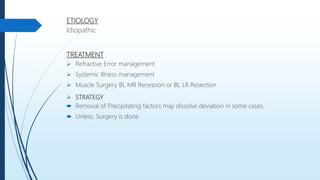
ETIOLOGY
Idiopathic
TREATMENT
 Refractive Error management
 Systemic Illness management
 Muscle Surgery BL MR Recession or BL LR Resection
 STRATEGY
 Removal of Precipitating factors may dissolve deviation in some cases.
 Unless, Surgery is done
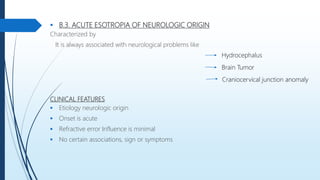
 B.3. ACUTE ESOTROPIA OF NEUROLOGIC ORIGIN
Characterized by
It is always associated with neurological problems like
CLINICAL FEATURES
 Etiology neurologic origin
 Onset is acute
 Refractive error Influence is minimal
 No certain associations, sign or symptoms
Hydrocephalus
Brain Tumor
Craniocervical junction anomaly
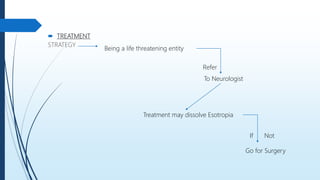
 TREATMENT
STRATEGY
Being a life threatening entity
Refer
To Neurologist
Treatment may dissolve Esotropia
If Not
Go for Surgery
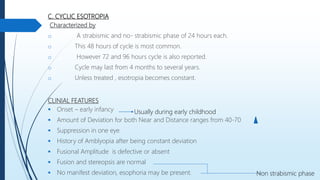
C. CYCLIC ESOTROPIA
Characterized by
o A strabismic and no- strabismic phase of 24 hours each.
o This 48 hours of cycle is most common.
o However 72 and 96 hours cycle is also reported.
o Cycle may last from 4 months to several years.
o Unless treated , esotropia becomes constant.
CLINIAL FEATURES
 Onset – early infancy
 Amount of Deviation for both Near and Distance ranges from 40-70
 Suppression in one eye
 History of Amblyopia after being constant deviation
 Fusional Amplitude is defective or absent
 Fusion and stereopsis are normal
 No manifest deviation, esophoria may be present.
Usually during early childhood
Non strabismic phase
 Not related to
 Visual Acuity
 General or Ocular fatigue
 Accommodation
 Disruption of sensory fusion
 Esotropia may be UL or B L
ETIOLOGY
Idiopathic
TREATMENT
Muscle Surgery
D. RECURRENT ESOTROPIA ( AKA Malignant Esotropia)
An unusual form of esotropia which reoccurs of the same angle even after multiple
operations.
No associations with conditions like :-
Increased uncorrected hyperopia
A deep seated ARC
Nystagmus blockage syndrome
An unstable AC/A ratio
Blind Spot Syndrome
CLINICAL FEATURES
 Recurrent occurrence
 AC/A Normal
 Refractive Error influence is minimal
ETIOLOGY
Idiopathic
TREATMENT
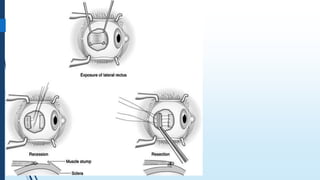
Initially Muscle Surgery
BI Prisms mounted on spectacle
Non- Accommodative Convergent Squint

Non- Accommodative Convergent Squint

  • 1.
  • 2.
    Definition  Non-Accommodative Esotropiaor Non-Accommodative convergent Squint refers to the ESO-DEVIATIONS which are not primarily elicited by the direct influence of ACCOMMODATION.  Characterized by -Comitant Esotropia -Acquired -Onset after 6 months to 5 years -Small to large angle deviation -little or no hyperopia -Normal AC/A ratio -No neurologic or systemic sign or symptoms
  • 3.
  • 4.
    Non-Accommodative Esotropia Essential Infantile Acquired Basic type Convergence Excess Divergence Insufficiency Acuteacquired Comitant eso Acute strabismus after Artificial interruption of fusion Acute strabismus Without Preceding disruption Of fusion Acute esotropia of neurologic origin Cyclic Recurrent
  • 5.
    A. Essential B. AcuteAcquired Comitant A. 1.ESSENTIAL INFANTILE ESOTROPIA -Esotropia unilateral or bilateral -occurs after birth within 6 months Etiology -Primary cause idiopathic -Secondary causes are : >Primary motor dysfunction associated with poor fusion >family history of strabismus >born prematurely >a seizure disorder of hydrocephalus
  • 6.
    FIXATION PATTERN INVESTIGATION .Doll’s eye movement . Alternate Patching ASSOCIATED FACTOTS  Nystagmus; both manifest (rare) and latent (common)  Amblyopia ; not common  Inferior oblique Over Action  Abnormal Head Posture  DVD OR DHD  Asymmetric Optokinetic Nystagmus Placing object on lateral side
  • 7.
    Clinical Features  Amountof Deviation =30- 40  Onset = after birth – 6 months (75% 2-3 months)  Fixation Pattern = cross fixation  Visual Acuity = Normal or Equal in Both Eyes  Refractive Error = may or may not present TREATMENT  Muscle Surgery – first check for associated factors and then wait for 6- 7 months for surgery  Bilateral MR Recession or LR Resection
  • 8.
     A. 2.ESSENTIAL Acquired Esotropia a. Basic b. Convergence c. Divergence Insufficiency a. Basic Esotropia - Comitant Esotropia - Amount of deviation is almost equal for distance and near in optically corrected eye - Normal AC/A ratio Etiology -Innervational imbalance in muscle Excessive Tonic convergence Muscle Imbalance Improper Muscle Tone
  • 9.
    CLINICAL FEATURES Onset =after 6 months – 5 years Amount of Deviation = almost equal for distance and near Normal AC/A ratio NPA within normal limit Refractive Error = Hyperopia or Emmetropia TREATMENT (No glasses or miotics are helpful) -First treat amblyopia -Muscle Surgery (BL MR recession but depends on surgeon)
  • 10.
     b. ConvergenceExcess Esotropia - Comitant Esotropia - More deviation at near than distance -Divergence is normal ( Deviation at distance is neutralized) -Not associated with any refractive error or High AC/A ratio Etiology Increased Innervational Tone of Converging Muscle Clinical Features  onset – 1 to 5 years of age  AC/A ratio is normal  NPA is normal  Amount of Deviation is more at near than distance  Refractive Error may be Hyperopic or else EMMETROPIC
  • 11.
     TREATMENT Muscle Surgery( BL MR Recession but depends on surgeon)
  • 12.
     C. DIVERGENCEINSUFFICIENCY ESOTROPIA Comitant esotropia in which deviation is more in distance than near and is associated with the weakening of the diverging muscle. - Convergence for near is normal - Chances of amblyopia is high Etiology Innervational imbalance in muscle action Clinical Features - After 6 months to any age - AC/A ratio is normal - NPA is normal - Amount of deviation is more at distance than near - Refractive Error is not associated
  • 13.
     TREATMENT Muscle Surgeryis not reliable Spectacles with BO prisms are helpful Spectacle to be worn when distance vision is needed
  • 14.
     B. ACUTEACQUIRED COMITANT ESOTROPIA  Comitant esotropia which is always associated with diplopia.  It has acute onset and so can occur at any age.  It is not associated with paralysis of muscle B.1. ACUTE STRABISMUS AFTER ARTIFICIAL INTERRUPTION OF FUSION Patients may have no history of Squint. Esotropia occurs after interruption of FUSION. Fusion breakdown conditions are :- i. Prolonged bandaging or Patching ii. Occlusion in refractive amblyopia iii. Swelling of eyelid followed by trauma Postulate ; initially patients have ESOPHORIA which was being controlled by well self functioning fusion.
  • 15.
     CLINICAL FEATURES Onset is acute , can occur at any age group  Diplopia is always present  Amount of Deviation is slightly more in near than distance  Associated with precipitating factors TREATMENT  Refractive Error management  Systemic Illness management  Muscle Surgery  STRATEGY Patient may close one or both eye to avoid diplopia Refractive Error or Systemic Illness BL MR Recession or BL LR Resection Removal of Precipitating factors may dissolve deviation in some cases. Unless, Surgery is done
  • 16.
     B.2. ACUTESTRABISMUS WITHOUT PRECEEDING DISRUPTION OF FUSION Characteristics:  Acute onset  Diplopia  Relatively large angle of Esotropia  No sign of paralysis of muscle  No interruption in fusion is associated  Precipitating Factors CLINICAL FEATURES  Onset is acute for all age group  Refractive error has minimal effect  Accommodative Element is minimal  Amount of deviation ranges from 20 - 60 Prolonged illness
  • 17.
    ETIOLOGY Idiopathic TREATMENT  Refractive Errormanagement  Systemic Illness management  Muscle Surgery BL MR Recession or BL LR Resection  STRATEGY  Removal of Precipitating factors may dissolve deviation in some cases.  Unless, Surgery is done
  • 18.
     B.3. ACUTEESOTROPIA OF NEUROLOGIC ORIGIN Characterized by It is always associated with neurological problems like CLINICAL FEATURES  Etiology neurologic origin  Onset is acute  Refractive error Influence is minimal  No certain associations, sign or symptoms Hydrocephalus Brain Tumor Craniocervical junction anomaly
  • 19.
     TREATMENT STRATEGY Being alife threatening entity Refer To Neurologist Treatment may dissolve Esotropia If Not Go for Surgery
  • 20.
    C. CYCLIC ESOTROPIA Characterizedby o A strabismic and no- strabismic phase of 24 hours each. o This 48 hours of cycle is most common. o However 72 and 96 hours cycle is also reported. o Cycle may last from 4 months to several years. o Unless treated , esotropia becomes constant. CLINIAL FEATURES  Onset – early infancy  Amount of Deviation for both Near and Distance ranges from 40-70  Suppression in one eye  History of Amblyopia after being constant deviation  Fusional Amplitude is defective or absent  Fusion and stereopsis are normal  No manifest deviation, esophoria may be present. Usually during early childhood Non strabismic phase
  • 21.
     Not relatedto  Visual Acuity  General or Ocular fatigue  Accommodation  Disruption of sensory fusion  Esotropia may be UL or B L
  • 22.
  • 23.
    D. RECURRENT ESOTROPIA( AKA Malignant Esotropia) An unusual form of esotropia which reoccurs of the same angle even after multiple operations. No associations with conditions like :- Increased uncorrected hyperopia A deep seated ARC Nystagmus blockage syndrome An unstable AC/A ratio Blind Spot Syndrome CLINICAL FEATURES  Recurrent occurrence  AC/A Normal  Refractive Error influence is minimal
  • 24.