Bifocals
Presented by –
MAAZ UL HAQ
C.L GUPTA EYE INSTITUTE MORADABAD
Definition
• A bifocal lens is defined as a le
ns having two portions of differ
ent focal power, used for differe
nt distances …most likely distan
ce and near
Basic Principle
Bifocal addition segment can be created by
 Increasing the refractive index of the button
 Steepening the curvature of the button keeping the
same material
History
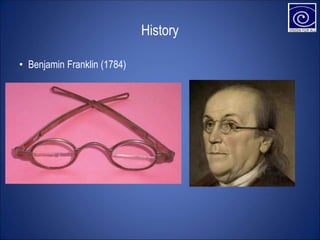
• Benjamin Franklin (1784)
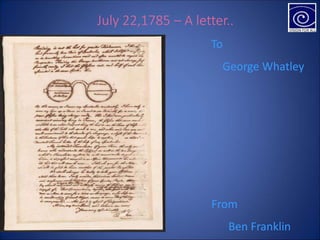
From
Ben Franklin
July 22,1785 – A letter..

To
George Whatley
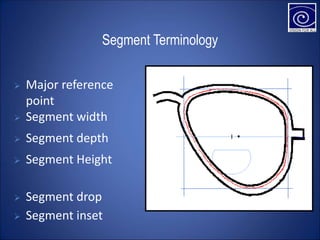
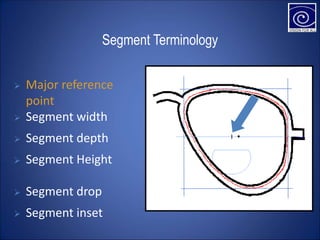
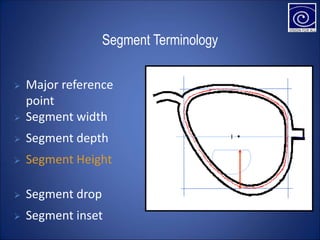
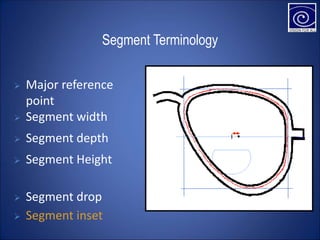
Segment Terminology
 Segment width
 Segment depth
 Segment Height
 Segment drop
 Segment inset
 Major reference
point
Segment Terminology
 Segment width
 Segment depth
 Segment Height
 Segment drop
 Segment inset
 Major reference
point
Segment Terminology
 Segment width
 Segment depth
 Segment Height
 Segment drop
 Segment inset
 Major reference
point
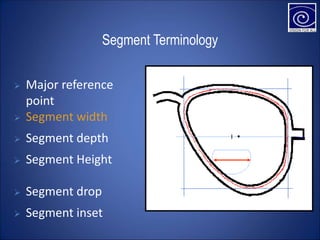
Segment width or diameter
• Widest horizontal measurement of the segment
• For kryptok – max. 22mm
• For D – bifocal max. 28mm
Segment Terminology
 Segment width
 Segment depth
 Segment Height
 Segment drop
 Segment inset
 Major reference
point
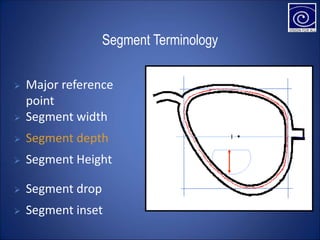
Segment depth
• Vertical distance from the segment top to a horizontal line tangent to t
he segment bottom at its lowest point.
Segment Terminology
 Segment width
 Segment depth
 Segment Height
 Segment drop
 Segment inset
 Major reference
point
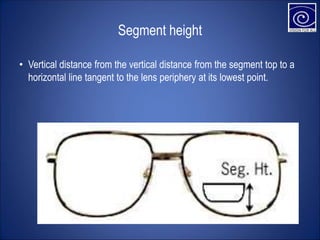
Segment height
• Vertical distance from the vertical distance from the segment top to a
horizontal line tangent to the lens periphery at its lowest point.
Segment Terminology
 Segment width
 Segment depth
 Segment Height
 Segment drop
 Segment inset
 Major reference
point
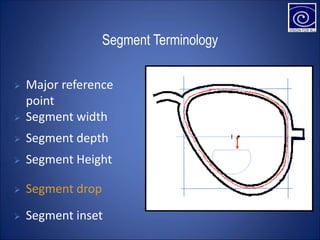
Segment drop
• Vertical distance from the segment top to the distance optical center
•
Segment Terminology
 Segment width
 Segment depth
 Segment Height
 Segment drop
 Segment inset
 Major reference
point
Segment inset
• The horizantal distance b/w the distance OC and segment OC. – Geo
metric Inset.
Relation with…
• IPD↑ - ↑Seg In
• + ↑-↑seg In
• Fixation distance ↑- seg seginset↓.
Types of Bifocals (according to segment type
)
Basic bifocal segment types include:
1. Round segment
2. Flat top segment
3. Curve-top and panoptik segments
4. Ribbon segments  B and R segment
5. Franklin style or Executive segments
Round Segments(Kryptok bifocals)
• Vary in size from a small lens of 22 mm up to the largest, 40 m
m.
• The most common size is 22 mm
• The optical center (OC) of a round segment is always at the cen
ter of the segment.
Kryptok Bifocal
Advantages:
• No dust collection
• No discoloration
• Relatively invisible
• Easy to manufacture
• Low cost
• Good distance users
Disadvantages:
• Drooping of eyes
• Increased image jump
• Chromatic aberration
• Only 22mm
Flat-top Segments
• Basically round segments with the top cut off
• The top is generally “cut off” 4.5 to 5.0 mm above the center o
f the segment
• The segment OC is about 5 mm below the seg line
• Allows the lens segment to have maximum reading width wher
e a person will be reading
Cont….
• Flat tops are also known as D segs.
• Segment sizes range from 22 up to 45 mm
• Most commonly used now are 28 mm or greater
Flat Top Bifocal
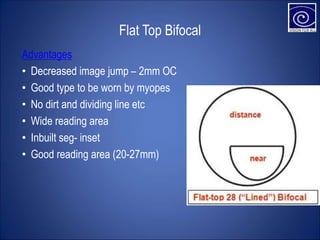
Advantages
• Decreased image jump – 2mm OC
• Good type to be worn by myopes
• No dirt and dividing line etc
• Wide reading area
• Inbuilt seg- inset
• Good reading area (20-27mm)
Flat Top Bifocal
Disadvantages:
• Chromatic aberration - fused type, while it is absent with one-piece fla
t top type
• Expensive type
• No to Hypermetropic distance correction
• Care to be taken - Right axis
• Prominent seg – top.
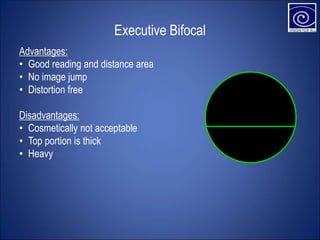
Franklin-Style or Executive Segments
• More commonly known by the trade name, Executive
• It is a one-piece lens with the segment extending the full width
of the lens
• Has the segment OC on the segment line
• Therefore also known as “monocentric” bifocals.
Executive Bifocal
Advantages:
• Good reading and distance area
• No image jump
• Distortion free
Disadvantages:
• Cosmetically not acceptable
• Top portion is thick
• Heavy
Curve-top & Panoptik segments
• Look similar to flat tops, except that the upper line is arched, r
ather than flat
• The top of panoptik segments are curved as well, but the corn
ers are rounded.
Ribbon Segments
• Ribbon segments are basically round segments with the top an
d bottom cut off
• Two types: B and an R segment
Cont….
• The B is only 9 mm deep and is good for someone who must b
e able to have distance vision below the bifocal area
• The R segment has a 14 mm depth. It is seldom used as a regul
ar bifocal lens
• Both B and R segments have their segment optical centers in t
he middle of the segment
Types of bifocal (according to construction)
• Basically there are three main types:
1. Fused bifocal
2. One piece bifocal
3. Cemented bifocal
Fused bifocals/multifocals
• available only in glass
• The segment of the lens is made from glass having a higher ref
ractive index than that of the distance lens.
Cont….
• Segment cannot be felt because it is fused into distance portio
n
• The basic designs include round seg, flat-top seg, panoptic sag
and ribbon segments
One piece bifocal/multifocals
• Are made from one lens material
• change in power in the segment portion of the lens is due to a
change in the surface curvature of the lens
• Can be identified by feeling the segment border
Cont….
• Can be made from any lens material
• All plastic lenses are made as one piece multifocals
• Examples are ultex bifocal, franklin or exucutive style
Cemented bifocals/multifocals
• Cement lenses are custom-made lenses that have a small segm
ent glued onto the distance lens
• The cement used is Canada balsam (having same refractive ind
ex as the glass)
Cont..
• Advantages are very easy to made, inexpensive and may be re
placed by a new power when required
• Problems are canada balsam may dry and crystalized or may so
ften
• Used only for specialized custom purposes
Test
1. Which of the following is correct?
a. (distance power) + (near power) = (near Rx)
b. (near power) - (distance power) = (near addition)
c. (near addition) = (distance power) - (near power)
d. (near power) - (distance power) = (near Rx)
e. None of the above is correct
2. Which of the following statements is correct?
a. Seg height is always equal to seg depth.
b. Seg depth is always greater than or equal to seg
height.
c. Seg height is always greater than or equal to seg
depth.
d. Seg height is always greater than seg depth.
e. None of the above is correct
The lensmeter reads:
−1.00 −1.00 × 180 in the distance portion
+1.50 −1.00 × 180 in the near portion
What is the near add?
a. +l.50 D
b. +l.75 D
c. +2.00 D
d. +2.25 D
e. +2.50 D
If you could not see a lens and were only able to
feel the surfaces, which of the following
multifocals could not be distinguished from a
single vision lens?
a. a fused glass multifocal lens
b. a one-piece construction multifocal lens
c. a cement segment multifocal lens
d. All could be distinguished from a single vision
lens.
e. None could be distinguished from a single
vision lens.
An Executive lens is an example of which type of
construction?
a. fused
b. one piece
c. cement segment
Which of the following multifocal construction
methods are used only with glass?
a. fused
b. one piece
c. cement segment
True or false?
• One-piece multifocal construction is
used only with plastic lenses, not with glass.
Measuring for Bifocals
• As easy as measuring IPD
• Measurement for segment height should be done using only t
he actual frame that will be worn
• The frame must be carefully positioned to sit at the same heig
ht at which it will be worn.
Method
Two methods
1. Lower limbus method
2. Lower lid margin method
Steps in Measuring Bifocal Height Using Lo
wer
Lid or Limbal Method
1. Fitter positions himself or herself on the same level as the subj
ect.
2. Subject fixates the bridge of the fitter’s nose.
3. Holding frame in correct wearing position, the fitter places the
PD rule vertically in front of subject’s right eye. The zero point i
s at lower limbus and the ruler scale is positioned downward.
4. For a rimmed frame, the fitter reads the scale at the level of th
e lowest point where the inside of the groove would be. For a r
imless frame, the reference is the level of the lowest point on t
he demo lens.
5. Repeat for left eye.
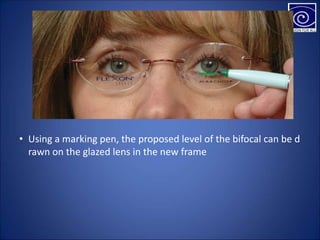
• Using a marking pen, the proposed level of the bifocal can be d
rawn on the glazed lens in the new frame
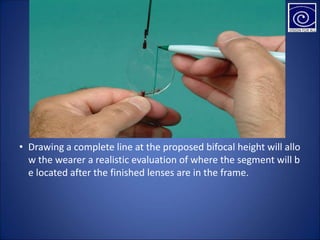
• Drawing a complete line at the proposed bifocal height will allo
w the wearer a realistic evaluation of where the segment will b
e located after the finished lenses are in the frame.

Bifocals PPT

  • 1.
    Bifocals Presented by – MAAZUL HAQ C.L GUPTA EYE INSTITUTE MORADABAD
  • 2.
    Definition • A bifocallens is defined as a le ns having two portions of differ ent focal power, used for differe nt distances …most likely distan ce and near
  • 3.
    Basic Principle Bifocal additionsegment can be created by  Increasing the refractive index of the button  Steepening the curvature of the button keeping the same material
  • 4.
  • 5.
    From Ben Franklin July 22,1785– A letter.. To George Whatley
  • 6.
    Segment Terminology  Segmentwidth  Segment depth  Segment Height  Segment drop  Segment inset  Major reference point
  • 7.
    Segment Terminology  Segmentwidth  Segment depth  Segment Height  Segment drop  Segment inset  Major reference point
  • 8.
    Segment Terminology  Segmentwidth  Segment depth  Segment Height  Segment drop  Segment inset  Major reference point
  • 9.
    Segment width ordiameter • Widest horizontal measurement of the segment • For kryptok – max. 22mm • For D – bifocal max. 28mm
  • 10.
    Segment Terminology  Segmentwidth  Segment depth  Segment Height  Segment drop  Segment inset  Major reference point
  • 11.
    Segment depth • Verticaldistance from the segment top to a horizontal line tangent to t he segment bottom at its lowest point.
  • 12.
    Segment Terminology  Segmentwidth  Segment depth  Segment Height  Segment drop  Segment inset  Major reference point
  • 13.
    Segment height • Verticaldistance from the vertical distance from the segment top to a horizontal line tangent to the lens periphery at its lowest point.
  • 14.
    Segment Terminology  Segmentwidth  Segment depth  Segment Height  Segment drop  Segment inset  Major reference point
  • 15.
    Segment drop • Verticaldistance from the segment top to the distance optical center •
  • 16.
    Segment Terminology  Segmentwidth  Segment depth  Segment Height  Segment drop  Segment inset  Major reference point
  • 17.
    Segment inset • Thehorizantal distance b/w the distance OC and segment OC. – Geo metric Inset.
  • 18.
    Relation with… • IPD↑- ↑Seg In • + ↑-↑seg In • Fixation distance ↑- seg seginset↓.
  • 19.
    Types of Bifocals(according to segment type ) Basic bifocal segment types include: 1. Round segment 2. Flat top segment 3. Curve-top and panoptik segments 4. Ribbon segments  B and R segment 5. Franklin style or Executive segments
  • 20.
    Round Segments(Kryptok bifocals) •Vary in size from a small lens of 22 mm up to the largest, 40 m m. • The most common size is 22 mm • The optical center (OC) of a round segment is always at the cen ter of the segment.
  • 21.
    Kryptok Bifocal Advantages: • Nodust collection • No discoloration • Relatively invisible • Easy to manufacture • Low cost • Good distance users Disadvantages: • Drooping of eyes • Increased image jump • Chromatic aberration • Only 22mm
  • 22.
    Flat-top Segments • Basicallyround segments with the top cut off • The top is generally “cut off” 4.5 to 5.0 mm above the center o f the segment • The segment OC is about 5 mm below the seg line • Allows the lens segment to have maximum reading width wher e a person will be reading
  • 23.
    Cont…. • Flat topsare also known as D segs. • Segment sizes range from 22 up to 45 mm • Most commonly used now are 28 mm or greater
  • 24.
    Flat Top Bifocal Advantages •Decreased image jump – 2mm OC • Good type to be worn by myopes • No dirt and dividing line etc • Wide reading area • Inbuilt seg- inset • Good reading area (20-27mm)
  • 25.
    Flat Top Bifocal Disadvantages: •Chromatic aberration - fused type, while it is absent with one-piece fla t top type • Expensive type • No to Hypermetropic distance correction • Care to be taken - Right axis • Prominent seg – top.
  • 26.
    Franklin-Style or ExecutiveSegments • More commonly known by the trade name, Executive • It is a one-piece lens with the segment extending the full width of the lens • Has the segment OC on the segment line • Therefore also known as “monocentric” bifocals.
  • 27.
    Executive Bifocal Advantages: • Goodreading and distance area • No image jump • Distortion free Disadvantages: • Cosmetically not acceptable • Top portion is thick • Heavy
  • 28.
    Curve-top & Panoptiksegments • Look similar to flat tops, except that the upper line is arched, r ather than flat • The top of panoptik segments are curved as well, but the corn ers are rounded.
  • 29.
    Ribbon Segments • Ribbonsegments are basically round segments with the top an d bottom cut off • Two types: B and an R segment
  • 30.
    Cont…. • The Bis only 9 mm deep and is good for someone who must b e able to have distance vision below the bifocal area • The R segment has a 14 mm depth. It is seldom used as a regul ar bifocal lens • Both B and R segments have their segment optical centers in t he middle of the segment
  • 31.
    Types of bifocal(according to construction) • Basically there are three main types: 1. Fused bifocal 2. One piece bifocal 3. Cemented bifocal
  • 32.
    Fused bifocals/multifocals • availableonly in glass • The segment of the lens is made from glass having a higher ref ractive index than that of the distance lens.
  • 33.
    Cont…. • Segment cannotbe felt because it is fused into distance portio n • The basic designs include round seg, flat-top seg, panoptic sag and ribbon segments
  • 34.
    One piece bifocal/multifocals •Are made from one lens material • change in power in the segment portion of the lens is due to a change in the surface curvature of the lens • Can be identified by feeling the segment border
  • 35.
    Cont…. • Can bemade from any lens material • All plastic lenses are made as one piece multifocals • Examples are ultex bifocal, franklin or exucutive style
  • 36.
    Cemented bifocals/multifocals • Cementlenses are custom-made lenses that have a small segm ent glued onto the distance lens • The cement used is Canada balsam (having same refractive ind ex as the glass)
  • 37.
    Cont.. • Advantages arevery easy to made, inexpensive and may be re placed by a new power when required • Problems are canada balsam may dry and crystalized or may so ften • Used only for specialized custom purposes
  • 38.
    Test 1. Which ofthe following is correct? a. (distance power) + (near power) = (near Rx) b. (near power) - (distance power) = (near addition) c. (near addition) = (distance power) - (near power) d. (near power) - (distance power) = (near Rx) e. None of the above is correct
  • 39.
    2. Which ofthe following statements is correct? a. Seg height is always equal to seg depth. b. Seg depth is always greater than or equal to seg height. c. Seg height is always greater than or equal to seg depth. d. Seg height is always greater than seg depth. e. None of the above is correct
  • 40.
    The lensmeter reads: −1.00−1.00 × 180 in the distance portion +1.50 −1.00 × 180 in the near portion What is the near add? a. +l.50 D b. +l.75 D c. +2.00 D d. +2.25 D e. +2.50 D
  • 41.
    If you couldnot see a lens and were only able to feel the surfaces, which of the following multifocals could not be distinguished from a single vision lens? a. a fused glass multifocal lens b. a one-piece construction multifocal lens c. a cement segment multifocal lens d. All could be distinguished from a single vision lens. e. None could be distinguished from a single vision lens.
  • 42.
    An Executive lensis an example of which type of construction? a. fused b. one piece c. cement segment
  • 43.
    Which of thefollowing multifocal construction methods are used only with glass? a. fused b. one piece c. cement segment
  • 44.
    True or false? •One-piece multifocal construction is used only with plastic lenses, not with glass.
  • 45.
    Measuring for Bifocals •As easy as measuring IPD • Measurement for segment height should be done using only t he actual frame that will be worn • The frame must be carefully positioned to sit at the same heig ht at which it will be worn.
  • 46.
    Method Two methods 1. Lowerlimbus method 2. Lower lid margin method
  • 47.
    Steps in MeasuringBifocal Height Using Lo wer Lid or Limbal Method 1. Fitter positions himself or herself on the same level as the subj ect. 2. Subject fixates the bridge of the fitter’s nose. 3. Holding frame in correct wearing position, the fitter places the PD rule vertically in front of subject’s right eye. The zero point i s at lower limbus and the ruler scale is positioned downward.
  • 48.
    4. For arimmed frame, the fitter reads the scale at the level of th e lowest point where the inside of the groove would be. For a r imless frame, the reference is the level of the lowest point on t he demo lens. 5. Repeat for left eye.
  • 49.
    • Using amarking pen, the proposed level of the bifocal can be d rawn on the glazed lens in the new frame
  • 50.
    • Drawing acomplete line at the proposed bifocal height will allo w the wearer a realistic evaluation of where the segment will b e located after the finished lenses are in the frame.