ABBEROMETRY
ABERROMETER
• ALL FORM OF DEVIATION OR REFRACTIVE ERRORS
ARE BASICALLY ABERRATION
TYPES:
a)LOWER ORDER ABBERATION:
Myopia,Hypermetropia,Regular Astigmatism
b)Higher Order Aberration
*Sperical
*Chromatic
*Coma
• HIGHER ORDER ABERRATION
a)1ST ORDER: Tilt (Prism)
b) 2nd Order: Defocus Astigmatism
c): 3rd Order: Coma,Trefoil
d)4th Order: Sperical aberration,Tetrafoil
e)5th Order: Pentafoil
d)6th Order: hexafoil
Heptafoil,Octafoil
• People with higher order Aberrations my not
see perfectly even with the glass or CL
Aberrometer
• It is the instruments used to measure
aberration
• Aberromertry has become clinically important,
Since the Progress in Imaging and Refractive
Surgery may allow the correction of certain
aberration
Wave front aberrometry
• Wavefront aberrometry
Wavefront aberrometry is more popular in
clinical practice.
It is for the measurement of aberration in the
Optical system of eye by Wave Front analysis by
evaluating how light that enters into the eye is
modified and image on to the retina
Principles
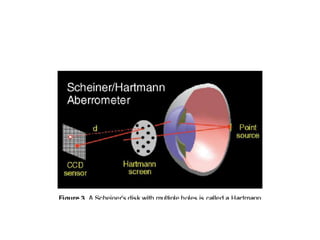
1) Hatmann-Shack Principle
A single laser bean is projected as a spot on the
retina and the reflected bundle of rays passes
through the optical system of the eye. It is then
picked up by an array of small lenslets,which focus
these rays into spot on an array of CCD camer. Then
the mossaic of spot is used to define the wavefront
and analyse its deformation.Each spot are analyzed
and a color coded picture of the wavefront is
generated by the aberrometer (Eg: LASAR Wave
(alcon),Wavescan (Visx))
• 2) Tscherning Principle
A Bundle of equidistant light rays shown on the
cornea which are imaged on the retina. A low
light CCD camera linked to a computer is used to
analyze the pattern of the spots observed on the
retina
Eg: Allegreto
Factors effecting total ocular
Wavefront
• Age
• Size of pupil
• Accomodation
• Chromatic Abberation
• Tearfilm
• Misalignment of the eye
• Refractive Error
Clinical Application
• Wave front guided refractive sx.
• Role in early Diagnosis of keratoconus.
• Wavefront guided LASIK Enhancement.
• Cataract/PCO Who have good VA in the
normal Light Condition
Management
• Treat the cause
• Tinted Glass
• Filters
• Sunglass
THANK YOU!

ABBEROMETRY.pptx

  • 1.
  • 2.
    ABERROMETER • ALL FORMOF DEVIATION OR REFRACTIVE ERRORS ARE BASICALLY ABERRATION TYPES: a)LOWER ORDER ABBERATION: Myopia,Hypermetropia,Regular Astigmatism b)Higher Order Aberration *Sperical *Chromatic *Coma
  • 3.
    • HIGHER ORDERABERRATION a)1ST ORDER: Tilt (Prism) b) 2nd Order: Defocus Astigmatism c): 3rd Order: Coma,Trefoil d)4th Order: Sperical aberration,Tetrafoil e)5th Order: Pentafoil d)6th Order: hexafoil Heptafoil,Octafoil
  • 4.
    • People withhigher order Aberrations my not see perfectly even with the glass or CL
  • 5.
    Aberrometer • It isthe instruments used to measure aberration • Aberromertry has become clinically important, Since the Progress in Imaging and Refractive Surgery may allow the correction of certain aberration
  • 6.
    Wave front aberrometry •Wavefront aberrometry Wavefront aberrometry is more popular in clinical practice. It is for the measurement of aberration in the Optical system of eye by Wave Front analysis by evaluating how light that enters into the eye is modified and image on to the retina
  • 7.
    Principles 1) Hatmann-Shack Principle Asingle laser bean is projected as a spot on the retina and the reflected bundle of rays passes through the optical system of the eye. It is then picked up by an array of small lenslets,which focus these rays into spot on an array of CCD camer. Then the mossaic of spot is used to define the wavefront and analyse its deformation.Each spot are analyzed and a color coded picture of the wavefront is generated by the aberrometer (Eg: LASAR Wave (alcon),Wavescan (Visx))
  • 10.
    • 2) TscherningPrinciple A Bundle of equidistant light rays shown on the cornea which are imaged on the retina. A low light CCD camera linked to a computer is used to analyze the pattern of the spots observed on the retina Eg: Allegreto
  • 12.
    Factors effecting totalocular Wavefront • Age • Size of pupil • Accomodation • Chromatic Abberation • Tearfilm • Misalignment of the eye • Refractive Error
  • 13.
    Clinical Application • Wavefront guided refractive sx. • Role in early Diagnosis of keratoconus. • Wavefront guided LASIK Enhancement. • Cataract/PCO Who have good VA in the normal Light Condition
  • 14.
    Management • Treat thecause • Tinted Glass • Filters • Sunglass
  • 15.