Anesthetic Agents
GA/LA
Rabindra Adhikary
ravinems@iom.edu.np
M.Optom, 1st Batch
Tilganga Institute of Ophthalmology
Pokhara University
Types
• General
• Regional
• Local
• Topical
GA
• Combination of drugs causes generalized loss of
consciousness & muscle movements
– Reversible & doesn’t jeopardize pt health
– Fasting Rule:
• Water/clear fluids: 2 hours
• Solid food: 6 hours
• Breast milk: 4 hours
– Drugs
• Barbiturates
• Ketamine
• Etomidate
• Propofol
Stages of GA
• STAGE I: Induction
– Consciousness to unconsciosness
• STAGE II: Excitement
– Excitement of inhibitory neurons of CNS
– Involuntary movement of muscle
– Heart rate, BP and respiration increases
• STAGE III: Surgical Anesthesia
– Loss of muscle tone and reflexes
– Ideal stage for surgery
• STAGE IV: Medullary Paralysis
– Respiratory or cardiovascular failure  death
– Overdose
– Careful monitoring in stage 3.
Common General Anesthetics [GAs]
• Nitrous Oxide
– Commonly called laughing gas with a formula N2O
– Colorless, non-inflammable, slightly sweet odor and
taste in room temperature
– Most used gaseous anesthetic in the world
– Other uses: food additive as propellant, fuel additive
for higher combustion, respiratory inhalant for
euphoric pleasures, refrigerant
– Due to its weaker anesthetic and muscle relaxant
properties, it is always supplemented with other
agents to increase the potency
Dosage and administration
• For the maintenance of anaesthesia, nitrous
oxide must always be mixed with at least 30%
oxygen. This is usually accomplished using a
compressed-gas anaesthetic machine.
• For analgesia, a concentration of 50% nitrous
oxide with 50% oxygen usually suffices
• Mode of administration: Inhalation
• Indication of Nitrous Oxide
– Surgical anesthesia, analgesia, pain
• Renal excretion accounts for >70%
• Side effects:
– Nausea, vomitting
– Paresthesia, lack of concentration
– Peripheral neuropathy, atonia
– Hypoxia [in overdose]
Halothane
• volatile inhalational anesthetic agent
• colourless, volatile, non-irritant liquid with a
sweet odour
• In anaesthetic dosage it depresses both cerebral
function and sympathetic activity and produces
little, if any, preliminary excitement
• surgical anaesthesia can be produced in 2-5
minutes.
• The recovery time is rapid and the incidence of
postoperative nausea and vomiting is low.
• Side effects
– Cardio-depressant
– Hepatitis
– Respiratory and vasomotor depression
• Administered through specially calibrated vaporizer
• Concentrations of 0.5-1.5% are usually adequate
for adults and children
• Recovery is fast, but also depends upon the
dosage
– Shivering is seen during recovery cover with warm
blankets
• Contra-indications
– Raised CSF pressure
– Family h/o malignant hyperthermia
– Jaundice/hepatitis
• Halothane should be stored in tightly closed
amber-glass containers protected from light,
below 25°C. Thymol is added as a stabilizing
agent to commercially produced supplies at a
concentration of 100 micrograms/ml.
Ketamine HCL
• Non-barbiturate general anesthetic
administered IM or IV
• 2 –(0-chlorophenyl)-2-(methylamino)
cyclohexanone hydrochloride
• Rapidly acting Gawith profound analgesia
• Best suited for short procedures, used in
conjunction with other drugs for long
procedures
• Initial dose administered intravenously may range from
1mg/kg to 4.5mg/kg. The average amount to produce 5-10
minutes of surgical anesthesia has been 2mg/kg
• Intramuscular dose ranges from 6.5 to 13mg/kg. A dose of
10mg/kg produces 12-25 min surgical anesthesia
• Given over a period of 60 secs
• Side effects may include:
– Respiratory depression
– Cardiac decompensation
– Systemic hypertension
– Diplopia and nystagmus
– Slightly Raised IOP
Propofol
• 2,6-Bis(1-methylethyl) phenol
• C12H18O
• Vulnerable to microbial contamination
– Strict aseptic technique should be applied
• Mode of administration:
– IV infusion
– IV injection
Indication
• Induction and maintenance of GA
• Conscious sedation for diagnostic and surgical
procedures
• Sedation during intensive care
• GA for 3 year or above
• Contraindications
– Who has cardiovascular depression/hypotension
– Not be used for ICU sedation for pt who have fat
metabolism disorder
– Epilepsy: various manifestation of seizures have been
reported, so, not indicated to epileptic pts.
– Pregnancy, labor and delivery
Propofol Dose
• Rapid and smooth hypnosiswith in 40 sec
(arm-brain circulation time)
– However, induction > 60 sec
RA
• Analgesic effect in specific body parts, eg. Legs,
hands [where procedures are targeted] like
epidural anesthesia
– Reduced risks comparative to GA
– Applicable for resource limited set up
– Pt consciousness retained greater cooperation
• Drug:
– Percutaneous lidocaine
– Bupivacaine
– Livobupivacaine
– Ropivacaine
LA
• Local anesthetics are a group of structurally
related compounds which share as principal
mechanism of action the blockade of voltage-
gated sodium channel, resulting in reversible
interruption of nerve signal transduction.
– Used both topically or as injection form
• When used with epinephrine [adrenaline] LA has
– prolonged duration of action
– Reduced systemic absorption
[epinephrine has vasoconstriction effect on alpha
receptors of blood vessels]
Chemical structure
• All local anesthetic [except cocaine] contains 3
basic structural components:
Aromatic
Ring
• Usually
substituted
Connecting
Group
• Ester
[novocaine]
• Or, amide
[lidocaine]
Ionizable
amino
Group
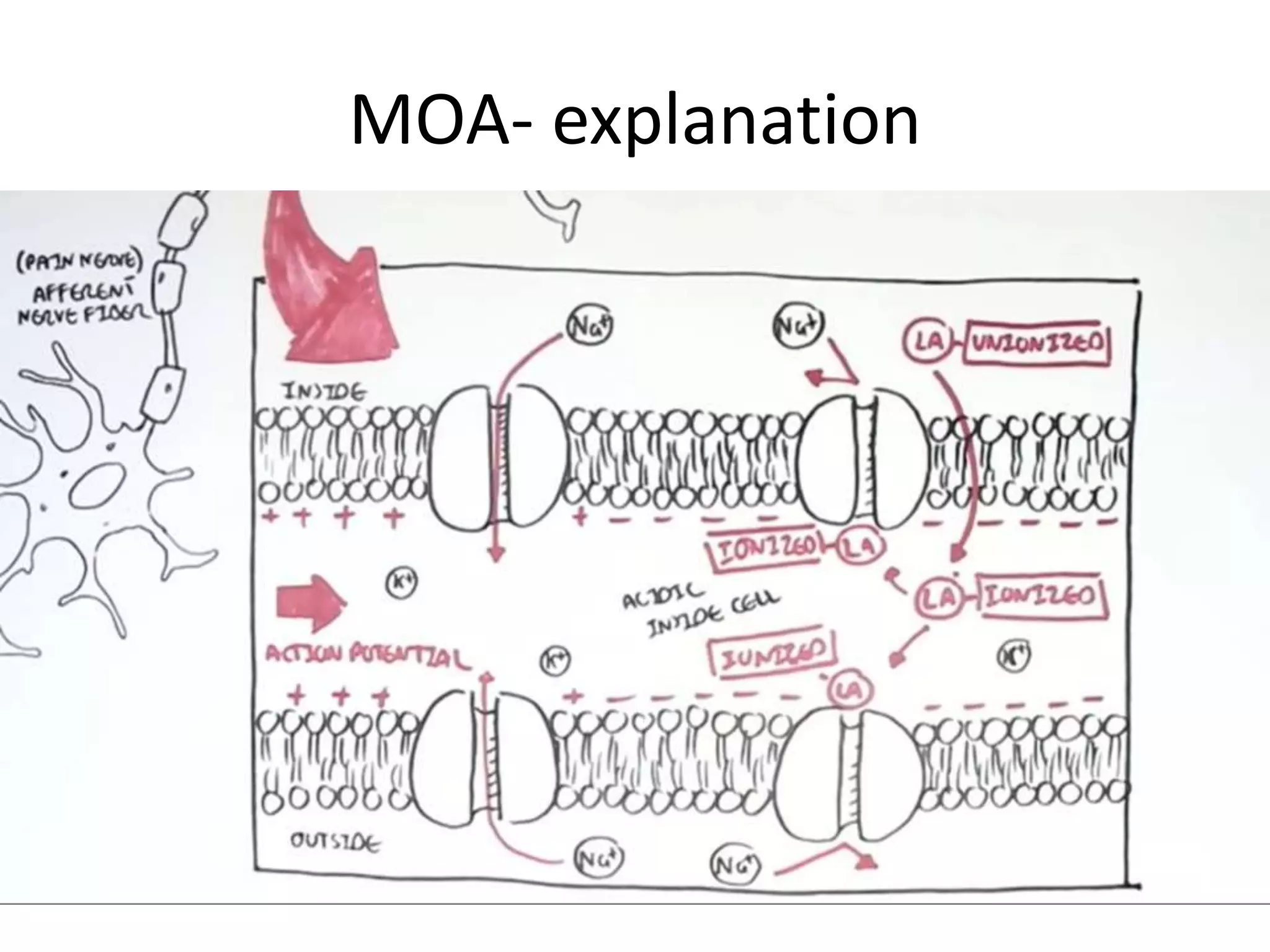
MOA
• LA receptors are located in the Na+ channel of
axonal membrane
• Receptors consists of 2 gates:
– Activation gate (m gate)
– Inactivation gate (h gate)
• Action of h gate is responsible for blocking
Na+ channels
MOA- explanation
MoA
• Block the nerve conduction by preventing membrane
permeability to sodium ions that normally leads to nerve
impulse through creating membrane potential
• An ideal LAs may have the following
characteristics :
– reversibility
– a rapid onset of action
– a predictable duration of action
– good tolerance at high doses with a low risk of
systemic toxicity.
• Next to sodium channel blockade LA also act upon
– Calcium and potassium channels
– G protein coupled receptors  this gives the anti-
inflammatory effect
• Different additives may be used with LA for better
and prolonged effect:
– Buprenorphine [↑ed nausea and vomitting]
– Dexmeditomidine & Clonidine [dose dependent
systemic side effect eg. Bradycardia, hypotension]
– Dexamethasone [least systemic side effect and longest
nerve block duration]
• Lidocaine 2% with Bupivacaine 0.75%
• In retrobulbar block, use of epinephrine is
done cautiously as it may cause ciliary or
ophthalmic artery spasm
Common LAs
Generic Name Trade Name
Lidocaine Xylocaine
Bupivacaine Sensorcaine, Marcaine
2- chloroprocaine Nesacaine
Etidocaine Duranest
Levobupivacaine Chirocaine
Mepivacaine Carbocaine, Polocaine
Proparacaine Aurocaine
Ropivacaine Naropin
Tetracaine Pontocaine
Procaine Novacaine
Common Ophthalmic anesthetics
• Lidocaine
• Proparacaine
• Tetracaine
• Proxymetacaine
[all in hydrochloride form]
Lidocaine
• Belongs to amide class
– Trade name Xylocaine
• Most popular local anesthetic agent
• First modern local anesthetic [since 1940]
• Injected through the skin directly to the
targeted body parts to be numbed
• Contraindications in:
– Cardiac arrythmias [heart block]
– Liver, kidney and coronary artery diseases
• 90% hepatic metabolism
• Elimination half life is 1.5 to 2 hours
– Prolonged to 3.5 times in pt with liver diseases
• Drug interactions: simultaneous use with the
following drugs causes drug interactions. So,
extreme cautions is required:
– Antidepressants [triptyline, imipramine]
– Antipsychotics [phenothiazines, butyrophenones]
– lidocaine has additive effect on CNS depression with
sedatives
– When used in a pt who is using propanolol [beta
blocker], the anesthetic effect of lidocaine is severely
reduced to 47%, 7& co-administered use reduced its
effect to 30%
Dosage of Lidocaine
• Retrobulbar block: 2%
– Each dose consists of 4 ml [80mg]
– Anesthesia onsets after 3-5 min
– Duration without epinephrine: 1.5 to 2 min
• Peribulbar: 1%
– Each dose 10-15 ml [100-150mg]
– Anesthesia onsets after 3-5 min
– Duration without epinephrine: 1.5 to 2 min
Retrobulbar Block
• Surgery involving cornea, AC, lens regional
anesthetic block
• Local anesthetic is introduced into the muscle
cone. So, it blocks:
– Ciliary nerves
– Ciliary ganglions
– Cranial nerves III, IV and VI
• Does not anesthetize CN VII [7th Nerve]
– Pt is able to close the eye with orbicularis oculi
– But not open with LPS
Peribulbar Block
• Local anesthetic introduced into the
orbicularis oculi muscle
• Blocks
– Ciliary nerves
– CN III and VI
– Does not affect optic nerve [CN II]
• Lower complication rate than retrubulbar but
difficult to get complete dense block
Tetracaine
• Amino Ester:
• 4-N-butyl benzoic ester
• S/E
– Stinging
– Burning
– Redness
• In ophthalmic practice, used in
– Diagnostic- Tonometry, gonioscopy
– therapeutic - paracentesis of AC
– minor surgical procedures-chalazion, corneal
suture or FB removal
Dose
• For tonometry and other procedures
– 1-2 drops in the eyes just prior to evaluation
• For minor surgical procedures FB removal or
suture removal
– 1-2 drops every 5-10 min until procedure lasts
• For prolonged anesthesia
– 1-2 drops every 5-10 min upto 3-5 doses
Procaine
• Amino ester
• C13 H20N2O2 ; popular trade name: novocain
• 2-(diethylamino)ethyl 4-aminobenzoate
• Produces local or regional anesthesia
• Has the advantage of constricting the blood
vessels-reduces bleeding
• Metabolized in the plasma by the enzyme
pseudocholinesterase through hydrolysis into
PABA
• With normal kidney function the drug is
rapidly excreted by tubular excretion
• Dosage
– 0.25%, 0.5% for Local infiltration
– 1%, 2% for peripheral nerve block
• Half life: 7.7 min
• Contraindications
– Known hypersensitivity of procaine or PABA
Thank You!

Anesthetic agents: General and Local

  • 1.
    Anesthetic Agents GA/LA Rabindra Adhikary ravinems@iom.edu.np M.Optom,1st Batch Tilganga Institute of Ophthalmology Pokhara University
  • 2.
  • 3.
    GA • Combination ofdrugs causes generalized loss of consciousness & muscle movements – Reversible & doesn’t jeopardize pt health – Fasting Rule: • Water/clear fluids: 2 hours • Solid food: 6 hours • Breast milk: 4 hours – Drugs • Barbiturates • Ketamine • Etomidate • Propofol
  • 4.
    Stages of GA •STAGE I: Induction – Consciousness to unconsciosness • STAGE II: Excitement – Excitement of inhibitory neurons of CNS – Involuntary movement of muscle – Heart rate, BP and respiration increases • STAGE III: Surgical Anesthesia – Loss of muscle tone and reflexes – Ideal stage for surgery • STAGE IV: Medullary Paralysis – Respiratory or cardiovascular failure  death – Overdose – Careful monitoring in stage 3.
  • 5.
    Common General Anesthetics[GAs] • Nitrous Oxide – Commonly called laughing gas with a formula N2O – Colorless, non-inflammable, slightly sweet odor and taste in room temperature – Most used gaseous anesthetic in the world – Other uses: food additive as propellant, fuel additive for higher combustion, respiratory inhalant for euphoric pleasures, refrigerant – Due to its weaker anesthetic and muscle relaxant properties, it is always supplemented with other agents to increase the potency
  • 6.
    Dosage and administration •For the maintenance of anaesthesia, nitrous oxide must always be mixed with at least 30% oxygen. This is usually accomplished using a compressed-gas anaesthetic machine. • For analgesia, a concentration of 50% nitrous oxide with 50% oxygen usually suffices • Mode of administration: Inhalation
  • 7.
    • Indication ofNitrous Oxide – Surgical anesthesia, analgesia, pain • Renal excretion accounts for >70% • Side effects: – Nausea, vomitting – Paresthesia, lack of concentration – Peripheral neuropathy, atonia – Hypoxia [in overdose]
  • 8.
    Halothane • volatile inhalationalanesthetic agent • colourless, volatile, non-irritant liquid with a sweet odour • In anaesthetic dosage it depresses both cerebral function and sympathetic activity and produces little, if any, preliminary excitement • surgical anaesthesia can be produced in 2-5 minutes. • The recovery time is rapid and the incidence of postoperative nausea and vomiting is low.
  • 9.
    • Side effects –Cardio-depressant – Hepatitis – Respiratory and vasomotor depression • Administered through specially calibrated vaporizer • Concentrations of 0.5-1.5% are usually adequate for adults and children • Recovery is fast, but also depends upon the dosage – Shivering is seen during recovery cover with warm blankets
  • 10.
    • Contra-indications – RaisedCSF pressure – Family h/o malignant hyperthermia – Jaundice/hepatitis • Halothane should be stored in tightly closed amber-glass containers protected from light, below 25°C. Thymol is added as a stabilizing agent to commercially produced supplies at a concentration of 100 micrograms/ml.
  • 11.
    Ketamine HCL • Non-barbiturategeneral anesthetic administered IM or IV • 2 –(0-chlorophenyl)-2-(methylamino) cyclohexanone hydrochloride • Rapidly acting Gawith profound analgesia • Best suited for short procedures, used in conjunction with other drugs for long procedures
  • 12.
    • Initial doseadministered intravenously may range from 1mg/kg to 4.5mg/kg. The average amount to produce 5-10 minutes of surgical anesthesia has been 2mg/kg • Intramuscular dose ranges from 6.5 to 13mg/kg. A dose of 10mg/kg produces 12-25 min surgical anesthesia • Given over a period of 60 secs • Side effects may include: – Respiratory depression – Cardiac decompensation – Systemic hypertension – Diplopia and nystagmus – Slightly Raised IOP
  • 13.
    Propofol • 2,6-Bis(1-methylethyl) phenol •C12H18O • Vulnerable to microbial contamination – Strict aseptic technique should be applied • Mode of administration: – IV infusion – IV injection
  • 14.
    Indication • Induction andmaintenance of GA • Conscious sedation for diagnostic and surgical procedures • Sedation during intensive care • GA for 3 year or above • Contraindications – Who has cardiovascular depression/hypotension – Not be used for ICU sedation for pt who have fat metabolism disorder – Epilepsy: various manifestation of seizures have been reported, so, not indicated to epileptic pts. – Pregnancy, labor and delivery
  • 15.
    Propofol Dose • Rapidand smooth hypnosiswith in 40 sec (arm-brain circulation time) – However, induction > 60 sec
  • 16.
    RA • Analgesic effectin specific body parts, eg. Legs, hands [where procedures are targeted] like epidural anesthesia – Reduced risks comparative to GA – Applicable for resource limited set up – Pt consciousness retained greater cooperation • Drug: – Percutaneous lidocaine – Bupivacaine – Livobupivacaine – Ropivacaine
  • 17.
    LA • Local anestheticsare a group of structurally related compounds which share as principal mechanism of action the blockade of voltage- gated sodium channel, resulting in reversible interruption of nerve signal transduction. – Used both topically or as injection form • When used with epinephrine [adrenaline] LA has – prolonged duration of action – Reduced systemic absorption [epinephrine has vasoconstriction effect on alpha receptors of blood vessels]
  • 18.
    Chemical structure • Alllocal anesthetic [except cocaine] contains 3 basic structural components: Aromatic Ring • Usually substituted Connecting Group • Ester [novocaine] • Or, amide [lidocaine] Ionizable amino Group
  • 21.
    MOA • LA receptorsare located in the Na+ channel of axonal membrane • Receptors consists of 2 gates: – Activation gate (m gate) – Inactivation gate (h gate) • Action of h gate is responsible for blocking Na+ channels
  • 22.
  • 23.
    MoA • Block thenerve conduction by preventing membrane permeability to sodium ions that normally leads to nerve impulse through creating membrane potential
  • 24.
    • An idealLAs may have the following characteristics : – reversibility – a rapid onset of action – a predictable duration of action – good tolerance at high doses with a low risk of systemic toxicity.
  • 25.
    • Next tosodium channel blockade LA also act upon – Calcium and potassium channels – G protein coupled receptors  this gives the anti- inflammatory effect • Different additives may be used with LA for better and prolonged effect: – Buprenorphine [↑ed nausea and vomitting] – Dexmeditomidine & Clonidine [dose dependent systemic side effect eg. Bradycardia, hypotension] – Dexamethasone [least systemic side effect and longest nerve block duration]
  • 26.
    • Lidocaine 2%with Bupivacaine 0.75% • In retrobulbar block, use of epinephrine is done cautiously as it may cause ciliary or ophthalmic artery spasm
  • 27.
    Common LAs Generic NameTrade Name Lidocaine Xylocaine Bupivacaine Sensorcaine, Marcaine 2- chloroprocaine Nesacaine Etidocaine Duranest Levobupivacaine Chirocaine Mepivacaine Carbocaine, Polocaine Proparacaine Aurocaine Ropivacaine Naropin Tetracaine Pontocaine Procaine Novacaine
  • 28.
    Common Ophthalmic anesthetics •Lidocaine • Proparacaine • Tetracaine • Proxymetacaine [all in hydrochloride form]
  • 29.
    Lidocaine • Belongs toamide class – Trade name Xylocaine • Most popular local anesthetic agent • First modern local anesthetic [since 1940] • Injected through the skin directly to the targeted body parts to be numbed • Contraindications in: – Cardiac arrythmias [heart block] – Liver, kidney and coronary artery diseases
  • 30.
    • 90% hepaticmetabolism • Elimination half life is 1.5 to 2 hours – Prolonged to 3.5 times in pt with liver diseases
  • 31.
    • Drug interactions:simultaneous use with the following drugs causes drug interactions. So, extreme cautions is required: – Antidepressants [triptyline, imipramine] – Antipsychotics [phenothiazines, butyrophenones] – lidocaine has additive effect on CNS depression with sedatives – When used in a pt who is using propanolol [beta blocker], the anesthetic effect of lidocaine is severely reduced to 47%, 7& co-administered use reduced its effect to 30%
  • 32.
    Dosage of Lidocaine •Retrobulbar block: 2% – Each dose consists of 4 ml [80mg] – Anesthesia onsets after 3-5 min – Duration without epinephrine: 1.5 to 2 min • Peribulbar: 1% – Each dose 10-15 ml [100-150mg] – Anesthesia onsets after 3-5 min – Duration without epinephrine: 1.5 to 2 min
  • 33.
    Retrobulbar Block • Surgeryinvolving cornea, AC, lens regional anesthetic block • Local anesthetic is introduced into the muscle cone. So, it blocks: – Ciliary nerves – Ciliary ganglions – Cranial nerves III, IV and VI • Does not anesthetize CN VII [7th Nerve] – Pt is able to close the eye with orbicularis oculi – But not open with LPS
  • 34.
    Peribulbar Block • Localanesthetic introduced into the orbicularis oculi muscle • Blocks – Ciliary nerves – CN III and VI – Does not affect optic nerve [CN II] • Lower complication rate than retrubulbar but difficult to get complete dense block
  • 35.
    Tetracaine • Amino Ester: •4-N-butyl benzoic ester • S/E – Stinging – Burning – Redness
  • 36.
    • In ophthalmicpractice, used in – Diagnostic- Tonometry, gonioscopy – therapeutic - paracentesis of AC – minor surgical procedures-chalazion, corneal suture or FB removal
  • 37.
    Dose • For tonometryand other procedures – 1-2 drops in the eyes just prior to evaluation • For minor surgical procedures FB removal or suture removal – 1-2 drops every 5-10 min until procedure lasts • For prolonged anesthesia – 1-2 drops every 5-10 min upto 3-5 doses
  • 38.
    Procaine • Amino ester •C13 H20N2O2 ; popular trade name: novocain • 2-(diethylamino)ethyl 4-aminobenzoate • Produces local or regional anesthesia • Has the advantage of constricting the blood vessels-reduces bleeding • Metabolized in the plasma by the enzyme pseudocholinesterase through hydrolysis into PABA
  • 39.
    • With normalkidney function the drug is rapidly excreted by tubular excretion • Dosage – 0.25%, 0.5% for Local infiltration – 1%, 2% for peripheral nerve block • Half life: 7.7 min • Contraindications – Known hypersensitivity of procaine or PABA
  • 40.