
Vision Assessment and Vision Screening in
Children
Refractive error and spectacle correction
Amblyopia
Strabismus
Nystagmus
Rabindra Adhikary
M. Optom 1st Batch
Tilganga Institute of ophthalmology (TIO)
Pokhara University
Facilitators: Dr Srijana Adhikari, Dr Rojeeta Parajuli
Date: 4th of June, 2019
Pediatric Ophthalmology
– Layout
• Vision Assessment and Vision Screening in
Children
• Refractive error and spectacle correction
• Amblyopia
• Strabismus
• Nystagmus
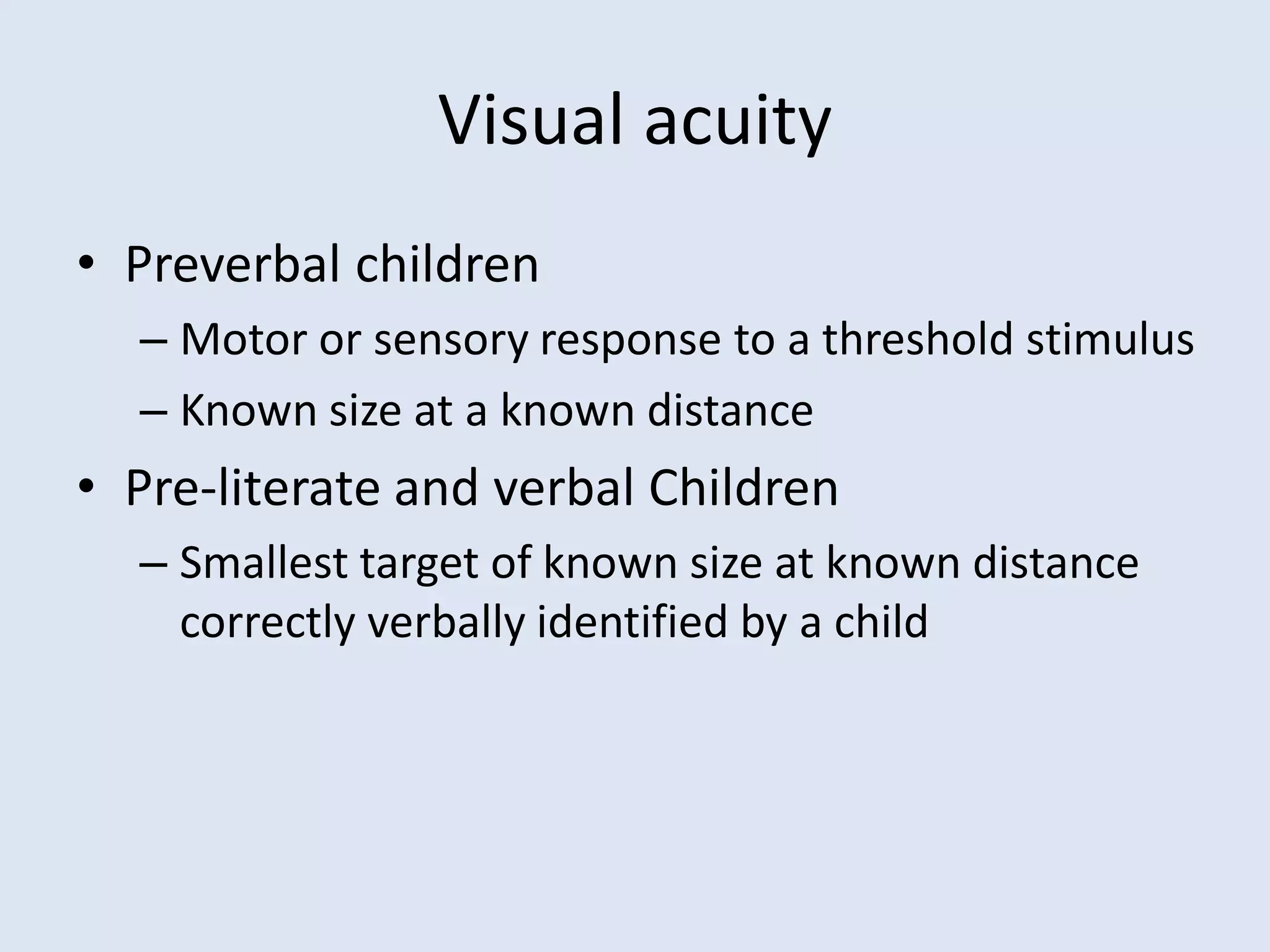
Visual acuity
• Preverbal children
– Motor or sensory response to a threshold stimulus
– Known size at a known distance
• Pre-literate and verbal Children
– Smallest target of known size at known distance
correctly verbally identified by a child
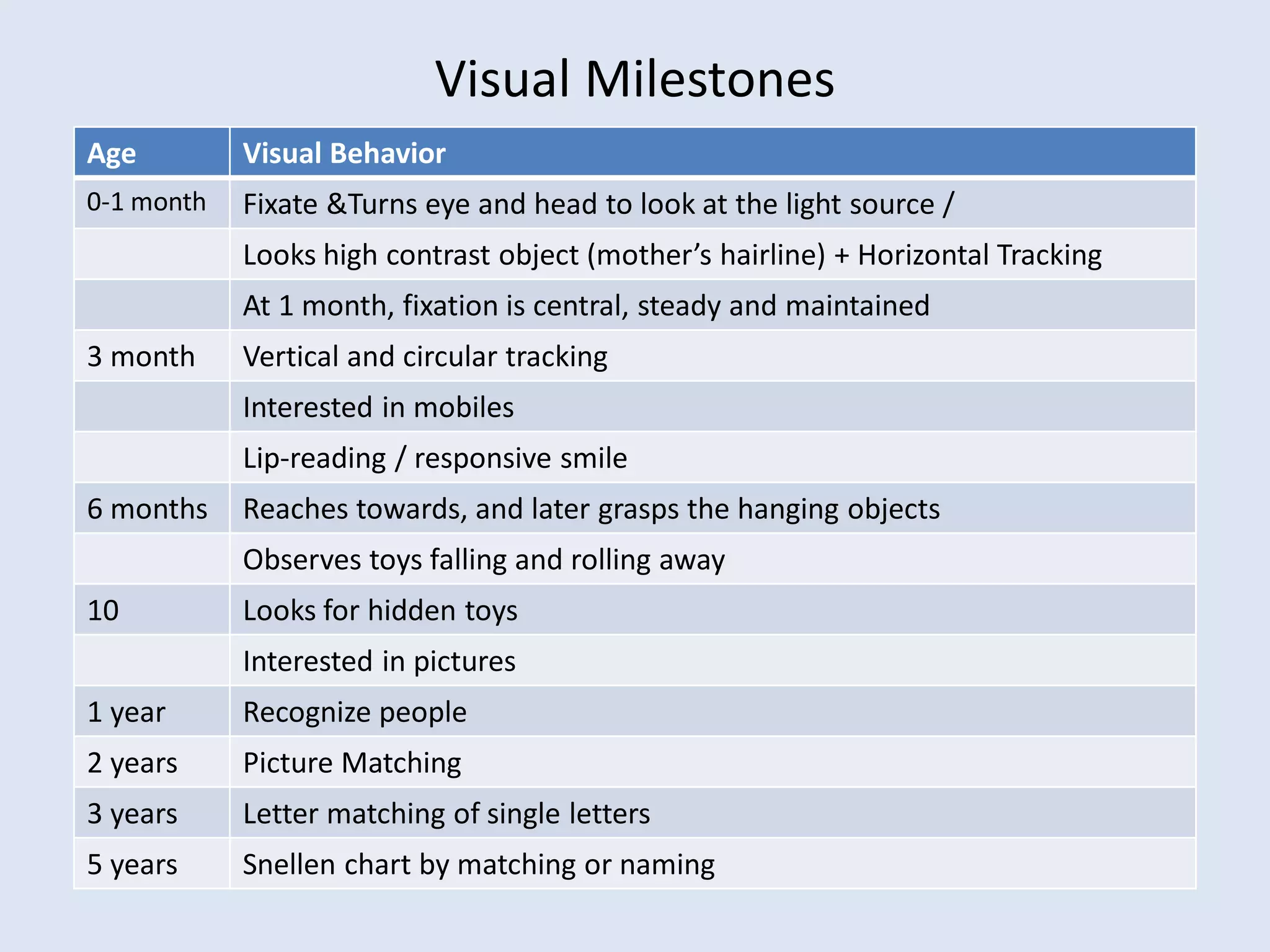
Visual Milestones
Age Visual Behavior
0-1 month Fixate &Turns eye and head to look at the light source /
Looks high contrast object (mother’s hairline) + Horizontal Tracking
At 1 month, fixation is central, steady and maintained
3 month Vertical and circular tracking
Interested in mobiles
Lip-reading / responsive smile
6 months Reaches towards, and later grasps the hanging objects
Observes toys falling and rolling away
10 Looks for hidden toys
Interested in pictures
1 year Recognize people
2 years Picture Matching
3 years Letter matching of single letters
5 years Snellen chart by matching or naming
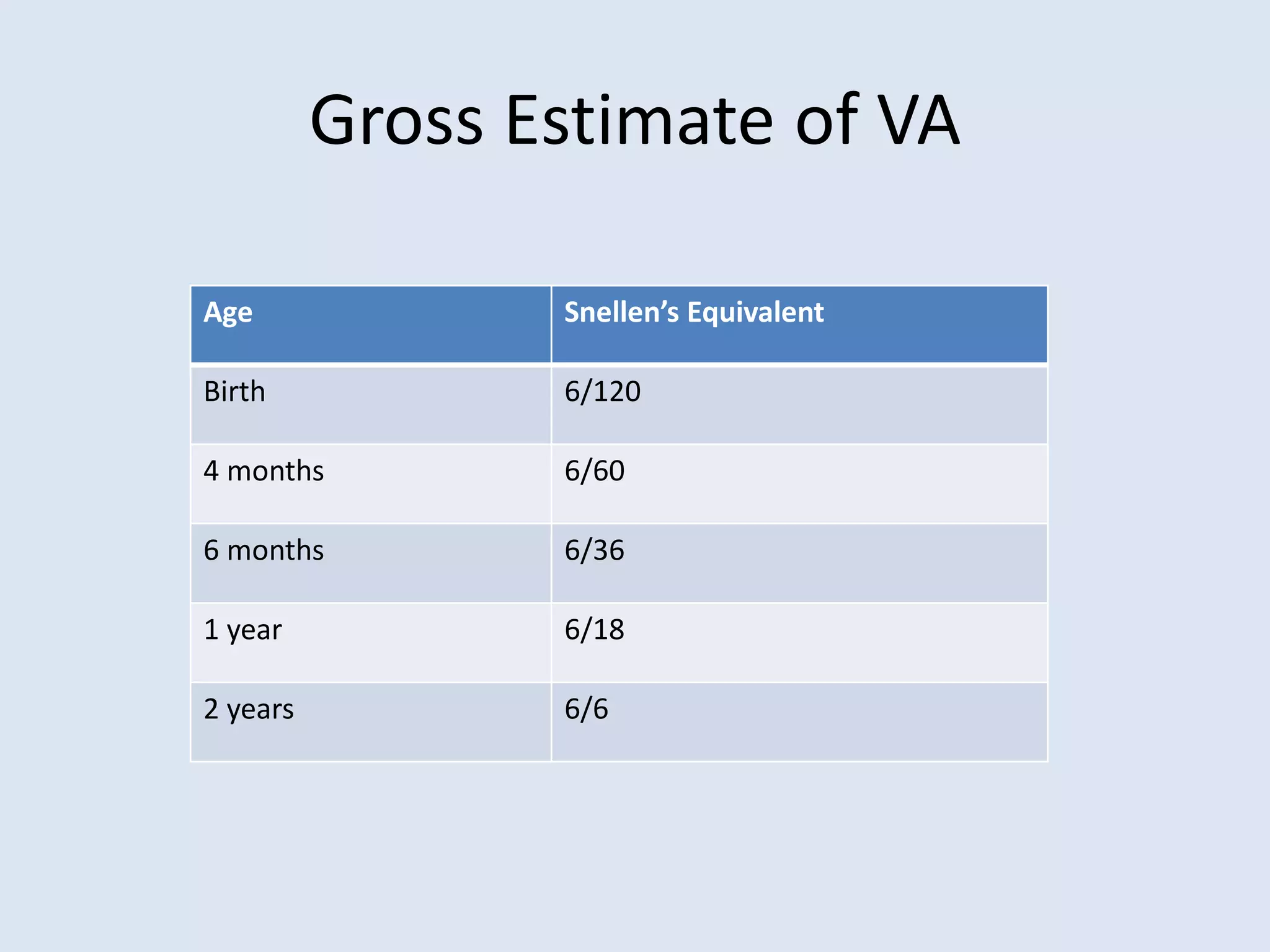
Gross Estimate of VA
Age Snellen’s Equivalent
Birth 6/120
4 months 6/60
6 months 6/36
1 year 6/18
2 years 6/6
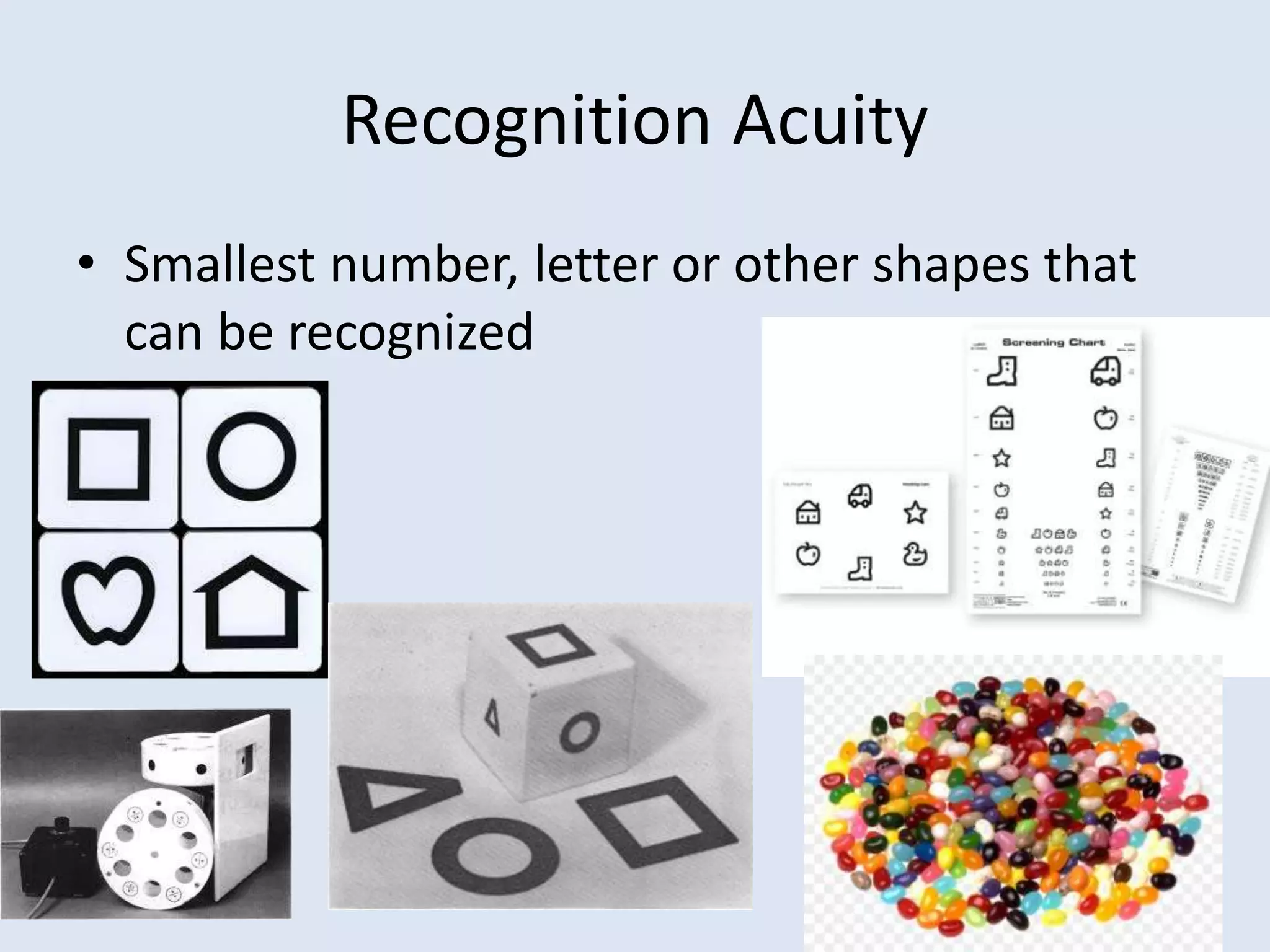
Recognition Acuity
• Smallest number, letter or other shapes that
can be recognized
–
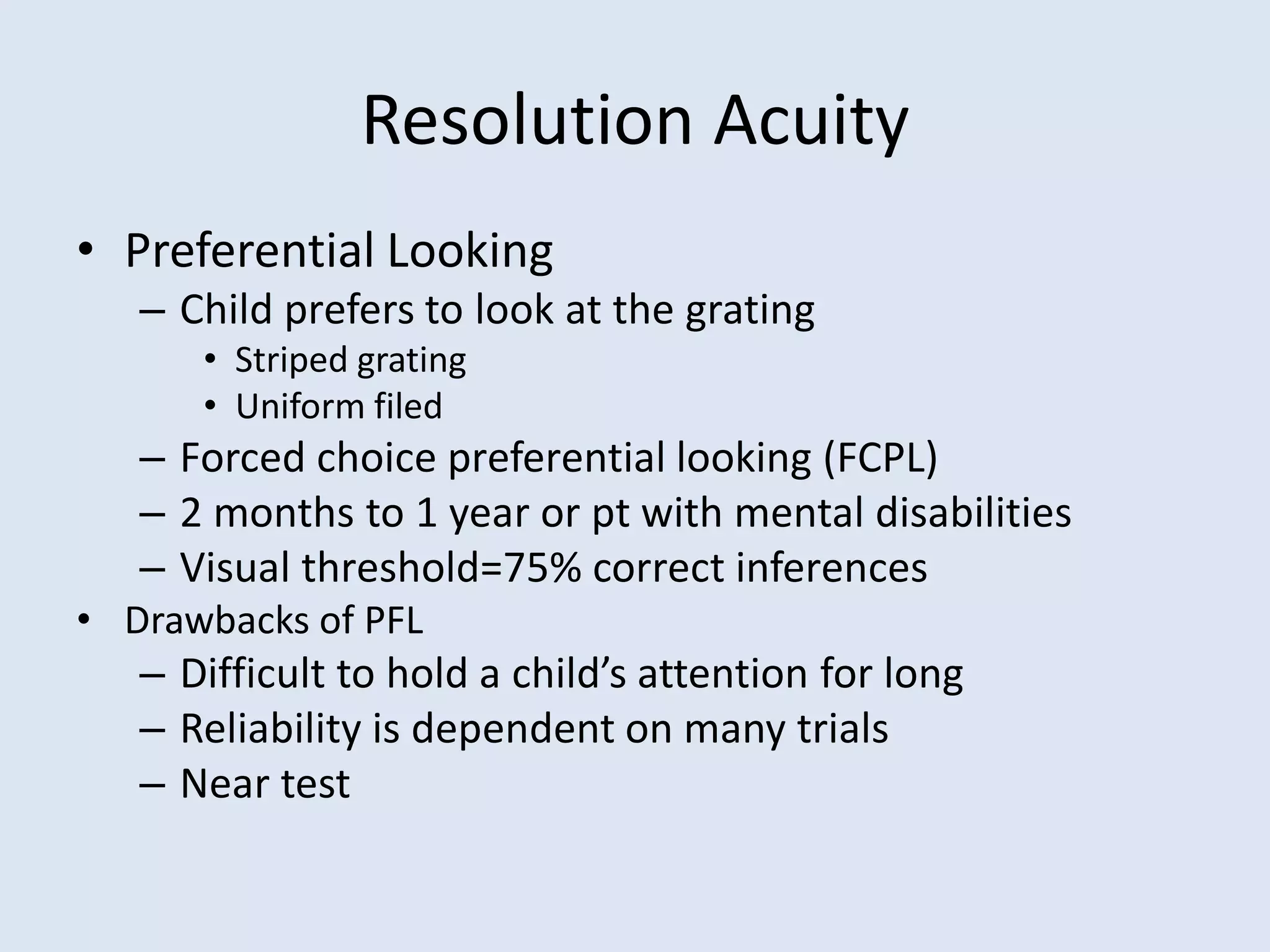
Resolution Acuity
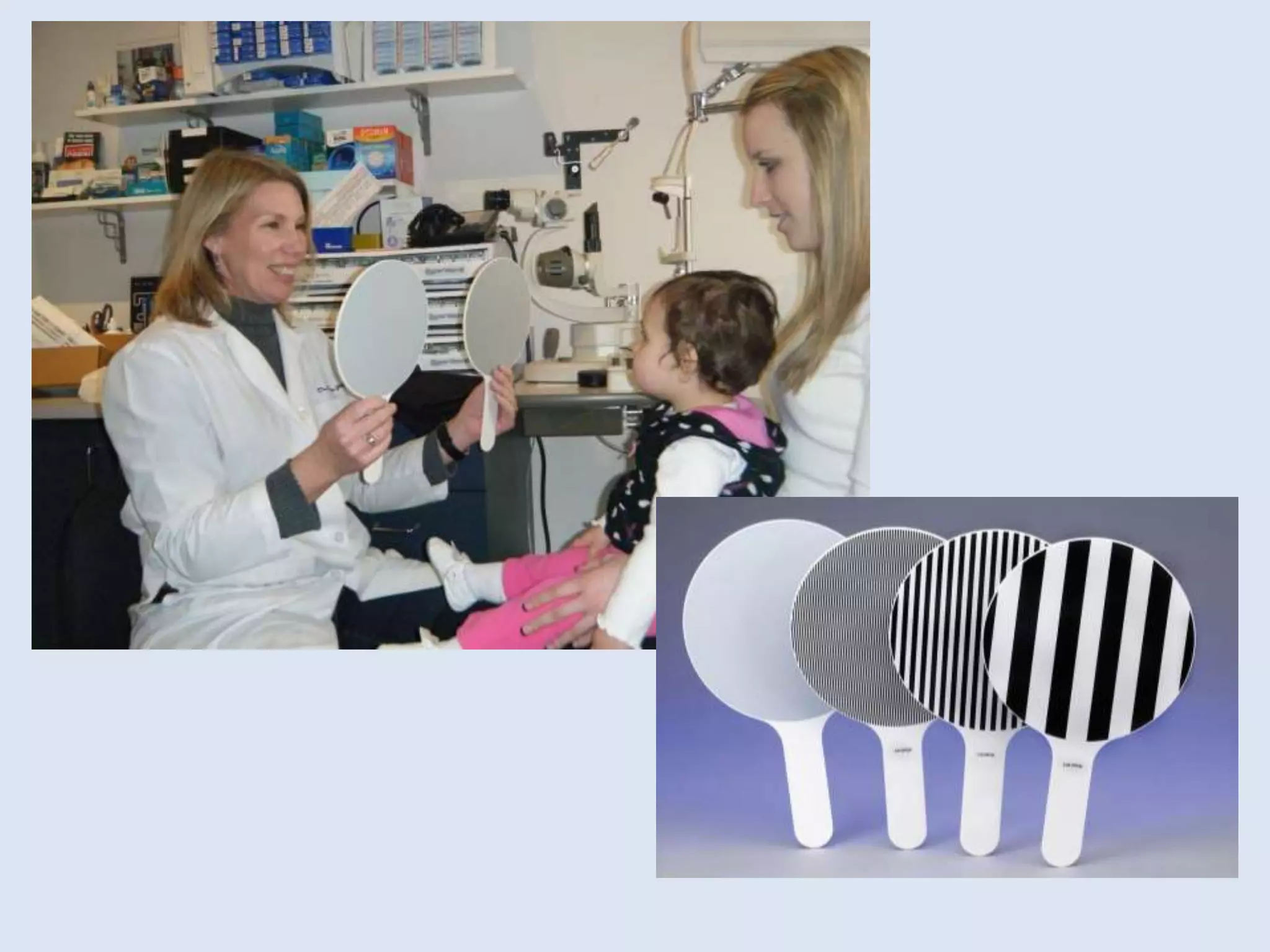
• Preferential Looking
– Child prefers to look at the grating
• Striped grating
• Uniform filed
– Forced choice preferential looking (FCPL)
– 2 months to 1 year or pt with mental disabilities
– Visual threshold=75% correct inferences
• Drawbacks of PFL
– Difficult to hold a child’s attention for long
– Reliability is dependent on many trials
– Near test
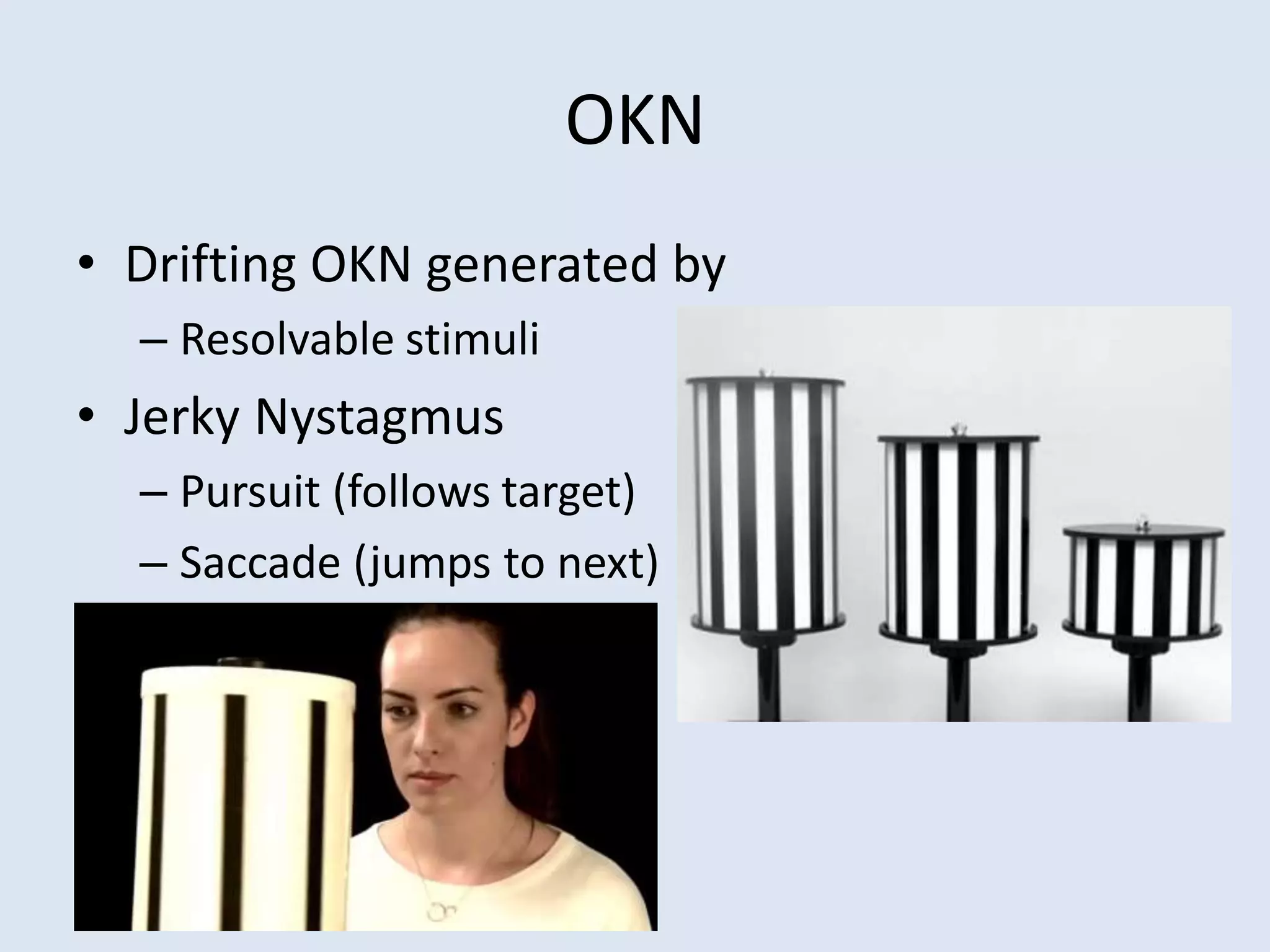
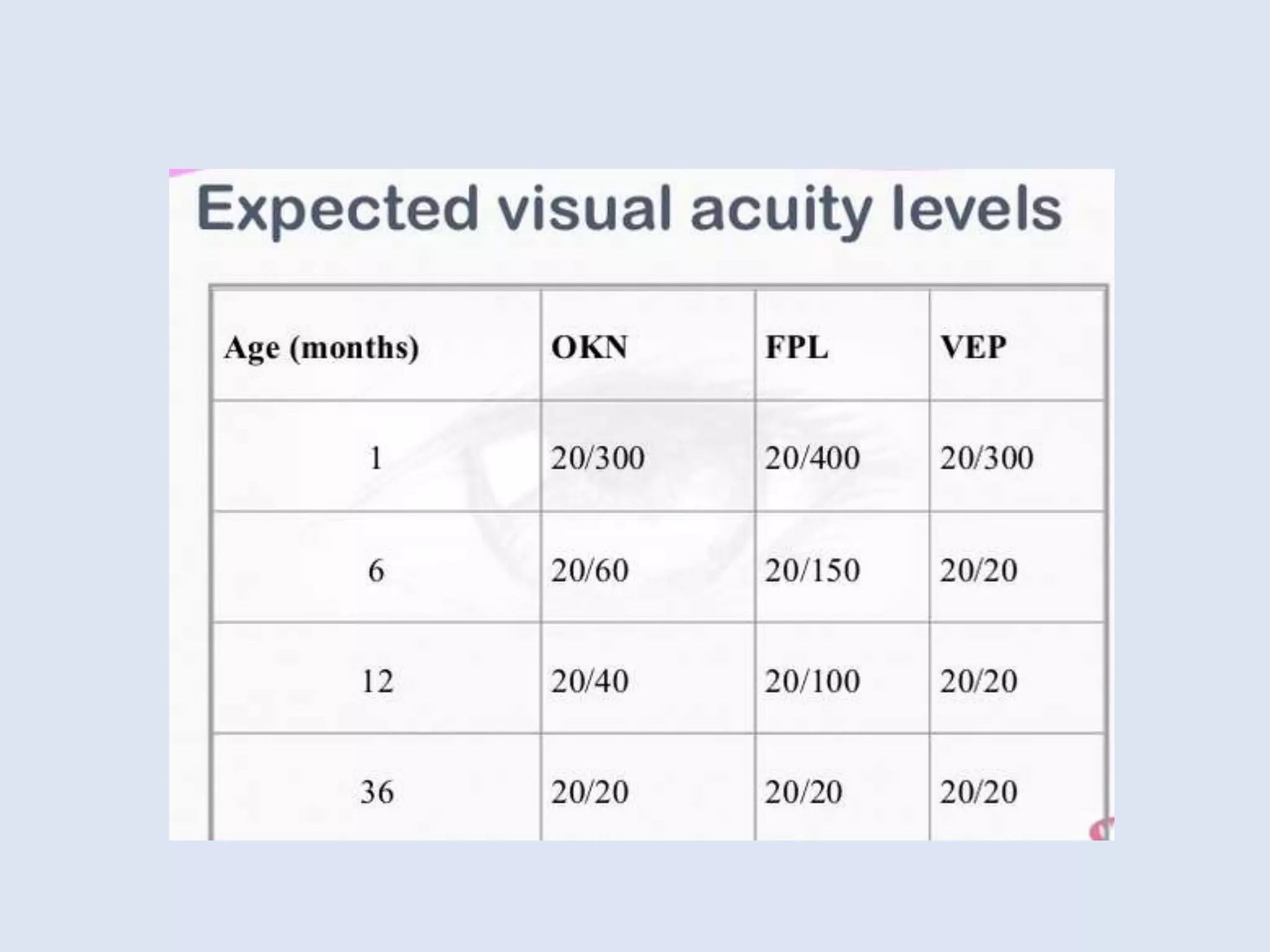
OKN
• Drifting OKN generated by
– Resolvable stimuli
• Jerky Nystagmus
– Pursuit (follows target)
– Saccade (jumps to next)
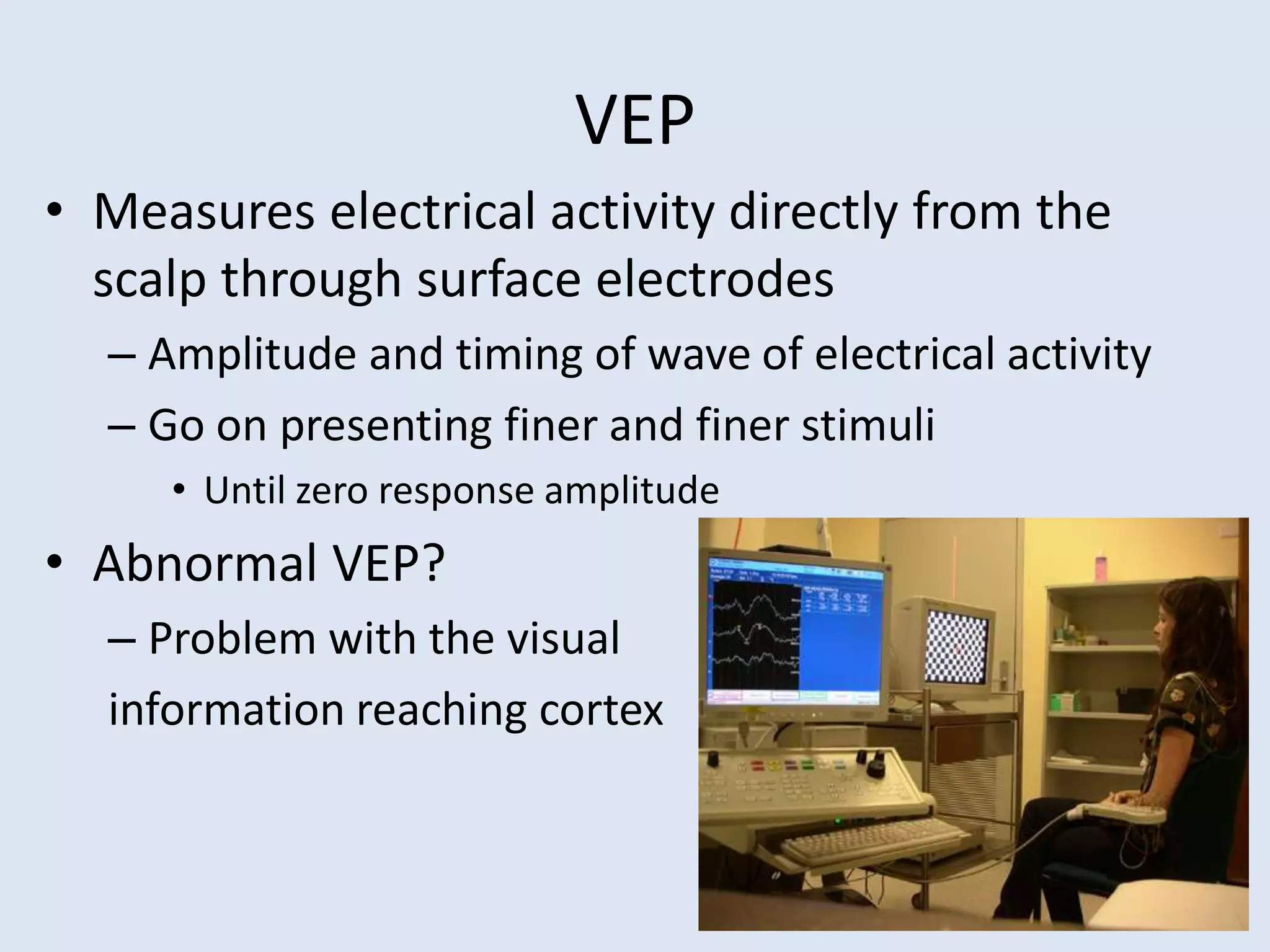
VEP
• Measures electrical activity directly from the
scalp through surface electrodes
– Amplitude and timing of wave of electrical activity
– Go on presenting finer and finer stimuli
• Until zero response amplitude
• Abnormal VEP?
– Problem with the visual
information reaching cortex
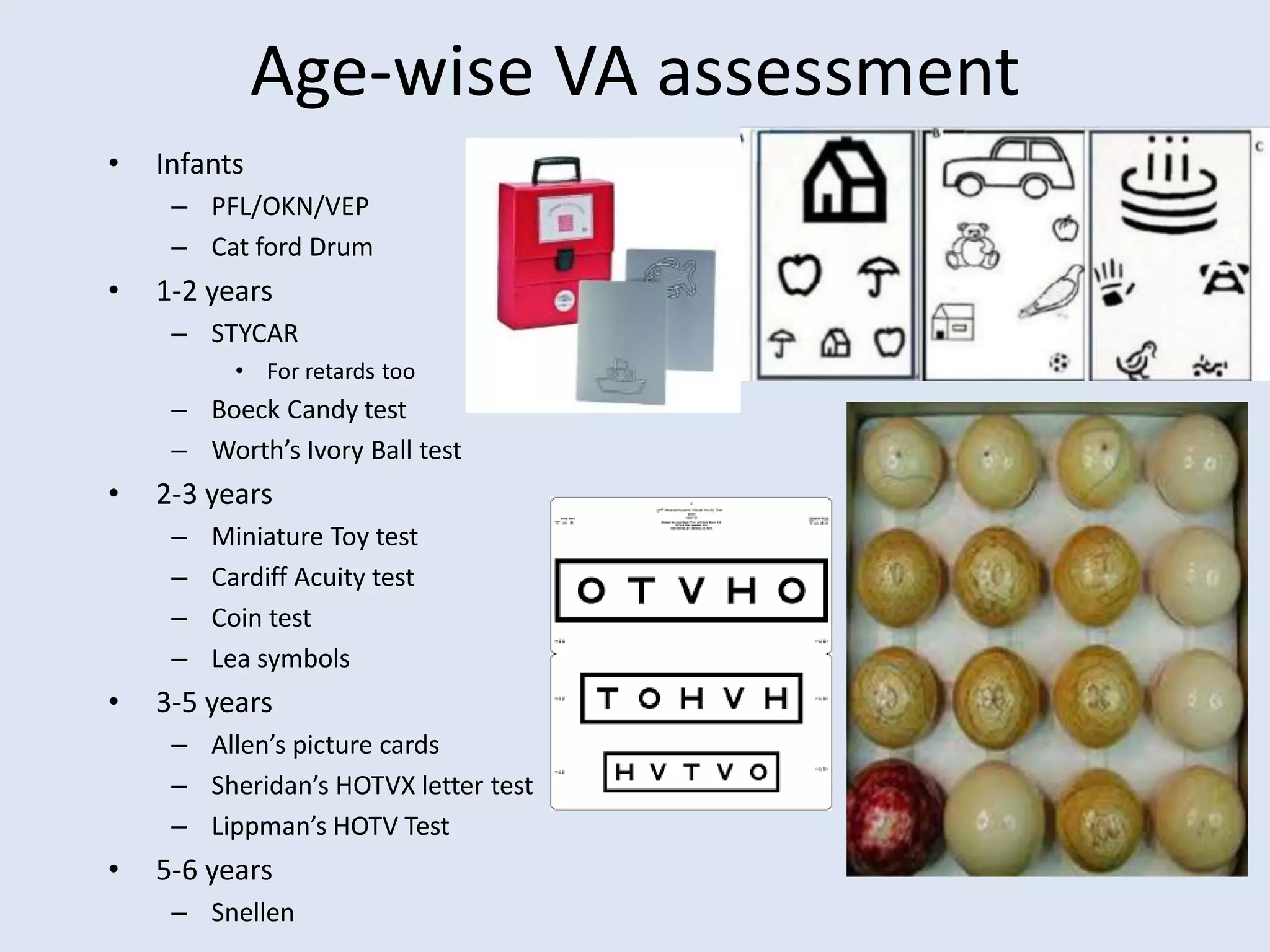
Age-wise VA assessment
• Infants
– PFL/OKN/VEP
– Cat ford Drum
• 1-2 years
– STYCAR
• For retards too
– Boeck Candy test
– Worth’s Ivory Ball test
• 2-3 years
– Miniature Toy test
– Cardiff Acuity test
– Coin test
– Lea symbols
• 3-5 years
– Allen’s picture cards
– Sheridan’s HOTVX letter test
– Lippman’s HOTV Test
• 5-6 years
– Snellen
Screening
• Age ranges and visual/ocular pathology to be
detected by screening:
Pre-term Perinatal/infantile Pre-school School age
ROP Congenital cataract
Glaucoma
Anterior segment
disorder
Amblyogenic
factors
-anisometropia
-strabismus
-high refractive
error
-Ptosis
-Media opacity
Refractive error
Fixation Reflex
• CSM
– Monocular central fixation (C)
• No eccentric fixation
– Hold steady Fixation (S)
– Maintain fixation (M)
• With the viewing eye
• Even when the fellow eye is uncovered
• F + F
– Fixate and Follow the light stimuli
– Monocular viewing conditions
Pupillary Response
• Birth- 3 years (or upto when VA can’t be
measured)
• Pupil reactions to the changes of light stimulus
– Direct
– Consensual
• Not equivalent to visual ability but indicates
– Intact neurologic visual pathways
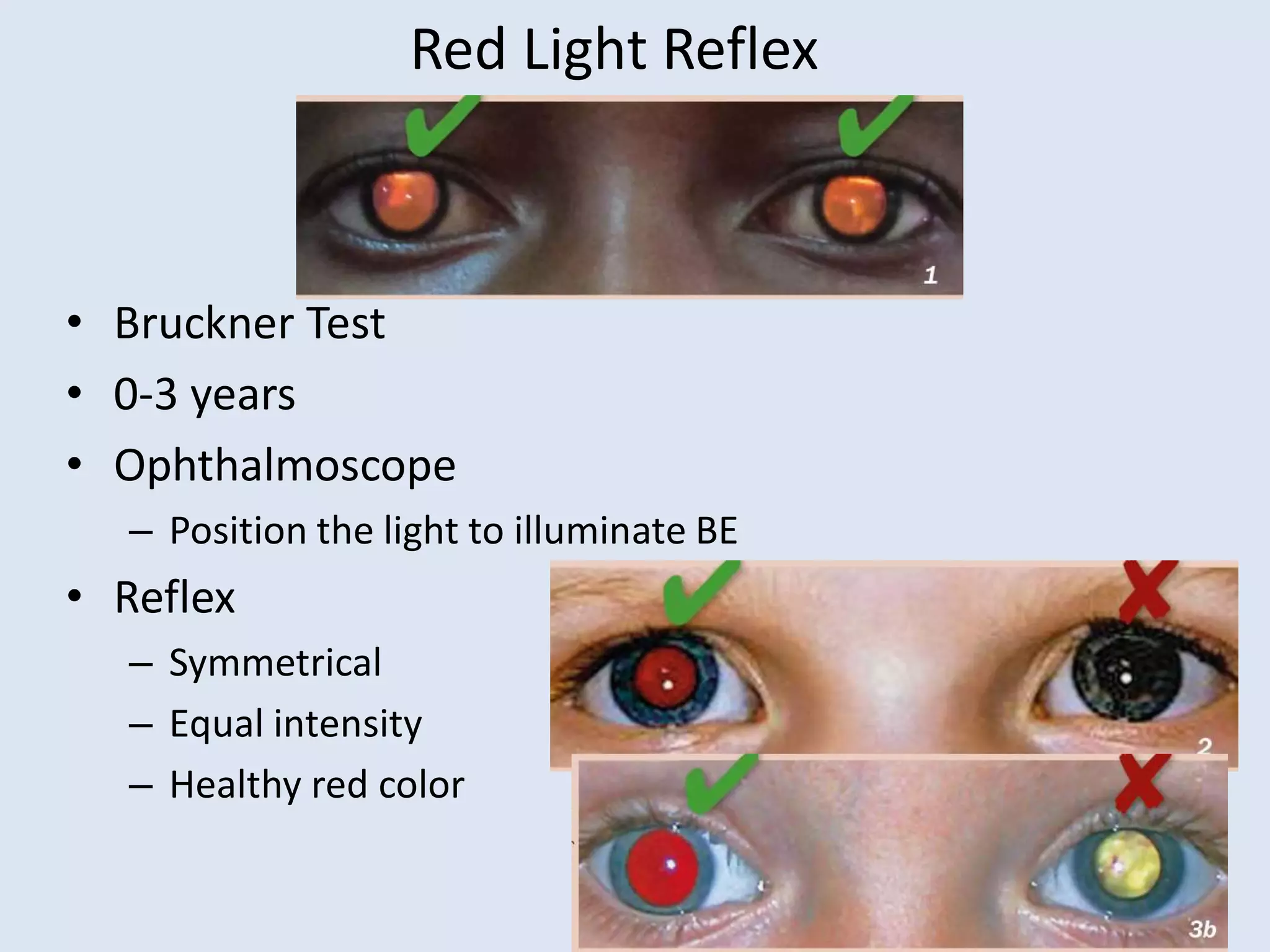
Red Light Reflex
• Bruckner Test
• 0-3 years
• Ophthalmoscope
– Position the light to illuminate BE
• Reflex
– Symmetrical
– Equal intensity
– Healthy red color
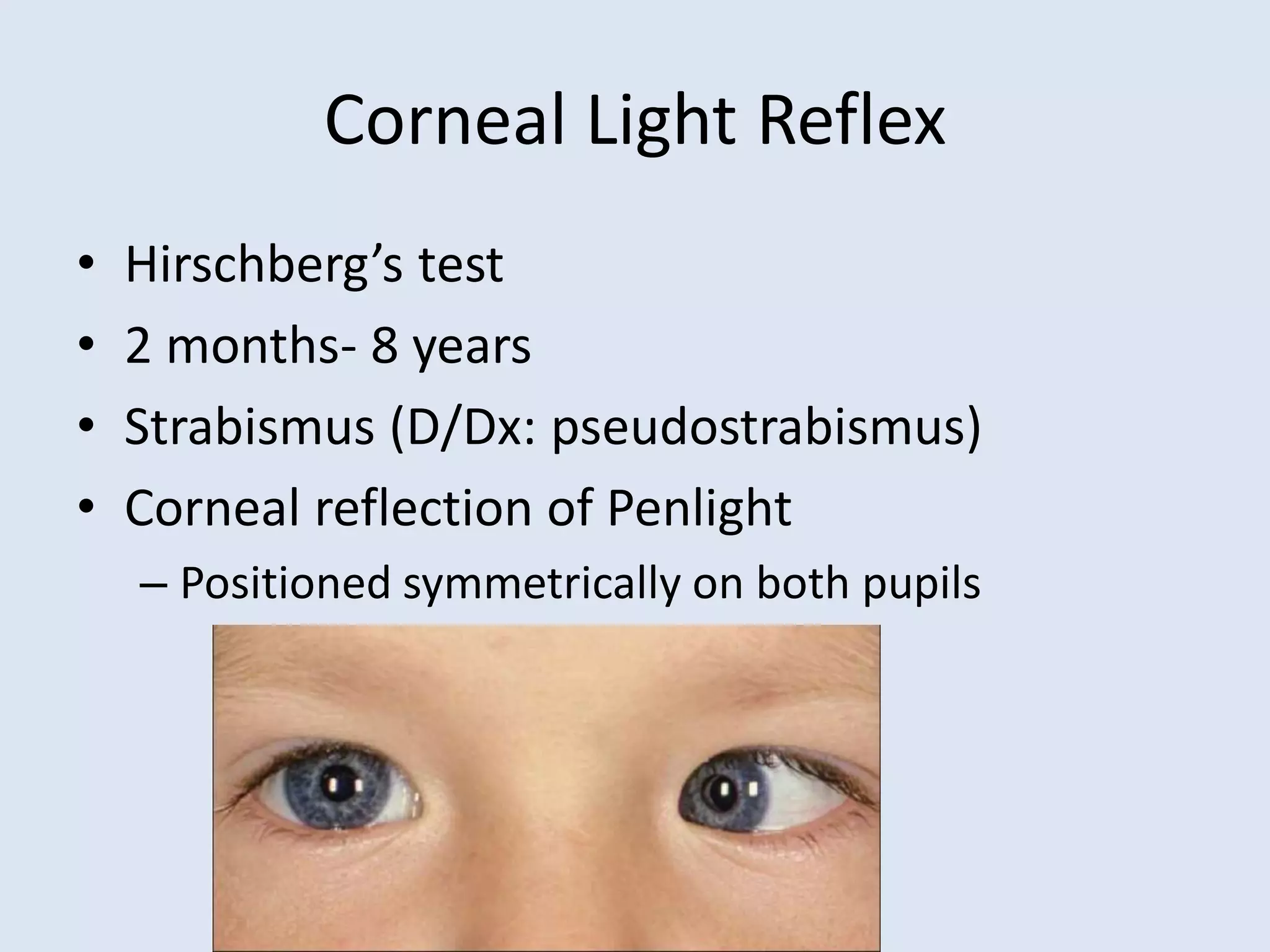
Corneal Light Reflex
• Hirschberg’s test
• 2 months- 8 years
• Strabismus (D/Dx: pseudostrabismus)
• Corneal reflection of Penlight
– Positioned symmetrically on both pupils
Cover test
• To know if eye deviates when fusion is
interrupted
– Observing the fixating eye when other eye is
covered (Cover test)
– Observing the eye being uncovered for movement
when the occluder is shifted to the other eye
(alternate cover)
– Observing the eye being uncovered for movement
when the occluder is removed (cover uncover)
Stereo-acuity
• 3-8 years
• Needs polarized glass
• Random dot E or stereo butterfly
• To check problems with stereo-acuity and
depth perception
Color vision
• At 6 years (first grader)
• Others: optional
• To check color deficiency
– Ishihara Pseudo-isochromatic Plates,
– Color Vision Testing Made Easy
– Good-Lite Book of Color Plates.
• Fluorescent desk lamp - if enough natural
daylight is not available.
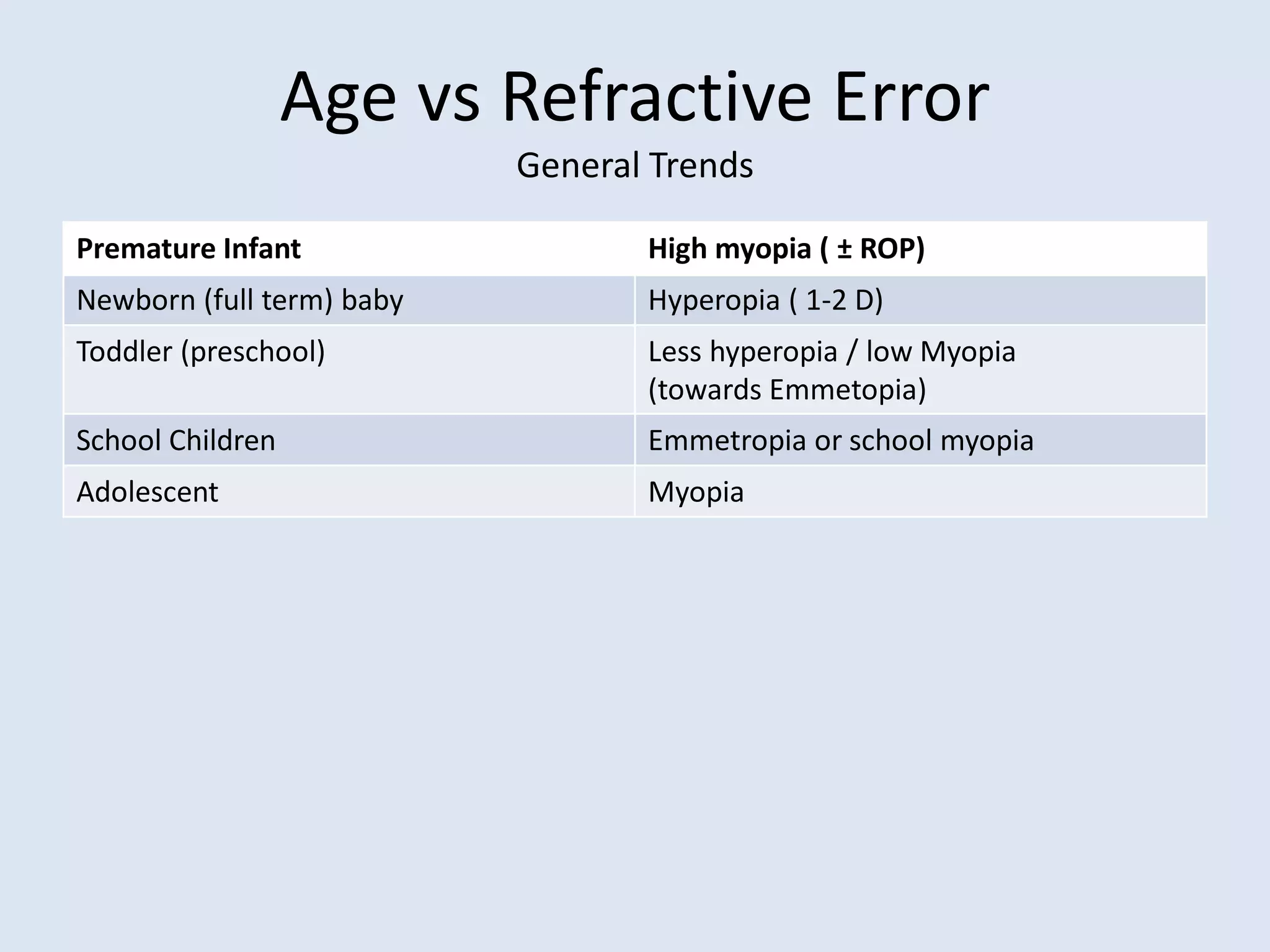
Age vs Refractive Error
General Trends
Premature Infant High myopia ( ± ROP)
Newborn (full term) baby Hyperopia ( 1-2 D)
Toddler (preschool) Less hyperopia / low Myopia
(towards Emmetopia)
School Children Emmetropia or school myopia
Adolescent Myopia
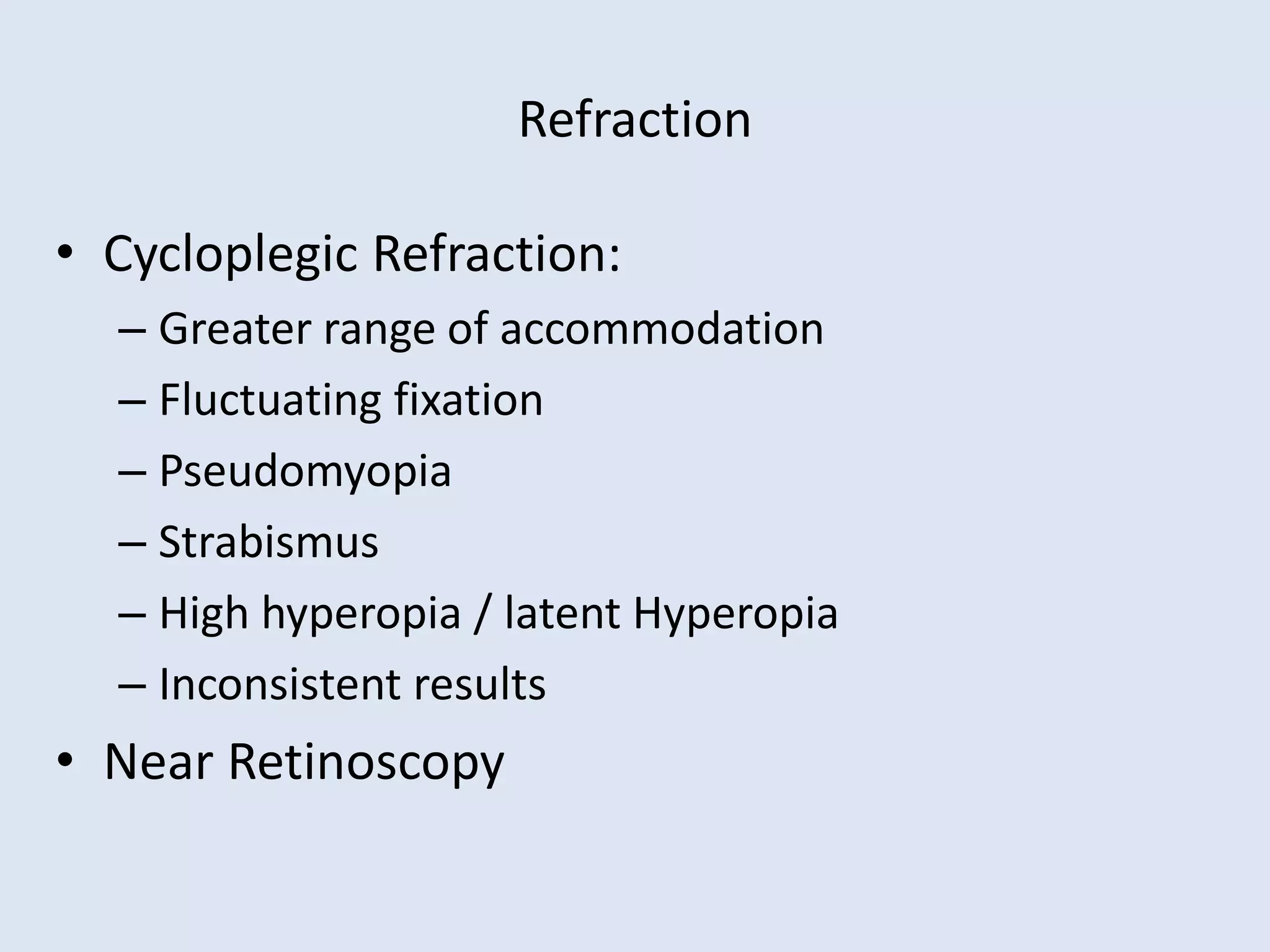
Refraction
• Cycloplegic Refraction:
– Greater range of accommodation
– Fluctuating fixation
– Pseudomyopia
– Strabismus
– High hyperopia / latent Hyperopia
– Inconsistent results
• Near Retinoscopy
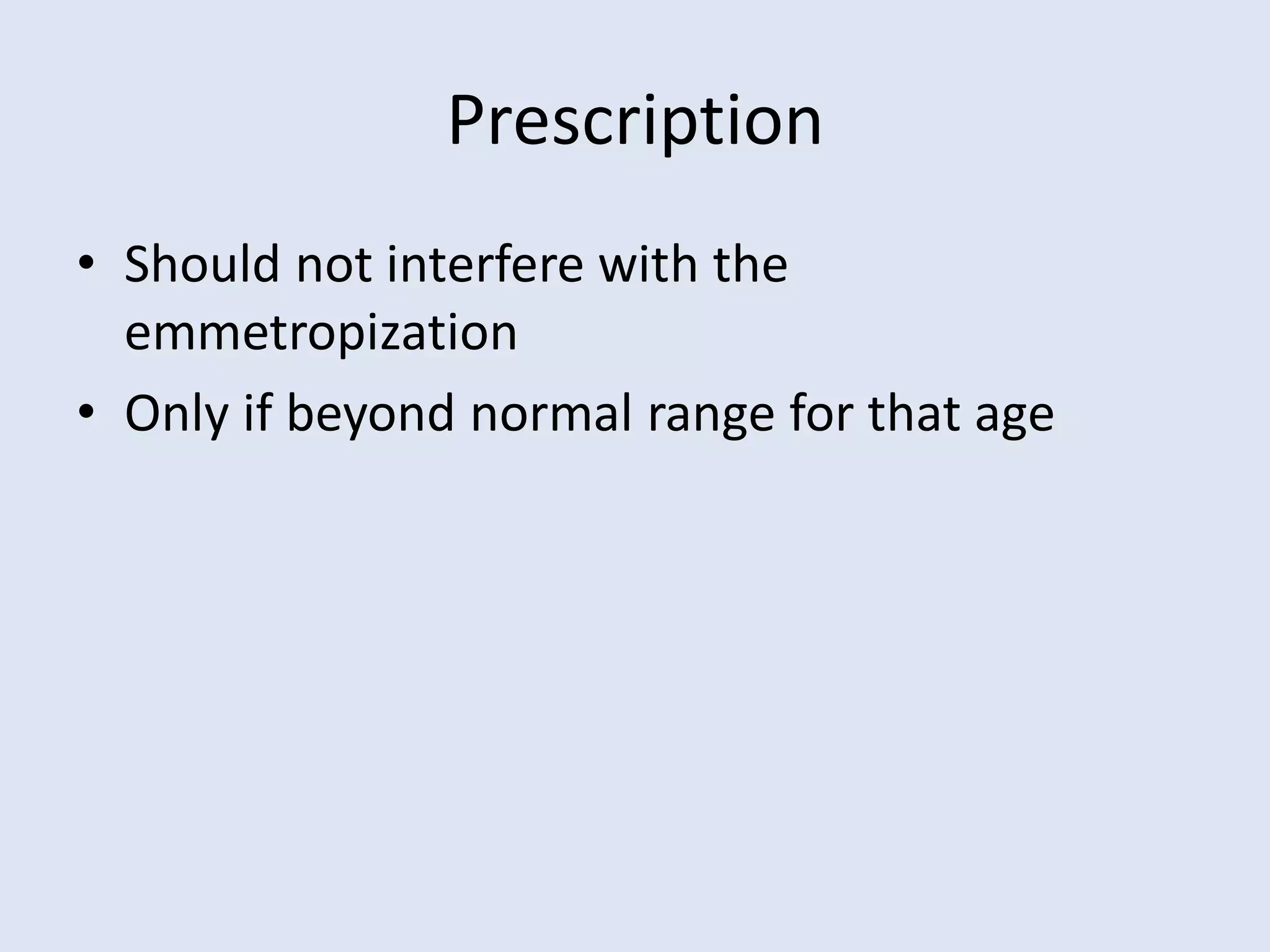
Prescription
• Should not interfere with the
emmetropization
• Only if beyond normal range for that age
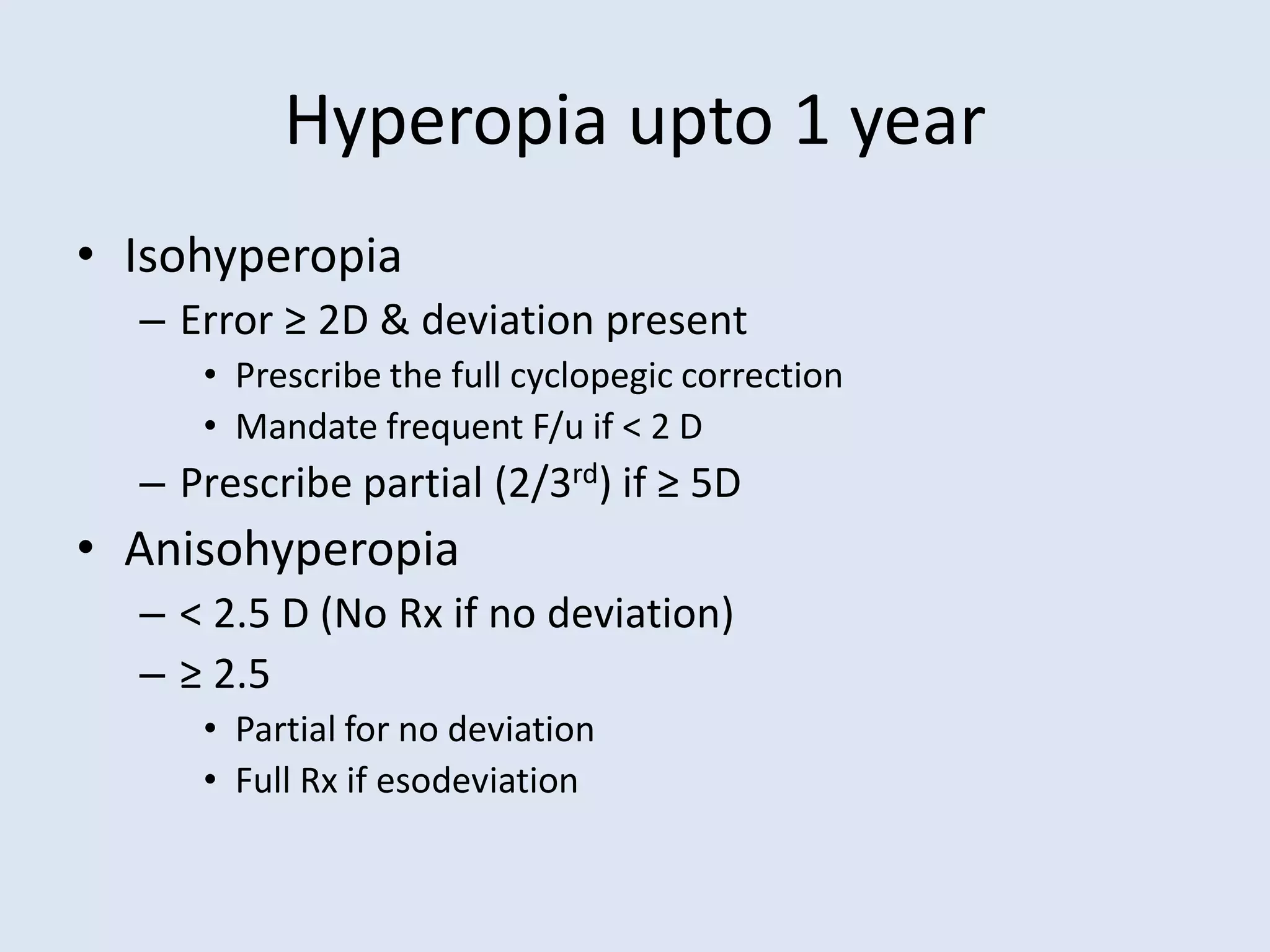
Hyperopia upto 1 year
• Isohyperopia
– Error ≥ 2D & deviation present
• Prescribe the full cyclopegic correction
• Mandate frequent F/u if < 2 D
– Prescribe partial (2/3rd) if ≥ 5D
• Anisohyperopia
– < 2.5 D (No Rx if no deviation)
– ≥ 2.5
• Partial for no deviation
• Full Rx if esodeviation
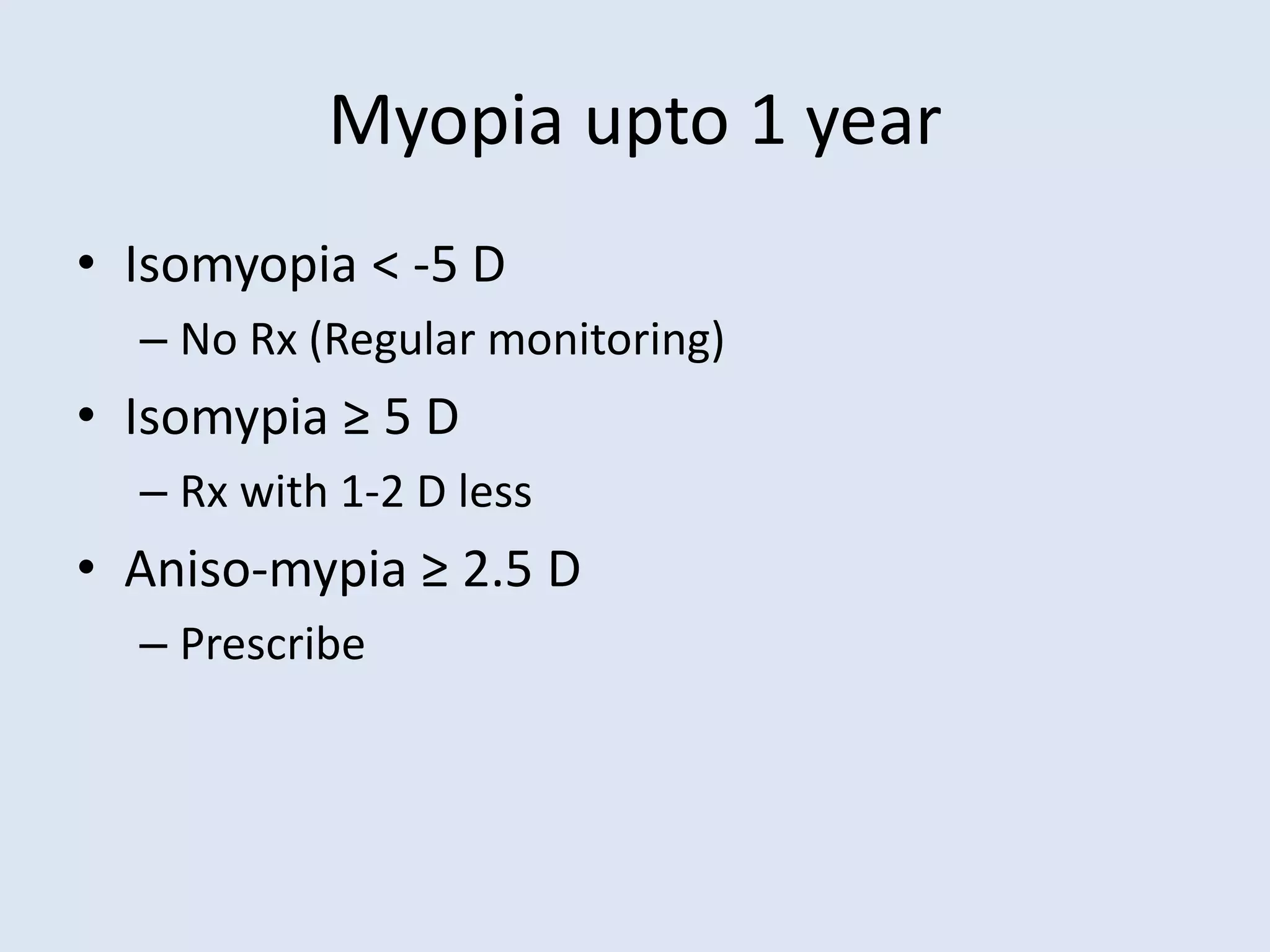
Myopia upto 1 year
• Isomyopia < -5 D
– No Rx (Regular monitoring)
• Isomypia ≥ 5 D
– Rx with 1-2 D less
• Aniso-mypia ≥ 2.5 D
– Prescribe
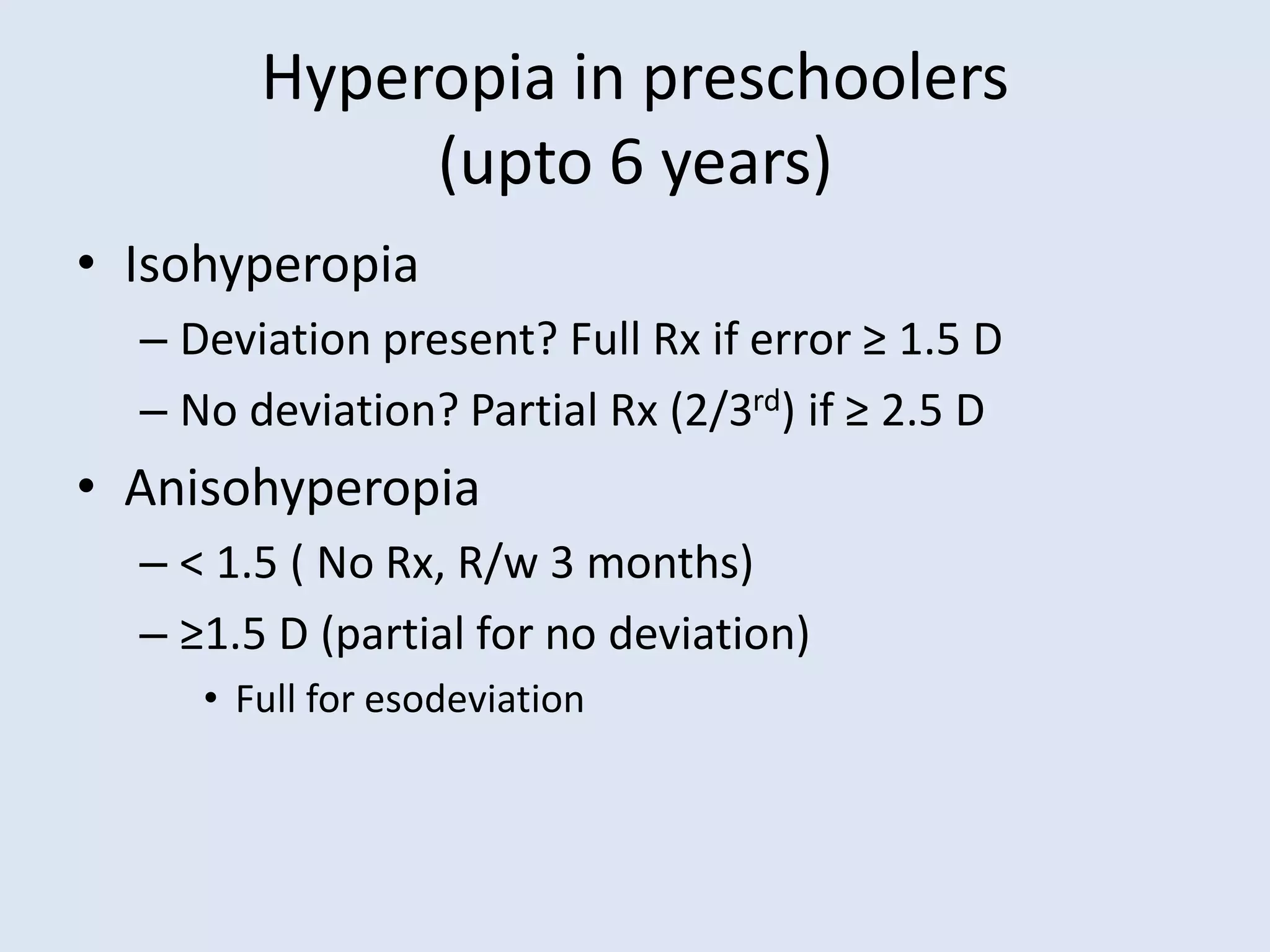
Hyperopia in preschoolers
(upto 6 years)
• Isohyperopia
– Deviation present? Full Rx if error ≥ 1.5 D
– No deviation? Partial Rx (2/3rd) if ≥ 2.5 D
• Anisohyperopia
– < 1.5 ( No Rx, R/w 3 months)
– ≥1.5 D (partial for no deviation)
• Full for esodeviation
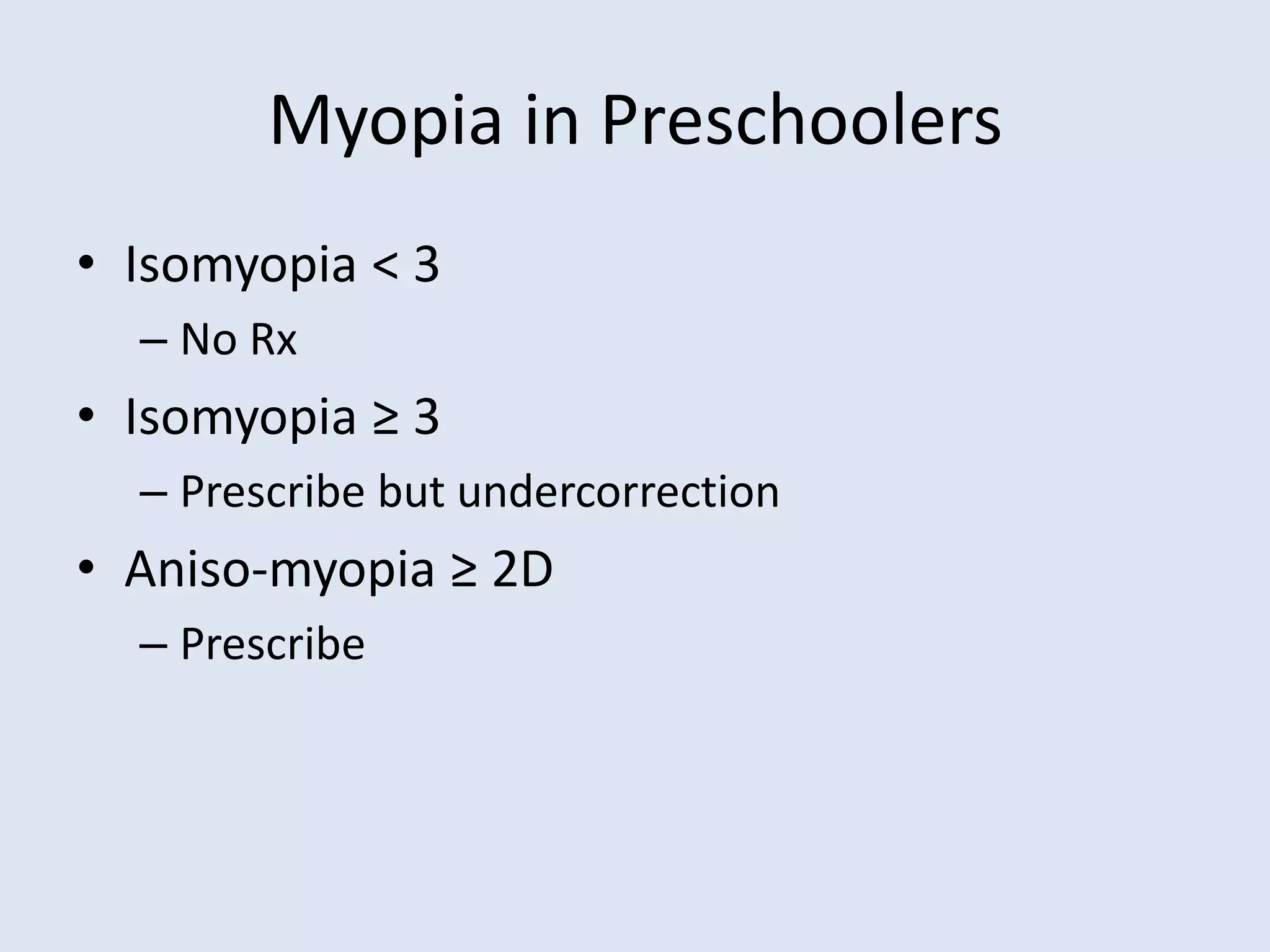
Myopia in Preschoolers
• Isomyopia < 3
– No Rx
• Isomyopia ≥ 3
– Prescribe but undercorrection
• Aniso-myopia ≥ 2D
– Prescribe
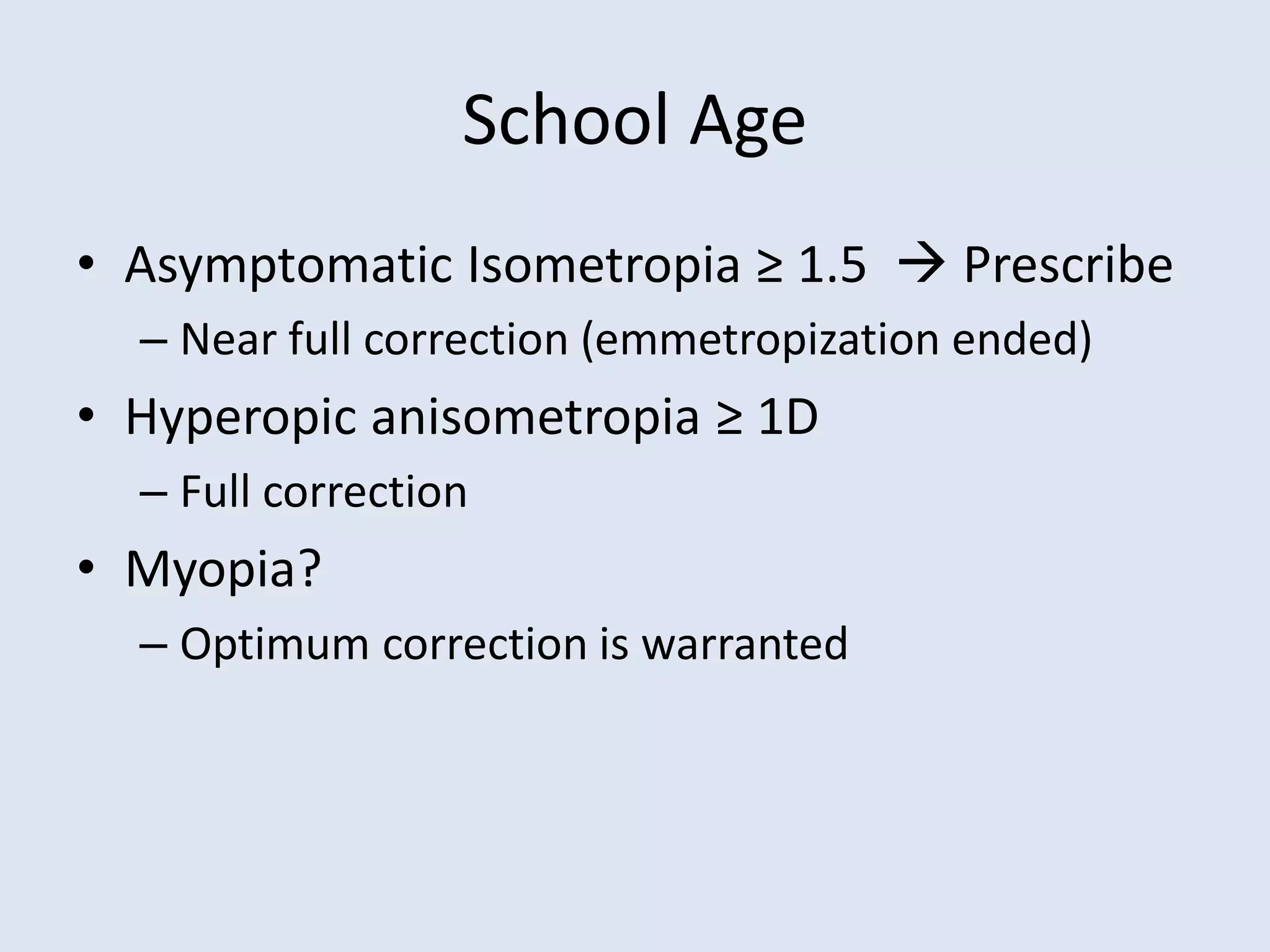
School Age
• Asymptomatic Isometropia ≥ 1.5  Prescribe
– Near full correction (emmetropization ended)
• Hyperopic anisometropia ≥ 1D
– Full correction
• Myopia?
– Optimum correction is warranted
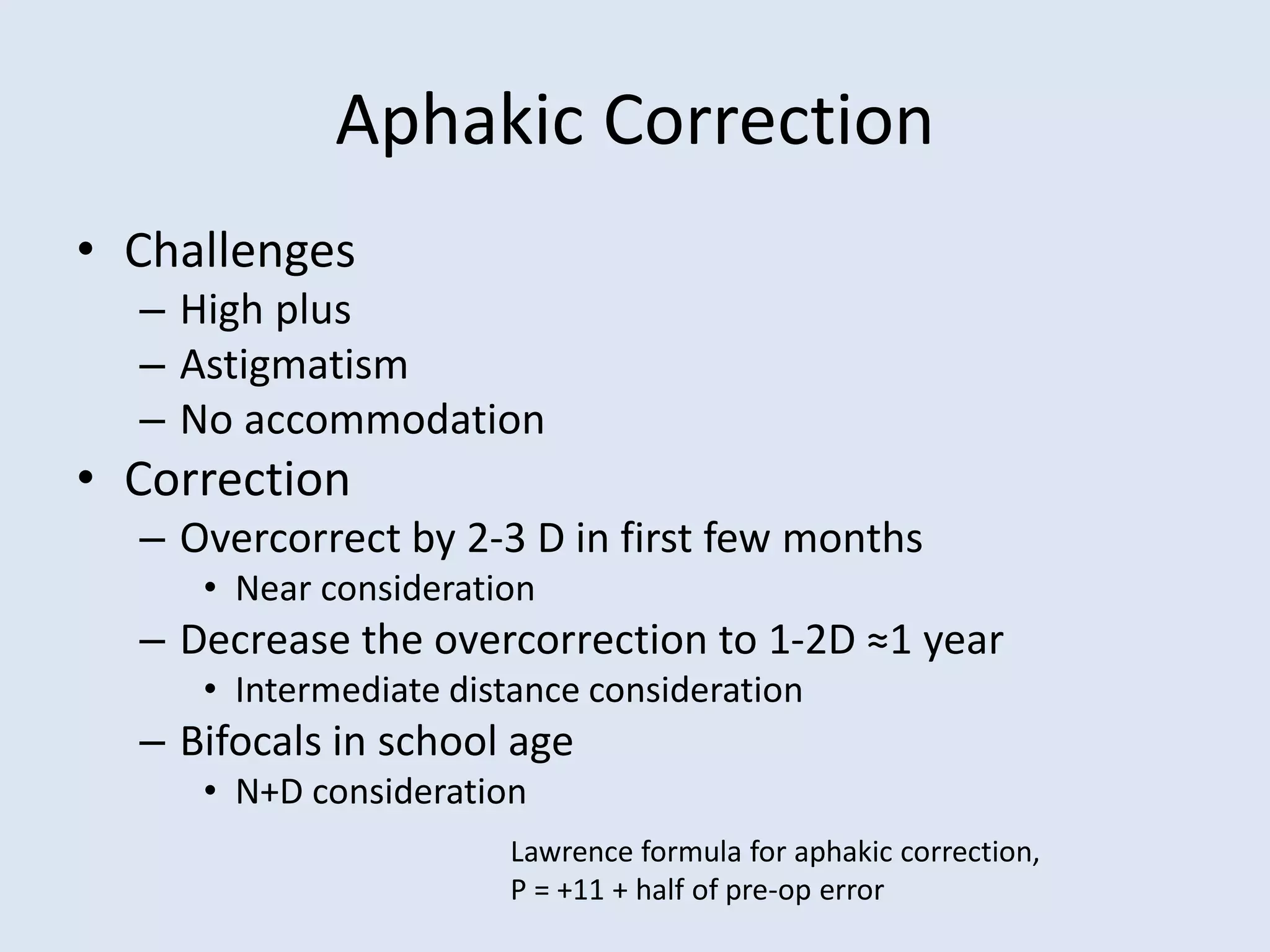
Aphakic Correction
• Challenges
– High plus
– Astigmatism
– No accommodation
• Correction
– Overcorrect by 2-3 D in first few months
• Near consideration
– Decrease the overcorrection to 1-2D ≈1 year
• Intermediate distance consideration
– Bifocals in school age
• N+D consideration
Lawrence formula for aphakic correction,
P = +11 + half of pre-op error
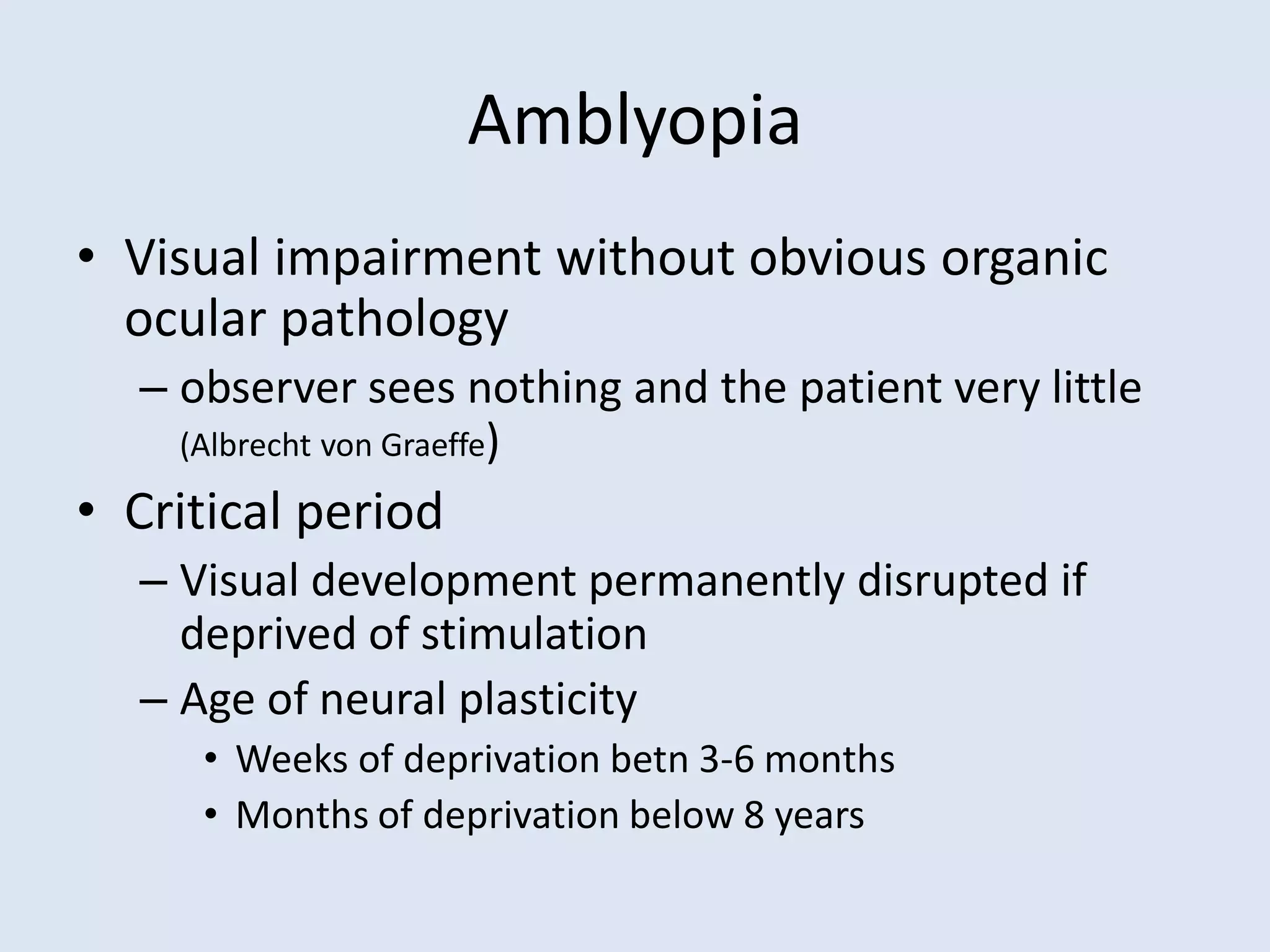
Amblyopia
• Visual impairment without obvious organic
ocular pathology
– observer sees nothing and the patient very little
(Albrecht von Graeffe)
• Critical period
– Visual development permanently disrupted if
deprived of stimulation
– Age of neural plasticity
• Weeks of deprivation betn 3-6 months
• Months of deprivation below 8 years
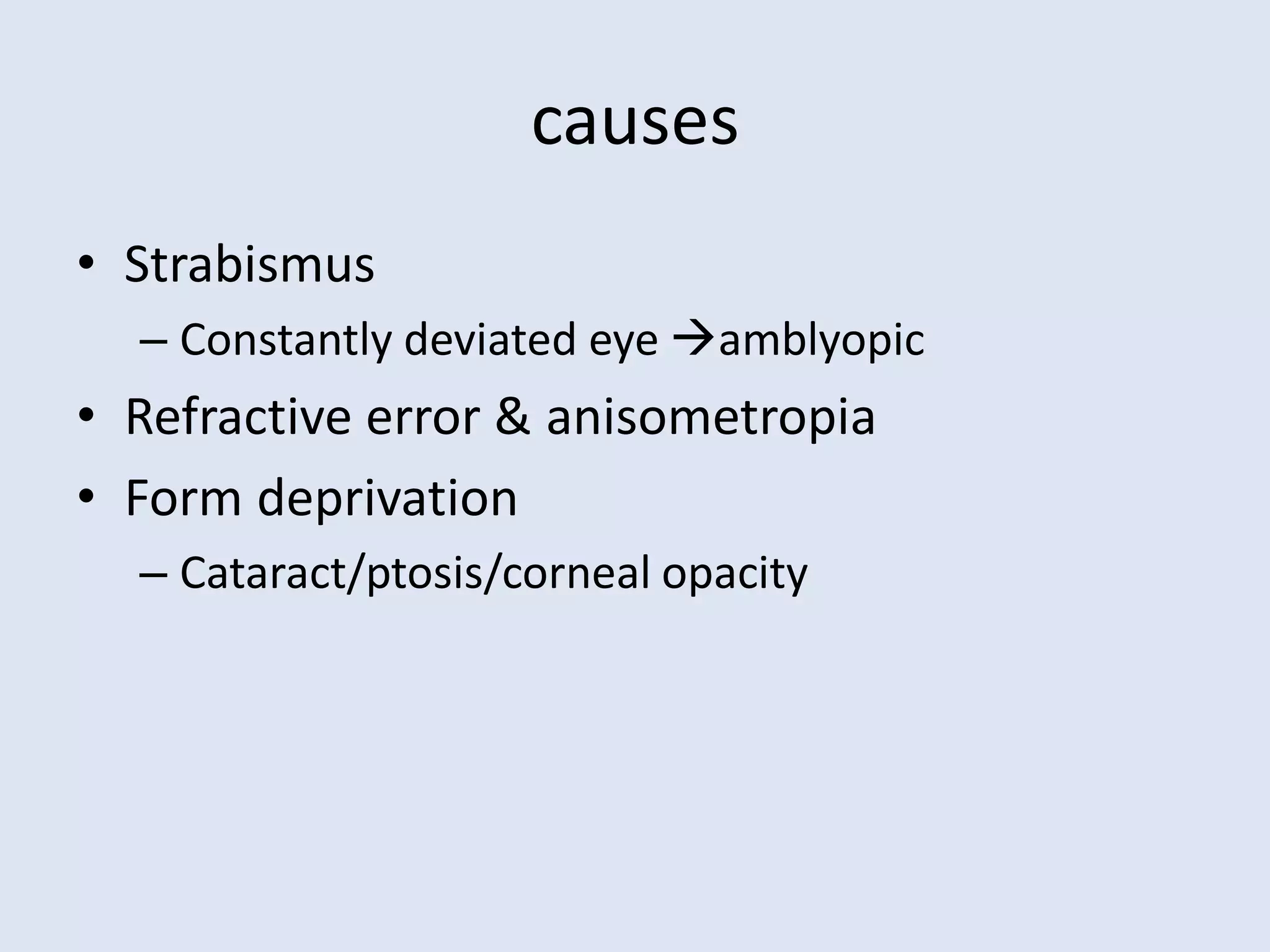
causes
• Strabismus
– Constantly deviated eye amblyopic
• Refractive error & anisometropia
• Form deprivation
– Cataract/ptosis/corneal opacity
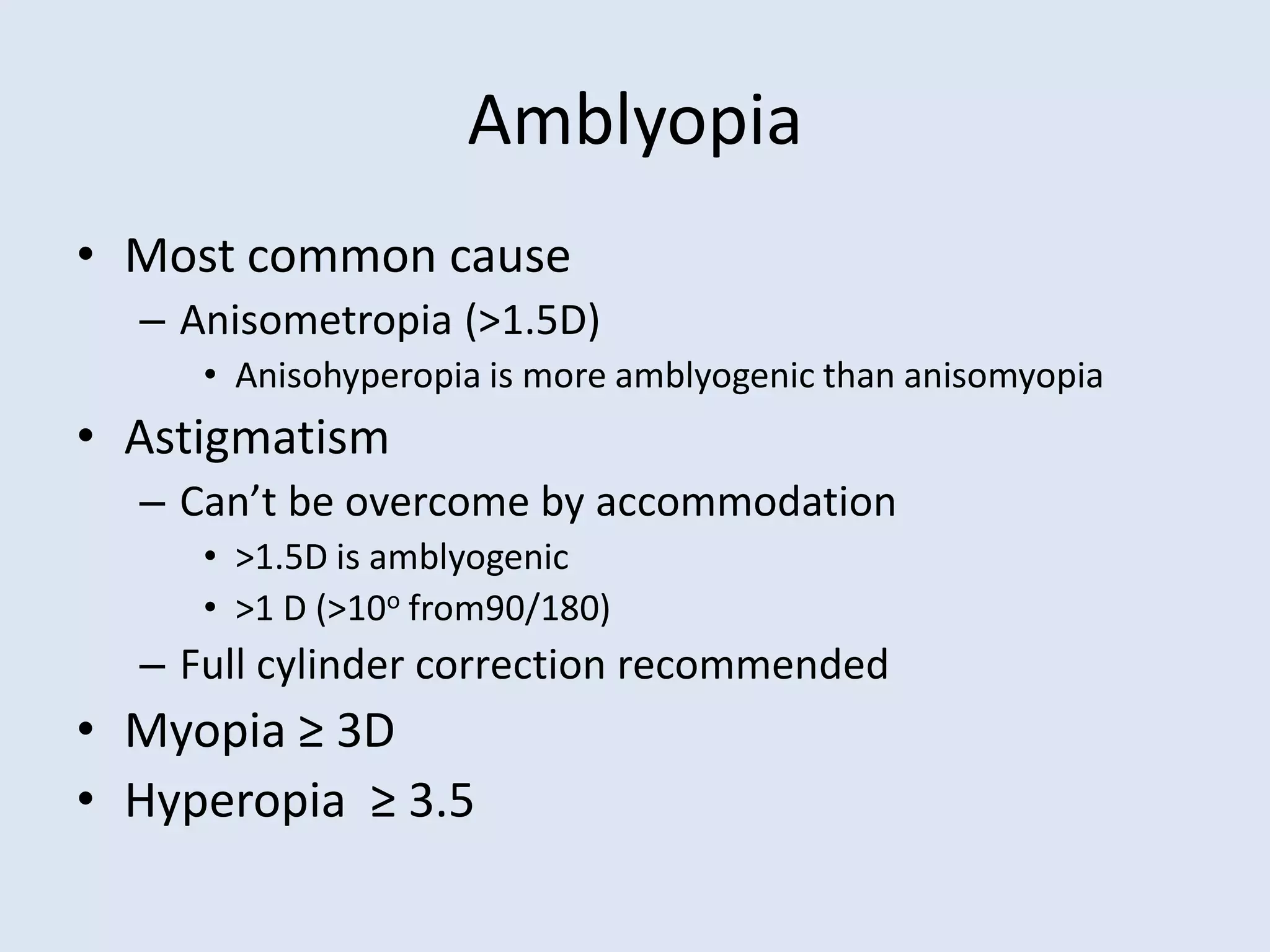
Amblyopia
• Most common cause
– Anisometropia (>1.5D)
• Anisohyperopia is more amblyogenic than anisomyopia
• Astigmatism
– Can’t be overcome by accommodation
• >1.5D is amblyogenic
• >1 D (>10o from90/180)
– Full cylinder correction recommended
• Myopia ≥ 3D
• Hyperopia ≥ 3.5
Strabismus
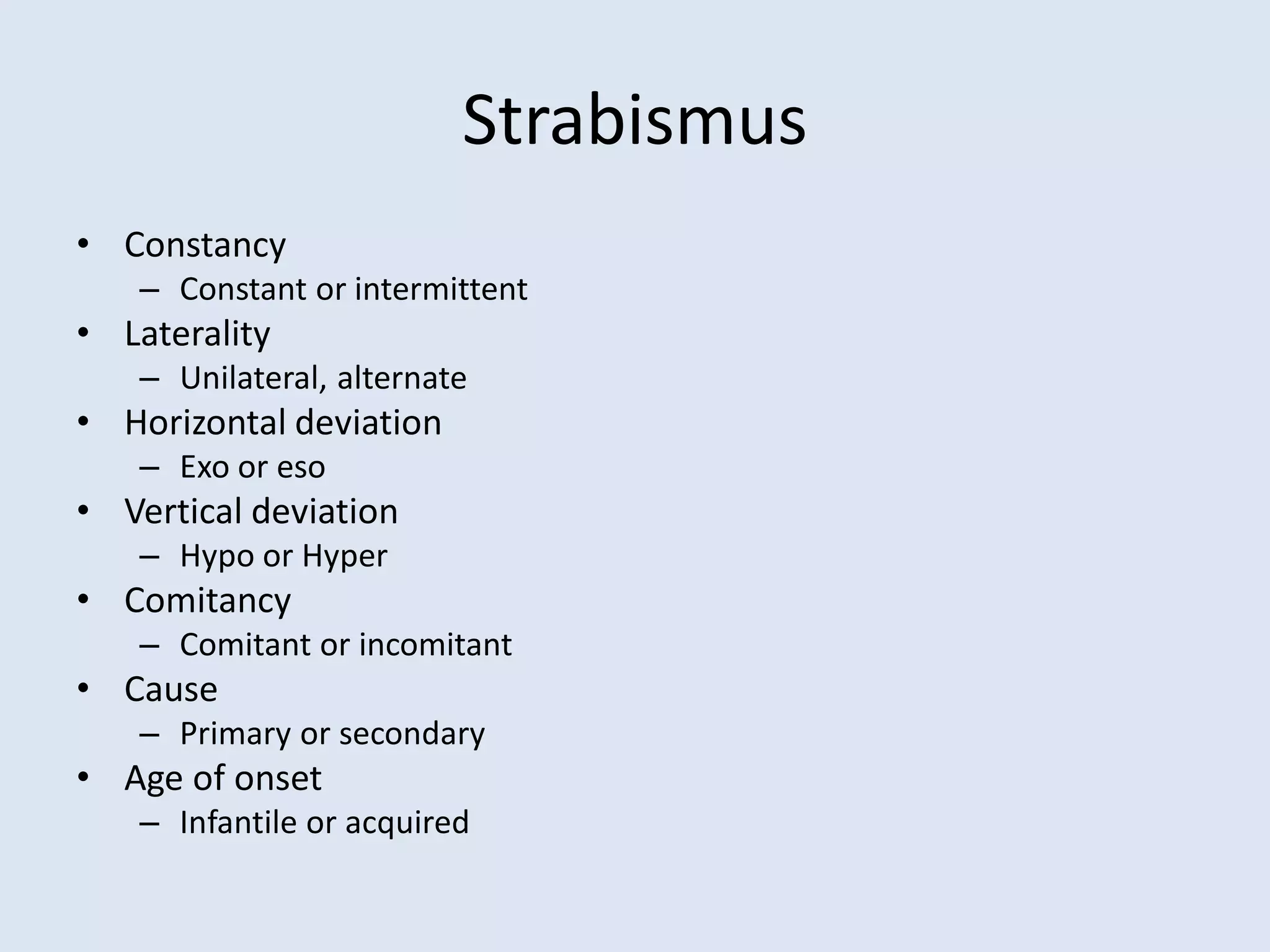
• Constancy
– Constant or intermittent
• Laterality
– Unilateral, alternate
• Horizontal deviation
– Exo or eso
• Vertical deviation
– Hypo or Hyper
• Comitancy
– Comitant or incomitant
• Cause
– Primary or secondary
• Age of onset
– Infantile or acquired
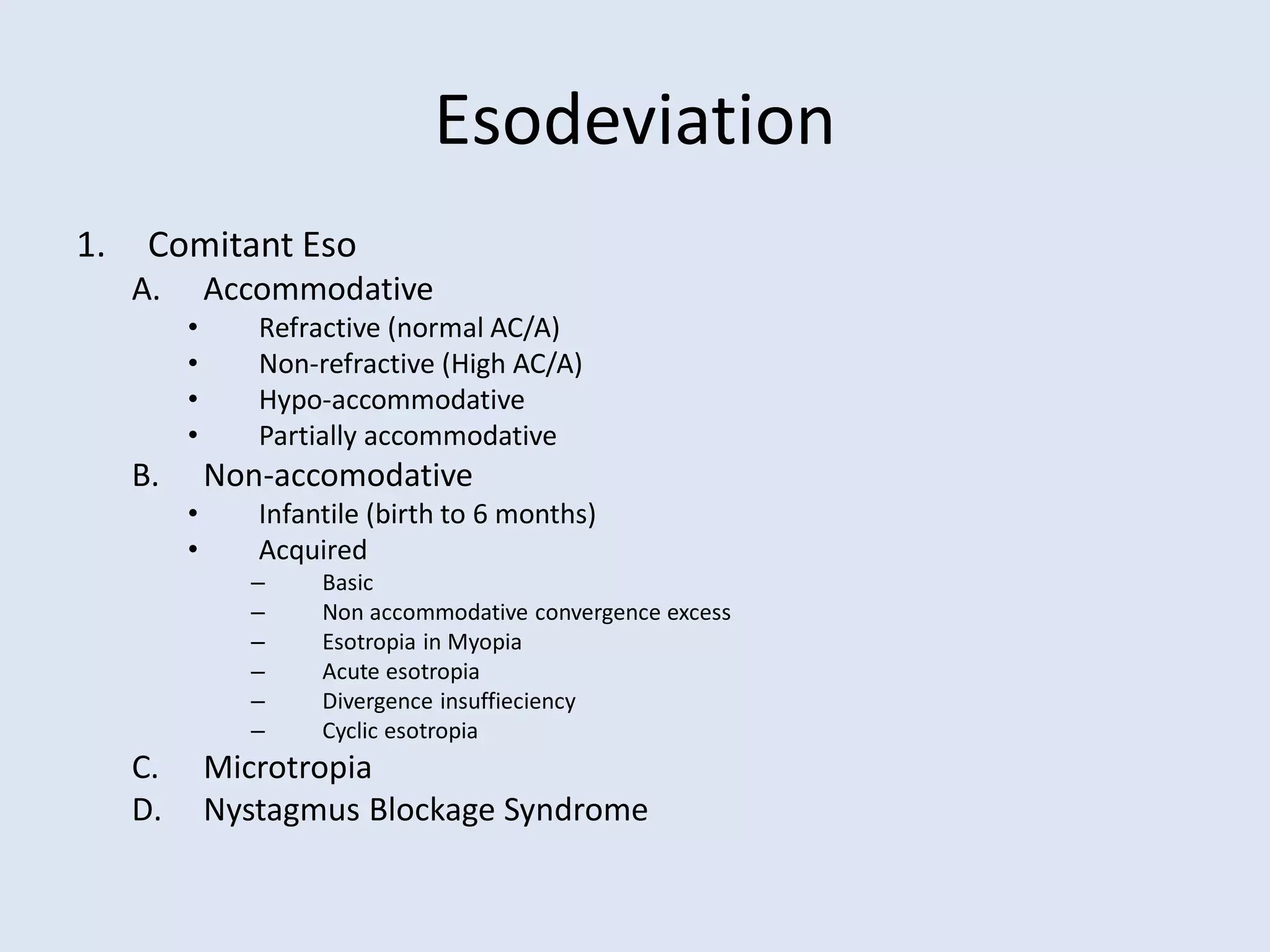
Esodeviation
1. Comitant Eso
A. Accommodative
• Refractive (normal AC/A)
• Non-refractive (High AC/A)
• Hypo-accommodative
• Partially accommodative
B. Non-accomodative
• Infantile (birth to 6 months)
• Acquired
– Basic
– Non accommodative convergence excess
– Esotropia in Myopia
– Acute esotropia
– Divergence insuffieciency
– Cyclic esotropia
C. Microtropia
D. Nystagmus Blockage Syndrome
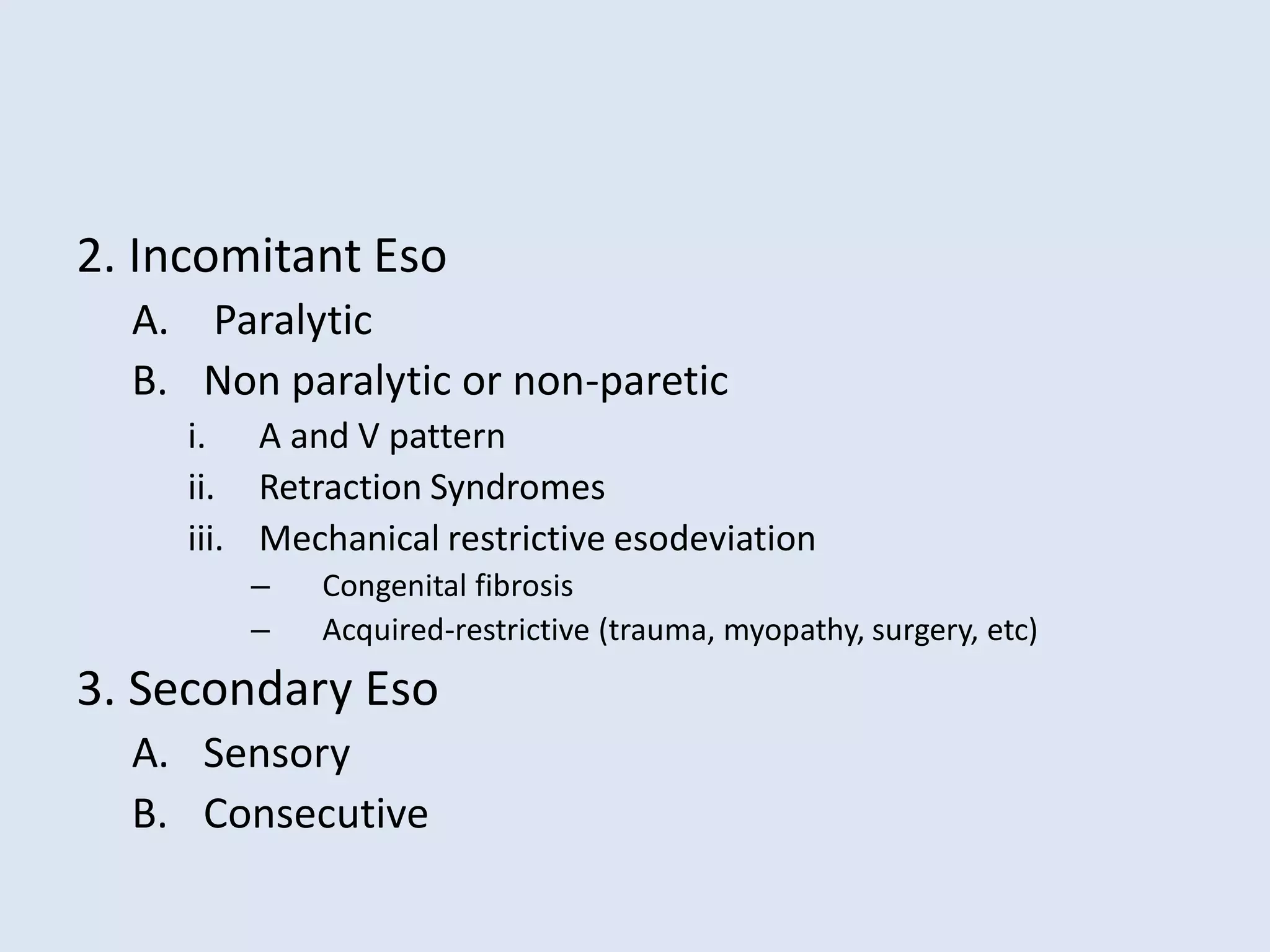
2. Incomitant Eso
A. Paralytic
B. Non paralytic or non-paretic
i. A and V pattern
ii. Retraction Syndromes
iii. Mechanical restrictive esodeviation
– Congenital fibrosis
– Acquired-restrictive (trauma, myopathy, surgery, etc)
3. Secondary Eso
A. Sensory
B. Consecutive
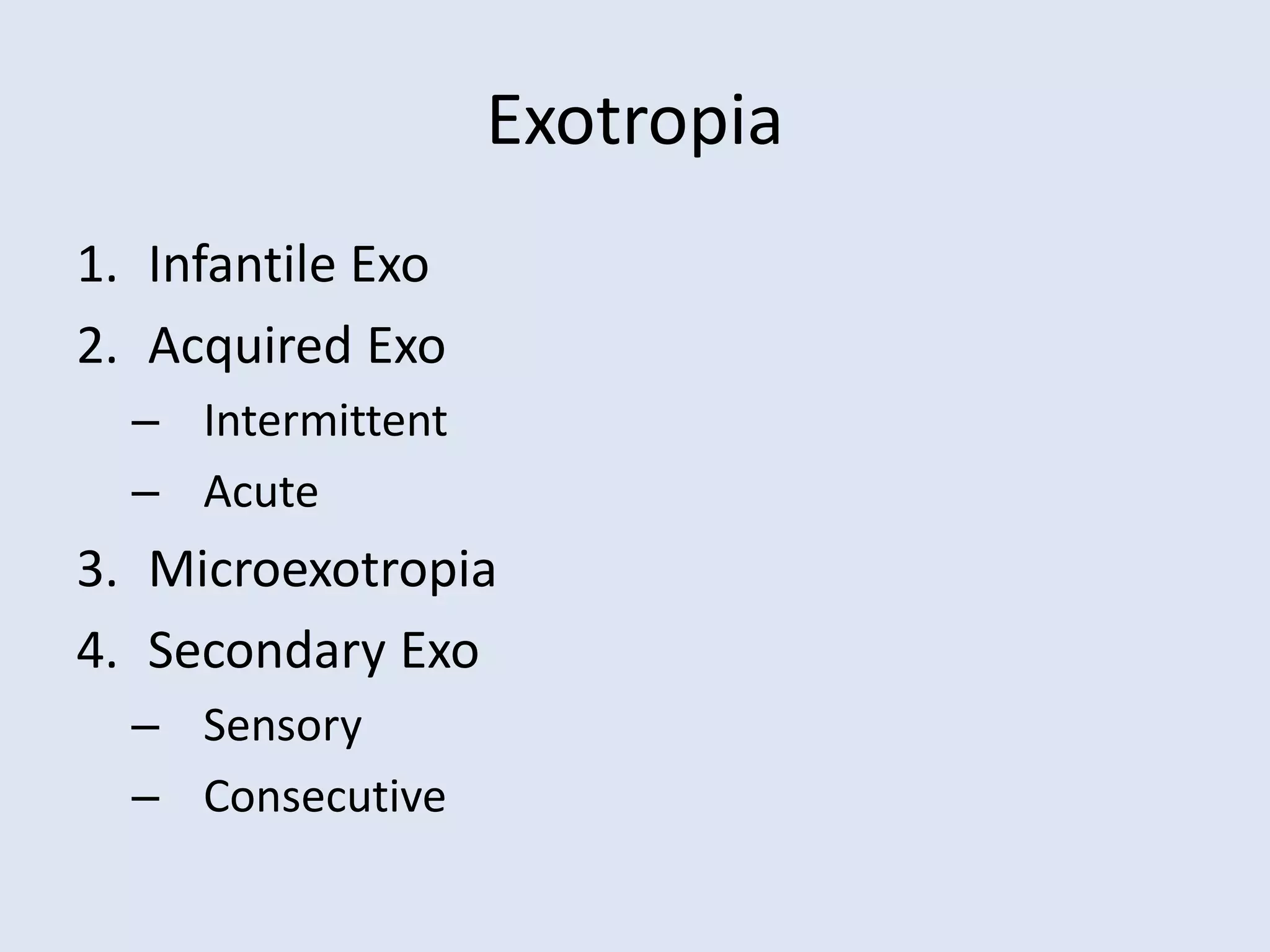
Exotropia
1. Infantile Exo
2. Acquired Exo
– Intermittent
– Acute
3. Microexotropia
4. Secondary Exo
– Sensory
– Consecutive
Nystagmus
• Involuntary, rhythmic, pendular or jerky
conjugate oscillation
– Congenital
– Acquired
Congenital Manifest Nystagmus
• First 3 months of life
• Cause
– Cataract
– Congenital glaucoma
– Aniridia
– Achromatopsia
– Down’s syndrome
– High Myopia
– Optic Nerve Hypoplasia
– Leber’s amaurosis
– OCA
Latent Vs Manifest-latent
• Latent
– Evoked by occluding one eye
– Absence when both eyes are open
• Manifest latent
– Latent nystagmus that gets evident at some gazes
– Is lesser in amplitude than the latent one
• Ocular Nystagmus
– Congenital (or with in 1st week ) ocular defects
• Spasmus Nutans
– 1st year of life and disappears 1-2 years
– High Frequency (7Hz), small amplitude
– Head nodding
• Sensory Defect Nystagmus
– Cause: inadequate image formation at fovea
– Anterior visual pathway disease
– Always B/L and horizontal
– Pendular and oscillates with equal velocity in both
direction
• Motor Defect
– Cause: efferent mechanism disruption
– Centers or pathways for oculomotor pathways
– Null Point: VA improved due to dampening of
Nystagmus
M. Optom First Batch @TIO (2019)

Vision Assessment and Vision Screening in Children, Refractive Error and Spectacle Correction, Amblyopia, Strabismus and Nystagmus

  • 1.
    Vision Assessment andVision Screening in Children Refractive error and spectacle correction Amblyopia Strabismus Nystagmus Rabindra Adhikary M. Optom 1st Batch Tilganga Institute of ophthalmology (TIO) Pokhara University Facilitators: Dr Srijana Adhikari, Dr Rojeeta Parajuli Date: 4th of June, 2019
  • 2.
    Pediatric Ophthalmology – Layout •Vision Assessment and Vision Screening in Children • Refractive error and spectacle correction • Amblyopia • Strabismus • Nystagmus
  • 3.
    Visual acuity • Preverbalchildren – Motor or sensory response to a threshold stimulus – Known size at a known distance • Pre-literate and verbal Children – Smallest target of known size at known distance correctly verbally identified by a child
  • 4.
    Visual Milestones Age VisualBehavior 0-1 month Fixate &Turns eye and head to look at the light source / Looks high contrast object (mother’s hairline) + Horizontal Tracking At 1 month, fixation is central, steady and maintained 3 month Vertical and circular tracking Interested in mobiles Lip-reading / responsive smile 6 months Reaches towards, and later grasps the hanging objects Observes toys falling and rolling away 10 Looks for hidden toys Interested in pictures 1 year Recognize people 2 years Picture Matching 3 years Letter matching of single letters 5 years Snellen chart by matching or naming
  • 5.
    Gross Estimate ofVA Age Snellen’s Equivalent Birth 6/120 4 months 6/60 6 months 6/36 1 year 6/18 2 years 6/6
  • 6.
    Recognition Acuity • Smallestnumber, letter or other shapes that can be recognized –
  • 7.
    Resolution Acuity • PreferentialLooking – Child prefers to look at the grating • Striped grating • Uniform filed – Forced choice preferential looking (FCPL) – 2 months to 1 year or pt with mental disabilities – Visual threshold=75% correct inferences • Drawbacks of PFL – Difficult to hold a child’s attention for long – Reliability is dependent on many trials – Near test
  • 9.
    OKN • Drifting OKNgenerated by – Resolvable stimuli • Jerky Nystagmus – Pursuit (follows target) – Saccade (jumps to next)
  • 10.
    VEP • Measures electricalactivity directly from the scalp through surface electrodes – Amplitude and timing of wave of electrical activity – Go on presenting finer and finer stimuli • Until zero response amplitude • Abnormal VEP? – Problem with the visual information reaching cortex
  • 12.
    Age-wise VA assessment •Infants – PFL/OKN/VEP – Cat ford Drum • 1-2 years – STYCAR • For retards too – Boeck Candy test – Worth’s Ivory Ball test • 2-3 years – Miniature Toy test – Cardiff Acuity test – Coin test – Lea symbols • 3-5 years – Allen’s picture cards – Sheridan’s HOTVX letter test – Lippman’s HOTV Test • 5-6 years – Snellen
  • 13.
    Screening • Age rangesand visual/ocular pathology to be detected by screening: Pre-term Perinatal/infantile Pre-school School age ROP Congenital cataract Glaucoma Anterior segment disorder Amblyogenic factors -anisometropia -strabismus -high refractive error -Ptosis -Media opacity Refractive error
  • 14.
    Fixation Reflex • CSM –Monocular central fixation (C) • No eccentric fixation – Hold steady Fixation (S) – Maintain fixation (M) • With the viewing eye • Even when the fellow eye is uncovered • F + F – Fixate and Follow the light stimuli – Monocular viewing conditions
  • 15.
    Pupillary Response • Birth-3 years (or upto when VA can’t be measured) • Pupil reactions to the changes of light stimulus – Direct – Consensual • Not equivalent to visual ability but indicates – Intact neurologic visual pathways
  • 16.
    Red Light Reflex •Bruckner Test • 0-3 years • Ophthalmoscope – Position the light to illuminate BE • Reflex – Symmetrical – Equal intensity – Healthy red color
  • 17.
    Corneal Light Reflex •Hirschberg’s test • 2 months- 8 years • Strabismus (D/Dx: pseudostrabismus) • Corneal reflection of Penlight – Positioned symmetrically on both pupils
  • 18.
    Cover test • Toknow if eye deviates when fusion is interrupted – Observing the fixating eye when other eye is covered (Cover test) – Observing the eye being uncovered for movement when the occluder is shifted to the other eye (alternate cover) – Observing the eye being uncovered for movement when the occluder is removed (cover uncover)
  • 19.
    Stereo-acuity • 3-8 years •Needs polarized glass • Random dot E or stereo butterfly • To check problems with stereo-acuity and depth perception
  • 20.
    Color vision • At6 years (first grader) • Others: optional • To check color deficiency – Ishihara Pseudo-isochromatic Plates, – Color Vision Testing Made Easy – Good-Lite Book of Color Plates. • Fluorescent desk lamp - if enough natural daylight is not available.
  • 21.
    Age vs RefractiveError General Trends Premature Infant High myopia ( ± ROP) Newborn (full term) baby Hyperopia ( 1-2 D) Toddler (preschool) Less hyperopia / low Myopia (towards Emmetopia) School Children Emmetropia or school myopia Adolescent Myopia
  • 22.
    Refraction • Cycloplegic Refraction: –Greater range of accommodation – Fluctuating fixation – Pseudomyopia – Strabismus – High hyperopia / latent Hyperopia – Inconsistent results • Near Retinoscopy
  • 23.
    Prescription • Should notinterfere with the emmetropization • Only if beyond normal range for that age
  • 24.
    Hyperopia upto 1year • Isohyperopia – Error ≥ 2D & deviation present • Prescribe the full cyclopegic correction • Mandate frequent F/u if < 2 D – Prescribe partial (2/3rd) if ≥ 5D • Anisohyperopia – < 2.5 D (No Rx if no deviation) – ≥ 2.5 • Partial for no deviation • Full Rx if esodeviation
  • 25.
    Myopia upto 1year • Isomyopia < -5 D – No Rx (Regular monitoring) • Isomypia ≥ 5 D – Rx with 1-2 D less • Aniso-mypia ≥ 2.5 D – Prescribe
  • 26.
    Hyperopia in preschoolers (upto6 years) • Isohyperopia – Deviation present? Full Rx if error ≥ 1.5 D – No deviation? Partial Rx (2/3rd) if ≥ 2.5 D • Anisohyperopia – < 1.5 ( No Rx, R/w 3 months) – ≥1.5 D (partial for no deviation) • Full for esodeviation
  • 27.
    Myopia in Preschoolers •Isomyopia < 3 – No Rx • Isomyopia ≥ 3 – Prescribe but undercorrection • Aniso-myopia ≥ 2D – Prescribe
  • 28.
    School Age • AsymptomaticIsometropia ≥ 1.5  Prescribe – Near full correction (emmetropization ended) • Hyperopic anisometropia ≥ 1D – Full correction • Myopia? – Optimum correction is warranted
  • 29.
    Aphakic Correction • Challenges –High plus – Astigmatism – No accommodation • Correction – Overcorrect by 2-3 D in first few months • Near consideration – Decrease the overcorrection to 1-2D ≈1 year • Intermediate distance consideration – Bifocals in school age • N+D consideration Lawrence formula for aphakic correction, P = +11 + half of pre-op error
  • 30.
    Amblyopia • Visual impairmentwithout obvious organic ocular pathology – observer sees nothing and the patient very little (Albrecht von Graeffe) • Critical period – Visual development permanently disrupted if deprived of stimulation – Age of neural plasticity • Weeks of deprivation betn 3-6 months • Months of deprivation below 8 years
  • 31.
    causes • Strabismus – Constantlydeviated eye amblyopic • Refractive error & anisometropia • Form deprivation – Cataract/ptosis/corneal opacity
  • 32.
    Amblyopia • Most commoncause – Anisometropia (>1.5D) • Anisohyperopia is more amblyogenic than anisomyopia • Astigmatism – Can’t be overcome by accommodation • >1.5D is amblyogenic • >1 D (>10o from90/180) – Full cylinder correction recommended • Myopia ≥ 3D • Hyperopia ≥ 3.5
  • 33.
    Strabismus • Constancy – Constantor intermittent • Laterality – Unilateral, alternate • Horizontal deviation – Exo or eso • Vertical deviation – Hypo or Hyper • Comitancy – Comitant or incomitant • Cause – Primary or secondary • Age of onset – Infantile or acquired
  • 34.
    Esodeviation 1. Comitant Eso A.Accommodative • Refractive (normal AC/A) • Non-refractive (High AC/A) • Hypo-accommodative • Partially accommodative B. Non-accomodative • Infantile (birth to 6 months) • Acquired – Basic – Non accommodative convergence excess – Esotropia in Myopia – Acute esotropia – Divergence insuffieciency – Cyclic esotropia C. Microtropia D. Nystagmus Blockage Syndrome
  • 35.
    2. Incomitant Eso A.Paralytic B. Non paralytic or non-paretic i. A and V pattern ii. Retraction Syndromes iii. Mechanical restrictive esodeviation – Congenital fibrosis – Acquired-restrictive (trauma, myopathy, surgery, etc) 3. Secondary Eso A. Sensory B. Consecutive
  • 36.
    Exotropia 1. Infantile Exo 2.Acquired Exo – Intermittent – Acute 3. Microexotropia 4. Secondary Exo – Sensory – Consecutive
  • 37.
    Nystagmus • Involuntary, rhythmic,pendular or jerky conjugate oscillation – Congenital – Acquired
  • 38.
    Congenital Manifest Nystagmus •First 3 months of life • Cause – Cataract – Congenital glaucoma – Aniridia – Achromatopsia – Down’s syndrome – High Myopia – Optic Nerve Hypoplasia – Leber’s amaurosis – OCA
  • 39.
    Latent Vs Manifest-latent •Latent – Evoked by occluding one eye – Absence when both eyes are open • Manifest latent – Latent nystagmus that gets evident at some gazes – Is lesser in amplitude than the latent one • Ocular Nystagmus – Congenital (or with in 1st week ) ocular defects • Spasmus Nutans – 1st year of life and disappears 1-2 years – High Frequency (7Hz), small amplitude – Head nodding
  • 40.
    • Sensory DefectNystagmus – Cause: inadequate image formation at fovea – Anterior visual pathway disease – Always B/L and horizontal – Pendular and oscillates with equal velocity in both direction • Motor Defect – Cause: efferent mechanism disruption – Centers or pathways for oculomotor pathways – Null Point: VA improved due to dampening of Nystagmus
  • 41.
    M. Optom FirstBatch @TIO (2019)