z
z
VERGENCE
NANDHU KRISHNA
3rd YEAR B.OPTOMETRY
z
Introduction
❖ A vergence is the simultaneous movement of both eyes in
opposite directions to obtain binocular vision.
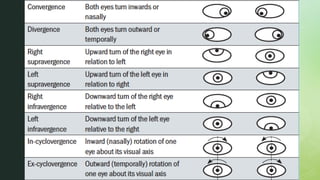
❖ Vergence can be Horizontal , Vertical or Torsional.
❖ To look at an object closer by, the eyes move towards each other
(Convergence), while for an object farther away eyes move away
from each other (Divergence).
❖ It permits Stereopsis and prevent Diplopia.
z
❖Fusional vergence
The movement of both eyes that enables the fusion of monocular images
producing binocular vision.
❖Proximal vergence
Vergence due to the awareness of a fixation object being near or far in the
absence of disparity and of cues for accommodation. This includes also
vergence that is due to a subject's intent to fixate an object in the dark.
Types of vergence
z
❖Tonic vergence:
Vergence due to normal extraocular muscle tone, with no
accommodation and no stimulus to binocular fusion. Tonic vergence
is considered to move the eyes from an anatomical position of rest
(which would be the eye's position if it were not innervated) to the
physiological position of eyes.
❖Accommodative vergence
Vergence that occurs when the eyes accommodate.
The stimulus for accommodative vergence is blurred retinal
images. Accommodative vergence is measured as the ratio between
how much convergence takes place for a given accommodation
(AC/A ratio).
z AC/A ratio
▪ Measurement of the convergence induced by accommodation
per diopter of accommodation.
▪ Use: To determine the change in accommodative
convergence that occurs when the patient accommodates a
given amount.
▪ Unit:Prism dioptresΔ / 1 lens diopter.
▪ Normal range:3-5 Δ/D
z
Examination of vergence
▪ The information required to evaluate patients with abnormalities
of vergence are measures of ocular alignment , near points of
convergence and accommodation, fusional
amplitude and the AC/A ratio .
▪ With this data the we can separate disorders of vergence from
other disorders of oculomotor alignment, disorders of
convergence from disorders of divergence, and convergence or
divergence excess from insufficiency syndromes.
z
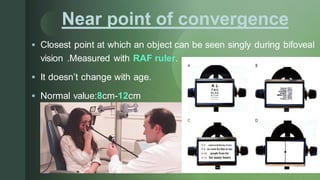
Near point of convergence
▪ Closest point at which an object can be seen singly during bifoveal
vision .Measured with RAF ruler.
▪ It doesn’t change with age.
▪ Normal value:8cm-12cm
z Anomalies of vergence
Common disorders of vergence include:
▪ Convergence insufficiency
▪ Convergence excess
▪ Divergence insufficiency
▪ Divergence excess.
In these conditions the terms "excess" and "insufficiency" refer to
high and low AC/A ratios
z
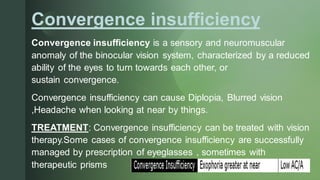
Convergence insufficiency
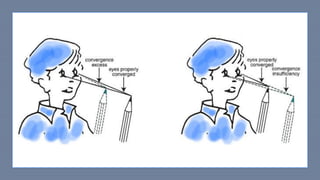
Convergence insufficiency is a sensory and neuromuscular
anomaly of the binocular vision system, characterized by a reduced
ability of the eyes to turn towards each other, or
sustain convergence.
Convergence insufficiency can cause Diplopia, Blurred vision
,Headache when looking at near by things.
TREATMENT: Convergence insufficiency can be treated with vision
therapy.Some cases of convergence insufficiency are successfully
managed by prescription of eyeglasses , sometimes with
therapeutic prisms
z
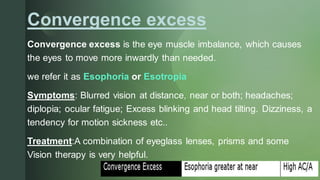
Convergence excess
Convergence excess is the eye muscle imbalance, which causes
the eyes to move more inwardly than needed.
we refer it as Esophoria or Esotropia
Symptoms: Blurred vision at distance, near or both; headaches;
diplopia; ocular fatigue; Excess blinking and head tilting. Dizziness, a
tendency for motion sickness etc..
Treatment:A combination of eyeglass lenses, prisms and some
Vision therapy is very helpful.
z
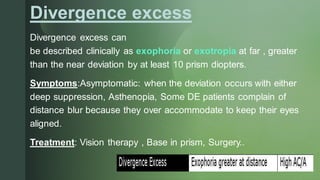
Divergence excess
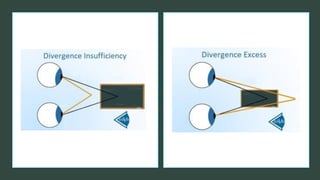
Divergence excess can
be described clinically as exophoria or exotropia at far , greater
than the near deviation by at least 10 prism diopters.
Symptoms:Asymptomatic: when the deviation occurs with either
deep suppression, Asthenopia, Some DE patients complain of
distance blur because they over accommodate to keep their eyes
aligned.
Treatment: Vision therapy , Base in prism, Surgery..
z
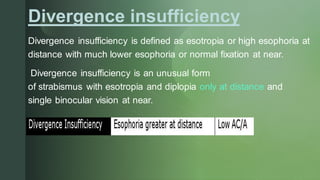
Divergence insufficiency
Divergence insufficiency is defined as esotropia or high esophoria at
distance with much lower esophoria or normal fixation at near.
Divergence insufficiency is an unusual form
of strabismus with esotropia and diplopia only at distance and
single binocular vision at near.
z
Vergence and its anomalies

Vergence and its anomalies

  • 1.
  • 2.
    z Introduction ❖ A vergenceis the simultaneous movement of both eyes in opposite directions to obtain binocular vision. ❖ Vergence can be Horizontal , Vertical or Torsional. ❖ To look at an object closer by, the eyes move towards each other (Convergence), while for an object farther away eyes move away from each other (Divergence). ❖ It permits Stereopsis and prevent Diplopia.
  • 4.
    z ❖Fusional vergence The movementof both eyes that enables the fusion of monocular images producing binocular vision. ❖Proximal vergence Vergence due to the awareness of a fixation object being near or far in the absence of disparity and of cues for accommodation. This includes also vergence that is due to a subject's intent to fixate an object in the dark. Types of vergence
  • 5.
    z ❖Tonic vergence: Vergence dueto normal extraocular muscle tone, with no accommodation and no stimulus to binocular fusion. Tonic vergence is considered to move the eyes from an anatomical position of rest (which would be the eye's position if it were not innervated) to the physiological position of eyes. ❖Accommodative vergence Vergence that occurs when the eyes accommodate. The stimulus for accommodative vergence is blurred retinal images. Accommodative vergence is measured as the ratio between how much convergence takes place for a given accommodation (AC/A ratio).
  • 6.
    z AC/A ratio ▪Measurement of the convergence induced by accommodation per diopter of accommodation. ▪ Use: To determine the change in accommodative convergence that occurs when the patient accommodates a given amount. ▪ Unit:Prism dioptresΔ / 1 lens diopter. ▪ Normal range:3-5 Δ/D
  • 7.
    z Examination of vergence ▪The information required to evaluate patients with abnormalities of vergence are measures of ocular alignment , near points of convergence and accommodation, fusional amplitude and the AC/A ratio . ▪ With this data the we can separate disorders of vergence from other disorders of oculomotor alignment, disorders of convergence from disorders of divergence, and convergence or divergence excess from insufficiency syndromes.
  • 8.
    z Near point ofconvergence ▪ Closest point at which an object can be seen singly during bifoveal vision .Measured with RAF ruler. ▪ It doesn’t change with age. ▪ Normal value:8cm-12cm
  • 9.
    z Anomalies ofvergence Common disorders of vergence include: ▪ Convergence insufficiency ▪ Convergence excess ▪ Divergence insufficiency ▪ Divergence excess. In these conditions the terms "excess" and "insufficiency" refer to high and low AC/A ratios
  • 10.
    z Convergence insufficiency Convergence insufficiencyis a sensory and neuromuscular anomaly of the binocular vision system, characterized by a reduced ability of the eyes to turn towards each other, or sustain convergence. Convergence insufficiency can cause Diplopia, Blurred vision ,Headache when looking at near by things. TREATMENT: Convergence insufficiency can be treated with vision therapy.Some cases of convergence insufficiency are successfully managed by prescription of eyeglasses , sometimes with therapeutic prisms
  • 11.
    z Convergence excess Convergence excessis the eye muscle imbalance, which causes the eyes to move more inwardly than needed. we refer it as Esophoria or Esotropia Symptoms: Blurred vision at distance, near or both; headaches; diplopia; ocular fatigue; Excess blinking and head tilting. Dizziness, a tendency for motion sickness etc.. Treatment:A combination of eyeglass lenses, prisms and some Vision therapy is very helpful.
  • 13.
    z Divergence excess Divergence excesscan be described clinically as exophoria or exotropia at far , greater than the near deviation by at least 10 prism diopters. Symptoms:Asymptomatic: when the deviation occurs with either deep suppression, Asthenopia, Some DE patients complain of distance blur because they over accommodate to keep their eyes aligned. Treatment: Vision therapy , Base in prism, Surgery..
  • 14.
    z Divergence insufficiency Divergence insufficiencyis defined as esotropia or high esophoria at distance with much lower esophoria or normal fixation at near. Divergence insufficiency is an unusual form of strabismus with esotropia and diplopia only at distance and single binocular vision at near.
  • 15.