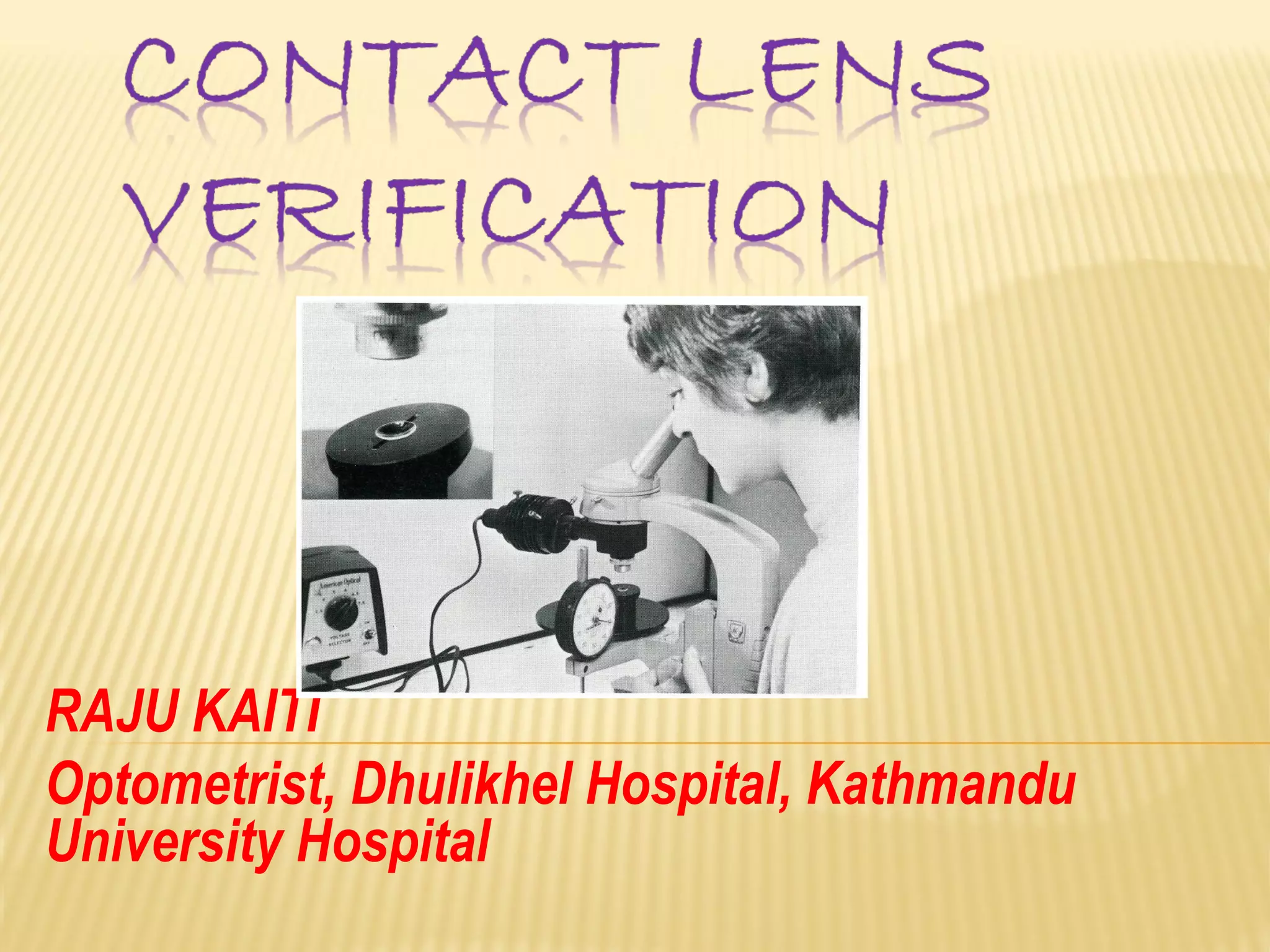
RAJU KAITI
Optometrist, Dhulikhel Hospital, Kathmandu
University Hospital
 Checking quality and physical characteristics
for-
 Prescription use
 Contact lens fitting sets
 Research purposes
 Contact lens verification undergoes two stages,
laboratory and clinical.
 Laboratory
 During the final phase of manufacture, an overall parameter
check is performed to ensure the lenses do not differ significantly
from the parameters ordered by the practitioner.
 Clinics
 Verification of lenses upon receipt, rather than during the
dispensing visit, is advisable.
 Patients
 ‘on-eye’ fit is another indicator of whether a contact lens has been
manufactured to specifications.
 Ensure correct lens is dispensed
 Quality of manufacturing(as per quality standard)
 Assess changes in contact lens with wear
 To ensure that proper over-refraction and trial fitting
examination has been conducted, the accuracy of trial
sets used in the clinic should be determined.
 Rigid and soft lenses have similar parameters which
require verification by the practitioner.
 Radii of curvature
 Linear parameters
 Edge profile
 Power
 Lens quality
 Rigid and soft contact lenses should be hydrated in a
soaking solution for 12 - 24 hours before verification
procedures are conducted.
 Back optic zone radius
 Back central optic zone radius
 Back peripheral optic zone radius
 Front optic zone radius
 Front central optic zone radius
 Front peripheral optic zone radius
 Back optic zone diameter
 Back central optic zone diameter
 Back peripheral optic zone diameter
 Front optic zone diameter
 Front peripheral optic zone diameter
 Total diameter
 Bifocal segment size and position
 Central
 Edge
 Lenticular junction
 At any other specified point
 Axial and radial edge lift
 Edge shapes
 Back vertex power
 Front vertex power
 Near addition
 Prism and base direction
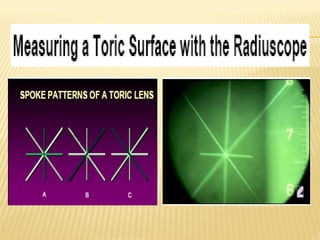
 Cylinder power
 Aberration
 Finish
 Polish
 Edge form
 Transitions
 Tint
 Material
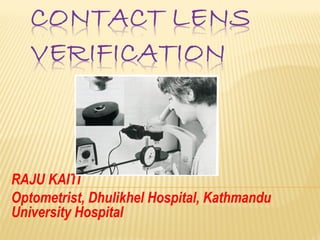
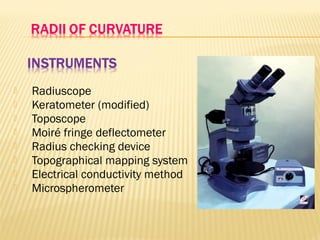
 Radiuscope
 Keratometer (modified)
 Toposcope
 Moiré fringe deflectometer
 Radius checking device
 Topographical mapping system
 Electrical conductivity method
 Microspherometer
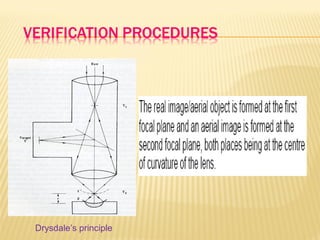
Drysdale’s principle
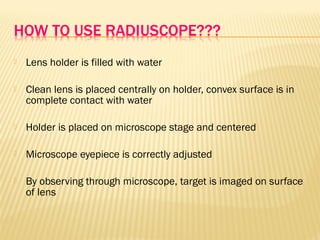
 Lens holder is filled with water
 Clean lens is placed centrally on holder, convex surface is in
complete contact with water
 Holder is placed on microscope stage and centered
 Microscope eyepiece is correctly adjusted
 By observing through microscope, target is imaged on surface
of lens
 Dial gauge reading is recorded
 Second focus at centre of curvature of surface is obtained
 Second reading is recorded
 Difference between two dial gauge reading gives radius of
curvature of surface
 Procedure is repeated twice and average of 3 reading is taken
 Radius is measured in different point of lens as it may vary
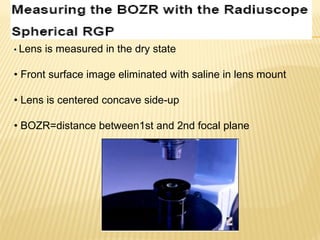
• Lens is measured in the dry state
• Front surface image eliminated with saline in lens mount
• Lens is centered concave side-up
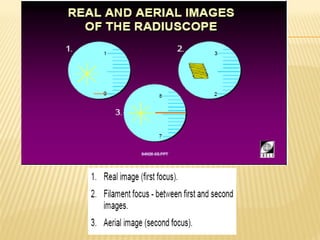
• BOZR=distance between1st and 2nd focal plane
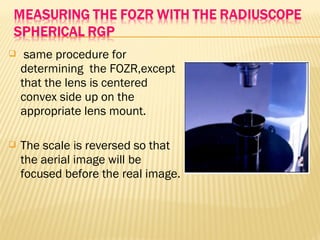
 same procedure for
determining the FOZR,except
that the lens is centered
convex side up on the
appropriate lens mount.
 The scale is reversed so that
the aerial image will be
focused before the real image.
 Air checking, which requires
the SCL to be dabbed with a lint-
free cloth and measured in a
semi-dehydrated state.
 The critical duration of such air-
checking is approximately one
minute depending on ambient
temperature and humidity.
 Requires a wet cell filled
with saline solution
 The readings are multiplied
by the refractive index of
saline to calculate the BOZR
IMMERSION
 The Keratometer which is used for measuring corneal
curvature can also be used to measure the BOZR of a
contact lens by using special attachments.
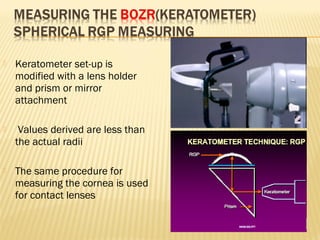
 Keratometer set-up is
modified with a lens holder
and prism or mirror
attachment
 Values derived are less than
the actual radii
 The same procedure for
measuring the cornea is used
for contact lenses
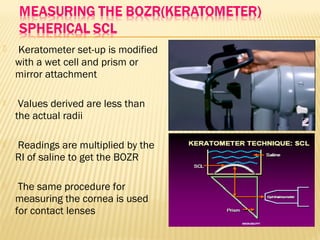
 Keratometer set-up is modified
with a wet cell and prism or
mirror attachment
 Values derived are less than
the actual radii
 Readings are multiplied by the
RI of saline to get the BOZR
 The same procedure for
measuring the cornea is used
for contact lenses
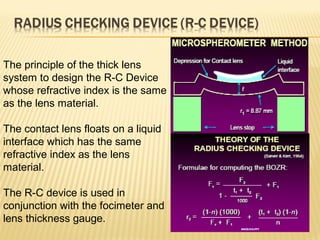
The principle of the thick lens
system to design the R-C Device
whose refractive index is the same
as the lens material.
The contact lens floats on a liquid
interface which has the same
refractive index as the lens
material.
The R-C device is used in
conjunction with the focimeter and
lens thickness gauge.
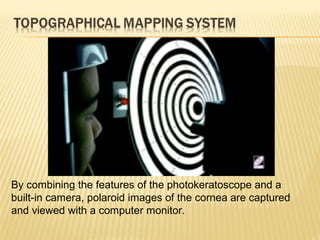
By combining the features of the photokeratoscope and a
built-in camera, polaroid images of the cornea are captured
and viewed with a computer monitor.
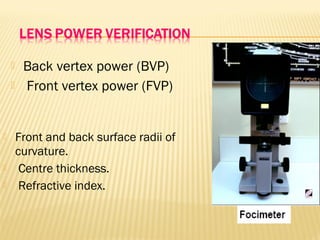
 Back vertex power (BVP)
 Front vertex power (FVP)
 Front and back surface radii of
curvature.
 Centre thickness.
 Refractive index.
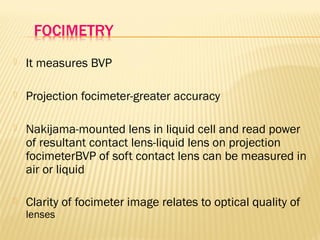
 It measures BVP
 Projection focimeter-greater accuracy
 Nakijama-mounted lens in liquid cell and read power
of resultant contact lens-liquid lens on projection
focimeterBVP of soft contact lens can be measured in
air or liquid
 Clarity of focimeter image relates to optical quality of
lenses
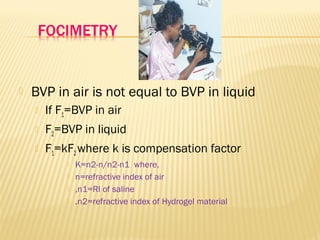
 BVP in air is not equal to BVP in liquid
 If F1=BVP in air
 F2=BVP in liquid
 F1=kF2where k is compensation factor
 K=n2-n/n2-n1 where,
 n=refractive index of air
 ,n1=RI of saline
 .n2=refractive index of Hydrogel material
 Lens is cleaned and dried
 Lens must be centered concave side down on the
focimeter stop
 Reading is taken off the power drum/scale after
focusing the mires
 Back vertex focal length is measured from the plane
of the focimeter stop
 Power for each meridian is measured
 Cylinder value is derived from measuring the
difference in meridional powers
 The SCL is measured by air-checking it with the focimeter.
 The lens is dabbed with a lint-free cloth/tissue to remove
excess water.
 The SCL is centered on the focimeter support and the
procedure used to measure RGP lenses is followed.
 An SCL can also be measured by immersing the lens in
saline contained in a wet cell. Because the lens power is
measured in saline, the value has to be multiplied by four
(approximately) to calculate the true lens power in air.
 Procedure is same as for BVP but with lens convex
side down
 FVP measurements can be converted to BVP by using
a table with known center thickness and back optic
zone radius
 Lens diameters
 back optic zone diameter (BOZD)
 total diameter
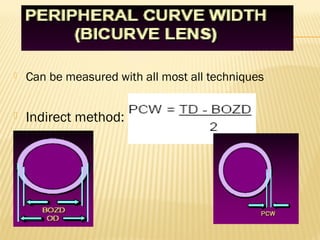
 peripheral curve width (PCW)
 Lens thickness
 centre thickness (ct)
 edge thickness
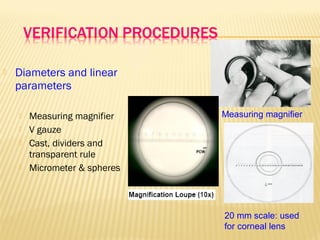
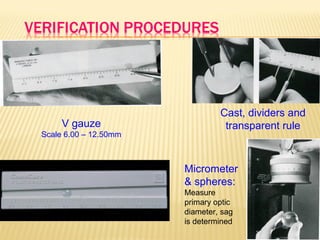
 Diameters and linear
parameters
 Measuring magnifier
 V gauze
 Cast, dividers and
transparent rule
 Micrometer & spheres
Measuring magnifier
20 mm scale: used
for corneal lens
V gauze
Scale 6.00 – 12.50mm
Cast, dividers and
transparent rule
Micrometer
& spheres:
Measure
primary optic
diameter, sag
is determined
 Can be measured with all most all techniques
 Indirect method:
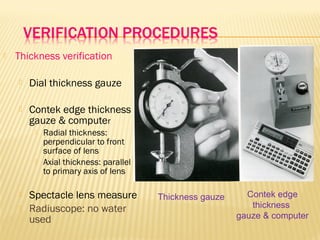
 Thickness verification
 Dial thickness gauze
 Contek edge thickness
gauze & computer
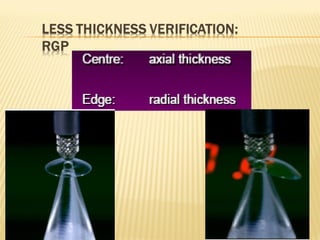
 Radial thickness:
perpendicular to front
surface of lens
 Axial thickness: parallel
to primary axis of lens
 Spectacle lens measure
 Radiuscope: no water
used
Thickness gauze Contek edge
thickness
gauze & computer
 Lens diameters
 total diameter
 FOZD
 Lens thickness
 centre thickness (ct)
 edge thickness
 Instruments:
 Projection magnifier
 Moiré fringe deflectometer
 10x loupe with graticule
 Electronic thickness gauge
 Pressure controlled gauge
 Electrical thickness gauge
 Radiuscope (modified)
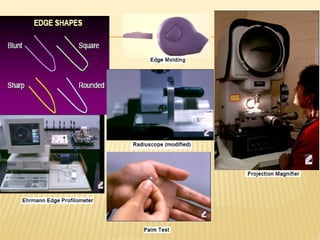
Instruments/techniques:
• Edge molding
• Projection magnifier
• Ehrmann profilometer
• Palm test
• Radiuscope (modified)
 Surface defects
 Optical quality
 Lens impurities/deposits
 Scratches and lathe marks:
 Can cause:
 deposit build up
 poor wettability
 surface hydrophobicity
 Indicate over polishing during manufacture
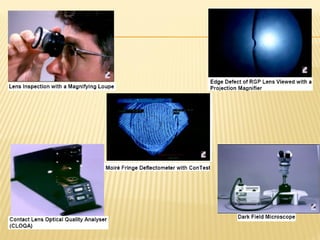
 Instruments:
 Magnifying 10x loupe
 Projection magnifier
 Contact lens optical quality analyzer (CLOQA)
 Dark field microscope
 Moire fringe deflectometer
 White background test
 Variation in thickness
 Hydrogel contact lenses are flexible
 If exposed to atmosphere, they dehydrate and
alter their contour. Verification in air is
inaccurate due to-
 Shrinkage of Hydrogel on dehydration
 Accumulation of surface moisture
 So, artifact liquid cells are used to measure
parameters of soft lenses
 But RGP lenses can be measured in air
 Mandell 1974 recommend following procedure-
 Lens should be removed from its liquid using sterile spatula or soft
plastics protected forceps
 Lens is then placed on lint free tissue and tissue is folded over
uppermost convex of lens
 Both surface are blotted dry
 Lens is dried in air with forceps
 Lens surfaces are examined for smudges
 It is preferable to check lens within one minute
 %water content = mass of watermass of hydrated lens x 100
 Water content of Hydrogel contact lenses is measured by
sensitive microbalance
 Alternative methods-
 Refractive index
 Refractive indexes decreases as water content increases
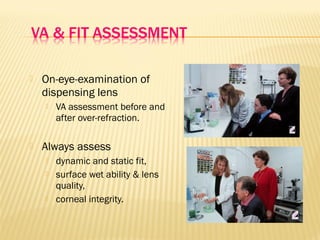
 On-eye-examination of
dispensing lens
 VA assessment before and
after over-refraction.
 Always assess
 dynamic and static fit,
 surface wet ability & lens
quality,
 corneal integrity.
 At the end of the verification process, the real
indicator that an accurate and optimal fitting
has been achieved is evaluation of the lens in
situ.
 Ensure that contact lenses dispensed have the
correct parameters, are sterile and in good
condition.
 Ensure that optimum visual acuity is achieved by
the patient with the contact lenses.
 Ensure that the contact lenses fit satisfactorily.
 Provide instruction on care and maintenance.
THANK

Contact lens verification(raju)

  • 1.
    RAJU KAITI Optometrist, DhulikhelHospital, Kathmandu University Hospital
  • 2.
     Checking qualityand physical characteristics for-  Prescription use  Contact lens fitting sets  Research purposes  Contact lens verification undergoes two stages, laboratory and clinical.
  • 3.
     Laboratory  Duringthe final phase of manufacture, an overall parameter check is performed to ensure the lenses do not differ significantly from the parameters ordered by the practitioner.  Clinics  Verification of lenses upon receipt, rather than during the dispensing visit, is advisable.  Patients  ‘on-eye’ fit is another indicator of whether a contact lens has been manufactured to specifications.
  • 4.
     Ensure correctlens is dispensed  Quality of manufacturing(as per quality standard)  Assess changes in contact lens with wear  To ensure that proper over-refraction and trial fitting examination has been conducted, the accuracy of trial sets used in the clinic should be determined.
  • 5.
     Rigid andsoft lenses have similar parameters which require verification by the practitioner.  Radii of curvature  Linear parameters  Edge profile  Power  Lens quality  Rigid and soft contact lenses should be hydrated in a soaking solution for 12 - 24 hours before verification procedures are conducted.
  • 7.
     Back opticzone radius  Back central optic zone radius  Back peripheral optic zone radius  Front optic zone radius  Front central optic zone radius  Front peripheral optic zone radius
  • 8.
     Back opticzone diameter  Back central optic zone diameter  Back peripheral optic zone diameter  Front optic zone diameter  Front peripheral optic zone diameter  Total diameter  Bifocal segment size and position
  • 9.
     Central  Edge Lenticular junction  At any other specified point
  • 10.
     Axial andradial edge lift  Edge shapes
  • 11.
     Back vertexpower  Front vertex power  Near addition  Prism and base direction  Cylinder power  Aberration
  • 12.
     Finish  Polish Edge form  Transitions  Tint  Material
  • 14.
     Radiuscope  Keratometer(modified)  Toposcope  Moiré fringe deflectometer  Radius checking device  Topographical mapping system  Electrical conductivity method  Microspherometer
  • 15.
  • 17.
     Lens holderis filled with water  Clean lens is placed centrally on holder, convex surface is in complete contact with water  Holder is placed on microscope stage and centered  Microscope eyepiece is correctly adjusted  By observing through microscope, target is imaged on surface of lens
  • 18.
     Dial gaugereading is recorded  Second focus at centre of curvature of surface is obtained  Second reading is recorded  Difference between two dial gauge reading gives radius of curvature of surface  Procedure is repeated twice and average of 3 reading is taken  Radius is measured in different point of lens as it may vary
  • 19.
    • Lens ismeasured in the dry state • Front surface image eliminated with saline in lens mount • Lens is centered concave side-up • BOZR=distance between1st and 2nd focal plane
  • 20.
     same procedurefor determining the FOZR,except that the lens is centered convex side up on the appropriate lens mount.  The scale is reversed so that the aerial image will be focused before the real image.
  • 22.
     Air checking,which requires the SCL to be dabbed with a lint- free cloth and measured in a semi-dehydrated state.  The critical duration of such air- checking is approximately one minute depending on ambient temperature and humidity.  Requires a wet cell filled with saline solution  The readings are multiplied by the refractive index of saline to calculate the BOZR IMMERSION
  • 23.
     The Keratometerwhich is used for measuring corneal curvature can also be used to measure the BOZR of a contact lens by using special attachments.
  • 24.
     Keratometer set-upis modified with a lens holder and prism or mirror attachment  Values derived are less than the actual radii  The same procedure for measuring the cornea is used for contact lenses
  • 25.
     Keratometer set-upis modified with a wet cell and prism or mirror attachment  Values derived are less than the actual radii  Readings are multiplied by the RI of saline to get the BOZR  The same procedure for measuring the cornea is used for contact lenses
  • 26.
    The principle ofthe thick lens system to design the R-C Device whose refractive index is the same as the lens material. The contact lens floats on a liquid interface which has the same refractive index as the lens material. The R-C device is used in conjunction with the focimeter and lens thickness gauge.
  • 27.
    By combining thefeatures of the photokeratoscope and a built-in camera, polaroid images of the cornea are captured and viewed with a computer monitor.
  • 28.
     Back vertexpower (BVP)  Front vertex power (FVP)  Front and back surface radii of curvature.  Centre thickness.  Refractive index.
  • 29.
     It measuresBVP  Projection focimeter-greater accuracy  Nakijama-mounted lens in liquid cell and read power of resultant contact lens-liquid lens on projection focimeterBVP of soft contact lens can be measured in air or liquid  Clarity of focimeter image relates to optical quality of lenses
  • 30.
     BVP inair is not equal to BVP in liquid  If F1=BVP in air  F2=BVP in liquid  F1=kF2where k is compensation factor  K=n2-n/n2-n1 where,  n=refractive index of air  ,n1=RI of saline  .n2=refractive index of Hydrogel material
  • 31.
     Lens iscleaned and dried  Lens must be centered concave side down on the focimeter stop  Reading is taken off the power drum/scale after focusing the mires  Back vertex focal length is measured from the plane of the focimeter stop
  • 32.
     Power foreach meridian is measured  Cylinder value is derived from measuring the difference in meridional powers
  • 33.
     The SCLis measured by air-checking it with the focimeter.  The lens is dabbed with a lint-free cloth/tissue to remove excess water.  The SCL is centered on the focimeter support and the procedure used to measure RGP lenses is followed.  An SCL can also be measured by immersing the lens in saline contained in a wet cell. Because the lens power is measured in saline, the value has to be multiplied by four (approximately) to calculate the true lens power in air.
  • 34.
     Procedure issame as for BVP but with lens convex side down  FVP measurements can be converted to BVP by using a table with known center thickness and back optic zone radius
  • 35.
     Lens diameters back optic zone diameter (BOZD)  total diameter  peripheral curve width (PCW)  Lens thickness  centre thickness (ct)  edge thickness
  • 36.
     Diameters andlinear parameters  Measuring magnifier  V gauze  Cast, dividers and transparent rule  Micrometer & spheres Measuring magnifier 20 mm scale: used for corneal lens
  • 37.
    V gauze Scale 6.00– 12.50mm Cast, dividers and transparent rule Micrometer & spheres: Measure primary optic diameter, sag is determined
  • 38.
     Can bemeasured with all most all techniques  Indirect method:
  • 39.
     Thickness verification Dial thickness gauze  Contek edge thickness gauze & computer  Radial thickness: perpendicular to front surface of lens  Axial thickness: parallel to primary axis of lens  Spectacle lens measure  Radiuscope: no water used Thickness gauze Contek edge thickness gauze & computer
  • 41.
     Lens diameters total diameter  FOZD  Lens thickness  centre thickness (ct)  edge thickness
  • 42.
     Instruments:  Projectionmagnifier  Moiré fringe deflectometer  10x loupe with graticule  Electronic thickness gauge  Pressure controlled gauge  Electrical thickness gauge  Radiuscope (modified)
  • 43.
    Instruments/techniques: • Edge molding •Projection magnifier • Ehrmann profilometer • Palm test • Radiuscope (modified)
  • 45.
     Surface defects Optical quality  Lens impurities/deposits
  • 46.
     Scratches andlathe marks:  Can cause:  deposit build up  poor wettability  surface hydrophobicity  Indicate over polishing during manufacture
  • 47.
     Instruments:  Magnifying10x loupe  Projection magnifier  Contact lens optical quality analyzer (CLOQA)  Dark field microscope  Moire fringe deflectometer
  • 49.
     White backgroundtest  Variation in thickness
  • 50.
     Hydrogel contactlenses are flexible  If exposed to atmosphere, they dehydrate and alter their contour. Verification in air is inaccurate due to-  Shrinkage of Hydrogel on dehydration  Accumulation of surface moisture  So, artifact liquid cells are used to measure parameters of soft lenses  But RGP lenses can be measured in air
  • 51.
     Mandell 1974recommend following procedure-  Lens should be removed from its liquid using sterile spatula or soft plastics protected forceps  Lens is then placed on lint free tissue and tissue is folded over uppermost convex of lens  Both surface are blotted dry  Lens is dried in air with forceps  Lens surfaces are examined for smudges  It is preferable to check lens within one minute
  • 52.
     %water content= mass of watermass of hydrated lens x 100  Water content of Hydrogel contact lenses is measured by sensitive microbalance  Alternative methods-  Refractive index  Refractive indexes decreases as water content increases
  • 53.
     On-eye-examination of dispensinglens  VA assessment before and after over-refraction.  Always assess  dynamic and static fit,  surface wet ability & lens quality,  corneal integrity.
  • 54.
     At theend of the verification process, the real indicator that an accurate and optimal fitting has been achieved is evaluation of the lens in situ.
  • 55.
     Ensure thatcontact lenses dispensed have the correct parameters, are sterile and in good condition.  Ensure that optimum visual acuity is achieved by the patient with the contact lenses.  Ensure that the contact lenses fit satisfactorily.  Provide instruction on care and maintenance.
  • 56.