Leprosy Control Programmes in India Avanthika Lakshmanan
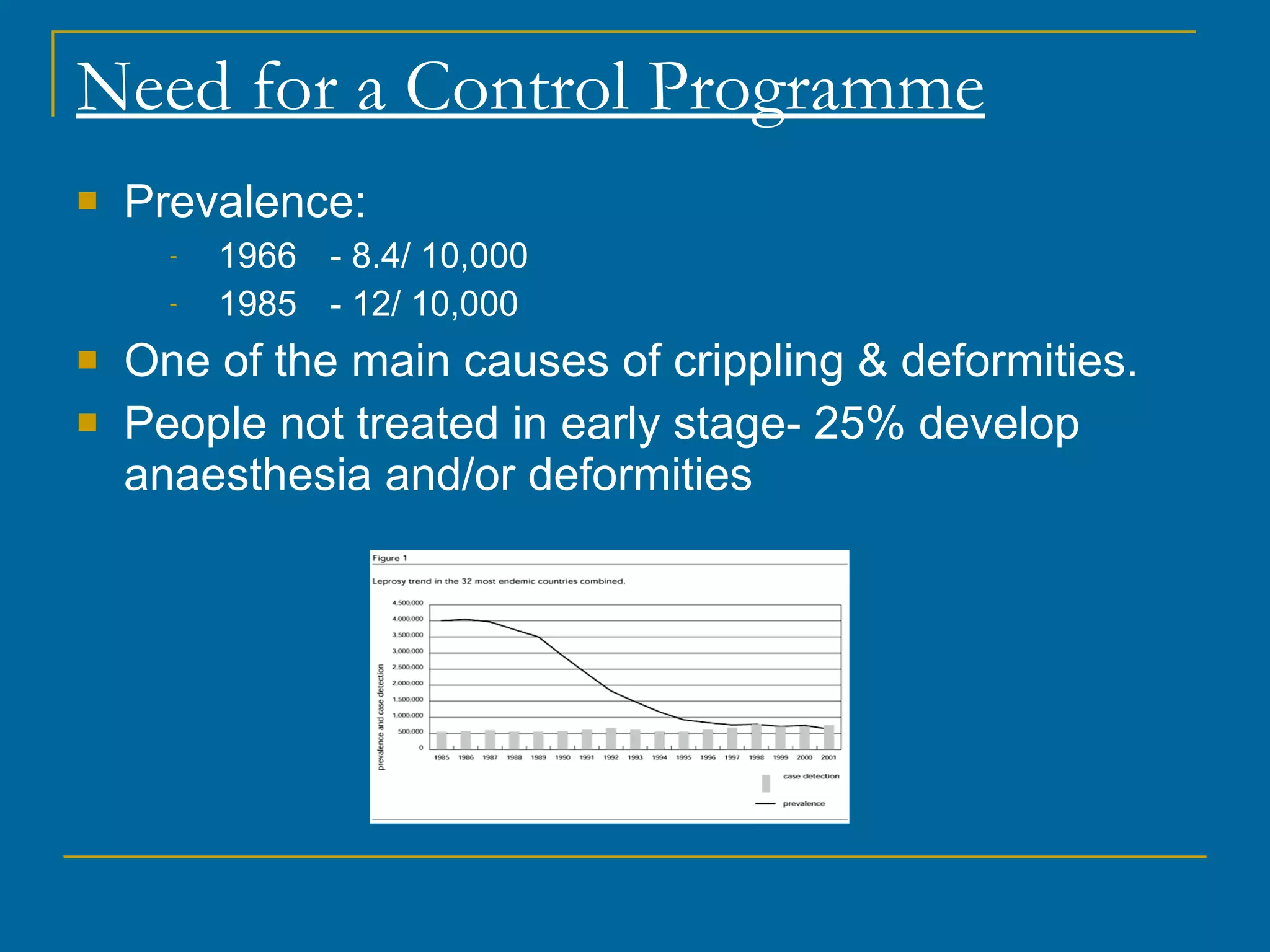
Need for a Control Programme Prevalence: 1966 - 8.4/ 10,000 1985 - 12/ 10,000 One of the main causes of crippling & deformities. People not treated in early stage- 25% develop anaesthesia and/or deformities
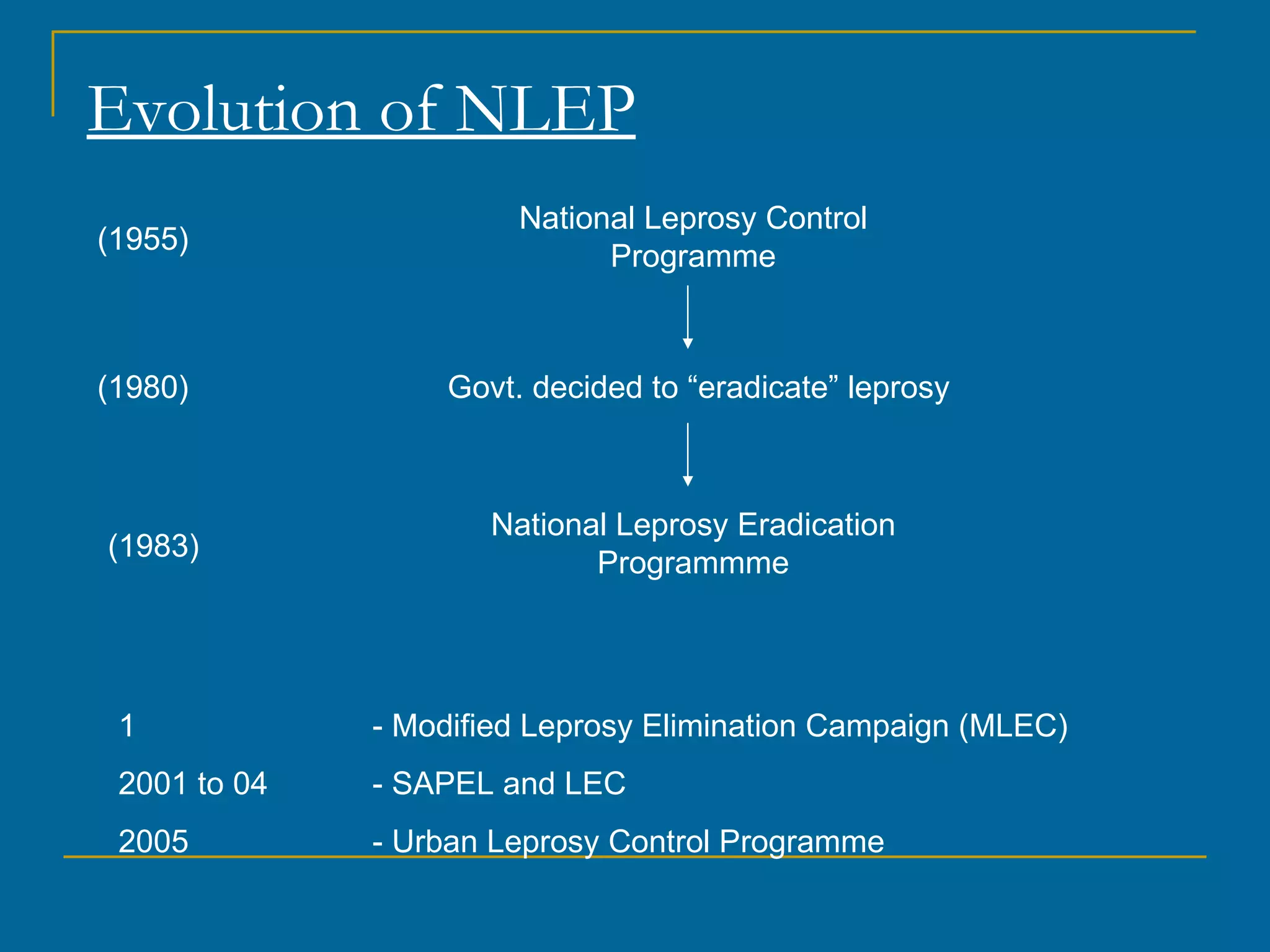
National Leprosy Control Programme (1955) (1980) Govt. decided to “eradicate” leprosy (1983) National Leprosy Eradication Programmme - Modified Leprosy Elimination Campaign (MLEC) 2001 to 04 - SAPEL and LEC 2005 - Urban Leprosy Control Programme Evolution of NLEP
National Leprosy Control Programme Since 1955, centrally aided To control Leprosy through Early detection of cases Dapsone monotherapy Fourth Five year plan- centrally sponsored 1980- ‘Eradicate’ Leprosy ‘ Working Group’ Revised strategy based on  multi- drug chemotherapy Aimed at Eradication
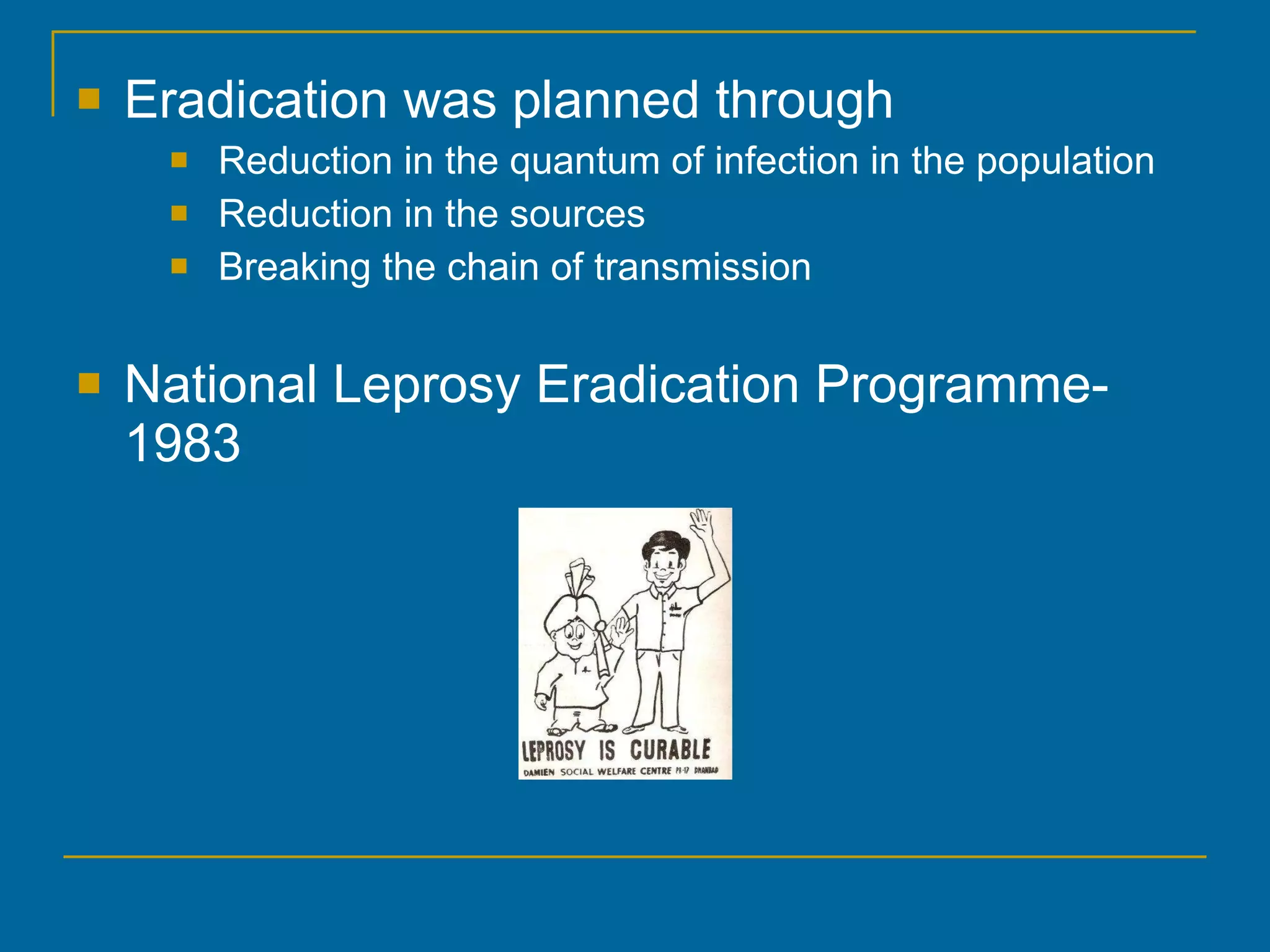
Eradication was planned through Reduction in the quantum of infection in the population Reduction in the sources Breaking the chain of transmission National Leprosy Eradication Programme- 1983
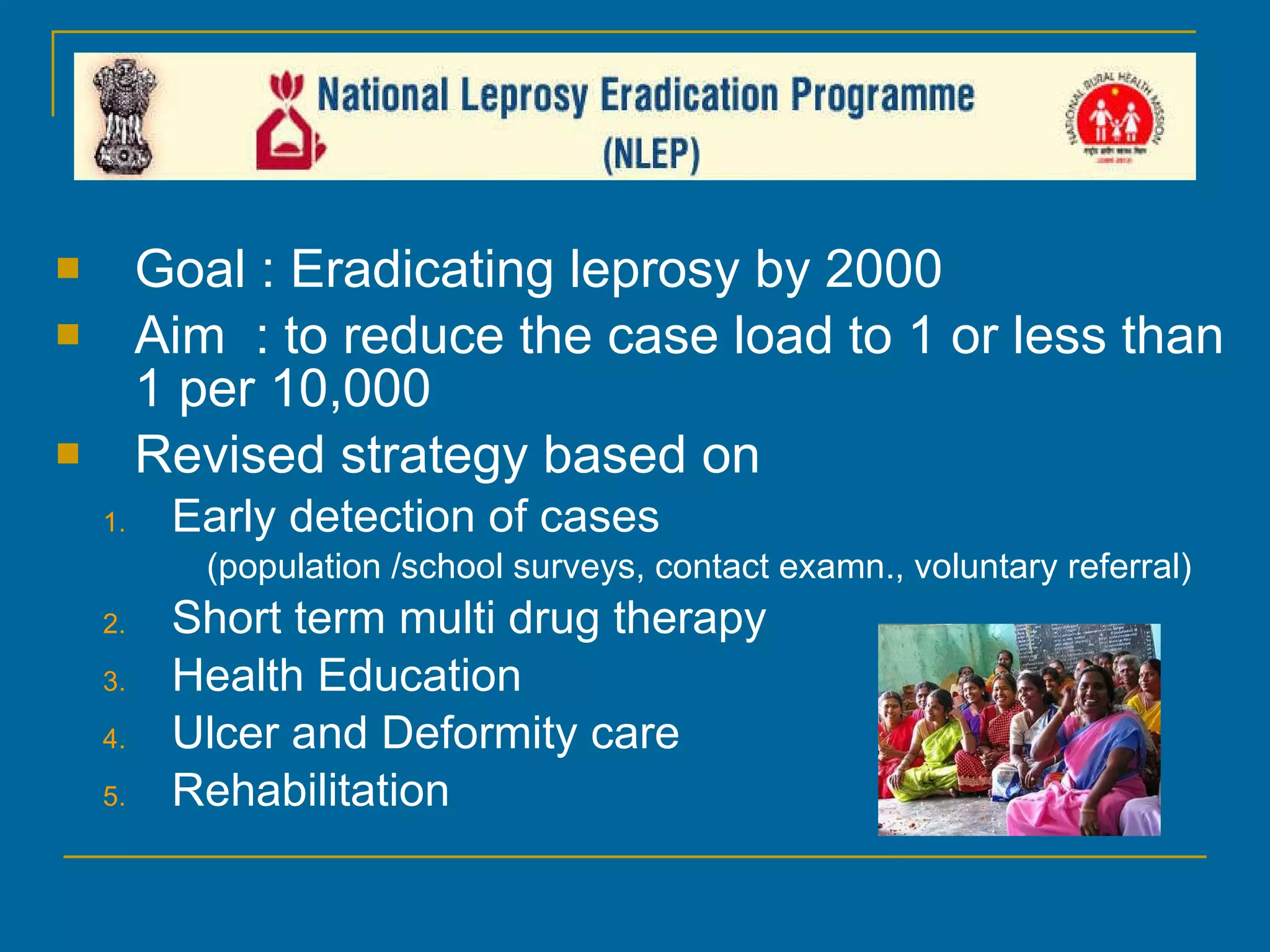
National Leprosy Eradication Programme Goal : Eradicating leprosy by 2000 Aim  : to reduce the case load to 1 or less than 1 per 10,000 Revised strategy based on Early detection of cases (population /school surveys, contact examn., voluntary referral) Short term multi drug therapy Health Education Ulcer and Deformity care Rehabilitation
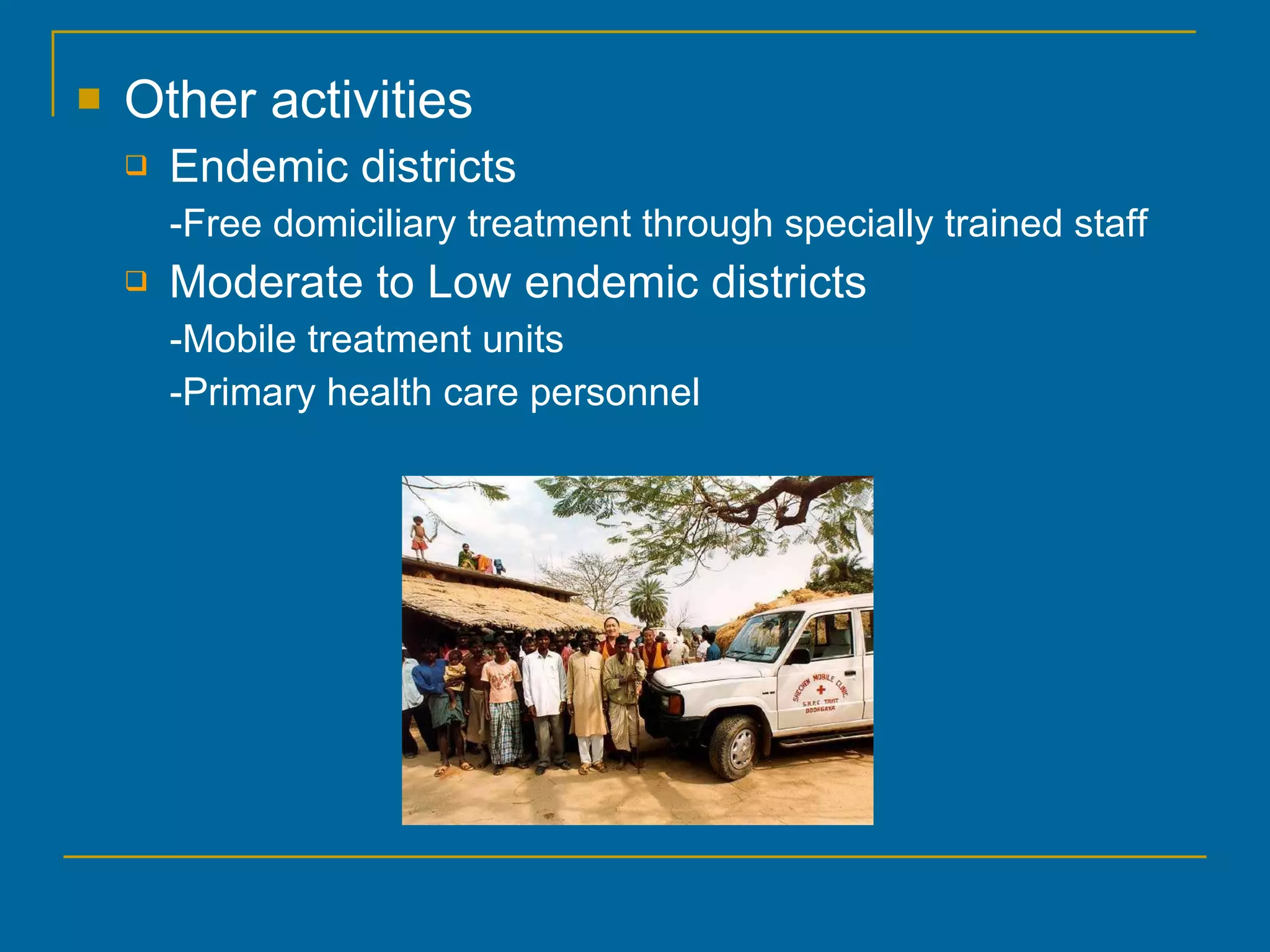
Other activities Endemic districts  -Free domiciliary treatment through specially trained staff Moderate to Low endemic districts -Mobile treatment units -Primary health care personnel
Modified Leprosy Elimination Campaign Mid term appraisal of NLEP in 1997 Though progress was satisfactory at national level, it was uneven in some states MLEC involved Orientation training to health staff Increase public awareness House to House search in endemic districts to detect new leprosy cases throughout the country for 6 days Five such campaigns Fourth campaign- states were divided into 3 categories based on endemicity of leprosy
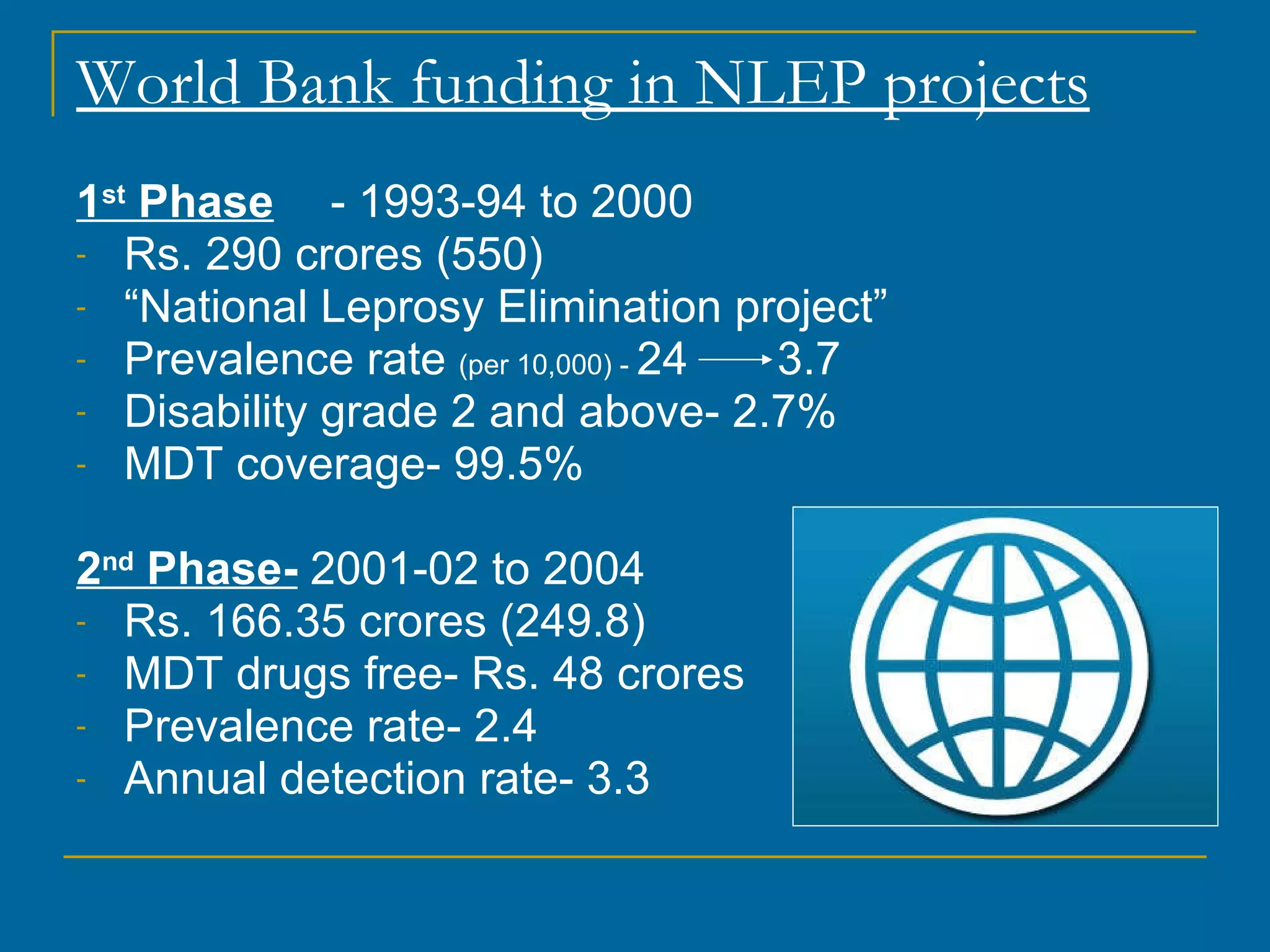
SAPEL & LEC In addition to regular surveillance activities Rural areas-  Special Action Project for  elimination of Leprosy Urban Areas- Leprosy Elimination  Campaigns For early detection and prompt treatment  IEC in rural/ tribal/ slum areas 1440 SAPEL/LEC projects – decentralized during 2001-04
World Bank funding in NLEP projects 1 st  Phase - 1993-94 to 2000 Rs. 290 crores (550) “ National Leprosy Elimination project” Prevalence rate  (per 10,000) -  24  3.7 Disability grade 2 and above- 2.7% MDT coverage- 99.5% 2 nd  Phase-  2001-02 to 2004 Rs. 166.35 crores (249.8) MDT drugs free- Rs. 48 crores Prevalence rate- 2.4 Annual detection rate- 3.3
NLEP is being continued now with Indian Govt. funding from Jan 2005 Additional funding from WHO and ILEP Free MDT drugs- Novartis through WHO
Other Programmes Focused Leprosy Elimination Plan (FLEP)  2005-06 high priority districts and blocks Cut off Point: PR > 5 /10,000 in 2004-05 > 3 / 10,000 in 2005-06 Situational Activity Plan (SAP) in 2007 - 19 high priority districts Block Leprosy Awareness Campaign(BLAC)2007 - 275 high priority blocks in 19 states Urban Leprosy Sensitization and Awareness Campaign - 49 urban areas
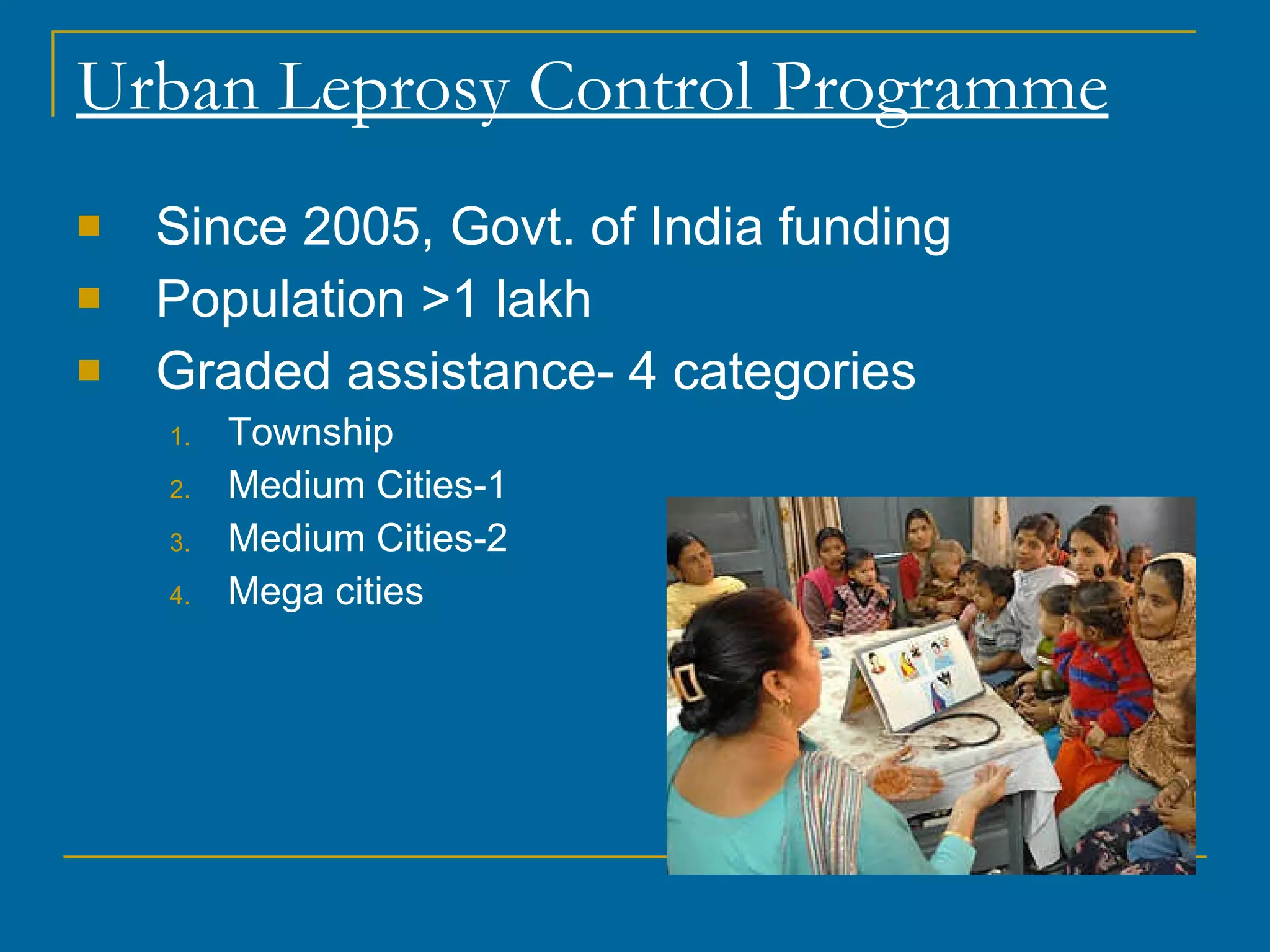
Urban Leprosy Control Programme Since 2005, Govt. of India funding Population >1 lakh Graded assistance- 4 categories Township Medium Cities-1 Medium Cities-2 Mega cities
Leprosy Elimination Monitoring (LEM ) - to asses performance of leprosy services - Drug supply management, IEC etc. With WHO assistance, through NIHFW. 12 priority endemic states 1 st Jun ‘02 2 nd May-Jun ’03 (13) 3 rd May- Jun ’04 Independent surveys- The Leprosy Mission
NLEP : National Action Plan for ’06-07 Objectives: To continue the efforts to achieve elimination of Leprosy To maintain the gains achieved and to continue efforts at district and block level To make quality leprosy services available
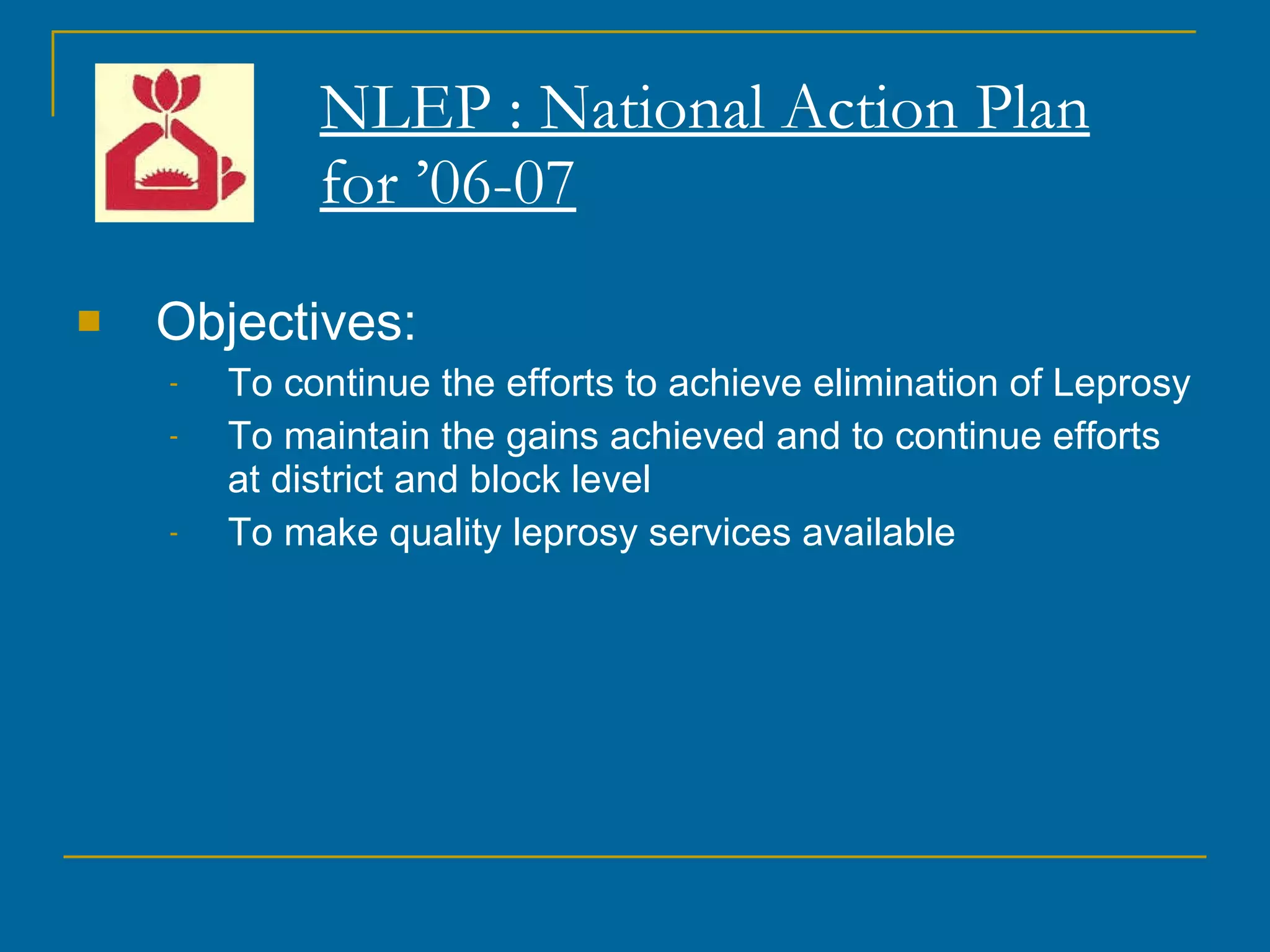
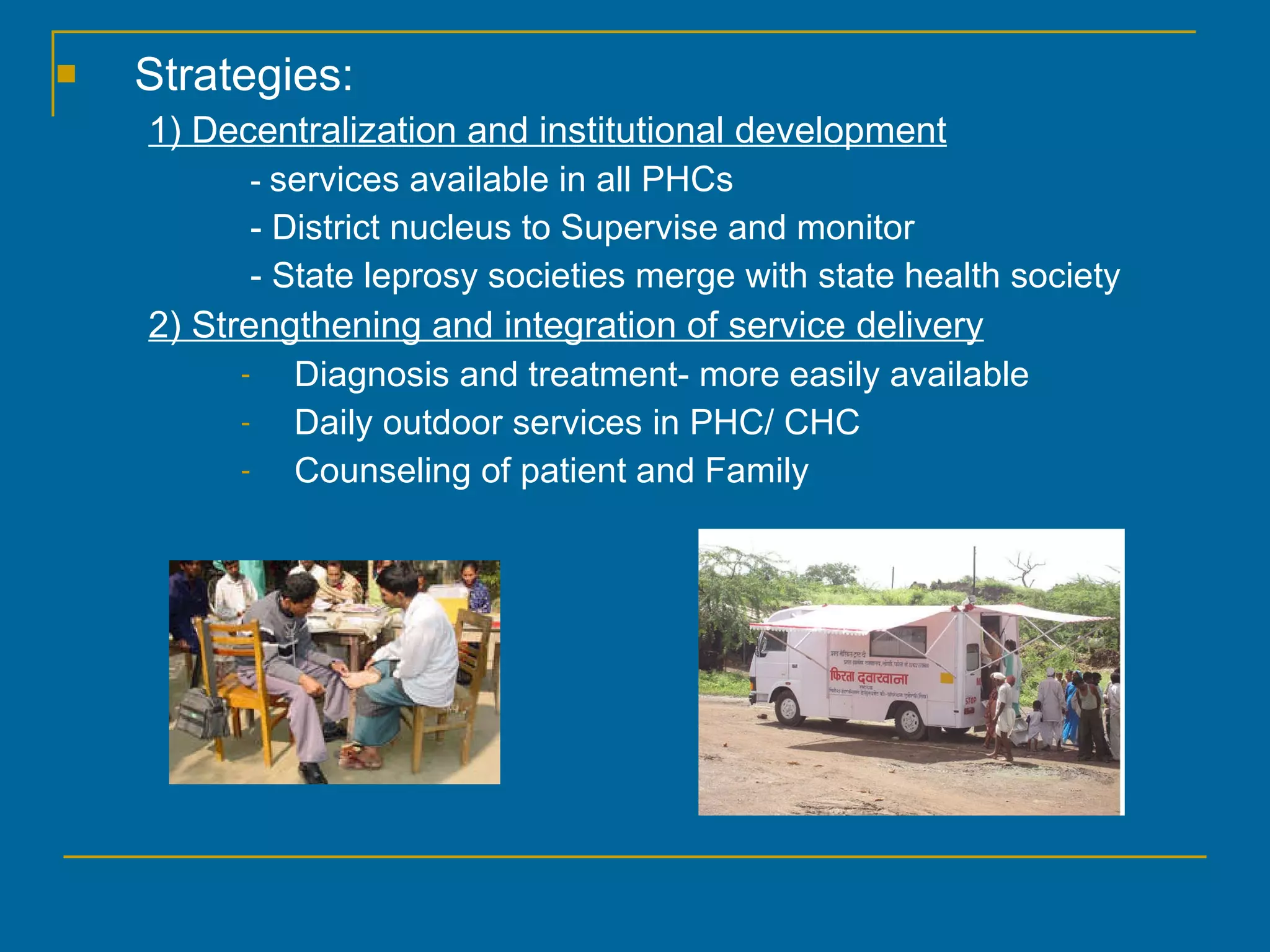
Strategies: 1) Decentralization and institutional development -  services available in all PHCs - District nucleus to Supervise and monitor - State leprosy societies merge with state health society 2) Strengthening and integration of service delivery Diagnosis and treatment- more easily available Daily outdoor services in PHC/ CHC Counseling of patient and Family
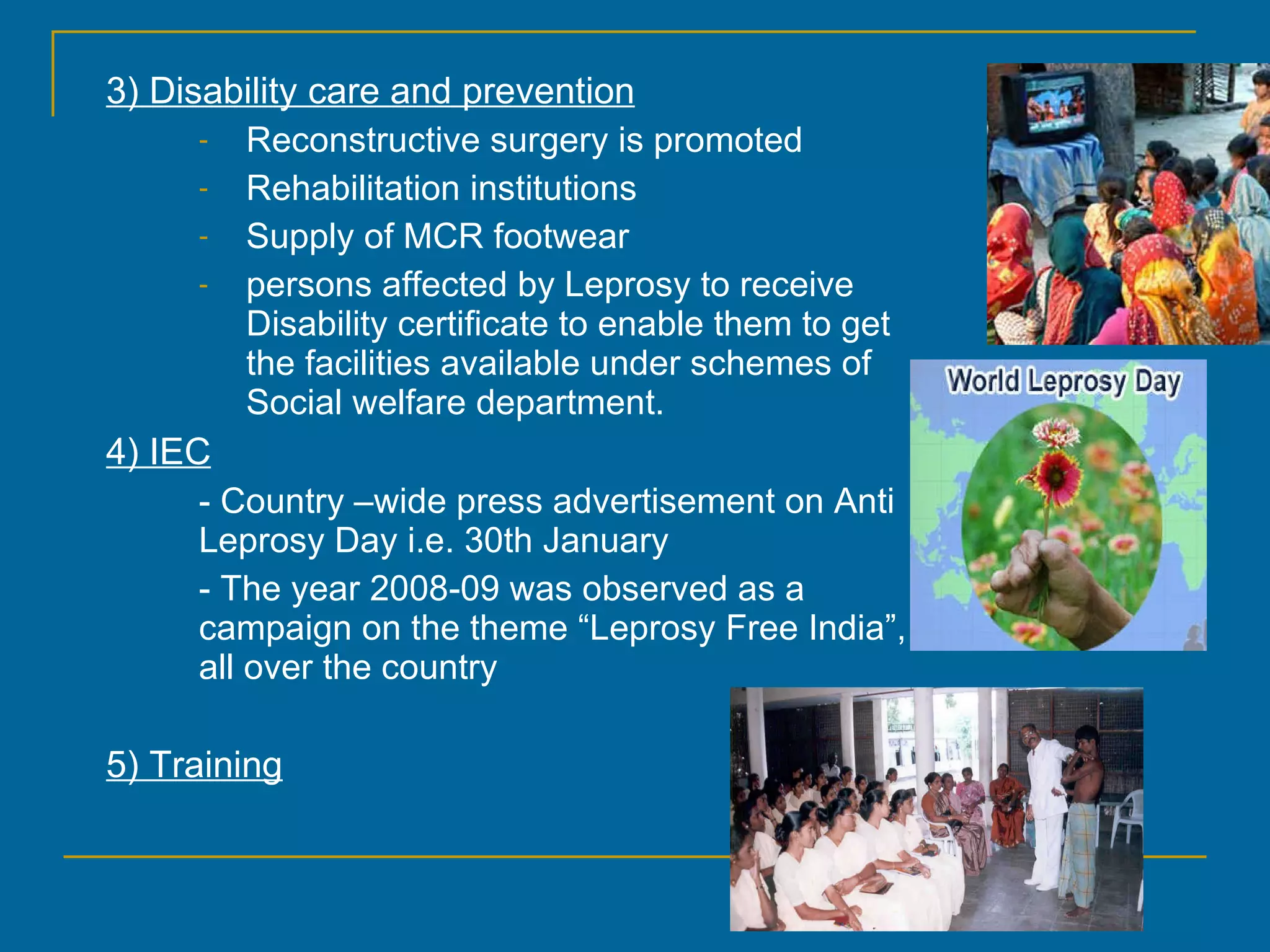
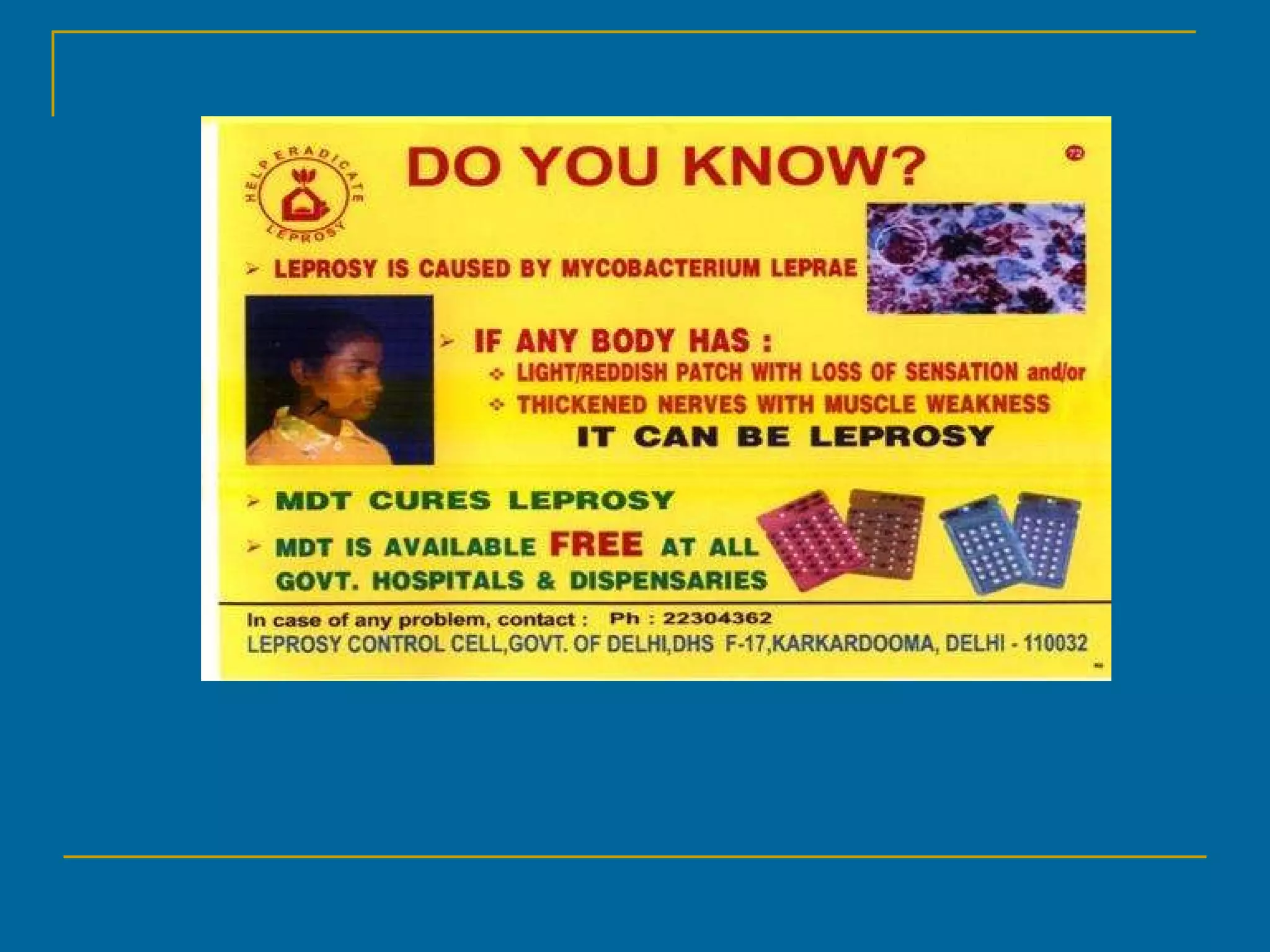
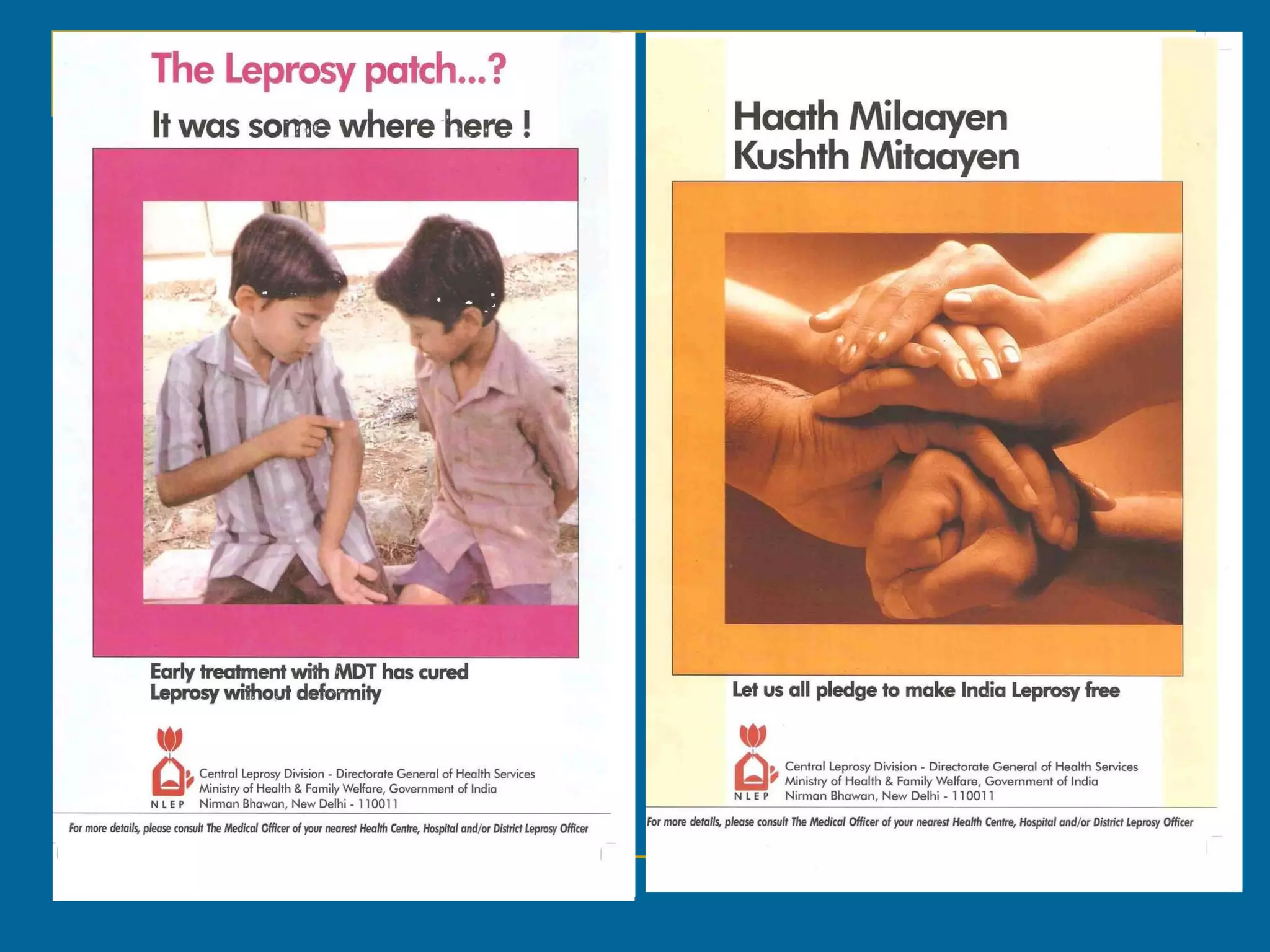
3) Disability care and prevention Reconstructive surgery is promoted Rehabilitation institutions Supply of MCR footwear persons affected by Leprosy to receive Disability certificate to enable them to get the facilities available under schemes of Social welfare department. 4) IEC - Country –wide press advertisement on Anti Leprosy Day i.e. 30th January - The year 2008-09 was observed as a campaign on the theme “Leprosy Free India”, all over the country  5) Training
 
 
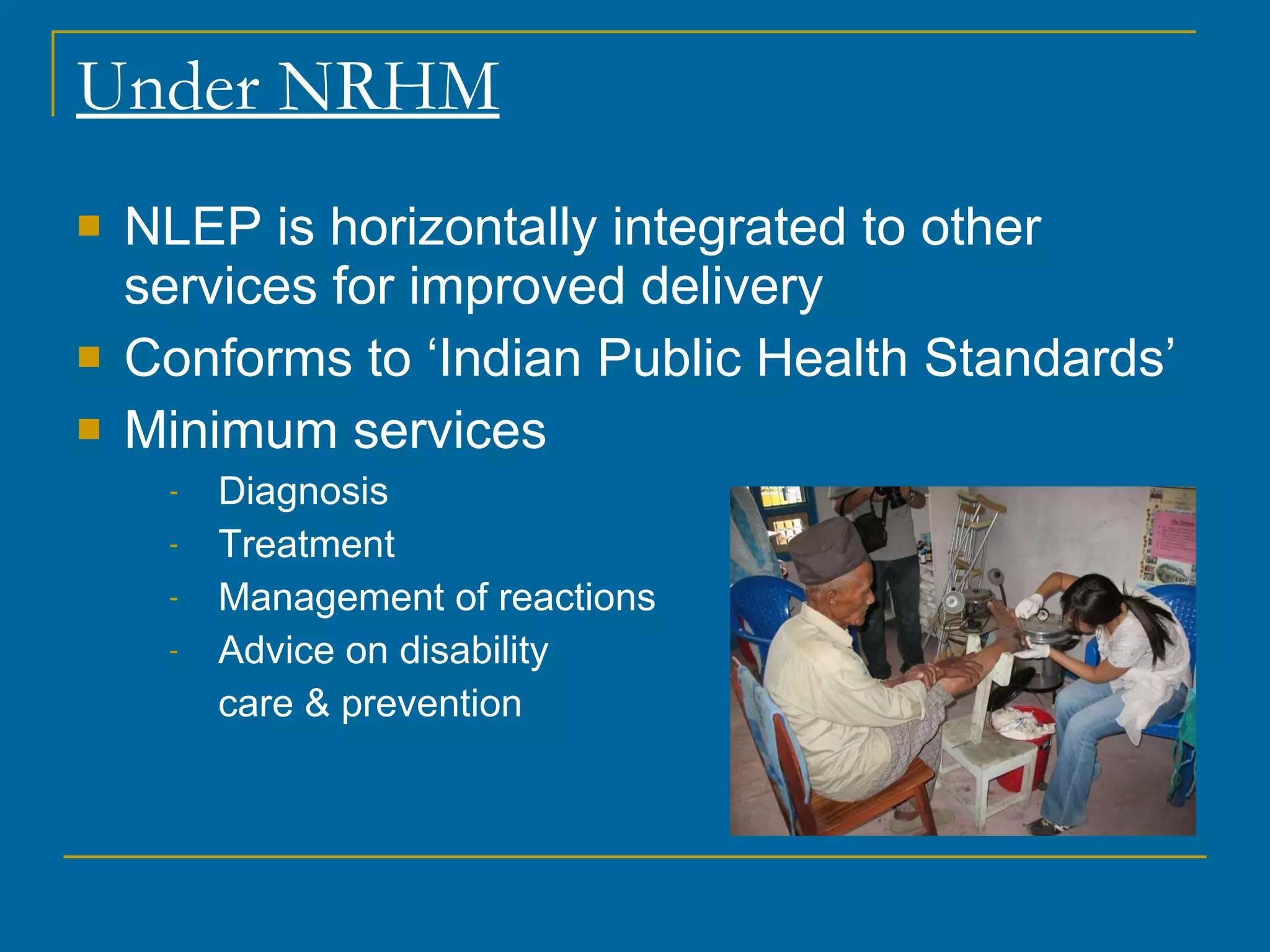
Under NRHM NLEP is horizontally integrated to other services for improved delivery Conforms to ‘Indian Public Health Standards’ Minimum services Diagnosis Treatment Management of reactions Advice on disability  care & prevention
Officials/ Staff attached to District Leprosy Organisation Deputy Director of Medical Services (Leprosy) Medical Officer- Deputy Director (Leprosy) Health Educator Non Medical Supervisor Physio Technicians Health Inspectors Lab technician
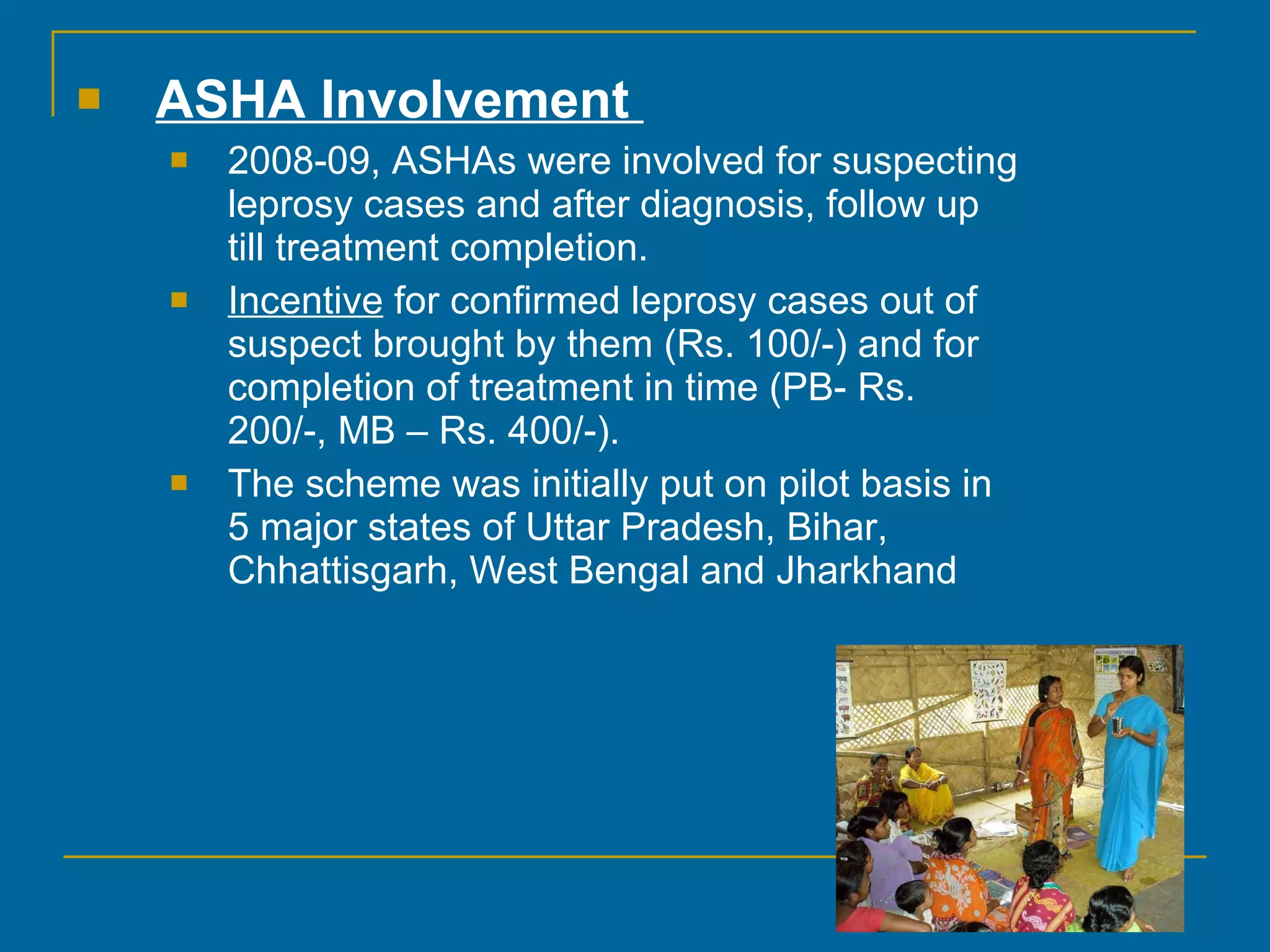
ASHA Involvement  2008-09, ASHAs were involved for suspecting leprosy cases and after diagnosis, follow up till treatment completion.  Incentive  for confirmed leprosy cases out of suspect brought by them (Rs. 100/-) and for completion of treatment in time (PB- Rs. 200/-, MB – Rs. 400/-).  The scheme was initially put on pilot basis in 5 major states of Uttar Pradesh, Bihar, Chhattisgarh, West Bengal and Jharkhand
Research Central JALMA institute at Agra Central Leprosy teaching and Training institute, Chengalpet Regional training & research institutes at Aska(orissa), Raipur( Chattisgarh), and Gouripur(W.B.)
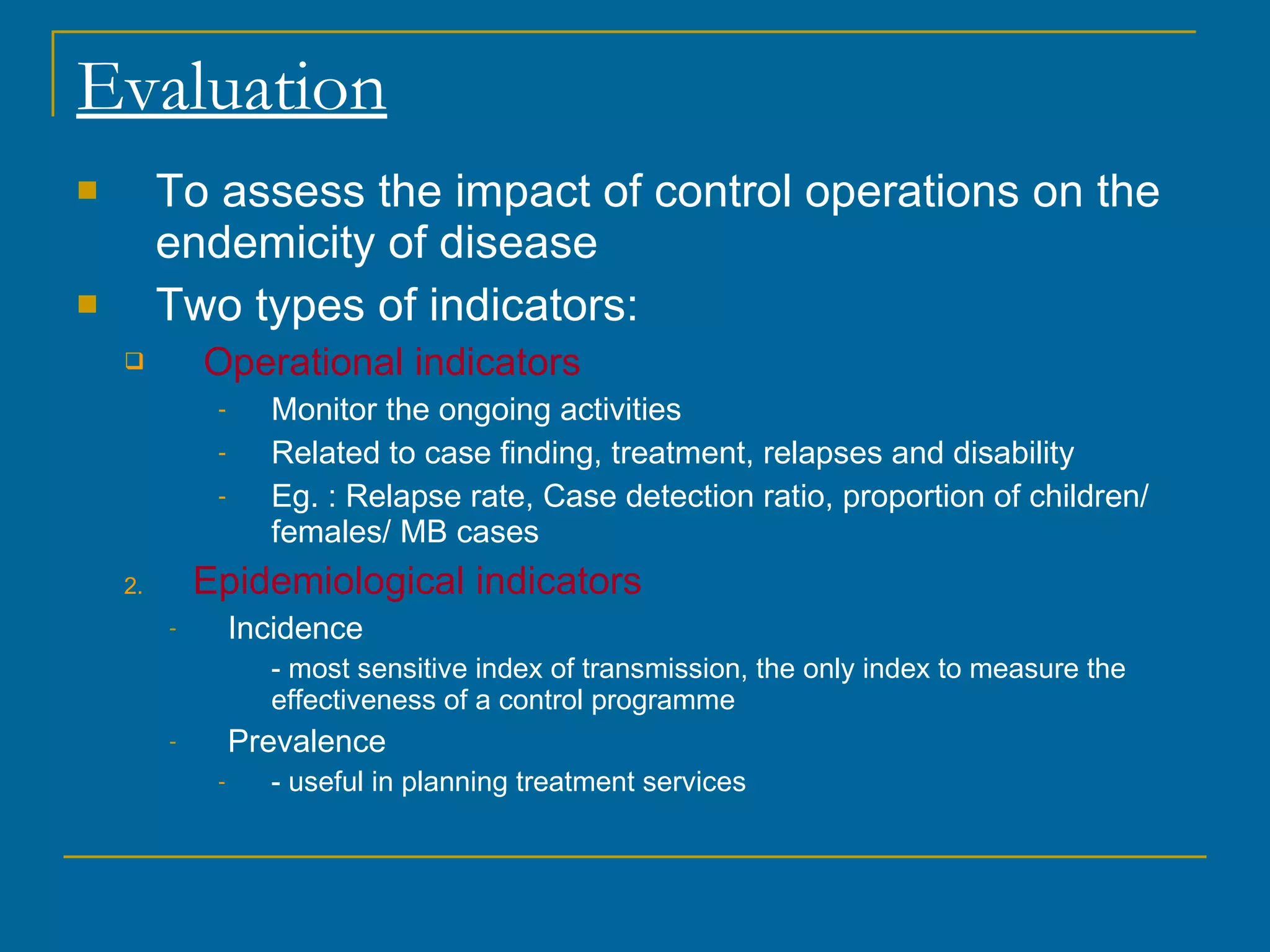
Evaluation To assess the impact of control operations on the endemicity of disease Two types of indicators: Operational indicators Monitor the ongoing activities Related to case finding, treatment, relapses and disability Eg. : Relapse rate, Case detection ratio, proportion of children/ females/ MB cases  Epidemiological indicators Incidence - most sensitive index of transmission, the only index to measure the effectiveness of a control programme Prevalence - useful in planning treatment services
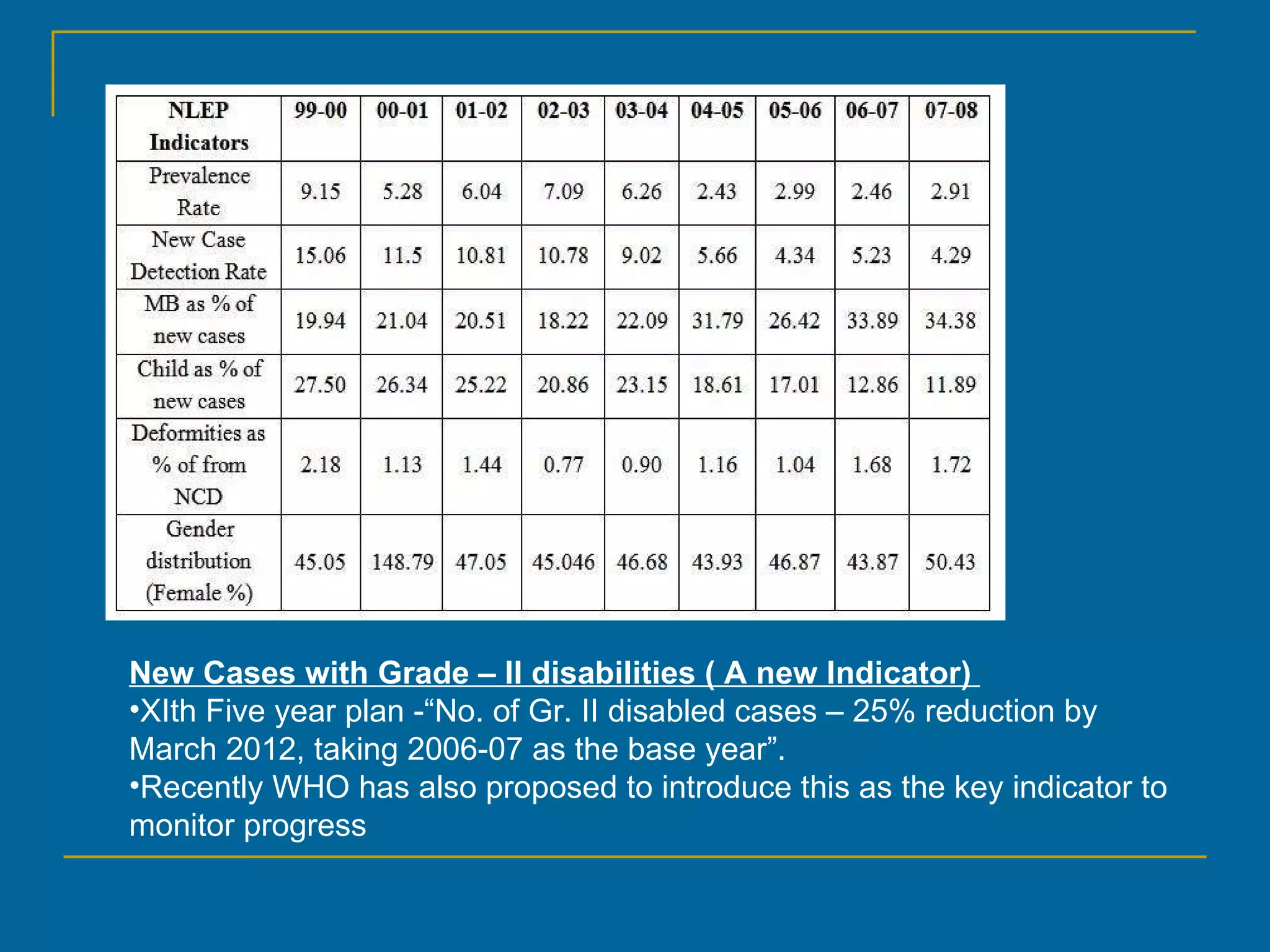
New Cases with Grade – II disabilities ( A new Indicator)  XIth Five year plan -“No. of Gr. II disabled cases – 25% reduction by March 2012, taking 2006-07 as the base year”.  Recently WHO has also proposed to introduce this as the key indicator to monitor progress
WHO global strategy (2006-10) Sustain leprosy control activities in all  endemic countries Use  Case detection  as the  Main indicator  to monitor progress Ensure high quality diagnosis, case management, recording & reporting Strengthen routine & referral services Discontinue campaign approach Develop tools/ procedures that are home / community based, locally appropriate – for prevention of disabilities; rehabilitation services Promote operational research
Partners WHO UNICEF SIDA DANIDA Damien Foundation
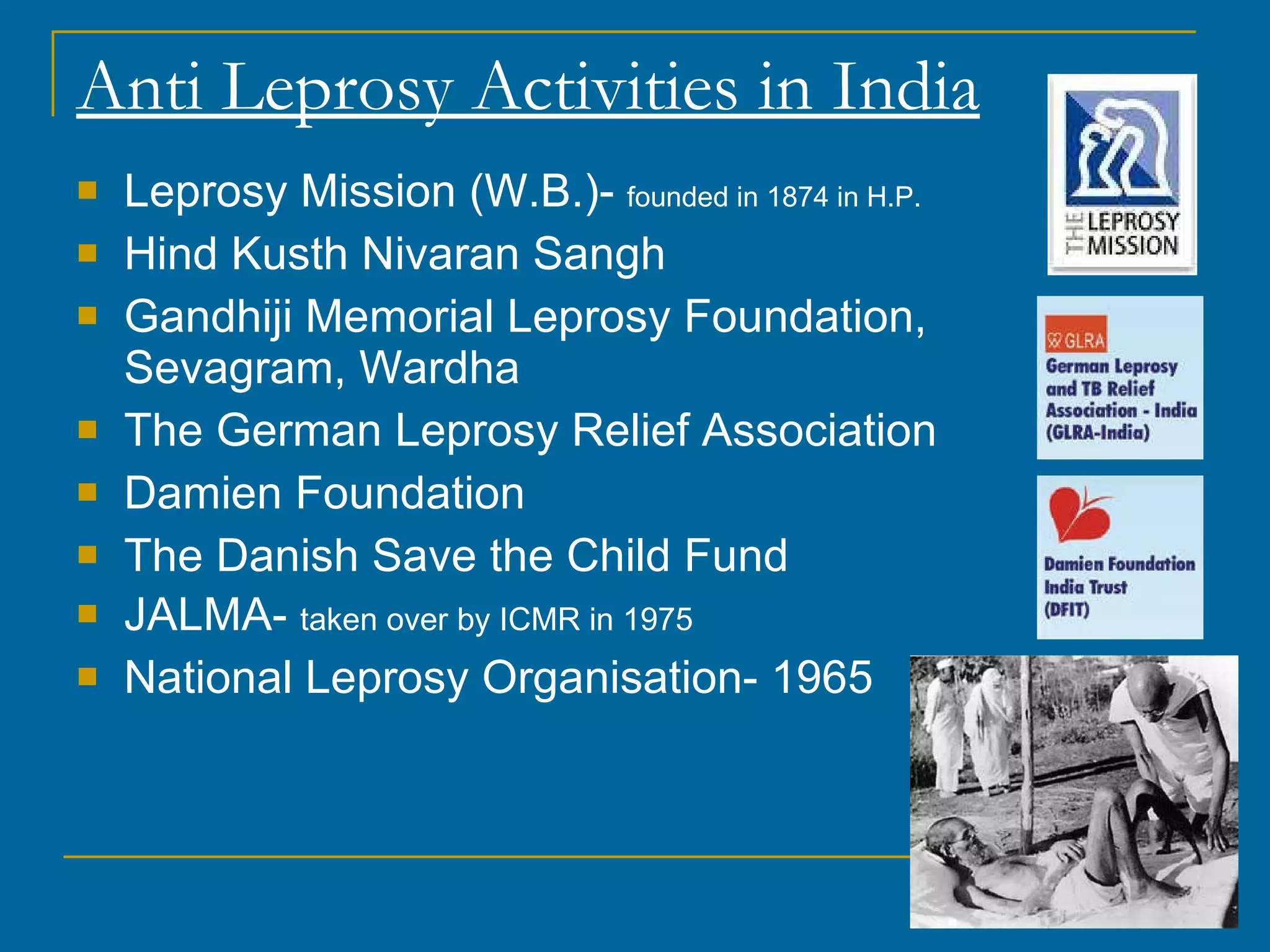
Anti Leprosy Activities in India Leprosy Mission (W.B.)-  founded in 1874 in H.P. Hind Kusth Nivaran Sangh Gandhiji Memorial Leprosy Foundation, Sevagram, Wardha The German Leprosy Relief Association Damien Foundation The Danish Save the Child Fund JALMA-  taken over by ICMR in 1975 National Leprosy Organisation- 1965
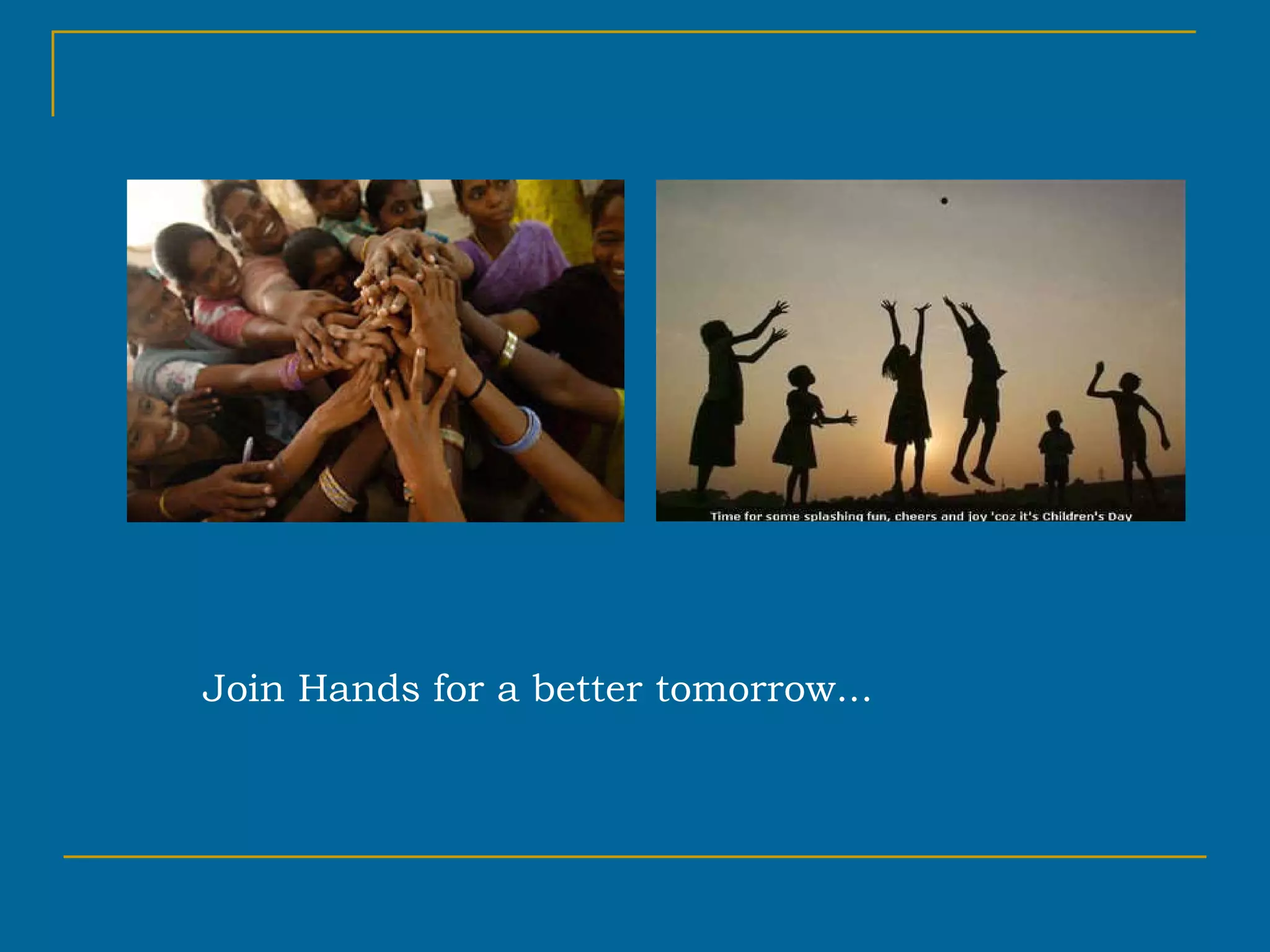
Join Hands for a better tomorrow...

8.Leprosy Control Programmes In India

  • 1.
    Leprosy Control Programmesin India Avanthika Lakshmanan
  • 2.
    Need for aControl Programme Prevalence: 1966 - 8.4/ 10,000 1985 - 12/ 10,000 One of the main causes of crippling & deformities. People not treated in early stage- 25% develop anaesthesia and/or deformities
  • 3.
    National Leprosy ControlProgramme (1955) (1980) Govt. decided to “eradicate” leprosy (1983) National Leprosy Eradication Programmme - Modified Leprosy Elimination Campaign (MLEC) 2001 to 04 - SAPEL and LEC 2005 - Urban Leprosy Control Programme Evolution of NLEP
  • 4.
    National Leprosy ControlProgramme Since 1955, centrally aided To control Leprosy through Early detection of cases Dapsone monotherapy Fourth Five year plan- centrally sponsored 1980- ‘Eradicate’ Leprosy ‘ Working Group’ Revised strategy based on multi- drug chemotherapy Aimed at Eradication
  • 5.
    Eradication was plannedthrough Reduction in the quantum of infection in the population Reduction in the sources Breaking the chain of transmission National Leprosy Eradication Programme- 1983
  • 6.
    National Leprosy EradicationProgramme Goal : Eradicating leprosy by 2000 Aim : to reduce the case load to 1 or less than 1 per 10,000 Revised strategy based on Early detection of cases (population /school surveys, contact examn., voluntary referral) Short term multi drug therapy Health Education Ulcer and Deformity care Rehabilitation
  • 7.
    Other activities Endemicdistricts -Free domiciliary treatment through specially trained staff Moderate to Low endemic districts -Mobile treatment units -Primary health care personnel
  • 8.
    Modified Leprosy EliminationCampaign Mid term appraisal of NLEP in 1997 Though progress was satisfactory at national level, it was uneven in some states MLEC involved Orientation training to health staff Increase public awareness House to House search in endemic districts to detect new leprosy cases throughout the country for 6 days Five such campaigns Fourth campaign- states were divided into 3 categories based on endemicity of leprosy
  • 9.
    SAPEL & LECIn addition to regular surveillance activities Rural areas- Special Action Project for elimination of Leprosy Urban Areas- Leprosy Elimination Campaigns For early detection and prompt treatment IEC in rural/ tribal/ slum areas 1440 SAPEL/LEC projects – decentralized during 2001-04
  • 10.
    World Bank fundingin NLEP projects 1 st Phase - 1993-94 to 2000 Rs. 290 crores (550) “ National Leprosy Elimination project” Prevalence rate (per 10,000) - 24 3.7 Disability grade 2 and above- 2.7% MDT coverage- 99.5% 2 nd Phase- 2001-02 to 2004 Rs. 166.35 crores (249.8) MDT drugs free- Rs. 48 crores Prevalence rate- 2.4 Annual detection rate- 3.3
  • 11.
    NLEP is beingcontinued now with Indian Govt. funding from Jan 2005 Additional funding from WHO and ILEP Free MDT drugs- Novartis through WHO
  • 12.
    Other Programmes FocusedLeprosy Elimination Plan (FLEP) 2005-06 high priority districts and blocks Cut off Point: PR > 5 /10,000 in 2004-05 > 3 / 10,000 in 2005-06 Situational Activity Plan (SAP) in 2007 - 19 high priority districts Block Leprosy Awareness Campaign(BLAC)2007 - 275 high priority blocks in 19 states Urban Leprosy Sensitization and Awareness Campaign - 49 urban areas
  • 13.
    Urban Leprosy ControlProgramme Since 2005, Govt. of India funding Population >1 lakh Graded assistance- 4 categories Township Medium Cities-1 Medium Cities-2 Mega cities
  • 14.
    Leprosy Elimination Monitoring(LEM ) - to asses performance of leprosy services - Drug supply management, IEC etc. With WHO assistance, through NIHFW. 12 priority endemic states 1 st Jun ‘02 2 nd May-Jun ’03 (13) 3 rd May- Jun ’04 Independent surveys- The Leprosy Mission
  • 15.
    NLEP : NationalAction Plan for ’06-07 Objectives: To continue the efforts to achieve elimination of Leprosy To maintain the gains achieved and to continue efforts at district and block level To make quality leprosy services available
  • 16.
    Strategies: 1) Decentralizationand institutional development - services available in all PHCs - District nucleus to Supervise and monitor - State leprosy societies merge with state health society 2) Strengthening and integration of service delivery Diagnosis and treatment- more easily available Daily outdoor services in PHC/ CHC Counseling of patient and Family
  • 17.
    3) Disability careand prevention Reconstructive surgery is promoted Rehabilitation institutions Supply of MCR footwear persons affected by Leprosy to receive Disability certificate to enable them to get the facilities available under schemes of Social welfare department. 4) IEC - Country –wide press advertisement on Anti Leprosy Day i.e. 30th January - The year 2008-09 was observed as a campaign on the theme “Leprosy Free India”, all over the country 5) Training
  • 18.
  • 19.
  • 20.
    Under NRHM NLEPis horizontally integrated to other services for improved delivery Conforms to ‘Indian Public Health Standards’ Minimum services Diagnosis Treatment Management of reactions Advice on disability care & prevention
  • 21.
    Officials/ Staff attachedto District Leprosy Organisation Deputy Director of Medical Services (Leprosy) Medical Officer- Deputy Director (Leprosy) Health Educator Non Medical Supervisor Physio Technicians Health Inspectors Lab technician
  • 22.
    ASHA Involvement 2008-09, ASHAs were involved for suspecting leprosy cases and after diagnosis, follow up till treatment completion. Incentive for confirmed leprosy cases out of suspect brought by them (Rs. 100/-) and for completion of treatment in time (PB- Rs. 200/-, MB – Rs. 400/-). The scheme was initially put on pilot basis in 5 major states of Uttar Pradesh, Bihar, Chhattisgarh, West Bengal and Jharkhand
  • 23.
    Research Central JALMAinstitute at Agra Central Leprosy teaching and Training institute, Chengalpet Regional training & research institutes at Aska(orissa), Raipur( Chattisgarh), and Gouripur(W.B.)
  • 24.
    Evaluation To assessthe impact of control operations on the endemicity of disease Two types of indicators: Operational indicators Monitor the ongoing activities Related to case finding, treatment, relapses and disability Eg. : Relapse rate, Case detection ratio, proportion of children/ females/ MB cases Epidemiological indicators Incidence - most sensitive index of transmission, the only index to measure the effectiveness of a control programme Prevalence - useful in planning treatment services
  • 25.
    New Cases withGrade – II disabilities ( A new Indicator) XIth Five year plan -“No. of Gr. II disabled cases – 25% reduction by March 2012, taking 2006-07 as the base year”. Recently WHO has also proposed to introduce this as the key indicator to monitor progress
  • 26.
    WHO global strategy(2006-10) Sustain leprosy control activities in all endemic countries Use Case detection as the Main indicator to monitor progress Ensure high quality diagnosis, case management, recording & reporting Strengthen routine & referral services Discontinue campaign approach Develop tools/ procedures that are home / community based, locally appropriate – for prevention of disabilities; rehabilitation services Promote operational research
  • 27.
    Partners WHO UNICEFSIDA DANIDA Damien Foundation
  • 28.
    Anti Leprosy Activitiesin India Leprosy Mission (W.B.)- founded in 1874 in H.P. Hind Kusth Nivaran Sangh Gandhiji Memorial Leprosy Foundation, Sevagram, Wardha The German Leprosy Relief Association Damien Foundation The Danish Save the Child Fund JALMA- taken over by ICMR in 1975 National Leprosy Organisation- 1965
  • 29.
    Join Hands fora better tomorrow...