National Leprosy
Eradication Programme
Dr Deepak Upadhyay
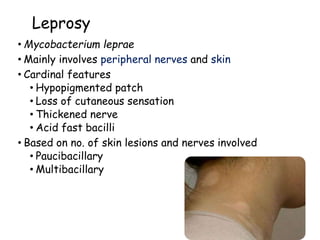
Leprosy
• Mycobacterium leprae
• Mainly involves peripheral nerves and skin
• Cardinal features
• Hypopigmented patch
• Loss of cutaneous sensation
• Thickened nerve
• Acid fast bacilli
• Based on no. of skin lesions and nerves involved
• Paucibacillary
• Multibacillary
Problem statement
• WORLD : According to WHO data
• 2,15,656 new cases detected during 2013
• 1,80,618 cases registered prevalence at beginning
of 2014
• Among new cases 71.68% multibacillary
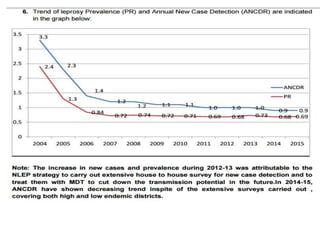
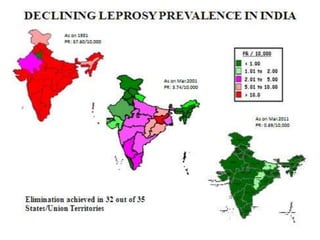
• Prevalence rate dropped from 21.1 cases per
10,000 in 1985 to 0.32 case per 10,000 population
at beginning of 2014
• Leprosy has been eliminated from 119 of 122
countries
Milestones in NLEP
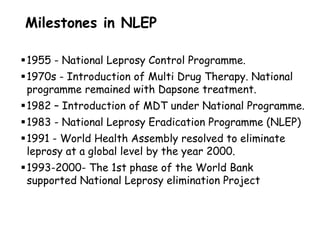
1955 - National Leprosy Control Programme.
1970s - Introduction of Multi Drug Therapy. National
programme remained with Dapsone treatment.
1982 – Introduction of MDT under National Programme.
1983 - National Leprosy Eradication Programme (NLEP)
1991 - World Health Assembly resolved to eliminate
leprosy at a global level by the year 2000.
1993-2000- The 1st phase of the World Bank
supported National Leprosy elimination Project
Milestones in NLEP (Continue)
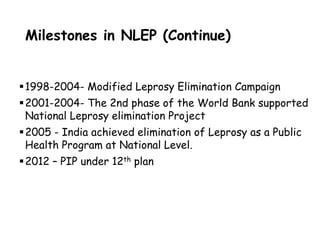
1998-2004- Modified Leprosy Elimination Campaign
2001-2004- The 2nd phase of the World Bank supported
National Leprosy elimination Project
2005 - India achieved elimination of Leprosy as a Public
Health Program at National Level.
2012 – PIP under 12th plan
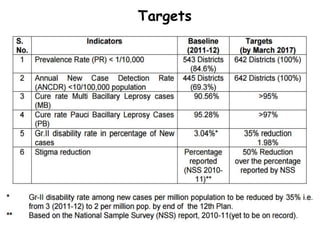
Targets
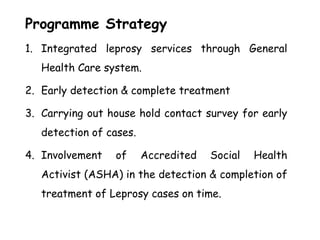
Programme Strategy
1. Integrated leprosy services through General
Health Care system.
2. Early detection & complete treatment
3. Carrying out house hold contact survey for early
detection of cases.
4. Involvement of Accredited Social Health
Activist (ASHA) in the detection & completion of
treatment of Leprosy cases on time.
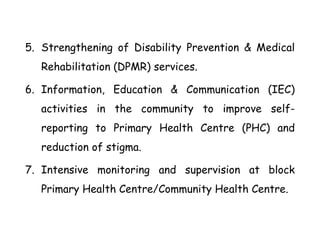
5. Strengthening of Disability Prevention & Medical
Rehabilitation (DPMR) services.
6. Information, Education & Communication (IEC)
activities in the community to improve self-
reporting to Primary Health Centre (PHC) and
reduction of stigma.
7. Intensive monitoring and supervision at block
Primary Health Centre/Community Health Centre.
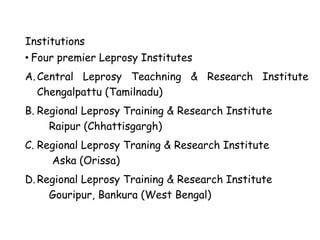
Institutions
• Four premier Leprosy Institutes
A.Central Leprosy Teachning & Research Institute
Chengalpattu (Tamilnadu)
B. Regional Leprosy Training & Research Institute
Raipur (Chhattisgargh)
C. Regional Leprosy Traning & Research Institute
Aska (Orissa)
D. Regional Leprosy Training & Research Institute
Gouripur, Bankura (West Bengal)
1a.DECENTRALIZATION OF NLEP
SERVICES
• State level societies are formed & funding to districts
is done by these.
• In smaller states/UTS - district societies
1b.INTEGRATION OF NLEP WITH
GENERAL HEALTH CARE SYSTEM
• Integration means to provide “comprehensive”
essential services from one service point:
ADVANTAGES:
• Patients detected early
• Patients treated early
• Transmission of infection interrupted early
• Development of deformities prevented
• Stigma reduced further
NRHM & NLEP:
Link person-ASHA
Performance based incentive:
2. Early detection & complete treatment
(i) To improve access to services.
(ii) To involve women including leprosy affected persons in
case detection.
(iii) To organize skin camps for detecting leprosy patients
while providing services for other skin conditions.
(iv)To undertake contact survey to identify the source in
the neighbourhood of each child or M.B. case.
(v) To increase awareness through the ANM, AWW,
ASHA and other Health Workers
2.Multi Drug Therapy (MDT)
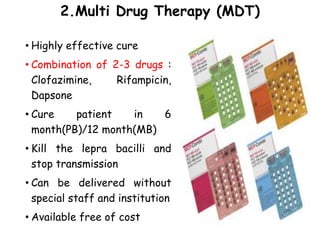
• Highly effective cure
• Combination of 2-3 drugs :
Clofazimine, Rifampicin,
Dapsone
• Cure patient in 6
month(PB)/12 month(MB)
• Kill the lepra bacilli and
stop transmission
• Can be delivered without
special staff and institution
• Available free of cost
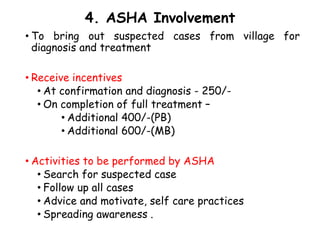
4. ASHA Involvement
• To bring out suspected cases from village for
diagnosis and treatment
• Receive incentives
• At confirmation and diagnosis - 250/-
• On completion of full treatment –
• Additional 400/-(PB)
• Additional 600/-(MB)
• Activities to be performed by ASHA
• Search for suspected case
• Follow up all cases
• Advice and motivate, self care practices
• Spreading awareness .
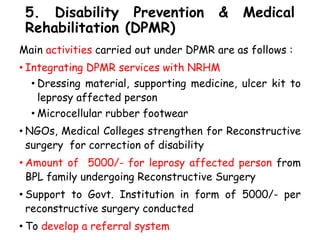
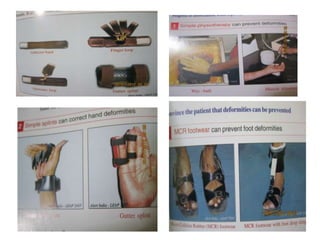
5. Disability Prevention & Medical
Rehabilitation (DPMR)
Main activities carried out under DPMR are as follows :
• Integrating DPMR services with NRHM
• Dressing material, supporting medicine, ulcer kit to
leprosy affected person
• Microcellular rubber footwear
• NGOs, Medical Colleges strengthen for Reconstructive
surgery for correction of disability
• Amount of 5000/- for leprosy affected person from
BPL family undergoing Reconstructive Surgery
• Support to Govt. Institution in form of 5000/- per
reconstructive surgery conducted
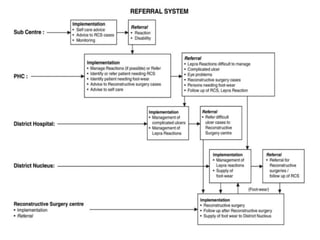
• To develop a referral system
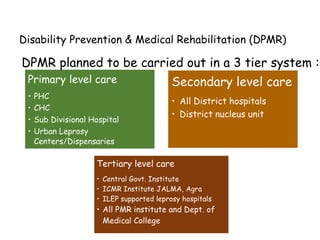
Disability Prevention & Medical Rehabilitation (DPMR)
Primary level care
• PHC
• CHC
• Sub Divisional Hospital
• Urban Leprosy
Centers/Dispensaries
Secondary level care
• All District hospitals
• District nucleus unit
Tertiary level care
• Central Govt. Institute
• ICMR Institute JALMA, Agra
• ILEP supported leprosy hospitals
• All PMR institute and Dept. of
Medical College
DPMR planned to be carried out in a 3 tier system :-
.
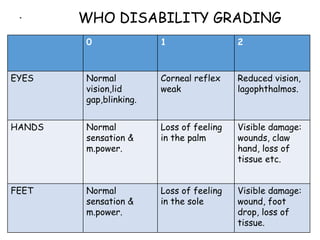
0 1 2
EYES Normal
vision,lid
gap,blinking.
Corneal reflex
weak
Reduced vision,
lagophthalmos.
HANDS Normal
sensation &
m.power.
Loss of feeling
in the palm
Visible damage:
wounds, claw
hand, loss of
tissue etc.
FEET Normal
sensation &
m.power.
Loss of feeling
in the sole
Visible damage:
wound, foot
drop, loss of
tissue.
WHO DISABILITY GRADING
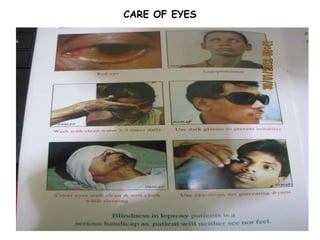
CARE OF EYES
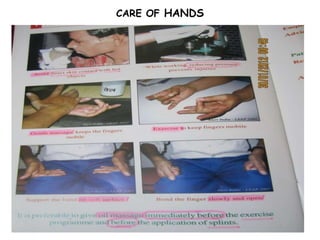
CARE OF HANDS
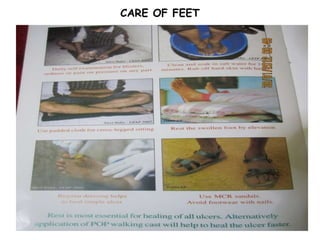
CARE OF FEET
6. IEC :Information Education &
Communication
Focus on –
• Behaviour change in community against stigma and
discrimination against leprosy affected person
• Making the public aware about the
• Availability of MDT
• Correction of deformity through surgery
• Leprosy affected person can live a normal life
with family
7. MONITORING & EVALUATION
• PRIMARY INDICATOR:
-Annual New Case Detection Rate (ANCDR)
-Treatment Completion Rate (cohort analysis)
• INDICATORS FOR CASE DETECTION:
- Proportion of new cases with Gr II disability
- Proportion of child cases(15yrs) among new cases
- Proportion of MB cases among new cases
- Proportion of Female cases among new cases
• INDICATORS FOR QUALITY OF SERVICE:
- Proportion of new cases correctly diagnosed.
- Proportion of defaulters.
- Number of relapses during a year.
- Proportion of cases with new disabilities.
MODIFIED LEPROSY ELIMINATION
CAMPAIGN (MLEC)
• Organising camps for 1 or 2 wks duration
• Services available:
case detection, Tt & referral
• Mass media
• Quite effective in case finding & has been employed
during phase-II.
• Five MLEC rounds conducted
BLOCK LEPROSY AWARENESS
CAMPAIGNS (BLAC)
• Carried out for 15 days in identified priority areas
during Sep-Nov each yr.
• Made huge impact on:
oHidden case detection
oBetter case management
oImprovement in spreading the awareness
oBringing down PR in high endemic areas.
SPECIAL ACTION PROJECTS FOR THE
ELIMINATION OF LEPROSY(SAPEL)
• For people living in special difficult to access areas or
situation or neglected communities.
• Strategies:
early detection & prompt MDT with proper IEC.
LEPROSY ELIMINATION
CAMPAIGNS(LEC) FOR URBAN AREAS
• GOI provides assistance to urban areas with 1lakh
population.
• Activities done
• Identify human resources available with Govt., Civil
societies, NGOs and Private Medical Practitioners
for leprosy services
• Build capacity
• Examination of all household contacts of all new
cases at least once before the completion of
treatment of index case.
• Identify one referral centre
• Mobile Health Clinics
• System of record keeping and reporting
• regular MDT supply
• sensitization meetings for IEC and advocacy
‘’ THANK U ‘’

National leprosy eradication programme

  • 1.
  • 2.
    Leprosy • Mycobacterium leprae •Mainly involves peripheral nerves and skin • Cardinal features • Hypopigmented patch • Loss of cutaneous sensation • Thickened nerve • Acid fast bacilli • Based on no. of skin lesions and nerves involved • Paucibacillary • Multibacillary
  • 3.
    Problem statement • WORLD: According to WHO data • 2,15,656 new cases detected during 2013 • 1,80,618 cases registered prevalence at beginning of 2014 • Among new cases 71.68% multibacillary • Prevalence rate dropped from 21.1 cases per 10,000 in 1985 to 0.32 case per 10,000 population at beginning of 2014 • Leprosy has been eliminated from 119 of 122 countries
  • 6.
    Milestones in NLEP 1955- National Leprosy Control Programme. 1970s - Introduction of Multi Drug Therapy. National programme remained with Dapsone treatment. 1982 – Introduction of MDT under National Programme. 1983 - National Leprosy Eradication Programme (NLEP) 1991 - World Health Assembly resolved to eliminate leprosy at a global level by the year 2000. 1993-2000- The 1st phase of the World Bank supported National Leprosy elimination Project
  • 7.
    Milestones in NLEP(Continue) 1998-2004- Modified Leprosy Elimination Campaign 2001-2004- The 2nd phase of the World Bank supported National Leprosy elimination Project 2005 - India achieved elimination of Leprosy as a Public Health Program at National Level. 2012 – PIP under 12th plan
  • 8.
  • 9.
    Programme Strategy 1. Integratedleprosy services through General Health Care system. 2. Early detection & complete treatment 3. Carrying out house hold contact survey for early detection of cases. 4. Involvement of Accredited Social Health Activist (ASHA) in the detection & completion of treatment of Leprosy cases on time.
  • 10.
    5. Strengthening ofDisability Prevention & Medical Rehabilitation (DPMR) services. 6. Information, Education & Communication (IEC) activities in the community to improve self- reporting to Primary Health Centre (PHC) and reduction of stigma. 7. Intensive monitoring and supervision at block Primary Health Centre/Community Health Centre.
  • 11.
    Institutions • Four premierLeprosy Institutes A.Central Leprosy Teachning & Research Institute Chengalpattu (Tamilnadu) B. Regional Leprosy Training & Research Institute Raipur (Chhattisgargh) C. Regional Leprosy Traning & Research Institute Aska (Orissa) D. Regional Leprosy Training & Research Institute Gouripur, Bankura (West Bengal)
  • 12.
    1a.DECENTRALIZATION OF NLEP SERVICES •State level societies are formed & funding to districts is done by these. • In smaller states/UTS - district societies
  • 13.
    1b.INTEGRATION OF NLEPWITH GENERAL HEALTH CARE SYSTEM • Integration means to provide “comprehensive” essential services from one service point: ADVANTAGES: • Patients detected early • Patients treated early • Transmission of infection interrupted early • Development of deformities prevented • Stigma reduced further NRHM & NLEP: Link person-ASHA Performance based incentive:
  • 14.
    2. Early detection& complete treatment (i) To improve access to services. (ii) To involve women including leprosy affected persons in case detection. (iii) To organize skin camps for detecting leprosy patients while providing services for other skin conditions. (iv)To undertake contact survey to identify the source in the neighbourhood of each child or M.B. case. (v) To increase awareness through the ANM, AWW, ASHA and other Health Workers
  • 15.
    2.Multi Drug Therapy(MDT) • Highly effective cure • Combination of 2-3 drugs : Clofazimine, Rifampicin, Dapsone • Cure patient in 6 month(PB)/12 month(MB) • Kill the lepra bacilli and stop transmission • Can be delivered without special staff and institution • Available free of cost
  • 16.
    4. ASHA Involvement •To bring out suspected cases from village for diagnosis and treatment • Receive incentives • At confirmation and diagnosis - 250/- • On completion of full treatment – • Additional 400/-(PB) • Additional 600/-(MB) • Activities to be performed by ASHA • Search for suspected case • Follow up all cases • Advice and motivate, self care practices • Spreading awareness .
  • 17.
    5. Disability Prevention& Medical Rehabilitation (DPMR) Main activities carried out under DPMR are as follows : • Integrating DPMR services with NRHM • Dressing material, supporting medicine, ulcer kit to leprosy affected person • Microcellular rubber footwear • NGOs, Medical Colleges strengthen for Reconstructive surgery for correction of disability • Amount of 5000/- for leprosy affected person from BPL family undergoing Reconstructive Surgery • Support to Govt. Institution in form of 5000/- per reconstructive surgery conducted • To develop a referral system
  • 18.
    Disability Prevention &Medical Rehabilitation (DPMR) Primary level care • PHC • CHC • Sub Divisional Hospital • Urban Leprosy Centers/Dispensaries Secondary level care • All District hospitals • District nucleus unit Tertiary level care • Central Govt. Institute • ICMR Institute JALMA, Agra • ILEP supported leprosy hospitals • All PMR institute and Dept. of Medical College DPMR planned to be carried out in a 3 tier system :-
  • 20.
    . 0 1 2 EYESNormal vision,lid gap,blinking. Corneal reflex weak Reduced vision, lagophthalmos. HANDS Normal sensation & m.power. Loss of feeling in the palm Visible damage: wounds, claw hand, loss of tissue etc. FEET Normal sensation & m.power. Loss of feeling in the sole Visible damage: wound, foot drop, loss of tissue. WHO DISABILITY GRADING
  • 21.
  • 22.
  • 23.
  • 25.
    6. IEC :InformationEducation & Communication Focus on – • Behaviour change in community against stigma and discrimination against leprosy affected person • Making the public aware about the • Availability of MDT • Correction of deformity through surgery • Leprosy affected person can live a normal life with family
  • 26.
    7. MONITORING &EVALUATION • PRIMARY INDICATOR: -Annual New Case Detection Rate (ANCDR) -Treatment Completion Rate (cohort analysis)
  • 27.
    • INDICATORS FORCASE DETECTION: - Proportion of new cases with Gr II disability - Proportion of child cases(15yrs) among new cases - Proportion of MB cases among new cases - Proportion of Female cases among new cases • INDICATORS FOR QUALITY OF SERVICE: - Proportion of new cases correctly diagnosed. - Proportion of defaulters. - Number of relapses during a year. - Proportion of cases with new disabilities.
  • 28.
    MODIFIED LEPROSY ELIMINATION CAMPAIGN(MLEC) • Organising camps for 1 or 2 wks duration • Services available: case detection, Tt & referral • Mass media • Quite effective in case finding & has been employed during phase-II. • Five MLEC rounds conducted
  • 29.
    BLOCK LEPROSY AWARENESS CAMPAIGNS(BLAC) • Carried out for 15 days in identified priority areas during Sep-Nov each yr. • Made huge impact on: oHidden case detection oBetter case management oImprovement in spreading the awareness oBringing down PR in high endemic areas.
  • 30.
    SPECIAL ACTION PROJECTSFOR THE ELIMINATION OF LEPROSY(SAPEL) • For people living in special difficult to access areas or situation or neglected communities. • Strategies: early detection & prompt MDT with proper IEC.
  • 31.
    LEPROSY ELIMINATION CAMPAIGNS(LEC) FORURBAN AREAS • GOI provides assistance to urban areas with 1lakh population. • Activities done • Identify human resources available with Govt., Civil societies, NGOs and Private Medical Practitioners for leprosy services • Build capacity • Examination of all household contacts of all new cases at least once before the completion of treatment of index case. • Identify one referral centre • Mobile Health Clinics • System of record keeping and reporting • regular MDT supply • sensitization meetings for IEC and advocacy
  • 32.

Editor's Notes

  • #17 Activities to be performed by ASHAs (i) Search for suspected cases of leprosy i.e. before any sign of disability appears. Such early detection will help in prevention of disability and also cut down transmission potential. (ii)Follow up all cases for completion of treatment in scheduled time. During follow up visit also look for symptoms of any reaction due to leprosy and refer them to the Health Workers/PHC for treatment. This will again reduce chances of disability occurring in cases under treatment. (iii) Advise and motivate self-care practices by disabled cases for proper care of their hands and feet during the follow up period. This will improve quality of life of the affected persons and prevent deterioration of disabilities. (iv) Spreading awareness.