Dr. Shivangi Dixit
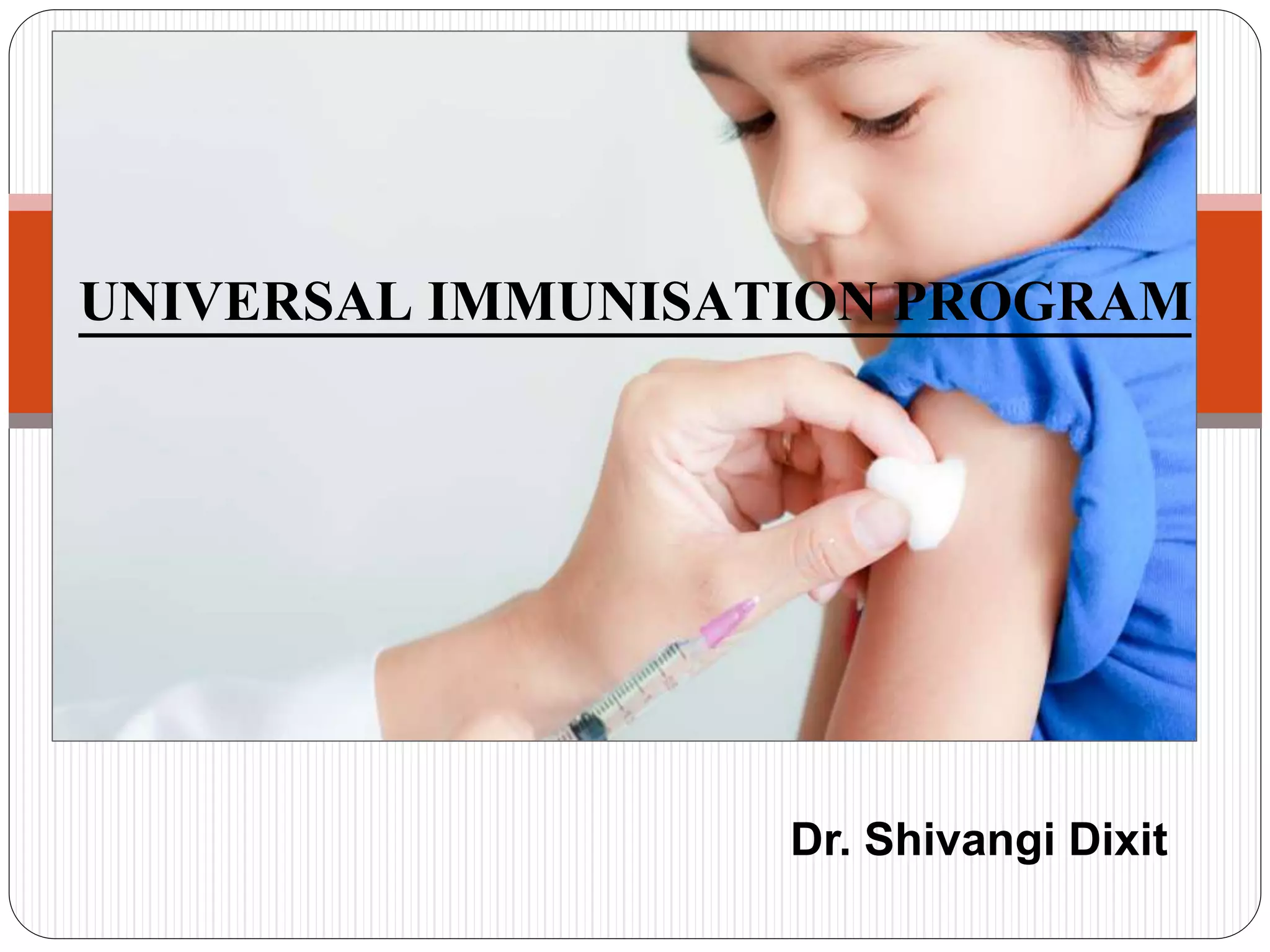
UNIVERSAL IMMUNISATION PROGRAM
Universal Immunization
Programme
• vaccination program launched by the
Government of India in1985.
• became a part of Child Survival and Safe
motherhood Programme in 1992 and is currently
one of the
key areas under National Rural Health
Mission(NRHM) since 2005.
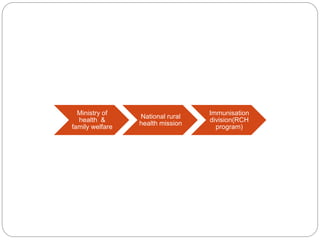
Ministry of
health &
family welfare
National rural
health mission
Immunisation
division(RCH
program)
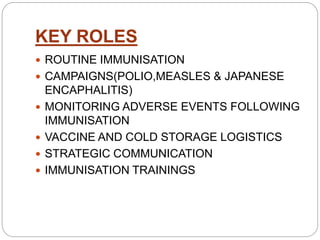
KEY ROLES
 ROUTINE IMMUNISATION
 CAMPAIGNS(POLIO,MEASLES & JAPANESE
ENCAPHALITIS)
 MONITORING ADVERSE EVENTS FOLLOWING
IMMUNISATION
 VACCINE AND COLD STORAGE LOGISTICS
 STRATEGIC COMMUNICATION
 IMMUNISATION TRAININGS
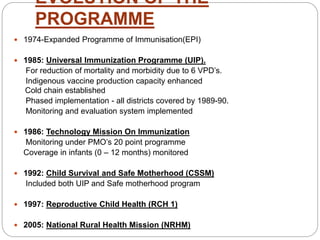
EVOLUTION OF THE
PROGRAMME
 1974-Expanded Programme of Immunisation(EPI)
 1985: Universal Immunization Programme (UIP).
For reduction of mortality and morbidity due to 6 VPD’s.
Indigenous vaccine production capacity enhanced
Cold chain established
Phased implementation - all districts covered by 1989-90.
Monitoring and evaluation system implemented
 1986: Technology Mission On Immunization
Monitoring under PMO’s 20 point programme
Coverage in infants (0 – 12 months) monitored
 1992: Child Survival and Safe Motherhood (CSSM)
Included both UIP and Safe motherhood program
 1997: Reproductive Child Health (RCH 1)
 2005: National Rural Health Mission (NRHM)
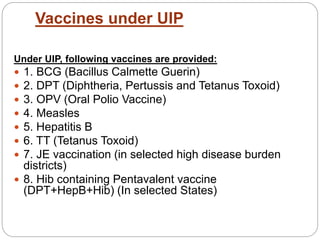
Vaccines under UIP
Under UIP, following vaccines are provided:
 1. BCG (Bacillus Calmette Guerin)
 2. DPT (Diphtheria, Pertussis and Tetanus Toxoid)
 3. OPV (Oral Polio Vaccine)
 4. Measles
 5. Hepatitis B
 6. TT (Tetanus Toxoid)
 7. JE vaccination (in selected high disease burden
districts)
 8. Hib containing Pentavalent vaccine
(DPT+HepB+Hib) (In selected States)
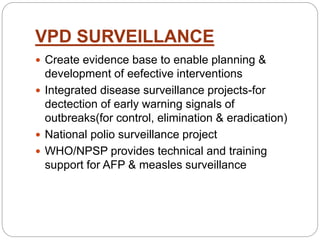
VPD SURVEILLANCE
 Create evidence base to enable planning &
development of eefective interventions
 Integrated disease surveillance projects-for
dectection of early warning signals of
outbreaks(for control, elimination & eradication)
 National polio surveillance project
 WHO/NPSP provides technical and training
support for AFP & measles surveillance
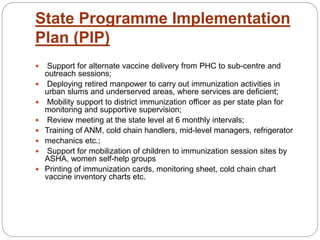
State Programme Implementation
Plan (PIP)
 Support for alternate vaccine delivery from PHC to sub-centre and
outreach sessions;
 Deploying retired manpower to carry out immunization activities in
urban slums and underserved areas, where services are deficient;
 Mobility support to district immunization officer as per state plan for
monitoring and supportive supervision;
 Review meeting at the state level at 6 monthly intervals;
 Training of ANM, cold chain handlers, mid-level managers, refrigerator
 mechanics etc.;
 Support for mobilization of children to immunization session sites by
ASHA, women self-help groups
 Printing of immunization cards, monitoring sheet, cold chain chart
vaccine inventory charts etc.
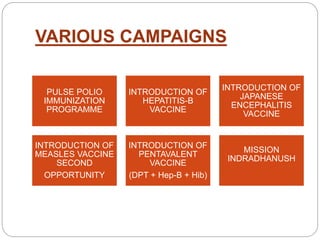
VARIOUS CAMPAIGNS
PULSE POLIO
IMMUNIZATION
PROGRAMME
INTRODUCTION OF
HEPATITIS-B
VACCINE
INTRODUCTION OF
JAPANESE
ENCEPHALITIS
VACCINE
INTRODUCTION OF
MEASLES VACCINE
SECOND
OPPORTUNITY
INTRODUCTION OF
PENTAVALENT
VACCINE
(DPT + Hep-B + Hib)
MISSION
INDRADHANUSH
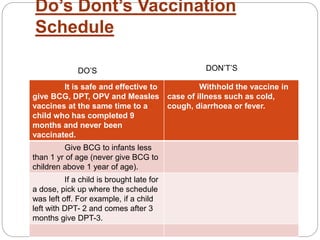
Do’s Dont’s Vaccination
Schedule
It is safe and effective to
give BCG, DPT, OPV and Measles
vaccines at the same time to a
child who has completed 9
months and never been
vaccinated.
Withhold the vaccine in
case of illness such as cold,
cough, diarrhoea or fever.
Give BCG to infants less
than 1 yr of age (never give BCG to
children above 1 year of age).
If a child is brought late for
a dose, pick up where the schedule
was left off. For example, if a child
left with DPT- 2 and comes after 3
months give DPT-3.
DO’S DON’T’S
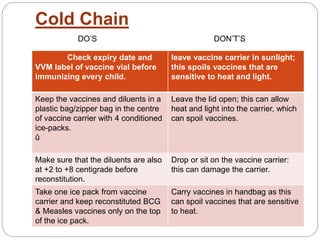
Cold Chain
Check expiry date and
VVM label of vaccine vial before
immunizing every child.
leave vaccine carrier in sunlight;
this spoils vaccines that are
sensitive to heat and light.
Keep the vaccines and diluents in a
plastic bag/zipper bag in the centre
of vaccine carrier with 4 conditioned
ice-packs.
û
Leave the lid open; this can allow
heat and light into the carrier, which
can spoil vaccines.
Make sure that the diluents are also
at +2 to +8 centigrade before
reconstitution.
Drop or sit on the vaccine carrier:
this can damage the carrier.
Take one ice pack from vaccine
carrier and keep reconstituted BCG
& Measles vaccines only on the top
of the ice pack.
Carry vaccines in handbag as this
can spoil vaccines that are sensitive
to heat.
DO’S DON’T’S
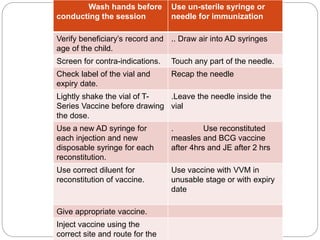
Wash hands before
conducting the session
Use un-sterile syringe or
needle for immunization
Verify beneficiary’s record and
age of the child.
.. Draw air into AD syringes
Screen for contra-indications. Touch any part of the needle.
Check label of the vial and
expiry date.
Recap the needle
Lightly shake the vial of T-
Series Vaccine before drawing
the dose.
.Leave the needle inside the
vial
Use a new AD syringe for
each injection and new
disposable syringe for each
reconstitution.
. Use reconstituted
measles and BCG vaccine
after 4hrs and JE after 2 hrs
Use correct diluent for
reconstitution of vaccine.
Use vaccine with VVM in
unusable stage or with expiry
date
Give appropriate vaccine.
Inject vaccine using the
correct site and route for the
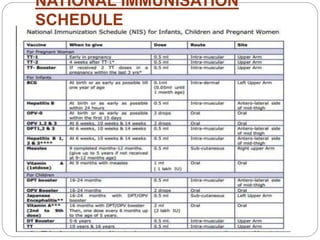
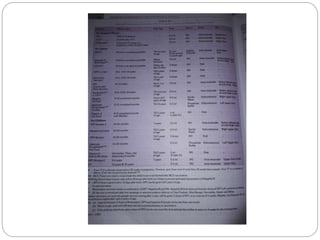
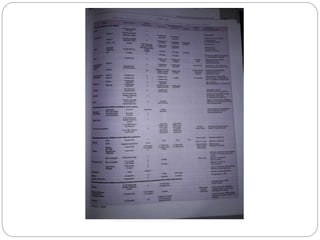
NATIONAL IMMUNISATION
SCHEDULE
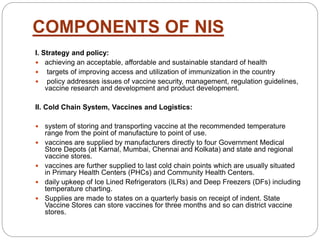
COMPONENTS OF NIS
I. Strategy and policy:
 achieving an acceptable, affordable and sustainable standard of health
 targets of improving access and utilization of immunization in the country
 policy addresses issues of vaccine security, management, regulation guidelines,
vaccine research and development and product development.
II. Cold Chain System, Vaccines and Logistics:
 system of storing and transporting vaccine at the recommended temperature
range from the point of manufacture to point of use.
 vaccines are supplied by manufacturers directly to four Government Medical
Store Depots (at Karnal, Mumbai, Chennai and Kolkata) and state and regional
vaccine stores.
 vaccines are further supplied to last cold chain points which are usually situated
in Primary Health Centers (PHCs) and Community Health Centers.
 daily upkeep of Ice Lined Refrigerators (ILRs) and Deep Freezers (DFs) including
temperature charting.
 Supplies are made to states on a quarterly basis on receipt of indent. State
Vaccine Stores can store vaccines for three months and so can district vaccine
stores.
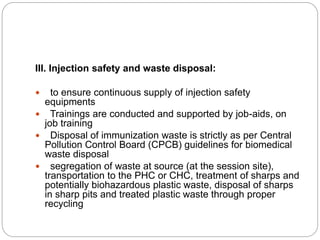
III. Injection safety and waste disposal:
 to ensure continuous supply of injection safety
equipments
 Trainings are conducted and supported by job-aids, on
job training
 Disposal of immunization waste is strictly as per Central
Pollution Control Board (CPCB) guidelines for biomedical
waste disposal
 segregation of waste at source (at the session site),
transportation to the PHC or CHC, treatment of sharps and
potentially biohazardous plastic waste, disposal of sharps
in sharp pits and treated plastic waste through proper
recycling
IV. Strategic communication:
 policy-making and guidance for consistent
information activity through coherent messaging
 issue of media advocacy, proactive planning and
effective media response is emerging as one of
the key elements
 The diseases being targeted are diphtheria,
whooping cough, tetanus, poliomyelitis,
tuberculosis, measles and Hepatitis B. In addition
to these, vaccines for Japanese Encephalitis[2]
and Haemophilus influenzae type B are also
being provided in selected states.
Schemes:
a) Routine Immunization:
Objectives:
The stated objectives of UIP are:
 To rapidly increase immunization coverage.
 To improve the quality of services.
 To establish a reliable cold chain system to the
health facility level.
 Monitoring of performance.
 To achieve self sufficiency in vaccine production.
Scope and eligibility:
 India has one of the largest Universal Immunization
Programs (UIP) in the world in terms of the quantities of
vaccines used, number of beneficiaries covered,
geographical spread and human resources involved.
 Under the UIP, all vaccines are given free of cost to the
beneficiaries as per the National Immunization Schedule.
 o All beneficiaries’ namely pregnant women and children
can get themselves vaccinated at the nearest
Government/Private health facility or at an immunization
post (Anganwadi centres/ other identified sites) near to
their village/urban locality on fixed days.
 o The UIP covers all sections of the society across the
country with the same high quality vaccines.
Achievements:
 The biggest achievement of the immunization
program is the eradication of small pox.
 One more significant milestone is that India is
free of Poliomyelitis caused by Wild Polio Virus
(WPV) for more than 33 months.
 Besides, vaccination has contributed significantly
to the decline in the cases and deaths due to the
Vaccine Preventable Diseases (VPDs).
Universal immunisation program

Universal immunisation program

  • 1.
    Dr. Shivangi Dixit UNIVERSALIMMUNISATION PROGRAM
  • 2.
    Universal Immunization Programme • vaccinationprogram launched by the Government of India in1985. • became a part of Child Survival and Safe motherhood Programme in 1992 and is currently one of the key areas under National Rural Health Mission(NRHM) since 2005.
  • 3.
    Ministry of health & familywelfare National rural health mission Immunisation division(RCH program)
  • 4.
    KEY ROLES  ROUTINEIMMUNISATION  CAMPAIGNS(POLIO,MEASLES & JAPANESE ENCAPHALITIS)  MONITORING ADVERSE EVENTS FOLLOWING IMMUNISATION  VACCINE AND COLD STORAGE LOGISTICS  STRATEGIC COMMUNICATION  IMMUNISATION TRAININGS
  • 5.
    EVOLUTION OF THE PROGRAMME 1974-Expanded Programme of Immunisation(EPI)  1985: Universal Immunization Programme (UIP). For reduction of mortality and morbidity due to 6 VPD’s. Indigenous vaccine production capacity enhanced Cold chain established Phased implementation - all districts covered by 1989-90. Monitoring and evaluation system implemented  1986: Technology Mission On Immunization Monitoring under PMO’s 20 point programme Coverage in infants (0 – 12 months) monitored  1992: Child Survival and Safe Motherhood (CSSM) Included both UIP and Safe motherhood program  1997: Reproductive Child Health (RCH 1)  2005: National Rural Health Mission (NRHM)
  • 6.
    Vaccines under UIP UnderUIP, following vaccines are provided:  1. BCG (Bacillus Calmette Guerin)  2. DPT (Diphtheria, Pertussis and Tetanus Toxoid)  3. OPV (Oral Polio Vaccine)  4. Measles  5. Hepatitis B  6. TT (Tetanus Toxoid)  7. JE vaccination (in selected high disease burden districts)  8. Hib containing Pentavalent vaccine (DPT+HepB+Hib) (In selected States)
  • 7.
    VPD SURVEILLANCE  Createevidence base to enable planning & development of eefective interventions  Integrated disease surveillance projects-for dectection of early warning signals of outbreaks(for control, elimination & eradication)  National polio surveillance project  WHO/NPSP provides technical and training support for AFP & measles surveillance
  • 8.
    State Programme Implementation Plan(PIP)  Support for alternate vaccine delivery from PHC to sub-centre and outreach sessions;  Deploying retired manpower to carry out immunization activities in urban slums and underserved areas, where services are deficient;  Mobility support to district immunization officer as per state plan for monitoring and supportive supervision;  Review meeting at the state level at 6 monthly intervals;  Training of ANM, cold chain handlers, mid-level managers, refrigerator  mechanics etc.;  Support for mobilization of children to immunization session sites by ASHA, women self-help groups  Printing of immunization cards, monitoring sheet, cold chain chart vaccine inventory charts etc.
  • 9.
    VARIOUS CAMPAIGNS PULSE POLIO IMMUNIZATION PROGRAMME INTRODUCTIONOF HEPATITIS-B VACCINE INTRODUCTION OF JAPANESE ENCEPHALITIS VACCINE INTRODUCTION OF MEASLES VACCINE SECOND OPPORTUNITY INTRODUCTION OF PENTAVALENT VACCINE (DPT + Hep-B + Hib) MISSION INDRADHANUSH
  • 10.
    Do’s Dont’s Vaccination Schedule Itis safe and effective to give BCG, DPT, OPV and Measles vaccines at the same time to a child who has completed 9 months and never been vaccinated. Withhold the vaccine in case of illness such as cold, cough, diarrhoea or fever. Give BCG to infants less than 1 yr of age (never give BCG to children above 1 year of age). If a child is brought late for a dose, pick up where the schedule was left off. For example, if a child left with DPT- 2 and comes after 3 months give DPT-3. DO’S DON’T’S
  • 11.
    Cold Chain Check expirydate and VVM label of vaccine vial before immunizing every child. leave vaccine carrier in sunlight; this spoils vaccines that are sensitive to heat and light. Keep the vaccines and diluents in a plastic bag/zipper bag in the centre of vaccine carrier with 4 conditioned ice-packs. û Leave the lid open; this can allow heat and light into the carrier, which can spoil vaccines. Make sure that the diluents are also at +2 to +8 centigrade before reconstitution. Drop or sit on the vaccine carrier: this can damage the carrier. Take one ice pack from vaccine carrier and keep reconstituted BCG & Measles vaccines only on the top of the ice pack. Carry vaccines in handbag as this can spoil vaccines that are sensitive to heat. DO’S DON’T’S
  • 12.
    Wash hands before conductingthe session Use un-sterile syringe or needle for immunization Verify beneficiary’s record and age of the child. .. Draw air into AD syringes Screen for contra-indications. Touch any part of the needle. Check label of the vial and expiry date. Recap the needle Lightly shake the vial of T- Series Vaccine before drawing the dose. .Leave the needle inside the vial Use a new AD syringe for each injection and new disposable syringe for each reconstitution. . Use reconstituted measles and BCG vaccine after 4hrs and JE after 2 hrs Use correct diluent for reconstitution of vaccine. Use vaccine with VVM in unusable stage or with expiry date Give appropriate vaccine. Inject vaccine using the correct site and route for the
  • 13.
  • 14.
    COMPONENTS OF NIS I.Strategy and policy:  achieving an acceptable, affordable and sustainable standard of health  targets of improving access and utilization of immunization in the country  policy addresses issues of vaccine security, management, regulation guidelines, vaccine research and development and product development. II. Cold Chain System, Vaccines and Logistics:  system of storing and transporting vaccine at the recommended temperature range from the point of manufacture to point of use.  vaccines are supplied by manufacturers directly to four Government Medical Store Depots (at Karnal, Mumbai, Chennai and Kolkata) and state and regional vaccine stores.  vaccines are further supplied to last cold chain points which are usually situated in Primary Health Centers (PHCs) and Community Health Centers.  daily upkeep of Ice Lined Refrigerators (ILRs) and Deep Freezers (DFs) including temperature charting.  Supplies are made to states on a quarterly basis on receipt of indent. State Vaccine Stores can store vaccines for three months and so can district vaccine stores.
  • 15.
    III. Injection safetyand waste disposal:  to ensure continuous supply of injection safety equipments  Trainings are conducted and supported by job-aids, on job training  Disposal of immunization waste is strictly as per Central Pollution Control Board (CPCB) guidelines for biomedical waste disposal  segregation of waste at source (at the session site), transportation to the PHC or CHC, treatment of sharps and potentially biohazardous plastic waste, disposal of sharps in sharp pits and treated plastic waste through proper recycling
  • 16.
    IV. Strategic communication: policy-making and guidance for consistent information activity through coherent messaging  issue of media advocacy, proactive planning and effective media response is emerging as one of the key elements
  • 17.
     The diseasesbeing targeted are diphtheria, whooping cough, tetanus, poliomyelitis, tuberculosis, measles and Hepatitis B. In addition to these, vaccines for Japanese Encephalitis[2] and Haemophilus influenzae type B are also being provided in selected states.
  • 18.
    Schemes: a) Routine Immunization: Objectives: Thestated objectives of UIP are:  To rapidly increase immunization coverage.  To improve the quality of services.  To establish a reliable cold chain system to the health facility level.  Monitoring of performance.  To achieve self sufficiency in vaccine production.
  • 19.
    Scope and eligibility: India has one of the largest Universal Immunization Programs (UIP) in the world in terms of the quantities of vaccines used, number of beneficiaries covered, geographical spread and human resources involved.  Under the UIP, all vaccines are given free of cost to the beneficiaries as per the National Immunization Schedule.  o All beneficiaries’ namely pregnant women and children can get themselves vaccinated at the nearest Government/Private health facility or at an immunization post (Anganwadi centres/ other identified sites) near to their village/urban locality on fixed days.  o The UIP covers all sections of the society across the country with the same high quality vaccines.
  • 20.
    Achievements:  The biggestachievement of the immunization program is the eradication of small pox.  One more significant milestone is that India is free of Poliomyelitis caused by Wild Polio Virus (WPV) for more than 33 months.  Besides, vaccination has contributed significantly to the decline in the cases and deaths due to the Vaccine Preventable Diseases (VPDs).