NATIONAL AIDS CONTROL PROGRAMME
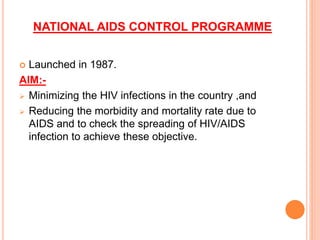
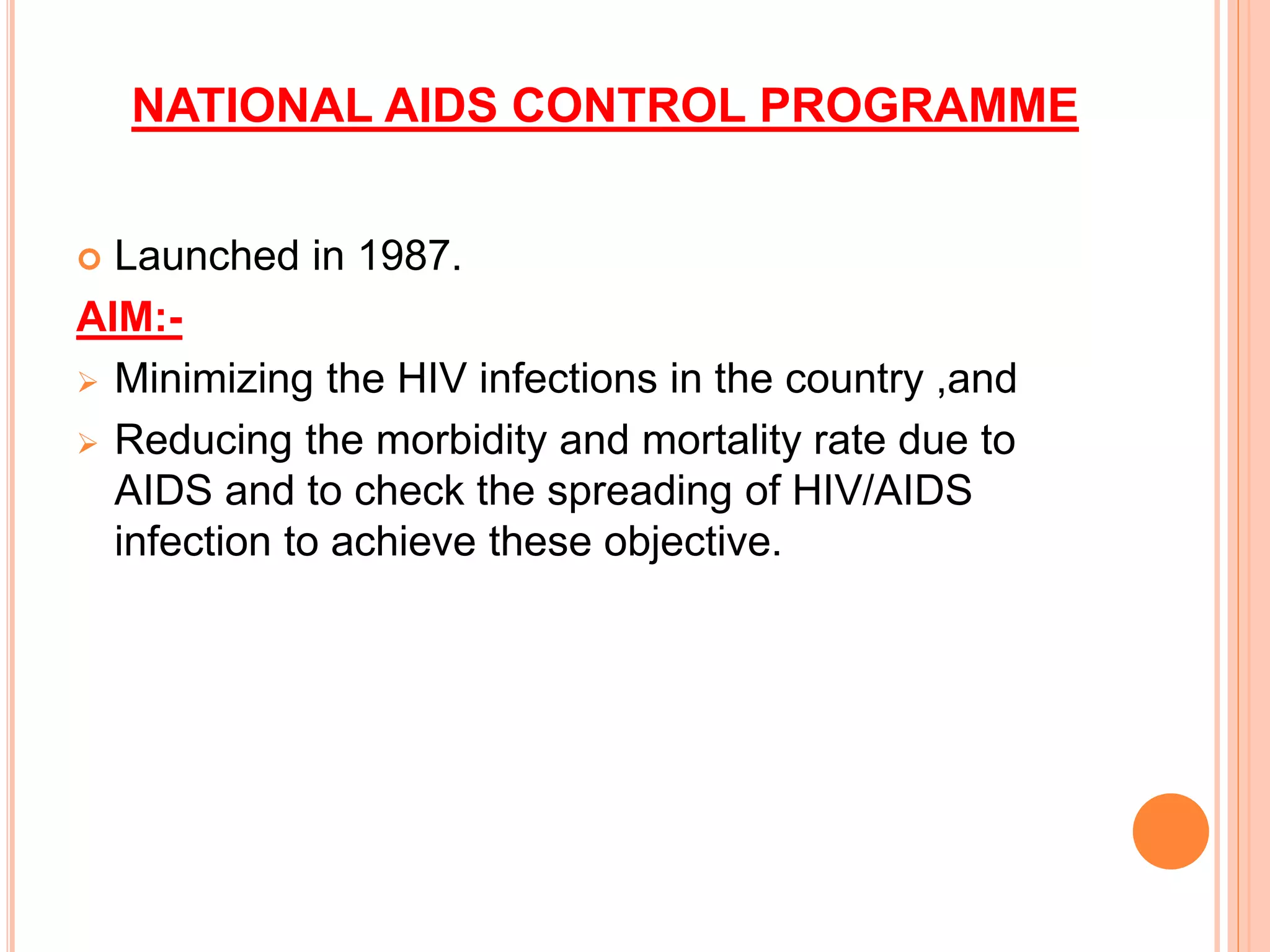
 Launched in 1987.
AIM:-
 Minimizing the HIV infections in the country ,and
 Reducing the morbidity and mortality rate due to
AIDS and to check the spreading of HIV/AIDS
infection to achieve these objective.
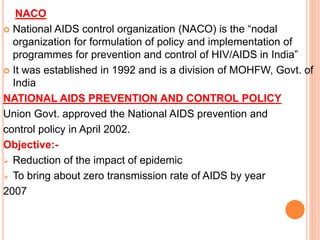
NACO
 National AIDS control organization (NACO) is the “nodal
organization for formulation of policy and implementation of
programmes for prevention and control of HIV/AIDS in India”
 It was established in 1992 and is a division of MOHFW, Govt. of
India
NATIONAL AIDS PREVENTION AND CONTROL POLICY
Union Govt. approved the National AIDS prevention and
control policy in April 2002.
Objective:-
 Reduction of the impact of epidemic
 To bring about zero transmission rate of AIDS by year
2007
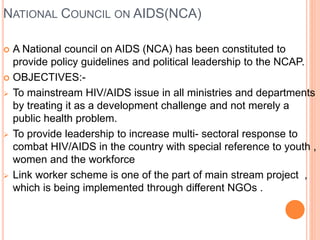
NATIONAL COUNCIL ON AIDS(NCA)
 A National council on AIDS (NCA) has been constituted to
provide policy guidelines and political leadership to the NCAP.
 OBJECTIVES:-
 To mainstream HIV/AIDS issue in all ministries and departments
by treating it as a development challenge and not merely a
public health problem.
 To provide leadership to increase multi- sectoral response to
combat HIV/AIDS in the country with special reference to youth ,
women and the workforce
 Link worker scheme is one of the part of main stream project ,
which is being implemented through different NGOs .
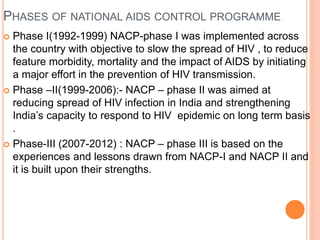
PHASES OF NATIONAL AIDS CONTROL PROGRAMME
 Phase I(1992-1999) NACP-phase I was implemented across
the country with objective to slow the spread of HIV , to reduce
feature morbidity, mortality and the impact of AIDS by initiating
a major effort in the prevention of HIV transmission.
 Phase –II(1999-2006):- NACP – phase II was aimed at
reducing spread of HIV infection in India and strengthening
India’s capacity to respond to HIV epidemic on long term basis
.
 Phase-III (2007-2012) : NACP – phase III is based on the
experiences and lessons drawn from NACP-I and NACP II and
it is built upon their strengths.

National aids control programme

  • 1.
    NATIONAL AIDS CONTROLPROGRAMME  Launched in 1987. AIM:-  Minimizing the HIV infections in the country ,and  Reducing the morbidity and mortality rate due to AIDS and to check the spreading of HIV/AIDS infection to achieve these objective.
  • 2.
    NACO  National AIDScontrol organization (NACO) is the “nodal organization for formulation of policy and implementation of programmes for prevention and control of HIV/AIDS in India”  It was established in 1992 and is a division of MOHFW, Govt. of India NATIONAL AIDS PREVENTION AND CONTROL POLICY Union Govt. approved the National AIDS prevention and control policy in April 2002. Objective:-  Reduction of the impact of epidemic  To bring about zero transmission rate of AIDS by year 2007
  • 3.
    NATIONAL COUNCIL ONAIDS(NCA)  A National council on AIDS (NCA) has been constituted to provide policy guidelines and political leadership to the NCAP.  OBJECTIVES:-  To mainstream HIV/AIDS issue in all ministries and departments by treating it as a development challenge and not merely a public health problem.  To provide leadership to increase multi- sectoral response to combat HIV/AIDS in the country with special reference to youth , women and the workforce  Link worker scheme is one of the part of main stream project , which is being implemented through different NGOs .
  • 4.
    PHASES OF NATIONALAIDS CONTROL PROGRAMME  Phase I(1992-1999) NACP-phase I was implemented across the country with objective to slow the spread of HIV , to reduce feature morbidity, mortality and the impact of AIDS by initiating a major effort in the prevention of HIV transmission.  Phase –II(1999-2006):- NACP – phase II was aimed at reducing spread of HIV infection in India and strengthening India’s capacity to respond to HIV epidemic on long term basis .  Phase-III (2007-2012) : NACP – phase III is based on the experiences and lessons drawn from NACP-I and NACP II and it is built upon their strengths.