Integrated Disease Surveillance Project
                (IDSP)


 State Institute of Health & Family Welfare, Jaipur
IDSP


Ø Decentralized, state based Project
Ø 5 year project with support from WB


          SIHFW: an ISO 9001: 2008 certified Institution   2
Genesis of IDSP


 SIHFW: an ISO 9001: 2008 certified Institution
                                                  3
National Surveillance Program for
        Comm. Diseases
    Ø Pilot Launch-1997 in 5 Districts
    Ø 20 districts added in 1997-98
    Ø Another 20 in 1998-99
    Ø 101 Districts, 35 States/ UT at end of 9th
      Plan
    Ø NICD-Nodal Agency
    Ø Weekly Outbreak reporting from Districts
      (including nil reporting) to the Centre.
            SIHFW: an ISO 9001: 2008 certified Institution   3
Objectives

Ø Establish a decentralized system of
  disease surveillance for timely and
  effective public health action
Ø Improve the efficiency of disease
  surveillance for use in health planning,
  management and evaluating control
  strategies


       SIHFW: an ISO 9001: 2008 certified Institution   4
Components of IDSP

Ø Establish and Operate a Central-level
  Disease Surveillance Unit
Ø Integrate and strengthen disease
  surveillance at the state and district levels
Ø Improve laboratory support
Ø Training for disease surveillance and
  action.

       SIHFW: an ISO 9001: 2008 certified Institution   5
Expected outcome

Ø Early detection of outbreaks

Ø Early institution of containment measures

Ø Reduction in morbidity & mortality

Ø Minimize economic loss


        SIHFW: an ISO 9001: 2008 certified Institution   6
NSPCD: Lessons
Ø Significantly improved the capacity of
  districts and states.

Ø It was not case based reporting and did
  not give a complete picture of disease
  burden

Ø GoI not convinced to expand this
  program to all 600 districts in the country
       SIHFW: an ISO 9001: 2008 certified Institution   7
Strategy
Ø Surveil a limited number of health
  conditions and risk factors
Ø Strengthen data quality, analysis and links
  to action
Ø Improve laboratory support
Ø Train stakeholders in disease surveillance
Ø Coordinate and decentralize surveillance
  activities
Ø Integrate disease surveillance at the state
  and district levels
       SIHFW: an ISO 9001: 2008 certified Institution   8
Diseases under IDSP

1. Regular Surveillance:
Ø Vector Borne Disease :Malaria
Ø Water Borne Disease :Acute Diarrheal
                         Disease(Cholera)
                        :Typhoid
Ø Respiratory Diseases :Tuberculosis
Ø VPDs                  :Measles


        SIHFW: an ISO 9001: 2008 certified Institution   9
Diseases under eradication                    : Polio
Other Conditions                              : Road Traffic Accidents
Other International
commitments                                    : Plague
Unusual clinical syndromes                     : Menigoencephalitis
                                                /Respiratory
                                                 (Causing death /
                                                 hospitalization)


              SIHFW: an ISO 9001: 2008 certified Institution          10
Dengue Hemorrhagic fevers and other
   undiagnosed conditions
2. Sentinel Surveillance
    STD/Blood borne : HIV/HBV, HCV
    Other Conditions   : Water Quality
                       : Outdoor Air Quality
                         (Large Urban centers)


           SIHFW: an ISO 9001: 2008 certified Institution   11
3. Regular periodic Community surveys:
     NCD Risk Factors : Anthropometry,
                            Physical activity,
                            Blood Pressure,
                            Tobacco,
                            Nutrition,
                            Blindness
4. Additional State Priorities: Each state may
   identify up to five additional conditions for
   surveillance.

         SIHFW: an ISO 9001: 2008 certified Institution   12
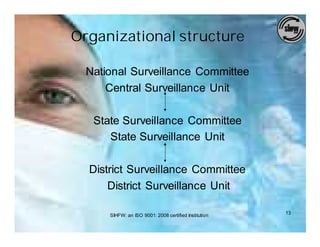
Organizational structure

  National Surveillance Committee
      Central Surveillance Unit

   State Surveillance Committee
      State Surveillance Unit

  District Surveillance Committee
      District Surveillance Unit

      SIHFW: an ISO 9001: 2008 certified Institution   13
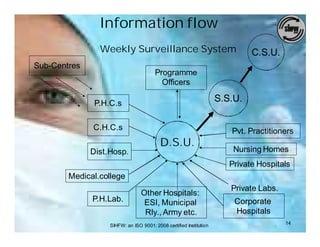
Information flow
                Weekly Surveillance System                                   C.S.U.
Sub-Centres
                                        Programme
                                          Officers

               P.H.C.s
                                                                    S.S.U.

              C.H.C.s                                                  Pvt. Practitioners
                                          D.S.U.
              Dist.Hosp.                                                Nursing Homes
                                                                       Private Hospitals
        Medical.college
                                                                       Private Labs.
                                 Other Hospitals:
              P.H.Lab.            ESI, Municipal                        Corporate
                                  Rly., Army etc.                       Hospitals
                   SIHFW: an ISO 9001: 2008 certified Institution                      14
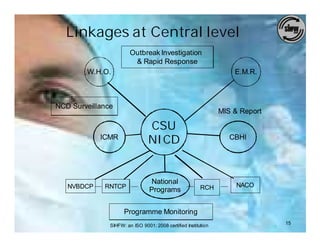
Linkages at Central level
                        Outbreak Investigation
                         & Rapid Response
        W.H.O.                                                      E.M.R.


NCD Surveillance
                                                                MIS & Report

                                CSU
            ICMR                                                   CBHI
                                NICD


                                 National                            NACO
   NVBDCP    RNTCP                                       RCH
                                 Programs


                     Programme Monitoring
               SIHFW: an ISO 9001: 2008 certified Institution                  15
Strengths of IDSP

Ø Functional integration of surveillance
  components of vertical programs
Ø Reporting of suspect, probable and
  confirmed cases –Syndromic reporting
  from periphery
Ø Strong IT component for data analysis
Ø Trigger levels for gradated response
Ø Action component in the reporting formats
Ø Streamlined flow of funds to the districts

       SIHFW: an ISO 9001: 2008 certified Institution   16
Key performance Indicators

 Ø Number and percentage of districts
   providing monthly surveillance reports
   on time – by state and overall

 Ø Number and percentage of responses
   to disease-specific triggers on time - by
   state and overall

       SIHFW: an ISO 9001: 2008 certified Institution   17
Ø Number and percentage of responses
  to disease-specific triggers assessed
  to be adequate - by state and overall
Ø Number and percentage of
  laboratories providing adequate
  quality of information – by state and
  center;
Ø Number of districts in which private
  providers are contributing to disease
  information

    SIHFW: an ISO 9001: 2008 certified Institution   18
Ø Number of reports derived from private
  health care providers;
Ø Number of reports derived from private
  laboratories;
Ø Number and % of states in which
  surveillance information relating to
  various vertical disease control
  programs have been integrated


     SIHFW: an ISO 9001: 2008 certified Institution   19
Ø Number and % of project districts and
  states publishing annual surveillance
  reports

Ø Publication by CSU of consolidated
  annual surveillance report


   SIHFW: an ISO 9001: 2008 certified Institution   20
IDSP reporting
Ø Form ‘S’ (Suspect Cases) by Health
  Workers (Sub Centres)
Ø Form ‘P’ (Probable Cases) by Doctors
  (PHC, CHC, Hospitals)
Ø Form ‘L’ (Lab Confirmed Cases) from
  Laboratories
Ø Frequency of reporting – weekly (Monday
  to Sunday)
Ø Data compilation/analysis and response
  should be at all levels. Presently at
  State/District/Block level 12- 15 Outbreaks
  reported every week.
         SIHFW: an ISO 9001: 2008 certified Institution   21
New initiatives under IDSP

   Alerts through IDSP call center:
 Ø Call Centre operational with 1075 toll
   free number since February 2008
 Ø Call received as on 8th October 2008 :
   18,872
 Ø No. of Health Alerts : 60
 Ø Led to detection of 5 outbreaks
   (Cholera, Acute Diarrheal Disease and
   Chickenpox)
       SIHFW: an ISO 9001: 2008 certified Institution   22
e-learning:
Ø The objective of e-learning is to
  enhance the skills to a wide arena of
  health personnel.
Ø Proposed components:
   Ø Discussion Forums
   Ø Online Survey & Assessment
   Ø Feedback
   Ø FAQs
Ø Currently e-learning modules are
  being prepared.
  SIHFW: an ISO 9001: 2008 certified Institution   23
Media Scanning Cell
Objective:
  ØTo provide the supplemental
    information about outbreaks
Method:
  ØNational and local newspapers,
    Internet surfing, TV channel
    screening for news item on disease
    occurrence

  SIHFW: an ISO 9001: 2008 certified Institution   24
Benefits of Media Scanning:
   ØIncreases the sensitivity &
    strengthen the surveillance
    system

   ØProvide early warning of
    occurrence of clusters of diseases


 SIHFW: an ISO 9001: 2008 certified Institution   25
Thank You

For more details log on to
www. sihfwrajasthan.com
             or
 contact : Director-SIHFW
             on
  sihfwraj@yahoo.co.in

IDSP

  • 1.
    Integrated Disease SurveillanceProject (IDSP) State Institute of Health & Family Welfare, Jaipur
  • 2.
    IDSP Ø Decentralized, statebased Project Ø 5 year project with support from WB SIHFW: an ISO 9001: 2008 certified Institution 2
  • 3.
    Genesis of IDSP SIHFW: an ISO 9001: 2008 certified Institution 3
  • 4.
    National Surveillance Programfor Comm. Diseases Ø Pilot Launch-1997 in 5 Districts Ø 20 districts added in 1997-98 Ø Another 20 in 1998-99 Ø 101 Districts, 35 States/ UT at end of 9th Plan Ø NICD-Nodal Agency Ø Weekly Outbreak reporting from Districts (including nil reporting) to the Centre. SIHFW: an ISO 9001: 2008 certified Institution 3
  • 5.
    Objectives Ø Establish adecentralized system of disease surveillance for timely and effective public health action Ø Improve the efficiency of disease surveillance for use in health planning, management and evaluating control strategies SIHFW: an ISO 9001: 2008 certified Institution 4
  • 6.
    Components of IDSP ØEstablish and Operate a Central-level Disease Surveillance Unit Ø Integrate and strengthen disease surveillance at the state and district levels Ø Improve laboratory support Ø Training for disease surveillance and action. SIHFW: an ISO 9001: 2008 certified Institution 5
  • 7.
    Expected outcome Ø Earlydetection of outbreaks Ø Early institution of containment measures Ø Reduction in morbidity & mortality Ø Minimize economic loss SIHFW: an ISO 9001: 2008 certified Institution 6
  • 8.
    NSPCD: Lessons Ø Significantlyimproved the capacity of districts and states. Ø It was not case based reporting and did not give a complete picture of disease burden Ø GoI not convinced to expand this program to all 600 districts in the country SIHFW: an ISO 9001: 2008 certified Institution 7
  • 9.
    Strategy Ø Surveil alimited number of health conditions and risk factors Ø Strengthen data quality, analysis and links to action Ø Improve laboratory support Ø Train stakeholders in disease surveillance Ø Coordinate and decentralize surveillance activities Ø Integrate disease surveillance at the state and district levels SIHFW: an ISO 9001: 2008 certified Institution 8
  • 10.
    Diseases under IDSP 1.Regular Surveillance: Ø Vector Borne Disease :Malaria Ø Water Borne Disease :Acute Diarrheal Disease(Cholera) :Typhoid Ø Respiratory Diseases :Tuberculosis Ø VPDs :Measles SIHFW: an ISO 9001: 2008 certified Institution 9
  • 11.
    Diseases under eradication : Polio Other Conditions : Road Traffic Accidents Other International commitments : Plague Unusual clinical syndromes : Menigoencephalitis /Respiratory (Causing death / hospitalization) SIHFW: an ISO 9001: 2008 certified Institution 10
  • 12.
    Dengue Hemorrhagic feversand other undiagnosed conditions 2. Sentinel Surveillance STD/Blood borne : HIV/HBV, HCV Other Conditions : Water Quality : Outdoor Air Quality (Large Urban centers) SIHFW: an ISO 9001: 2008 certified Institution 11
  • 13.
    3. Regular periodicCommunity surveys: NCD Risk Factors : Anthropometry, Physical activity, Blood Pressure, Tobacco, Nutrition, Blindness 4. Additional State Priorities: Each state may identify up to five additional conditions for surveillance. SIHFW: an ISO 9001: 2008 certified Institution 12
  • 14.
    Organizational structure National Surveillance Committee Central Surveillance Unit State Surveillance Committee State Surveillance Unit District Surveillance Committee District Surveillance Unit SIHFW: an ISO 9001: 2008 certified Institution 13
  • 15.
    Information flow Weekly Surveillance System C.S.U. Sub-Centres Programme Officers P.H.C.s S.S.U. C.H.C.s Pvt. Practitioners D.S.U. Dist.Hosp. Nursing Homes Private Hospitals Medical.college Private Labs. Other Hospitals: P.H.Lab. ESI, Municipal Corporate Rly., Army etc. Hospitals SIHFW: an ISO 9001: 2008 certified Institution 14
  • 16.
    Linkages at Centrallevel Outbreak Investigation & Rapid Response W.H.O. E.M.R. NCD Surveillance MIS & Report CSU ICMR CBHI NICD National NACO NVBDCP RNTCP RCH Programs Programme Monitoring SIHFW: an ISO 9001: 2008 certified Institution 15
  • 17.
    Strengths of IDSP ØFunctional integration of surveillance components of vertical programs Ø Reporting of suspect, probable and confirmed cases –Syndromic reporting from periphery Ø Strong IT component for data analysis Ø Trigger levels for gradated response Ø Action component in the reporting formats Ø Streamlined flow of funds to the districts SIHFW: an ISO 9001: 2008 certified Institution 16
  • 18.
    Key performance Indicators Ø Number and percentage of districts providing monthly surveillance reports on time – by state and overall Ø Number and percentage of responses to disease-specific triggers on time - by state and overall SIHFW: an ISO 9001: 2008 certified Institution 17
  • 19.
    Ø Number andpercentage of responses to disease-specific triggers assessed to be adequate - by state and overall Ø Number and percentage of laboratories providing adequate quality of information – by state and center; Ø Number of districts in which private providers are contributing to disease information SIHFW: an ISO 9001: 2008 certified Institution 18
  • 20.
    Ø Number ofreports derived from private health care providers; Ø Number of reports derived from private laboratories; Ø Number and % of states in which surveillance information relating to various vertical disease control programs have been integrated SIHFW: an ISO 9001: 2008 certified Institution 19
  • 21.
    Ø Number and% of project districts and states publishing annual surveillance reports Ø Publication by CSU of consolidated annual surveillance report SIHFW: an ISO 9001: 2008 certified Institution 20
  • 22.
    IDSP reporting Ø Form‘S’ (Suspect Cases) by Health Workers (Sub Centres) Ø Form ‘P’ (Probable Cases) by Doctors (PHC, CHC, Hospitals) Ø Form ‘L’ (Lab Confirmed Cases) from Laboratories Ø Frequency of reporting – weekly (Monday to Sunday) Ø Data compilation/analysis and response should be at all levels. Presently at State/District/Block level 12- 15 Outbreaks reported every week. SIHFW: an ISO 9001: 2008 certified Institution 21
  • 23.
    New initiatives underIDSP Alerts through IDSP call center: Ø Call Centre operational with 1075 toll free number since February 2008 Ø Call received as on 8th October 2008 : 18,872 Ø No. of Health Alerts : 60 Ø Led to detection of 5 outbreaks (Cholera, Acute Diarrheal Disease and Chickenpox) SIHFW: an ISO 9001: 2008 certified Institution 22
  • 24.
    e-learning: Ø The objectiveof e-learning is to enhance the skills to a wide arena of health personnel. Ø Proposed components: Ø Discussion Forums Ø Online Survey & Assessment Ø Feedback Ø FAQs Ø Currently e-learning modules are being prepared. SIHFW: an ISO 9001: 2008 certified Institution 23
  • 25.
    Media Scanning Cell Objective: ØTo provide the supplemental information about outbreaks Method: ØNational and local newspapers, Internet surfing, TV channel screening for news item on disease occurrence SIHFW: an ISO 9001: 2008 certified Institution 24
  • 26.
    Benefits of MediaScanning: ØIncreases the sensitivity & strengthen the surveillance system ØProvide early warning of occurrence of clusters of diseases SIHFW: an ISO 9001: 2008 certified Institution 25
  • 27.
    Thank You For moredetails log on to www. sihfwrajasthan.com or contact : Director-SIHFW on sihfwraj@yahoo.co.in