PARMESHVAR DAS VAISHNAV
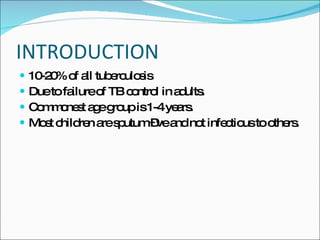
INTRODUCTION 10-20% of all tuberculosis Due to failure of TB control in adults. Commonest age group is 1-4 years. Most children are sputum –ve and not infectious to others.
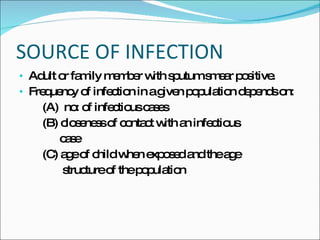
SOURCE OF INFECTION Adult or family member with sputum smear positive. Frequency of infection in a given population depends on: (A)  no: of infectious cases (B) closeness of contact with an infectious case (C) age of child when exposed and the age  structure of the population
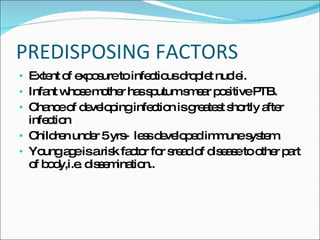
PREDISPOSING FACTORS Extent of exposure to infectious droplet nuclei. Infant whose mother has sputum smear positive PTB. Chance of developing infection is greatest shortly after infection Children under 5 yrs-  less developed immune system. Young age is a risk factor for sread of disease to other part of body,i.e. dissemination..
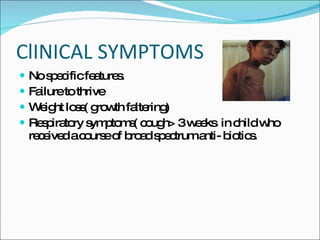
ClINICAL SYMPTOMS No specific features. Failure to thrive Weight loss( growth faltering) Respiratory symptoms( cough> 3 weeks  in child who received a course of broad spectrum anti- biotics.
DIAGNOSIS Particularly  difficult because they rarely cough up  sputum. Exposure Tuberculin  skin test Chest X ray.
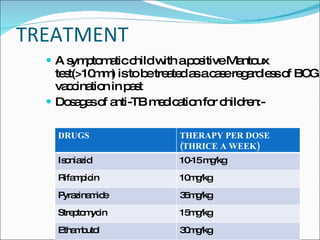
TREATMENT A symptomatic child with a positive Mantoux test(>10mm) is to be treated as a case regardless of BCG vaccination in past  Dosages of anti-TB medication for children:-  DRUGS THERAPY PER DOSE (THRICE A WEEK) Isoniazid 10-15 mg/kg Rifampicin 10mg/kg Pyrazinamide 35mg/kg Streptomycin 15mg/kg Ethambutol 30mg/kg
CHEMOPROPHYLAXIS For infant whose mother or any other houshold member is smear-positive,then  Chemoprophylaxis should be given  for 3 months. Then a mantoux test is done… .If test is negative-stop chemoprophylaxis and  BCG is given .If test is positive,chemoprophylaxis is  continued for a total duration of 6 months..
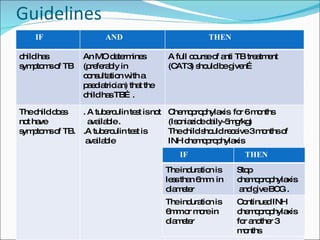
Guidelines IF AND  THEN child has symptoms of TB  An MO determines  (preferably in consultation with a paediatrician) that the child has TB….  A full course of anti TB treatment (CAT3) should be given… The child does  not have symptoms of TB. . A tuberculin test is not  available .  .A tuberculin test is  available  Chemoprophylaxis  for 6 months (Isoniazide daily-5mg/kg)  The child should receive 3 months of INH chemoprophylaxis IF IF THEN The induration is less than 6mm  in diameter Stop chemoprophylaxis  and give BCG . The induration is  6mm or more in diameter Continued INH chemoprophylaxis for another 3 months
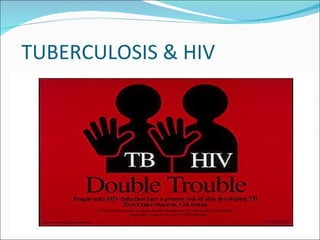
TUBERCULOSIS & HIV
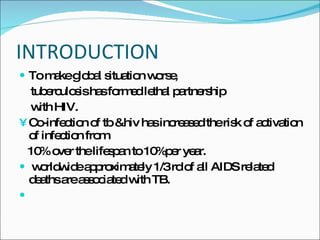
INTRODUCTION To make global situation worse, tuberculosis has formed lethal partnership  with HIV. Co-infection of tb &hiv has increased the risk of activation of infection from  10% over the lifespan to 10%per year. worldwide approximately 1/3 rd of all AIDS related  deaths are associated with TB.
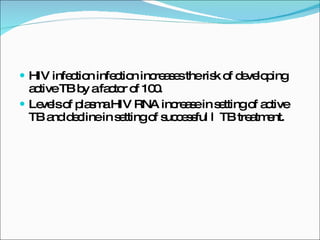
HIV infection infection increases the risk of developing  active TB by a factor of 100. Levels of plasma HIV RNA increase in setting of active TB and decline in setting of successful l  TB treatment.
EPIDEMIOLOGICAL IMPACT Reactivation of latent infection:  25-30% more likely to develop the disease than the people only with TB. Primary infection Recurring infection In the community
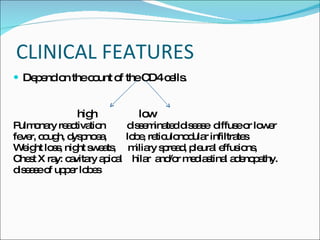
CLINICAL FEATURES Depend on the count of the CD4 cells. high  low Pulmonary reactivation  disseminated disease  diffuse or lower  fever, cough, dyspnoea,  lobe, reticulonodular infiltrates  Weight loss, night sweats,  miliary spread, pleural effusions,  Chest X ray: cavitary apical  hilar  and/or mediastinal adenopathy. disease of upper lobes
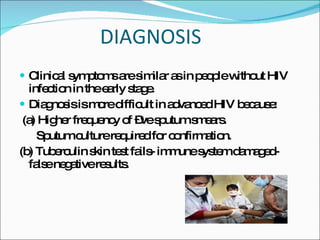
DIAGNOSIS Clinical symptoms are similar as in people without HIV infection in the early stage. Diagnosis is more difficult in advanced HIV because: (a) Higher frequency of –ve sputum smears. Sputum culture required for confirmation. (b) Tuberculin skin test fails- immune system damaged- false negative results.
(c) Chest radiography may be less useful- less cavitation – decreased immune response (d) Cases of extra pulmonary tuberculosis  seem to be more common in people who are  co-infection.
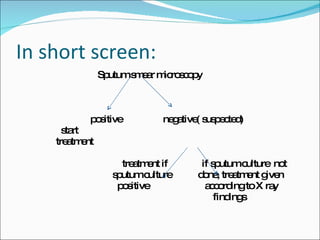
In short screen: Sputum smear microscopy positive  negative( suspected) start  treatment treatment if  if sputum culture  not  sputum culture  done, treatment given  positive  according to X ray findings
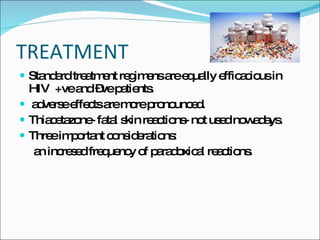
TREATMENT Standard treatment regimens are equally efficacious in  HIV  +ve and –ve patients.  adverse effects are more pronounced. Thiacetazone- fatal skin reactions- not used nowadays. Three important considerations: an incresed frequency of paradoxical reactions.
interaction between ART and rifamycins Development of rifampin monoresistance with widely spaced intermittent treatment. IRIS- Immune Reconstitution Inflammatory Syndrome: It is the exacerbation in signs, symptoms, radiographic and laboratory manifestations of TB due to ART administration. IRIS more common in advanced immunosuppressed and extrapulmonary TB.
IRIS is an immune response elicited by antigens released as bacilli are killed during effective chemotherapy Temporarily associated with improved immune function.  Managed by symptomatic treatment with glucocorticoids.
Rifampicin a potent inducer of enzyme of the cytochrome P450 system – lower the serum level of many HIV protein inhibitors and some NNRTIs. Rifabutin- has much less enzyme inducing activity. So recommended in place of Rifampicin.
TB IN PREGNANCY
INTRODUCTION Encountered in 1-2% of pregnant women. Course of TB is unmodified during pregnancy. Lesions remaining the same, there is no difference in mortality between pregnant and non-pregnant.
EFFECT OF TB ON PREGNANCY Pulmonary TB does  not affect  fertility unless there is associated genital TB. Usually there is no effect on the course of  pregnancy except for  a slight increase in the incidence of the abortion and premature labour. Rarely affect the foetus by transplacental route.
Greater danger  is the possibility of infection of the newborn by close contact when the mother has open TB. Diagnosis is based on symptoms, sputum examination and chest radiographs.
MANAGEMENT Problem- Possible effect on the foetus of the chemotherapeutic drugs. Time of institution of the treatment should be irrespective of period of gestation. the anti TB drug considered safe are: Ethambutol- 5-25mg/kg daily Isoniazid – 5 mg/kg not to exceed 300mg daily Pyridoxine- 50mg daily to reduce risk of INH induced neuropathy.
Rifampicin 10 mg/kg daily not to exceed 600 mg daily. duration – 9 months Routine AN care should be continued and foetal monitoring should be done to diagnose IUGR. Streptomycin, pyrazinamide - teratogenic- contraindicated
Congenital TB:  foetus affected either haematogenously  or through the umbilical vein . The fetus infected by aspiration of infected contents at delivery. Breastfeeding:  shouldnot be discouraged.
NEONATAL RISK AND THE MANAGEMENT. Tuberculin +ve mother without active disease doesnot pose any risk . If mother is sputum –ve in the last 3 month of gestation with active TB, the risk to infant is negligible.  If the mother is sputum +ve, then the neonate needs to be evaluated for active TB.  If there is no active TB in neonate, it should receive INH prophylaxis for 3 months until the mother’s sputum becomes –ve.
 

6

  • 1.
  • 2.
    INTRODUCTION 10-20% ofall tuberculosis Due to failure of TB control in adults. Commonest age group is 1-4 years. Most children are sputum –ve and not infectious to others.
  • 3.
    SOURCE OF INFECTIONAdult or family member with sputum smear positive. Frequency of infection in a given population depends on: (A) no: of infectious cases (B) closeness of contact with an infectious case (C) age of child when exposed and the age structure of the population
  • 4.
    PREDISPOSING FACTORS Extentof exposure to infectious droplet nuclei. Infant whose mother has sputum smear positive PTB. Chance of developing infection is greatest shortly after infection Children under 5 yrs- less developed immune system. Young age is a risk factor for sread of disease to other part of body,i.e. dissemination..
  • 5.
    ClINICAL SYMPTOMS Nospecific features. Failure to thrive Weight loss( growth faltering) Respiratory symptoms( cough> 3 weeks in child who received a course of broad spectrum anti- biotics.
  • 6.
    DIAGNOSIS Particularly difficult because they rarely cough up sputum. Exposure Tuberculin skin test Chest X ray.
  • 7.
    TREATMENT A symptomaticchild with a positive Mantoux test(>10mm) is to be treated as a case regardless of BCG vaccination in past Dosages of anti-TB medication for children:- DRUGS THERAPY PER DOSE (THRICE A WEEK) Isoniazid 10-15 mg/kg Rifampicin 10mg/kg Pyrazinamide 35mg/kg Streptomycin 15mg/kg Ethambutol 30mg/kg
  • 8.
    CHEMOPROPHYLAXIS For infantwhose mother or any other houshold member is smear-positive,then Chemoprophylaxis should be given for 3 months. Then a mantoux test is done… .If test is negative-stop chemoprophylaxis and BCG is given .If test is positive,chemoprophylaxis is continued for a total duration of 6 months..
  • 9.
    Guidelines IF AND THEN child has symptoms of TB An MO determines (preferably in consultation with a paediatrician) that the child has TB…. A full course of anti TB treatment (CAT3) should be given… The child does not have symptoms of TB. . A tuberculin test is not available . .A tuberculin test is available Chemoprophylaxis for 6 months (Isoniazide daily-5mg/kg) The child should receive 3 months of INH chemoprophylaxis IF IF THEN The induration is less than 6mm in diameter Stop chemoprophylaxis and give BCG . The induration is 6mm or more in diameter Continued INH chemoprophylaxis for another 3 months
  • 10.
  • 11.
    INTRODUCTION To makeglobal situation worse, tuberculosis has formed lethal partnership with HIV. Co-infection of tb &hiv has increased the risk of activation of infection from 10% over the lifespan to 10%per year. worldwide approximately 1/3 rd of all AIDS related deaths are associated with TB.
  • 12.
    HIV infection infectionincreases the risk of developing active TB by a factor of 100. Levels of plasma HIV RNA increase in setting of active TB and decline in setting of successful l TB treatment.
  • 13.
    EPIDEMIOLOGICAL IMPACT Reactivationof latent infection: 25-30% more likely to develop the disease than the people only with TB. Primary infection Recurring infection In the community
  • 14.
    CLINICAL FEATURES Dependon the count of the CD4 cells. high low Pulmonary reactivation disseminated disease diffuse or lower fever, cough, dyspnoea, lobe, reticulonodular infiltrates Weight loss, night sweats, miliary spread, pleural effusions, Chest X ray: cavitary apical hilar and/or mediastinal adenopathy. disease of upper lobes
  • 15.
    DIAGNOSIS Clinical symptomsare similar as in people without HIV infection in the early stage. Diagnosis is more difficult in advanced HIV because: (a) Higher frequency of –ve sputum smears. Sputum culture required for confirmation. (b) Tuberculin skin test fails- immune system damaged- false negative results.
  • 16.
    (c) Chest radiographymay be less useful- less cavitation – decreased immune response (d) Cases of extra pulmonary tuberculosis seem to be more common in people who are co-infection.
  • 17.
    In short screen:Sputum smear microscopy positive negative( suspected) start treatment treatment if if sputum culture not sputum culture done, treatment given positive according to X ray findings
  • 18.
    TREATMENT Standard treatmentregimens are equally efficacious in HIV +ve and –ve patients. adverse effects are more pronounced. Thiacetazone- fatal skin reactions- not used nowadays. Three important considerations: an incresed frequency of paradoxical reactions.
  • 19.
    interaction between ARTand rifamycins Development of rifampin monoresistance with widely spaced intermittent treatment. IRIS- Immune Reconstitution Inflammatory Syndrome: It is the exacerbation in signs, symptoms, radiographic and laboratory manifestations of TB due to ART administration. IRIS more common in advanced immunosuppressed and extrapulmonary TB.
  • 20.
    IRIS is animmune response elicited by antigens released as bacilli are killed during effective chemotherapy Temporarily associated with improved immune function. Managed by symptomatic treatment with glucocorticoids.
  • 21.
    Rifampicin a potentinducer of enzyme of the cytochrome P450 system – lower the serum level of many HIV protein inhibitors and some NNRTIs. Rifabutin- has much less enzyme inducing activity. So recommended in place of Rifampicin.
  • 22.
  • 23.
    INTRODUCTION Encountered in1-2% of pregnant women. Course of TB is unmodified during pregnancy. Lesions remaining the same, there is no difference in mortality between pregnant and non-pregnant.
  • 24.
    EFFECT OF TBON PREGNANCY Pulmonary TB does not affect fertility unless there is associated genital TB. Usually there is no effect on the course of pregnancy except for a slight increase in the incidence of the abortion and premature labour. Rarely affect the foetus by transplacental route.
  • 25.
    Greater danger is the possibility of infection of the newborn by close contact when the mother has open TB. Diagnosis is based on symptoms, sputum examination and chest radiographs.
  • 26.
    MANAGEMENT Problem- Possibleeffect on the foetus of the chemotherapeutic drugs. Time of institution of the treatment should be irrespective of period of gestation. the anti TB drug considered safe are: Ethambutol- 5-25mg/kg daily Isoniazid – 5 mg/kg not to exceed 300mg daily Pyridoxine- 50mg daily to reduce risk of INH induced neuropathy.
  • 27.
    Rifampicin 10 mg/kgdaily not to exceed 600 mg daily. duration – 9 months Routine AN care should be continued and foetal monitoring should be done to diagnose IUGR. Streptomycin, pyrazinamide - teratogenic- contraindicated
  • 28.
    Congenital TB: foetus affected either haematogenously or through the umbilical vein . The fetus infected by aspiration of infected contents at delivery. Breastfeeding: shouldnot be discouraged.
  • 29.
    NEONATAL RISK ANDTHE MANAGEMENT. Tuberculin +ve mother without active disease doesnot pose any risk . If mother is sputum –ve in the last 3 month of gestation with active TB, the risk to infant is negligible. If the mother is sputum +ve, then the neonate needs to be evaluated for active TB. If there is no active TB in neonate, it should receive INH prophylaxis for 3 months until the mother’s sputum becomes –ve.
  • 30.