NATIONAL LEPROSY
ERADICATION
PROGRAMME
04 April 2018
Presentor : Dr. Bushra Jabeen
Moderator: Dr. Shanthi M
1
CONTENTS
 Introduction
 Milestones
 Targets
 Burden of disease
 Strategy
 Components
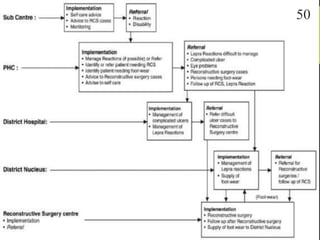
 Referral system
 Monitoring and evaluation
2
INTRODUCTION
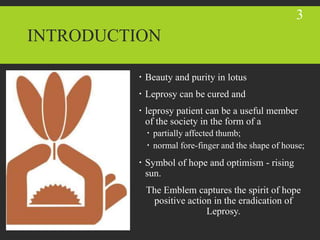
 Beauty and purity in lotus
 Leprosy can be cured and
 leprosy patient can be a useful member
of the society in the form of a
 partially affected thumb;
 normal fore-finger and the shape of house;
 Symbol of hope and optimism - rising
sun.
The Emblem captures the spirit of hope
positive action in the eradication of
Leprosy.
3
INTRODUCTION
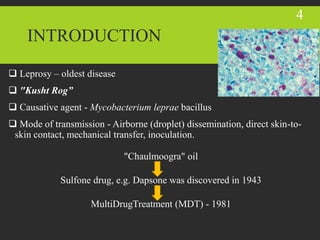
 Leprosy – oldest disease
 "Kusht Rog”
 Causative agent - Mycobacterium leprae bacillus
 Mode of transmission - Airborne (droplet) dissemination, direct skin-to-
skin contact, mechanical transfer, inoculation.
"Chaulmoogra" oil
Sulfone drug, e.g. Dapsone was discovered in 1943
MultiDrugTreatment (MDT) - 1981
4
INTRODUCTION
oNational Leprosy Eradication Program (NLEP) in 1983
- Objective to arrest the disease activity in all the known cases of leprosy
oHeaded by the Deputy Director of Health Services (Leprosy )
oStrategies and plans formulated centrally
oSupported as Partners by the World Health Organization, The International
Federation of Anti-leprosy Associations (ILEP)
5
OBJECTIVES
 Elimination of leprosy
 Strengthen Disability Prevention & Medical Rehabilitation of
persons affected by leprosy.
 Reduction in the level of stigma associated with leprosy.
6
MILESTONES
oThe Indian Council of the British Empire Leprosy Relief Association in 1925
oRenamed as Hind Kusht Nivaran Sangh in 1947
oNational Leprosy Control Program in 1955
oCentrally aided program for control through
– early detection of cases and
– treatment with Dapsone (DDS) monotherapy
o1981 - Leprosy eradication strategy planned
7
MILESTONES
 1981 – definite cure = MDT
 1983 - National Leprosy Eradication Programme launched
 2005 - Elimination of Leprosy at National Level
 2012 - Special action plan for 209 high endemic districts in 16
States/UTs
 2016 - Leprosy Case Detection Campaign (LCDC) have begun
8
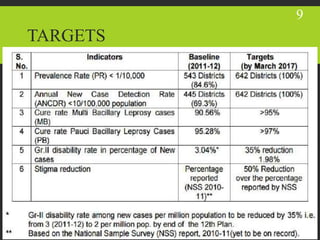
TARGETS
9
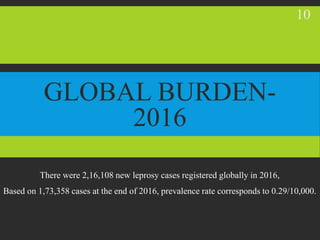
GLOBAL BURDEN-
2016
There were 2,16,108 new leprosy cases registered globally in 2016,
Based on 1,73,358 cases at the end of 2016, prevalence rate corresponds to 0.29/10,000.
10
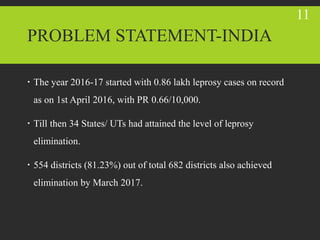
PROBLEM STATEMENT-INDIA
 The year 2016-17 started with 0.86 lakh leprosy cases on record
as on 1st April 2016, with PR 0.66/10,000.
 Till then 34 States/ UTs had attained the level of leprosy
elimination.
 554 districts (81.23%) out of total 682 districts also achieved
elimination by March 2017.
11
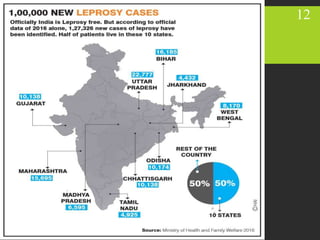
2016
12
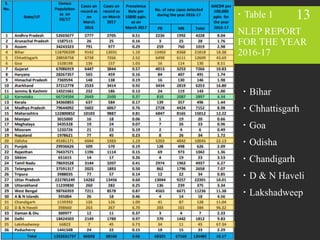
 Table 1
NLEP REPORT
FOR THE YEAR
2016-17
13
 Bihar
 Chhattisgarh
 Goa
 Odisha
 Chandigarh
 D & N Haveli
 Lakshadweep
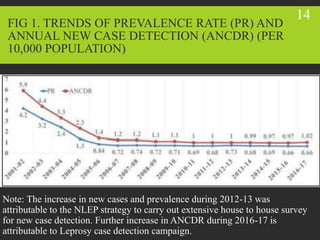
FIG 1. TRENDS OF PREVALENCE RATE (PR) AND
ANNUAL NEW CASE DETECTION (ANCDR) (PER
10,000 POPULATION)
Note: The increase in new cases and prevalence during 2012-13 was
attributable to the NLEP strategy to carry out extensive house to house survey
for new case detection. Further increase in ANCDR during 2016-17 is
attributable to Leprosy case detection campaign.
14
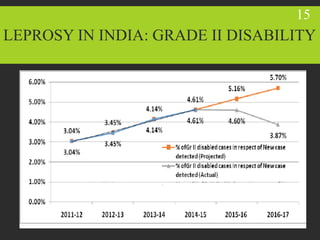
LEPROSY IN INDIA: GRADE II DISABILITY
15
KARNATAKA STATE BURDEN
 Capital : BANGALORE
 Districts : 30
 Achieved the Goal of elimination in the year 2005
 Estimated Population : 64805227 ( as on Mar 2015)
 Leprosy PR : 0.42/10000 pop. (March 2015 )
 Low endemic state up to end of 30/09/2015.
16
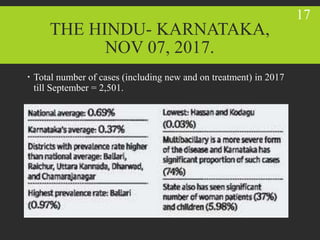
THE HINDU- KARNATAKA,
NOV 07, 2017.
17
 Total number of cases (including new and on treatment) in 2017
till September = 2,501.
STRATEGY
• Decentralized integrated leprosy services through General
Health Care system
• Early detection and complete treatment of new leprosy cases
• Carrying out house to house contact survey for detection of MB
and child cases
• Early diagnosis and prompt MDT, through routine and special
efforts
18
STRATEGY
• Involvement of ASHAs in the detection and complete treatment
of leprosy cases for leprosy work
• Strengthening of Disability Prevention & Medical
Rehabilitation (DPMR) services
• IEC activities in the community to improve self-reporting to
PHC and reduction of stigma
• Intensive monitoring and supervision at PHC/ CHC
19
PROGRAMME COMPONENTS
Approved in the 12th Plan (2013 - 2017):
1. Case Detection and Management
2. Disability Prevention and Medical Rehabilitation
3. Information, Education and Communication (IEC) including
Behaviour Change Communication (BCC)
4. Human Resource and Capacity building
5. Programme Management
20
1. CASE DETECTION
AND MANAGEMENT
21
CASE DETECTION AND
MANAGEMENT
Stigma associated with the disease.
Cut down the transmission potential
(i) To improve access to services.
(ii) To involve women including leprosy affected persons in case
detection.
(iii) To organize skin camps.
(iv) To undertake contact survey to identify the source.
(v) To increase awareness, to suspect and motivate leprosy affected
persons for early reporting to the Medical Officer.
22
ASHA INVOLVEMENT
To bring out suspected cases for diagnosis
Follow up the patients for completion of treatment.
The ASHA will be entitled to receive incentive as below:
(i) At confirmation of diagnosis – Rs. 250/-
(ii) On completion of full course of treatment in time –
PB - additional Rs.400/
MB - additional Rs.600/-
23
NGO’S INVOLVEMENT
 SET Scheme:
 Disability prevention, ulcer care, Research.
 IEC/BCC and stigma reduction
 Referral of suspects, diagnosis and provision of MDT
 Follow up of under treated cases.
 DPMR
 Referral for RCS
 Conduct of RCS
24
ADDITIONAL ACTIVITIES IN
URBAN AREAS
(i) Identify human resources available for leprosy services.
(ii) Capacity building at time of induction.
(iii) Examination of all household contacts of all new cases at least once
before the completion of treatment of index case.
(iv) Identify one referral centre in each urban location for diagnosis and to
manage leprosy with or without complications.
(v) Supervision and monitoring of the programme.
25
(vi) Mobile Health Clinics with leprosy services.
(vii) System of record keeping and reporting.
(viii) System of regular MDT supply to Health Centre.
(ix) Procure additional requirement
(x) Organise sensitization meetings for IEC and advocacy, participate in
exhibitions, quiz competition for awareness to reduce stigma.
ADDITIONAL ACTIVITIES IN
URBAN AREAS
26
LEPROSY CASE DETECTION
CAMPAIGN (LCDC)
 Implemented in high endemic districts
 Monitored by CLD and coordinated by states
 Online reporting system with patient tracking mechanism
(Nikusth)
 GIS mapping to study and project geographic distribution of
disease
27
2. DISABILITY PREVENTION
AND MEDICAL
REHABILITATION (DPMR)
28
DISABILITY PREVENTION AND
MEDICAL REHABILITATION (DPMR)
 All suspected cases of leprosy reaction, relapse, insensitive hands and feet
are referred to PHC for diagnosis.
 The patient needs to be empowered in self-care to prevent worsening of
disability.
 All PHC Medical Officers diagnose cases of reaction and treat them.
Severe reaction cases may be referred to the District Hospital, if not
responded within 2 weeks of starting treatment.
29
DISABILITY PREVENTION
Service and care for disabilities at all the Health Institutions.
Complicated ulcer cases are referred to District Hospital.
Microcellular Rubber (MCR) footwear - by the District cell through
PHC/CHC.
PHCs - follow up treatment to all patients referred back by the secondary
and tertiary level units for reaction, complication or post-surgery care.
30
MEDICAL REHABILITATION
SERVICES
 Patients with grade II disability diagnosed at the PHC are referred to the
district hospital/ district cell
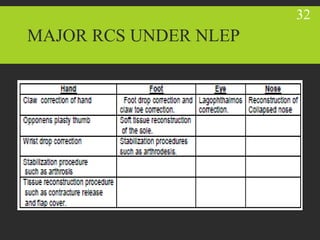
 Cases suitable for reconstructive surgery (RCS) are referred to RCS
centers recognized by Govt. of India in Govt. or NGO sector.
 Aids and appliances for medical rehabilitation are supplied to the patients.
 Disability care services
31
MAJOR RCS UNDER NLEP
32
QUALITY INDICATOR FOR RCS
SURGERY
 The cohort analysis report, at quarterly interval
 Proportion of Operated Cases with Improved Functional
Ability.
 It can be calculated as:
Number of cases with improved functional ability
at 6 months after operation × 100
Number of cases operated
upon during the cohort period
33
INCENTIVE
to Patient :
Rs. 8,000/- - major RCS - District Leprosy Officer
to Institutions :
(a) To all Govt. Institutions - Rs. 5000 per RCS.
(b) To all Govt. Hospitals/Institutions, providing RCS in
camps organised outside the Institution, an
additional amount of Rs. 5000 per RCS will be
paid.
34
3. INFORMATION, EDUCATION AND
COMMUNICATION (IEC) INCLUDING
BEHAVIOR CHANGE COMMUNICATION
(BCC)
35
INFORMATION, EDUCATION AND
COMMUNICATION (IEC/BCC)
Focus on communication for behavioral changes in the general
public.
Objectives of IEC :-
 To develop communication material.
 To complement and support the detection and treatment services
 To remove stigma.
 Active participation of communities
36
INTERPERSONAL COMMUNICATION
Priority Areas:
Low literacy rates.
Tribal population
Endemic districts (ANCDR
>10/100,000 pop.).
Urban areas with problem of
migration.
Target groups:
Women from the areas where
literacy rate is low.
School children
Population groups residing in
remote inaccessible areas;
Tribal population.
Migratory population.
People living in urban slums.
Through the health staff involving communities, panchayat leaders and NGO.
37
INTER PERSONAL COMMUNICATION
Women mobilization
Old Leprosy Peoples’ association
Complain mechanism - toll free number
Use of IVRS (interactive voice recognition system)
38
NLEP-GUIDELINES ON REDUCTION OF
STIGMAAND DISCRIMINATION AGAINST
PERSONS AFFECTED BY LEPROSY
Objective :-
Provide at one place, the facts about stigma against leprosy, its
various determinants and types
Indicate intervention strategies to be followed under NLEP
Suggest line of action to be taken by the states/Uts
39
INTERVENTION STRATEGIES
 Spreading awareness:
 Developing understandings & concepts based on scientific knowledge
 Preventing iatrogenic stigma
 Involving communities/societies
 Some interventions
 empowerment, counseling and education.
40
INDICATORS FOR MONITORING
BCC ACTIVITIES
1. New Case Detection Rate and Proportion of Early case detection
in voluntary reported
2. Proportion of gr. ii disability among new cases
3. Treatment Completion Rates in predefined areas
4. Number of cases availed Rehabilitation services
5. Number of cases reported / noticed discrimination.
6. Number of cases (under care) developed new disability
7. Number of group meetings (IPC) held.
41
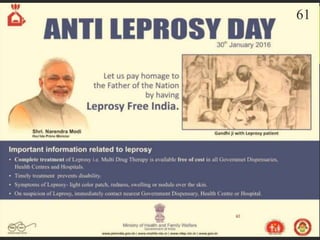
“LEPROSY FREE INDIA”
 IEC Campaign Fortnight organized every year from 30th January,
 Observed as Anti Leprosy Day in the country.
 The following activities are to be carried out during this campaign:
Mass publicity to improve early reporting of cases
Capacity building of health staff including ASHAs and volunteers
Intensive case detection drives
Activities to reduce stigma and discrimination
Participation of persons affected by leprosy
42
4. HUMAN RESOURCE
AND CAPACITY
BUILDING
43
HUMAN RESOURCE AND
CAPACITY BUILDING
The learning materials for training large number of GHC staff
were modified, shortened to 3 days duration
Learning material was also prepared and used for ASHAs
training.
A revised training manual also prepared for Medical Officers and
supplied to all States/UTs.
DPMR component major focus in all
Training for Health Supervisors (Male & Female) and Health
Workers (Male & Female) - every year.
44
5. PROGRAMME
MANAGEMENT
45
PROGRAMME MANAGEMENT
Supervision and Travel cost
 Services through the General Health care system with supervisory
support from the District cell.
 Supervisory visits - Central/State level officers & experts from
other organization.
46
PROGRAMME MANAGEMENT
Programme Appraisal
 Programme monitored through analysis of routine reports and
through field visits by the supervisory officers.
 Programme Appraisal by a committee of experts identified by
Central Leprosy Division will be undertaken during the 2nd and
the 4th year of the 12th Plan.
Annual Programme Assessment
 Performance under the programme assessed annually by an
Independent expert group.
47
PROGRAMME MANAGEMENT
National Sample Survey
 to assess the leprosy incidence in the country along with the
disability load and IEC status, in the year 2015-16.
Inter personal communication –
 The effective way to deal with difficult challenge of stigma
removal is to embark on intensive interpersonal communication
(IPC) with the target groups.
48
REFERRAL SYSTEM
49
50
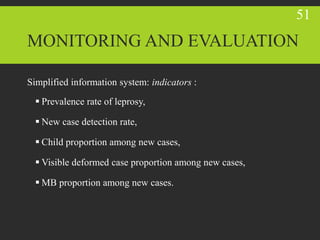
MONITORING AND EVALUATION
Simplified information system: indicators :
 Prevalence rate of leprosy,
 New case detection rate,
 Child proportion among new cases,
 Visible deformed case proportion among new cases,
 MB proportion among new cases.
51
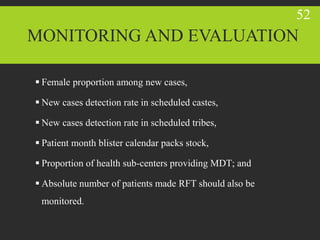
 Female proportion among new cases,
 New cases detection rate in scheduled castes,
 New cases detection rate in scheduled tribes,
 Patient month blister calendar packs stock,
 Proportion of health sub-centers providing MDT; and
 Absolute number of patients made RFT should also be
monitored.
52
MONITORING AND EVALUATION
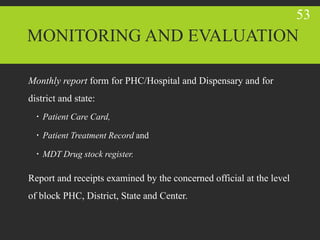
Monthly report form for PHC/Hospital and Dispensary and for
district and state:
 Patient Care Card,
 Patient Treatment Record and
 MDT Drug stock register.
Report and receipts examined by the concerned official at the level
of block PHC, District, State and Center.
53
MONITORING AND EVALUATION
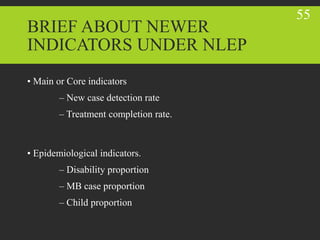
BRIEF ABOUT NEWER
INDICATORS UNDER NLEP
• Main or Core indicators
– New case detection rate
– Treatment completion rate.
• Epidemiological indicators.
– Disability proportion
– MB case proportion
– Child proportion
55
OTHER INITIATIVES
 Newsletters – Jan 2016
 Nikusht
 GIS mapping
 Uniform multidrug therapy regimen
 Mass drug administration
56
INSTITUTIONS
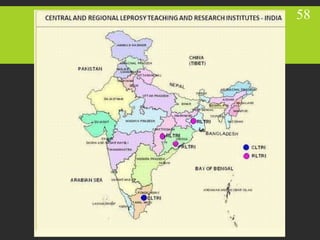
 Four premier Leprosy Institutes
 Working under Directorate General of Health Services, Ministry of
Health & F.W., Government of India
 Purpose :
Research (basic and applied ) in Leprosy and
Training of different categories of staff
 Management of referral patients,
 Providing quality care
Supervising and providing consultancy services to the State NLEP Units.
57
58
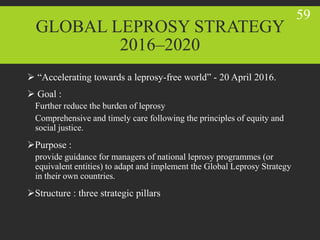
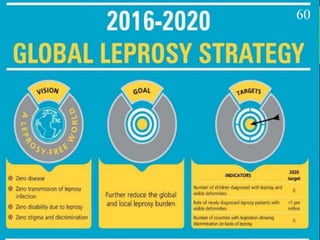
GLOBAL LEPROSY STRATEGY
2016–2020
 “Accelerating towards a leprosy-free world” - 20 April 2016.
 Goal :
Further reduce the burden of leprosy
Comprehensive and timely care following the principles of equity and
social justice.
Purpose :
provide guidance for managers of national leprosy programmes (or
equivalent entities) to adapt and implement the Global Leprosy Strategy
in their own countries.
Structure : three strategic pillars
59
60
61
THE FINAL PUSH STRATEGY
FOR ELIMINATION OF LEPROSY
• Expand MDT services to all health facilities
• Ensure that all existing and new cases are given appropriate MDT
regimens
• Encourage all patients take treatment regularly and completely
• Promote awareness in the community on leprosy
• Set targets and time table for activities
• Keep good records of all activities - monitor the progress.
62
REFERENCES
 Regional Office for South-East Asia, World Health Organization. (2017). Global Leprosy
Strategy 2016–2020. Accelerating towards a leprosy-free world. Monitoring and Evaluation
Guide. World Health Organization. Regional Office for South-East
Asia. http://www.who.int/iris/handle/10665/254907. License: CC BY-NC-SA 3.0 IGO
 Kishore J. National Health Programs Of India: National Vector Borne Disease Control
Programme. 12th edition
 Park K. Textbook of Preventive and Social Medicine: National Health Programs. 24th edition.
 National Leprosy Eradication Programme (NLEP)Training Manual for Medical Officer. Central
Leprosy Division, Directorate General of Health Services Nirman Bhawan, New Delhi.
 www.nlep.nic.in
 Karnataka - National Leprosy Eradication Programme (NLEP); nlep.nic.in/karnataka.html
 Karnataka - Latest news, Live Updates, Politics, Events - The Hindu;
www.thehindu.com/news/national/karnataka/
 K. Park; textbook of preventive and social medicine; 24th edition.
 Textbook of public health & community medicine 1st edition; AFMC Pune (2009); Ashok K.
Jindal, Puja Dudeja.
 https://scroll.in/pulse/808951/the-world-wont-be-free-of-leprosy-unless-india-delivers
63

NLEP

  • 1.
    NATIONAL LEPROSY ERADICATION PROGRAMME 04 April2018 Presentor : Dr. Bushra Jabeen Moderator: Dr. Shanthi M 1
  • 2.
    CONTENTS  Introduction  Milestones Targets  Burden of disease  Strategy  Components  Referral system  Monitoring and evaluation 2
  • 3.
    INTRODUCTION  Beauty andpurity in lotus  Leprosy can be cured and  leprosy patient can be a useful member of the society in the form of a  partially affected thumb;  normal fore-finger and the shape of house;  Symbol of hope and optimism - rising sun. The Emblem captures the spirit of hope positive action in the eradication of Leprosy. 3
  • 4.
    INTRODUCTION  Leprosy –oldest disease  "Kusht Rog”  Causative agent - Mycobacterium leprae bacillus  Mode of transmission - Airborne (droplet) dissemination, direct skin-to- skin contact, mechanical transfer, inoculation. "Chaulmoogra" oil Sulfone drug, e.g. Dapsone was discovered in 1943 MultiDrugTreatment (MDT) - 1981 4
  • 5.
    INTRODUCTION oNational Leprosy EradicationProgram (NLEP) in 1983 - Objective to arrest the disease activity in all the known cases of leprosy oHeaded by the Deputy Director of Health Services (Leprosy ) oStrategies and plans formulated centrally oSupported as Partners by the World Health Organization, The International Federation of Anti-leprosy Associations (ILEP) 5
  • 6.
    OBJECTIVES  Elimination ofleprosy  Strengthen Disability Prevention & Medical Rehabilitation of persons affected by leprosy.  Reduction in the level of stigma associated with leprosy. 6
  • 7.
    MILESTONES oThe Indian Councilof the British Empire Leprosy Relief Association in 1925 oRenamed as Hind Kusht Nivaran Sangh in 1947 oNational Leprosy Control Program in 1955 oCentrally aided program for control through – early detection of cases and – treatment with Dapsone (DDS) monotherapy o1981 - Leprosy eradication strategy planned 7
  • 8.
    MILESTONES  1981 –definite cure = MDT  1983 - National Leprosy Eradication Programme launched  2005 - Elimination of Leprosy at National Level  2012 - Special action plan for 209 high endemic districts in 16 States/UTs  2016 - Leprosy Case Detection Campaign (LCDC) have begun 8
  • 9.
  • 10.
    GLOBAL BURDEN- 2016 There were2,16,108 new leprosy cases registered globally in 2016, Based on 1,73,358 cases at the end of 2016, prevalence rate corresponds to 0.29/10,000. 10
  • 11.
    PROBLEM STATEMENT-INDIA  Theyear 2016-17 started with 0.86 lakh leprosy cases on record as on 1st April 2016, with PR 0.66/10,000.  Till then 34 States/ UTs had attained the level of leprosy elimination.  554 districts (81.23%) out of total 682 districts also achieved elimination by March 2017. 11
  • 12.
  • 13.
     Table 1 NLEPREPORT FOR THE YEAR 2016-17 13  Bihar  Chhattisgarh  Goa  Odisha  Chandigarh  D & N Haveli  Lakshadweep
  • 14.
    FIG 1. TRENDSOF PREVALENCE RATE (PR) AND ANNUAL NEW CASE DETECTION (ANCDR) (PER 10,000 POPULATION) Note: The increase in new cases and prevalence during 2012-13 was attributable to the NLEP strategy to carry out extensive house to house survey for new case detection. Further increase in ANCDR during 2016-17 is attributable to Leprosy case detection campaign. 14
  • 15.
    LEPROSY IN INDIA:GRADE II DISABILITY 15
  • 16.
    KARNATAKA STATE BURDEN Capital : BANGALORE  Districts : 30  Achieved the Goal of elimination in the year 2005  Estimated Population : 64805227 ( as on Mar 2015)  Leprosy PR : 0.42/10000 pop. (March 2015 )  Low endemic state up to end of 30/09/2015. 16
  • 17.
    THE HINDU- KARNATAKA, NOV07, 2017. 17  Total number of cases (including new and on treatment) in 2017 till September = 2,501.
  • 18.
    STRATEGY • Decentralized integratedleprosy services through General Health Care system • Early detection and complete treatment of new leprosy cases • Carrying out house to house contact survey for detection of MB and child cases • Early diagnosis and prompt MDT, through routine and special efforts 18
  • 19.
    STRATEGY • Involvement ofASHAs in the detection and complete treatment of leprosy cases for leprosy work • Strengthening of Disability Prevention & Medical Rehabilitation (DPMR) services • IEC activities in the community to improve self-reporting to PHC and reduction of stigma • Intensive monitoring and supervision at PHC/ CHC 19
  • 20.
    PROGRAMME COMPONENTS Approved inthe 12th Plan (2013 - 2017): 1. Case Detection and Management 2. Disability Prevention and Medical Rehabilitation 3. Information, Education and Communication (IEC) including Behaviour Change Communication (BCC) 4. Human Resource and Capacity building 5. Programme Management 20
  • 21.
    1. CASE DETECTION ANDMANAGEMENT 21
  • 22.
    CASE DETECTION AND MANAGEMENT Stigmaassociated with the disease. Cut down the transmission potential (i) To improve access to services. (ii) To involve women including leprosy affected persons in case detection. (iii) To organize skin camps. (iv) To undertake contact survey to identify the source. (v) To increase awareness, to suspect and motivate leprosy affected persons for early reporting to the Medical Officer. 22
  • 23.
    ASHA INVOLVEMENT To bringout suspected cases for diagnosis Follow up the patients for completion of treatment. The ASHA will be entitled to receive incentive as below: (i) At confirmation of diagnosis – Rs. 250/- (ii) On completion of full course of treatment in time – PB - additional Rs.400/ MB - additional Rs.600/- 23
  • 24.
    NGO’S INVOLVEMENT  SETScheme:  Disability prevention, ulcer care, Research.  IEC/BCC and stigma reduction  Referral of suspects, diagnosis and provision of MDT  Follow up of under treated cases.  DPMR  Referral for RCS  Conduct of RCS 24
  • 25.
    ADDITIONAL ACTIVITIES IN URBANAREAS (i) Identify human resources available for leprosy services. (ii) Capacity building at time of induction. (iii) Examination of all household contacts of all new cases at least once before the completion of treatment of index case. (iv) Identify one referral centre in each urban location for diagnosis and to manage leprosy with or without complications. (v) Supervision and monitoring of the programme. 25
  • 26.
    (vi) Mobile HealthClinics with leprosy services. (vii) System of record keeping and reporting. (viii) System of regular MDT supply to Health Centre. (ix) Procure additional requirement (x) Organise sensitization meetings for IEC and advocacy, participate in exhibitions, quiz competition for awareness to reduce stigma. ADDITIONAL ACTIVITIES IN URBAN AREAS 26
  • 27.
    LEPROSY CASE DETECTION CAMPAIGN(LCDC)  Implemented in high endemic districts  Monitored by CLD and coordinated by states  Online reporting system with patient tracking mechanism (Nikusth)  GIS mapping to study and project geographic distribution of disease 27
  • 28.
    2. DISABILITY PREVENTION ANDMEDICAL REHABILITATION (DPMR) 28
  • 29.
    DISABILITY PREVENTION AND MEDICALREHABILITATION (DPMR)  All suspected cases of leprosy reaction, relapse, insensitive hands and feet are referred to PHC for diagnosis.  The patient needs to be empowered in self-care to prevent worsening of disability.  All PHC Medical Officers diagnose cases of reaction and treat them. Severe reaction cases may be referred to the District Hospital, if not responded within 2 weeks of starting treatment. 29
  • 30.
    DISABILITY PREVENTION Service andcare for disabilities at all the Health Institutions. Complicated ulcer cases are referred to District Hospital. Microcellular Rubber (MCR) footwear - by the District cell through PHC/CHC. PHCs - follow up treatment to all patients referred back by the secondary and tertiary level units for reaction, complication or post-surgery care. 30
  • 31.
    MEDICAL REHABILITATION SERVICES  Patientswith grade II disability diagnosed at the PHC are referred to the district hospital/ district cell  Cases suitable for reconstructive surgery (RCS) are referred to RCS centers recognized by Govt. of India in Govt. or NGO sector.  Aids and appliances for medical rehabilitation are supplied to the patients.  Disability care services 31
  • 32.
  • 33.
    QUALITY INDICATOR FORRCS SURGERY  The cohort analysis report, at quarterly interval  Proportion of Operated Cases with Improved Functional Ability.  It can be calculated as: Number of cases with improved functional ability at 6 months after operation × 100 Number of cases operated upon during the cohort period 33
  • 34.
    INCENTIVE to Patient : Rs.8,000/- - major RCS - District Leprosy Officer to Institutions : (a) To all Govt. Institutions - Rs. 5000 per RCS. (b) To all Govt. Hospitals/Institutions, providing RCS in camps organised outside the Institution, an additional amount of Rs. 5000 per RCS will be paid. 34
  • 35.
    3. INFORMATION, EDUCATIONAND COMMUNICATION (IEC) INCLUDING BEHAVIOR CHANGE COMMUNICATION (BCC) 35
  • 36.
    INFORMATION, EDUCATION AND COMMUNICATION(IEC/BCC) Focus on communication for behavioral changes in the general public. Objectives of IEC :-  To develop communication material.  To complement and support the detection and treatment services  To remove stigma.  Active participation of communities 36
  • 37.
    INTERPERSONAL COMMUNICATION Priority Areas: Lowliteracy rates. Tribal population Endemic districts (ANCDR >10/100,000 pop.). Urban areas with problem of migration. Target groups: Women from the areas where literacy rate is low. School children Population groups residing in remote inaccessible areas; Tribal population. Migratory population. People living in urban slums. Through the health staff involving communities, panchayat leaders and NGO. 37
  • 38.
    INTER PERSONAL COMMUNICATION Womenmobilization Old Leprosy Peoples’ association Complain mechanism - toll free number Use of IVRS (interactive voice recognition system) 38
  • 39.
    NLEP-GUIDELINES ON REDUCTIONOF STIGMAAND DISCRIMINATION AGAINST PERSONS AFFECTED BY LEPROSY Objective :- Provide at one place, the facts about stigma against leprosy, its various determinants and types Indicate intervention strategies to be followed under NLEP Suggest line of action to be taken by the states/Uts 39
  • 40.
    INTERVENTION STRATEGIES  Spreadingawareness:  Developing understandings & concepts based on scientific knowledge  Preventing iatrogenic stigma  Involving communities/societies  Some interventions  empowerment, counseling and education. 40
  • 41.
    INDICATORS FOR MONITORING BCCACTIVITIES 1. New Case Detection Rate and Proportion of Early case detection in voluntary reported 2. Proportion of gr. ii disability among new cases 3. Treatment Completion Rates in predefined areas 4. Number of cases availed Rehabilitation services 5. Number of cases reported / noticed discrimination. 6. Number of cases (under care) developed new disability 7. Number of group meetings (IPC) held. 41
  • 42.
    “LEPROSY FREE INDIA” IEC Campaign Fortnight organized every year from 30th January,  Observed as Anti Leprosy Day in the country.  The following activities are to be carried out during this campaign: Mass publicity to improve early reporting of cases Capacity building of health staff including ASHAs and volunteers Intensive case detection drives Activities to reduce stigma and discrimination Participation of persons affected by leprosy 42
  • 43.
    4. HUMAN RESOURCE ANDCAPACITY BUILDING 43
  • 44.
    HUMAN RESOURCE AND CAPACITYBUILDING The learning materials for training large number of GHC staff were modified, shortened to 3 days duration Learning material was also prepared and used for ASHAs training. A revised training manual also prepared for Medical Officers and supplied to all States/UTs. DPMR component major focus in all Training for Health Supervisors (Male & Female) and Health Workers (Male & Female) - every year. 44
  • 45.
  • 46.
    PROGRAMME MANAGEMENT Supervision andTravel cost  Services through the General Health care system with supervisory support from the District cell.  Supervisory visits - Central/State level officers & experts from other organization. 46
  • 47.
    PROGRAMME MANAGEMENT Programme Appraisal Programme monitored through analysis of routine reports and through field visits by the supervisory officers.  Programme Appraisal by a committee of experts identified by Central Leprosy Division will be undertaken during the 2nd and the 4th year of the 12th Plan. Annual Programme Assessment  Performance under the programme assessed annually by an Independent expert group. 47
  • 48.
    PROGRAMME MANAGEMENT National SampleSurvey  to assess the leprosy incidence in the country along with the disability load and IEC status, in the year 2015-16. Inter personal communication –  The effective way to deal with difficult challenge of stigma removal is to embark on intensive interpersonal communication (IPC) with the target groups. 48
  • 49.
  • 50.
  • 51.
    MONITORING AND EVALUATION Simplifiedinformation system: indicators :  Prevalence rate of leprosy,  New case detection rate,  Child proportion among new cases,  Visible deformed case proportion among new cases,  MB proportion among new cases. 51
  • 52.
     Female proportionamong new cases,  New cases detection rate in scheduled castes,  New cases detection rate in scheduled tribes,  Patient month blister calendar packs stock,  Proportion of health sub-centers providing MDT; and  Absolute number of patients made RFT should also be monitored. 52 MONITORING AND EVALUATION
  • 53.
    Monthly report formfor PHC/Hospital and Dispensary and for district and state:  Patient Care Card,  Patient Treatment Record and  MDT Drug stock register. Report and receipts examined by the concerned official at the level of block PHC, District, State and Center. 53 MONITORING AND EVALUATION
  • 54.
    BRIEF ABOUT NEWER INDICATORSUNDER NLEP • Main or Core indicators – New case detection rate – Treatment completion rate. • Epidemiological indicators. – Disability proportion – MB case proportion – Child proportion 55
  • 55.
    OTHER INITIATIVES  Newsletters– Jan 2016  Nikusht  GIS mapping  Uniform multidrug therapy regimen  Mass drug administration 56
  • 56.
    INSTITUTIONS  Four premierLeprosy Institutes  Working under Directorate General of Health Services, Ministry of Health & F.W., Government of India  Purpose : Research (basic and applied ) in Leprosy and Training of different categories of staff  Management of referral patients,  Providing quality care Supervising and providing consultancy services to the State NLEP Units. 57
  • 57.
  • 58.
    GLOBAL LEPROSY STRATEGY 2016–2020 “Accelerating towards a leprosy-free world” - 20 April 2016.  Goal : Further reduce the burden of leprosy Comprehensive and timely care following the principles of equity and social justice. Purpose : provide guidance for managers of national leprosy programmes (or equivalent entities) to adapt and implement the Global Leprosy Strategy in their own countries. Structure : three strategic pillars 59
  • 59.
  • 60.
  • 61.
    THE FINAL PUSHSTRATEGY FOR ELIMINATION OF LEPROSY • Expand MDT services to all health facilities • Ensure that all existing and new cases are given appropriate MDT regimens • Encourage all patients take treatment regularly and completely • Promote awareness in the community on leprosy • Set targets and time table for activities • Keep good records of all activities - monitor the progress. 62
  • 62.
    REFERENCES  Regional Officefor South-East Asia, World Health Organization. (2017). Global Leprosy Strategy 2016–2020. Accelerating towards a leprosy-free world. Monitoring and Evaluation Guide. World Health Organization. Regional Office for South-East Asia. http://www.who.int/iris/handle/10665/254907. License: CC BY-NC-SA 3.0 IGO  Kishore J. National Health Programs Of India: National Vector Borne Disease Control Programme. 12th edition  Park K. Textbook of Preventive and Social Medicine: National Health Programs. 24th edition.  National Leprosy Eradication Programme (NLEP)Training Manual for Medical Officer. Central Leprosy Division, Directorate General of Health Services Nirman Bhawan, New Delhi.  www.nlep.nic.in  Karnataka - National Leprosy Eradication Programme (NLEP); nlep.nic.in/karnataka.html  Karnataka - Latest news, Live Updates, Politics, Events - The Hindu; www.thehindu.com/news/national/karnataka/  K. Park; textbook of preventive and social medicine; 24th edition.  Textbook of public health & community medicine 1st edition; AFMC Pune (2009); Ashok K. Jindal, Puja Dudeja.  https://scroll.in/pulse/808951/the-world-wont-be-free-of-leprosy-unless-india-delivers 63

Editor's Notes

  • #6 • No data were available regarding the prevalence of leprosy prior to 1955 – Leprosy Control Units (LCU) and – Survey, Education and Treatment (SET) centres were set up in each district starting from 1955. – These conducted surveys for detecting cases of leprosy and provided data for the program – In addition these conducted IEC and provided treatment to the cases detected • In 1980 - It was made a centrally-sponsored programme
  • #7 i.e. prevalence of less than 1 case per 10,000 population in all districts of the country.
  • #9 As on 31st December 2005, Prevalence Rate recorded in the country was 0.95/10,000 population
  • #11 according to official figures from 145 countries from the 6 WHO Regions.
  • #17 At Present there are 2448 on hand. So far 562430 cases have been cured with MDT since 1986.
  • #19 Current Strategy (under XII plan)
  • #24 The involvement of ASHAs will be monitored by the concerned PHC Medical Officers. Records of cases referred by ASHAs will be maintained properly and incentive will be paid on time and regular monthly report will be submitted to the District Leprosy Officer
  • #25 54/290 NGO’s get grant in aid from GOI Objective is to provide uniformity in diagnosis, treatment and monitoring through a wider programme base to maximize access to NLEP services. Survey, education and treatment scheme – 2006-7
  • #26 Supervision and monitoring of the programme is the responsibility of the District Leprosy Officer, and Medical Officer of the referral centre.
  • #27 of drugs, dressing material, aids and appliances for inhabitants of leprosy colony requiring regular care for their disabilities.
  • #28 This should help in early data analysis, prompt feedback for action.
  • #29 The services under DPMR will cover reaction management, self-care practices, provision of MCR Footwear, Aids & Appliances, referral services at District Hospitals and Medical Colleges/Central leprosy/ NGO Institutions including reconstructive surgery.
  • #30 Referral centres will be developed depending on the need, in all district hospitals and Medical colleges. The referral centres will be supported by Dermatologists/Physicians of the district hospital and a Physiotherapist. Posting of one Physiotherapist for each District Hospital in identified high endemic districts has been approved on contract basis during the 12th Plan period.
  • #31 such as ulcers, cracks and wounds, septic hand or feet etc. are available
  • #37 Objectives of IEC :- To develop communication material vis-à-vis the target audiences and deliver effectively. To complement and support the detection and treatment services being provided free of cost through the General Health Care System. To remove stigma associated with leprosy and prevent discrimination against leprosy affected persons. To specifically cover beneficiaries, health providers, influencers and the masses.
  • #39 The effective way to deal with difficult challenge of stigma removal is to embark on intensive inter-personal communication (IPC) with the target groups.
  • #41 Spread the demystifying messages and its interpretations, mainly regarding nature of disease, whether hereditary, whether leprosy cases are touchable, role of immunity in occurrence of leprosy, what is burnt out case and so on. However, mere information and education, to all and sundry about the signs and symptoms of leprosy and its curability, shall not work. It is imperative to break the barrier between persons affected by leprosy and the rest of the society, by appealing to peoples‟ emotions and their ability to empathise with those they feared and shunned.
  • #43 Central – channels and all india radio State – mass media. Outdoor media, rural media, advocacy Target audiences: selected communities with deep rooted stigma, leprosy affected person, general health care staff, ngo’s and community based organisations, disabled peoples organisations.
  • #45 General health care
  • #47 While regular State Govt. staff & experts will be drawing their TA/DA from the source of their salary, but contractual staff like surveillance Medical Officer, district leprosy consultant etc. will be paid from the programme budget. Similarly travel will be made by the consultants from the Central Leprosy Division to various States/UTs.
  • #56 Disability proportion • It is the percentages of people with grade I and grade II disability among the new leprosy cases detected during the reporting year and for whom a disability assessment was carried out
  • #58 to chronic ulcer and disabled patients with the help of Minor & Major Reconstructive Surgeries.
  • #59 Central leprosy teachning & research institute (CLTRI) CHENGALPATTU (TAMILNADU) Regional leprosy training & research institue (RLTRI) RAIPUR (CHHATTISGARGH) Regional leprosy traning & research institute(RLTRI) ASKA (ORISSA) Regional leprosy training & research institute RLTRI, GOURIPUR, BANKURA (WEST BENGAL)
  • #60 i) strengthen government ownership and partnerships; ii) stop leprosy and its complications; and iii) stop discrimination and promote inclusion. Adapting the suggested actions to national contexts will help countries to reach the global targets set for the year 2020. The Operational Manual has been developed by the World Health Organization with inputs from various core stakeholders such as national programme managers, technical agencies, funding agencies and nongovernmental organizations.
  • #62 30th jan 2017 – sparsh campaign
  • #63 so that individuals with suspicious lesions will report voluntarily for diagnosis and treatment