National Leprosy
Eradication Program
Presenter – Dr. Madhushree Acharya
Junior Resident (Academic)
CMFM, AIIMS BBSR
Moderator- Dr. Durgesh P. Sahoo
Senior Resident
Mahatma Gandhi nursing Parchure Shashtri, the great Sanskrit scholar who
suffered from leprosy 2
Outline of presentation
• Leprosy burden: Global & India
• NLEP : Background and Milestones
• Objectives
• Strategy
• Funding, Training Staffs & Institutes
• NLEP Components
• Disability prevention & Medical Rehabilitation
• Leprosy Case Detection Campaign
• Sparsh Leprosy awareness campaign
• Monitoring & Evaluation
• Critical review & SWOCH
• Conclusion
3
Global Scenario of Leprosy
• Registered global leprosy prevalence rate of 0.25/10,000
population (2017)
• New cases detected in 2017 globally 2.77/ 100,000
population
Source: Global leprosy update 2017
4
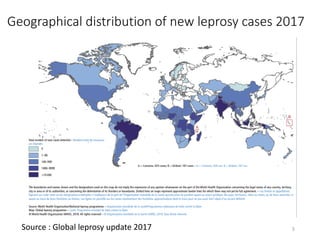
Geographical distribution of new leprosy cases 2017
Source : Global leprosy update 2017 5
Global trend of new leprosy case detection
2008-2017
Source: Global leprosy update 2017
6
Epidemiological Status of Leprosy in India
• A total of 1,35,485 new cases were detected during the year
2016-17, which gives Annual New Case Detection Rate
(ANCDR) of 10.17 per 100,000 population, as against
1,27,334 cases in 2015-16.
• A total of 88166 leprosy cases are on record as on 1st April
2017, giving a Prevalence Rate (PR) of 0.66 per 10,000
population, as against 86028 cases in 1st April 2016.
7
• Detailed information on new leprosy cases detected during
2016-17 indicates the proportion of
MB (49.57%), Female (39.17%), Child (8.7%), Grade II
Deformity (3.87%), ST cases (18.80%) and SC cases (18.78%)
• A total of 5245 Gr. II disability detected amongst the New
Leprosy Cases during 2016-17,indicating the Gr. II Disability
Rate of 3.94 / million population
• A total of 11792 child cases were recorded, indicating the
Child Case rate of 8.7%
8
9
10
11
Trend of Prevalence rate & ANCDR
India
Prevalence
rate
&
ANCDR
4.2
3.2
2.4
1.3
0.84
0.72 0.74 0.72 0.71 0.69 0.68 0.73 0.68 0.69 0.66 0.66
5.9
4.4
3.3
2.3
1.4
1.2 1.2 1.1 1.1 1 1 1 0.99 0.97 0.97 1.02
0
1
2
3
4
5
6
7
PR&ANCDR
Year
PR ANCDR Column1
Source: NLEP Annual Report 2016-2017 12
13
14
Odisha
15
16
17
18
Odisha –
District
wise
PR &
ANCDR
Indicators
• Epidemiological indicators:
Incidence
Prevalence
• Main or core indicators for monitoring progress:
No. and rate of new cases detected per 100,000
population per year
Rate of new cases with Grade2 disability per 100,000
population per year
Treatment completion/cure rate
19
• Main indicators for evaluating case detection:
% of new cases with G2D
% of child cases among new cases
% of Female among new cases
% of MB among new cases
• Service quality indicators:
Proportion of Defaulters
Number of relapses reported during the year
Proportion of New cases correctly diagnosed
Proportion of cases with new disabilities
20
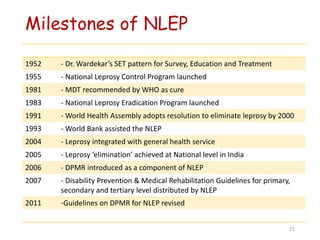
Milestones of NLEP
1952 - Dr. Wardekar’s SET pattern for Survey, Education and Treatment
1955 - National Leprosy Control Program launched
1981 - MDT recommended by WHO as cure
1983 - National Leprosy Eradication Program launched
1991 - World Health Assembly adopts resolution to eliminate leprosy by 2000
1993 - World Bank assisted the NLEP
2004 - Leprosy integrated with general health service
2005 - Leprosy ‘elimination’ achieved at National level in India
2006 - DPMR introduced as a component of NLEP
2007 - Disability Prevention & Medical Rehabilitation Guidelines for primary,
secondary and tertiary level distributed by NLEP
2011 -Guidelines on DPMR for NLEP revised
21
Objectives
• Elimination of leprosy i.e. prevalence of less than 1 case per
10,000 population in all districts of the country.
• Strengthen Disability Prevention & Medical Rehabilitation of
persons affected by leprosy.
• Reduction in the level of stigma associated with leprosy.
22
Programme Strategy
• Decentralized integrated leprosy services through General
Health Care system.
• Early detection & complete treatment of new leprosy cases.
• Carrying out house hold contact survey for early detection of MB
and child leprosy cases.
• Involvement of Accredited Social Health Activist (ASHA) in the
detection & completion of treatment of Leprosy cases on time.
23
Programme Strategy…
•Strengthening of Disability Prevention & Medical
Rehabilitation (DPMR) services.
• Information, Education & Communication (IEC) activities in
the community to improve self-reporting to Primary Health
Centre (PHC) and reduction of stigma.
• Intensive monitoring and supervision at block Primary
Health Centre/Community Health Centre.
24
Funding
• World Bank assistance in 2 phases :
1994- 2000
2001-2004
• India achieved leprosy elimination (i.e. prevalence
rate <1/10,000 population) in Dec 2005
• From Jan 2005 Govt. of India funds NLEP
25
Support from NGOs
• WHO supported all state leprosy cell by providing state NLEP
coordinators & zonal NLEP coordinators esp in high endemic
states
• International Federation of Anti-Leprosy Association (ILEP)
constituted by 10 Agencies supports integration of leprosy
services into GHS, reconstructive surgeries, CBR, OR etc
• MDT is supplied free of cost through NOVARTIS
• DANIDA (Danish International Development Agency) supports
leprosy program in India since 1986
26
27
Training – Human resources &
Capacity building
• DPMR training for medical officers in focus
• Training for Health Supervisors and health workers (M & F) every
year
• Training of atleast 2 Lab technicians from district hospital annually
for bacteriological diagnosis
• Involvement of ASHAs
• Training of Physiotherapists of district hospital
• Training in programme management, supervision & monitoring
given to staff of District cell
• SLO & DLO undergoing long duration courses at CLTRI & RLTRI
28
Institutes
1. Central Leprosy training
& research institute –
Chengalpattu, Tamil
Nadu
2. Regional Leprosy training
& research institutes –
i) Raipur
ii) Aska
iii) Gauripur
29
Programme Components
• Case Detection and Management
• Disability Prevention and Medical Rehabilitation
• Information, Education and Communication (IEC)
including Behaviour Change Communication (BCC)
• Human Resource and Capacity building
• Programme Management
30
Case diagnosis and management
Cardinal Signs – a) Hypopigmented or reddish skin lesion(s)
with definite sensory deficit.
b) Involvement of the peripheral nerves, as demonstrated by
definite thickening with loss of sensation and weakness of
the corresponding muscles of the hands, feet or eyes.
c) Demonstration of M leprae in the skin lesions –
Bacteriologfical confirmation
• Case of leprosy - A person with cardinal signs of leprosy and
yet to complete full course of MDT
31
32
Characteristic PB (Pauci Bacillary) MB (Multi Bacillary)
1 Skin lesions 1 - 5 lesions 6 and above
2 Peripheral nerve No nerve / only one
nerve involvement
More than one nerve
3 Skin smear Negative at all sites Positive at any site
Criteria for
grouping
33
Adults Child 6-14 years Child 0-5 years
Day 1
Rifampicin 600 mg
Dapsone 100 mg
Day 1
Rifampicin 450 mg
Dapsone 50 mg
Rifampicin 300 mg
(10 mg/kg body wt)
Dapsone 25mg
(2mg/kg body wt)
Day 2-28
Daily: Dapsone 100
mg
Day 2-28
Daily: Dapsone 50
mg
Day 2-28
Daily: Dapsone 25
mg
(2 mg/kg body wt)
MDT – for PB Leprosy
For 6 months
34
Adult Child 10-14 years Child 6-9 years
Day 1
Rifampicin 600 mg
Clofazimine 300 mg
Dapsone 100 mg
Day 1
Rifampicin 450 mg
Clofazimine 150 mg
Dapsone 50 mg
Day 1
Rifampicin 300 mg
(10 mg/kg body wt)
Clofazimine 100 mg
(6 mg/kg body wt)
Dapsone 25 mg
(2mg/kg body wt)
Day 2-28
Daily: Clofazimine
50 mg
Daily: Dapsone
100mg
Day 2-28
Alternate day:
Clofazimine 50 mg
Daily: Dapsone 50
mg
Day 2-28
Alternate day:
Clofazimine 50 mg
(1 mg/kg body wt)
Daily: Dapsone 25
mg
MDT – for MB leprosy
For 12 months
35
• Acute inflammatory response occurring in the course
of the disease.
• Promptly diagnosed and treated to prevent any
disability
• Pt more likely to develop leprosy reactions
• Multiple lesions
• Lesions close to the peripheral nerve
• Lesions on the face
• Pregnancy & Postpartum period
Lepra reaction
36
Managing a patient of Lepra reaction
37
40 mg once a day for the first 2 weeks, then
30 mg once a day for weeks 3 and 4
20 mg once a day for week 5 and 6
15 mg once a day for weeks 7 and 8
10 mg once a day for weeks 9 and 10, and
5 mg once a day for weeks 11 and 12
Type 1 Lepra Reaction
• Rest and analgesics.
• DOC- Prednisolone
• Schedule for Prednisolone therapy for an adult patient in
type 1 reaction
38
Type 2 reaction Treatment
Mild: few nodules, mild fever Analgesics
Severe: severe pain over
nodules, tendency for ulceration,
high fever, involvement of
internal organs
Steroid - Prednisolone whole
course not exceeding 2 to 3
weeks
Neuritis Prednisolone regimen
Type 2 Lepra reaction
Lepra reaction
Indications for referral
• Failure to respond after 4 weeks of steroid
treatment
• Eye involvement
• Other systemic involvement
• Recurrent lepra reactions
39
40
Hands & Feet
Grade 0 No anaesthesia over palm/sole
no visible deformity or damage
Grade 1 Anaesthesia present over palm/sole but
no visible deformity or damage
Grade 2 Visible deformity or damage present
Eyes
Grade 0 No eye problem due to leprosy; no evidence of visual
loss
Grade 2 Severe visual impairment, lagophthalmos, iridocylitis
and corneal opacities.
Grading of Disabilities
DPMR Services
• Total 115 (Govt.- 61 and NGO- 54) Institutions have been
recognized for conducting Reconstructive Surgery to correct
the disability in Leprosy Affected Persons.
• During the year 2016-17 a total of 2591 RCS (Govt. – 736
and NGO – 1855) were conducted.
• A total of 536 Relapse cases were confirmed and treated at
District Hospitals.
• MCR foot-wears were provided to 75739 Leprosy Affected
Persons in the year 2016-17
41
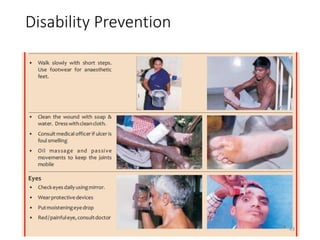
Disability Prevention
42
Disability Prevention
43
Use of MCR footwear
44
DPMR Services
• Provision of Microcellular Rubber ( MCR ) Footwear by
District Leprosy cell through PHC
• All PHC Medical Officers diagnose cases of reaction and
treat them. Severe reaction cases may be referred to the
District Hospital, if not responded within 2 weeks of starting
treatment
45
Medical Rehabilitation
• All patients with grade II disability diagnosed at the PHC
are referred to the District Hospital/ District cell for
further assessment and care.
• Cases suitable for Reconstructive Surgery (RCS) are
referred to RCS centres recognised by Govt. of India in
Govt. or NGO sector.
46
• Aids and appliances for Medical Rehabilitation are supplied to the
patients.
• Disability care services will be provided as routine activity and by
organizing camps particularly in areas not easily accessible and in
tribal areas. These camps will be used to screen patients for RCS
also.
Incentives in RCS
• BPL Patients with disability are given an incentive of Rs 5000 for
RCS
• Institution will get incentive of Rs 5000 for each major RCS
conducted
47
Urban Leprosy Control Program
• Implemented in 2005
• To address larger population size, migration, poor health
infrastructure increasing prevalence of leprosy in urban
areas
• Assistance is provided by Govt. of India to Urban areas with
population size >1 lakh
• Urban areas graded for assistance into 4 categories:
Township-I, Medium cities-I, Medium cities-II, Mega cities
48
Three-pronged Strategy
• In 2016-17, three pronged strategy was introduced for early
case detection:
• Leprosy Case Detection Campaign (LCDC)
• Focussed Leprosy Campaign (FLC)
• Special plan for ‘difficult to reach’ areas
49
Leprosy Case Detection Campaign
• To find out the hidden cases through active case finding in
endemic districts
• MDT provision to newly diagnosed cases
• Contact tracing of Household contacts of newly diagnosed
leprosy patients
• Started in 2016, last LCDC campaign held in Odisha from
27th Sep – 16th October 2018
• Online patient tracking portal “Nikusth” for early data
analysis, prompt feedback for action, GIS mapping to study
distribution of leprosy and assisting programme monitoring
50
SPARSH Leprosy awareness campaign
• Launched on 30th Jan,2017
• Awareness in the community regarding leprosy disease, symptoms and
treatment and reduction of social stigma
• Improved self-reporting of patients and thus limiting delay in diagnosis
and disability
51
52
53
Statewise percentage coverage of SLAC 2017
54
Statewise percentage coverage of SLAC 2018
55
56
57
58
ASHA based Leprosy Suspect Surveillance
• NHP 2017: To carry out Leprosy elimination the proportion
of grade-2 cases amongst new cases will become the
measure of community awareness and health systems
capacity, keeping in mind the global goal of reduction of
grade 2 disability to less than 1 per million by 2020.
• Accordingly, the policy envisages proactive measures
targeted towards elimination of leprosy from India,
surveillance system involving ASHA is established by Central
Leprosy Division (CLD) for NLEP
59
• Objectives of ASHA based Surveillance for Leprosy
Suspect (ABSULS) are to:
1. Conduct active surveillance of leprosy suspects including
NIL reporting
2. Prioritise leprosy case detection by ASHA
3. Improve monitoring and supervision of leprosy cases
detection activities at village level
60
• ASHAs are being involved to bring out leprosy cases from
villages for diagnosis at Primary Health Centre (PHC) and
follow up of confirmed cases for treatment completion
• Incentives being paid to ASHAs :
• After leprosy case confirmation - Rs. 250 for case
without disability , Rs.200 for case with disability
• After treatment completion – incentives are Rs. 400 for
PB case and Rs. 600 for MB case follow up
• At present this ASHA scheme is in place in 33 states (except
Goa, Chandigarh & Puducherry)
61
62
Monitoring and Evaluation
• Simplified HMIS – Indicators:
a) prevalence rate of leprosy
b) annual new case detection rate
c) child proportion among new cases
d) proportion of G2D among new cases
e) MB proportion among new cases
f) female proportion among new cases
g) new case detection rate in scheduled castes
h) new case detection rate in scheduled tribe
63
Monitoring & Evaluation
i) patient month blister calendar packs stock
j) proportion of health sub-centers providing MDT
k) absolute number of patients released from
treatment , should also be monitored
• Monthly reporting form based on patient care card,
patient treatment record and MDT stock register, send
to higher level of health centers and data are validated
and cross-checked by the center-in-charges.
64
Decentralized Planning
• Improved early case detection
• Improved case management
• Stigma reduced
• Development of leprosy expertise sustained
• Research supported evidence based programme practices
• Monitoring supervision and evaluation system improved
• Increased participation of persons affected by leprosy in
society
• Programme management ensured
65
• ‘Sparsh Leprosy Elimination Campaign’ (SLEC) a yearlong
comprehensive campaign till 2nd Oct 2019 is being rolled out
in 36 states - to achieve the new cases with Grade II disability
< 1 case/ million population
• Central Leprosy Division has extended its collaboration with
Indian Association of Leprologist (IAL) in order to receive
technical support and guidance from experts like
Dermatologist with rich experience working in Leprosy field
66
Chemoprophylaxis & Immunoprophylaxis
• Rifampicin 600mg once monthly for 6 months is given
to contacts of new detected leprosy cases in LCDC
• Mycobacterium Indicus Pranii (MIP) - exclusive
vaccine for leprosy developed in India.
• Mycobacterium Indicus Pranii (MIP) is a rapidly
growing non-pathogenic mycobacterium, which when
administered intra-dermally increases cell-mediated
immunity in the host
• MIP Vaccine acts as immunotherapeutic &
immunoprophylatic agent for leprosy cases and for
contacts of leprosy patients respectively
67
Critical Review - Strengths
• Leprosy can be diagnosed clinically
• MDT is effective treatment, reduces leprae bacilli load by
99% in single dose
• Relapse rate with MDT is low (0.1 yearly for PB & 0.06 yearly
for MB )
• LCDC & SPARSH awareness campaigns and for ‘difficult to
reach areas’ has increased detection of hidden cases
• Chemoprophylaxis of householdcontacts for disease
prevention
68
Limitations
• Continued transmission of infection after achieving
elimination target
• Slit skin smear examination was made optional in the
program
• Drug resistance to MDT : Alternative regimen
• Leper colonies to be banned to inhibit isolation
• Inadequate involvement of dermatologists in the program
69
Opportunities
• Free MDT from NOVARTIS
• Leprosy vaccine & MIP vaccine available
• Funds from NGOs & support from WHO
• USG can be cost-effective aid for early diagnosis of neuritis/
nerve damage
70
Challenges
• Social stigma and discrimination
• Myths and misconceptions
• Leprosy Legislations
• Disability and loss of productivity are not adequately
addressed
• Integration of leprosy services into general health services :
diagnosis expertise is compromised, decreased index of
suspicion, MPW are involved in other HIV/AIDS or TB control
programmes
• Increasing prevalence of HIV associated skin conditions may
mimic leprosy challenging early diagnosis
71
Conclusion
Challenges in “going the last mile”
• Level of international attention and political commitment is
declining.
• Knowledge about diagnosis and treatment is decreasing in
many countries.
• While leprosy decreased significantly from 1984 to 2004, a
stagnation has occurred from 2005 onwards.
72
73
4.2
3.2
2.4
1.3
0.84
0.72 0.74 0.72 0.71 0.69 0.68 0.73 0.68 0.69 0.66 0.66
5.9
4.4
3.3
2.3
1.4
1.2 1.2 1.1 1.1 1 1 1 0.99 0.97 0.97 1.02
0
1
2
3
4
5
6
7
PR&ANCDR
Year
PR ANCDR Column1
Challenges in “going the last mile”
Caused by several factors such as:
• Difficulty to maintain/increase knowledge about leprosy
among health workers
• Shift in priorities of national health authorities to diseases
with a larger patient burden.
• In times of high prevalence, a rough search was sufficient to
find cases but now more accurate/ integrated approach
required to find cases esp in remote areas
74
References
• Park K, Parks textbook of preventive & social medicine, 24th
edition, 2017.
• Kishore J, National health programs of India, 12th edition,
2017.
• Global Leprosy Update 2017
• NLEP training manual for Medical officers, 2013.
• NLEP – Progress Report for the year 2016-17
• www.nlep.nic.in
• www.who.int/leprosy/en
75
THANK YOU
“ Leprosy work is not merely medical relief; it is transforming
frustration of life into joy of dedication, personal ambition into
selfless service ”
~ Mahatma Gandhi
76

National leprosy eradication program

  • 1.
    National Leprosy Eradication Program Presenter– Dr. Madhushree Acharya Junior Resident (Academic) CMFM, AIIMS BBSR Moderator- Dr. Durgesh P. Sahoo Senior Resident
  • 2.
    Mahatma Gandhi nursingParchure Shashtri, the great Sanskrit scholar who suffered from leprosy 2
  • 3.
    Outline of presentation •Leprosy burden: Global & India • NLEP : Background and Milestones • Objectives • Strategy • Funding, Training Staffs & Institutes • NLEP Components • Disability prevention & Medical Rehabilitation • Leprosy Case Detection Campaign • Sparsh Leprosy awareness campaign • Monitoring & Evaluation • Critical review & SWOCH • Conclusion 3
  • 4.
    Global Scenario ofLeprosy • Registered global leprosy prevalence rate of 0.25/10,000 population (2017) • New cases detected in 2017 globally 2.77/ 100,000 population Source: Global leprosy update 2017 4
  • 5.
    Geographical distribution ofnew leprosy cases 2017 Source : Global leprosy update 2017 5
  • 6.
    Global trend ofnew leprosy case detection 2008-2017 Source: Global leprosy update 2017 6
  • 7.
    Epidemiological Status ofLeprosy in India • A total of 1,35,485 new cases were detected during the year 2016-17, which gives Annual New Case Detection Rate (ANCDR) of 10.17 per 100,000 population, as against 1,27,334 cases in 2015-16. • A total of 88166 leprosy cases are on record as on 1st April 2017, giving a Prevalence Rate (PR) of 0.66 per 10,000 population, as against 86028 cases in 1st April 2016. 7
  • 8.
    • Detailed informationon new leprosy cases detected during 2016-17 indicates the proportion of MB (49.57%), Female (39.17%), Child (8.7%), Grade II Deformity (3.87%), ST cases (18.80%) and SC cases (18.78%) • A total of 5245 Gr. II disability detected amongst the New Leprosy Cases during 2016-17,indicating the Gr. II Disability Rate of 3.94 / million population • A total of 11792 child cases were recorded, indicating the Child Case rate of 8.7% 8
  • 9.
  • 10.
  • 11.
  • 12.
    Trend of Prevalencerate & ANCDR India Prevalence rate & ANCDR 4.2 3.2 2.4 1.3 0.84 0.72 0.74 0.72 0.71 0.69 0.68 0.73 0.68 0.69 0.66 0.66 5.9 4.4 3.3 2.3 1.4 1.2 1.2 1.1 1.1 1 1 1 0.99 0.97 0.97 1.02 0 1 2 3 4 5 6 7 PR&ANCDR Year PR ANCDR Column1 Source: NLEP Annual Report 2016-2017 12
  • 13.
  • 14.
  • 15.
  • 16.
  • 17.
  • 18.
  • 19.
    Indicators • Epidemiological indicators: Incidence Prevalence •Main or core indicators for monitoring progress: No. and rate of new cases detected per 100,000 population per year Rate of new cases with Grade2 disability per 100,000 population per year Treatment completion/cure rate 19
  • 20.
    • Main indicatorsfor evaluating case detection: % of new cases with G2D % of child cases among new cases % of Female among new cases % of MB among new cases • Service quality indicators: Proportion of Defaulters Number of relapses reported during the year Proportion of New cases correctly diagnosed Proportion of cases with new disabilities 20
  • 21.
    Milestones of NLEP 1952- Dr. Wardekar’s SET pattern for Survey, Education and Treatment 1955 - National Leprosy Control Program launched 1981 - MDT recommended by WHO as cure 1983 - National Leprosy Eradication Program launched 1991 - World Health Assembly adopts resolution to eliminate leprosy by 2000 1993 - World Bank assisted the NLEP 2004 - Leprosy integrated with general health service 2005 - Leprosy ‘elimination’ achieved at National level in India 2006 - DPMR introduced as a component of NLEP 2007 - Disability Prevention & Medical Rehabilitation Guidelines for primary, secondary and tertiary level distributed by NLEP 2011 -Guidelines on DPMR for NLEP revised 21
  • 22.
    Objectives • Elimination ofleprosy i.e. prevalence of less than 1 case per 10,000 population in all districts of the country. • Strengthen Disability Prevention & Medical Rehabilitation of persons affected by leprosy. • Reduction in the level of stigma associated with leprosy. 22
  • 23.
    Programme Strategy • Decentralizedintegrated leprosy services through General Health Care system. • Early detection & complete treatment of new leprosy cases. • Carrying out house hold contact survey for early detection of MB and child leprosy cases. • Involvement of Accredited Social Health Activist (ASHA) in the detection & completion of treatment of Leprosy cases on time. 23
  • 24.
    Programme Strategy… •Strengthening ofDisability Prevention & Medical Rehabilitation (DPMR) services. • Information, Education & Communication (IEC) activities in the community to improve self-reporting to Primary Health Centre (PHC) and reduction of stigma. • Intensive monitoring and supervision at block Primary Health Centre/Community Health Centre. 24
  • 25.
    Funding • World Bankassistance in 2 phases : 1994- 2000 2001-2004 • India achieved leprosy elimination (i.e. prevalence rate <1/10,000 population) in Dec 2005 • From Jan 2005 Govt. of India funds NLEP 25
  • 26.
    Support from NGOs •WHO supported all state leprosy cell by providing state NLEP coordinators & zonal NLEP coordinators esp in high endemic states • International Federation of Anti-Leprosy Association (ILEP) constituted by 10 Agencies supports integration of leprosy services into GHS, reconstructive surgeries, CBR, OR etc • MDT is supplied free of cost through NOVARTIS • DANIDA (Danish International Development Agency) supports leprosy program in India since 1986 26
  • 27.
  • 28.
    Training – Humanresources & Capacity building • DPMR training for medical officers in focus • Training for Health Supervisors and health workers (M & F) every year • Training of atleast 2 Lab technicians from district hospital annually for bacteriological diagnosis • Involvement of ASHAs • Training of Physiotherapists of district hospital • Training in programme management, supervision & monitoring given to staff of District cell • SLO & DLO undergoing long duration courses at CLTRI & RLTRI 28
  • 29.
    Institutes 1. Central Leprosytraining & research institute – Chengalpattu, Tamil Nadu 2. Regional Leprosy training & research institutes – i) Raipur ii) Aska iii) Gauripur 29
  • 30.
    Programme Components • CaseDetection and Management • Disability Prevention and Medical Rehabilitation • Information, Education and Communication (IEC) including Behaviour Change Communication (BCC) • Human Resource and Capacity building • Programme Management 30
  • 31.
    Case diagnosis andmanagement Cardinal Signs – a) Hypopigmented or reddish skin lesion(s) with definite sensory deficit. b) Involvement of the peripheral nerves, as demonstrated by definite thickening with loss of sensation and weakness of the corresponding muscles of the hands, feet or eyes. c) Demonstration of M leprae in the skin lesions – Bacteriologfical confirmation • Case of leprosy - A person with cardinal signs of leprosy and yet to complete full course of MDT 31
  • 32.
    32 Characteristic PB (PauciBacillary) MB (Multi Bacillary) 1 Skin lesions 1 - 5 lesions 6 and above 2 Peripheral nerve No nerve / only one nerve involvement More than one nerve 3 Skin smear Negative at all sites Positive at any site Criteria for grouping
  • 33.
    33 Adults Child 6-14years Child 0-5 years Day 1 Rifampicin 600 mg Dapsone 100 mg Day 1 Rifampicin 450 mg Dapsone 50 mg Rifampicin 300 mg (10 mg/kg body wt) Dapsone 25mg (2mg/kg body wt) Day 2-28 Daily: Dapsone 100 mg Day 2-28 Daily: Dapsone 50 mg Day 2-28 Daily: Dapsone 25 mg (2 mg/kg body wt) MDT – for PB Leprosy For 6 months
  • 34.
    34 Adult Child 10-14years Child 6-9 years Day 1 Rifampicin 600 mg Clofazimine 300 mg Dapsone 100 mg Day 1 Rifampicin 450 mg Clofazimine 150 mg Dapsone 50 mg Day 1 Rifampicin 300 mg (10 mg/kg body wt) Clofazimine 100 mg (6 mg/kg body wt) Dapsone 25 mg (2mg/kg body wt) Day 2-28 Daily: Clofazimine 50 mg Daily: Dapsone 100mg Day 2-28 Alternate day: Clofazimine 50 mg Daily: Dapsone 50 mg Day 2-28 Alternate day: Clofazimine 50 mg (1 mg/kg body wt) Daily: Dapsone 25 mg MDT – for MB leprosy For 12 months
  • 35.
    35 • Acute inflammatoryresponse occurring in the course of the disease. • Promptly diagnosed and treated to prevent any disability • Pt more likely to develop leprosy reactions • Multiple lesions • Lesions close to the peripheral nerve • Lesions on the face • Pregnancy & Postpartum period Lepra reaction
  • 36.
  • 37.
    Managing a patientof Lepra reaction 37 40 mg once a day for the first 2 weeks, then 30 mg once a day for weeks 3 and 4 20 mg once a day for week 5 and 6 15 mg once a day for weeks 7 and 8 10 mg once a day for weeks 9 and 10, and 5 mg once a day for weeks 11 and 12 Type 1 Lepra Reaction • Rest and analgesics. • DOC- Prednisolone • Schedule for Prednisolone therapy for an adult patient in type 1 reaction
  • 38.
    38 Type 2 reactionTreatment Mild: few nodules, mild fever Analgesics Severe: severe pain over nodules, tendency for ulceration, high fever, involvement of internal organs Steroid - Prednisolone whole course not exceeding 2 to 3 weeks Neuritis Prednisolone regimen Type 2 Lepra reaction
  • 39.
    Lepra reaction Indications forreferral • Failure to respond after 4 weeks of steroid treatment • Eye involvement • Other systemic involvement • Recurrent lepra reactions 39
  • 40.
    40 Hands & Feet Grade0 No anaesthesia over palm/sole no visible deformity or damage Grade 1 Anaesthesia present over palm/sole but no visible deformity or damage Grade 2 Visible deformity or damage present Eyes Grade 0 No eye problem due to leprosy; no evidence of visual loss Grade 2 Severe visual impairment, lagophthalmos, iridocylitis and corneal opacities. Grading of Disabilities
  • 41.
    DPMR Services • Total115 (Govt.- 61 and NGO- 54) Institutions have been recognized for conducting Reconstructive Surgery to correct the disability in Leprosy Affected Persons. • During the year 2016-17 a total of 2591 RCS (Govt. – 736 and NGO – 1855) were conducted. • A total of 536 Relapse cases were confirmed and treated at District Hospitals. • MCR foot-wears were provided to 75739 Leprosy Affected Persons in the year 2016-17 41
  • 42.
  • 43.
  • 44.
    Use of MCRfootwear 44
  • 45.
    DPMR Services • Provisionof Microcellular Rubber ( MCR ) Footwear by District Leprosy cell through PHC • All PHC Medical Officers diagnose cases of reaction and treat them. Severe reaction cases may be referred to the District Hospital, if not responded within 2 weeks of starting treatment 45
  • 46.
    Medical Rehabilitation • Allpatients with grade II disability diagnosed at the PHC are referred to the District Hospital/ District cell for further assessment and care. • Cases suitable for Reconstructive Surgery (RCS) are referred to RCS centres recognised by Govt. of India in Govt. or NGO sector. 46
  • 47.
    • Aids andappliances for Medical Rehabilitation are supplied to the patients. • Disability care services will be provided as routine activity and by organizing camps particularly in areas not easily accessible and in tribal areas. These camps will be used to screen patients for RCS also. Incentives in RCS • BPL Patients with disability are given an incentive of Rs 5000 for RCS • Institution will get incentive of Rs 5000 for each major RCS conducted 47
  • 48.
    Urban Leprosy ControlProgram • Implemented in 2005 • To address larger population size, migration, poor health infrastructure increasing prevalence of leprosy in urban areas • Assistance is provided by Govt. of India to Urban areas with population size >1 lakh • Urban areas graded for assistance into 4 categories: Township-I, Medium cities-I, Medium cities-II, Mega cities 48
  • 49.
    Three-pronged Strategy • In2016-17, three pronged strategy was introduced for early case detection: • Leprosy Case Detection Campaign (LCDC) • Focussed Leprosy Campaign (FLC) • Special plan for ‘difficult to reach’ areas 49
  • 50.
    Leprosy Case DetectionCampaign • To find out the hidden cases through active case finding in endemic districts • MDT provision to newly diagnosed cases • Contact tracing of Household contacts of newly diagnosed leprosy patients • Started in 2016, last LCDC campaign held in Odisha from 27th Sep – 16th October 2018 • Online patient tracking portal “Nikusth” for early data analysis, prompt feedback for action, GIS mapping to study distribution of leprosy and assisting programme monitoring 50
  • 51.
    SPARSH Leprosy awarenesscampaign • Launched on 30th Jan,2017 • Awareness in the community regarding leprosy disease, symptoms and treatment and reduction of social stigma • Improved self-reporting of patients and thus limiting delay in diagnosis and disability 51
  • 52.
  • 53.
  • 54.
  • 55.
  • 56.
  • 57.
  • 58.
  • 59.
    ASHA based LeprosySuspect Surveillance • NHP 2017: To carry out Leprosy elimination the proportion of grade-2 cases amongst new cases will become the measure of community awareness and health systems capacity, keeping in mind the global goal of reduction of grade 2 disability to less than 1 per million by 2020. • Accordingly, the policy envisages proactive measures targeted towards elimination of leprosy from India, surveillance system involving ASHA is established by Central Leprosy Division (CLD) for NLEP 59
  • 60.
    • Objectives ofASHA based Surveillance for Leprosy Suspect (ABSULS) are to: 1. Conduct active surveillance of leprosy suspects including NIL reporting 2. Prioritise leprosy case detection by ASHA 3. Improve monitoring and supervision of leprosy cases detection activities at village level 60
  • 61.
    • ASHAs arebeing involved to bring out leprosy cases from villages for diagnosis at Primary Health Centre (PHC) and follow up of confirmed cases for treatment completion • Incentives being paid to ASHAs : • After leprosy case confirmation - Rs. 250 for case without disability , Rs.200 for case with disability • After treatment completion – incentives are Rs. 400 for PB case and Rs. 600 for MB case follow up • At present this ASHA scheme is in place in 33 states (except Goa, Chandigarh & Puducherry) 61
  • 62.
  • 63.
    Monitoring and Evaluation •Simplified HMIS – Indicators: a) prevalence rate of leprosy b) annual new case detection rate c) child proportion among new cases d) proportion of G2D among new cases e) MB proportion among new cases f) female proportion among new cases g) new case detection rate in scheduled castes h) new case detection rate in scheduled tribe 63
  • 64.
    Monitoring & Evaluation i)patient month blister calendar packs stock j) proportion of health sub-centers providing MDT k) absolute number of patients released from treatment , should also be monitored • Monthly reporting form based on patient care card, patient treatment record and MDT stock register, send to higher level of health centers and data are validated and cross-checked by the center-in-charges. 64
  • 65.
    Decentralized Planning • Improvedearly case detection • Improved case management • Stigma reduced • Development of leprosy expertise sustained • Research supported evidence based programme practices • Monitoring supervision and evaluation system improved • Increased participation of persons affected by leprosy in society • Programme management ensured 65
  • 66.
    • ‘Sparsh LeprosyElimination Campaign’ (SLEC) a yearlong comprehensive campaign till 2nd Oct 2019 is being rolled out in 36 states - to achieve the new cases with Grade II disability < 1 case/ million population • Central Leprosy Division has extended its collaboration with Indian Association of Leprologist (IAL) in order to receive technical support and guidance from experts like Dermatologist with rich experience working in Leprosy field 66
  • 67.
    Chemoprophylaxis & Immunoprophylaxis •Rifampicin 600mg once monthly for 6 months is given to contacts of new detected leprosy cases in LCDC • Mycobacterium Indicus Pranii (MIP) - exclusive vaccine for leprosy developed in India. • Mycobacterium Indicus Pranii (MIP) is a rapidly growing non-pathogenic mycobacterium, which when administered intra-dermally increases cell-mediated immunity in the host • MIP Vaccine acts as immunotherapeutic & immunoprophylatic agent for leprosy cases and for contacts of leprosy patients respectively 67
  • 68.
    Critical Review -Strengths • Leprosy can be diagnosed clinically • MDT is effective treatment, reduces leprae bacilli load by 99% in single dose • Relapse rate with MDT is low (0.1 yearly for PB & 0.06 yearly for MB ) • LCDC & SPARSH awareness campaigns and for ‘difficult to reach areas’ has increased detection of hidden cases • Chemoprophylaxis of householdcontacts for disease prevention 68
  • 69.
    Limitations • Continued transmissionof infection after achieving elimination target • Slit skin smear examination was made optional in the program • Drug resistance to MDT : Alternative regimen • Leper colonies to be banned to inhibit isolation • Inadequate involvement of dermatologists in the program 69
  • 70.
    Opportunities • Free MDTfrom NOVARTIS • Leprosy vaccine & MIP vaccine available • Funds from NGOs & support from WHO • USG can be cost-effective aid for early diagnosis of neuritis/ nerve damage 70
  • 71.
    Challenges • Social stigmaand discrimination • Myths and misconceptions • Leprosy Legislations • Disability and loss of productivity are not adequately addressed • Integration of leprosy services into general health services : diagnosis expertise is compromised, decreased index of suspicion, MPW are involved in other HIV/AIDS or TB control programmes • Increasing prevalence of HIV associated skin conditions may mimic leprosy challenging early diagnosis 71
  • 72.
    Conclusion Challenges in “goingthe last mile” • Level of international attention and political commitment is declining. • Knowledge about diagnosis and treatment is decreasing in many countries. • While leprosy decreased significantly from 1984 to 2004, a stagnation has occurred from 2005 onwards. 72
  • 73.
    73 4.2 3.2 2.4 1.3 0.84 0.72 0.74 0.720.71 0.69 0.68 0.73 0.68 0.69 0.66 0.66 5.9 4.4 3.3 2.3 1.4 1.2 1.2 1.1 1.1 1 1 1 0.99 0.97 0.97 1.02 0 1 2 3 4 5 6 7 PR&ANCDR Year PR ANCDR Column1
  • 74.
    Challenges in “goingthe last mile” Caused by several factors such as: • Difficulty to maintain/increase knowledge about leprosy among health workers • Shift in priorities of national health authorities to diseases with a larger patient burden. • In times of high prevalence, a rough search was sufficient to find cases but now more accurate/ integrated approach required to find cases esp in remote areas 74
  • 75.
    References • Park K,Parks textbook of preventive & social medicine, 24th edition, 2017. • Kishore J, National health programs of India, 12th edition, 2017. • Global Leprosy Update 2017 • NLEP training manual for Medical officers, 2013. • NLEP – Progress Report for the year 2016-17 • www.nlep.nic.in • www.who.int/leprosy/en 75
  • 76.
    THANK YOU “ Leprosywork is not merely medical relief; it is transforming frustration of life into joy of dedication, personal ambition into selfless service ” ~ Mahatma Gandhi 76