NATIONAL AIDS CONTROL PROGRAMME
 Was launched in 1987
 MHFW set up National AIDS Control Organization
(NACO) to implement and monitor the programme.
AIM:-
 Prevent further transmission of HIV
 To decrease morbidity and mortality
 To minimize socio-economic impact
MILESTONES OF THE PROGRAMME
 1986 First case of HIV detected.
AIDS Task Force set up by the ICMR.
National AIDS Committee established under the Ministry of
Health.
 1990- Medium Term Plan launched for four states and
the four metros.
 1992 - NACP-I begin to slow down the spread of HIV infection.
- National AIDS Control Board constituted.
- NACO set-up.
 1999- NACP-II begins, focussing on behaviour change,
increased decentralization and NGO involvement.
State AIDS Control Societies established
MILESTONES…..
 2002 National AIDS Control Policy adopted.
- National Blood Policy adopted.
 2004- Anti-retroviral treatment initiated.
 2006 - National Council on AIDS constituted
under chairmanship of the Prime Minister.
-National Policy on Paediatric ART formulated.
 2007 -NACP-III launched for 5 years (2007-
2012).
 2012- NACP-IV launched for 5 years (2012-
2017).
NATIONAL AIDS CONTROL PROGRAMME
 NACP-IV 2012-2017 –
Primary goal is to halt and reverse the epidemic in
india over next five years
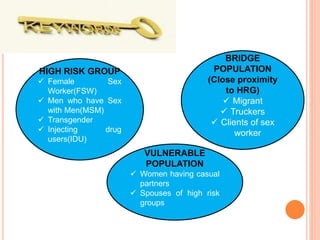
HIGH RISK GROUP
 Female Sex
Worker(FSW)
 Men who have Sex
with Men(MSM)
 Transgender
 Injecting drug
users(IDU)
VULNERABLE
POPULATION
 Women having casual
partners
 Spouses of high risk
groups
BRIDGE
POPULATION
(Close proximity
to HRG)
 Migrant
 Truckers
 Clients of sex
worker
PACKAGE OF SERVICES UNDER NACP-IV
1. Prevention services 2. care, support and treatment
1. Prevention services:-
 Targeted interventions for high-risk groups (female
sexworkers, men who have sex with men, transgenders/hijras,
injecting drug users) and bridge population(truckers and
migrants)
 Needle-syringe exchange programme and opioid
substitution therapy for IDUs
 Prevention interventions for migrant population at
source, transit and destination
 Link worker scheme for HRGs and vulnerable
population in rural areas
PREVENTION SERVICES…….
 Blood safety
 Prevention and control of STI / RTI
 HIV counselling and testing services
 Prevention of parent to child transmission
 Condom promotion
 Information, education and communication and behaviour change
communication (BCC)
 Social mobilization, youth interventions and
adolescence education programme
 Work place interventions.
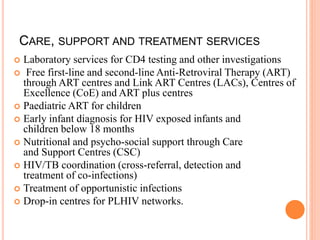
CARE, SUPPORT AND TREATMENT SERVICES
 Laboratory services for CD4 testing and other investigations
 Free first-line and second-line Anti-Retroviral Therapy (ART)
through ART centres and Link ART Centres (LACs), Centres of
Excellence (CoE) and ART plus centres
 Paediatric ART for children
 Early infant diagnosis for HIV exposed infants and
children below 18 months
 Nutritional and psycho-social support through Care
and Support Centres (CSC)
 HIV/TB coordination (cross-referral, detection and
treatment of co-infections)
 Treatment of opportunistic infections
 Drop-in centres for PLHIV networks.
CLASSIFICATION OF STATES
Group I High Prevalence States :
 > 5% in HRG and > 1% in antenatal women
 Maharashtra, Tamil Nadu, Karnataka, Andhra
Manipur and Nagaland
Group II Moderate Prevalence States :
 > 5% in HRG and < 1% in antenatal women
 Gujarat, Goa and Pondicherry
Group III Low Prevalence States :
 < 5% in HRG and < 1% in antenatal women
 Remaining states
3 BY 5 TARGET
To provide ART to 3 million people living
with HIV / AIDS in the developing
countries by the end of 2005.
HIV SURVEILLANCE
Types:-
1. HIV sentinel surveillance
2. HIV sero- surveillance
3. AIDS case surveillance
4. STD surveillance
5. Behaviour surveillance
6. Integration with surveillance of other dis. (T.B.)
WHAT IS SENTINEL SURVEILLANCE ?
 Its an active surveillance, done to detect hidden
cases in community.
 Instead of attempting to gather surveillance data
from all health care workers, a sentinel surveillance
system selects, either randomly or intentionally, a
small group of health workers from whom to gather
data. These health workers then receive greater
attention from health authorities than would be
possible with universal surveillance.
 More detailed and accurate data is obtained from
this
HIV SENTINEL SURVEILLANCE
 Was started in 1994 with 55 sentinel sites
Objective:
1. To determine the level of HIV infection;
2. To understand the trends of HIV epidemic
3. To understand the geographical spread of HIV infection and
emerging pockets;
4. To provide information for prioritization of resources
5. To estimate HIV prevalence and HIV burden in the
country.
Objective is best achieved by annual cross-sectional survey of the
risk group.
COUNSELLING AND HIV TESTING SERVICES
Include the following components :-
1. Integrated Counselling and Testing
Centres (ICTC)
2. Prevention of parent-to-child
transmission of HIV(PPTCT)
3. HIV/tuberculosis collaborative activities
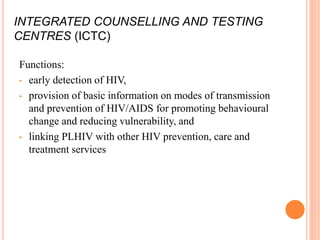
INTEGRATED COUNSELLING AND TESTING
CENTRES (ICTC)
Functions:
• early detection of HIV,
• provision of basic information on modes of transmission
and prevention of HIV/AIDS for promoting behavioural
change and reducing vulnerability, and
• linking PLHIV with other HIV prevention, care and
treatment services
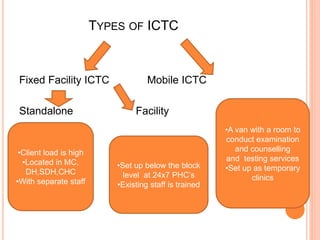
TYPES OF ICTC
Fixed Facility ICTC Mobile ICTC
Standalone Facility
•Client load is high
•Located in MC,
DH,SDH,CHC
•With separate staff
•Set up below the block
level at 24x7 PHC’s
•Existing staff is trained
•A van with a room to
conduct examination
and counselling
and testing services
•Set up as temporary
clinics
PREVENTION OF PARENT TO CHILD
TRANSMISSION(PPTCT)
Started in country in year 2002 with single dose Navirapine
(SD-NVP) prophylaxis to HIV positive pregnant women
during labour and also for her newborn child
immediately after birth.
AIM:
 To offer HIV testing to every pregnant women (universal
coverage) and
 eliminate transmission of HIV from mother to child.
 India has also transitioned from the single dose
Nevirapine strategy to that of Multi-drug ARV
prophylaxis in sept. 2012 to HIV positive pregnant
women.
 SD-NVP => 3TC+TDF+EFV
(Lamivudine + Tenofovir + Efavirenz)
ESSENTIAL PACKAGE OF SERVICES IN PTCT
1. HIV counselling and testing to all pregnant women enrolled
into antenatal care, with an ‘opt out‘ option.
2. move from an "ANC-Centric" to a "Family-Centric" approach.
3. Provision of life-long ART (TDF+3TC+EFV) to all
pregnant and breast-feeding HIV infected women,
regardless of CD4 count and clinical stage of HIV
progression.
4. Promotion of institutional deliveries of all HIV infected
pregnant women.
5. Provision of care for associated conditions (STI/RTI, TB)etc
6. Provision of nutrition, counselling and psychosocial
support for HIV infected pregnant women.
7. Provision of counselling and support for initiation of exclusive
breast-feeds within an hour of delivery as the preferred option
and continued for 6 months.
8. Provision of ARV prophylaxis (SD-NVP) to infants from birth
up to a minimum of 6 months.
9. Integrating follow-up of HIV-exposed infants into routine
healthcare services including immunization.
10. Ensuring initiation of Co-trimoxazole Prophylactic Therapy
(CPT) and Early Infant Diagnosis (EID) using HIV-DNA PCR at
6 weeks of age onwards, as per the EID guidelines.
11. Strengthening community follow-up and outreach
through local community networks to support HIV positive
pregnant women and their families.
ACTIVITIES TO REDUCE HIV-TB MORTALITY
CARE, SUPPORT AND TREATMENT
Aimed at
 to provide comprehensive services to people living with
HIV (PLHIV) with respect to free Anti-Retroviral
Therapy (ART),
 psychosocial support,
 prevention and treatment of opportunistic infections
including tuberculosis, and facilitating home-based care
and impact mitigation.
SERVICES PROVIDED UNDER NACP
(1) ART- adult and Paediatric ART
(2) Targeted intervention
(3) Link worker scheme
(4) Blood transfusion services
(5) STD control programme
ART
1. First line ART:- is given in new case and through
ART centres
2. Alternate first line ART:- in patient with
intolerance to first line ART and through centre of
excellence(CoE) and ART plus centres
3. Second line ART : is given to treatment failure of
first line or alternate first line ART and through
CoE and ART plus centres
TARGETED INTERVENTION
 Objective is to improve health-seeking behaviour of high
risk groups(HRG) and reduce their risk of acquiring
sexually transmitted infections (STI) and HIV infections.
 HRG = female sex workers (FSW), men
who have sex with men (MSM), transgenders (TG)/hijras
and injecting drug users (IDU) and bridge populations
include high risk behaviour migrants and long distance
truckers.
SERVICES OFFERED THROUGH TARGETED INTERVENTIONS
 Detection and treatment for STI
 Condom promotion through social marketing (for HRG and
bridge population)
 Behaviour change communication
 Creating an enabling environment with community involvement
and participation
 Linkages to integrated counselling and testing centres
 Linkages with care and support services for HIV positive HRGs
 Community organization and ownership building
 Specific interventions for IDUs
 Distribution of clean needles and syringes Abscess
prevention and management
 Opioid substitution therapy
 Linkage with detoxification/rehabilitation services
 Specific interventions for MSM/TGs
 Provision of lubricants
 Specific interventions for TG/hijra populations
 Provision of project-based STI clinics
 Community based outreach services by link worker.
for HRG, and vulnerable groups.
 Objective of scheme include- information on prevention of
HIV, Counselling, referral to ICTC, STI clinic, promotion and
distribution of condoms.
LINK WORKER SCHEME
MANAGEMENT OF RTI / STI
Provision of RTI/STI in high risk group population includes:
 Free consultation and treatment for their symptomatic STI /RTI.
 SURAKSHA CLINICS:-NACO has branded the STI/RTI
services as "Suraksha Clinic" .
 Syndromic management
 Prepacked colour coded kits
7 kits- Grey, green, white , blue,
red, yellow, black
BLOOD TRANSFUSION
SERVICE
 Professional blood donation prohibited.
 Only licensed blood banks are permitted to operate in the
country
 voluntary blood donation is encouraged.
 ensure safe collection, processing, storage and
distribution of blood and blood products.
 Testing of every unit of blood is mandatory for- HIV,
HBV, HCV, malaria, syphilis.
 BLOOD SAFETY programme renamed as blood
transfusion service.
INFORMATION, EDUCATION
AND COMMUNICATION
Communication in NACP-IV is directed at:
a. To increase knowledge among general population
(especially youth and women) on safe sexual behaviour;
b. To sustain behaviour change in high risk groups and
bridge populations;
c. To generate demand for care, support and treatment
services; and
d. To make appropriate changes in societal norms that
·reinforce positive attitude, beliefs and practices to reduce
stigma and discrimination.
ADOLESCENCE EDUCATION PROGRAMME
 This programme runs in secondary and senior secondary
schools to built up life skills of adolescents to cope with the
physical and psychological changes associated with
growing up.
 Provide education about AIDS
RED RIBBON CLUBS
 To encourage peer-to-peer messaging on HIV
prevention and
 to provide a safe space for young people to seek
clarifications of their doubts and myths surrounding
HIV/AIDS.
 The RRCs also promote voluntary blood donation among
youth.
National AIDS Control Programme

National AIDS Control Programme

  • 1.
  • 2.
    NATIONAL AIDS CONTROLPROGRAMME  Was launched in 1987  MHFW set up National AIDS Control Organization (NACO) to implement and monitor the programme. AIM:-  Prevent further transmission of HIV  To decrease morbidity and mortality  To minimize socio-economic impact
  • 3.
    MILESTONES OF THEPROGRAMME  1986 First case of HIV detected. AIDS Task Force set up by the ICMR. National AIDS Committee established under the Ministry of Health.  1990- Medium Term Plan launched for four states and the four metros.  1992 - NACP-I begin to slow down the spread of HIV infection. - National AIDS Control Board constituted. - NACO set-up.  1999- NACP-II begins, focussing on behaviour change, increased decentralization and NGO involvement. State AIDS Control Societies established
  • 4.
    MILESTONES…..  2002 NationalAIDS Control Policy adopted. - National Blood Policy adopted.  2004- Anti-retroviral treatment initiated.  2006 - National Council on AIDS constituted under chairmanship of the Prime Minister. -National Policy on Paediatric ART formulated.  2007 -NACP-III launched for 5 years (2007- 2012).  2012- NACP-IV launched for 5 years (2012- 2017).
  • 5.
    NATIONAL AIDS CONTROLPROGRAMME  NACP-IV 2012-2017 – Primary goal is to halt and reverse the epidemic in india over next five years
  • 6.
    HIGH RISK GROUP Female Sex Worker(FSW)  Men who have Sex with Men(MSM)  Transgender  Injecting drug users(IDU) VULNERABLE POPULATION  Women having casual partners  Spouses of high risk groups BRIDGE POPULATION (Close proximity to HRG)  Migrant  Truckers  Clients of sex worker
  • 7.
    PACKAGE OF SERVICESUNDER NACP-IV 1. Prevention services 2. care, support and treatment 1. Prevention services:-  Targeted interventions for high-risk groups (female sexworkers, men who have sex with men, transgenders/hijras, injecting drug users) and bridge population(truckers and migrants)  Needle-syringe exchange programme and opioid substitution therapy for IDUs  Prevention interventions for migrant population at source, transit and destination  Link worker scheme for HRGs and vulnerable population in rural areas
  • 8.
    PREVENTION SERVICES…….  Bloodsafety  Prevention and control of STI / RTI  HIV counselling and testing services  Prevention of parent to child transmission  Condom promotion  Information, education and communication and behaviour change communication (BCC)  Social mobilization, youth interventions and adolescence education programme  Work place interventions.
  • 9.
    CARE, SUPPORT ANDTREATMENT SERVICES  Laboratory services for CD4 testing and other investigations  Free first-line and second-line Anti-Retroviral Therapy (ART) through ART centres and Link ART Centres (LACs), Centres of Excellence (CoE) and ART plus centres  Paediatric ART for children  Early infant diagnosis for HIV exposed infants and children below 18 months  Nutritional and psycho-social support through Care and Support Centres (CSC)  HIV/TB coordination (cross-referral, detection and treatment of co-infections)  Treatment of opportunistic infections  Drop-in centres for PLHIV networks.
  • 10.
    CLASSIFICATION OF STATES GroupI High Prevalence States :  > 5% in HRG and > 1% in antenatal women  Maharashtra, Tamil Nadu, Karnataka, Andhra Manipur and Nagaland Group II Moderate Prevalence States :  > 5% in HRG and < 1% in antenatal women  Gujarat, Goa and Pondicherry Group III Low Prevalence States :  < 5% in HRG and < 1% in antenatal women  Remaining states
  • 11.
    3 BY 5TARGET To provide ART to 3 million people living with HIV / AIDS in the developing countries by the end of 2005.
  • 13.
    HIV SURVEILLANCE Types:- 1. HIVsentinel surveillance 2. HIV sero- surveillance 3. AIDS case surveillance 4. STD surveillance 5. Behaviour surveillance 6. Integration with surveillance of other dis. (T.B.)
  • 14.
    WHAT IS SENTINELSURVEILLANCE ?  Its an active surveillance, done to detect hidden cases in community.  Instead of attempting to gather surveillance data from all health care workers, a sentinel surveillance system selects, either randomly or intentionally, a small group of health workers from whom to gather data. These health workers then receive greater attention from health authorities than would be possible with universal surveillance.  More detailed and accurate data is obtained from this
  • 15.
    HIV SENTINEL SURVEILLANCE Was started in 1994 with 55 sentinel sites Objective: 1. To determine the level of HIV infection; 2. To understand the trends of HIV epidemic 3. To understand the geographical spread of HIV infection and emerging pockets; 4. To provide information for prioritization of resources 5. To estimate HIV prevalence and HIV burden in the country. Objective is best achieved by annual cross-sectional survey of the risk group.
  • 16.
    COUNSELLING AND HIVTESTING SERVICES Include the following components :- 1. Integrated Counselling and Testing Centres (ICTC) 2. Prevention of parent-to-child transmission of HIV(PPTCT) 3. HIV/tuberculosis collaborative activities
  • 17.
    INTEGRATED COUNSELLING ANDTESTING CENTRES (ICTC) Functions: • early detection of HIV, • provision of basic information on modes of transmission and prevention of HIV/AIDS for promoting behavioural change and reducing vulnerability, and • linking PLHIV with other HIV prevention, care and treatment services
  • 18.
    TYPES OF ICTC FixedFacility ICTC Mobile ICTC Standalone Facility •Client load is high •Located in MC, DH,SDH,CHC •With separate staff •Set up below the block level at 24x7 PHC’s •Existing staff is trained •A van with a room to conduct examination and counselling and testing services •Set up as temporary clinics
  • 19.
    PREVENTION OF PARENTTO CHILD TRANSMISSION(PPTCT) Started in country in year 2002 with single dose Navirapine (SD-NVP) prophylaxis to HIV positive pregnant women during labour and also for her newborn child immediately after birth. AIM:  To offer HIV testing to every pregnant women (universal coverage) and  eliminate transmission of HIV from mother to child.
  • 20.
     India hasalso transitioned from the single dose Nevirapine strategy to that of Multi-drug ARV prophylaxis in sept. 2012 to HIV positive pregnant women.  SD-NVP => 3TC+TDF+EFV (Lamivudine + Tenofovir + Efavirenz)
  • 21.
    ESSENTIAL PACKAGE OFSERVICES IN PTCT 1. HIV counselling and testing to all pregnant women enrolled into antenatal care, with an ‘opt out‘ option. 2. move from an "ANC-Centric" to a "Family-Centric" approach. 3. Provision of life-long ART (TDF+3TC+EFV) to all pregnant and breast-feeding HIV infected women, regardless of CD4 count and clinical stage of HIV progression. 4. Promotion of institutional deliveries of all HIV infected pregnant women. 5. Provision of care for associated conditions (STI/RTI, TB)etc 6. Provision of nutrition, counselling and psychosocial support for HIV infected pregnant women.
  • 22.
    7. Provision ofcounselling and support for initiation of exclusive breast-feeds within an hour of delivery as the preferred option and continued for 6 months. 8. Provision of ARV prophylaxis (SD-NVP) to infants from birth up to a minimum of 6 months. 9. Integrating follow-up of HIV-exposed infants into routine healthcare services including immunization. 10. Ensuring initiation of Co-trimoxazole Prophylactic Therapy (CPT) and Early Infant Diagnosis (EID) using HIV-DNA PCR at 6 weeks of age onwards, as per the EID guidelines. 11. Strengthening community follow-up and outreach through local community networks to support HIV positive pregnant women and their families.
  • 23.
    ACTIVITIES TO REDUCEHIV-TB MORTALITY
  • 24.
    CARE, SUPPORT ANDTREATMENT Aimed at  to provide comprehensive services to people living with HIV (PLHIV) with respect to free Anti-Retroviral Therapy (ART),  psychosocial support,  prevention and treatment of opportunistic infections including tuberculosis, and facilitating home-based care and impact mitigation.
  • 25.
    SERVICES PROVIDED UNDERNACP (1) ART- adult and Paediatric ART (2) Targeted intervention (3) Link worker scheme (4) Blood transfusion services (5) STD control programme
  • 26.
    ART 1. First lineART:- is given in new case and through ART centres 2. Alternate first line ART:- in patient with intolerance to first line ART and through centre of excellence(CoE) and ART plus centres 3. Second line ART : is given to treatment failure of first line or alternate first line ART and through CoE and ART plus centres
  • 27.
    TARGETED INTERVENTION  Objectiveis to improve health-seeking behaviour of high risk groups(HRG) and reduce their risk of acquiring sexually transmitted infections (STI) and HIV infections.  HRG = female sex workers (FSW), men who have sex with men (MSM), transgenders (TG)/hijras and injecting drug users (IDU) and bridge populations include high risk behaviour migrants and long distance truckers.
  • 28.
    SERVICES OFFERED THROUGHTARGETED INTERVENTIONS  Detection and treatment for STI  Condom promotion through social marketing (for HRG and bridge population)  Behaviour change communication  Creating an enabling environment with community involvement and participation  Linkages to integrated counselling and testing centres  Linkages with care and support services for HIV positive HRGs  Community organization and ownership building
  • 29.
     Specific interventionsfor IDUs  Distribution of clean needles and syringes Abscess prevention and management  Opioid substitution therapy  Linkage with detoxification/rehabilitation services  Specific interventions for MSM/TGs  Provision of lubricants  Specific interventions for TG/hijra populations  Provision of project-based STI clinics
  • 30.
     Community basedoutreach services by link worker. for HRG, and vulnerable groups.  Objective of scheme include- information on prevention of HIV, Counselling, referral to ICTC, STI clinic, promotion and distribution of condoms. LINK WORKER SCHEME
  • 31.
    MANAGEMENT OF RTI/ STI Provision of RTI/STI in high risk group population includes:  Free consultation and treatment for their symptomatic STI /RTI.  SURAKSHA CLINICS:-NACO has branded the STI/RTI services as "Suraksha Clinic" .  Syndromic management  Prepacked colour coded kits 7 kits- Grey, green, white , blue, red, yellow, black
  • 32.
    BLOOD TRANSFUSION SERVICE  Professionalblood donation prohibited.  Only licensed blood banks are permitted to operate in the country  voluntary blood donation is encouraged.  ensure safe collection, processing, storage and distribution of blood and blood products.  Testing of every unit of blood is mandatory for- HIV, HBV, HCV, malaria, syphilis.  BLOOD SAFETY programme renamed as blood transfusion service.
  • 33.
    INFORMATION, EDUCATION AND COMMUNICATION Communicationin NACP-IV is directed at: a. To increase knowledge among general population (especially youth and women) on safe sexual behaviour; b. To sustain behaviour change in high risk groups and bridge populations; c. To generate demand for care, support and treatment services; and d. To make appropriate changes in societal norms that ·reinforce positive attitude, beliefs and practices to reduce stigma and discrimination.
  • 34.
    ADOLESCENCE EDUCATION PROGRAMME This programme runs in secondary and senior secondary schools to built up life skills of adolescents to cope with the physical and psychological changes associated with growing up.  Provide education about AIDS
  • 35.
    RED RIBBON CLUBS To encourage peer-to-peer messaging on HIV prevention and  to provide a safe space for young people to seek clarifications of their doubts and myths surrounding HIV/AIDS.  The RRCs also promote voluntary blood donation among youth.