NATIONAL
URBAN HEALTH
MISSION
Presentor: Dr. Bushra Jabeen
Moderator: Dr. Archana S
06/06/2018
1
■ Cities offer the lure
■ Rapid and unplanned urban growth.
■ Human health at risk.
National Urban Health Mission
■ Health concerns of the urban poor.
■ Facilitate equitable access to available health facilities
■ Rationalize and strengthen the existing capacity of health
delivery.
2
Contents
1. Introduction
2. Functions
3. Goal
4. Strategy
5. Target
6. Components
7. Institutional framework
8. Urban health insurance
model
9. Primary urban health
center
10. Some Schemes
11. Monitoring and evaluation
12. SWOT
13. Measurable indicators
3
Introduction
■ The urban population is estimated to increase to 43.2
crores in 2021.
■ Urban growth  urban poor population.
■ “Crowded out"
■ Ineffective outreach and weak referral system
■ The social exclusion, lack of information and assistance at
hospitals.
4
Introduction
■ The lack of economic resources restricts their access to
the available private facilities.
■ The lack of standards and norms for the urban health
delivery system.
■ Urban poor - "illegal status".
■ Heterogeneity among slum dwellers
5
Purpose
■ Meet health needs of the urban poor –
The slum dwellers and other marginalized urban dwellers
(Rickshaw pullers, street vendors, railway and bus station
coolies, homeless people, street children, construction site
workers, who may be in slums or on sites).
6
Functions
■ Essential primary health care services
(by investing in high - caliber health professionals,
appropriate technology through public – private
partnership, and health insurance for urban poor).
■ Focus on slums and other urban poor.
7
Goal
■ Improve the health status of the poor by:
• Facilitating equitable access to quality health care
• Revising public health system
• Building public private partnership
• Community based risk pooling and insurance mechanism
• Active involvement of the urban local bodies.
8
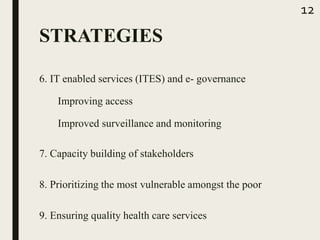
STRATEGIES
1. Improving the efficiency of public health system
 Strengthening,
 Revamping and
 Rationalizing urban primary health structure.
9
2. Partnership
Non-government providers
Health delivery gaps
10
3. Promotion of access to improved health care
Household level
Community based groups:
Mahila Arogya Samiti
STRATEGIES
4. Strengthening public health
Preventive and Promotive action
11
5. Increased access to health care
Risk pooling and
Community health insurance models
STRATEGIES
12
7. Capacity building of stakeholders
8. Prioritizing the most vulnerable amongst the poor
9. Ensuring quality health care services
6. IT enabled services (ITES) and e- governance
Improving access
Improved surveillance and monitoring
STRATEGIES
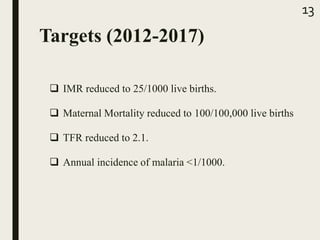
Targets (2012-2017)
 IMR reduced to 25/1000 live births.
 Maternal Mortality reduced to 100/100,000 live births
 TFR reduced to 2.1.
 Annual incidence of malaria <1/1000.
13
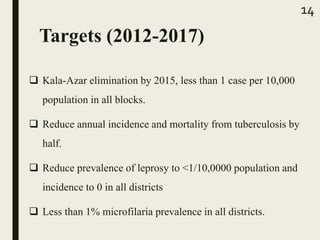
14
 Kala-Azar elimination by 2015, less than 1 case per 10,000
population in all blocks.
 Reduce annual incidence and mortality from tuberculosis by
half.
 Reduce prevalence of leprosy to <1/10,0000 population and
incidence to 0 in all districts
 Less than 1% microfilaria prevalence in all districts.
Targets (2012-2017)
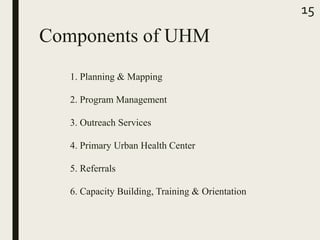
Components of UHM
1. Planning & Mapping
2. Program Management
3. Outreach Services
4. Primary Urban Health Center
5. Referrals
6. Capacity Building, Training & Orientation
15
Components of UHM
7. Community Risk Pooling/Insurance
8. Public Private Partnership (PPP)
9. Monitoring & Evaluation (including ITES)
10. Special Program for Vulnerable Groups
11. Support for city level public health action
12. Additional Support for National Health Programs
16
Institutional Framework Under
National Urban Health Mission
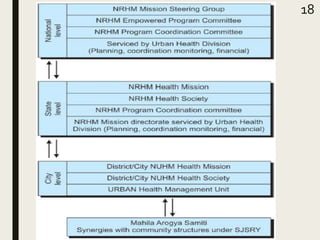
■ At the National and State level, National Rural Health
Mission (NRHM) is utilized for NUHM activities.
■ At each city level, separate City NUHM Health Society is
framed,
17
18
Urban Social Health Activist
(USHA)
■ She is a resident woman of the same slum,
■ Studied at least up to 8th standard,
■ Preferably in the age group of 25–45 years,
■ Married/widowed/divorced,
■ Chosen by urban local body counselors.
19
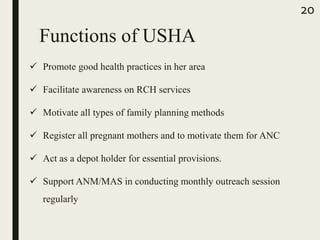
Functions of USHA
 Promote good health practices in her area
 Facilitate awareness on RCH services
 Motivate all types of family planning methods
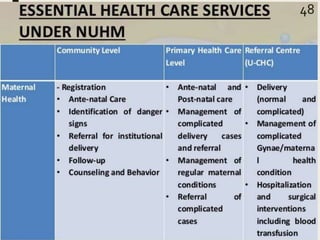
 Register all pregnant mothers and to motivate them for ANC
 Act as a depot holder for essential provisions.
 Support ANM/MAS in conducting monthly outreach session
regularly
20
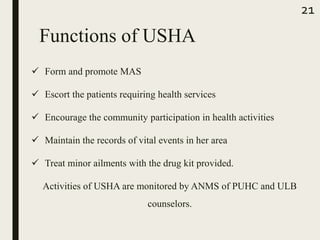
 Form and promote MAS
 Escort the patients requiring health services
 Encourage the community participation in health activities
 Maintain the records of vital events in her area
 Treat minor ailments with the drug kit provided.
Activities of USHA are monitored by ANMS of PUHC and ULB
counselors.
21
Functions of USHA
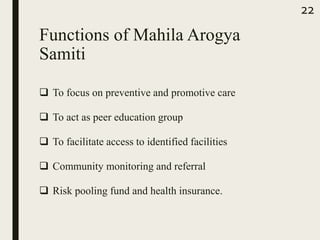
Functions of Mahila Arogya
Samiti
 To focus on preventive and promotive care
 To act as peer education group
 To facilitate access to identified facilities
 Community monitoring and referral
 Risk pooling fund and health insurance.
22
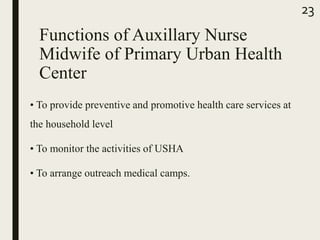
Functions of Auxillary Nurse
Midwife of Primary Urban Health
Center
• To provide preventive and promotive health care services at
the household level
• To monitor the activities of USHA
• To arrange outreach medical camps.
23
COMMUNITY RISK
POOLING
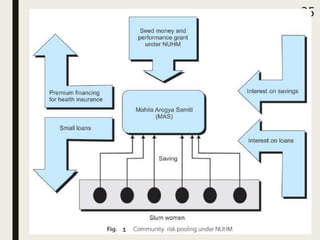
■ This consists of women from Mahila Arogya Samiti.
■ One time seed money (Rs. 25 per household) will be given
by the Government at the initial time and again annual
performance grant (Rs.25 per household) is given.
■ From this pool, money is utilized for other purposes.
24
25
1
Urban Health Insurance Model
■ This includes all the urban population (slum and nonslum).
■ All members are issued photo identity card (Family health
suraksha card).
■ Premium—annual amount is fixed per person and
subsidized premium is offered for the poor.
26
Benefits
 Hospitalization, in patient services > 24 hours.
 Consultation, investigation and room charges and medicines and
surgical/medical procedures.
 Maternal and childhood conditions and illnesses.
 Monetary coverage - maximum of Rs.50,000/year/enrolled
household.
27
Primary Urban Health Center
■ Location - near the slum to be served
■ Covers 50,000 population,
■ Provides curative health care.
■ Annual fund of Rs.1 per head provided to each PUHC.
28
Staff Pattern of PUHC
■ Medical officer – 1
■ Pharmacist/Lab. technician – 2
■ Program health manager – 1
■ Multi-skilled nurse – 2
■ ANMs – 4
■ Account keeper – 1
■ Support staff – 3
29
Functions of PUHC
1. Medical care—OPD services.
2. RCH—II services
3. National Health Program
4. Collection and reporting of vital events
5. IDSP
6. Referral services
7. Basic laboratory services
8. Counseling services
9. Services for non communicable diseases
10. Social mobilization and community level activities.
30
Intrasectoral Coordination
■ PUHC Established by - Housing and slum development society
■ RNTCP, ICTC, AYUSH, IDSP, NVBDCP
■ Convergence of all National Health Programs
■ Convergence with Swarn Jayanthi Shahri Rozgar Yojana
■ Convergence with ICDs and education department
■ Convergence with Jawaharlal Nehru National Urban Renewal
Mission.
31
Swarna Jayanti Shahari Rozgar
Yojana
■ Key Objectives of the revised SJSRY
♦ Adressing urban poverty allevialtion - gainful employment
♦ Supporting skill development and training
♦ Empowering the community
32
Jawaharlal Nehru National
Urban Renewal Mission
■ Two Sub-Missions:
– Urban Infrastructure and Governance
– Basic Services to the Urban Poor.
■ Objective
– To create economically productive, efficient equitable and
responsive cities.
– Sponsored for Bangalore and Mysore cities
33
Rajiv Awas Yojana (RAY)
Vision
“Slum Free India” with inclusive and equitable cities in which every
citizen has access to basic civic infrastructure, social amenities and
decent shelter.
Mission
1. All existing slums - avail the basic amenities
2. Redressing the failures of the formal system
3. Plan for affordable housing stock for the urban poor and initiating
crucial policy changes required for facilitating the same.
34
MAMTA Scheme
■ An example of Public Private Partnership in Health Care
■ India suffers from high maternal and neonatal mortality.
■ Overburdened Government hospitals.
■ PPP model
■ Private Hospitals join MAMTA scheme.
■ Comprehensive care - the hospital is being given Rs. 4000/by the
district societies.
■ Part packages - institutional deliveries alone Rs. 3000/- is given.
■ Only Antenatal care - Rs. 2000/-
35
Services for the beneficiary
under the Scheme:
a. 3 antenatal checkups with investigations and two ultrasound
examinations.
b. Injection TT and Iron Folic Acid Tablets
c. Institutional delivery facilities, including emergency obstetric care
d. Essential new born care
e. Blood transfusion, cesarean section, ICU, essential newborn care,
and resuscitation when necessary.
f. 1 postnatal checkup within first week of delivery.
36
Monitoring and evaluation
■ Monitoring will be done in three stages:
– Community based monitoring
– Health management information system (HMIS) for
reporting and feedback
– External evaluations.
37
SWOT ANALYSIS
38
Strengths
■ Focuses on the urban poor
■ Special emphasis would be on improving the health care services to
vulnerable
■ Need based contractual human resources, equipments and drugs.
■ Health care delivery with the help of outreach sessions
■ Strengthening promotive action for improved health and nutrition
and prevention of diseases.
■ Capacity building, monetary and nonmonetary incentives and
managerial support.
■ Encouraging development of standard treatment protocols.
39
Weaknesses-
■ Training of USHAs
■ Number of USHAs to be recruited.
■ No time-limits to carry out its activities but targets are
set.
■ POPs for states are not framed.
40
Opportunities
■ Provision of Rogi Kalyan Samiti is being made for promoting
local action.
■ Partnership with nongovernment sector
■ Promote community participation and empowerment.
■ The availability of ITES - effective tracking and monitoring of
the diseases and timely intervention.
■ Geographical Information Systems - to map the slums accurately.
41
Threats
■ Casualty of a bureaucratic logjam and inter-ministry
turf issues.
■ Overlapping other schemes
■ All the slums are not notified
■ Funding is not clear and is more general.
42
Measurable Indicators of
improved health of the urban poor
at the City Level
■ Cities/population with all slums and facilities mapped
■ Number cities/population where Mission has been initiated
■ Increase in OPD attendance
■ Increase in BPL referrals from UHCs
■ Increase in BPL referrals availed at referral units
■ Number of Slum/ Cluster level Health and Sanitation Day
43
Measurable Indicators . . .
■ Number of USHA receiving full honorarium
■ Number of MAS formed
■ Number of UHCs with Program Manager
■ Increase in ANC check-up of pregnant women
■ Increased TT (2nd dose) coverage among pregnant women
■ Increase in institutional deliveries as percentage of total deliveries
■ Increase in complete immunization among children < 12months
■ Increase in case detection for malaria through blood examination
44
■ Increase in case detection of TB through identification of chest
symptomatic
■ Increase in referral for sputum microscopy examination for TB
■ Increase in number of cases screened and treated for dental ailments
■ Increase in number of cases screened for diabetes at UHCs
■ Increase in number of cases referred and operated for heart related
ailments
■ Increase in first aid and referral of burns and injury cases
■ Increase in number of mental health services at primary health care
level in urban health settings.
■ Increase in the awareness of community about tobacco
products/alcohol and substance abuse
45
Measurable Indicators . . .
SUMMARY
46
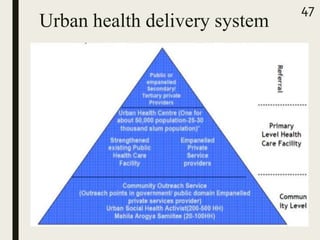
Urban health delivery system
47
48
References
■ National health mission [online]. 2018 May 23; available from:
URL: nhm.gov.in/nhm/nuhm.html
■ Schemes/ programmes [online]. 2018 June 02; available from: URL:
http://www.uddkar.gov.in
■ Kishore J. National health programs: National Urban Health
Mission. 12th edition
■ Park K. Textbook of Preventive and Social Medicine: National
Health Programs. 24th edition.
■ Textbook of Community medicine with recent advances 4th edition;
Suryakantha (2016); section 4 chapter 17 occupational health pg.
237
■ Bhalwar R. National Urban Health Mission.Textbook of public
health & community medicine 1st edition; AFMC Pune (2009).
49

NUHM

  • 1.
    NATIONAL URBAN HEALTH MISSION Presentor: Dr.Bushra Jabeen Moderator: Dr. Archana S 06/06/2018 1
  • 2.
    ■ Cities offerthe lure ■ Rapid and unplanned urban growth. ■ Human health at risk. National Urban Health Mission ■ Health concerns of the urban poor. ■ Facilitate equitable access to available health facilities ■ Rationalize and strengthen the existing capacity of health delivery. 2
  • 3.
    Contents 1. Introduction 2. Functions 3.Goal 4. Strategy 5. Target 6. Components 7. Institutional framework 8. Urban health insurance model 9. Primary urban health center 10. Some Schemes 11. Monitoring and evaluation 12. SWOT 13. Measurable indicators 3
  • 4.
    Introduction ■ The urbanpopulation is estimated to increase to 43.2 crores in 2021. ■ Urban growth  urban poor population. ■ “Crowded out" ■ Ineffective outreach and weak referral system ■ The social exclusion, lack of information and assistance at hospitals. 4
  • 5.
    Introduction ■ The lackof economic resources restricts their access to the available private facilities. ■ The lack of standards and norms for the urban health delivery system. ■ Urban poor - "illegal status". ■ Heterogeneity among slum dwellers 5
  • 6.
    Purpose ■ Meet healthneeds of the urban poor – The slum dwellers and other marginalized urban dwellers (Rickshaw pullers, street vendors, railway and bus station coolies, homeless people, street children, construction site workers, who may be in slums or on sites). 6
  • 7.
    Functions ■ Essential primaryhealth care services (by investing in high - caliber health professionals, appropriate technology through public – private partnership, and health insurance for urban poor). ■ Focus on slums and other urban poor. 7
  • 8.
    Goal ■ Improve thehealth status of the poor by: • Facilitating equitable access to quality health care • Revising public health system • Building public private partnership • Community based risk pooling and insurance mechanism • Active involvement of the urban local bodies. 8
  • 9.
    STRATEGIES 1. Improving theefficiency of public health system  Strengthening,  Revamping and  Rationalizing urban primary health structure. 9
  • 10.
    2. Partnership Non-government providers Healthdelivery gaps 10 3. Promotion of access to improved health care Household level Community based groups: Mahila Arogya Samiti STRATEGIES
  • 11.
    4. Strengthening publichealth Preventive and Promotive action 11 5. Increased access to health care Risk pooling and Community health insurance models STRATEGIES
  • 12.
    12 7. Capacity buildingof stakeholders 8. Prioritizing the most vulnerable amongst the poor 9. Ensuring quality health care services 6. IT enabled services (ITES) and e- governance Improving access Improved surveillance and monitoring STRATEGIES
  • 13.
    Targets (2012-2017)  IMRreduced to 25/1000 live births.  Maternal Mortality reduced to 100/100,000 live births  TFR reduced to 2.1.  Annual incidence of malaria <1/1000. 13
  • 14.
    14  Kala-Azar eliminationby 2015, less than 1 case per 10,000 population in all blocks.  Reduce annual incidence and mortality from tuberculosis by half.  Reduce prevalence of leprosy to <1/10,0000 population and incidence to 0 in all districts  Less than 1% microfilaria prevalence in all districts. Targets (2012-2017)
  • 15.
    Components of UHM 1.Planning & Mapping 2. Program Management 3. Outreach Services 4. Primary Urban Health Center 5. Referrals 6. Capacity Building, Training & Orientation 15
  • 16.
    Components of UHM 7.Community Risk Pooling/Insurance 8. Public Private Partnership (PPP) 9. Monitoring & Evaluation (including ITES) 10. Special Program for Vulnerable Groups 11. Support for city level public health action 12. Additional Support for National Health Programs 16
  • 17.
    Institutional Framework Under NationalUrban Health Mission ■ At the National and State level, National Rural Health Mission (NRHM) is utilized for NUHM activities. ■ At each city level, separate City NUHM Health Society is framed, 17
  • 18.
  • 19.
    Urban Social HealthActivist (USHA) ■ She is a resident woman of the same slum, ■ Studied at least up to 8th standard, ■ Preferably in the age group of 25–45 years, ■ Married/widowed/divorced, ■ Chosen by urban local body counselors. 19
  • 20.
    Functions of USHA Promote good health practices in her area  Facilitate awareness on RCH services  Motivate all types of family planning methods  Register all pregnant mothers and to motivate them for ANC  Act as a depot holder for essential provisions.  Support ANM/MAS in conducting monthly outreach session regularly 20
  • 21.
     Form andpromote MAS  Escort the patients requiring health services  Encourage the community participation in health activities  Maintain the records of vital events in her area  Treat minor ailments with the drug kit provided. Activities of USHA are monitored by ANMS of PUHC and ULB counselors. 21 Functions of USHA
  • 22.
    Functions of MahilaArogya Samiti  To focus on preventive and promotive care  To act as peer education group  To facilitate access to identified facilities  Community monitoring and referral  Risk pooling fund and health insurance. 22
  • 23.
    Functions of AuxillaryNurse Midwife of Primary Urban Health Center • To provide preventive and promotive health care services at the household level • To monitor the activities of USHA • To arrange outreach medical camps. 23
  • 24.
    COMMUNITY RISK POOLING ■ Thisconsists of women from Mahila Arogya Samiti. ■ One time seed money (Rs. 25 per household) will be given by the Government at the initial time and again annual performance grant (Rs.25 per household) is given. ■ From this pool, money is utilized for other purposes. 24
  • 25.
  • 26.
    Urban Health InsuranceModel ■ This includes all the urban population (slum and nonslum). ■ All members are issued photo identity card (Family health suraksha card). ■ Premium—annual amount is fixed per person and subsidized premium is offered for the poor. 26
  • 27.
    Benefits  Hospitalization, inpatient services > 24 hours.  Consultation, investigation and room charges and medicines and surgical/medical procedures.  Maternal and childhood conditions and illnesses.  Monetary coverage - maximum of Rs.50,000/year/enrolled household. 27
  • 28.
    Primary Urban HealthCenter ■ Location - near the slum to be served ■ Covers 50,000 population, ■ Provides curative health care. ■ Annual fund of Rs.1 per head provided to each PUHC. 28
  • 29.
    Staff Pattern ofPUHC ■ Medical officer – 1 ■ Pharmacist/Lab. technician – 2 ■ Program health manager – 1 ■ Multi-skilled nurse – 2 ■ ANMs – 4 ■ Account keeper – 1 ■ Support staff – 3 29
  • 30.
    Functions of PUHC 1.Medical care—OPD services. 2. RCH—II services 3. National Health Program 4. Collection and reporting of vital events 5. IDSP 6. Referral services 7. Basic laboratory services 8. Counseling services 9. Services for non communicable diseases 10. Social mobilization and community level activities. 30
  • 31.
    Intrasectoral Coordination ■ PUHCEstablished by - Housing and slum development society ■ RNTCP, ICTC, AYUSH, IDSP, NVBDCP ■ Convergence of all National Health Programs ■ Convergence with Swarn Jayanthi Shahri Rozgar Yojana ■ Convergence with ICDs and education department ■ Convergence with Jawaharlal Nehru National Urban Renewal Mission. 31
  • 32.
    Swarna Jayanti ShahariRozgar Yojana ■ Key Objectives of the revised SJSRY ♦ Adressing urban poverty allevialtion - gainful employment ♦ Supporting skill development and training ♦ Empowering the community 32
  • 33.
    Jawaharlal Nehru National UrbanRenewal Mission ■ Two Sub-Missions: – Urban Infrastructure and Governance – Basic Services to the Urban Poor. ■ Objective – To create economically productive, efficient equitable and responsive cities. – Sponsored for Bangalore and Mysore cities 33
  • 34.
    Rajiv Awas Yojana(RAY) Vision “Slum Free India” with inclusive and equitable cities in which every citizen has access to basic civic infrastructure, social amenities and decent shelter. Mission 1. All existing slums - avail the basic amenities 2. Redressing the failures of the formal system 3. Plan for affordable housing stock for the urban poor and initiating crucial policy changes required for facilitating the same. 34
  • 35.
    MAMTA Scheme ■ Anexample of Public Private Partnership in Health Care ■ India suffers from high maternal and neonatal mortality. ■ Overburdened Government hospitals. ■ PPP model ■ Private Hospitals join MAMTA scheme. ■ Comprehensive care - the hospital is being given Rs. 4000/by the district societies. ■ Part packages - institutional deliveries alone Rs. 3000/- is given. ■ Only Antenatal care - Rs. 2000/- 35
  • 36.
    Services for thebeneficiary under the Scheme: a. 3 antenatal checkups with investigations and two ultrasound examinations. b. Injection TT and Iron Folic Acid Tablets c. Institutional delivery facilities, including emergency obstetric care d. Essential new born care e. Blood transfusion, cesarean section, ICU, essential newborn care, and resuscitation when necessary. f. 1 postnatal checkup within first week of delivery. 36
  • 37.
    Monitoring and evaluation ■Monitoring will be done in three stages: – Community based monitoring – Health management information system (HMIS) for reporting and feedback – External evaluations. 37
  • 38.
  • 39.
    Strengths ■ Focuses onthe urban poor ■ Special emphasis would be on improving the health care services to vulnerable ■ Need based contractual human resources, equipments and drugs. ■ Health care delivery with the help of outreach sessions ■ Strengthening promotive action for improved health and nutrition and prevention of diseases. ■ Capacity building, monetary and nonmonetary incentives and managerial support. ■ Encouraging development of standard treatment protocols. 39
  • 40.
    Weaknesses- ■ Training ofUSHAs ■ Number of USHAs to be recruited. ■ No time-limits to carry out its activities but targets are set. ■ POPs for states are not framed. 40
  • 41.
    Opportunities ■ Provision ofRogi Kalyan Samiti is being made for promoting local action. ■ Partnership with nongovernment sector ■ Promote community participation and empowerment. ■ The availability of ITES - effective tracking and monitoring of the diseases and timely intervention. ■ Geographical Information Systems - to map the slums accurately. 41
  • 42.
    Threats ■ Casualty ofa bureaucratic logjam and inter-ministry turf issues. ■ Overlapping other schemes ■ All the slums are not notified ■ Funding is not clear and is more general. 42
  • 43.
    Measurable Indicators of improvedhealth of the urban poor at the City Level ■ Cities/population with all slums and facilities mapped ■ Number cities/population where Mission has been initiated ■ Increase in OPD attendance ■ Increase in BPL referrals from UHCs ■ Increase in BPL referrals availed at referral units ■ Number of Slum/ Cluster level Health and Sanitation Day 43
  • 44.
    Measurable Indicators .. . ■ Number of USHA receiving full honorarium ■ Number of MAS formed ■ Number of UHCs with Program Manager ■ Increase in ANC check-up of pregnant women ■ Increased TT (2nd dose) coverage among pregnant women ■ Increase in institutional deliveries as percentage of total deliveries ■ Increase in complete immunization among children < 12months ■ Increase in case detection for malaria through blood examination 44
  • 45.
    ■ Increase incase detection of TB through identification of chest symptomatic ■ Increase in referral for sputum microscopy examination for TB ■ Increase in number of cases screened and treated for dental ailments ■ Increase in number of cases screened for diabetes at UHCs ■ Increase in number of cases referred and operated for heart related ailments ■ Increase in first aid and referral of burns and injury cases ■ Increase in number of mental health services at primary health care level in urban health settings. ■ Increase in the awareness of community about tobacco products/alcohol and substance abuse 45 Measurable Indicators . . .
  • 46.
  • 47.
  • 48.
  • 49.
    References ■ National healthmission [online]. 2018 May 23; available from: URL: nhm.gov.in/nhm/nuhm.html ■ Schemes/ programmes [online]. 2018 June 02; available from: URL: http://www.uddkar.gov.in ■ Kishore J. National health programs: National Urban Health Mission. 12th edition ■ Park K. Textbook of Preventive and Social Medicine: National Health Programs. 24th edition. ■ Textbook of Community medicine with recent advances 4th edition; Suryakantha (2016); section 4 chapter 17 occupational health pg. 237 ■ Bhalwar R. National Urban Health Mission.Textbook of public health & community medicine 1st edition; AFMC Pune (2009). 49

Editor's Notes

  • #3 There is a need of sound health policy to handle such health transition.
  • #7 Cover all cities with a population of more than 100,000. It would cover slum dwellers.
  • #14 1. Reduce MMR to 1/1000 live births 2. Reduce IMR to 25/1000 live births 3. Reduce TFR to 2.1
  • #18 which monitors Mahila Arogya Samiti (MAS), USHA (Urban Social Health Activist) and other activities of NUHM
  • #19 At the National and State level, National Rural Health Mission (NRHM) is utilized for NUHM activities. At each city level, separate City NUHM Health Society is framed, which monitors Mahila Arogya Samiti (MAS), USHA (Urban Social Health Activist) and other activities of NUHM.
  • #20 (ULB)
  • #21 essential provisions like ORS packets, IFA tablets, chloroquine tablets, oral pills, condoms, etc.
  • #26 Use of pooling: The fund is utilized for unforeseen health expenditure of the member or family, other activities like group meetings, mobilization for health camps etc.
  • #28 Amount is directly paid to the empanelled.
  • #31 4 hours in the morning and 2 hours in the evening Referral units: Existing hospitals including urban local body maternity homes, state Government hospitals and medical colleges.
  • #33 to enable the urban poor to have access to employment opportunities provided by the market or undertake self-employment; - self-managed community structures and capacity building programmes
  • #36 includes Antenatal care, institutional delivery, new born care and postnatal care,
  • #37 pregnant woman (14-18 wks and 32-36 wks) registered under the scheme. Other benefits: cash incentive of Rs. 600/- available under Janani Suraksha Yojana. If woman under the MAMTA scheme delivers a girl child then the girl child is be entitled to receive benefits under 'Ladli Scheme‘.
  • #41 Plan of operation-POPs
  • #42 to improve access to curative care and to promote active community participation and ownership.
  • #43 • One example of overlaps between the government schemes is the ministry oflabor and employment's Rashtriya Swasthya Bima Yojana, a health insurance scheme for the so-called below poverty line (BPL) sections of the population. • Under its plan, NUHM, too, gives provisions for health insurance for urban poor through "Family Health Suraksha" cards under the Community Health Insurance model. • A second instance is the significant overlap in coverage of cities and services that JNNURM, administered by the ministry of urban employment and poverty alleviation, has with NUHM
  • #44 is also proposed to be assessed annually through e- enabled HMIS and surveys. Some of the measurable indicators are given below: