Social And Preventive
Pharmacy
Pulse Polio Programme
By
Kaushal Kumar
TABLE OF CONTENTS
01 02 03 04
Introduction Objective Life Cycle Out Come
Introduction
Polio is a viral disease that destroys the nerve cells present in
the spinal cord causing paralysis or muscle weakness to some
part of the body.
Pulse Polio Programme was launched in 1995 after a
resolution for a global initiative of polio eradication was
adopted by World Health Assembly (WHA) in 1988.
Children in the age group of 0-5 years administered polio
drops during National and Sub-national immunization rounds
(in high risk areas) every year.
About 172 million children are immunized during each National
Immunization Day (NID).
Objective
 Achieving hundred per cent coverage under Oral Polio Vaccine.
 To immunize children through improved social mobilization plan mop-up operations
in areas where poliovirus has almost disappeared.
 Maintain high level of morale among the public.
 To immunise those children who are not earlier immunised or are partially
immunized.
 To boost the immunity of children already immunised
 To replace disease carrying wild virus by harmless vaccine virus in the environment
Polio Casein India
According to the Ministry of Health, the last polio case in the country was
reported from Howrah district of west Bengal (13 January 2011). Type-1
Polio Virus
WHO on 24th February 2012 removed India from the list of countries with
active endemic wild polio virus transmission.
Last case of Wild Polio Virus Type 2 in India was reported in 1999.
On 27 March 2014, the World Health Organization (WHO) declared India
a polio-free country, since no cases of wild polio been reported in for five
years.
Transmission
The WHO defines polio or poliomyelitis as a highly infectious viral disease, which
mainly affects young children.
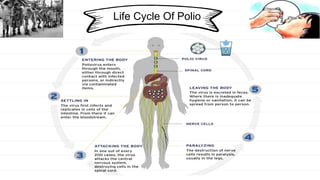
The virus is transmitted by person-to-person, spread mainly through the faecal-oral
route or, less frequently , by a common vehicle (contaminated water or food),
multiplies in the intestine, from where it can invade the nervous system & can cause
paralysis.
Under the programme, all states & Union territories have developed Rapid Response
Team (RRT) to responed to any polio outbreak in the country.
To prevent the virus from coming to India, the govt. has since March 2014 made the
Oral Polio Vaccination (OPV) mandatory for those travelling between India & polio
affected countries such as (Afghanistan, Nigeria, Pakistan, Kenya, Syria, Cameroon)
World Polio Day
World Polio Day was established by Rotary International on 24th Oct to celebrate the
birth of Jonas Salk, who developed a vaccine against Poliomyelitis.
Establishment of the Global Polio Eradication Initiative (GPEI) in 1988 reduce polio
world wide by 99%.
 Three individual & immunologically distinct wild poliovirus strains :
Wild Polio Virus Type 1 (WPV1)
Wild Polio Virus Type 2 (WPV2)
Wild Polio Virus Type 3 (WPV3)
They cause irreversible paralysis or even death.
 Two types of vaccines to prevent infection.
Oral Polio Vaccine - (OPV) Primary 3 dose (6, 10, 14) weeks and 1 booster dose at 16-24
months.
Inactivated Polio Vaccine - (IPV) Additional dose along with 3rd dose of DPT under the UIP.
Life Cycle Of Polio
Causes
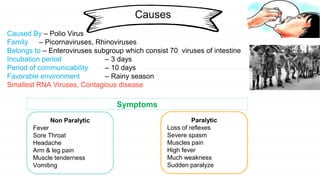
Caused By – Polio Virus
Family – Picornaviruses, Rhinoviruses
Belongs to – Enteroviruses subgroup which consist 70 viruses of intestine
Incubation period – 3 days
Period of communicability – 10 days
Favorable environment – Rainy season
Smallest RNA Viruses, Contagious disease
Non Paralytic
Fever
Sore Throat
Headache
Arm & leg pain
Muscle tenderness
Vomiting
Paralytic
Loss of reflexes
Severe spasm
Muscles pain
High fever
Much weakness
Sudden paralyze
Symptoms
Outcome
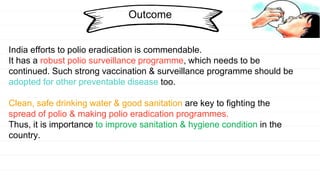
India efforts to polio eradication is commendable.
It has a robust polio surveillance programme, which needs to be
continued. Such strong vaccination & surveillance programme should be
adopted for other preventable disease too.
Clean, safe drinking water & good sanitation are key to fighting the
spread of polio & making polio eradication programmes.
Thus, it is importance to improve sanitation & hygiene condition in the
country.
THANKS !
Do you have any questions?
easyconceptkaushal@gmail.com
+91 9546688666

Pulse polio programme.pptx

  • 1.
    Social And Preventive Pharmacy PulsePolio Programme By Kaushal Kumar
  • 2.
    TABLE OF CONTENTS 0102 03 04 Introduction Objective Life Cycle Out Come
  • 3.
    Introduction Polio is aviral disease that destroys the nerve cells present in the spinal cord causing paralysis or muscle weakness to some part of the body. Pulse Polio Programme was launched in 1995 after a resolution for a global initiative of polio eradication was adopted by World Health Assembly (WHA) in 1988. Children in the age group of 0-5 years administered polio drops during National and Sub-national immunization rounds (in high risk areas) every year. About 172 million children are immunized during each National Immunization Day (NID).
  • 4.
    Objective  Achieving hundredper cent coverage under Oral Polio Vaccine.  To immunize children through improved social mobilization plan mop-up operations in areas where poliovirus has almost disappeared.  Maintain high level of morale among the public.  To immunise those children who are not earlier immunised or are partially immunized.  To boost the immunity of children already immunised  To replace disease carrying wild virus by harmless vaccine virus in the environment
  • 5.
    Polio Casein India Accordingto the Ministry of Health, the last polio case in the country was reported from Howrah district of west Bengal (13 January 2011). Type-1 Polio Virus WHO on 24th February 2012 removed India from the list of countries with active endemic wild polio virus transmission. Last case of Wild Polio Virus Type 2 in India was reported in 1999. On 27 March 2014, the World Health Organization (WHO) declared India a polio-free country, since no cases of wild polio been reported in for five years.
  • 6.
    Transmission The WHO definespolio or poliomyelitis as a highly infectious viral disease, which mainly affects young children. The virus is transmitted by person-to-person, spread mainly through the faecal-oral route or, less frequently , by a common vehicle (contaminated water or food), multiplies in the intestine, from where it can invade the nervous system & can cause paralysis. Under the programme, all states & Union territories have developed Rapid Response Team (RRT) to responed to any polio outbreak in the country. To prevent the virus from coming to India, the govt. has since March 2014 made the Oral Polio Vaccination (OPV) mandatory for those travelling between India & polio affected countries such as (Afghanistan, Nigeria, Pakistan, Kenya, Syria, Cameroon)
  • 7.
    World Polio Day WorldPolio Day was established by Rotary International on 24th Oct to celebrate the birth of Jonas Salk, who developed a vaccine against Poliomyelitis. Establishment of the Global Polio Eradication Initiative (GPEI) in 1988 reduce polio world wide by 99%.  Three individual & immunologically distinct wild poliovirus strains : Wild Polio Virus Type 1 (WPV1) Wild Polio Virus Type 2 (WPV2) Wild Polio Virus Type 3 (WPV3) They cause irreversible paralysis or even death.  Two types of vaccines to prevent infection. Oral Polio Vaccine - (OPV) Primary 3 dose (6, 10, 14) weeks and 1 booster dose at 16-24 months. Inactivated Polio Vaccine - (IPV) Additional dose along with 3rd dose of DPT under the UIP.
  • 8.
  • 9.
    Causes Caused By –Polio Virus Family – Picornaviruses, Rhinoviruses Belongs to – Enteroviruses subgroup which consist 70 viruses of intestine Incubation period – 3 days Period of communicability – 10 days Favorable environment – Rainy season Smallest RNA Viruses, Contagious disease Non Paralytic Fever Sore Throat Headache Arm & leg pain Muscle tenderness Vomiting Paralytic Loss of reflexes Severe spasm Muscles pain High fever Much weakness Sudden paralyze Symptoms
  • 10.
    Outcome India efforts topolio eradication is commendable. It has a robust polio surveillance programme, which needs to be continued. Such strong vaccination & surveillance programme should be adopted for other preventable disease too. Clean, safe drinking water & good sanitation are key to fighting the spread of polio & making polio eradication programmes. Thus, it is importance to improve sanitation & hygiene condition in the country.
  • 11.
    THANKS ! Do youhave any questions? easyconceptkaushal@gmail.com +91 9546688666