By :-
Akshit Manasvi Aman Deep
Roll no.-03 Roll no.-04
Introduction
Problem Statement
National Leprosy Eradication Programme
• Components
• Initiatives
• Referral Services
• Services in urban Areas
• Strategy
• Case detection
• Management
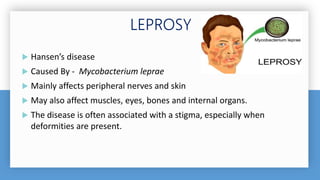
 Hansen’s disease
 Caused By - Mycobacterium leprae
 Mainly affects peripheral nerves and skin
 May also affect muscles, eyes, bones and internal organs.
 The disease is often associated with a stigma, especially when
deformities are present.
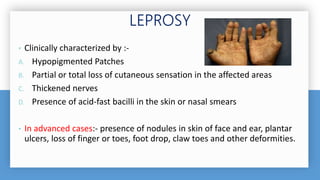
• Clinically characterized by :-
A. Hypopigmented Patches
B. Partial or total loss of cutaneous sensation in the affected areas
C. Thickened nerves
D. Presence of acid-fast bacilli in the skin or nasal smears
• In advanced cases:- presence of nodules in skin of face and ear, plantar
ulcers, loss of finger or toes, foot drop, claw toes and other deformities.
• 2,08,613 new cases of leprosy were detected in 2018.
• Registered prevalence was 184,194 cases in 2018.
• The number of relapse cases in 2016 were 2,749.
• The number of treatment cases were 11,947.
PROBLEM STATEMENT
WORLD
INDIA
Based on reports from States /UTs for year 2016-17
• A total of 1.35 lakh new cases were detected
• ANCDR =10.17 per lakh population.
• A total of 88,166 cases were on record as of 31st March,
2017.
• PR= 0.66 per 10,000
• In 2018, 1.2 lakh (1,20,334) new cases of leprosy were
detected in India.
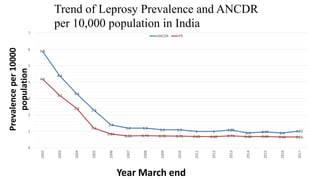
Trend of Leprosy Prevalence and ANCDR
per 10,000 population in India
5.9
4.4
3.3
2.3
1.4
1.2 1.2 1.1 1.1 1 1 1.09
0.9 0.97 0.9 1.02
4.2
3.2
2.4
1.2
0.84 0.72 0.74 0.72 0.71 0.69 0.68 0.73 0.68 0.69 0.66 0.66
0
1
2
3
4
5
6
7
2002
2003
2004
2005
2006
2007
2008
2009
2010
2011
2012
2013
2014
2015
2016
2017
ANCDR PR
Prevalenceper10000
population
Year March end
• In operation since 1955.
• To achieve control of Leprosy through early detection of cases and
Dapsone monotherapy.
• In 1980s ,Govt. of India declared its resolve to eradicate Leprosy by
year 2000.
• In 1983 the control programme was redesignated as - National
Leprosy “Eradication” programme with strategy based on
multidrug-chemotherapy.
NATIONAL LEPROSY CONTROL PROGRAMME
• The aim was to reduce case load to 1 or less than 1 per 10,000
population.
• After introduction of MDT, case load of Leprosy came down from
57.6 cases per 10,000 population in 1981 to less than 1 at
national level in December 2005.
• 34 states /UTs achieved status of leprosy elimination.
• Only 2 states /UTs Chhattisgarh and Dadra Nagar Haweli are yet
to achieve elimination.
• Bihar ,Goa, Chandigarh and Odisa who achieved elimination
status earlier,show PR>1 per 1000 population.
i. Decentralized integrated leprosy services through
general health care system;
ii. Capacity building of all general health services
functionaries;
iii. Intensified information ,education and communication;
iv. Prevention of disability and medical rehabilitation ; and
v. Intensified monitoring and supervision.
The components of the programme are as follows:-
MAJOR INITIATIVES
i. New case detection : main indicator of the programme
ii. Treatment completion rate : important indicator
iii. Intensive IEC campaign : “Towards Leprosy Free India” :
 early reporting of cases
 treatment completion
 provision of quality leprosy services
 reduction of stigma and discrimination towards patients
 awareness through mass media and local media
iv. Role of ASHA :-
Activities to be performed by ASHA
• Search for suspected case of leprosy i.e. before any sign of
disability appears.
• Follow up all cases for completion of treatment in scheduled time.
• Reference of cases to Health workers and PHCs.
• Advice and motivate self care practices to improve quality of life
and prevent deterioration.
• Spreading awareness.
• To facilitate the involvement of ASHA in programme, they are being paid
incentive money:
a) On confirmed diagnosis of case brought by them : Rs.250
b) An early case before onset of visible deformity : Rs.250
c) A new case with visible deformity: Rs.200
d) On completion of full course treatment within specified time :
PB Leprosy case : Rs.400
MB Leprosy case : Rs. 600
V. More emphasis on providing Disability Prevention and Medical
Rehabilition (DPMR) services to Leprosy patients.
a) Dressing material, supportive medicines and ulcer kits.
b) Microcellular rubber footwear for protection of insensitive feet.
c) 41 NGOS, 42 Govt. Medical Colleges strengthened for providing
reconstructive surgeries.
d) An amount of Rs.5000, provided as incentive to each Leprosy affected
person below poverty line undergoing reconstructive surgery.
e) Support of Rs.5000, also given to Govt. institutes per reconstructive
surgery conducted.
 Disability prevention and medical rehabilitation
Implementation of DPMR activities as per guidelines and
reporting its outcome
E.g. t/t of leprosy reaction , ulcer , physiotherapy , reconstructive
surgery and providing microcellular footwear.
Integrating DPMR services i.e. convergence of NLEP services
into NRHM facilitates this integration
To develop a referral system for prevention of disability services
Main activities are :-
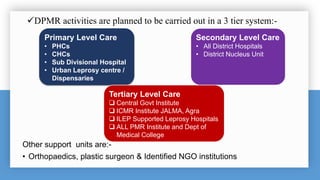
DPMR activities are planned to be carried out in a 3 tier system:-
Primary Level Care
• PHCs
• CHCs
• Sub Divisional Hospital
• Urban Leprosy centre /
Dispensaries
Tertiary Level Care
 Central Govt Institute
 ICMR Institute JALMA, Agra
 ILEP Supported Leprosy Hospitals
 ALL PMR Institute and Dept of
Medical College
Secondary Level Care
• All District Hospitals
• District Nucleus Unit
Other support units are:-
• Orthopaedics, plastic surgeon & Identified NGO institutions
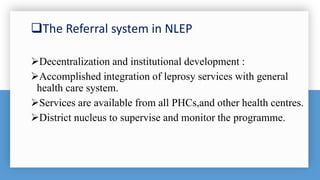
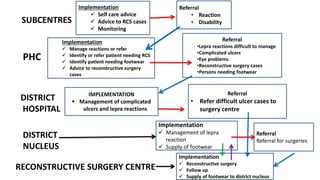
The Referral system in NLEP
Decentralization and institutional development :
Accomplished integration of leprosy services with general
health care system.
Services are available from all PHCs,and other health centres.
District nucleus to supervise and monitor the programme.
Referral
• Reaction
• Disability
Implementation
 Manage reactions or refer
 Identify or refer patient needing RCS
 Identify patient needing footwear
 Advice to reconstructive surgery
cases
Referral
•Lepra reactions difficult to manage
•Complicated ulcers
•Eye problems
•Reconstructive surgery cases
•Persons needing footwear
IMPLEMENTATION
 Management of complicated
ulcers and lepra reactions
Referral
• Refer difficult ulcer cases to
surgery centre
Implementation
 Management of lepra
reaction
 Supply of footwear
Implementation
 Self care advice
 Advice to RCS cases
 Monitoring
Referral
Referral for surgeries
Implementation
 Reconstructive surgery
 Follow up
 Supply of footwear to district nucleus
SUBCENTRES
PHC
DISTRICT
HOSPITAL
DISTRICT
NUCLEUS
RECONSTRUCTIVE SURGERY CENTRE
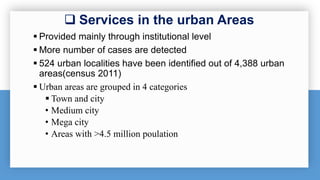
 Services in the urban Areas
 Provided mainly through institutional level
 More number of cases are detected
 524 urban localities have been identified out of 4,388 urban
areas(census 2011)
 Urban areas are grouped in 4 categories
 Town and city
• Medium city
• Mega city
• Areas with >4.5 million poulation
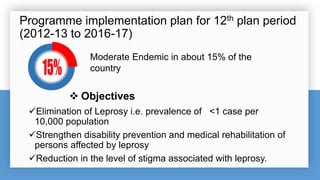
Programme implementation plan for 12th plan period
(2012-13 to 2016-17)
Elimination of Leprosy i.e. prevalence of <1 case per
10,000 population
Strengthen disability prevention and medical rehabilitation of
persons affected by leprosy
Reduction in the level of stigma associated with leprosy.
Moderate Endemic in about 15% of the
country
 Objectives
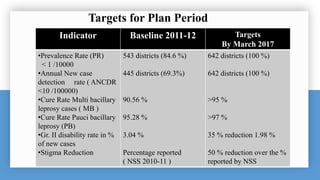
Targets for Plan Period
Indicator Baseline 2011-12 Targets
By March 2017
•Prevalence Rate (PR)
< 1 /10000
•Annual New case
detection rate ( ANCDR
<10 /100000)
•Cure Rate Multi bacillary
leprosy cases ( MB )
•Cure Rate Pauci bacillary
leprosy (PB)
•Gr. II disability rate in %
of new cases
•Stigma Reduction
543 districts (84.6 %)
445 districts (69.3%)
90.56 %
95.28 %
3.04 %
Percentage reported
( NSS 2010-11 )
642 districts (100 %)
>95 %
>97 %
35 % reduction 1.98 %
50 % reduction over the %
reported by NSS
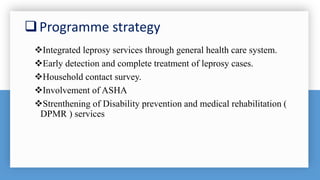
Programme strategy
Integrated leprosy services through general health care system.
Early detection and complete treatment of leprosy cases.
Household contact survey.
Involvement of ASHA
Strenthening of Disability prevention and medical rehabilitation (
DPMR ) services
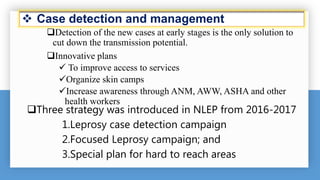
 Case detection and management
Detection of the new cases at early stages is the only solution to
cut down the transmission potential.
Innovative plans
 To improve access to services
Organize skin camps
Increase awareness through ANM, AWW, ASHA and other
health workers
Three strategy was introduced in NLEP from 2016-2017
1.Leprosy case detection campaign
2.Focused Leprosy campaign; and
3.Special plan for hard to reach areas
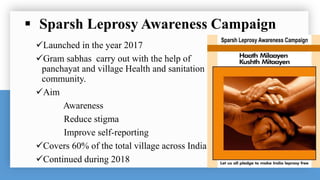
 Sparsh Leprosy Awareness Campaign
Launched in the year 2017
Gram sabhas carry out with the help of
panchayat and village Health and sanitation
community.
Aim
Awareness
Reduce stigma
Improve self-reporting
Covers 60% of the total village across India
Continued during 2018
 Incentive to patient
• Rs 8000/- will be paid to all patients affected by leprosy
undergoing major reconstructive surgery .
• Payment made by the district leprosy officer.
 Survey Education and Treatment
• NGO support mainly required for follow up of under treatment
cases in urban and difficult to reach areas.
 IEC- Information Education & Communication
Focus on –
Behavior change in community against stigma and discrimination
against leprosy affected person.
Making the public aware about the
• Correction of deformity through surgery.
• Leprosy affected person can live a normal life with family.
• Availability of MDT
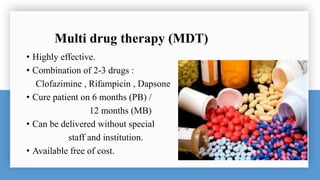
Multi drug therapy (MDT)
• Highly effective.
• Combination of 2-3 drugs :
Clofazimine , Rifampicin , Dapsone
• Cure patient on 6 months (PB) /
12 months (MB)
• Can be delivered without special
staff and institution.
• Available free of cost.
BIBLIOGRAPHY
Park’s textbook of Preventive and
social Medicine by K.PARK
NLEP

NLEP

  • 2.
    By :- Akshit ManasviAman Deep Roll no.-03 Roll no.-04
  • 3.
    Introduction Problem Statement National LeprosyEradication Programme • Components • Initiatives • Referral Services • Services in urban Areas • Strategy • Case detection • Management
  • 4.
     Hansen’s disease Caused By - Mycobacterium leprae  Mainly affects peripheral nerves and skin  May also affect muscles, eyes, bones and internal organs.  The disease is often associated with a stigma, especially when deformities are present.
  • 5.
    • Clinically characterizedby :- A. Hypopigmented Patches B. Partial or total loss of cutaneous sensation in the affected areas C. Thickened nerves D. Presence of acid-fast bacilli in the skin or nasal smears • In advanced cases:- presence of nodules in skin of face and ear, plantar ulcers, loss of finger or toes, foot drop, claw toes and other deformities.
  • 6.
    • 2,08,613 newcases of leprosy were detected in 2018. • Registered prevalence was 184,194 cases in 2018. • The number of relapse cases in 2016 were 2,749. • The number of treatment cases were 11,947. PROBLEM STATEMENT WORLD
  • 7.
    INDIA Based on reportsfrom States /UTs for year 2016-17 • A total of 1.35 lakh new cases were detected • ANCDR =10.17 per lakh population. • A total of 88,166 cases were on record as of 31st March, 2017. • PR= 0.66 per 10,000 • In 2018, 1.2 lakh (1,20,334) new cases of leprosy were detected in India.
  • 8.
    Trend of LeprosyPrevalence and ANCDR per 10,000 population in India 5.9 4.4 3.3 2.3 1.4 1.2 1.2 1.1 1.1 1 1 1.09 0.9 0.97 0.9 1.02 4.2 3.2 2.4 1.2 0.84 0.72 0.74 0.72 0.71 0.69 0.68 0.73 0.68 0.69 0.66 0.66 0 1 2 3 4 5 6 7 2002 2003 2004 2005 2006 2007 2008 2009 2010 2011 2012 2013 2014 2015 2016 2017 ANCDR PR Prevalenceper10000 population Year March end
  • 9.
    • In operationsince 1955. • To achieve control of Leprosy through early detection of cases and Dapsone monotherapy. • In 1980s ,Govt. of India declared its resolve to eradicate Leprosy by year 2000. • In 1983 the control programme was redesignated as - National Leprosy “Eradication” programme with strategy based on multidrug-chemotherapy. NATIONAL LEPROSY CONTROL PROGRAMME
  • 10.
    • The aimwas to reduce case load to 1 or less than 1 per 10,000 population. • After introduction of MDT, case load of Leprosy came down from 57.6 cases per 10,000 population in 1981 to less than 1 at national level in December 2005. • 34 states /UTs achieved status of leprosy elimination. • Only 2 states /UTs Chhattisgarh and Dadra Nagar Haweli are yet to achieve elimination. • Bihar ,Goa, Chandigarh and Odisa who achieved elimination status earlier,show PR>1 per 1000 population.
  • 11.
    i. Decentralized integratedleprosy services through general health care system; ii. Capacity building of all general health services functionaries; iii. Intensified information ,education and communication; iv. Prevention of disability and medical rehabilitation ; and v. Intensified monitoring and supervision. The components of the programme are as follows:-
  • 12.
    MAJOR INITIATIVES i. Newcase detection : main indicator of the programme ii. Treatment completion rate : important indicator iii. Intensive IEC campaign : “Towards Leprosy Free India” :  early reporting of cases  treatment completion  provision of quality leprosy services  reduction of stigma and discrimination towards patients  awareness through mass media and local media
  • 13.
    iv. Role ofASHA :- Activities to be performed by ASHA • Search for suspected case of leprosy i.e. before any sign of disability appears. • Follow up all cases for completion of treatment in scheduled time. • Reference of cases to Health workers and PHCs. • Advice and motivate self care practices to improve quality of life and prevent deterioration. • Spreading awareness.
  • 14.
    • To facilitatethe involvement of ASHA in programme, they are being paid incentive money: a) On confirmed diagnosis of case brought by them : Rs.250 b) An early case before onset of visible deformity : Rs.250 c) A new case with visible deformity: Rs.200 d) On completion of full course treatment within specified time : PB Leprosy case : Rs.400 MB Leprosy case : Rs. 600
  • 15.
    V. More emphasison providing Disability Prevention and Medical Rehabilition (DPMR) services to Leprosy patients. a) Dressing material, supportive medicines and ulcer kits. b) Microcellular rubber footwear for protection of insensitive feet. c) 41 NGOS, 42 Govt. Medical Colleges strengthened for providing reconstructive surgeries. d) An amount of Rs.5000, provided as incentive to each Leprosy affected person below poverty line undergoing reconstructive surgery. e) Support of Rs.5000, also given to Govt. institutes per reconstructive surgery conducted.
  • 16.
     Disability preventionand medical rehabilitation Implementation of DPMR activities as per guidelines and reporting its outcome E.g. t/t of leprosy reaction , ulcer , physiotherapy , reconstructive surgery and providing microcellular footwear. Integrating DPMR services i.e. convergence of NLEP services into NRHM facilitates this integration To develop a referral system for prevention of disability services Main activities are :-
  • 17.
    DPMR activities areplanned to be carried out in a 3 tier system:- Primary Level Care • PHCs • CHCs • Sub Divisional Hospital • Urban Leprosy centre / Dispensaries Tertiary Level Care  Central Govt Institute  ICMR Institute JALMA, Agra  ILEP Supported Leprosy Hospitals  ALL PMR Institute and Dept of Medical College Secondary Level Care • All District Hospitals • District Nucleus Unit Other support units are:- • Orthopaedics, plastic surgeon & Identified NGO institutions
  • 18.
    The Referral systemin NLEP Decentralization and institutional development : Accomplished integration of leprosy services with general health care system. Services are available from all PHCs,and other health centres. District nucleus to supervise and monitor the programme.
  • 19.
    Referral • Reaction • Disability Implementation Manage reactions or refer  Identify or refer patient needing RCS  Identify patient needing footwear  Advice to reconstructive surgery cases Referral •Lepra reactions difficult to manage •Complicated ulcers •Eye problems •Reconstructive surgery cases •Persons needing footwear IMPLEMENTATION  Management of complicated ulcers and lepra reactions Referral • Refer difficult ulcer cases to surgery centre Implementation  Management of lepra reaction  Supply of footwear Implementation  Self care advice  Advice to RCS cases  Monitoring Referral Referral for surgeries Implementation  Reconstructive surgery  Follow up  Supply of footwear to district nucleus SUBCENTRES PHC DISTRICT HOSPITAL DISTRICT NUCLEUS RECONSTRUCTIVE SURGERY CENTRE
  • 20.
     Services inthe urban Areas  Provided mainly through institutional level  More number of cases are detected  524 urban localities have been identified out of 4,388 urban areas(census 2011)  Urban areas are grouped in 4 categories  Town and city • Medium city • Mega city • Areas with >4.5 million poulation
  • 21.
    Programme implementation planfor 12th plan period (2012-13 to 2016-17) Elimination of Leprosy i.e. prevalence of <1 case per 10,000 population Strengthen disability prevention and medical rehabilitation of persons affected by leprosy Reduction in the level of stigma associated with leprosy. Moderate Endemic in about 15% of the country  Objectives
  • 22.
    Targets for PlanPeriod Indicator Baseline 2011-12 Targets By March 2017 •Prevalence Rate (PR) < 1 /10000 •Annual New case detection rate ( ANCDR <10 /100000) •Cure Rate Multi bacillary leprosy cases ( MB ) •Cure Rate Pauci bacillary leprosy (PB) •Gr. II disability rate in % of new cases •Stigma Reduction 543 districts (84.6 %) 445 districts (69.3%) 90.56 % 95.28 % 3.04 % Percentage reported ( NSS 2010-11 ) 642 districts (100 %) 642 districts (100 %) >95 % >97 % 35 % reduction 1.98 % 50 % reduction over the % reported by NSS
  • 23.
    Programme strategy Integrated leprosyservices through general health care system. Early detection and complete treatment of leprosy cases. Household contact survey. Involvement of ASHA Strenthening of Disability prevention and medical rehabilitation ( DPMR ) services
  • 24.
     Case detectionand management Detection of the new cases at early stages is the only solution to cut down the transmission potential. Innovative plans  To improve access to services Organize skin camps Increase awareness through ANM, AWW, ASHA and other health workers Three strategy was introduced in NLEP from 2016-2017 1.Leprosy case detection campaign 2.Focused Leprosy campaign; and 3.Special plan for hard to reach areas
  • 25.
     Sparsh LeprosyAwareness Campaign Launched in the year 2017 Gram sabhas carry out with the help of panchayat and village Health and sanitation community. Aim Awareness Reduce stigma Improve self-reporting Covers 60% of the total village across India Continued during 2018
  • 26.
     Incentive topatient • Rs 8000/- will be paid to all patients affected by leprosy undergoing major reconstructive surgery . • Payment made by the district leprosy officer.  Survey Education and Treatment • NGO support mainly required for follow up of under treatment cases in urban and difficult to reach areas.
  • 27.
     IEC- InformationEducation & Communication Focus on – Behavior change in community against stigma and discrimination against leprosy affected person. Making the public aware about the • Correction of deformity through surgery. • Leprosy affected person can live a normal life with family. • Availability of MDT
  • 28.
    Multi drug therapy(MDT) • Highly effective. • Combination of 2-3 drugs : Clofazimine , Rifampicin , Dapsone • Cure patient on 6 months (PB) / 12 months (MB) • Can be delivered without special staff and institution. • Available free of cost.
  • 29.
    BIBLIOGRAPHY Park’s textbook ofPreventive and social Medicine by K.PARK