Disease Transmission

            &
    Infection Control
Disease Transmission

    Microorganisms
Microbiology
• Microbiology is the study of microorganisms
• micro means microscopically small
• bio means living organisms
• The existence of microorganisms is not
  usually noticed unless they cause illness
• Most microorganisms do not produce human
  illness
• Beneficial microorganisms are used in the
  production of cheese and yogurt
Disease Transmission
•    Five major groups of microorganisms
2.   Bacteria
3.   Rickettsiae
4.   Viruses
5.   Protozoa
6.   Fungi
Bacteria
• One celled microorganisms
• Humans host a variety of bacteria at all
  times
• The skin, respiratory tract and
  gastrointestinal tract are inhabited by
  harmless bacteria
Diseases Caused by Bacteria
•   Dental Decay
•   Periodontal Disease
•   Pneumonia
•   Rheumatic Fever
•   Syphilis
•   Tuberculosis
Rickettsiae
• Transmitted to humans by bite of an
  infected insect ( lice , fleas, ticks, and
  mosquitoes)
• Rocky Mountain spotted fever
• Typhus
• Not of concern in dentistry
Protozoa
• Found in freshwater and marine
  habitats and in moist soil
• May be responsible for intestinal
  infections in humans
• Not of concern in dentistry
Viruses
• Require an electron microscope to see them
• Much smaller than bacteria
• Parasitic – live and multiply only inside an
  appropriate host cell
• Not affected by antibiotics
• Diseases caused by viruses include: AIDS,
  Hepatitis, Herpes, Polio, West Nile, SARS
Fungi
• Plants such as mushrooms, yeasts and
  moulds that lack chlorophyll
• Fungi are not green
• Two divisions: yeasts and moulds
• Oral Candidiasis is a common yeast
  found in the oral cavity of about ½ the
  patient population
The Chain of Infection
• Virulence – refers to the degree of strength of
  that organism in its ability to produce disease
• Numbers – there must be a high enough
  number of microorganisms present to
  overwhelm the body’s defenses
• Susceptible host – is a person who is unable
  to resist infection
• Portal of Entry – means of entering the body
  such as a needlestick
Universal Precautions
• The basis of Universal Precautions is
  acceptance that blood and certain body
  fluids of all patients are considered
  potentially infectious for HIV, Hepatitis B
  and all other Bloodborne pathogens.
• Not all patients with infectious diseases
  can be identified by obtaining a medical
  history.
Routes of Transmission
Airborne transmission
• Aerosol spray – dental handpiece
• Mists – ultrasonic scaler
• Spatter – from saliva
Cross Contamination
• Food Transmission
• Many diseases are transmitted by
  contaminated food that has not been cooked
  or refrigerated properly
• Water may have been contaminated with
  human or animal fecal material
• TB, botulism and staphylococcal and
  streptococcal infections are spread this way
Fecal –Oral
• Occurs most often among healthcare
  workers , day care workers, and by
  careless food handlers
• Prevented by proper handwashing after
  using the toilet
• May be transmitted by touching another
  person or contact with contaminated
  surfaces or food
Dental Office
• Improperly sterilized instruments and
  equipment can transfer all bloodborne
  diseases
• Dental treatment often involves contact
  with blood and always with saliva,
  bloodborne diseases are of major
  concern
• HCV, HBC, HIV
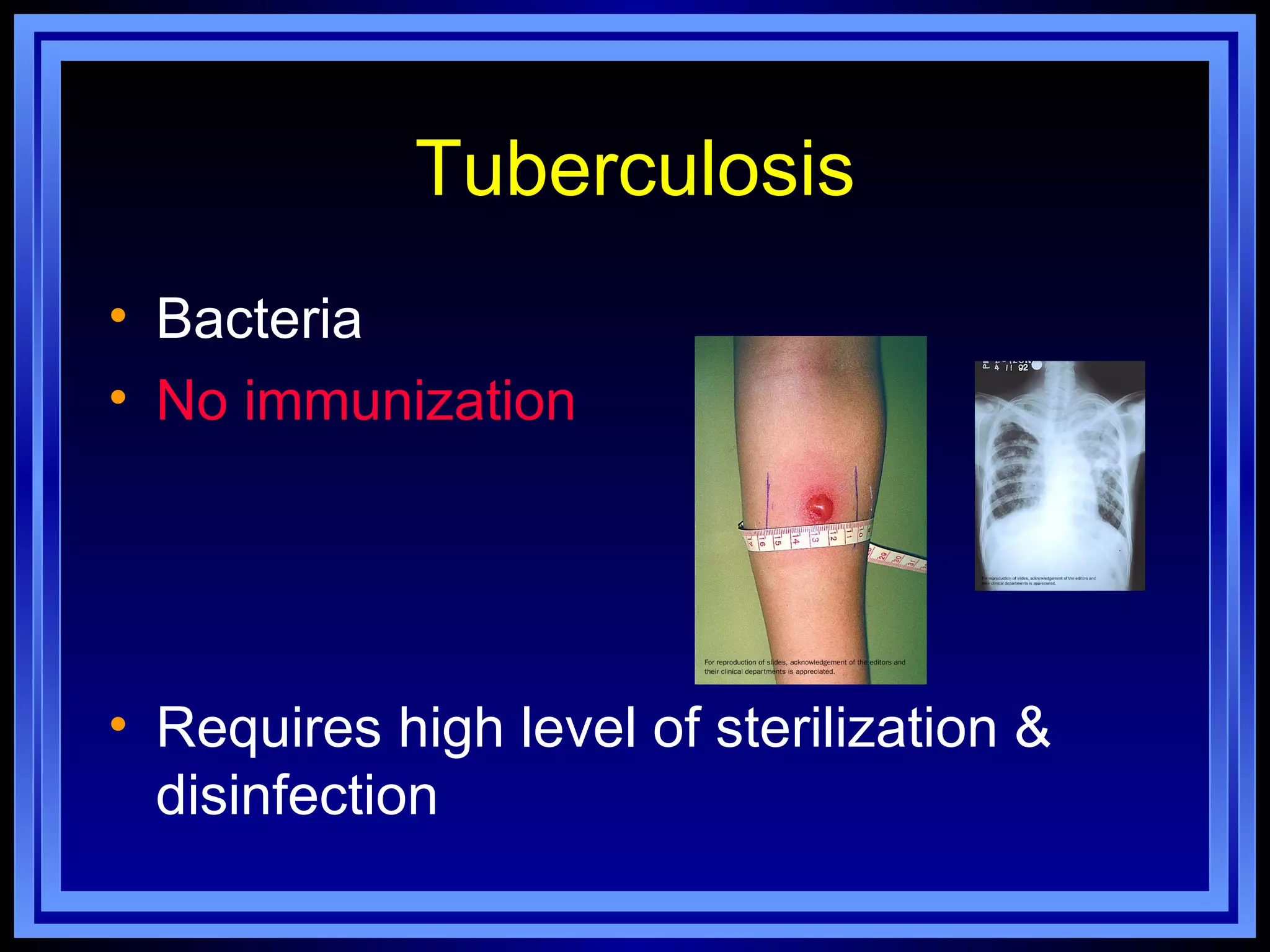
Tuberculosis
• Bacteria
• No immunization


• Requires high level of sterilization &
  disinfection
HAV
•   Acute Infective Hepatitis A
•   Liver disease
•   Found in stool
•   No carrier state
•   Transmission is fecal/oral route
•   Prevented by good personal hygiene
•   Instrument sterilization
•   Vaccination
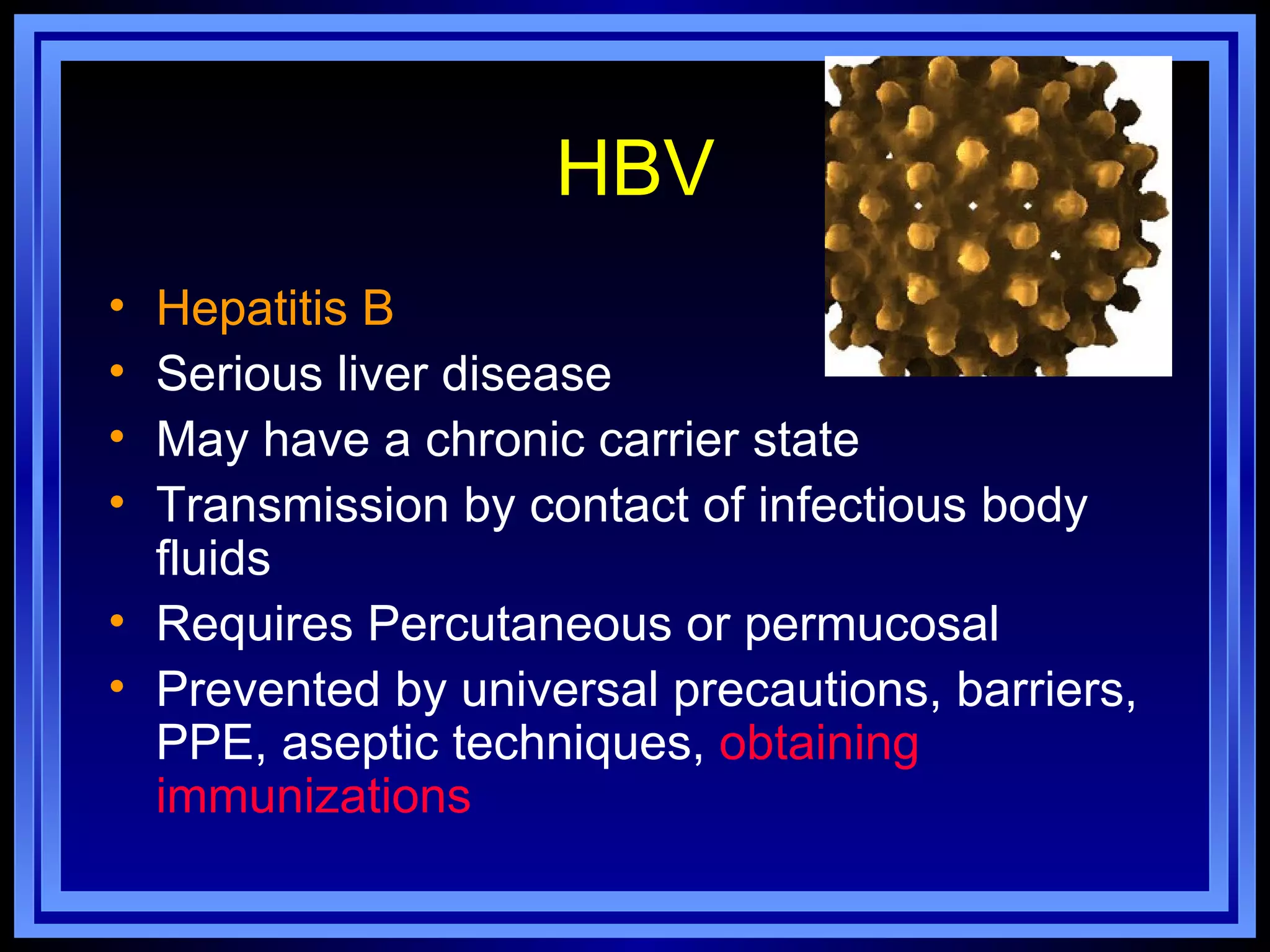
HBV
• Hepatitis B
• Serious liver disease
• May have a chronic carrier state
• Transmission by contact of infectious body
  fluids
• Requires Percutaneous or permucosal
• Prevented by universal precautions, barriers,
  PPE, aseptic techniques, obtaining
  immunizations
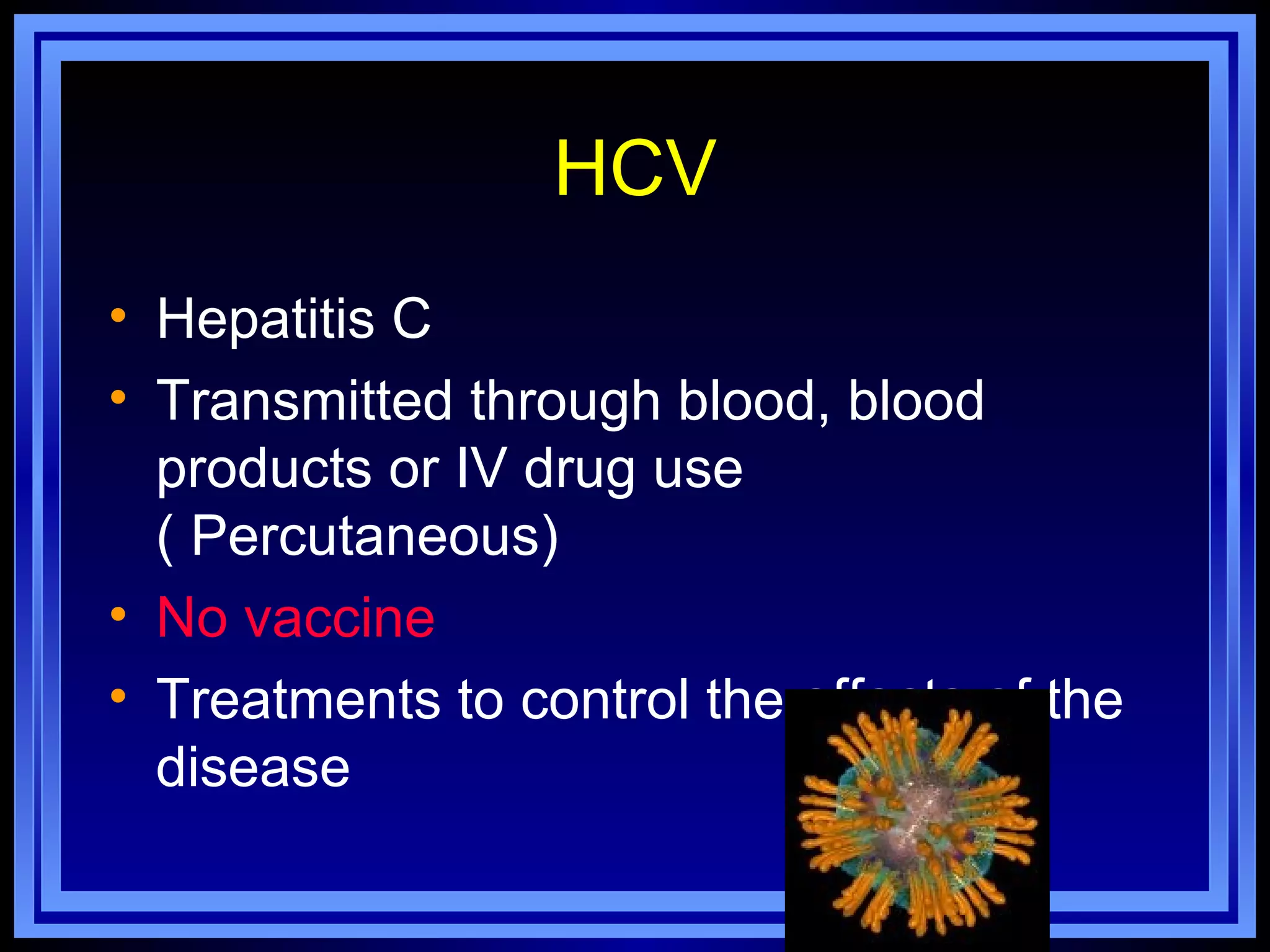
HCV
• Hepatitis C
• Transmitted through blood, blood
  products or IV drug use
  ( Percutaneous)
• No vaccine
• Treatments to control the effects of the
  disease
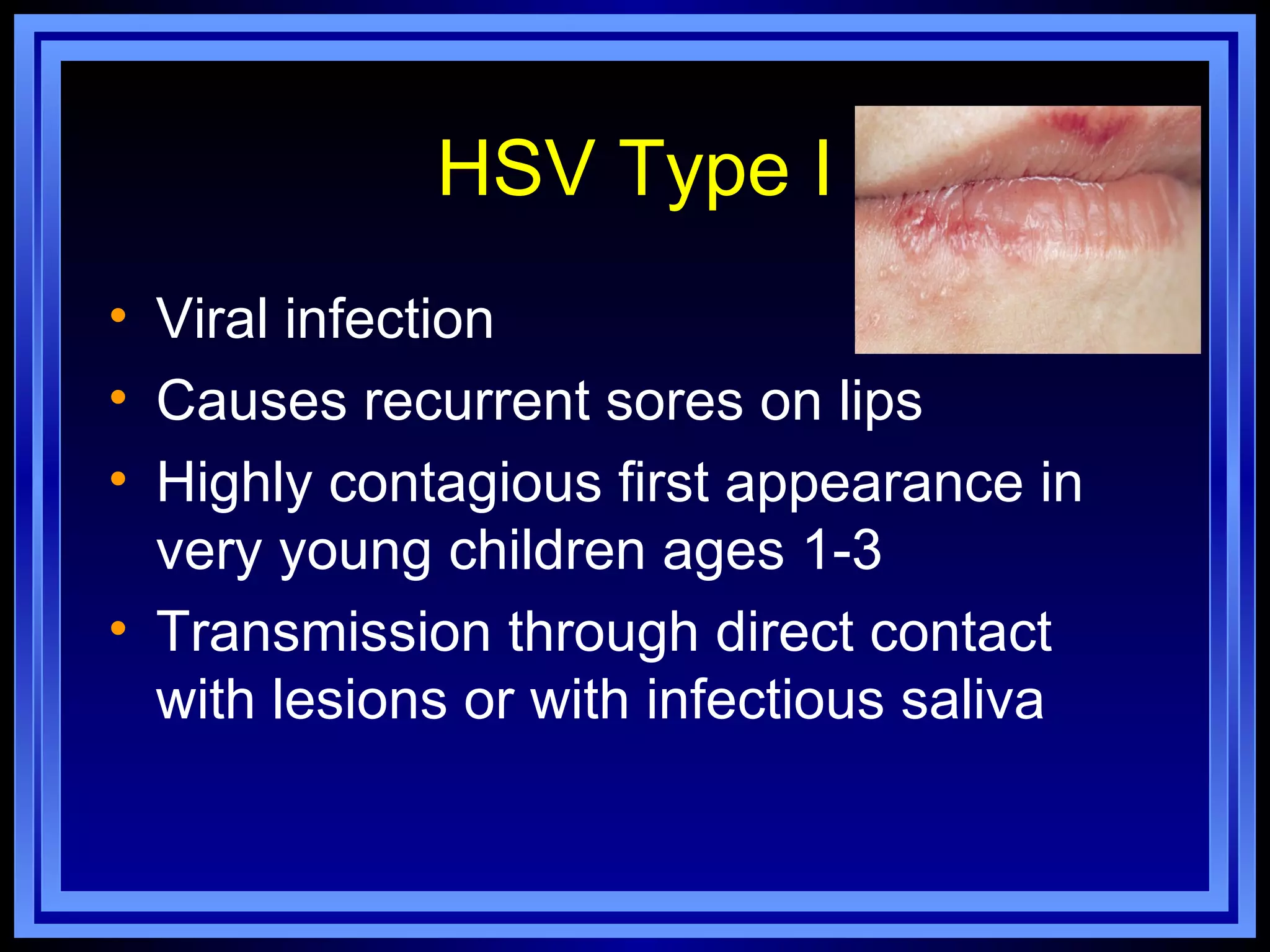
HSV Type I
• Viral infection
• Causes recurrent sores on lips
• Highly contagious first appearance in
  very young children ages 1-3
• Transmission through direct contact
  with lesions or with infectious saliva
HSV Type II
• Genital Herpes
• Most common STD in the U.S.
• Transmitted only during occurrences of
  the lesions
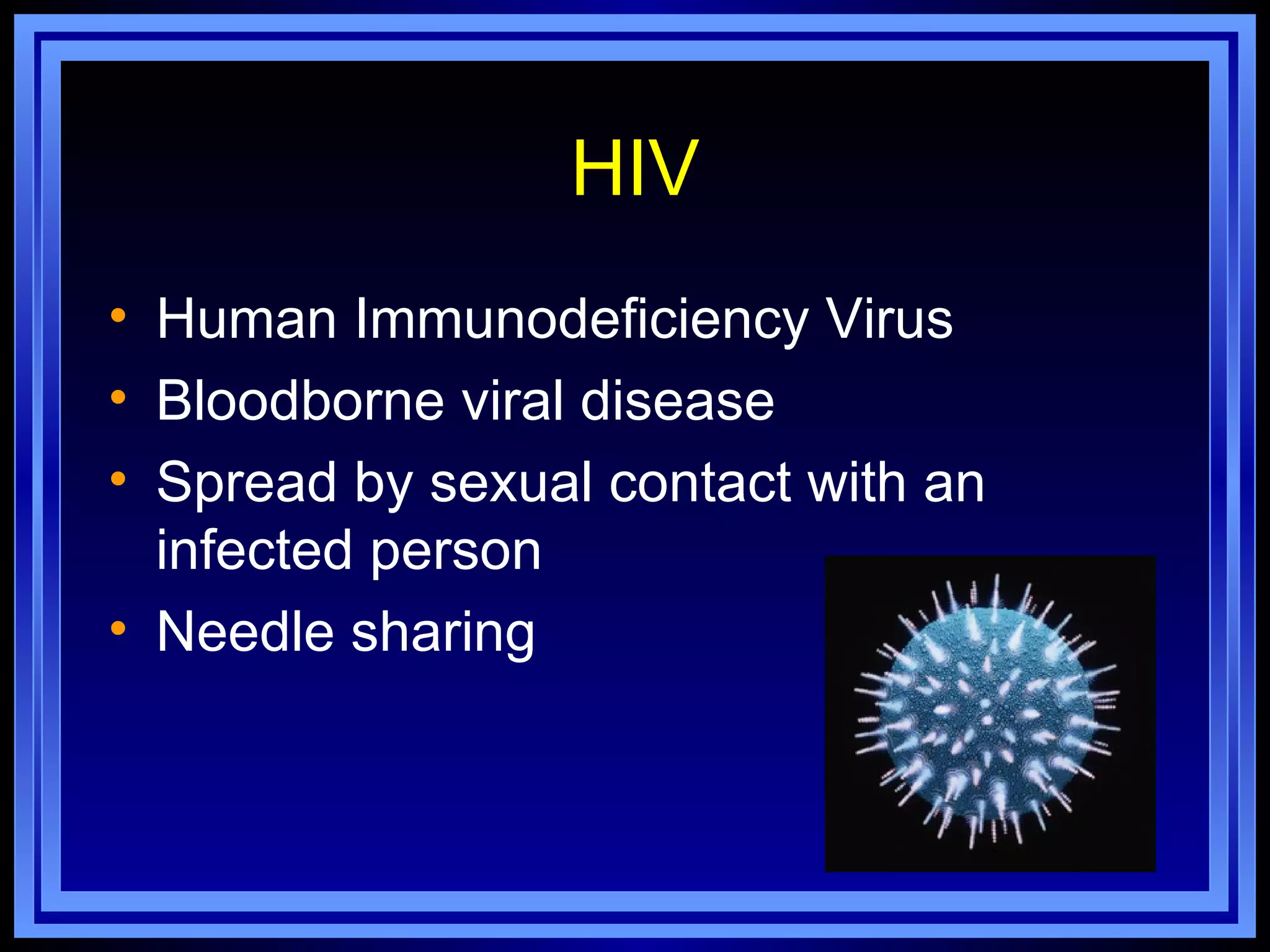
HIV
• Human Immunodeficiency Virus
• Bloodborne viral disease
• Spread by sexual contact with an
  infected person
• Needle sharing
Preventing Disease Transmission

• Immunization – Hepatitis B, MMR &
  influenza
• Handwashing Protocols
• Office Hygiene
• Pre cleaning – remove bioburden that
  could inactivate disinfectant
Infection Control
• Sterilization: process that kills all
  microorganisms
• If a surface is not clean, it cannot be
  disinfected.
• If a surface cannot be easily &
  thoroughly cleaned & disinfected it
  should have barrier protection
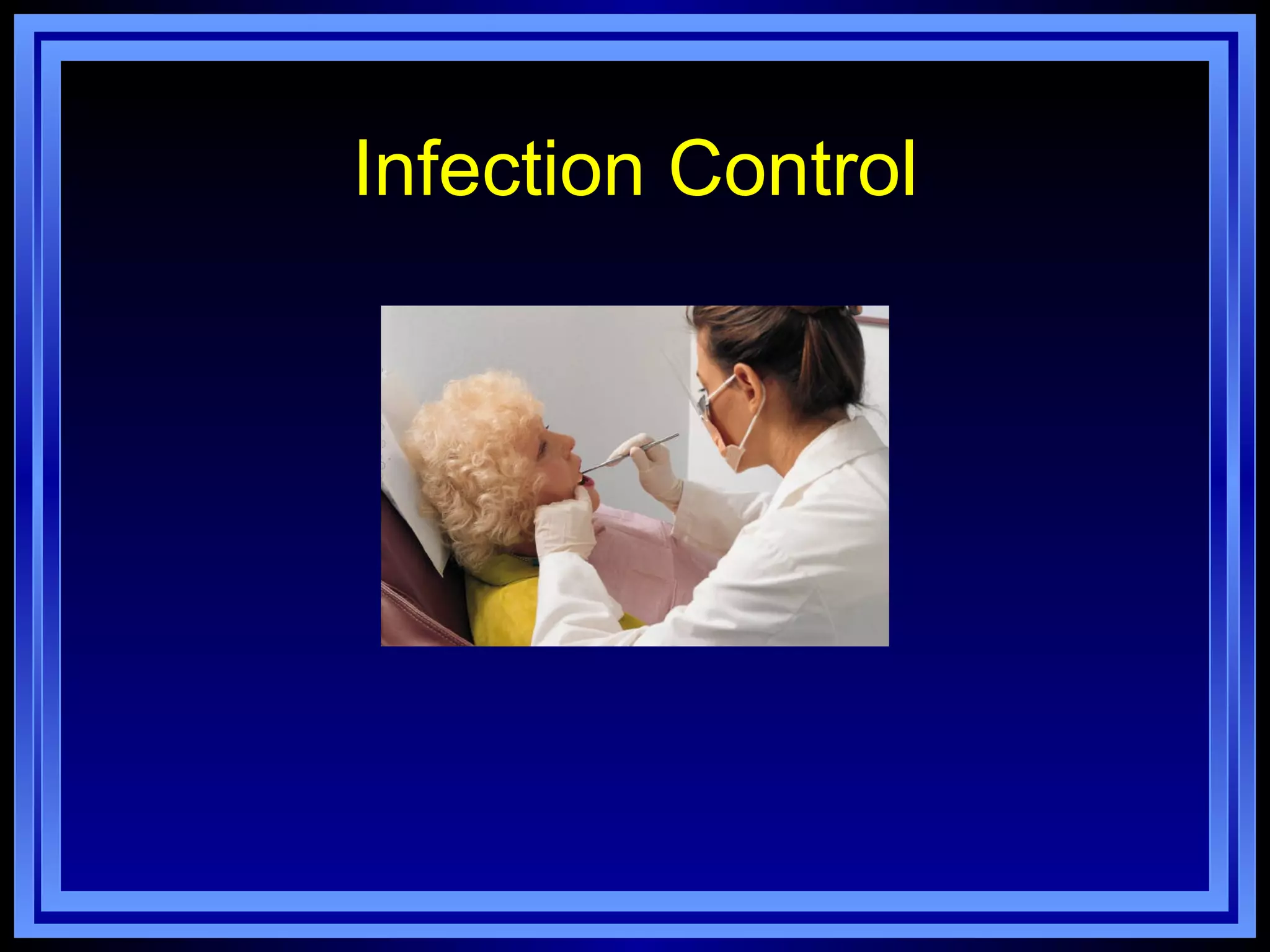
Infection Control
Sterilization Techniques
• Asepsis = the product of sterilization
• Sterilization destroys all microbial forms
  including bacterial spores
• All reusable items must be heat
  sterilized
Terminology
• Sterilize: process where all forms of life
  are COMPLETELY destroyed
• Disinfect: process where some forms of
  life are destroyed
• Sanitize: process that few forms of life
  are destroyed
Sterilization
1.    Steam Autoclave
2.   Chemical Vapor Sterilization
3.   Dry Heat Oven
4.   Chemical Immersion
Steam Autoclave Sterilization
• Sterilizes dental instruments by means
  of steam under pressure
• Rapidly kills all microorganisms
• Disadvantage is that the moisture may
  cause corrosion on some high carbon
  steel instruments
Chemical Vapor Sterilization
• Similar to autoclaving except a
  combination of chemicals is used
  instead of water
• Does not rust, dull, or corrode
  instruments if absolutely dry
• Chemical vapors can be irritating
Dry Heat Sterilization
• Operate by heating up air and
  transferring that heat from the air to the
  instruments
• Requires higher temperatures than
  steam or chemical vapor sterilization
• Instruments will not rust
• Static air and forced air
• Toaster oven is NOT adequate
Chemical Liquid Sterilization
• For items that will be damaged by heat
• Requires a 10 hour contact time
• Post sterilization procedures are
  essential
• Must be used full strength
• Replace solutions as recommended by
  the manufacturer
Disinfection
• Process that kills disease causing
  microorganisms, but not necessarily all
  microbial life
• Disinfectant: chemical used to reduce
  or lower the number of microorganisms
  on inanimate objects
• Applied to countertops and dental chair
Disinfectant Solutions
• Glutaraldehydes          • Iodophors
• High level               • Intermediate level
  disinfectant/sterilant     disinfectant
• Times for disinfection   • Effective within 5 – 10
  range from 10 – 90         minutes
  minutes                  • Contain iodine
• Generally used as an     • May discolor clothing or
  immersion disinfectant     other surfaces
Disinfectants
• Synthetic Phenol          • Sodium Hypochlorite
• Broad spectrum activity   • Intermediate level
• Surfaces must be            disinfectant
  cleaned first             • Main ingredient in
• Can be used on metal        bleach
  glass rubber or plastic   • Not EPA registered so
                              is NO longer a
                              recommended product
                              for use as a disinfectant
                              in a dental setting
Performing Treatment Room
       Cleaning & Disinfection
1. Personal Protective Equipment
2. Preclean with the appropriate product
3. Spray the paper towel or gauze
4. Vigorously wipe the surface to be cleaned
5. Spray a fresh paper towel or gauze and this
   time let the surface remain moist for the
   recommended time for tuberculocidal action
6. Usually 10 minutes
Barriers
• Useful to cover equipment and
  surfaces that are difficult to clean and
  disinfect
• Should be resistant to fluids
• Prevents contamination when properly
  placed
• Changed for each patient ( mask,
  gloves)
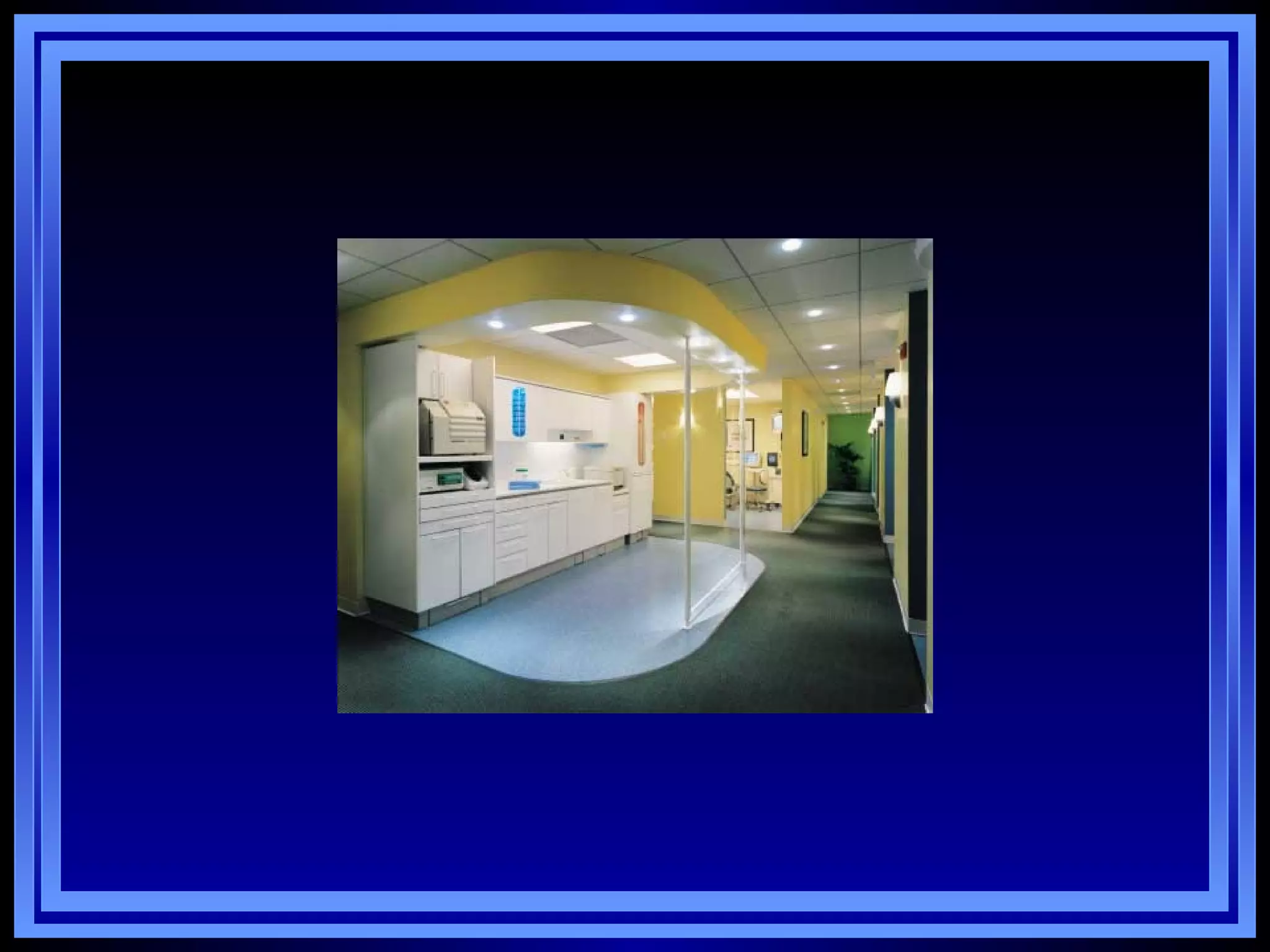
Instrument Processing
• Protective clothing, mask, eyewear and
  utility gloves
• Soiled instruments are processed in a
  single loop or workflow pattern
• From dirty to clean to sterile to storage
  without ever doubling back
Ultrasonic Cleaning
• Used to loosen and remove debris from instruments
• Reduces hand injuries from cuts and punctures
• Produces sound waves which can travel through
  metal & glass
• Causes cavitation ( formation of bubbles in liquid)
• Implosion = mechanical cleaning action of bursting
  bubbles
• Combined with chemical action of the solution
  removes the debris from the instruments
• 16 times more effective than scrubbing by hand
Biologic Monitoring
• Spore testing
• Only way to determine if sterilization has
  occurred
• Strips of paper contain harmless bacterial
  spores ( heat resistant)
• Placed inside instrument packs during normal
  operation
• Sent to UBC for culturing and a report is sent
  back
Maintaining Infection Control
          While Gloved
• During dental procedures it may be
  necessary to touch surfaces or objects
• Use a barrier or cotton forceps to
  minimize the possibility of cross-
  contamination
• Limit operatory contamination by being
  prepared for treatment
Mini - paper
Break into pairs and choose one topic
• Explain Universal Precautions
• Explain Biologic monitoring
• Explain Ultrasonic cleaning
• Explain Disinfection
Conclusion
• Discuss your mini – paper with the
  class

How much could you recall?
Was the PowerPoint helpful for recalling
 the information?
Would you like this type of format again?
Thank you

Infection control powerpoint 1

  • 1.
    Disease Transmission & Infection Control
  • 2.
    Disease Transmission Microorganisms
  • 3.
    Microbiology • Microbiology isthe study of microorganisms • micro means microscopically small • bio means living organisms • The existence of microorganisms is not usually noticed unless they cause illness • Most microorganisms do not produce human illness • Beneficial microorganisms are used in the production of cheese and yogurt
  • 4.
    Disease Transmission • Five major groups of microorganisms 2. Bacteria 3. Rickettsiae 4. Viruses 5. Protozoa 6. Fungi
  • 5.
    Bacteria • One celledmicroorganisms • Humans host a variety of bacteria at all times • The skin, respiratory tract and gastrointestinal tract are inhabited by harmless bacteria
  • 6.
    Diseases Caused byBacteria • Dental Decay • Periodontal Disease • Pneumonia • Rheumatic Fever • Syphilis • Tuberculosis
  • 7.
    Rickettsiae • Transmitted tohumans by bite of an infected insect ( lice , fleas, ticks, and mosquitoes) • Rocky Mountain spotted fever • Typhus • Not of concern in dentistry
  • 8.
    Protozoa • Found infreshwater and marine habitats and in moist soil • May be responsible for intestinal infections in humans • Not of concern in dentistry
  • 9.
    Viruses • Require anelectron microscope to see them • Much smaller than bacteria • Parasitic – live and multiply only inside an appropriate host cell • Not affected by antibiotics • Diseases caused by viruses include: AIDS, Hepatitis, Herpes, Polio, West Nile, SARS
  • 10.
    Fungi • Plants suchas mushrooms, yeasts and moulds that lack chlorophyll • Fungi are not green • Two divisions: yeasts and moulds • Oral Candidiasis is a common yeast found in the oral cavity of about ½ the patient population
  • 11.
    The Chain ofInfection • Virulence – refers to the degree of strength of that organism in its ability to produce disease • Numbers – there must be a high enough number of microorganisms present to overwhelm the body’s defenses • Susceptible host – is a person who is unable to resist infection • Portal of Entry – means of entering the body such as a needlestick
  • 12.
    Universal Precautions • Thebasis of Universal Precautions is acceptance that blood and certain body fluids of all patients are considered potentially infectious for HIV, Hepatitis B and all other Bloodborne pathogens. • Not all patients with infectious diseases can be identified by obtaining a medical history.
  • 13.
  • 14.
    Airborne transmission • Aerosolspray – dental handpiece • Mists – ultrasonic scaler • Spatter – from saliva
  • 15.
    Cross Contamination • FoodTransmission • Many diseases are transmitted by contaminated food that has not been cooked or refrigerated properly • Water may have been contaminated with human or animal fecal material • TB, botulism and staphylococcal and streptococcal infections are spread this way
  • 16.
    Fecal –Oral • Occursmost often among healthcare workers , day care workers, and by careless food handlers • Prevented by proper handwashing after using the toilet • May be transmitted by touching another person or contact with contaminated surfaces or food
  • 17.
    Dental Office • Improperlysterilized instruments and equipment can transfer all bloodborne diseases • Dental treatment often involves contact with blood and always with saliva, bloodborne diseases are of major concern • HCV, HBC, HIV
  • 18.
    Tuberculosis • Bacteria • Noimmunization • Requires high level of sterilization & disinfection
  • 19.
    HAV • Acute Infective Hepatitis A • Liver disease • Found in stool • No carrier state • Transmission is fecal/oral route • Prevented by good personal hygiene • Instrument sterilization • Vaccination
  • 20.
    HBV • Hepatitis B •Serious liver disease • May have a chronic carrier state • Transmission by contact of infectious body fluids • Requires Percutaneous or permucosal • Prevented by universal precautions, barriers, PPE, aseptic techniques, obtaining immunizations
  • 21.
    HCV • Hepatitis C •Transmitted through blood, blood products or IV drug use ( Percutaneous) • No vaccine • Treatments to control the effects of the disease
  • 22.
    HSV Type I •Viral infection • Causes recurrent sores on lips • Highly contagious first appearance in very young children ages 1-3 • Transmission through direct contact with lesions or with infectious saliva
  • 23.
    HSV Type II •Genital Herpes • Most common STD in the U.S. • Transmitted only during occurrences of the lesions
  • 24.
    HIV • Human ImmunodeficiencyVirus • Bloodborne viral disease • Spread by sexual contact with an infected person • Needle sharing
  • 25.
    Preventing Disease Transmission •Immunization – Hepatitis B, MMR & influenza • Handwashing Protocols • Office Hygiene • Pre cleaning – remove bioburden that could inactivate disinfectant
  • 26.
    Infection Control • Sterilization:process that kills all microorganisms • If a surface is not clean, it cannot be disinfected. • If a surface cannot be easily & thoroughly cleaned & disinfected it should have barrier protection
  • 27.
  • 28.
    Sterilization Techniques • Asepsis= the product of sterilization • Sterilization destroys all microbial forms including bacterial spores • All reusable items must be heat sterilized
  • 29.
    Terminology • Sterilize: processwhere all forms of life are COMPLETELY destroyed • Disinfect: process where some forms of life are destroyed • Sanitize: process that few forms of life are destroyed
  • 30.
    Sterilization 1. Steam Autoclave 2. Chemical Vapor Sterilization 3. Dry Heat Oven 4. Chemical Immersion
  • 31.
    Steam Autoclave Sterilization •Sterilizes dental instruments by means of steam under pressure • Rapidly kills all microorganisms • Disadvantage is that the moisture may cause corrosion on some high carbon steel instruments
  • 32.
    Chemical Vapor Sterilization •Similar to autoclaving except a combination of chemicals is used instead of water • Does not rust, dull, or corrode instruments if absolutely dry • Chemical vapors can be irritating
  • 33.
    Dry Heat Sterilization •Operate by heating up air and transferring that heat from the air to the instruments • Requires higher temperatures than steam or chemical vapor sterilization • Instruments will not rust • Static air and forced air • Toaster oven is NOT adequate
  • 34.
    Chemical Liquid Sterilization •For items that will be damaged by heat • Requires a 10 hour contact time • Post sterilization procedures are essential • Must be used full strength • Replace solutions as recommended by the manufacturer
  • 35.
    Disinfection • Process thatkills disease causing microorganisms, but not necessarily all microbial life • Disinfectant: chemical used to reduce or lower the number of microorganisms on inanimate objects • Applied to countertops and dental chair
  • 36.
    Disinfectant Solutions • Glutaraldehydes • Iodophors • High level • Intermediate level disinfectant/sterilant disinfectant • Times for disinfection • Effective within 5 – 10 range from 10 – 90 minutes minutes • Contain iodine • Generally used as an • May discolor clothing or immersion disinfectant other surfaces
  • 37.
    Disinfectants • Synthetic Phenol • Sodium Hypochlorite • Broad spectrum activity • Intermediate level • Surfaces must be disinfectant cleaned first • Main ingredient in • Can be used on metal bleach glass rubber or plastic • Not EPA registered so is NO longer a recommended product for use as a disinfectant in a dental setting
  • 38.
    Performing Treatment Room Cleaning & Disinfection 1. Personal Protective Equipment 2. Preclean with the appropriate product 3. Spray the paper towel or gauze 4. Vigorously wipe the surface to be cleaned 5. Spray a fresh paper towel or gauze and this time let the surface remain moist for the recommended time for tuberculocidal action 6. Usually 10 minutes
  • 39.
    Barriers • Useful tocover equipment and surfaces that are difficult to clean and disinfect • Should be resistant to fluids • Prevents contamination when properly placed • Changed for each patient ( mask, gloves)
  • 40.
    Instrument Processing • Protectiveclothing, mask, eyewear and utility gloves • Soiled instruments are processed in a single loop or workflow pattern • From dirty to clean to sterile to storage without ever doubling back
  • 42.
    Ultrasonic Cleaning • Usedto loosen and remove debris from instruments • Reduces hand injuries from cuts and punctures • Produces sound waves which can travel through metal & glass • Causes cavitation ( formation of bubbles in liquid) • Implosion = mechanical cleaning action of bursting bubbles • Combined with chemical action of the solution removes the debris from the instruments • 16 times more effective than scrubbing by hand
  • 43.
    Biologic Monitoring • Sporetesting • Only way to determine if sterilization has occurred • Strips of paper contain harmless bacterial spores ( heat resistant) • Placed inside instrument packs during normal operation • Sent to UBC for culturing and a report is sent back
  • 44.
    Maintaining Infection Control While Gloved • During dental procedures it may be necessary to touch surfaces or objects • Use a barrier or cotton forceps to minimize the possibility of cross- contamination • Limit operatory contamination by being prepared for treatment
  • 45.
    Mini - paper Breakinto pairs and choose one topic • Explain Universal Precautions • Explain Biologic monitoring • Explain Ultrasonic cleaning • Explain Disinfection
  • 46.
    Conclusion • Discuss yourmini – paper with the class How much could you recall? Was the PowerPoint helpful for recalling the information? Would you like this type of format again?
  • 47.

Editor's Notes

  • #20 Can live outside the body for months depending on the environmental conditions
  • #22 Hep D needs HepB to occur – higher risk of death with combination Hep E fecal oral transmission contaminated food and water- mostly in developing countries
  • #44 Students will each receive a spore test to perform as an assignment. Must be complete by October 6 th . Process indicators simply identify packages that have been exposed to a certain temperature, they do not measure duration or the pressure. Useful in determining paks that have been processes and those that were not.