Sir Francis Bacon
By Joe Thomas
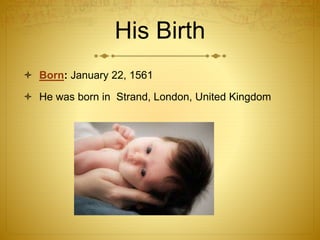
His Birth
 Born: January 22, 1561
 He was born in Strand, London, United Kingdom
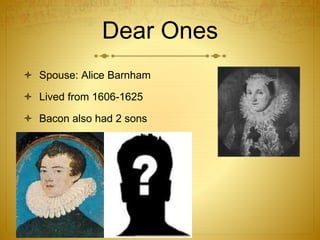
Dear Ones
 Spouse: Alice Barnham
 Lived from 1606-1625
 Bacon also had 2 sons
His Education
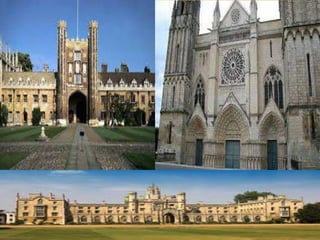
 Education: Trinity College, Cambridge, University of
Cambridge, University of Poitiers
 Francis Bacon began attending Trinity College, Cambridge,
in April 1573, when he was 12 years old. He completed his
course of study at Trinity in December 1575. Bacon
enrolled in a law program at Honorable Society of Gray's
Inn. Finding the curriculum at Gray's Inn stale and old
fashioned, Bacon later called his tutors "men of sharp wits,
shut up in their cells if a few authors, chiefly Aristotle, their
dictator." Bacon favored the new Renaissance humanism
over Aristotelianism and scholasticism, the more traditional
schools of thought in England at the time.
Who was he?
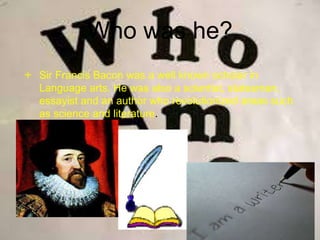
 Sir Francis Bacon was a well known scholar in
Language arts. He was also a scientist, statesman,
essayist and an author who revolutionized areas such
as science and literature.
What Did he do?
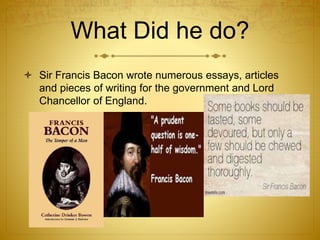
 Sir Francis Bacon wrote numerous essays, articles
and pieces of writing for the government and Lord
Chancellor of England.
Contributions to the
Renaissance
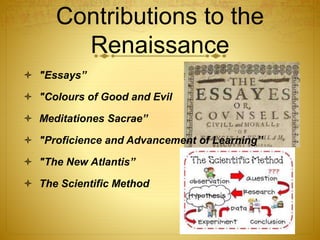
 "Essays”
 "Colours of Good and Evil
 Meditationes Sacrae”
 "Proficience and Advancement of Learning”
 "The New Atlantis”
 The Scientific Method
Contributions to
Philosophy
 Adaptations in the Aristotelian Philosophy
 Among his earlier publication were the "Essays",
the "Colours of Good and Evil", the "Meditationes
Sacrae" (which includes his famous aphorism,
"knowledge is power”
Bacon’s contributions to
The Scientific Revolution
 Francis Bacon formulated a set of empirical and
inductive methodologies,, known as the Baconian
method.
 Sir Francis Bacon formulated a more practical
approach to conclusions and hypothesis in
Science.
References
 http://www.philosophybasics.com/philosophers_bacon
_francis.html
 http://www.famousscientists.org/francis-bacon/
 http://www.biography.com/people/francis-bacon-
9194632
 http://www.bartleby.com/3/1/7.html
Thanks For Listening!

Sir francis bacon

  • 1.
  • 2.
    His Birth  Born:January 22, 1561  He was born in Strand, London, United Kingdom
  • 3.
    Dear Ones  Spouse:Alice Barnham  Lived from 1606-1625  Bacon also had 2 sons
  • 4.
    His Education  Education:Trinity College, Cambridge, University of Cambridge, University of Poitiers  Francis Bacon began attending Trinity College, Cambridge, in April 1573, when he was 12 years old. He completed his course of study at Trinity in December 1575. Bacon enrolled in a law program at Honorable Society of Gray's Inn. Finding the curriculum at Gray's Inn stale and old fashioned, Bacon later called his tutors "men of sharp wits, shut up in their cells if a few authors, chiefly Aristotle, their dictator." Bacon favored the new Renaissance humanism over Aristotelianism and scholasticism, the more traditional schools of thought in England at the time.
  • 5.
    Who was he? Sir Francis Bacon was a well known scholar in Language arts. He was also a scientist, statesman, essayist and an author who revolutionized areas such as science and literature.
  • 6.
    What Did hedo?  Sir Francis Bacon wrote numerous essays, articles and pieces of writing for the government and Lord Chancellor of England.
  • 7.
    Contributions to the Renaissance "Essays”  "Colours of Good and Evil  Meditationes Sacrae”  "Proficience and Advancement of Learning”  "The New Atlantis”  The Scientific Method
  • 8.
    Contributions to Philosophy  Adaptationsin the Aristotelian Philosophy  Among his earlier publication were the "Essays", the "Colours of Good and Evil", the "Meditationes Sacrae" (which includes his famous aphorism, "knowledge is power”
  • 9.
    Bacon’s contributions to TheScientific Revolution  Francis Bacon formulated a set of empirical and inductive methodologies,, known as the Baconian method.  Sir Francis Bacon formulated a more practical approach to conclusions and hypothesis in Science.
  • 10.
    References  http://www.philosophybasics.com/philosophers_bacon _francis.html  http://www.famousscientists.org/francis-bacon/ http://www.biography.com/people/francis-bacon- 9194632  http://www.bartleby.com/3/1/7.html
  • 11.

Editor's Notes

  • #6 Francis bacon was an essayist, statesman, author, philosopher and scientist. Born: January 22, 1561, Strand, London, United Kingdom

n Died: April 9, 1626, Highgate, United Kingdom

n mNationality: English

n mSpouse: Alice Barnham (m. 1606–1625)

n mEducation: Trinity College, Cambridge, University of Cambridge, University of Poitiers
  • #9 "knowledge is power”- is a pragmatism