The Scientific Revolution
Truth? In the Middle Ages, scholars decided  truth based on the Bible or from  Greek or Roman texts.
In the Renaissance, people questioned how the universe worked. This caused the Scientific Revolution.
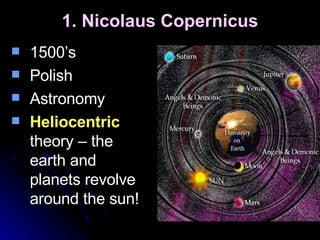
1. Nicolaus Copernicus 1500’s  Polish Astronomy Heliocentric   theory – the earth and planets revolve around the sun!
Until this time, scholars believed in the  geocentric theory , that  everything in the universe revolved around the earth.
Copernicus’ theory still didn’t explain why the planets orbited the way they did. Fearing ridicule or persecution, Copernicus did not publish his findings until 1543, the year he died.
2. Johannes Kepler Late 1500’s German Math and astronomy Calculated the orbits of the planets (elliptical)
1609-1642 Italian Scientist & astronomer Invented the telescope 3. Galileo Galilei
In Italy,   Galileo  confirmed Copernicus’ heliocentric theory through the use of his telescope.
The Catholic Church warned Galileo, but in 1632 he published a heliocentric book!
The pope called Galileo to Rome to stand trial.
Under the threat of torture and excommunication, Galileo knelt before the cardinals and read a confession that the heliocentric theory was false.
Galileo was never again a free man, living under house arrest and dying in 1642 in Florence. His books and ideas still spread throughout Europe.
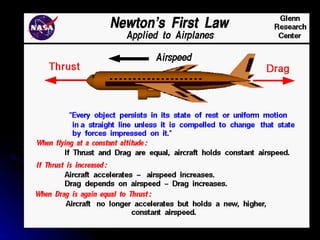
4. Isaac Newton 1687- published book English  Physicist Developed the law of gravity & laws of motion
What does an apple have to do with gravity? Ac-cording to George Stukeley, Newton’s biographer and friend, Newton was sitting in the shade of an apple tree when an apple fell nearby. Newton began to wonder why apples always fall to the ground. Why don’t they fall sideways or up? Newton reasoned that the earth must have a power that draws objects to it. That was the beginning of the law of gravity.
Newton established the  law of universal gravitation . According to this law, every object in the universe attracts every other object. In 1687, Newton wrote  Mathematical Principles of Natural Philosophy , full of his ideas.
 
 
5. Robert Boyle 1600’s English  Chemist Distinguished elements and compounds
Boyle defined the term  element  in 1661 as " . . . certain primitive and simple, or perfectly unmingled bodies; which not being made of any other bodies, or of one another, are the ingredients of which all those called perfectly mixt bodies are immediately compounded, and into which they are ultimately resolved."  Although Boyle's chief scientific interest was chemistry, he developed a brilliant series of experiments in which he used an air pump to create a vacuum. He also developed what later became known as "Boyle's law" that the volume of a gas varies inversely with pressure.
7. Andreas Vesalius 1500’s Italian Physician He accurately detailed the human body
8. William Harvey 1600’s English Biologist Developed theory of blood circulation (the heart pumps blood through the body)   This illustration depicts one of William Harvey's experiments in his  On the Circulation of the Blood  (1628). Venal valves had already been discovered, but here Harvey shows that venal blood flows only toward the heart. He ligatured an arm to make obvious the veins and their valves, then pressed blood away from the heart and showed that the vein would remain empty because blocked by the valve.
 
9. Francis Bacon 1600’s  French Scientist Developed the Scientific Method
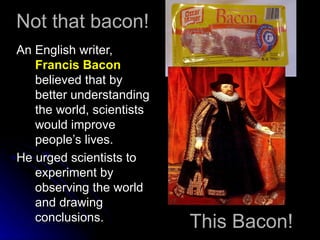
Not that bacon! An English writer,  Francis Bacon  believed that by better understanding the world, scientists would improve people’s lives. He urged scientists to experiment by observing the world and drawing conclusions. This Bacon!
10. Rene Descartes 1600’s French Scientist Supported idea that human reason should be used to find truth
A French researcher,  Rene Descartes  relied on mathematics and logic. He believed that everything should be doubted until proved by reason.
“ I think therefore I am.”  ~ Rene Descartes

Scientific Revolution

  • 1.
  • 2.
    Truth? In theMiddle Ages, scholars decided truth based on the Bible or from Greek or Roman texts.
  • 3.
    In the Renaissance,people questioned how the universe worked. This caused the Scientific Revolution.
  • 4.
    1. Nicolaus Copernicus1500’s Polish Astronomy Heliocentric theory – the earth and planets revolve around the sun!
  • 5.
    Until this time,scholars believed in the geocentric theory , that everything in the universe revolved around the earth.
  • 6.
    Copernicus’ theory stilldidn’t explain why the planets orbited the way they did. Fearing ridicule or persecution, Copernicus did not publish his findings until 1543, the year he died.
  • 7.
    2. Johannes KeplerLate 1500’s German Math and astronomy Calculated the orbits of the planets (elliptical)
  • 8.
    1609-1642 Italian Scientist& astronomer Invented the telescope 3. Galileo Galilei
  • 9.
    In Italy, Galileo confirmed Copernicus’ heliocentric theory through the use of his telescope.
  • 10.
    The Catholic Churchwarned Galileo, but in 1632 he published a heliocentric book!
  • 11.
    The pope calledGalileo to Rome to stand trial.
  • 12.
    Under the threatof torture and excommunication, Galileo knelt before the cardinals and read a confession that the heliocentric theory was false.
  • 13.
    Galileo was neveragain a free man, living under house arrest and dying in 1642 in Florence. His books and ideas still spread throughout Europe.
  • 14.
    4. Isaac Newton1687- published book English Physicist Developed the law of gravity & laws of motion
  • 15.
    What does anapple have to do with gravity? Ac-cording to George Stukeley, Newton’s biographer and friend, Newton was sitting in the shade of an apple tree when an apple fell nearby. Newton began to wonder why apples always fall to the ground. Why don’t they fall sideways or up? Newton reasoned that the earth must have a power that draws objects to it. That was the beginning of the law of gravity.
  • 16.
    Newton established the law of universal gravitation . According to this law, every object in the universe attracts every other object. In 1687, Newton wrote Mathematical Principles of Natural Philosophy , full of his ideas.
  • 17.
  • 18.
  • 19.
    5. Robert Boyle1600’s English Chemist Distinguished elements and compounds
  • 20.
    Boyle defined theterm element in 1661 as " . . . certain primitive and simple, or perfectly unmingled bodies; which not being made of any other bodies, or of one another, are the ingredients of which all those called perfectly mixt bodies are immediately compounded, and into which they are ultimately resolved." Although Boyle's chief scientific interest was chemistry, he developed a brilliant series of experiments in which he used an air pump to create a vacuum. He also developed what later became known as "Boyle's law" that the volume of a gas varies inversely with pressure.
  • 21.
    7. Andreas Vesalius1500’s Italian Physician He accurately detailed the human body
  • 22.
    8. William Harvey1600’s English Biologist Developed theory of blood circulation (the heart pumps blood through the body) This illustration depicts one of William Harvey's experiments in his On the Circulation of the Blood (1628). Venal valves had already been discovered, but here Harvey shows that venal blood flows only toward the heart. He ligatured an arm to make obvious the veins and their valves, then pressed blood away from the heart and showed that the vein would remain empty because blocked by the valve.
  • 23.
  • 24.
    9. Francis Bacon1600’s French Scientist Developed the Scientific Method
  • 25.
    Not that bacon!An English writer, Francis Bacon believed that by better understanding the world, scientists would improve people’s lives. He urged scientists to experiment by observing the world and drawing conclusions. This Bacon!
  • 26.
    10. Rene Descartes1600’s French Scientist Supported idea that human reason should be used to find truth
  • 27.
    A French researcher, Rene Descartes relied on mathematics and logic. He believed that everything should be doubted until proved by reason.
  • 28.
    “ I thinktherefore I am.” ~ Rene Descartes