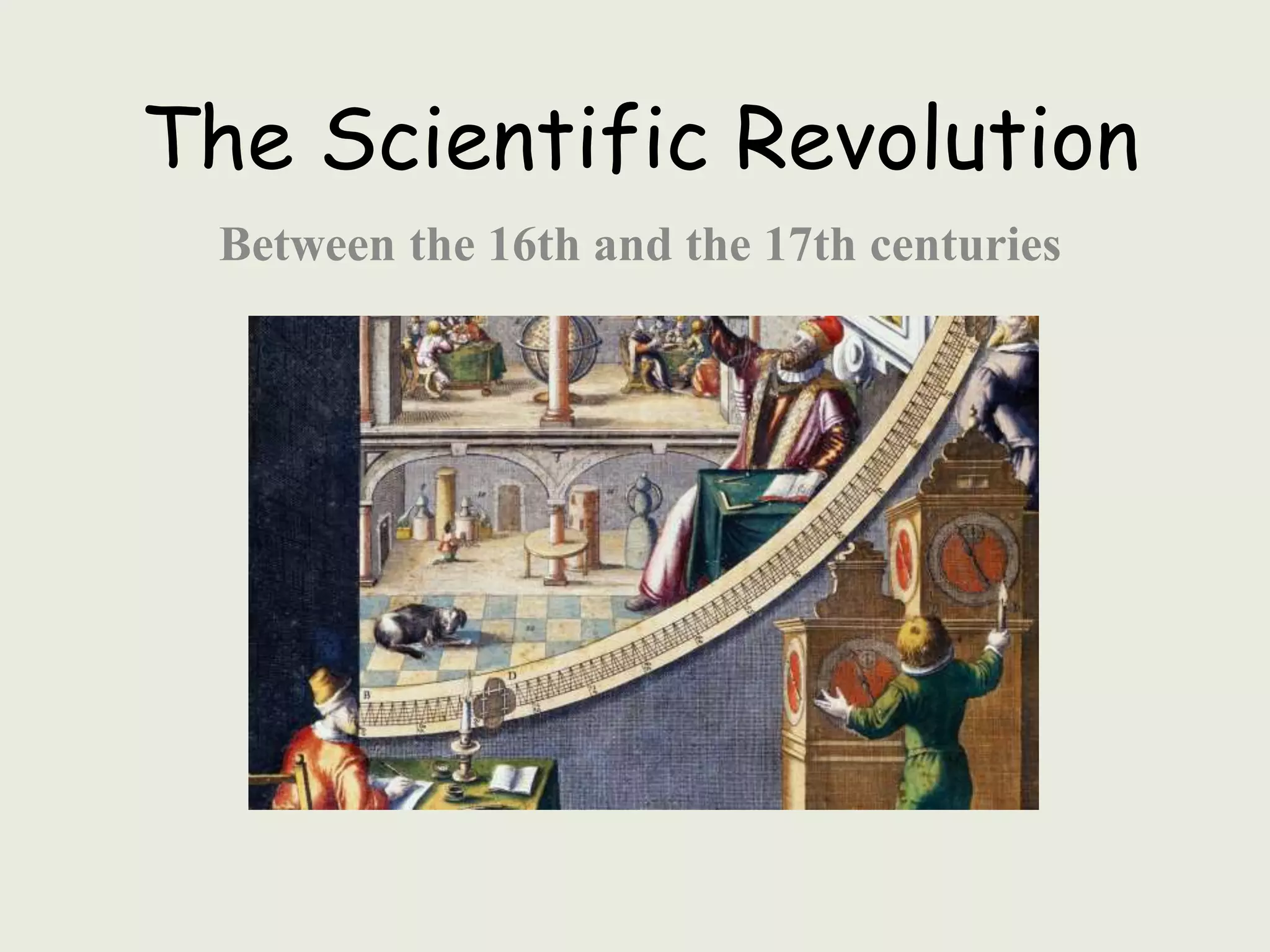
The Scientific Revolution
Between the 16th and the 17th centuries
«Scientific Revolution»
A term commonly referring to the transformation of
thought about nature thanks to which the Aristotelian
tradition was replaced by the so-called «modern
science»
Period: between 16th-17° centuries
1543 : Copernicus De Revolutionibus 1687 : Newton
Principia
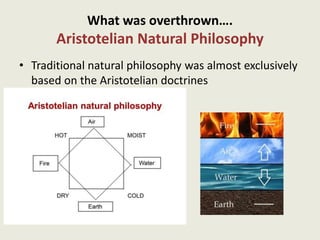
What was overthrown….
Aristotelian Natural Philosophy
• Traditional natural philosophy was almost exclusively
based on the Aristotelian doctrines
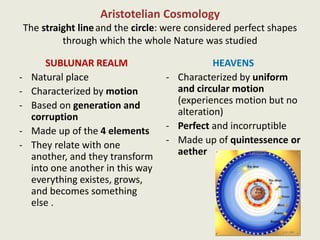
Aristotelian Cosmology
The straight lineand the circle: were considered perfect shapes
through which the whole Nature was studied
SUBLUNAR REALM
- Natural place
- Characterized by motion
- Based on generation and
corruption
- Made up of the 4 elements
- They relate with one
another, and they transform
into one another in this way
everything existes, grows,
and becomes something
else .
HEAVENS
- Characterized by uniform
and circular motion
(experiences motion but no
alteration)
- Perfect and incorruptible
- Made up of quintessence or
aether
The Scientific Revolution : A TIMELINE
AROUND 1600 (btw Queen Elizabeth I – King James I)
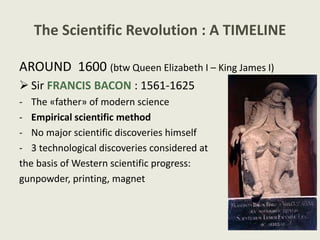
 Sir FRANCIS BACON : 1561-1625
- The «father» of modern science
- Empirical scientific method
- No major scientific discoveries himself
- 3 technological discoveries considered at
the basis of Western scientific progress:
gunpowder, printing, magnet
The Scientific Revolution : A TIMELINE
BACON – GILBERT- HARVEY
three groundbreaking English scientific thinkers
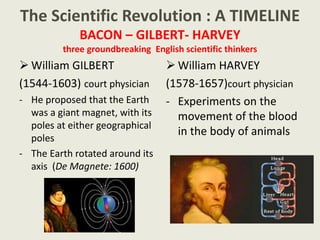
 William GILBERT
(1544-1603) court physician
- He proposed that the Earth
was a giant magnet, with its
poles at either geographical
poles
- The Earth rotated around its
axis (De Magnete: 1600)
 William HARVEY
(1578-1657)court physician
- Experiments on the
movement of the blood
in the body of animals
The Scientific Revolution : A TIMELINE
 1543: N. Copernicus: heliocentric theory (On the
Revolutions of Celestial Bodies) publ. Just before death
 1584: G. Bruno : the universe is infinitely large, the Earth
isn’t the centre of it burned at the stake as heretic
 1618: J. Kepler: ELLIPSES law of planetary motion
describes the form and operatin of planetary orbits
Final rejection of Aristotelian system
 1630: Galilei: Dialogue on the Two Chief Systems of the
World
1633:Galilei forced to recant his theories supports
heliocentric Copernican view; laws of terrestrial physics =
laws of celestial physics
 1637 Descartes: principles of deductive reasoning
1660 : Charles II and the Restoration
of the Monarchy
• Science took off
• Charles II: interested himself in chemistry
• In 1660: J. Wilkins (from Oxford Univ), Sir C. Wren +
group of talented experimental scientists + some
gentlemen founded THE ROYAL SOCIETY
with the patronage of the King
(1662)
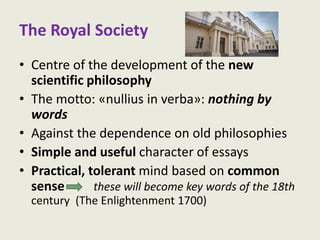
The Royal Society
• Centre of the development of the new
scientific philosophy
• The motto: «nullius in verba»: nothing by
words
• Against the dependence on old philosophies
• Simple and useful character of essays
• Practical, tolerant mind based on common
sense these will become key words of the 18th
century (The Enlightenment 1700)
The Royal Society : some members
• Sir Christopher Wren (1632-1723)
• Edmond Halley (1656-1742)
• Sir Isaac Newton (1642-1727)
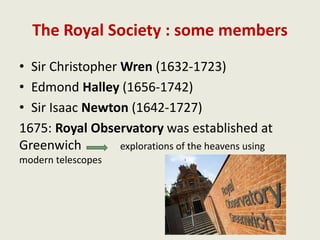
1675: Royal Observatory was established at
Greenwich explorations of the heavens using
modern telescopes
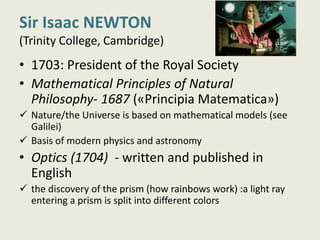
Sir Isaac NEWTON
(Trinity College, Cambridge)
• 1703: President of the Royal Society
• Mathematical Principles of Natural
Philosophy- 1687 («Principia Matematica»)
 Nature/the Universe is based on mathematical models (see
Galilei)
 Basis of modern physics and astronomy
• Optics (1704) - written and published in
English
 the discovery of the prism (how rainbows work) :a light ray
entering a prism is split into different colors
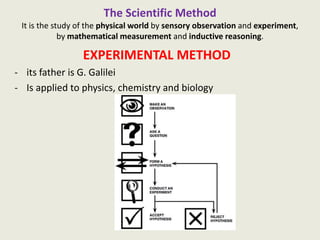
The Scientific Method
It is the study of the physical world by sensory observation and experiment,
by mathematical measurement and inductive reasoning.
EXPERIMENTAL METHOD
- its father is G. Galilei
- Is applied to physics, chemistry and biology
Steps of the Scientific- Experimental
Method
1. make an OBSERVATION: scientists are naturally curious about
the world
2. Form a QUESTION
3. Form a HYPOTHESIS, it provides a direction to further
scientific investigation
4. Conduct an EXPERIMENT: the hypoyhesis must be test; it is
used to prove a hypothesis right or wrong, and to formulate
scientific theories.
5. Record and analyse the data and draw a CONCLUSION: if the
data proves the hypothesis correct, the original question is
answered. On the other hand, if the data disproves the
hypothesis, the scientific inquiry continues.

The scientific revolution ppt

  • 1.
    The Scientific Revolution Betweenthe 16th and the 17th centuries
  • 2.
    «Scientific Revolution» A termcommonly referring to the transformation of thought about nature thanks to which the Aristotelian tradition was replaced by the so-called «modern science» Period: between 16th-17° centuries 1543 : Copernicus De Revolutionibus 1687 : Newton Principia
  • 3.
    What was overthrown…. AristotelianNatural Philosophy • Traditional natural philosophy was almost exclusively based on the Aristotelian doctrines
  • 4.
    Aristotelian Cosmology The straightlineand the circle: were considered perfect shapes through which the whole Nature was studied SUBLUNAR REALM - Natural place - Characterized by motion - Based on generation and corruption - Made up of the 4 elements - They relate with one another, and they transform into one another in this way everything existes, grows, and becomes something else . HEAVENS - Characterized by uniform and circular motion (experiences motion but no alteration) - Perfect and incorruptible - Made up of quintessence or aether
  • 5.
    The Scientific Revolution: A TIMELINE AROUND 1600 (btw Queen Elizabeth I – King James I)  Sir FRANCIS BACON : 1561-1625 - The «father» of modern science - Empirical scientific method - No major scientific discoveries himself - 3 technological discoveries considered at the basis of Western scientific progress: gunpowder, printing, magnet
  • 6.
    The Scientific Revolution: A TIMELINE BACON – GILBERT- HARVEY three groundbreaking English scientific thinkers  William GILBERT (1544-1603) court physician - He proposed that the Earth was a giant magnet, with its poles at either geographical poles - The Earth rotated around its axis (De Magnete: 1600)  William HARVEY (1578-1657)court physician - Experiments on the movement of the blood in the body of animals
  • 7.
    The Scientific Revolution: A TIMELINE  1543: N. Copernicus: heliocentric theory (On the Revolutions of Celestial Bodies) publ. Just before death  1584: G. Bruno : the universe is infinitely large, the Earth isn’t the centre of it burned at the stake as heretic  1618: J. Kepler: ELLIPSES law of planetary motion describes the form and operatin of planetary orbits Final rejection of Aristotelian system  1630: Galilei: Dialogue on the Two Chief Systems of the World 1633:Galilei forced to recant his theories supports heliocentric Copernican view; laws of terrestrial physics = laws of celestial physics  1637 Descartes: principles of deductive reasoning
  • 8.
    1660 : CharlesII and the Restoration of the Monarchy • Science took off • Charles II: interested himself in chemistry • In 1660: J. Wilkins (from Oxford Univ), Sir C. Wren + group of talented experimental scientists + some gentlemen founded THE ROYAL SOCIETY with the patronage of the King (1662)
  • 9.
    The Royal Society •Centre of the development of the new scientific philosophy • The motto: «nullius in verba»: nothing by words • Against the dependence on old philosophies • Simple and useful character of essays • Practical, tolerant mind based on common sense these will become key words of the 18th century (The Enlightenment 1700)
  • 10.
    The Royal Society: some members • Sir Christopher Wren (1632-1723) • Edmond Halley (1656-1742) • Sir Isaac Newton (1642-1727) 1675: Royal Observatory was established at Greenwich explorations of the heavens using modern telescopes
  • 11.
    Sir Isaac NEWTON (TrinityCollege, Cambridge) • 1703: President of the Royal Society • Mathematical Principles of Natural Philosophy- 1687 («Principia Matematica»)  Nature/the Universe is based on mathematical models (see Galilei)  Basis of modern physics and astronomy • Optics (1704) - written and published in English  the discovery of the prism (how rainbows work) :a light ray entering a prism is split into different colors
  • 12.
    The Scientific Method Itis the study of the physical world by sensory observation and experiment, by mathematical measurement and inductive reasoning. EXPERIMENTAL METHOD - its father is G. Galilei - Is applied to physics, chemistry and biology
  • 13.
    Steps of theScientific- Experimental Method 1. make an OBSERVATION: scientists are naturally curious about the world 2. Form a QUESTION 3. Form a HYPOTHESIS, it provides a direction to further scientific investigation 4. Conduct an EXPERIMENT: the hypoyhesis must be test; it is used to prove a hypothesis right or wrong, and to formulate scientific theories. 5. Record and analyse the data and draw a CONCLUSION: if the data proves the hypothesis correct, the original question is answered. On the other hand, if the data disproves the hypothesis, the scientific inquiry continues.