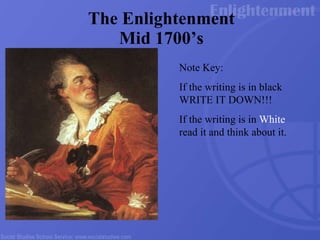
The Enlightenment Mid 1700’s Note Key: If the writing is in black WRITE IT DOWN!!! If the writing is in  White  read it and think about it.
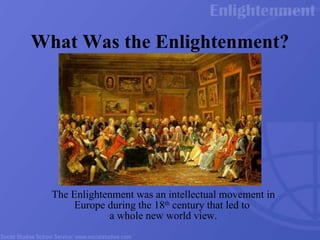
What Was the Enlightenment? The Enlightenment was an intellectual movement in Europe during the 18 th  century that led to  a whole new world view.
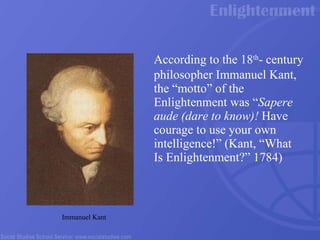
According to the 18 th - century philosopher Immanuel Kant, the “motto” of the Enlightenment was  “ Sapere aude (dare to know)!  Have courage to use your own intelligence!”  (Kant, “What Is Enlightenment?” 1784)   Immanuel Kant
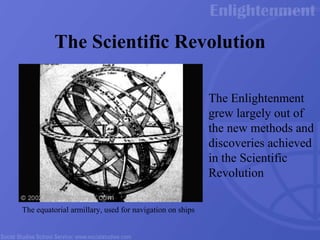
The Scientific Revolution The Enlightenment grew largely out of the new methods and discoveries achieved in the Scientific Revolution The equatorial armillary, used for navigation on ships
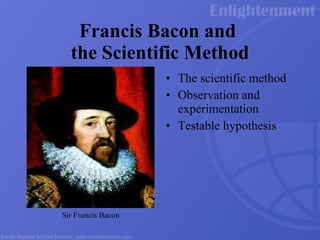
Francis Bacon and  the Scientific Method The scientific method Observation and experimentation Testable hypothesis Sir Francis Bacon
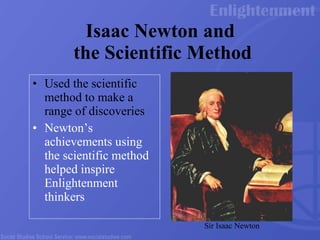
Isaac Newton and  the Scientific Method Used the scientific method to make a range of discoveries Newton’s achievements using the scientific method helped inspire Enlightenment thinkers Sir Isaac Newton
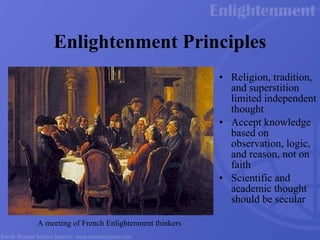
Enlightenment Principles Religion, tradition, and superstition limited independent thought Accept knowledge based on observation, logic, and reason, not on faith Scientific and academic thought should be secular  A meeting of French Enlightenment thinkers
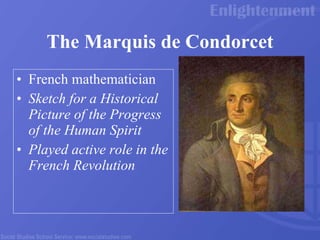
The Marquis de Condorcet French mathematician Sketch for a Historical Picture of the Progress of the Human Spirit Played active role in the French Revolution
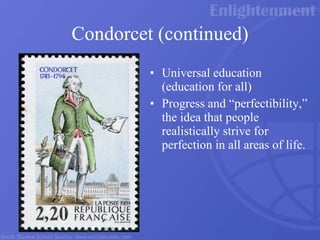
Condorcet (continued) Universal education (education for all) Progress and “perfectibility,” the idea that people realistically strive for perfection in all areas of life.
New Social Developments
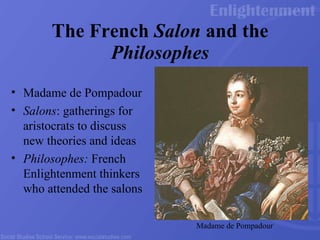
The French  Salon  and the  Philosophes Madame de Pompadour Madame de Pompadour Salons : gatherings for aristocrats to discuss new theories and ideas Philosophes:  French Enlightenment thinkers who attended the salons
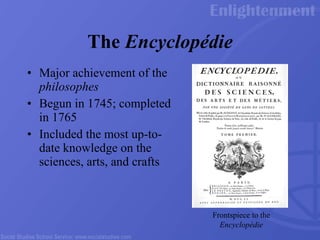
The  Encyclop é die Major achievement of the  philosophes Begun in 1745; completed in 1765 Included the most up-to-date knowledge on the sciences, arts, and crafts Frontspiece to the  Encyclop é die
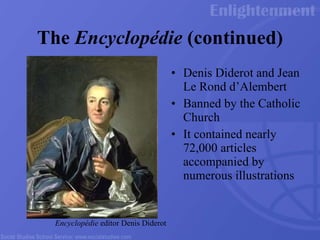
The  Encyclop é die  (continued) Denis Diderot and  Jean Le Rond d’Alembert Banned by the Catholic Church It contained nearly 72,000 articles accompanied by numerous illustrations  Encyclop é die  editor Denis Diderot
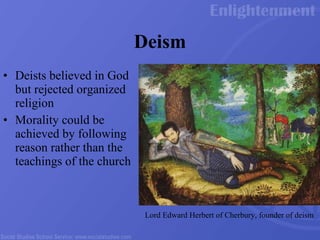
Deism Deists believed in God but rejected organized religion Morality could be achieved by following reason rather than the teachings of the church Lord Edward Herbert of Cherbury, founder of deism
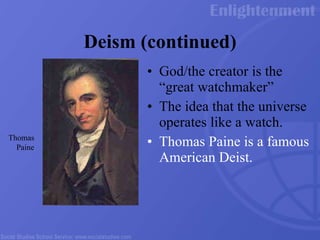
Deism (continued) God/the creator is the “great watchmaker” The idea that the universe operates like a watch.  Thomas Paine is a famous American Deist.   Thomas  Paine
How Rulers Ruled  Before the Enlightenment Divine Rights of Kings The idea that rulers receive their authority from God and are answerable only to God.
Stop Take a deep breath and let it out. Continue breathing deeply and quietly until the teacher distributes paper to the class. Answer the following questions on this half sheet of paper.
Enlightenment Questions 1.  What do you believe is the nature of human beings?  Are people born inherently good or bad?  Can people’s nature change? Explain your answers completely.   2.  What would Martinez look like if there were no laws or police? 3.  What would you do if you saw a person drop a $100 bill?  Explain your reasoning.
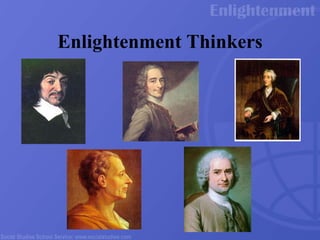
Enlightenment Thinkers
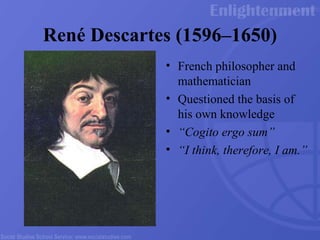
Ren é  Descartes (1596 –1650) French philosopher and mathematician Questioned the basis of his own knowledge “ Cogito ergo sum” “ I think, therefore, I am.”
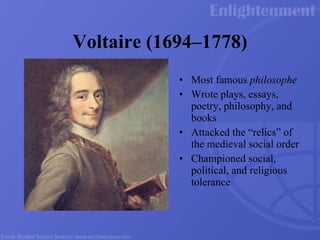
Voltaire (1694 – 1778) Most famous  philosophe Wrote plays, essays, poetry, philosophy, and books Attacked the “relics” of the medieval social order Championed social, political, and religious tolerance
Voltaire (con’t) Credited with the idea of freedom of speech. He was very critical of the French government and the Roman Catholic Church.  Was imprisoned in the Bastille twice.  “I do not agree with what you have to say, but I'll defend to the death your right to say it”.
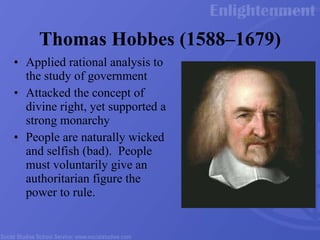
Thomas Hobbes (1588 – 1679) Applied rational analysis to the study of government Attacked the concept of divine right, yet supported a strong monarchy People are naturally wicked and selfish (bad).  People must voluntarily give an authoritarian figure the power to rule.
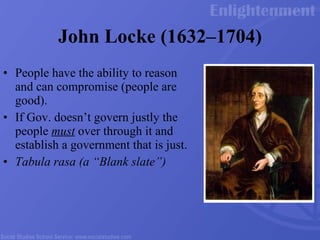
John Locke (1632 – 1704) People have the ability to reason and can compromise (people are good).  If Gov. doesn’t govern justly the people  must  over through it and establish a government that is just.  Tabula rasa (a “Blank slate”)
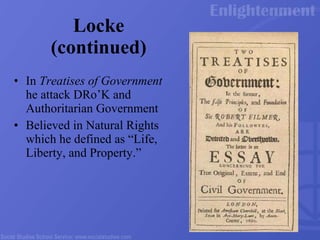
Locke (continued) In  Treatises of Government  he attack DRo’K and Authoritarian Government Believed in Natural Rights which he defined as “Life, Liberty, and Property.”
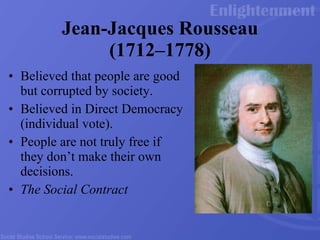
Jean-Jacques Rousseau (1712 – 1778) Believed that people are good but corrupted by society.  Believed in Direct Democracy (individual vote).  People are not truly free if they don’t make their own decisions.  The Social Contract
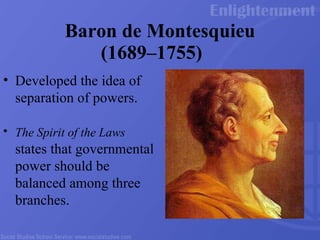
Baron de Montesquieu  (1689 –1755) Developed the idea of  separation of powers.  The Spirit of the Laws  states that governmental power should be balanced among three branches.
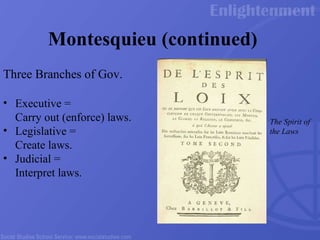
Montesquieu (continued ) Three Branches of Gov. Executive =  Carry out (enforce) laws. Legislative =  Create laws. Judicial =  Interpret laws.  The Spirit of the Laws
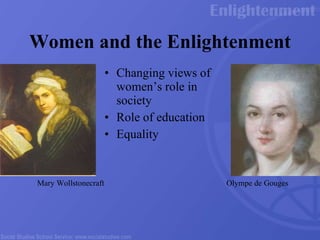
Women and the Enlightenment   Changing views of women’s role in society Role of education Equality  Mary Wollstonecraft Olympe de Gouges
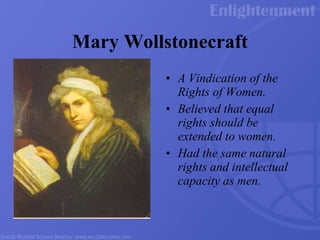
Mary Wollstonecraft A Vindication of the Rights of Women. Believed that equal rights should be extended to women. Had the same natural rights and intellectual capacity as men.
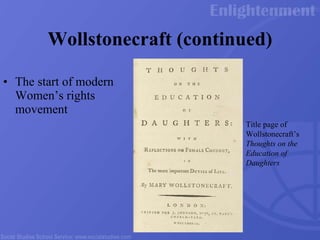
Wollstonecraft (continued) The start of modern Women’s rights movement Title page of Wollstonecraft’s  Thoughts on the Education of Daughters
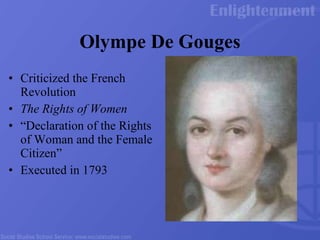
Olympe De Gouges Criticized the French Revolution The Rights of Women “ Declaration of the Rights of Woman and the Female Citizen” Executed in 1793
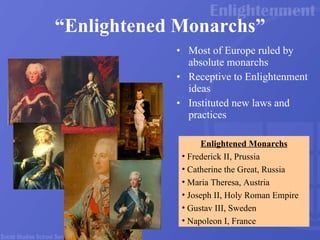
“ Enlightened Monarchs” Most of Europe ruled by absolute monarchs Receptive to Enlightenment ideas Instituted new laws and practices   Enlightened Monarchs Frederick II, Prussia Catherine the Great, Russia Maria Theresa, Austria Joseph II, Holy Roman Empire Gustav III, Sweden Napoleon I, France
Influenced by the Enlightenment
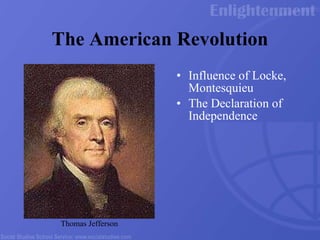
The American Revolution Influence of Locke, Montesquieu The Declaration of Independence Thomas Jefferson
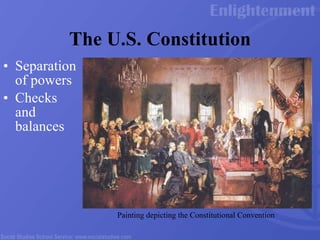
The U.S. Constitution Separation of powers Checks and balances Painting depicting the Constitutional Convention
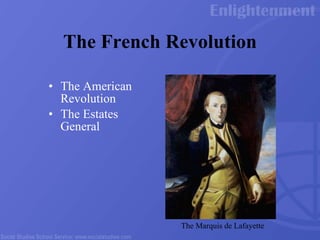
The French Revolution The American Revolution The Estates General The Marquis de Lafayette
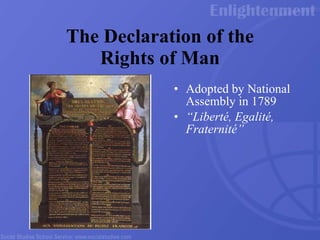
The Declaration of the Rights of Man Adopted by National Assembly in 1789 “ Liberté, Egalité, Fraternité”
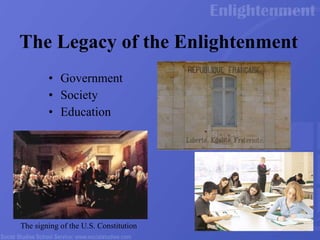
The Legacy of the Enlightenment Government Society Education The signing of the U.S. Constitution
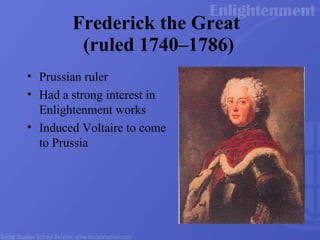
Frederick the Great  (ruled 1740 –1786) Prussian ruler Had a strong interest in Enlightenment works Induced Voltaire to come to Prussia
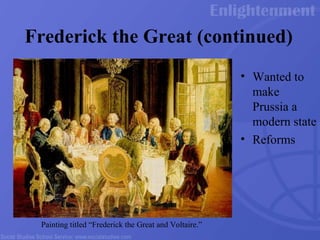
Frederick the Great (continued ) Wanted to make Prussia a modern state Reforms  Painting titled “Frederick the Great and Voltaire.”
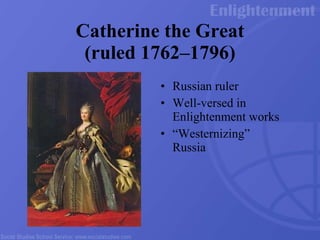
Catherine the Great (ruled 1762 –1796) Russian ruler Well-versed in Enlightenment works “ Westernizing” Russia
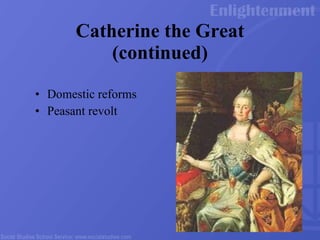
Catherine the Great (continued ) Domestic reforms Peasant revolt
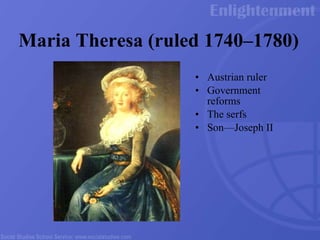
Maria Theresa (ruled 1740 –1780) Austrian ruler Government reforms The serfs Son — Joseph II
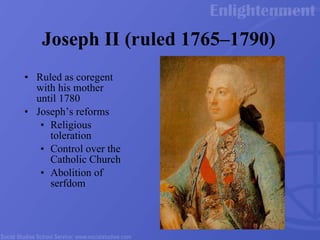
Joseph II (ruled 1765–1790) Ruled as coregent with his mother until 1780 Joseph’s reforms Religious toleration Control over the Catholic Church Abolition of serfdom
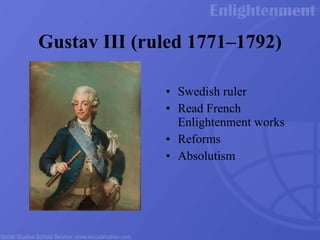
Gustav III (ruled 1771 –1792) Swedish ruler Read French Enlightenment works Reforms Absolutism
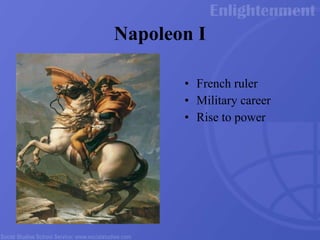
Napoleon I French ruler Military career Rise to power
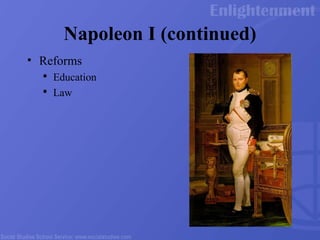
Napoleon I (continued) Reforms Education Law

The Enlightenment

  • 1.
    The Enlightenment Mid1700’s Note Key: If the writing is in black WRITE IT DOWN!!! If the writing is in White read it and think about it.
  • 2.
    What Was theEnlightenment? The Enlightenment was an intellectual movement in Europe during the 18 th century that led to a whole new world view.
  • 3.
    According to the18 th - century philosopher Immanuel Kant, the “motto” of the Enlightenment was “ Sapere aude (dare to know)! Have courage to use your own intelligence!” (Kant, “What Is Enlightenment?” 1784) Immanuel Kant
  • 4.
    The Scientific RevolutionThe Enlightenment grew largely out of the new methods and discoveries achieved in the Scientific Revolution The equatorial armillary, used for navigation on ships
  • 5.
    Francis Bacon and the Scientific Method The scientific method Observation and experimentation Testable hypothesis Sir Francis Bacon
  • 6.
    Isaac Newton and the Scientific Method Used the scientific method to make a range of discoveries Newton’s achievements using the scientific method helped inspire Enlightenment thinkers Sir Isaac Newton
  • 7.
    Enlightenment Principles Religion,tradition, and superstition limited independent thought Accept knowledge based on observation, logic, and reason, not on faith Scientific and academic thought should be secular A meeting of French Enlightenment thinkers
  • 8.
    The Marquis deCondorcet French mathematician Sketch for a Historical Picture of the Progress of the Human Spirit Played active role in the French Revolution
  • 9.
    Condorcet (continued) Universaleducation (education for all) Progress and “perfectibility,” the idea that people realistically strive for perfection in all areas of life.
  • 10.
  • 11.
    The French Salon and the Philosophes Madame de Pompadour Madame de Pompadour Salons : gatherings for aristocrats to discuss new theories and ideas Philosophes: French Enlightenment thinkers who attended the salons
  • 12.
    The Encyclopé die Major achievement of the philosophes Begun in 1745; completed in 1765 Included the most up-to-date knowledge on the sciences, arts, and crafts Frontspiece to the Encyclop é die
  • 13.
    The Encyclopé die (continued) Denis Diderot and Jean Le Rond d’Alembert Banned by the Catholic Church It contained nearly 72,000 articles accompanied by numerous illustrations Encyclop é die editor Denis Diderot
  • 14.
    Deism Deists believedin God but rejected organized religion Morality could be achieved by following reason rather than the teachings of the church Lord Edward Herbert of Cherbury, founder of deism
  • 15.
    Deism (continued) God/thecreator is the “great watchmaker” The idea that the universe operates like a watch. Thomas Paine is a famous American Deist. Thomas Paine
  • 16.
    How Rulers Ruled Before the Enlightenment Divine Rights of Kings The idea that rulers receive their authority from God and are answerable only to God.
  • 17.
    Stop Take adeep breath and let it out. Continue breathing deeply and quietly until the teacher distributes paper to the class. Answer the following questions on this half sheet of paper.
  • 18.
    Enlightenment Questions 1. What do you believe is the nature of human beings? Are people born inherently good or bad? Can people’s nature change? Explain your answers completely. 2. What would Martinez look like if there were no laws or police? 3. What would you do if you saw a person drop a $100 bill? Explain your reasoning.
  • 19.
  • 20.
    Ren é Descartes (1596 –1650) French philosopher and mathematician Questioned the basis of his own knowledge “ Cogito ergo sum” “ I think, therefore, I am.”
  • 21.
    Voltaire (1694 –1778) Most famous philosophe Wrote plays, essays, poetry, philosophy, and books Attacked the “relics” of the medieval social order Championed social, political, and religious tolerance
  • 22.
    Voltaire (con’t) Creditedwith the idea of freedom of speech. He was very critical of the French government and the Roman Catholic Church. Was imprisoned in the Bastille twice. “I do not agree with what you have to say, but I'll defend to the death your right to say it”.
  • 23.
    Thomas Hobbes (1588– 1679) Applied rational analysis to the study of government Attacked the concept of divine right, yet supported a strong monarchy People are naturally wicked and selfish (bad). People must voluntarily give an authoritarian figure the power to rule.
  • 24.
    John Locke (1632– 1704) People have the ability to reason and can compromise (people are good). If Gov. doesn’t govern justly the people must over through it and establish a government that is just. Tabula rasa (a “Blank slate”)
  • 25.
    Locke (continued) In Treatises of Government he attack DRo’K and Authoritarian Government Believed in Natural Rights which he defined as “Life, Liberty, and Property.”
  • 26.
    Jean-Jacques Rousseau (1712– 1778) Believed that people are good but corrupted by society. Believed in Direct Democracy (individual vote). People are not truly free if they don’t make their own decisions. The Social Contract
  • 27.
    Baron de Montesquieu (1689 –1755) Developed the idea of separation of powers. The Spirit of the Laws states that governmental power should be balanced among three branches.
  • 28.
    Montesquieu (continued )Three Branches of Gov. Executive = Carry out (enforce) laws. Legislative = Create laws. Judicial = Interpret laws. The Spirit of the Laws
  • 29.
    Women and theEnlightenment Changing views of women’s role in society Role of education Equality Mary Wollstonecraft Olympe de Gouges
  • 30.
    Mary Wollstonecraft AVindication of the Rights of Women. Believed that equal rights should be extended to women. Had the same natural rights and intellectual capacity as men.
  • 31.
    Wollstonecraft (continued) Thestart of modern Women’s rights movement Title page of Wollstonecraft’s Thoughts on the Education of Daughters
  • 32.
    Olympe De GougesCriticized the French Revolution The Rights of Women “ Declaration of the Rights of Woman and the Female Citizen” Executed in 1793
  • 33.
    “ Enlightened Monarchs”Most of Europe ruled by absolute monarchs Receptive to Enlightenment ideas Instituted new laws and practices Enlightened Monarchs Frederick II, Prussia Catherine the Great, Russia Maria Theresa, Austria Joseph II, Holy Roman Empire Gustav III, Sweden Napoleon I, France
  • 34.
    Influenced by theEnlightenment
  • 35.
    The American RevolutionInfluence of Locke, Montesquieu The Declaration of Independence Thomas Jefferson
  • 36.
    The U.S. ConstitutionSeparation of powers Checks and balances Painting depicting the Constitutional Convention
  • 37.
    The French RevolutionThe American Revolution The Estates General The Marquis de Lafayette
  • 38.
    The Declaration ofthe Rights of Man Adopted by National Assembly in 1789 “ Liberté, Egalité, Fraternité”
  • 39.
    The Legacy ofthe Enlightenment Government Society Education The signing of the U.S. Constitution
  • 40.
    Frederick the Great (ruled 1740 –1786) Prussian ruler Had a strong interest in Enlightenment works Induced Voltaire to come to Prussia
  • 41.
    Frederick the Great(continued ) Wanted to make Prussia a modern state Reforms Painting titled “Frederick the Great and Voltaire.”
  • 42.
    Catherine the Great(ruled 1762 –1796) Russian ruler Well-versed in Enlightenment works “ Westernizing” Russia
  • 43.
    Catherine the Great(continued ) Domestic reforms Peasant revolt
  • 44.
    Maria Theresa (ruled1740 –1780) Austrian ruler Government reforms The serfs Son — Joseph II
  • 45.
    Joseph II (ruled1765–1790) Ruled as coregent with his mother until 1780 Joseph’s reforms Religious toleration Control over the Catholic Church Abolition of serfdom
  • 46.
    Gustav III (ruled1771 –1792) Swedish ruler Read French Enlightenment works Reforms Absolutism
  • 47.
    Napoleon I Frenchruler Military career Rise to power
  • 48.
    Napoleon I (continued)Reforms Education Law