The Scientific Revolution A New World View
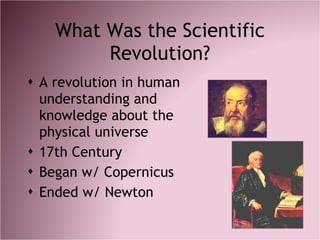
What Was the Scientific Revolution? A revolution in human understanding and knowledge about the physical universe 17th Century Began w/ Copernicus Ended w/ Newton
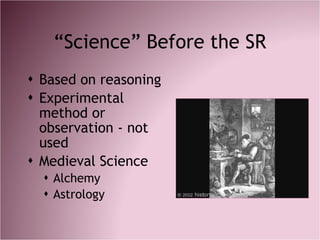
“ Science” Before the SR Based on reasoning Experimental method or observation - not used Medieval Science Alchemy Astrology
Creating a New Worldview  Hallmarks of SR Questioning of old knowledge & assumptions Gradual replacement of religious & superstitious presumptions Gradual rise of science & reason
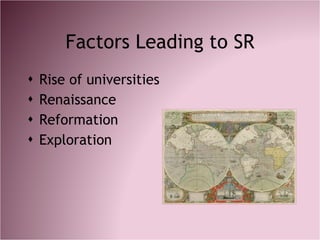
Factors Leading to SR Rise of universities Renaissance Reformation Exploration
Astronomy & Physics Work with the person next to you and diagram the Universe as we know it today Be as accurate as possible You have 2 minutes…
How does your diagram differ?
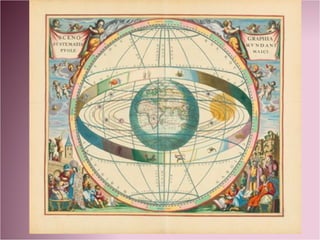
Astronomy & Physics Prior to SR - Ptolemaic System prevailed Geocentric Universe Earth is at center Remains fixed while the heavens move around it
 
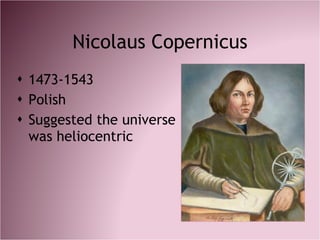
Nicolaus Copernicus 1473-1543 Polish Suggested the universe was heliocentric
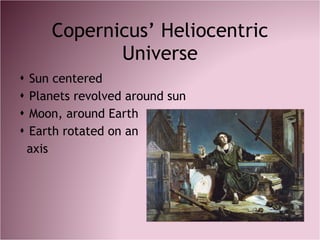
Copernicus’ Heliocentric Universe Sun centered Planets revolved around sun Moon, around Earth Earth rotated on an  axis
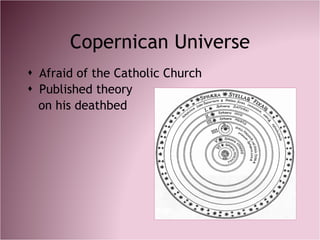
Copernican Universe Afraid of the Catholic Church Published theory  on his deathbed
Tycho Brahe 1546-1601 Danish mathematician More accurate positioning of planets
Johannes Kepler 1571-1630 German mathematician Proved Copernican theory via math Kepler’s First Law  Earth orbits in an elliptical (egg-shaped) pattern, not circular like Copernicus suggested
Galileo Galilei 1564-1642 Italian mathematician Improved telescope Went public with heliocentrism
Science on Trial Catholic Church - not happy Arrested by Inquisition Tried Condemned Forced to recant Copernican views House arrest
Sir Isaac Newton 1642-1727 British mathematician Laws of motion
Universal Law of Gravity Explains why planets continue an elliptical orbit around sun Mathematical in nature States that every object in the universe is attracted to every other object by a force called gravity
Medicine Better understanding of anatomy & physiology Microscope invented
Chemistry Robert Boyle Boyle’s Law (properties of gasses) Antoine Lavoisier Father of modern chemistry Invented system for naming chemical elements still used today (periodic table)
Rationalism Reason, not tradition, is the source of all knowledge René Descartes (1596-1650) French philosopher & mathematician Cogito, ergo sum  (“I think, therefore I am”) Deductive reasoning (general  specific)
Empiricism The belief that experience is the only true source of knowledge Huge shift toward empiricism in the SR Led to development of the Scientific Method
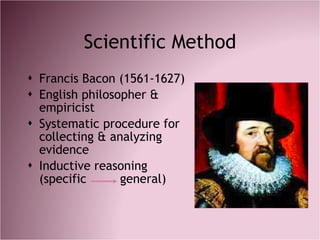
Scientific Method Francis Bacon (1561-1627) English philosopher & empiricist Systematic procedure for collecting & analyzing evidence Inductive reasoning (specific  general)

AP Scientific Revolution

  • 1.
    The Scientific RevolutionA New World View
  • 2.
    What Was theScientific Revolution? A revolution in human understanding and knowledge about the physical universe 17th Century Began w/ Copernicus Ended w/ Newton
  • 3.
    “ Science” Beforethe SR Based on reasoning Experimental method or observation - not used Medieval Science Alchemy Astrology
  • 4.
    Creating a NewWorldview Hallmarks of SR Questioning of old knowledge & assumptions Gradual replacement of religious & superstitious presumptions Gradual rise of science & reason
  • 5.
    Factors Leading toSR Rise of universities Renaissance Reformation Exploration
  • 6.
    Astronomy & PhysicsWork with the person next to you and diagram the Universe as we know it today Be as accurate as possible You have 2 minutes…
  • 7.
    How does yourdiagram differ?
  • 8.
    Astronomy & PhysicsPrior to SR - Ptolemaic System prevailed Geocentric Universe Earth is at center Remains fixed while the heavens move around it
  • 9.
  • 10.
    Nicolaus Copernicus 1473-1543Polish Suggested the universe was heliocentric
  • 11.
    Copernicus’ Heliocentric UniverseSun centered Planets revolved around sun Moon, around Earth Earth rotated on an axis
  • 12.
    Copernican Universe Afraidof the Catholic Church Published theory on his deathbed
  • 13.
    Tycho Brahe 1546-1601Danish mathematician More accurate positioning of planets
  • 14.
    Johannes Kepler 1571-1630German mathematician Proved Copernican theory via math Kepler’s First Law Earth orbits in an elliptical (egg-shaped) pattern, not circular like Copernicus suggested
  • 15.
    Galileo Galilei 1564-1642Italian mathematician Improved telescope Went public with heliocentrism
  • 16.
    Science on TrialCatholic Church - not happy Arrested by Inquisition Tried Condemned Forced to recant Copernican views House arrest
  • 17.
    Sir Isaac Newton1642-1727 British mathematician Laws of motion
  • 18.
    Universal Law ofGravity Explains why planets continue an elliptical orbit around sun Mathematical in nature States that every object in the universe is attracted to every other object by a force called gravity
  • 19.
    Medicine Better understandingof anatomy & physiology Microscope invented
  • 20.
    Chemistry Robert BoyleBoyle’s Law (properties of gasses) Antoine Lavoisier Father of modern chemistry Invented system for naming chemical elements still used today (periodic table)
  • 21.
    Rationalism Reason, nottradition, is the source of all knowledge René Descartes (1596-1650) French philosopher & mathematician Cogito, ergo sum (“I think, therefore I am”) Deductive reasoning (general specific)
  • 22.
    Empiricism The beliefthat experience is the only true source of knowledge Huge shift toward empiricism in the SR Led to development of the Scientific Method
  • 23.
    Scientific Method FrancisBacon (1561-1627) English philosopher & empiricist Systematic procedure for collecting & analyzing evidence Inductive reasoning (specific general)